156: Peter Boettke on Hayekian Economics, Political Economy and Social Philosophy
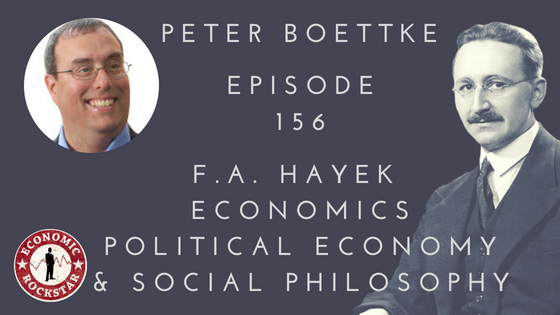
Peter Boettke of George Mason University joins me once again on the podcast.
He discusses the Hayekian principles laid out in his new book “F. A. Hayek: Economics, Political Economy and Social Philosophy”.
Other Episodes Featuring Professor Boettke:
- 084: Mises v Marx: A Discussion with Peter Boettke
- 082: Peter Boettke on Smith and Keynes and Why We Should Be ‘Living Economics’
Book:
F. A. Hayek: Economics, Political Economy and Social Philosophy by Peter Boettke
If you are at a university and your university library has the Springer subscription (which most do), you can order a print-on -demand version for $25, so that makes it somewhat more reasonable than the library prices. You can click here for a discount flyer to get 20% off.
Patreon
If you’re a fan of the podcast and would like to show your support in anyway, please check out my Patreon page at www.patreon.com/economicrockstar where you can sign up for any of the awards for as little as $1 a month or you can simply follow me on the Economic Rockstar Facebook page or on Twitter or simply recommend the show to a friend, especially if they have never had the opportunity to study economics.
Podcast: Play in new window | Download







 009: Naomi Brockwell (Bitcoin Girl) on Bitcoins, Liberty, Government and Fiat Currency.
 006: Andrew Heaton on Using Comedy to Explain Economic Concepts
 084: Mises v Marx: A Discussion with Peter Boettke
 019: Mark Thornton on the Decriminalization of Marijuana and the Skyscraper Curse
 108: Steve Horwitz on Spontaneous Order, the Microfoundations of Macroeconomics and Three Economic Myths
 072: Friedrich A. Hayek – That Entrepreneurial Knowledge is Situational and Commonsensical, Not Scientific
 048: Steve Hanke on Currency Boards, Moral Hazard and the Benefits of Privatization
 018: Mark Thornton on Austrian Economics and Why the Nazi’s and the KGB Wanted Mises Papers
 042: Parviz Parvizi on Clammr, Coffee, Coase and the Economy of Iran
 135: David Zetland Bonus Episode
 David Zetland
September 3, 2018 at 7:41 amPete’s a great guest and I love his insights into economics. On “environment and sustainability,” however, he — like Russ Roberts — confuse the potential for market solutions with the problem of managing non-excludable goods (such as the environment), which are — by their nature — difficult to possess, price and thus “provide” via market forces. This mistake is common for economists, as non-excludable goods are best managed via communal (peer-to-peer) or government (top down) forces, unlike markets that work from the bottom up.
In this old post (http://www.env-econ.net/2008/05/was-julian-simo.html), I point out that the Simon/Ehrlich bet was about these two different types of good, i.e., that they were talking past each other.
I’m looking forward to hearing from Ehrlich.