• ABOUT
  • RESOURCES
  • PODCAST
  • BOOKS
  • BLOG
  • SUPPORTERS
  • QFA Financial Advice
  • CONTACT

Economic Rockstar

Connecting Brilliant Minds in Economics and Finance

156: Peter Boettke on Hayekian Economics, Political Economy and Social Philosophy
September 1, 2018 by Frank

http://traffic.libsyn.com/economicrockstar/156_Peter_Boettke_Final.mp3
Play in New WindowDownload

156: Peter Boettke on Hayekian Economics, Political Economy and Social Philosophy

Peter Boettke of George Mason University joins me once again on the podcast.

He discusses the Hayekian principles laid out in his new book “F. A. Hayek: Economics, Political Economy and Social Philosophy”.

Other Episodes Featuring Professor Boettke:

  • 084: Mises v Marx: A Discussion with Peter Boettke
  • 082: Peter Boettke on Smith and Keynes and Why We Should Be ‘Living Economics’

Book:

F. A. Hayek: Economics, Political Economy and Social Philosophy by Peter Boettke

If you are at a university and your university library has the Springer subscription (which most do), you can order a print-on -demand version for $25, so that makes it somewhat more reasonable than the library prices.  You can click here for a discount flyer to get 20% off.

Patreon

If you’re a fan of the podcast and would like to show your support in anyway, please check out my Patreon page at www.patreon.com/economicrockstar where you can sign up for any of the awards for as little as $1 a month or you can simply follow me on the Economic Rockstar Facebook page or on Twitter or simply recommend the show to a friend, especially if they have never had the opportunity to study economics.

http://traffic.libsyn.com/economicrockstar/156_Peter_Boettke_Final.mp3

Podcast: Play in new window | Download

  • facebook
  • linkedin
  • twitter
  • google+
  • pinterest

137: Rakesh Ramachandran on Crypto Economics and How Knowledge of Austrian Economics Created His Blockchain Company QBRICS

April 21, 2018 by Frank

http://traffic.libsyn.com/economicrockstar/137_Rakesh_Ramachandran_Final.mp3
Play in New WindowDownload

137: Rakesh Ramachandran on Crypto Economics and How Knowledge of Austrian Economics Created His Blockchain Company QBRICS

Rakesh Ramachandran in co-founder and CEO of QBRICS, an enterpreise blockchain platform company.

Rakesh is self-thought in economics and created QBRICS based on his readings of Austrian economics.

He is a long-time listener to the podcast and I’m thrilled to to share this conversation with you.

In this episode Rakesh mentions and discusses:

  • QBRICS
  • Cryptocurrency
  • Blockchain technology
  • Problems with cryptocurrency – volatility which limits transactions and a pure technology problem.
  • Scarcity in economics and why cryptos are better that fiat currencies.
  • FEMA – Foreign Exchange Management Act (India)
  • Venezuela’s cryptocurrency Petro 
  • Quantum Resistance Encryption Method 
  • General Data Protection Regulation (GDPR) 

Books:

  • The Bhagavad Gita
  • The General Theory of Employment, Interest and Money by John Maynard Keynes
  • The Wealth of Nations by Adam Smith
  • Human Action by Ludwig von Mises
  • Tractatus Logico-Philosophicus by Ludwig von Wittgenstein
  • Boyhood Days by Rabindranath Tagore
  • Kalidasa – sanskrit poet

Patreon

If you’re a fan of the podcast and would like to show your support in anyway, please check out my Patreon page at www.patreon.com/economicrockstar where you can sign up for any of the awards for as little as $1 a month or you can simply follow me on the Economic Rockstar Facebook page or on Twitter or simply recommend the show to a friend, especially if they have never had the opportunity to study economics.

http://traffic.libsyn.com/economicrockstar/137_Rakesh_Ramachandran_Final.mp3

Podcast: Play in new window | Download
  • facebook
  • linkedin
  • twitter
  • google+
  • pinterest

108: Steve Horwitz on Spontaneous Order, the Microfoundations of Macroeconomics and Three Economic Myths

October 20, 2016 by Frank

http://traffic.libsyn.com/economicrockstar/108_Steve_Horwitz_Final.mp3
Play in New WindowDownload

108: Steve Horwitz on Spontaneous Order, the Microfoundations of Macroeconomics and Three Economic Myths

steve-horwitz-rush-economic-rockstar

Steven Horwitz is the Charles A. Dana Professor of Economics at St. Lawrence University in Canton, NY and is currently Visiting Scholar at Ball State University, Indiana.

Professor Horwitz is also an Affiliated Senior Scholar at the Mercatus Center Virgina, a Senior Fellow at the Fraser Institute in Canada, and a Distinguished Fellow at the Foundation for Economic Education.

Steve is the author of three books, Monetary Evolution, Free Banking, and Economic Order, Microfoundations and Macroeconomics: An Austrian Perspective, and Hayek’s Modern Family:  Classical Liberalism and the Evolution of Social Institutions.

He has written extensively on Austrian economics, Hayekian political economy, monetary theory and history, and American economic history.

Steve has a series of popular YouTube videos for the Learn Liberty series from the Institute for Humane Studies and blogs at Bleeding Heart Libertarians and writes regularly for FEE.org.

A member of the Mont Pelerin Society, he has a PhD in Economics from George Mason University and an AB in Economics and Philosophy from the University of Michigan.

Economics:

In this episode, Steve discusses and mentions: Austrian economics, spontaneous order, microeconomics, macroeconomics, free markets, capital markets and government.

Economists:

In this episode, Steve discusses and mentions: Adam Smith, F. A. Hayek, Karl Menger and Ludwig von Mises.

In this Episode, you will learn:

  • whether macro problems are the result of micro problems or is there a reverse causality.
  • Menger: the link between Adam Smith and F. A. Hayek.
  • the micro foundations of Adam Smith’s ‘Spontaneous Order’.
  • how the private sector responded better than government to the devastation caused by Hurricane Katrina. Is this a case for free market economics?
  • the three economic myths, including the gender wage gap and the rich getting rich and the poor getting poorer according to Professor Horwitz.
  • and much much more.

Where to Find Professor Horwitz:

  • bleedingheartlibertarians.com
  • www.fee.org
  • www.montpelerin.org

Links:

  • A Hayekian Theory of Parental Rights by Steve Horwitz
  • Capitalism and the Humanization of the Family by Steve Horwitz
  • Ayn Rand
  • Rush 
  • Neil Peart 
  • Hold Your Fire by Rush

Writing Tips:

  1. Write something everyday. Be in the habit of writing. Don’t feel like you’ have to edit everything as you go along.
  2. If you have writer’s block, just push through. Just start writing. There’s an old aphorism among writers: “How can I know what I think ’til I see what I say”.

Pedagogy:

Think about teaching as coaching. Like a coach, help students develop a skill. In this case the skill is the economic way of thinking – Steve Horwitz.

Books:

  • The Pure Theory of Capital by F. A.  Hayek
  • Success and Luck: Good Fortune and the Myth of Meritocracy by Robert H. Frank
  • The Global Great Depression and the Coming of World War Two by John Moser
  • Hayek’s Modern Family: Classical Liberalism and the Evolution of Social Institutions by Steve Horwitz

http://traffic.libsyn.com/economicrockstar/108_Steve_Horwitz_Final.mp3

Podcast: Play in new window | Download

  • facebook
  • linkedin
  • twitter
  • google+
  • pinterest

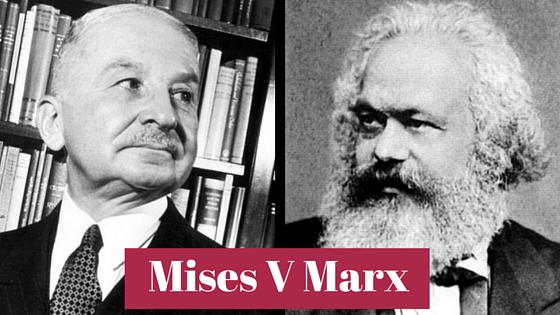
084: Mises v Marx: A Discussion with Peter Boettke

May 5, 2016 by Frank

http://traffic.libsyn.com/economicrockstar/084_Peter_Boettke_2_Final.mp3
Play in New WindowDownload

084: Mises v Marx: A Discussion with Peter Boettke

Mises V Marx

In this episode, Professor Peter Boettke, Professor of Economics and Philosophy at George Mason University, discusses the thinking of Ludwig von Mises and Karl Marx. Peter highlights the underlying theses behind both economists arguments – liberalism and socialism.

Read the first chapter to Living Economics by Peter Boettke here.

Economics:

In this episode, Peter mentions: Austrian economics, Marxism, liberalism, socialism, the Diamond-Water Paradox, instability of capitalism, private ownership, communal ownership, monopoly, financial crisis, leverage, 

Economists:

In this episode, Peter mentions: Ludwig von Mises, Karl Marx, Milton Friedman, Joan Robinson, Rosa Luxemburg, Elinor Ostrom, Adam Smith, F. A. Hayek, Milton Friedman, Paul Samuelson, John Cochrane, Paul Krugman, Joseph Stiglitz and J. K. Galbraith.

Books:

  • Living Economics: Yesterday, Today, and Tomorrow by Peter J. Boettke
  • The Communist Manifesto by Karl Marx
  • Karl Marx and the Close of His System  by Eugen von Böhm-Bawerk
  • Mises: The Last Knight of Liberalism Jörg Guido Hülsmann
  • Phishing for Phools: The Economics of Manipulation and Deception by George A. Akerlof and Robert Schiller
  • After War: The Political Economy of Exporting Democracy by Christopher J. Coyne
  • Doing Bad by Doing Good: Why Humanitarian Action Fails by Christopher J. Coyne
  • The Road to Serfdom: Text and Documents–The Definitive Edition by F. A. Hayek
  • How the Dismal Science Got Its Name: Classical Economics and the Ur-Text of Racial Politics by David M. Levy
  • The Soul of Man Under Socialism by Oscar Wilde
  • The Grapes of Wrath by John Steinbeck
http://traffic.libsyn.com/economicrockstar/084_Peter_Boettke_2_Final.mp3

Podcast: Play in new window | Download

  • facebook
  • linkedin
  • twitter
  • google+
  • pinterest

082: Peter Boettke on Smith and Keynes and Why We Should Be ‘Living Economics’

April 21, 2016 by Frank

http://traffic.libsyn.com/economicrockstar/082_Peter_Boettke.mp3
Play in New WindowDownload

082: Peter Boettke on Smith and Keynes and Why We Should Be ‘Living Economics’

Peter Boettke is Professor of Economics and Philosophy at George Mason University, the BB&TPeter Boettke Economic Rockstar Professor for the Study of Capitalism, and the Director of the F.A. Hayek Program for Advanced Study in Philosophy, Politics, and Economics at the Mercatus Center at George Mason University.

Peter is now the co-author, along with David Prychitko, of the classic principles of economics texts of Paul Heyne’s The Economic Way of Thinking.

Professor Boettke’s most recent book, Living Economics, provides a resource for how teachers and students can engage in many fascinating questions in economics and illuminates the core principles that should guide our thinking.

Peter’s efforts in the classroom have earned him a number of distinctions including the Golden Dozen Award for Excellence in Teaching from the College of Arts and Sciences at New York University and the George Mason University Alumni Association’s 2009 Faculty Member of the Year award.

Peter’s research has primarily been in the area of comparative political and economic systems and the consequences with regard to material progress and political freedom.

Economics:

In this episode, Peter mentions: Classical economics, Austrian economics, Keynesian economics, credit transmission, institutions, the invisible hand, mainline economics, mainstream economics, private property, public choice, rent-seeking, opportunity cost, scarcity, exchange, markets, negative externalities, laissez-faire, Coase theorem, Pigouvian tax, reciprocity, inflation, stagflation and Malthus’ theory of The General Glut.

Economists:

In this episode, Peter mentions: Adam Smith, F. A. Hayek, Ludwig von Mises, Milton Friedman, Paul Samuelson, John Maynard Keynes,Frédéric Bastiat, David Hume, Vernon Smith, Thomas Robert Malthus, J. K. Galbraith, Paul Heyne, Hyman Minsky, Thorstein Veblen, Steve Keen, Ben Bernanke, Arthur Pigou, Gordon Tullock, James Buchanan, Robert Coase, Elinor Ostrom, Vincent Ostrom and Major Douglas.

Papers:

  • Teaching Austrian Economics to Graduate Students
  • Beyond Equilibrium Economics: Reflections on the Uniqueness of the Austrian Tradition

Books:

  • Living Economics: Yesterday, Today, and Tomorrow by Peter J. Boettke
  • The Economic Consequences of Peace by J. M. Keynes
  • The End of Laissez-Faire by J. M. Keynes
  • The Rogue Gallery of Economic Thinkers by J. M. Keynes
  • The Road to Serfdom by F. A. Hayek
  • Challenging Institutional Analysis and Development: The Bloomington School by Paul Dragos Aligica and Peter Boettke
http://traffic.libsyn.com/economicrockstar/082_Peter_Boettke.mp3

Podcast: Play in new window | Download

  • facebook
  • linkedin
  • twitter
  • google+
  • pinterest

072: Friedrich A. Hayek – That Entrepreneurial Knowledge is Situational and Commonsensical, Not Scientific

February 11, 2016 by Frank

http://traffic.libsyn.com/economicrockstar/072_Hayek_Essay.mp3
Play in New WindowDownload

072: Friedrich A. Hayek – That Entrepreneurial Knowledge is Situational and Commonsensical, Not Scientific

HayekIn this essay, I present a personal essay based on the work of Freidrich A. Hayek, most notably concerning his thoughts and discussion on how knowledge cannot be scientifically calculated for use within a centrally planned organisation, which is argued in his own essays ‘The Use of Knowledge in Society’ (1945) and ‘Competition as a Discovery Procedure’ (1984). 


That Entrepreneurial Knowledge is Situational and Commonsensical, Not Scientific

Part One:

Explanation and Development of the Thesis

In Austrian theory, that entrepreneur is an agent whose character has been carefully explored. Such on entrepreneur operates in a market economy, which is referred to as a ‘discovery process’ by Hayek¹. That entrepreneurs knowledge of the market is imperfect due to do reasoning that knowledge is dispersed amongst the undertakers of the business.

Entrepreneurs possess a certain degree of knowledge dust is unique to them individually and one that cannot be expressed quantitatively. Thus, Hayek disregards all neo-classical and Keynesian economics as they seem to dismiss the role of the entrepreneur via use of quantitative analysis (of averages and aggregates) in measuring equilibrium points to which all entrepreneurs must strive towards and achieve.

The unquantifiable (tacit) knowledge, possessed by the entrepreneur, is therefore ignored when scientific knowledge is made available. As Hayek stated ‘the knowledge of the particular circumstances of time and place… is… the body of very important but unorganized knowledge which cannot possibly be called scientific in the sense of knowledge of general rules’ (1945).

In the writings of Hayek, sScientific knowledge is associated with centralized planning whereas entrepreneurial knowledge is associated with a market order where knowledge is dispersed and situational. The latter includes tacit knowledge, as it is not directly communicable.

‘Every individual… possesses unique information of which beneficial use… [is] based on… [the] knowledge of people of local conditions and of special circumstances… of the fleeting moment not known to others… The sort of knowledge with which I have been concerned is knowledge of the kind which by its nature cannot enter into statistics and therefore cannot be conveyed to any central authority and statistical form’ (Hayek, 1945: 251).

The market economy can only operate at its most optimum level given the knowledge of entrepreneurs who mutually adjust via negative feedback. There is no role for scientific knowledge, as such use would ‘collectively’ combine the knowledge of all entrepreneurs in some mathematical formulation, thereby ignoring situational and commonsensical knowledge.

The market is a ‘discovery process’ for all undertakers who aim to eliminate in perfect knowledge by receiving ‘information for judgments about… matters by reading…, watching…, experiencing…, chatting…, strolling… Much of what he thereby observes – or senses – he could not express in explicit words or numbers’ (Yeager, 1996).

Thus, the entrepreneur will base decisions regarding cost minimisation, prices, allocation of resources, etc. on what they know and what they believe is the right and optimum choice. Scientific knowledge is irrelevant, as it does not quantify the ‘feel’ for the market. It aims for an equilibrium point in time, is costly, his complicated and fails to adjust to changes in the market at the required time.

Tacit knowledge is often not consciously known, even to those who process it, and come never be communicated to a central authority or used in their scientific evaluations. Such entrepreneurial knowledge is unknowingly transmitted throughout the economy as an unintended consequence of individuals pursuing their own ends. The unintended consequences of an economy fail to be recognized by those reliant on scientific knowledge, whereas the entrepreneur with situational knowledge, will recognize such and act accordingly.

Spontaneity is key to the entrepreneur and utmost for the market economy, thereby suggesting that the process towards obtaining equilibrium is a never ending process. As Knight put it, ‘business decisions deal with situations which are far too unique, for any sort of statistical tabulation to have any value for guidance’ (1971: 231).

Part Two:

A] Argument Against the Thesis

Hayek’s thesis that entrepreneurial knowledge is not scientific has drawn the attention of its critics, most notably Lange, Dickinson and Stiglitz. All three believe that entrepreneurial knowledge consists of scientific information as it practically improves business decisions.

Lange (1938) proposed that scientific knowledge of, say, conditional prices for all goods and factors of production should be made available and that these could be taken as parameters in the decision-making process of the entrepreneur. The result would speed up the equilibrium process and enhance the knowledge of the entrepreneur regarding market indicators.

‘the Central Planning Board has a much wider knowledge of what is going on in the whole economic system than any private entrepreneur can ever have’ (Lange, 1938).

In the advent of supercomputers, Lange stated that entrepreneurs could use scientific information to aid in their decision-making and that such scientific knowledge could be obtained in real-time given the demands of the market.

Dickinson agreed with Lange, stating that rational calculation under socialism was at least theoretically possible. Dickinson believed that any economy could be formerly represented by a Walrasian system of equations from which the undertakers in the market base their decisions to achieve an equilibrium point. Such scientific knowledge is vital for entrepreneurs if they wish to remain competitive and understand the direction taken by the market as a whole.

Stiglitz refers to ‘imperfect knowledge’ as known-to-be-available information that is costly to produce. Stiglitz states that such information, not known by the entrepreneur, could be obtained by acquiring statistical and computable data about the markets which can aid in the process of eliminating the imperfect knowledge of the entrepreneur and reduce uncertainty and risk.

Each decision is made within a well-defined framework made up of a given objective function, a given set of resource constraints, and a given set of technologically or economically means of transforming resources into desired objectives².

A famous physicist, Lord Kelvin, stated that ‘When you cannot measure your knowledge is meager and unsatisfactory’³ a statement that many critics of Hayek will stand by.

B] Arguments in Favor of the Thesis:

The main body of argument for Hayek’s thesis came from Hayek himself, although many supported his writings such as Kirzner, Gray and Yeager. Hayek argued that entrepreneurial knowledge is by no means scientific. Knowledge is dispersed throughout society and it is embodied in habits and dispositions of the entrepreneur.

Entrepreneurial knowledge ‘is “knowing where to look for knowledge” rather than knowledge of substantive market information’ (Kirzner, 1973: 68). Entrepreneurial knowledge cannot be quantified or recognized by a central planner or any undertaker in a market who uses a scientific approach.

‘Pantometria’ fails to recognize the tacit knowledge of the entrepreneur and, thus, competitive market behavior relying on scientific knowledge, cannot be a true reflection of entrepreneurial undertakings.

‘there is… a body of very important but unorganised knowledge which cannot possibly be called scientific… the knowledge of the particular circumstances of time and place… every individual… possesses unique information of which beneficial use might be made, but of which use can be made only if the decisions depending on it are left to him or are made with his active co-operation’ (Hayek, 1968, 250).

In response to Langes criticisms, Hayek states that the ‘imperfect knowledge’ of the entrepreneur is actually ‘previously unthought of knowledge’ which must be discovered by the entrepreneur without any need for science. The entrepreneur, given unique and tacit knowledge, can’t adapt to changing requirements of the market process.

Those who possessed scientific knowledge aim for an equilibrium point in time but fail to recognize that ‘long before [equilibrium] is reached the circumstances to which the local efforts adapt themselves will have changed themselves’. Only the entrepreneur who possesses unique and tacit knowledge will ‘change their plans in the direction made necessary by actual changes’.

‘One major flaw in all proposals for the economic planning is that they are all bound to attempt to transform entrepreneurial perception of opportunities into mechanical procedures for resource-utilization and to incur vast losses of efficiency in so attempting’ (Gray, 1998: 38).

With the application of scientific knowledge, entrepreneurs misinterpret the markers process and, as such, tacit knowledge is lost when averages and aggregates our computed. Entrepreneurs, due to the ‘organised complexity [of the market process] where we expect to find permanent constant relations between aggregates or averages’, must not rely upon scientific knowledge.

Part Three:

Argued Statement of Writer’s Own Position

  1. Acceptance of the Thesis

Having read the relevant literature and wait of the arguments for and against the thesis, the author is in the position of agreeing with Hayek’s thesis.

It is true that not all knowledge can be observed and represented by variables to be inserted into complicated scientific models and conceptual frameworks. Each entrepreneur possesses unique knowledge that orders do not have. Such knowledge is based upon intuition, beliefs, sense and first-hand know-how, which is collectively and instinctively used by entrepreneur to achieve his/her ends.

We human beings live in a world where science seems to preoccupy our minds and influence our decisions. However, such scientific knowledge it is based on the law of averages and probabilities, which persuade entrepreneurs that some optimum outcome will be achieved at some point in time.

The author shares the view of Hayek that there exists a body of knowledge that is ‘particular to the circumstances of time and place’ which cannot be detected, quantified or interpreted by any scientific machine, framework or equation. For example, become attrition’s aim to explain the relationships between variables, but there exists an error term in each regression due to unknown variables that are omitted from the model.

Introducing the case of the BSE crisis, a conflict of interest between individual and scientific knowledge is apparent. It is all well and good to provide statistical data, but entrepreneurs, who operate in the beef industry, do not need such information, how’s they already knew of the crisis when it became apparent.

Such knowledge was situational to entrepreneur and it was common sense that the affected cattle would be a threat to his/her undertakings. The entrepreneur, by a discovery process, will operate in the best possible market available under such a crisis. No scientific knowledge is required in predicting an equilibrium point for the farmer.

2. Objection to the Thesis

Despite accepting that entrepreneurial knowledge is situational and commonsensical, the author shares the view of Stiglitz that’s of entrepreneurs cannot afford to be ignorant of the fact that scientific methods are vital in expanding the decision making process of the entrepreneur. It is evident to every undertaker in a market. Scientific evaluations of costs, prices and other indices are available I’m very helpful in finalizing decisions.

Part Three

Responses to Objections Against the Writer’s Position:

In the previous section, it had been acknowledged that entrepreneurial knowledge is situational and commonsensical, but it is the belief of the writer that such knowledge is incomplete without the use of scientific knowledge.

Scientific knowledge is considered a net benefactor to entrepreneurs as it provides vital information that can almost drastically eliminate imperfections of knowledge. ‘Misallocations’ or ‘wastes’ would be minimised.

However, it is understandable to criticize the above statement and defend the position of Hayek. Entrepreneurs will eventually eliminate the imperfection that they possess via the ‘discovery process’ without the dependency of science.

To describe entrepreneurial activity as wasteful because it corrects mistakes only after they occur seems, as Kirzner put it, ‘similar to ascribing the ailment to the medicine which heals it, or even to blaming the diagnostic procedure for the disease is identifies’ (1973: 236).

To conclude, the writer believes that entrepreneurial knowledge is situational and to some degree commonsensical but it also includes an element of science.

References:

Caldwell, B. J. (1997). Hayek and Socialism. Journal of Economic Literature, 35(4):1856-1890.

Gray, J. (1998). Hayek on Liberty. Third edition. Routeledge: London and New York.

Hayek, F. A. (1945). The Use of Knowledge in Society. American Economic Review. XXXV, No. 4. pp. 519-30. American Economic Association.

Hayek, F. A. (1968). Competition as a Discovery Procedure. The Quarterly Journal of Austrian Economics 5, No. 3 (Fall 2002): 9–23.

Check out this FREE Kindle ebook ‘The Essential Hayek’ by Donald Boudreaux

http://traffic.libsyn.com/economicrockstar/072_Hayek_Essay.mp3

Podcast: Play in new window | Download

  • facebook
  • linkedin
  • twitter
  • google+
  • pinterest

037: Noah Smith on Austrian Theory Being a ‘Bad Joke’, Heterodox Models and Efficient Markets

June 18, 2015 by Frank

http://traffic.libsyn.com/economicrockstar/037_Noah_Smith.mp3
Play in New WindowDownload

037: Noah Smith on Austrian Theory Being a ‘Bad Joke’, Heterodox Models and Efficient Markets

Noah Smith is Assistant Professor of Finance at Stony Brook University, New York where he is also a member of the Center for Behavioral Noah SmithFinance research team. Noah’s research Interests include Experimental Finance, Behavioral Finance and Macroeconomics Noah was panel discussant for the Institute for New Economic Thinking Task Force and has received numerous research awards and fellowships. 

Noah is a regular contributor to Bloomberg View where he writes extensively on economics and finance related topics. He also writes at his fantastic economics blog Noahpinion.

Noah received his PhD in economics from the University of Michigan, graduating in 2012. His dissertation examined expectation formation in financial markets. Noah majored in physics as an undergraduate at Stanford University, and spent three years working in Japan, where he still returns from time to time to do research.

Everyone who meets in the public sphere, unless you’re extremely dry and technical, is going to piss people off. Econ is one of those fields where everyone has their own opinion and position and their models that they like. Traditionally, it was this very closed discipline. Econ was for economists and they didn’t often interface with the outside world except through official policy advice and the occasional op-ed. People start talking in the public sphere and I think that disturbs a lot of people. So all the blogs are bad boys really – Noah Smith.

Economics:

GDP, inflation, Central Bank, consumption, microeconomics, macroeconomics, behavioral economics, DSGE, game theory, decision theory, supply, demand, time series, interest rates, linear regression, forecasting, Quantitative Easing, money, gold, Federal Reserve, efficient markets hypothesis, extrapolative expectations, hedge funds, adverse selection, random walk, fat tails and volatility.

Economists:

Paul Samuelson, Brad DeLong, Steve Keen, Greg Mankiw, John H. Cochrane, Jack Schwager, Josh Angrist, Steve Pischke, Ed Phelps, Robert Lucas, Ed Prescott, Paul Volcker, Ludwig von Mises, Friedrich Hayek, Hyman Minsky, Andrei Schleifer, Alok Kumar, Kelly Schuh,  Jonathan Burke, Burton Malkiel, Marcus Brunnermeier, Mark Thoma, Tyler Cowen and Alex Tabarrok.

Find out:

  • whether economists suffer from ‘Physics Envy’.
  • if we should remove mathematics from economics.
  • how math took over economics.
  • if there is a connection between economics and physics.
  • how economics is becoming a more data-driven field.
  • about the micro foundations to macro theory and why these models don’t work.
  • why theory and math-focused economics papers are waning in the academic publishing field.
  • how to approach teaching micro and macro when the theoretical models may not explain much.
  • about whether Economics is moving away from the orthodox method of teaching toward a heterodox method.
  • about the difference between Heterodox and Orthodox teaching in Economics.
  • why Noah considers Austrian Economics to be a bad joke.
  • where Noah falls within the economic spectrum.
  • why Noah believes that heterodox economics is not the future.
  • Noah’s recommended economics blogs to follow.
  • why the Efficient Market Hypothesis is a good starting model for finance students to understand.
  • and much much more

Physics Envy and the Mathematisation of Economics:

At one point economics was a literary discipline. It was philosophical. It was people writing down verbal description of how they thought things worked. Then people started writing down equations. At first it was just a couple of people doing it who were obscure and then, with Paul Samuelson, they really started putting everything in terms of equations and mathematising everything. It was at that point people started to mention that economists had ‘Physics Envy’ because physicists write everything in equations. Maybe that was true as Samuelson had also studied Physics. This was probably a misnomer.

There were new mathematical tools and people were just trying to apply them to things. Math really took over economics and the style of math they did was sometimes similar to physics. Mathematicians are very rigorous. They start with axioms and they have this really formal proof structure. A physicists approach to working with equations is a lot more ad hoc and informal. So in economics, you see both styles. Noah doesn’t think there’s a lot of connection between economics and physics. He also doesn’t believe there is any particular pieces of math in economics that were inspired by physics.

Math helps you organise your thoughts. It makes your economic theory more internally consistent because math always has to work out perfectly and all the logic has to work out. But in practice it rarely does that. What usually happens is that people usually end up sticking in the assumptions they need to get the conclusions they want to see in the theories. So there’s essentially no discipline provided by math on theory, but math is useful when you want to get actual numbers.

Economics is becoming a more and more data-driven field. Now that we have information technology, we have so much data. We have macro data and industry-level data that we can keep track of with electronic records. Government can easily keep track of statistics on all kinds of variables on the economy. We have a lot more financial data. It is easier to get people surveyed so you have a lot more survey data. So you have huge amounts of data that is easily transferable and easily manipulatable in statistics programs. Economists are basically rolling in data. What we’ve seen from that is that data and empirics has become so much central  to the economics field in recent years. The number of published papers that are data and empiric-focused has soared, whereas the percent that is just theory and math-focused has gone down in the last twenty years.

On Teaching Micro and Macro When Theoretical Models Fail:

Economics is not data-free. You can use data to help you teach. But in terms of giving students a hands-on thing where they can predict some outcome something, well for lower-level students, there’s not much you can do. But for upper-level students there are some things you can do with linear regression that help you make a prediction or forecast. Certainly with graduate-level students you can do things with time series econometrics. Then you can have them make forecasts and see how well their forecasts come out. There’s things you can do but it doesn’t work as beautifully as it does in Physics – Noah Smith

Noah Smith on Why He Considers Austrian Economics to be a Bad Joke and Why Heterodox Economics is Not the Future:

The idea that economics is substantially divided between the orthodox and the heterodox is wrong. That’s just not the way it is. There’s only a very few people in the world who call themselves heterodox. For any science you’re going to get some people somewhere who are doing something totally different. There’s probably somebody out there using physics models that look nothing like quantum mechanics or Newton’s Laws or any of the core physics models we think of as real physics. There’s probably someone out there doing some model of a type you and I never heard of and will never hear of. And that’s basically what the heterodox economics guys are.

The people who call themselves heterodox in economics, include some people who are nakedly political. All they really are is political, well I could say hacks but they’re not paid by parties, but they’re trying to make economics into a politicised discipline. So, the most prominent group of these is people who call themselves Austrians.

There were these guys, called the Austrians, who wrote some ideas down. All of those ideas were later taken up by the mathematical economists and put into math language. Most were tested in some way. They were developed further on. But then what happened was there was a tribe of people who declared that all the mathematical economics was bullshit and that what we had to do was pay attention to the wisdom of the ‘Old Masters’. So they spend a lot of time reading the old wisdom of Mises and Hayek and those guys. And the only way this group could survive when economics itself had moved on was to take donations from political people who agree with their politics.

So they politicise themselves in order to survive. And in the wilderness where they deserve to be, their method of analysis they use are a joke. A lot of mainstream normal economics might also be a joke but the Austrian stuff is definitely a joke. And the problem is with the addition of politics to the mix, it really becomes a bad joke.

Most of what they do is advocating through their version of free markets or advocating for various conservative policies and politics. And that’s what they spend most of their time doing. It’s clear that what they really want to do is just turn economics into a mouthpiece for conservative ideas.

I haven’t spent hundreds of hours reading Mises because that would be robbing me of many many valuable hours of my life-span and I’m mortal and my life-span is ticking away and I can’t spend my time reading Mises. I’ve read a little bit. It was obviously silly. It was like reading Jacques Derrida.

It’s so dense and confusing and self-referential and full of neologisms and just, frankly, badly written that what it descends into this infinite recursion where you have people who read the ‘Old Master’ and write some interpretation of the ‘Old Master’ and then someone reads what that person wrote and mis-interprets that and then writes their own interpretation of that. Then you just have this infinite recurring commentary where nobody really knows what the hell anyone else is talking about and they all just sort of talk about their own distorted, twisted perception of what these other people talk about. It gives no insight and no understanding. People ‘parrot’ the words of the ‘Old Masters’ without understanding what the ‘Old Masters ‘ were necessarily meant or what those ideas would even imply.

If you criticise the ‘Old Masters’ or criticise this paradigm of relying on the ‘Old Masters’, They say “Oh, you have to go read everything the ‘Old Masters’ wrote before you are qualified to comment on this. How dare you comment on this when you haven’t read this and this and this. I’ve spent time reading this.” What do you say to that. That’s not scientific. That’s scholastic.

Sometimes you look at Minsky and you look at Hayek and you say these guys aren’t saying such different things after all actually. But the thing is you have the right-wingers in the modern day who think that Hayek and Mises are gods and left-wing guys who think Minsky is a god and they fight like cats and dogs.

The mere fact of these kind of battles is one thing that convinces me that so-called heterodox economics is not the future at all.

Austrians have a lot of blogs. They have a big mouth-piece; much bigger than their academic footprint. Austrians took a huge hit in 2011 and 2012. Those are absolute critical years for this sort of ‘pop-Austrianism’ that has become very popular on sites like zerohedge. All the Austrians are saying is the Fed is printing all this money doing Quantitative Easing. There’s going to be big inflation. And this never happened. That was like a thunderbolt that really discredited Austrians. They were saying things were going to happen by gold now. There was a gold bubble and gold is quite a bit off its peak. A lot of people lost some of their savings on that. People are not happy to lose their savings. If you bought gold collectibles in 2011, well you were a sad puppy when it crashed. That’s God’s punishment. That’s the market’s punishment anyway. It’s the markets punishment for making bets on silliness.

Where does Noah Fall within the Economic Spectrum:

I really don’t know. I suspect something that would look like demand is responsible for most recessions. And I suspect something that they call a limit cycle is going on where something in a boom actually causes a bust to become more likely. So booms lead to busts. Austrians said that, absolutely. The ‘Old Masters’ definitely said that and Minsky said that too – Noah Smith

Recommended Blogs:

  • Economists’ View by Mark Thoma
  • Marginal Revolution by Tyler Cowen and Alex Tabarrok
  • Grasping Reality by Brad DeLong

Recommended Book:

  • The Myth of the Rational Market by Justin Fox
http://traffic.libsyn.com/economicrockstar/037_Noah_Smith.mp3

Podcast: Play in new window | Download

  • facebook
  • linkedin
  • twitter
  • google+
  • pinterest

019: Mark Thornton on the Decriminalization of Marijuana and the Skyscraper Curse

February 12, 2015 by Frank

http://traffic.libsyn.com/economicrockstar/019_Mark_Thorton_Pt_2.mp3
Play in New WindowDownload

019: Mark Thornton on the Decriminalization of Marijuana and the Skyscraper Curse

This is the part 2 of an interview with Mark. Part 1 can be found as episode 18 on iTunes, Stitcher Radio or at www.economicrockstar.com/markthornton

Mark has withdrawn himself from politics and concentrates now on education, primarily of the general public because the Austrian perspective says:

the world works according to the ideology of the masses so we have to change that mindset of the masses before we’re ever going to get political reform of the type Austrians would like to see – Dr. Mark Thornton

Mark Thornton

In this episode, you will learn:

  • a little about Dr. Mark Thornton’s ancestral history.
  • Mark’s views on why Ron Paul should be the next US President or even the Speaker of the House of Representatives.
  • the Skyscraper Index and how a correlation exists between a record-setting height and a global economic crisis.
  • how Mark predicted the economic crises from 2007/08.
  • how the ending of the alcohol prohibition in 1933 cut homicides by 50% and how the countries can learn from this with the drugs industry.
  • the social-economic benefits of the decriminalization of drugs in Portugal.
  • the benefits of marijuana and why it should be legalized.

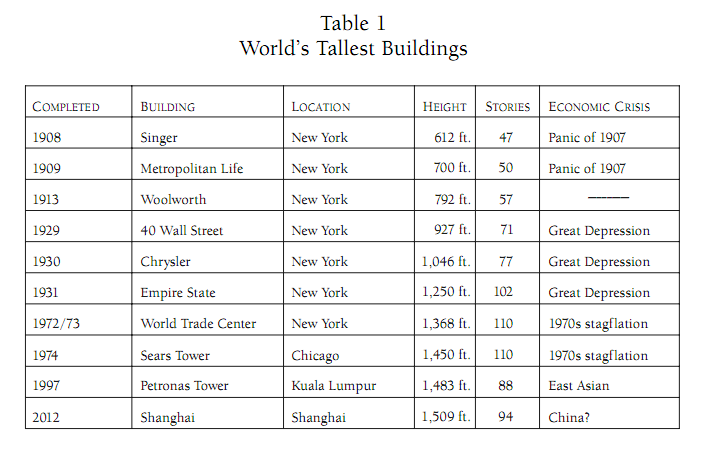
The Skyscraper Curse: How a Record-Breaking Skyscraper is Ominous for an Economic Crisis

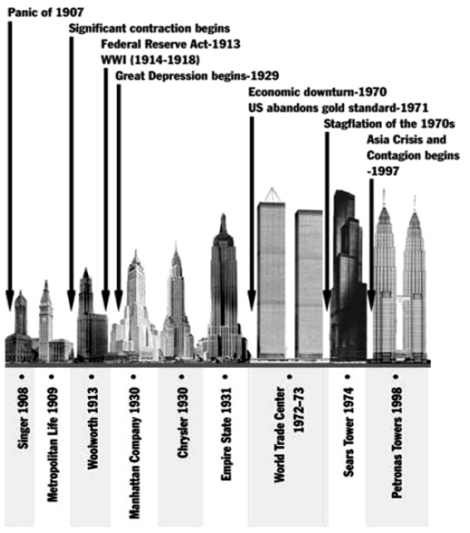
There appears to be a correlation between record-setting skyscrapers and world economic crises (Table 1 below). There may not be any rational reasoning as to why this correlation may exist but it has implications of the Austrian Theory of the Business Cycle.

Source: Thornton, M. (2005). Skyscrapers and Business Cycles. The Quarterly Journal of Austrian Economics, 8 (1): 51-74

Source: Thornton, M. (2005). Skyscrapers and Business Cycles. The Quarterly Journal of Austrian Economics, 8 (1): 51-74

Mark, in his writings, outlines the theoretical reasons and history of why the Skyscraper Index and crises are related. He also explains why it takes artificially low interest rates by the central banks to cause prosperity, speculation and exuberance which leads to record-setting skyscrapers.

In 2006, the Burj Dubai Tower in the Middle East set the record for the highest building in the world. This skyscraper wasn’t open to the public until 2010, but the record was set in 2006.

The Skyscraper Curse is great tool to see what’s going on in the most significant bubbles and busts over the last 100 years. The diagram below shows the tallest buildings at Mark’s time of writing in 2004/05. He has highlighted the correlations between the record-setting heights and the economic crises that followed. In Table 1 above, Mark questioned whether the next tallest building was to occur in China. In hindsight, the Burj Dubai Tower set the record in 2006 signalling the Great Recession. China is currently building 40% of the world’s skyscrapers. It had planned to build the tallest building in the world, reaching 838 metres, 10 metres higher than the Burj Dubai Tower. This was planned to be completed in 90 days. However, building has been postponed until safety examinations have been passed and building permits gained. Is China postponing its inevitable economic crisis?

Source: Thornton, M. (2005). Skyscrapers and Business Cycles. The Quarterly Journal of Austrian Economics, 8 (1): 51-74

Source: Thornton, M. (2005). Skyscrapers and Business Cycles. The Quarterly Journal of Austrian Economics, 8 (1): 51-74

The Economics of Prohibition and The Case for Legalizing Drugs

In the 1920s, the US government introduced The Prohibition on the manufacture, trade and consumption of alcohol. Consequently, there was an upsurge in the illegal manufacture and distribution of alcohol, creating a black market economy and the formation of mafia gangs. Crime and homicide rates increased.

In his book, The Economics of Prohibition, Dr. Mark Thornton takes a look at the consequences of todays prohibition – that of drugs – and how this has impacted on the economy, the counterfeiting of money and the lives of people.

By 1933, murder rates in the United States doubled to 10 in 100,000 of the population. When Prohibition did come to an end then, the murder rate fell back to normal levels of 5 in 100,000. There were virtually no organised crime outside New Orleans and New York City prior to The Alcohol Prohibition but it was everywhere after prohibition was put in place. By repealing prohibition, organised crime was reduced. Crime, corruption and bribery was and still is greatly enhanced by prohibition.

Today we see the same thing in the United States, most prominently in Centra America and South America where the drugs are grown, manufactured and transported to the US and Europe. Drug traffickers use Mexico, the land bridge of South America, to bring drugs into California and Texas and the murder rate in these states have increased substantially.

Civil societies in countries such as Nicaragua, Guatemala and Honduras have broken down completely. The drug gangs and drug cartels dominate those areas and they either bride the politicians, police and military or they threaten them. It has come to the point that young children are emigrating from Central America to the United States through Mexico given how bad the situation is for them and their families.

Mark is in favor of decriminalising and legalizing drugs which would have the effect of reducing organised crime, corruption and bribery. Portugal, for example, have decriminalised all drugs and have experienced improvements in all social indicators. There is less drug abuse, less needle-bourn diseases, less addiction, less drug consumption and less crime.

American’s are waking up to the fact that it is insane to make marijuana illegal: Dr Thornton

Click To Tweet

Marijuana is now legalized for recreational use in four states in the US, including the District of Columbia where Washington is. It can be used for medicinal purposes, in industry and in textiles and has many commercial uses. People’s ideology about marijuana, the prohibition and the war on drugs has changed.

Close to 80% of Americans support legal medical marijuana in the US.

Books and Papers by Mark Thornton:

  • Housing: Too Good to be True (2004) by Dr. Mark Thornton [FREE Download]
  • Skyscrapers and Business Cycles (2005) by Dr. Mark Thornton [FREE Download]
  • The Economics of Prohibition by Dr. Mark Thornton

Where To Find Mark Thornton:

  • Website: Mises.org
  • Twitter: @DrMarkThornton
  • Facebook: Mises Institute
  • LinkenIn: Friends of Austrian Economics and Mises Institute
http://traffic.libsyn.com/economicrockstar/019_Mark_Thorton_Pt_2.mp3

Podcast: Play in new window | Download

  • facebook
  • linkedin
  • twitter
  • google+
  • pinterest

018: Mark Thornton on Austrian Economics and Why the Nazi’s and the KGB Wanted Mises Papers

February 5, 2015 by Frank

http://traffic.libsyn.com/economicrockstar/018_Mark_Thornton_Pt_1.mp3
Play in New WindowDownload

018: Mark Thornton on Austrian Economics and Why the Nazi’s and the KGB Wanted Mises Papers

Mark ThorntonDr. Mark Thornton is an economist who lives in Auburn, Alabama. Mark is Senior Fellow at the Ludwig von Mises Institute and serves as the Book Review Editor of the Quarterly Journal of Austrian Economics.

Mark’s publications include The Economics of Prohibition; Tariffs, Blockades, and  Inflation: The Economics of the Civil War (2004), The Quotable Mises (2005),The Bastiat Collection (2007), An Essay on Economic Theory (2010), and The Bastiat Reader (2014).

Dr. Thornton served as the editor of the Austrian Economics Newsletter and as a member of the Editorial Board of the Journal of Libertarian Studies. He has served as a member of the graduate faculties of Auburn University and Columbus State University. He has also taught economics at Auburn University at Montgomery and Trinity University in Texas.

Mark served as Assistant Superintendent of Banking and economic adviser to Governor Fob James of Alabama (1997-1999), and he was awarded the University Research Award at Columbus State University in 2002. Mark is a graduate of St. Bonaventure University and received his PhD in economics from Auburn University.

Economics Themes:

In this interview, Mark mentions and discusses: Competition, Entrepreneurship, comparative economic systems, economic history, business cycles, value theory, population policy, purchasing power, deflation, monetary policy and bitcoins.

Economists and Economic Schools:

In this interview, Mark mentions: Ludwig von Miss, Friedrich Hayek, David Hume, Israel Kirzner, Carl Menger, Richard Cantillon, Friedrich von Wieser, Eugen von Böhm-Bawerk, Joseph Schumpeter, Fritz Machlup, Adam Smith, Anne-Robert-Jacques Turgot, Irving Fischer, Milton Friedman, Ben Bernanke, Scott Sumner, George Soros, Nassim Nicholas Taleb, Jim Rogers, Paul Krugman, Austrian Economics, Merchantilists, Physiocrats, French Liberals and Classical Economists.

Influencers and Favorite Economists:

Scott Sumner, Richard Cantillon, Ludwig von Mises and Murray Rothbard.

Why Mark Read Economics:

As a teenager I could clearly see in the 1970s, the government was the problem and in college I discovered libertarianism. I was an economics major and I also discovered Austrian economics. I come from a family of entrepreneurs and there my perspective was developed. The small business person and the day-to-day interferences and interventions government introduced in the form of regulations, subsidies and taxes.

I came across economics outside of the classroom and outside of college – Dr. Mark Thornton

Mark’s Affirmation and Motto:

‘Do not give in to evil but proceed ever more boldly against it’ – Virgil

Click To Tweet

By going by this motto, it frees you up to take a stand you actually believe in rather than watering it down or covering it up – Dr. Mark Thornton.

In this episode, you will learn:

  • about the Greek and Roman philosophical roots of Austrian Economics.
  • about the importance of deduction and logic in Austrian thinking.
  • the limitations to Austrian Economic thinking.
  • about Irish economist Richard Cantillon, who remains quite elusive in economics.
  • who Richard Cantillon influenced through his writings.
  • why the Austrian School of Economics is given its name.
  • how von Mises’ papers got in the hands of Nazi Germany and then the Soviets.
  • whether von Mises or Irving Fischer was right about the 1929 Stock Market Crash and the subsequent Great Depression.
  • who would support Bitcoins – von Mises or Fischer?
  • why bitcoins were created.
  • how similar bitcoins are with gold and the Gold Standard.

Austrian Economic Perspectives and Its Limitations

The Austrian Theory is based on logic and deduction and it tries to remain realistic. In other words, you don’t make false assumptions about humanity or the economy or the world we live in. You try to stick with realistic aspects of human behavior and you theorize, by deducing logically, what economic theory should be in order to help explain things in the real world.

The limitation for Austrian Economics is that it will never be able to have a complete theoretical understanding of the economy and it will never be able to make predictions about the future especially with respect to the magnitude of changes and the timing of actual real-world results. The Austrian School has limited predictive power about certain economic policies, regulation, subsidies, price controls, etc.

You can find Austrian insights going back to the Greeks and the Romans. It’s not until you get to the Scholastics where you see thinkers that have the same basis, realism, logic and deduction. The world works because of the ideology of the masses.

Richard Cantillon

Irish economist Richard Cantillon (1680s – 1734) is the precursor to Austrian Economics and he is the first person to put together a comprehensive treatise on economics along the lines of the Austrian School which would come after him. Cantillon was an influencer on people like Hayek, Karl Menger, the French Liberals and many of the Classical Economists and Physiocrats.

The Austrian School really starts with the publication of Cantillon’s essay ‘Essai sur la Nature du Commerce in Général’ (Essay on the Nature of Trade in General). Unfortunately, Cantillon fell out of favour with many investors that were caught up in the ‘Mississippi Bubble’ of which played a part and was subsequently ‘murdered’ when his house burnt down (there is speculation that he staged his own death to avoid the wrath of his debtors. His work was not published until 25 years after his murder. It influenced Adam Smith and Anne-Robert-Jacques Turgot. However, Cantillon’s work fell into obscurity at the time of the neo-classical school from the second half of the 19th Century to 1930 and has since been on a path of re-discovering and re-interpreting Cantillon – what he wrote, what it meant.

The Birth of Austrian Economics

Carl Menger wrote his book ‘Principles of Economics’ explaining his theoretical understanding of economics. His students von Wieser and von Böhm-Bawerk eventually became mentors to von Mises, Schumpeter and Hayek. They were known as Austrian economists simply because of their country of origin as they did not fit into any particular school of economics at that time. Hayek worked for von Mises at the Institute of Business Cycle Research. Hayek went on to work in the London School where he influenced many British economists to adopt the Austrian methods and theories.

Mises, the Nazi’s and the KGB

During World War II, Mises left Vienna due to the Nazi threat as he was both the arch-nemisis of all Socialists as well as being Jewish. On invading Vienna, the Nazi’s took von Mises works and were studied by the Nazi Intelligence Service. And when the Soviets invaded Germany, both Communists and National Socialists saw that von Mises was the main opponent of Socialism and saw that it was unviable. It was only because of the downfall of the Soviet Union was Mises’ papers rediscovered in Moscow in a KGB warehouse.

von Mises published a paper in 1920 and showed that  Socialism in its pure form was impossible and in any form was irrational. Socialism would not be efficient or productive when you have one person or one group of people making economic decisions on labor, resources and production. This would be an impossibility as they would have to come up with decisions as to what to produce, how to produce it, who to produce it for and how much to produce. They would then have to make those decisions on every good in the economy. It just can’t be done at this level, and the Soviet Union eventually realised this and they had to introduce money , wage rates and interest rates. They had to break up production by industry and introduce prices based on the West, and undergo the allocation of resources. In the end, no matter how many modifications they made, they still couldn’t produce enough food, clothing and shelter to keep their population growing.

Mises, Irving Fischer and the Fed

I ask Mark about Mises views of the economy in 1928 compared to that of Fischer’s. Fischer had been writing extensively in the public domain up to that point in time and Mises worried about the economy and the economic approach taken by government, which was largely influenced by Fischer. Fischer wrote that the US economy and investment in the stock market was safe. The 1929 Stock Market Crash and the subsequent Great Depression proved Mises correct and resulted in Fischer losing his wealth but not the use of his monetary economic perspective.

Irving Fischer was trained in Germany in modern economics with the use of statistics. The system he devised was based on a stable dollar, where the purchasing power of the dollar would remain the same. He developed price indexes to measure the purchasing power of the dollar and then suggested that monetary policy be implemented to maintain a stable dollar value. This type of mechanical economics and government bureaucracy to achieve this mechanistic view of the macro-economy resulted in Fischer being very influential in the US. He had a great influence on people like Milton Friedman and Ben Bernanke, and the modern economic policies of the US today are guided by his approach to a stable dollar and to the manipulation of monetary policy to keep a stable dollar. When the purchasing power of the dollar starts to increase the dollar – or deflation – then the monetary authorities have to throw in more dollars or credit in the system to try and dilute the value of that dollar.

Mises’ perspective and approach was different to Fischer’s and in 1928 he wrote a book outlining why Fischer’s approach was wrong and that it would cause considerable problems of size and magnitude. Mises approach was a more natural approach of the market economy that money was a weight of gold, silver or copper and the coins would remain the same weight, i.e. a silver dollar would be 25 grams of pure silver and these coins would be allowed to fluctuate in both the short-run and the long-run. This provides a shock absorber for the entire economy because the value of money is fluctuating, the value of domestic and foreign goods are fluctuating (in terms of domestic goods) and the system is not fragile. Everything can move in the economy.

However, Fischer’s approach, by guaranteeing a stable dollar and not allowing it to adjust vis-a-vis everything else in the economy creates ultimately a fragile system. Mises’ view was that you hold the metal content of the dollar constant and you allow them to fluctuate in market value, whereas Fischer believed you would essentially change the weight of the coins. He actually advocated this system but realised it to be unworkable and so retreated to making monetary policy maintain the market value of the US dollar or any currency.

Under Fischer’s approach, a bureaucracy has been created to be in charge of maintaining money and credit in the economy and giving the government the ability to increase the money supply to reduce interest rates. This has created a panacea for politicians to get out the ‘magic check book’ and make the economy ‘feel better’ in the short term.

The Central Bank is essentially a ‘legal’ counterfeiter, which is very valuable for both the political class as well as the big banks that it benefits – Dr. Mark Thornton

Bitcoins

The creator(s) of bitcoins did so in response to the financial crisis of 2008 – 2009 and they saw that central banks were responsible for that, as well as the banks who got a bailout. The average ordinary citizen ended up absorbing most of the losses.

Bitcoin is not controlled by politicians or anyone else. It’s part of an electronic marketplace and it mimics the Gold Standard in several ways:

Miners, or people who want to produce Bitcoins, have to expend real resources – their time, their money, their computing power, the purchase of special devices and a tremendous amount of electricity – just like the way gold miners expend resources on mining for gold.

The mining process becomes progressively more difficult overtime and there will be an end with production for bitcoin per se, whereas with gold, the process will go on indefinitely.

The way Bitcoin tries to alleviate the eventual deflationary pressure on bitcoins is that one Bitcoin can be broken up into a million different pieces in the same way a US dollar can be broken up into 100 pieces or cents.

Eventually people will stop allocating resources to the production of new Bitcoin. This can be a good thing because, at some point, resources will be wasted on producing valueless bitcoins from the social perspective.

Whoever invented Bitcoin did so on the Austrian perspective of the economy and on the perspective that the Gold Standard is a much better system and is decentralized in the market economy.

“Fischer was a ‘control-freak’ in many ways. He wanted to control everything, even the genetics of the American population. He would strongly disapprove of Bitcoin” – Dr. Mark Thornton

Recommended Books:

  • The Theory of Money and Credit by Ludwig von Mises
  • Principles of Economics by Carl Menger
http://traffic.libsyn.com/economicrockstar/018_Mark_Thornton_Pt_1.mp3

Podcast: Play in new window | Download

  • facebook
  • linkedin
  • twitter
  • google+
  • pinterest

009: Naomi Brockwell (Bitcoin Girl) on Bitcoins, Liberty, Government and Fiat Currency.

December 3, 2014 by Frank

http://traffic.libsyn.com/economicrockstar/009_Naomi_Brockwell.mp3
Play in New WindowDownload

009: Naomi Brockwell (Bitcoin Girl) on Bitcoins, Liberty, Government and Fiat Currency.

Naomi BrockwellNaomi Brockwell is the always effervescent face of Bitcoin Girl She is an opera singer, film-maker and actress, and studied commerce at the University of Western Australia. Currently residing in New York, Naomi also runs her own company Rainsworth Productions and is a fellow at The Moving Picture Institute. Naomi speaks five languages, plays six musical instruments and, of course, is a gold medal-winning Irish dancer. Naomi is on the Advisory Council of the Mannkal Economic Education Foundation.

Economic Themes:

In this interview, Naomi mentions and discusses: bitcoins, crypto-currencies, monetary policy, inflation, fiat currency, fractional reserve banking, central banks, living standards,  international trade, negative externalities, unintended consequences, equilibrium, supply and demand.

Economists and Economic Schools:

In this interview, Naomi mentions: Victor Niederhoffer, Gene Epstein, Murray Rothbard, Jean-Baptiste Say, Ludwig von Mises, Friedrich Hayek, Carl Menger, Erik Voorheese, Paul Krugman, Austrian economics, Libertarianism, Keynesian economics and Hunter Lewis.

Naomi’s Passions:

Economics, Film, Dance and Opera Singing.

Naomi’s Affirmations/Mantra:

“I like people who are inspiring and I like reading their biographies” – Naomi Brockwell

“We really underestimate what we can achieve and if we remember that so much more is possible than we may think, then that’s a good way to live. It encourages you to press your boundaries and explore new horizons. Seek what your potential is, really try to fulfil your potential.” – Naomi Brockwell

Naomi’s Influencers:

Gene Epstein, Murray Rothbard and Georgia Hilton of The Moving Picture Institute

Exclusive News Announced on the Economic Rockstar Podcast:

Naomi is writing a FUN and ACADEMIC book which will be released soon.

Find Out:

  • what Naomi’s two favorite drinks are – they’re Irish by the way!
  • and watch Naomi’s video ‘Bitcoin Girl’ (see below), made with The Moving Picture Institute, in which she is featured.
  • what began Naomi’s passion for economics after staying in New York City to study and train with other great opera singers.
  • how a discussion on the housing crisis and the housing bubble at Junto in New York City inspired Naomi to read economics.
  • how a chance email to Gene Epstein of Barron’s developed a passion for Austrian and Libertarian economics.
  • Naomi’s shared views with Gene on educating people in economics even if they disagree on some of the thinking.
  • why Naomi questions the foundation of fiat money after reading Rothbard.
  • why Naomi believes that the private sector can manage money better than the government.
  • why bitcoin is used voluntarily with no coercion.
  • what is a virtual or crypto-currency and how does it work when there is no physical coin to use.
  • what excites Naomi about Bitcoin and why, as Bitcoin Girl, she is becoming synonymous with Bitcoin.
  • what cryptography is and what it has to do with Bitcoin.
  • the difference between fractional reserve banking and how bitcoin operates.
  • what scares Naomi when she requested her Australian bank to transfer her own money into a Bitstamp account.
  • about Naomi’s thoughts on inflation and fiat currencies.
  • why Naomi believes that Bitcoin will take many people out of poverty and how it will benefit the 2.5 billion people that are un-bankable.
  • why Bitcoin owners have a right to privacy, while owners of fiat money run the risk of having their identity and privacy hacked.
  • why American venture capital investor Tim Draper bought up Bitcoins from the Silk Road auction.
  • where venture capital money is going in relation to Bitcoin.
  • why governments and central banks have a vested interest to make Bitcoin obsolete.
  • about the opportunities and the jobs being created by the Bitcoin industry.
  • why bitcoins are safe from government interference and control.
  • why Naomi thinks Uber and AirBnB should follow the decentralized model of Bitcoin.
  • if Bitcoin is a buying opportunity.
  • who is Satoshi Nakamoto (or maybe not!).
  • what Naomi was doing in a World War II submarine

https://www.youtube.com/watch?v=XEthXBHsEac

Advice:

Find people who you find really inspirational and learn as much as you can – Naomi Brockwell

Click To Tweet

On Bitcoins:

Bitcoin is a digital currency which is keeping up with the digital age – Naomi Brockwell

Click To Tweet

Bitcoin is a global currency keeping up with a global marketplace – Naomi Brockwell

Click To Tweet

Bitcoin is specifically being engineered as an ideal form of money – Naomi Brockwell

Click To Tweet

The fact that people are using Bitcoin because they prefer it over sovereign currency interests me – Naoim Brockwell

Click To Tweet

Bitcoin, in layman’s terms is ‘Money for the Internet’ – Naomi Brockwell

Click To Tweet

About Bitcoin: That is a superstar currency right there – Naomi Brockwell

Click To Tweet

Which is Safer – Your details with J.P. Morgan or a Bitcoin wallet?

It’s just as easy to get access to a persons bitcoin if they have access to the key as it is to get into someones house if you get access to their key. It’s very much the same issue. However, the issue I have with J.P. Morgan is that they take all of your private information. So identity fraud can ruin a persons life.

When a person hacks into my Bitcoin account, first of all it’s up to me to decide how I want to secure that. There are incredible secure ways that I can use to protect my Bitcoins.

There are no personal details attached to that money. There are no names, no phone numbers and no addresses – just ones and zeros.

If someone hacks into J.P. Morgan, they steal everything about me. That is really, really scary and that is far more severe than any Bitcoin hacking.

With Bitcoin, it’s all up to you how you want to safe-guard your property. There are paper wallets.

Venture capital investment is going to Bitcoin entrepreneurs who are improving the Bitcoin infrastructure.

There are going to be scammers just as there are in any other industry.

I feel that I’m empowered using Bitcoin – Naomi Brockwell

Click To Tweet

About Fiat Currency:

“As long as my money stays in an organisation that can be coerced by government or can play by its own rules, I don’t have control over my own money. That’s a scary thought. My instinct is to get my money out of that system as fast as I can so that I can regain the control over where I want to spend my own money” – Naomi Brockwell.

Inflation is a secret tax that the government didn’t need approval for. There is absolutely no sane reason why any person should accept money from someone that they know will be worth less the next day. It’s possibly the biggest scam ever created.

‘Money is not an invention of the State and it’s not a product of a legislative act’ – Carl Menger

Click To Tweet

On Sensationalist News Stories on Bitcoins:

“If it Bleeds, it Leads. So any bad news on Bitcoin is good news for media outlets” – Naomi Brockwell.

Click To Tweet

Every second week someone is putting out a report – it’s usually Paul Krugman that says ‘Bitcoin is finally dead’ – Naomi Brockwell

Personal Habits:

  • Naomi subscribes to Louise Hay’s Daily Affirmation
  • Naomi and Gene Epstein run an Austrian economics reading group together.
I like to surround myself with such amazing and inspiring people – Naomi Brockwell

Click To Tweet

Takeaway:

There is so much more to economics and to the housing crisis than the mainstream media let on – Naomi Brockwell

Click To Tweet

Economics is just an incredible way of helping the less fortunate areas of society, of helping people out of poverty, of helping the unrepresented, people being persecuted by government. Economic, if you really understand it, it provides all of these answers. With economics, you could do a lot more to help people.

Recommended Books:

  • What Has the Government Done to Our Money by Murray Rothbard
  • Money: How the Destruction of the Dollar Threatens the Global Economy – and What We Can Do About It by Steve Forbes
  • The Financial Crisis and the Free Market Cure: Why Pure Capitalism is the World Economy’s Only Hope by John Allison
  • Where Keynes Went Wrong: And Why World Governments Keep CreatingInflation, Bubbles, and Busts by Hunter LewisAudible

Favorite Internet Resources:

  • On Life and Liberty by Erik Voorheese
  • The Moving Picture Institute for FREE movies.
  • Liberty.me

Where To Find Naomi Brockwell:

  • Websites: naomibrockwell.com and bitcoingirl.com
  • Moving Picture Institute


http://traffic.libsyn.com/economicrockstar/009_Naomi_Brockwell.mp3

Podcast: Play in new window | Download

  • facebook
  • linkedin
  • twitter
  • google+
  • pinterest

Frank Conway

Frank Conway is founder of Economic Rockstar and lecturer of economics, finance and statistics. Read More…

View My Blog Posts

Youtube Sub

Become a Patron of the Economic Rockstar Podcast

patreon

Ireland’s Economy by the Numbers

Leaving Cert Economics: Ireland’s Economy  Click here to download a workbook on Ireland’s Economy so that you can add your own notes. [Original size] Ireland’s Economy by fconway

Categories

Subscribe and Never Miss An Episode

itunes-logo

Recent Posts

  • Ireland’s Economy by the Numbers April 8, 2019
  • 174: Wendy Carlin on The Core Project, Capitalism, Democracy and Normative Statements February 13, 2019
  • 173: Stephen Wright on Core Econ as a Learning Resource for Mainstream Economics January 28, 2019
  • 172: Best of 2018 Part 2: From the Great Depression to Futurism; Institutions, Individualism, Cooperation and Reciprocity January 22, 2019
  • 171: Best of 2018 Part 1 January 3, 2019

Copyright © 2026 · Podcast Pro Theme on Genesis Framework · WordPress · Log in

This website uses cookies to improve your experience. We'll assume you're ok with this, but you can opt-out if you wish. Accept Reject Read More
Privacy Policy

Privacy Overview

This website uses cookies to improve your experience while you navigate through the website. Out of these, the cookies that are categorized as necessary are stored on your browser as they are essential for the working of basic functionalities of the website. We also use third-party cookies that help us analyze and understand how you use this website. These cookies will be stored in your browser only with your consent. You also have the option to opt-out of these cookies. But opting out of some of these cookies may affect your browsing experience.
Necessary
Always Enabled
Necessary cookies are absolutely essential for the website to function properly. This category only includes cookies that ensures basic functionalities and security features of the website. These cookies do not store any personal information.
Non-necessary
Any cookies that may not be particularly necessary for the website to function and is used specifically to collect user personal data via analytics, ads, other embedded contents are termed as non-necessary cookies. It is mandatory to procure user consent prior to running these cookies on your website.
SAVE & ACCEPT