• ABOUT
  • RESOURCES
  • PODCAST
  • BOOKS
  • BLOG
  • SUPPORTERS
  • QFA Financial Advice
  • CONTACT

Economic Rockstar

Connecting Brilliant Minds in Economics and Finance

The Maths Factor: Give the Gift of Math

April 4, 2016 by Frank

The Maths Factor:

Give the Gift of Math to Your Child or Grandchild!

Here’s a little something that you or someone you know may be interested in.

I have my 8 year-old son signed up on this for just over a year now. His level of math is beyond his class year. He’s almost done with multiplication when he normally would be on addition and subtraction. There’s no pressure with performing.

The Maths Factor is easy to use and makes math learning fun. He literally spends less than 5 minutes a day doing it and the pay-off is amazing.

There’s no pressure with performing. The Maths Factor is easy to use and makes math learning fun. He literally spends less than 5 minutes a day doing it and the pay-off is amazing.

You can get started for just £1 for your first month. No commitments required. If it’s not for you, then you can cancel at any time.

Click on the image below and you’ll be redirected to a sign-up page to avail of this offer.

Honestly, the learning is fun.

You can choose the level that is suitable to your child’s requirements (Explorer, Adventurer or Pioneer) and the modules are geared toward getting the best out of your child’s learning ability.

Each module has up to 24 math questions. Prior to doing the 24 questions, Carol (pictured below) gives a video tutorial on the calculations (addition to division and, for the advanced, working with fractions and long division).

There’s also a Games Centre that matches up with the level so that your child can learn math without realising it. Clever!

What’s more, The Maths Factor has the 30 Day Challenge which encourages your child to complete 30 consecutive days of math. And the best thing is that once completed, your child is rewarded with a medal – a real medal. How’s that for a reward and an incentive (or a nudge to those Behavioral Economists).

For full disclosure, I’ll receive a small commission if you decide to sign up to The Maths Factor by clicking on the image below or by using the code FC-27287-FR. In return, you’ll get your first month for just £1.

If I didn’t believe in this, I wouldn’t share it so publicly. If you have any questions about it, please email me and I’ll get back to you.

TheMathsFactor Voucher


  • facebook
  • linkedin
  • twitter
  • google+
  • pinterest

Economic Rockstar Guests on TED

January 14, 2016 by Frank

Economic Rockstar TED

If you found the Economic Rockstar podcast interesting, then you’ll be interested in the TED talks that some of my guests gave on TED. Here they are ready for you to watch for your convenience. Enjoy!

Dan Ariely: Our buggy moral code

If you haven’t listened to Dan Ariely’s interview on the Economic Rockstar podcast, then check it out here.

Alex Tabarrok: How ideas trump crises

If you haven’t listened to Alex Tabarrok’s interview on the Economic Rockstar podcast, then check it out here.

Loretta Napoleoni: The intricate economics of terrorism

If you haven’t listened to Loretta Napoleoni’s interview on the Economic Rockstar podcast, then check it out here.

Dan Ariely: How equal do we want the world to be? You’d be surprised.

Dan Ariely: Beware of conflicts of interest

Dan Ariely: Are we in control of our own decisions? 

Dan Ariely: What makes us feel good about our work? 

  • facebook
  • linkedin
  • twitter
  • google+
  • pinterest

The Breadwinner: Pavarna – A Heroine to All Girls Symbolizing Self-Empowerment and the Fight Against Oppression and Inequality

August 26, 2015 by Frank

Pavarna - A Heroine to All Girls Symbolizing

Recently, I met up with Dr. Shanta Devarajan and his wife Dr. Nancy Benjamin in Waterford City on their recent trip to Ireland. Shanta is MENA Chief Economist at the World Bank and Nancy is Senior Economist also at the World Bank.

I arranged to meet up with Shanta after interviewing him on the Economic Rockstar podcast when he informed me of his trip. Shanta and Nancy were travelling by coach from Cork City to Kilkenny City and were making a 1-hour stop in Waterford City. It was a beautiful day in August and the sun was shining and the temperature was such that we decided to sit outside for lunch at The Granary Cafe.

Shanta and Nancy both had a Chicken and Bacon Caesar wrap with Shanta deciding on an Americano and Nancy on a bottle of still water. I personally went for a fruit scone and an Americano. While relaxing outdoors, we were greeted by the soothing shelther of a sapling and comforted by a genial gentle breeze.

This differed to my previous remote meeting with Shanta, which took place on a Skype call – he in his office in Washington DC at 4pm EST and me in my home in Portlaw, Co. Waterford at 9pm Irish time. It was an audio-only interview so we didn’t see each other. The conversation flowed but within the realm and restrictions of economic themes.

Our conversation at The Granary Cafe was quite mixed. We spoke about economics (of course!), the Economic Rockstar podcast, some guest recommendations for the show by Shanta (Patrick Honohan and Chris Blattman) and about Irish animation studio Cartoon Saloon. Yes, you read that correctly – Cartoon Saloon!

The Breadwinner symbolWhy did three economists have a conversation about Cartoon Saloon? Well, we found out that we are all in some way connected to Cartoon Saloon – or more accurately the story behind their animated film ‘The Breadwinner’ (being produced by Aircraft Pictures, Cartoon Saloon and Melusine Productions).


My brother, multi-award winning animator, Rory Conway is employed by Cartoon Saloon and is part of the animation team behind this feature-length film. Angelina Jolie Pitt is Executive Director and her production company Jolie Pas Productions will join forces with Cartoon Saloon to make this a super-awesome and award-winning team.

Both Shanta and Nancy were on their way to Kilkenny City and visiting the beautiful and awe-inspiring Kilkenny Castle. For the summer of 2015, Rory was artist-in-residence at Kilkenny Castle where he showcased Cartoon Saloon’s recent feature length movie ‘Song of the Sea’. Shanta and Nancy met Rory there, where he divulged everything about this movie from idea generation to character design.

Okay! The connection hasn’t be fully made just yet. Shanta, Nancy, myself, Rory, Cartoon Saloon, The Breadwinner, Angelina Jolie Pitt and economics? I understand if you’re confused right now, but allow me to explain.

During our conversation, we chatted about The Breadwinner (written by Deborah Ellis), a story about a young girl from Afghanistan who must disguise herself as a boy in order to earn money for her family. Nancy had mentioned the work done by an investigative journalist who had discovered the lives of young Afghan women after they had lived and behaved as young boys during their childhood and adolescence. Nancy explained how families with only girls and no boys would feel a sense of shame and embarrassment in society. This social stigma is typically avoided when a girl from the same family is chosen to dress-up and behave as a boy. The girl has her hair cut short and takes on a male name.

Digging a bit deeper on the internet about this phenomenon, I came across the term ‘Bacha Posh’ to describe these Afghan girls living as boys. Jenny Nordberg, investigative journalist, was the first to use Bacha Posh to describe these girls since this practice didn’t even have a name. Jenny’s breaking story in The New York Times revealed this practice to the rest of the world and subsequent dedicated research by her culminated into a fascinating and must-read book titled ‘The Underground Girls of Kabul’. Jenny Nordberg reveals so much about these girls during and after their livelihood as boys. She exposes gender inequality, powerlessness and resistance.

Dressing these girls as boys is not to deceive society. But the belief is that a Bacha Posh, as she becomes known, will bring some ‘fortune’ to her mother in a later pregnancy where it is hoped that a boy will be born. A Bacha Posh does not take on the role of a boy or a girl, but has some intermediate status. She will not cook and clean (like all males) and she can attend school and work (unlike all females). The remaining females in her family can be escorted by her – a task strictly reserved for males. These girls performed better in all aspects of education than other girls in society due to their schooling opportunities.

A Bacha Posh must revert back to her female ‘status’ once she reaches puberty or when she marries. However, the sense of empowerment, the freedom, the rights and the opportunities enjoyed by these young girls and women is too invaluable to give up. Having an experience of what should be a right to all women is a difficult thing to give up – being replaced with a life of oppression, zero rights and a slave-like existence.

The 5 years of research and interviews that Jenny Nordberg conducted to investigate the lives of Bacha Posh have shown that the reversal of social status experienced by these women can lead to irreversible psychological effects. They must take on the persona of the traditional Afghan woman and displace the once coerced mannerisms of a boy and all the ‘social fortunes’ that came with their ‘male-like’ status. Also, the sense of freedom and opportunity provided to these women shines light on the inequality that exists at a basic human level. Such controversial treatment of women in Afghanistan has led to a surge of activity in women’s rights movements there.

Novelists like Deborah Ellis, investigative journalists and authors like Jenny Nordberg, women’s rights activists like Angelina Jolie Pitt and animation studios like Cartoon Saloon are a powerful force when they shine light on the oppression and restrictions faced by Afghan women. They educate us through facts, imagery, art, visual expression, color, sound and a theme that many feel they could possibly relate to – a struggle against oppression and an authoritative regime, and the fight for survival and self-empowerment.

The Breadwinner

The people behind The Breadwinner, are setting themselves up to be an impressive and potent combination that could possibly re-write the history books in Afghanistan and for women’s rights everywhere. The Breadwinner depicts the life of a Bacha Posh in such a compelling way – a story of oppression and self-empowerment. A story of Parvana, “a young girl living under the Taliban regime in Afghanistan, who must disguise herself as a boy and become the breadwinner of the family when her father is unfairly imprisoned”. The Breadwinner also celebrates the culture, history and beauty of Afghanistan.

It’s amazing how a conversation over a cup of coffee could result in an urge to write this post and how people are somewhat connected by a story – a story of Parvana, the protagonist in The Breadwinner and a symbol of survival, hope, and empowerment through imagination.

Young girls everywhere, even those in developed countries like Ireland, the UK and the US, should read Parvana’s story and watch the movie upon its release. They should take away from it the themes of oppression and self-empowerment.

Parvana must be your heroine, symbolizing the determination and the willingness to succeed in a world lacking opportunity. You must reflect upon their own position in society, in school, in your home and in the media. When someone says that you should not hold a hammer, learn computer coding, play in the mud or open up an old computer and mess with the memory board because ‘you are a girl’, then think of Parvana and all the young girls and women like Parvana today and in the past who have fought for equal rights. Stand up for your rights, empower yourself with imagination and dream of your goals, irrespective of what anyone says, and strive toward making your dreams a reality.

The Breadwinner will win an Oscar once released in 2017. But the greatest accolade that will be bestowed on all involved in the creation of this film will be the knowledge that they will empower women, not only in Afghanistan but throughout the world, giving them strength to fight for their rights and equality. You’ve read it here first on Economic Rockstar – The Breadwinner will be a deserved winner of the Nobel Peace Prize and Jenny Nordberg deserves her place as an individual recipient of the Peace Prize too. Just like Malala Yousafzai, the 2014 Nobel Peace Prize recipient who is fighting for girls’ right to education in Pakistan and beyond, and who suffered an attack on her life by Taliban gunmen in doing so, Pavarna will be the fictional heroine of the oppression suffered by girls in Afghanistan and beyond.

Oh, by the way, a group of people can win the Nobel Peace Prize. Don’t believe me? Check out episode 036 of the Economic Rockstar podcast with Professor Jason Shogren who was a member of the Intergovernmental Panel on Climate Change (IPCC),  joint recipients of the Nobel Peace Prize in 2007 along with Al Gore.

Links:

Jenny Nordberg: www.bachaposh.com

Deborah Ellis: www.deborahellis.com

Cartoon Saloon: www.cartoonsaloon.ie

Economic Rockstar: www.economicrockstar.com

Books:

The Underground Girls of Kabul: In search of a hidden resistance in Afghanistan by Jenny Nordberg

Read an excerpt from Jenny’s award-winning book here.

The Breadwinner by Deborah Ellis


  • facebook
  • linkedin
  • twitter
  • google+
  • pinterest

How to set up your Blog in minutes with Bluehost!

August 3, 2015 by Frank

Are you ready to get your WordPress site up and running in minutes with Bluehost?

Follow the steps below and you’ll be an online rockstar in no time!

Step #1:

  • Click Here To Set Up Your Hosting Account & Aquire or Transfer Your Domain…

Your hosting account is where your website will be hosted and your domain is your website’s URL (economicrockstar.com is mine).

My #1 hosting recommendation is Bluehost because:

  1. They are a proven hosting company, hosting over 2 million websites.
  2. Their customer support is one of the best out there.
  3. One touch WordPress installation – setting up your website in 4 minutes.
  4. Their prices are the best (and they even buy your domain for you!).

Step #2:

  • Click here & click the green ‘get started now’ button…

Bluehost home page

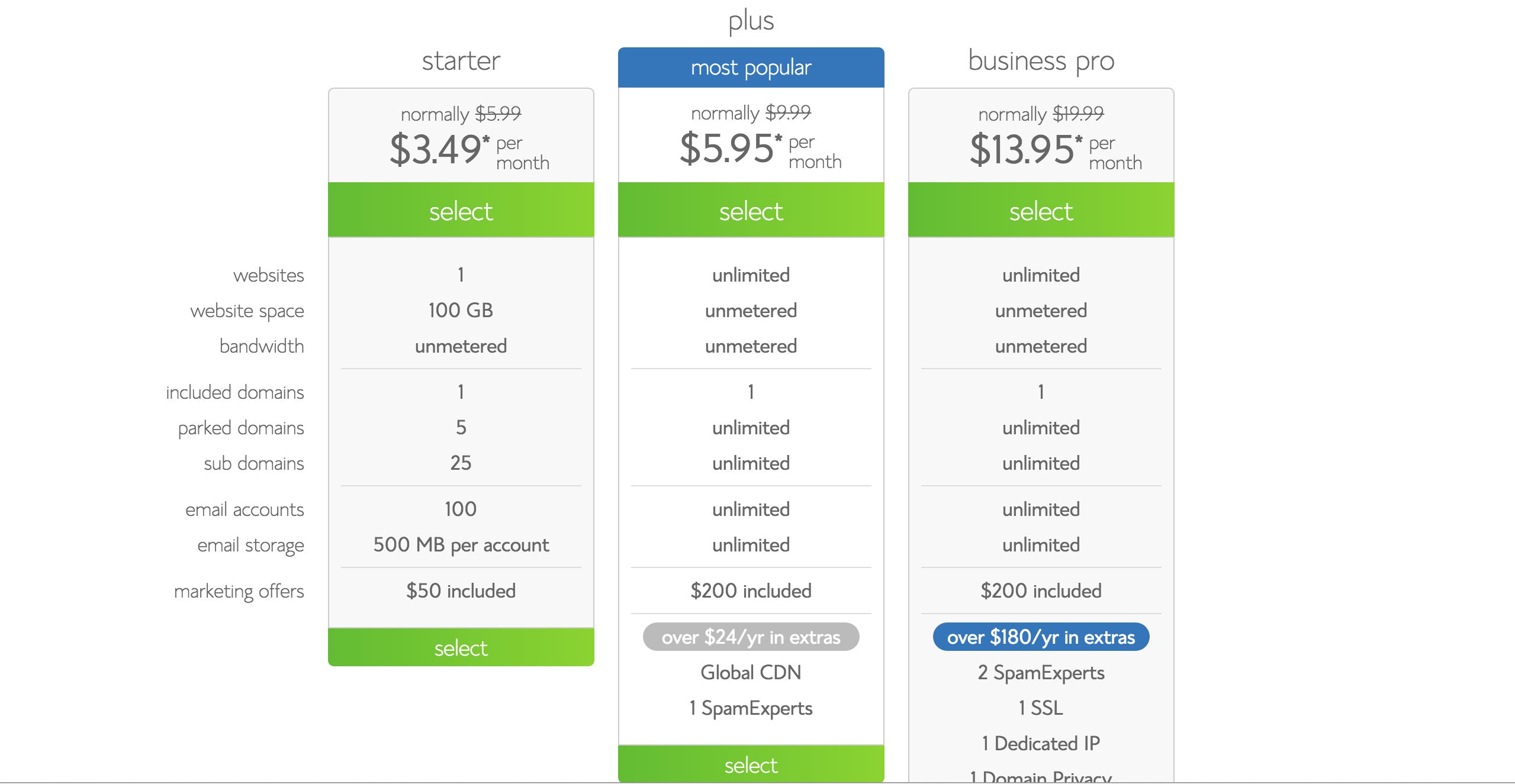
Step #3:

  • Select your plan…


    Bluehost Plans

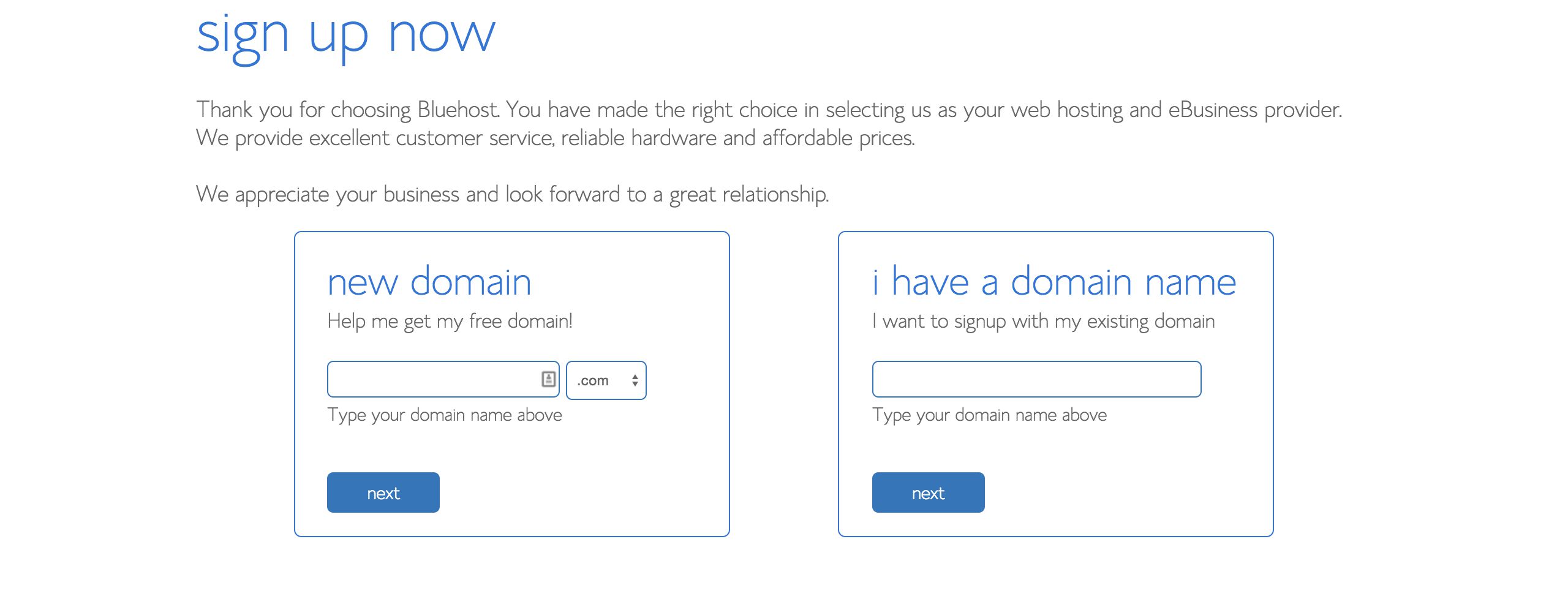
Step #4:

  • Choose your free domain name or transfer your current domain…

Bluehost Domains page

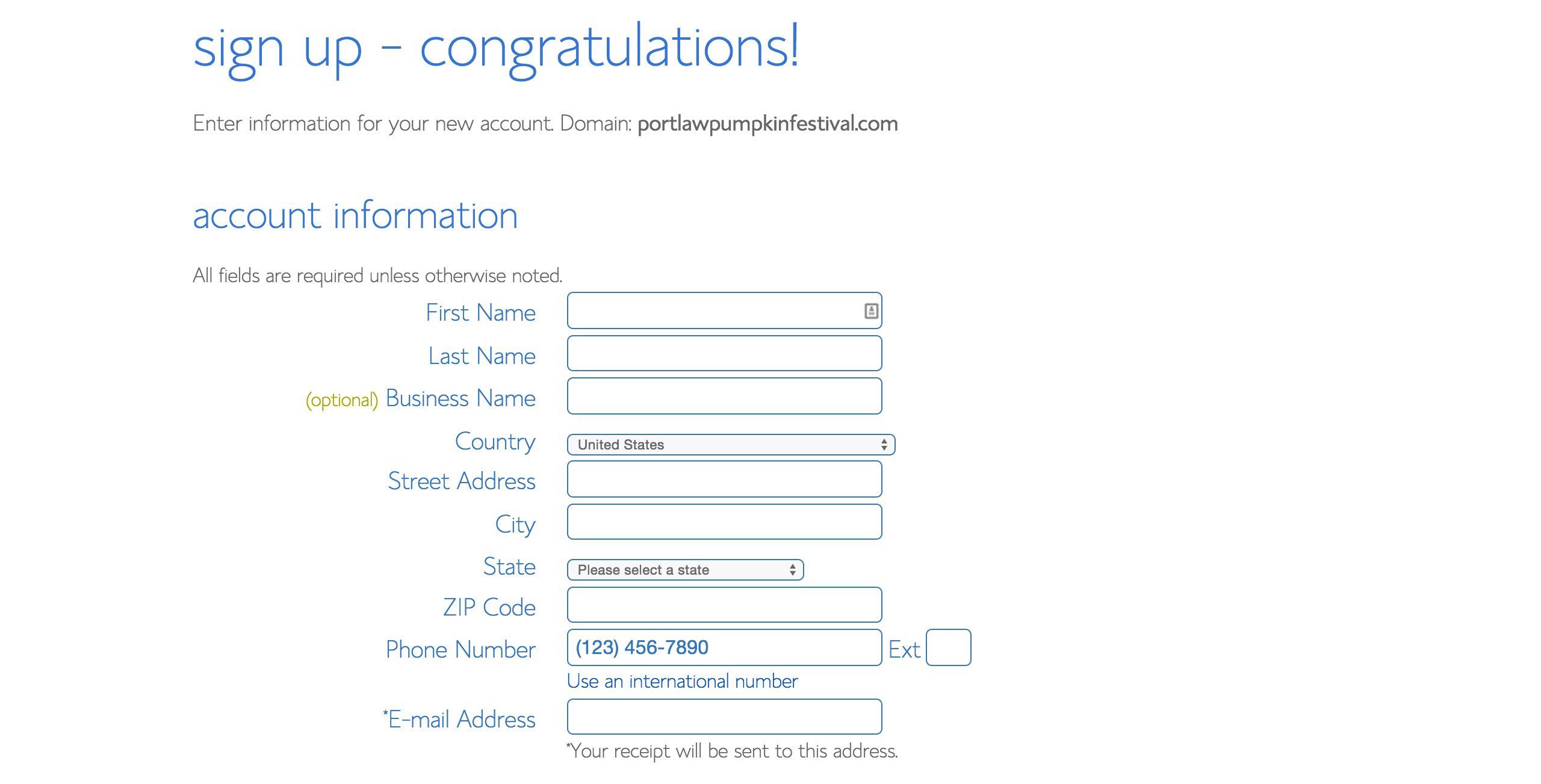
Step #5:

  • Place your order and pay for your plan…

Bluehost Sign Up page

Step #6:

  • Bluehost will email your login information.

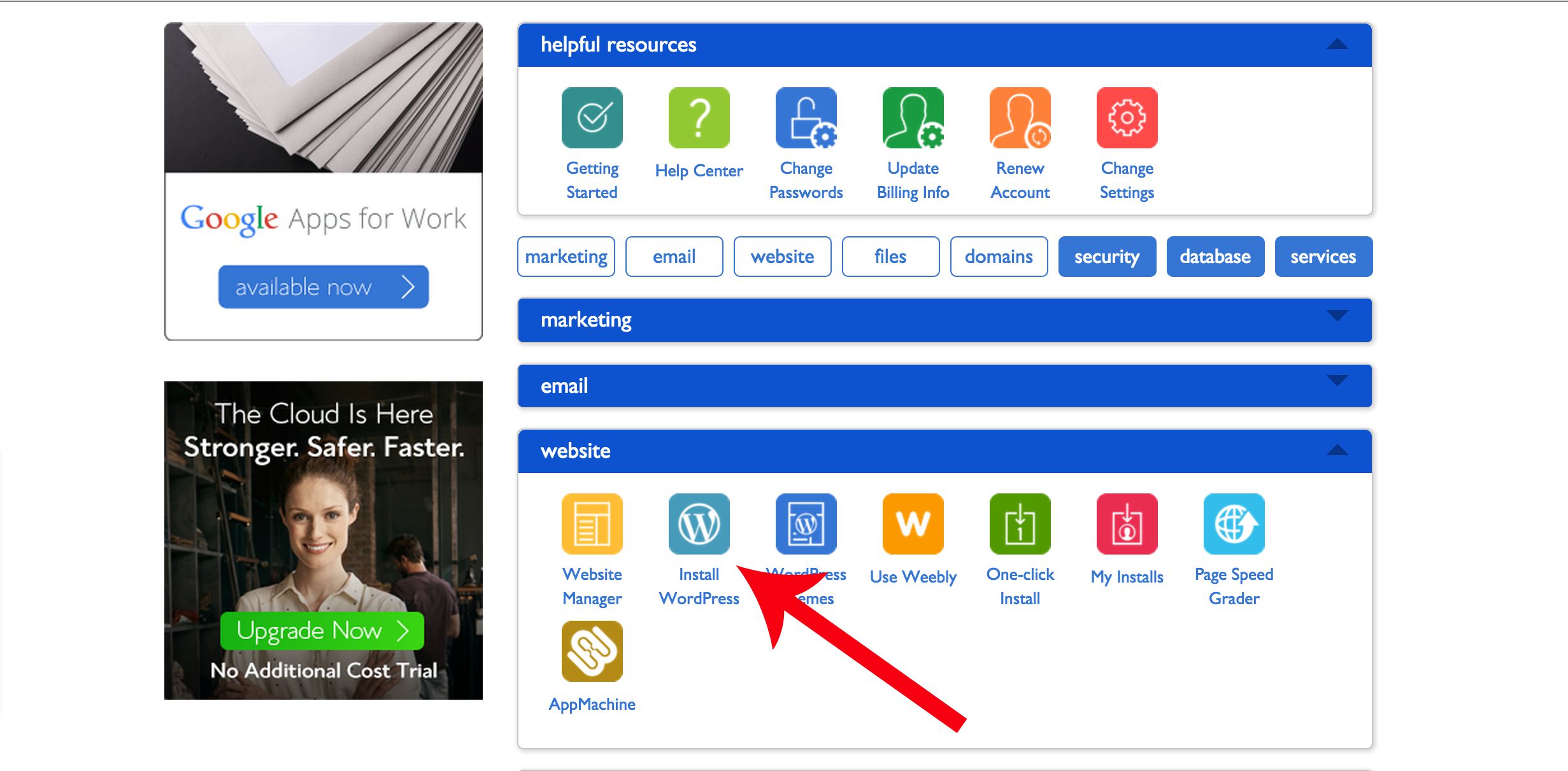
  • Login to Bluehost, and you’ll be taken to your Bluehost dashboard.

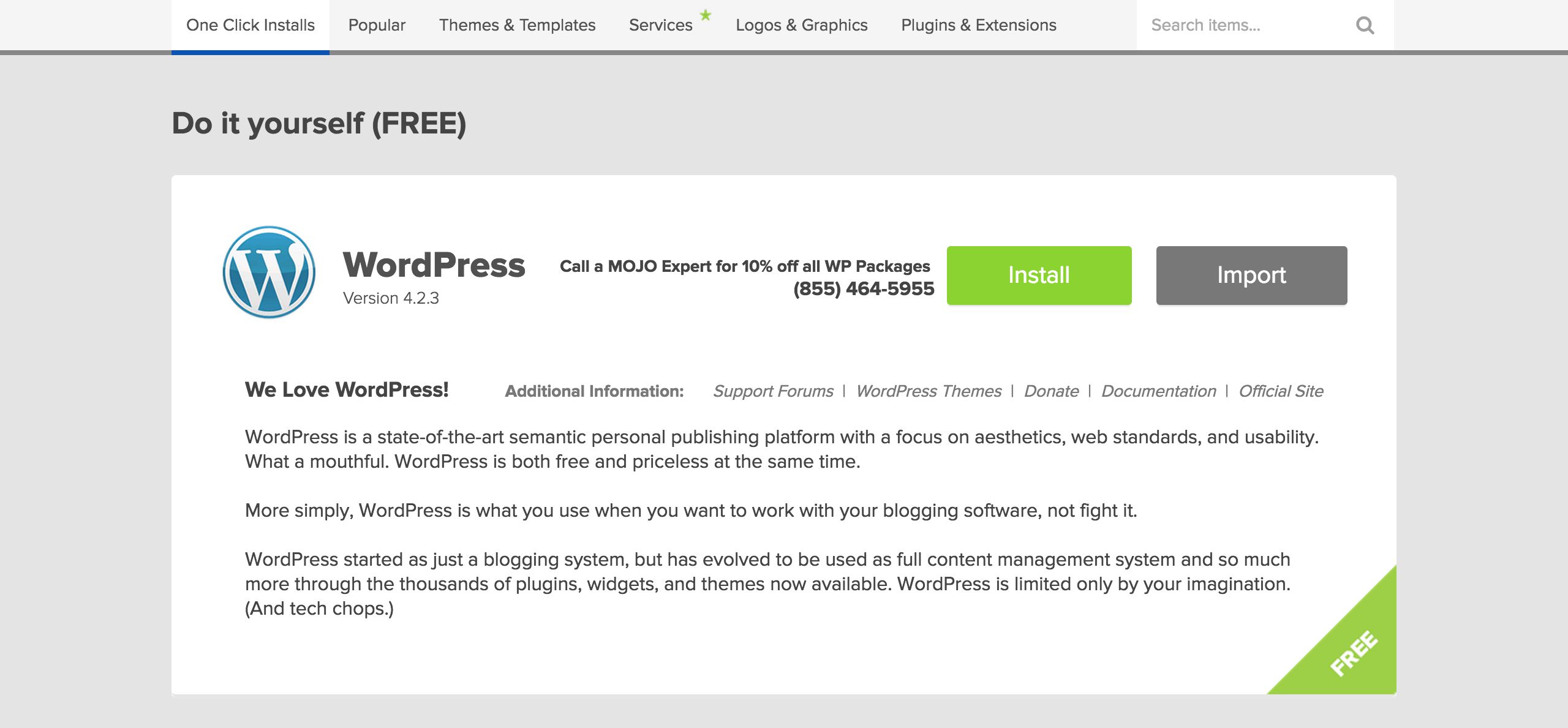
  • Here, you can install WordPress by double-clicking on ‘Install WordPress’…

Bluehost Install WP

Step #7:

  • Click the the green Install button…

Bluehost Install WP Step2

Step #8:

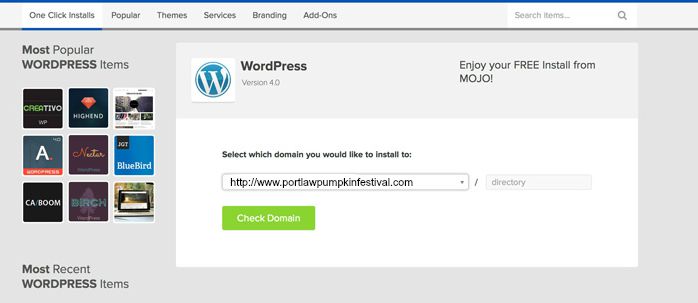
  • Choose the domain you registered or the one you transferred…

Bluehost Choose Domain

Step #9:

  • Check the ‘Show advanced options’ box.

  • Fill in the title, username, and password. Your title will be the name of your website (mine would be economicrockstar). The username and password will be what you use to login to the backend of your website (your WordPress dashboard).

IMPORTANT: Save this information somewhere where you won’t lose it. You will need it for step #11

step9

Step #10:

  • Bluehost will install WordPress on your server and let you know when it’s complete…

step10a

  • Click the ‘View Credentials’ button on the top right…

step10b

Step #11:

  • Click on ‘Admin URL’ (located below the green box) and enter your WordPress login credentials from step #9. This will take you to your WordPress dashboard. Your WordPress dashboard is where you will do almost everything on your blog. From writing articles to changing design…

Step11

Congratulations! You’re ready to rock your content!

Bluehost Affiliate Link

Disclosure:

The link above is an affiliate link which means that if you choose to make a purchase, I will earn a commission. This commission comes at no additional cost to you. Please understand that I have experience with Bluehost, and I recommend them because they are helpful and useful, not because of the small commissions I make if you decide to buy something. Please do not spend any money on these products unless you feel you need them or that they will help you achieve your goals.


  • facebook
  • linkedin
  • twitter
  • google+
  • pinterest

How to Calculate Statistics Using Excel

July 30, 2015 by Frank

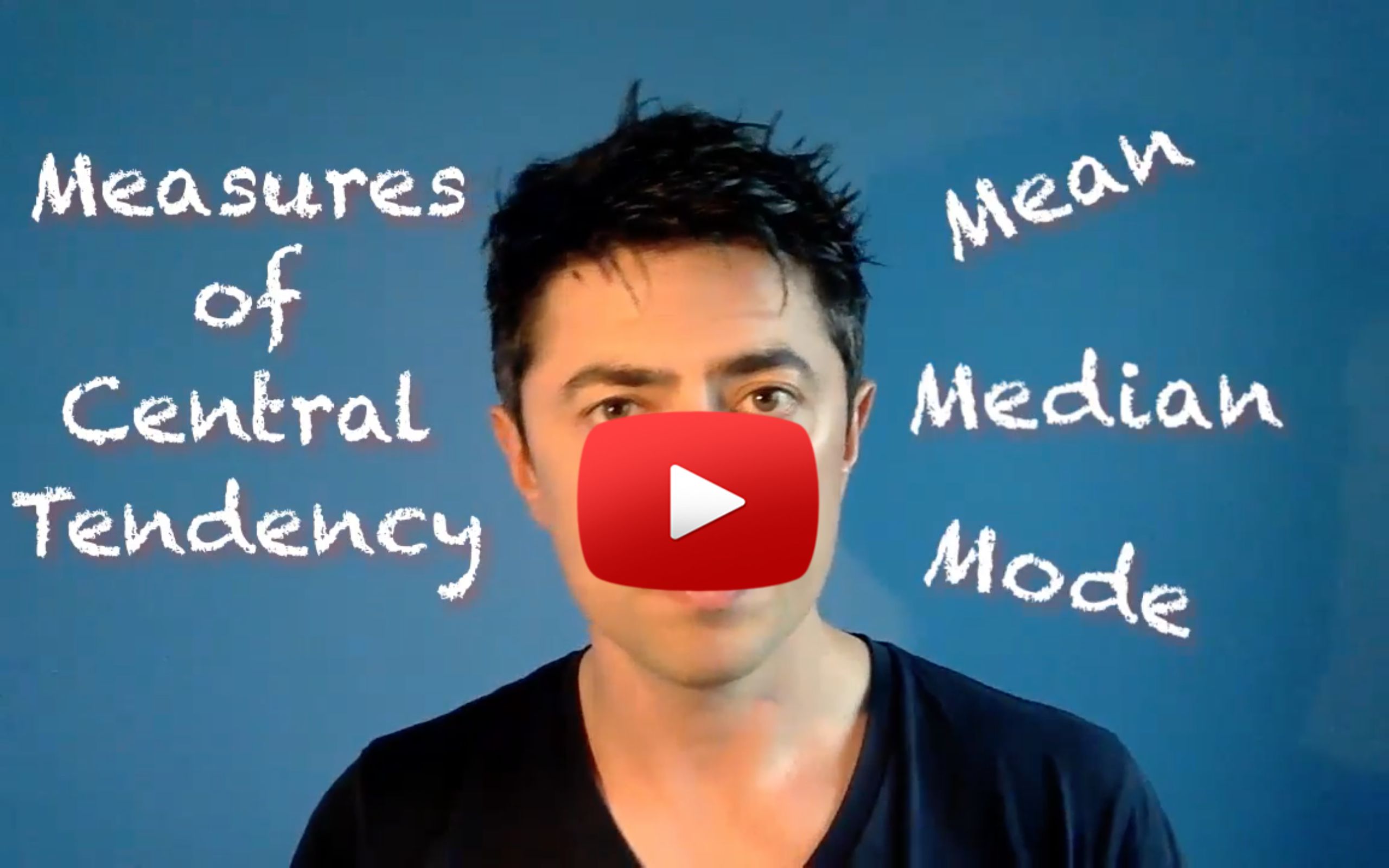
If you’ve just stumbled across this post, please feel free to download the PDF of Measures of Central Tendency and Dispersion. This will go great with the video series on YouTube and I hope you learn a lot from them.

Here’s one to get you started:

Thumbnail Vid 010a

Thanks for watching the ‘How to’ video series on statistics on my YouTube channel. I’ll be adding more content so why not subscribe to the Economic Rockstar channel on YouTube to get notified of any new video release.

Here’s a list of short ‘how to’ videos on statistics that you can watch right now:

►Simple Linear Regression Part 1

►Simple Linear Regression Part 2

►Simple Linear Regression Part 3

►Simple Linear Regression Part 4

►Calculation of Simple linear Regression Part 5

►How to Calculate the Correlation Coefficient

►How to Forecast using Time Series Analysis

►How to Calculate the Mean and Standard Deviation for a Data Set (Using Excel)

►How to Calculate the Mean, Median, Mode and Standard Deviation for a Data Set (Using Excel)

►How to Calculate the Mean Median and Mode for a Data Set Using Excel

►How to Calculate the Standard Deviation (formula) for a Data Set

  • facebook
  • linkedin
  • twitter
  • google+
  • pinterest

Conor McGregor is Homo Economicus: I’m Going To Whoop His Ass

January 18, 2015 by Frank

Conor McGregor is Homo Economicus: I’m Going To Whoop His Ass  

Conor-McGregor Colm O'Connor

Graphic Design and Illustration by Colm O’Connor www.colmoconnor.com

The Notorious Conor McGregor is one of Mixed Martial Arts (MMA) foremost fighters today. He has come from a life of obscurity to UFCs most feared and respected cage fighter today. What will McGregor do to take the UFC title from Jose Aldo? Is McGregor unstoppable? Will McGregor take down everyone in his path to this title? Is McGregor so focused on the prize that he cares less about how much damage he will do to others? Conor McGregor is Homo Economicus.

Is Conor McGregor the Perfect Example of Homo Economicus?

Economics is a social science and the Greek scholar Hesiod (700 – 650 BC) is considered to be first economist when he wrote about scarcity and resources: “…through work men grow rich in flocks and substance…” The term ‘Homo Economicus’ is the central theme to which the study of modern economics has evolved, and is considered to be first mentioned in the 19th Century works of J.S. Mills. Homo Economicus or Economic Man represents a rational person who aims to maximise their abilities in order to seek an optimal or best outcome. Such a rational person is considered self-interested and is destined to achieve their targeted aims irrespective of its undesirable effects on others.

So does McGregor fit Mills’ “arbitrary definition of man, as a being who inevitably does that by which he may obtain the greatest amount of necessaries, conveniences, and luxuries, with the smallest quantity of labour and physical self-denial with which they can be obtained”?

Let’s Get Rich

Is McGregor a rational, self-interested man with the sole determination of acquiring wealth or success without any heed for others and given the constraints that he faces? Yes! But only in the cage.

McGregor admits that money was never his objective when learning the art of fighting: “I’d rather be poor. I’d rather have no money and just be training than in a job I don’t love”. This attitude appears to defy the ideas behind Homo Economicus, but McGregor’s focus is in the octagon and not in the office. McGregor trains extremely hard, both physically and mentally, so that he is in the best shape possible for a fight. He’s aiming to maximise his strengths and abilities to win.

McGregor wants to make his riches doing what he is passionate about. “Competing is what I love to do and money is what I love to get”. He described his fight with Dennis Siver in Boston on January 18th, 2015 as “a keep fresh, get rich fight”.

Is he self-interested? When it comes to fighting, his focus is on winning. There is no room for cooperation and McGregor will achieve success irrespective of the undesirable effects on others.

  • McGregor visualized his Las Vegas fight with Dustin Poirier:

I believe that we will both come forward. I will crack him one or two. He will panic, he might rush in, I will crack him again, and then the fight will be done. I don’t believe he has many shots left in him and I don’t think he can take many of my shots. I will hurt him in the first couple of exchanges and then I will begin to play, to experiment. I am going to come out of the gates, spinning, flying through the air, and I will crack him with something that will put him down, and I believe it will be a first round stoppage.

  • Likewise, in a Q&A session for UFC178 in Las Vegas 2014, McGregor said what he’s prepared to do in order to win the Featherweight Title: “I will collect heads on the way to that goal… I will go over to Brazil as well and take out every man, woman and child to get that belt”.
  • In the same interview, McGregor mentioned that he didn’t like California and preferred his hometown, Dublin stating: “I’m over here conducting business, you know, and I don’t really care about anything else”.

McGregor shows all the characteristics that underpins the concept and ideals of Economic Man – someone who will fulfil a desired outcome irrespective of the undesirable effects on others.

Where to Find Conor McGregor:

  • Twitter: @TheNotoriousMMA
  • Facebook: The Notorious MMA

Frank Conway is the author of this post. To read other posts by Frank you can visit Economic Rockstar or listen to the podcast on iTunes.

  • facebook
  • linkedin
  • twitter
  • google+
  • pinterest

Protected: Bitcoins as Discussed by Bitcoin Girl, Naomi Brockwell, in Episode 009

December 4, 2014 by Frank

This content is password-protected. To view it, please enter the password below.

  • facebook
  • linkedin
  • twitter
  • google+
  • pinterest

Fundamental Analysis of Tesco and Facebook: A Case Study

October 25, 2014 by Frank

Fundamental Analysis:

Fundamental analysis is an approach used by some stock traders and stock market analysts to determine the valuation of a company or the stock market.  This is considered an important element in an analysts’ decision-making process as it is believed that such information can discern whether a stock or stock market is under or over-valued.

A recent webinar that I held in October 2014, titled “Using Fundamental Analysis in Stock Market Trading – Beta, P/E Ratio, Tobin’s q and More”, used Tesco and Facebook as a case study to determine whether these stocks would be considered a buying, selling or shorting opportunity. Fundamental analysis examined during this Tesco and Facebook case study were the price-earnings ratio, earnings per share, Tobin’s q, beta and some financial ratios.

Price-Earnings Ratio:

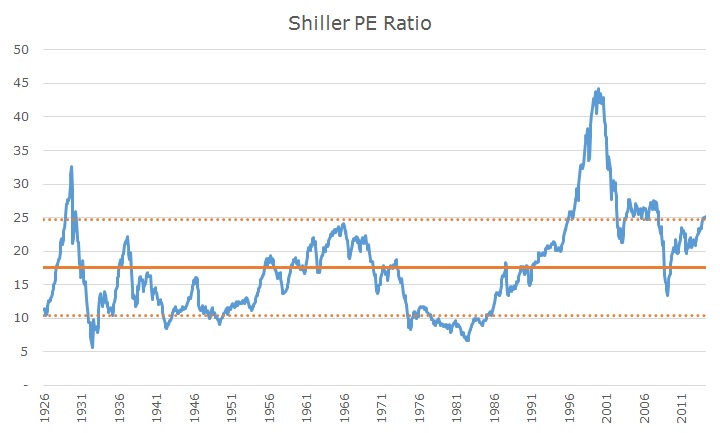
Shiller CAPE: 1926 - 2014

Source: Robert J. Shiller

The price-earnings ratio, or PE ratio for short, is a common value indicator, where a company’s share price is divided by its earnings per share (EPS). The PE ratio informs the investor of the number of years it will take to return each dollar invested, or alternatively it signals to the market the number of dollars an investor is willing to pay for $1 of earnings.

The PE ratio is found to have a historical average of approximately 16. Therefore, any number above this would be considered an over-valuation, while a number less than this is an under-valuation. However, problems arise if a company has negative earnings (the PE can only be interpreted when positive) or where the EPS is so small or almost zero (the PE becomes so large and irrelevant).

Robert J. Shiller and CAPE:

Yale economist and Nobel Laureate, Robert J. Shiller, developed the cyclically-adjusted PE [CAPE] to counter these problems by averaging 10 quarterly earnings. The possibility of a negative eps is removed. Shiller found the CAPE to average 17.5 over the period 1926 to 2014 for the S&P500 (see diagram 1 below).  CAPE was approximately 45 in 2001, which hugely over-valued the stock market , resulting in a stock market crash (see diagram 2). Shiller had warned of this impending crash for a number of years leading to this crash. This highlights another notable weakness of the PE ratio – it is not considered a good timing device, i.e. the ratio will fail to inform the trader of the optimal time to exit or enter the trade.

Tesco’s PE Ratio

Using advfn.com initially, it was found that the stock price of Tesco was 171 pence and its EPS was 12.07 pence, resulting in a PE ratio of 14.17.  This is quite a reasonable number and shouldn’t be of any concern.  However, events unfolded recently whereby Tesco failed to give an accurate account of its earnings and failed to inform investors of its performance. A look at Yahoo Finance seems to give an updated version of events, quoting the EPS at 0.12 pence – a significant difference to the 12.07 pence quoted by advfn.com. Based on the price of 171 pence, the PE ratio is 1413.22 (1425 based on my own calculations). This is way too high, and in order for the PE ratio to reflect the historical benchmark of 17.5, Tesco shares must collapse to 2.1 pence – a penny stock – to reflect the low EPS of 0.12 pence! Alternatively, the EPS must increase significantly to reflect the ‘justified’ price of 171 pence. This, however, is unlikely and, subsequently, the PE ratio becomes inconsequential and unreliable.

Facebook’s PE Ratio

Again, using advfn.com, Facebook’s PE ratio is an astonishing 124.1 based on the EPS of 0.62 cents and a share price of $80.18 (the PE ratio is found to be 129.32, but there may have been a time delay in updating the PE on advfn). Again, like our PE analysis of Tesco above, Facebook’ PE ratio is somewhat different to that quoted by Yahoo Finance. Based on an EPS of 0.94 and a share price of $80.04, the PE ratio is found to be 85.14, again indicating an over-valued company in terms of its stock price. Are investors willing to pay $85 for every $1 earned by Facebook? Not me! So, according to this valuation measure, Facebook is a sell. But remember, the PE ratio is not a good timing device, so shares could continue to increase for some time to come.

Confusion Over Differences in PE Ratios for the Same Stock

You may have noticed differences in the PE ratio as quoted by advfn.com and by Yahoo Finance. Ultimately, this boils down to the EPS quoted by each, since the stock price is commonly quoted. There is confusion as to what type of earnings a company should declare when releasing its results – GAAP or non-GAAP earnings? Likewise, there are differences in how analysts use earnings. Some quote actual earnings while others quote expected future earnings. There is no standard, and perhaps the SEC and others should create a standard practice.

Tobin’s q

Tobin’s q, another valuation measure, was developed by the late Nobel Laureate James Tobin, also another Yale economist.  He hypothesised that the market value of a stock should be equal to the replacement value of its assets, i.e. the stock price multiplied by the shares issues (i.e. market capitalisation) should have the same value as the assets of that company. Therefore, Tobin’s q has a theoretical value of 1.0 and any q value above this would indicate the stock price to be too high relative to the company’s assets.  Consequently, the share price should fall until the q ratio reverts back to unity. A q ratio below 1.0 indicates an under-valued company in terms of its market value, or more specifically, its share price. The stock price should rise as a result.

Again, using advfn.com, the Tobin’s q ratio for Tesco is 0.28. This is significantly low, suggesting that the company is considerably under-valued. The replacement value of Tesco’s assets are more than the market value of the company. In conclusion, based on this observation, Tesco’s recent share price plunge is unjustified. If Tesco were to sell off all its assets – both tangible and intangible – it would receive more that its market value as reflected in the share price of 171 pence.

PE Ratio and Tobin’s q for Tesco Are Incoherent

Tesco logoIt appears that both ratios are giving a conflicting message – the PE ratio of 1413.22 is over-valuing the company, whereas Tobin’s q is under-valuing the company. During the webinar (7:07 minutes into the discussion), I highlighted that both the PE ratio and Tobin’s q are correlated, meaning that they would typically be agreeable in terms of their conclusion. However, due to this disjointed interpretation and conclusion about whether Tesco should be a sell or short (according to the PE ratio) or a buy (according to Tobin’s q), it may be wise to consider other fundamentals such as the dividend yield, the beta coefficient and some financial ratios.

Understanding Facebook’s Tobin’s q

Facebook’s Tobin q is quoted at 11.43, indicating that the company is significantly over-valued. This confirms the PE over-valuation. The q of 11.43 suggests that the market value of Facebook far exceeds the replacement cost of its assets, i.e. if Facebook were to sell off its assets today, it would fail to match the market capitalisation of the firm. Facebook, being a tech company, does not have the physical or tangible assets of other companies like Tesco or Ford. However, the market values Facebook more than these and many other companies. Is the price of Facebook sustainable? According to Tobin’s q – No. However, further analysis of financial ratios indicate that Facebook is cash rich and is a low geared company. This is the complete opposite to Tesco.

Dividend Yield

The dividend yield is the amount of cash flow the investor receives from a company for every dollar invested in that company’s stock.  Tesco pays a dividend but Facebook does not. It can be argued that a company should retain its earnings and use the cash flow to invest in current and future projects. This will benefit the company and long-term investors as there is a growth and expansion expectation for the company, which may correlate with stock price appreciation. Investors, particularly value investors, prefer to invest in high dividend yielding stocks as they receive a return plus a possible equity gain.

Tesco Pays a Dividend But Facebook Does Not

Tesco paid an annual dividend yield of 8.63% based on the previous fiscal year dividends of 14.83 pence and the current share price of 171 pence (14.83/171). This appears to be a high yielding stock and great news for investors. However, since the tumultuous turn of events recently, interim dividends on October 23, are 1.16 pence – down from the previous interim dividend of 4.63 pence. As a crude estimation for full year dividend payments (in order to estimate the yield, I have assumed a final dividend of approximately 3 pence, resulting in a yield of 2.4% (total dividend of 4.16 divided by current share price). This seems realistic than the 8.63% yield. Since Facebook does not pay a dividend, it may be difficult to justify a buy or sell recommendation. It is not uncommon for company’s not to pay a dividend.

Beta

The beta of a stock signals the risk potential of the stock relative to the overall stock market. It is typically used by analysts or investors to match the risk profile of an investor with a stock. For example, traders and investors are not homogenous and their risk profiles differ. Some are risk averse, while others are more risk tolerant. Typically, the beta of a stock market or a large portfolio of shares has a value of 1.0. A company that has a beta below 1.0 is considered less risky and would suit risk averse investors, while a beta greater than 1.0 is a riskier investment. For example, a company with a beta of 1.4 will, on average, return 1.4% if the market returns 1.0%. The beta coefficient can be calculated by means of regression analysis, something I will demonstrate in the near future. The one criticism that I have about the beta coefficient is that it is based on historical data and is not indicative of the future risk profile of the company.

Tesco and Facebook are Low-Risk According to Their Beta

Tesco’s beta is 0.74 according to advfn.com, which indicates that Tesco is a low-risk investment (but N/A on Yahoo Finance). However, recent events has shown otherwise, hence my criticsm.  Facebook’s beta is 0.8 on Yahoo Finance also indicating a relative low-risk investment. Given thFacebooke high PE value for Facebook, I certainly would believe that this company is over-valued and I am personally surprised by its low beta value.

I speculate that the share price of Facebook has remained quite vigilant during recent stock market volatility. This is possibly due to the large shareholding that CEO and founder Mark Zuckerberg has, as well as the possible emotional attachment or herding behavior that some shareholders have in retaining their shares. This may have liquidity effects on share volume, as well as having net buyers in the market. This results in more stability in prices relative to the market or a continuation in share price increases. Confusing, right? But remember, I do speculate in explaining why Facebook’s PE is high but it’s share price continues to defy this over-valuation.

Financial Ratios

In the webinar, I briefly reviewed some common financial ratios for both companies, namely the current ratio and the acid test ratio.  A company is considered to have a healthy balance sheet if its Current ratio has a value of 2:1 and an Acid Test Ratio of 1:1, meaning that its assets can cover its liabilities. Tesco, however, has an extremely worrying Current Ratio of 0.84, whereas Facebook has an almost unheard of Current Ratio of 11.8.  Likewise, the Acid Test Ratio for both are 0.7 and 10.4. Tesco is considered an ‘unhealthy’ company, while Facebook has assets that more than covers its liabilities. Based on this alone, Tesco is a sell recommendation but Facebook should make its current investors quite happy.

A bar chart summarising Tesco’s Balance Sheet can be found at 11 minutes and 52 seconds into the webinar, while the same can be found for Facebook at 43 minutes and 26 seconds into the webinar. The ‘yellow’ shaded area in both bar charts indicate ‘Total Equity’ (on the left) and ‘Cash & Equivalents’ (on the right). Both companies significantly differ. Tesco’s ‘yellow’ areas are dwarfed by those of Facebook, meaning that Tesco is a highly geared company (more debt) and has very little cash, which is tied up in its fixed assets, debtors and stock. This is the nature of the type of business that Tesco finds itself in – it needs physical stores to sell its stock whereas Facebook’s business model is an online presence. Tobin’s q valuation of both companies could possibly be justified based on the assets of both companies.

Summary

On reflection, Tesco is a troubled company and its expansion plans into the Far East, as well as new markets such as insurance, telecoms and personal finance may have cost them dearly. They have lost market share in the retail space to German chains Aldi and Lidl. To meet debt obligations and fund current activities, Tesco may have to sell off some of its assets or perhaps a business arm, such as its banking operations. Since the market is undervaluing its shares according to Tobin’s q, this perhaps is a viable time to sell. The PE ratio can, in this case, be ignored and an investor looking to Tesco’s beta for an indication of a ‘safe bet’ can also ignore it as it places too much emphasis on historical returns relative to the market.

A question posed by an attendee during this webinar, Cristina Chase, asked if Warren Buffet had an effect on the current share price of Tesco due to his announcement of share selling. Reviewing the charts for Tesco, it was noted that the stock ‘gapped’ downward on two occasions possbly coinciding with his sell-off.

Another attendee, Lee Rock asked were Tesco and Facebook a buy or sell. To answer this, I reviewed the price chart patterns of both (technical analysis) to support the claims of the fundamental analysis discussed above. Tesco, has been trending downward since October 2013 but currently I noticed a double bottom formation at the 171 pence level for October 23, 2014. This double or, possibly, triple bottom could signal a reversal of the trend, particularly when the relative strength index is rising (for more on this and other technical trading indicators, please click here).

These indicators, together with Tobin’s q, suggest a buying opportunity. However, caution beckons in the near-term future for Tesco in dealing with the headwinds it faces. Regarding Facebook, the technical indicators is showing a drop in the price into a new trending pattern. The price of $80 is a critical resistance level and if Facebook fails to break above and settle above this level then the price could fall further. Both the PE ratio and Tobin’s q indicate an over-valuation of Facebook, therefore a sell recommendation. However, as stated above, Facebook is cash-rich and, coupled with the large equity holding of a few key personnel, the stock price may be supported at this high price.

If you would like to comment below, I would really appreciate it. Let me know of your opinions and suggestions and I will respond. For more posts like this, please visit www.economicrockstar.com or subscribe to our podcast on iTunes.

toto togel situs togel situs toto situs toto situs toto situs toto situs toto toto slot situs toto situs togel situs toto slot gacor situs toto situs togel situs toto situs toto situs togel situs toto pam4d situs toto pam4d gimbal4d pam4d gimbal4d sangkarbet sangkarbet pam4d toto slot
  • facebook
  • linkedin
  • twitter
  • google+
  • pinterest

Frank Conway

Frank Conway is founder of Economic Rockstar and lecturer of economics, finance and statistics. Read More…

View My Blog Posts

Youtube Sub

Become a Patron of the Economic Rockstar Podcast

patreon

Ireland’s Economy by the Numbers

Leaving Cert Economics: Ireland’s Economy  Click here to download a workbook on Ireland’s Economy so that you can add your own notes. [Original size] Ireland’s Economy by fconway

Categories

Subscribe and Never Miss An Episode

itunes-logo

Recent Posts

  • Ireland’s Economy by the Numbers April 8, 2019
  • 174: Wendy Carlin on The Core Project, Capitalism, Democracy and Normative Statements February 13, 2019
  • 173: Stephen Wright on Core Econ as a Learning Resource for Mainstream Economics January 28, 2019
  • 172: Best of 2018 Part 2: From the Great Depression to Futurism; Institutions, Individualism, Cooperation and Reciprocity January 22, 2019
  • 171: Best of 2018 Part 1 January 3, 2019

Copyright © 2026 · Podcast Pro Theme on Genesis Framework · WordPress · Log in

This website uses cookies to improve your experience. We'll assume you're ok with this, but you can opt-out if you wish. Accept Reject Read More
Privacy Policy

Privacy Overview

This website uses cookies to improve your experience while you navigate through the website. Out of these, the cookies that are categorized as necessary are stored on your browser as they are essential for the working of basic functionalities of the website. We also use third-party cookies that help us analyze and understand how you use this website. These cookies will be stored in your browser only with your consent. You also have the option to opt-out of these cookies. But opting out of some of these cookies may affect your browsing experience.
Necessary
Always Enabled
Necessary cookies are absolutely essential for the website to function properly. This category only includes cookies that ensures basic functionalities and security features of the website. These cookies do not store any personal information.
Non-necessary
Any cookies that may not be particularly necessary for the website to function and is used specifically to collect user personal data via analytics, ads, other embedded contents are termed as non-necessary cookies. It is mandatory to procure user consent prior to running these cookies on your website.
SAVE & ACCEPT