• ABOUT
  • RESOURCES
  • PODCAST
  • BOOKS
  • BLOG
  • SUPPORTERS
  • QFA Financial Advice
  • CONTACT

Economic Rockstar

Connecting Brilliant Minds in Economics and Finance

080: Will Australia’s Property Market and Economy Go Down Under? An Episode Featuring Steve Keen
April 10, 2016 by Frank

http://traffic.libsyn.com/economicrockstar/080_Australia_and_Steve_Keen.mp3
Play in New WindowDownload

080:  Will Australia’s Property Market and Economy Go Down Under? An Episode Featuring Steve Keen

1

This weeks episode of the Economic Rockstar podcast features the Australian economy. There is talk amongst economists, analysts and commentators, be it speculative or not, that the Australian economy or it’s housing market will implode within the next 12 to 18 months. I am joined with Professor Steve Keen who explains why the property market in Australia will crash, taking its economy down with it.

Given the nature of this podcast, I cannot ignore the discussion that is taking place on what’s going on with the  Australian economy. To be honest, a listener to this podcast who is living in Australia contacted me on what’s going on there, and he and his friends are taking precautions in the event of a collapse in house prices. I also have Irish friends who emigrated to Australia once the financial crisis hit. These young men travelled from Ireland to Australia and know, with first-hand experience, how an economy and housing market performs prior to a crash. They, like others, are tuned into events that lead to a bursting of a bubble. Doubters and cynics may claim that this is an unscientific approach to analysing the market, but shouldn’t we also consider non-numeric data in the form of intuition and gut-instinct?

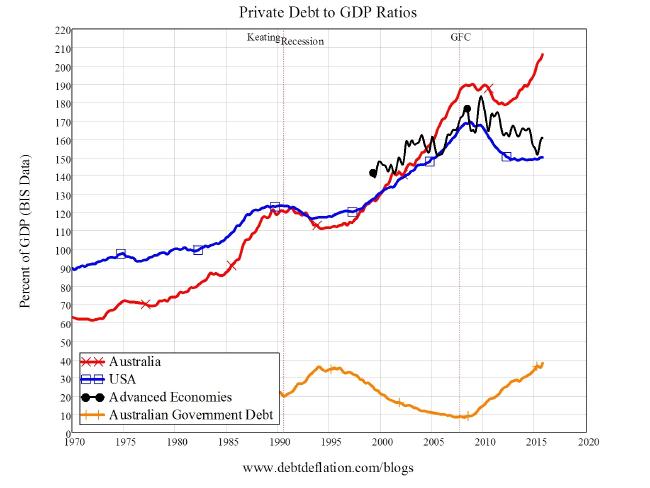
Economic data is also available today that supports the claim that the Australian housing market is on the brink of collapse. Australia’s private debt to GDP is currently at 210%, the highest in its history. Such high ratios were experienced by other developed economies prior to the Great Financial Crisis which pushed them into recession following a property market crash. Is Australia different? Australia is most definitely not immune to such crashes.

Did you know that house prices plunged 30 percent or more in NSW and Victoria in the 1890s and 1930s — the biggest such reversals in Australia’s history — the result was bank collapses and mass unemployment. Could this be repeated?

So a question I’d like to pose would be ‘What’s worse? Carrying out a pre-mortem or a post-mortem. Both can have very damaging repercussions for an individual if decision-making was wrong. A pre-mortem forces someone to take a contrarian view of the economy. They can then write up a checklist of possible events that could materialize and the actions that need to be taken today to assure a minimum negative impact.

Can a person’s pre-mortem be evidence of over-confidence or can it be a deep-rooted intuitive reading of all the vital signs that are indicating something sinister that had once played out before? After-all, many economies have experienced busts and housing market crashes. No country is immune to these events. What precipitates a housing crisis has been explained on numerous occasions in the economic literature, albeit for different time periods, economic cycles and, dare I say, personal viewpoints and data collection methods.

So, should we ignore the intuition and gut instinct of those in tune with the development of an economy and its actors? Is Australia different to other economies? After all, Australia hasn’t experienced a recession since 1991 – 25 years ago!

Should we ignore or heed the warnings of the naysayers? Can intuition be considered a valid barometer to understanding how events are likely to unfold in an economy?

Nobel laureate Danial Kahneman who, in an interview with McKinsey and Company, considered the intuition of professionals in the decision-making process. Kahneman stated that:

There are some conditions where you have to trust your intuition. When you are under time pressure for a decision, you need to follow intuition. My general view, though, would be that you should not take your intuitions at face value. Overconfidence is a powerful source of illusions, primarily determined by the quality and coherence of the story that you can construct, not by its validity. If people can construct a simple and coherent story, they will feel confident regardless of how well grounded it is in reality.

Despite this statement being considered under a different context, it could easily be applied to the economy since professionals are a subset of the population and their decisions can impact the local and wider economy.

Let’s break this statement down.

Kahneman states that “When you are under time pressure for a decision, you need to follow intuition.” In an economy or a housing market that is performing so well like Australia today, time doesn’t play a central role for the majority of those involved in the decision-making process. Of course, well-timed investments can be the difference between a gain and a loss.

Typically, in good times, people can become blind-sided and focus on the positive news. The economy will continue on as it has always done. The housing market will continue performing strongly and it will always be a good time to buy property. When you’re in the thick of it, the good times keep rolling. You want to participate in any market whose assets are experiencing capital appreciation. The majority of people make decisions based on past performance. The housing market in Australia has grown to unprecedented yet worrying levels.

Any negative news or commentary is largely dismissed and the bearers of the bad news are typically criticised and vilified. Humans have the ability to forget their past failings and fallibilities and repeatedly make the same mistakes over and over again. Economic history shows us the misconceptions and judgemental errors made by humans from Tulip Mania to the South Sea Bubble and the dot-com crash. If the housing market was to implode in Australia, time would become the main focus as people will rush to the exits. Housing is not as liquid as stocks or cash and a housing crash will be the result.

Participants in the Australian housing market are accumulating dangerous levels of private debt, never seen before in its history. Private household debt now stands at 210% of GDP. This is an unhealthy level for any economy to be in and one that was highlighted by Professor Steve Keen in his blog debtdeflation.com and his book Debunking Economics. Professor Keen warned of the risks to many economies and their housing market prior to the Great Financial Crisis.
Private Debt to GDP Steve Keen Economic Rockstar

Australia’s Private Debt to GDP Ratio as Calculated by Professor Steve Keen

He also warned about Australia’s economy at the time but Australia avoided a recession. Policy initiatives at the time, as well as the availability of credit, rising commodity prices (of which Australia benefits from), a demand for housing stock from mainland China and an appetite for risk to avail of the speculative gains being made in an accelerating property market has resulted in Australia being different to other economies.

Australia is the darling economy and a perceived role model on how to maintain economic growth. These positives led to immigration rising as a demand for employment increased. And as we know, when jobs are created, income levels rise feeding the demand for goods and services. Eventually, confidence rises and speculative purchases are made. When the desired expectations to these speculative purchases come to fruition, then people become overconfident.

As Kahneman stated earlier, “Overconfidence is a powerful source of illusions, primarily determined by the quality and coherence of the story that you can construct, not by its validity. If people can construct a simple and coherent story, they will feel confident regardless of how well grounded it is in reality.”

RBA economist Peter Tulip last year suggested Australian housing could be as much as 30 percent undervalued. This type of commentary is not helpful in a market that is overheating and when participants or would-be buyers are excited about capital appreciation despite being negatively geared. This is definitely a new take on Tulip Mania!

The same economist, Peter Tulip, in a 2007 working paper for the OECD, wrote about how safe Iceland’s economy was and that it’s banking system was secure and stable, and that it’s housing market should be liberalised and opened up to competition.

Today, there are reports of being able to borrow 10 times your pre-tax income to purchase a property. This is not a healthy situation for anyone to be in, including banks.

What could be the catalyst to a housing market crash in Australia?

Australia has an active sub-prime mortgage market. Interest rates are low at 2% (yet they could go lower as we have seen elsewhere). Perhaps the Royal Bank of Australia isa keeping a 2% cushion in the event of implementing a loose monetary policy in the event of a crash. Unfortunately, this type of stimulus will not work as households will be required to pay down its debt and the economy could enter into a Japanese-style era of stagflation.

Australia is dependent heavily on its commodities, hence the dollar being know as a commodity currency.  There is a continuing drop in resource prices and commodity-dependent companies such as Rio and BHP are in trouble.

Banking shares have dropped and could be seen as ominous of what’s to come. Are there people in the know? Are they liquidating their holdings? Check out what happened to many of the leading US and European banking shares prior to October 2008 – the official start of the Great Financial Crisis. They were already on a downward trajectory.

Is China slowing down? The Chinese have also accumulated high levels of private debt and their private debt to GDP ratio is similarly high to Australia’s. If Chinese investment in the Australian property market stops, then the market could implode.

There is an overwhelming supply of apartments in Brisbane, Melbourne and Sydney. Many of these apartments lie vacant and buyers are expecting their negatively geared position to be offset by further capital appreciation. Also, immigrants have proven to be very mobile. When signs of a weakening economy materialise, they will emigrate leaving a slump in housing or rental demand. Owners will fail to meet repayments as the main source of their rental income will disappear.

Put simply, in the words of Professor Steve Keen, Australia’s housing market is a Ponzi scheme and those that got in first will be the winners while all of those who got in over the last few years will suffer.

Links:

  • www.debtdeflation.com/blog by Steve Keen
  • Get Ready for an Australian Recession by 2017 – Steve Keen
  • Strategic decisions: When can you trust your gut? McKinsey and Company interview with Daniel Kahneman and Gary Klein.
  • Tulip, P. (2007). Financial Markets in Iceland. OECD. Working Paper No. 549.
  • Fox, R. and Tulip, P. (2014). Is Housing Overvalued? Reserve Bank of Australia.

Books:

  • Debunking Economics by Steve Keen

http://traffic.libsyn.com/economicrockstar/080_Australia_and_Steve_Keen.mp3

Podcast: Play in new window | Download

  • facebook
  • linkedin
  • twitter
  • google+
  • pinterest

069: Diane Coyle on GDP, Its Shortcomings and Alternative Measures

January 21, 2016 by Frank

http://traffic.libsyn.com/economicrockstar/069_Diane_Coyle.mp3
Play in New WindowDownload

069: Diane Coyle on GDP, Its Shortcomings and Alternative Measures

Diane Coyle is Professor of Economics at the University of Manchester and runs the consultancy Enlightenment Economics.diane coyle

Diane is Vice-Chair of the BBC Trust and was a member of the Migration Advisory Committee and a member of the Competition Commission. She is also a visiting research associate at the University of Oxford’s Smith School of Enterprise and the Environment. 

Diane specialises in competition analysis and the economics of new technologies and globalisation.

Diane is the author of several books, including GDP: A Brief But Affectionate History, The Economics of Enough, The Soulful Science, Sex, Drugs and Economics and Paradoxes of Prosperity.

She was previously Economics Editor of The Independent and before that worked at the Treasury and in the private sector as an economist.

Diane has a PhD from Harvard and was awarded the OBE in January 2009.

Using happiness is an excuse for inactivity – Diane Coyle

Click To Tweet

Influencers:

Peter Sinclair (University of Birmingham) and Ben Friedman (Harvard).

Economists:

In this interview, Diane mentions: Adam Smith, John Stuart Mill, Sir Charles Bean, Daron Acemoglu, Thomas Piketty, John McMillan, Tim Harford, Peter Sinclair (University of Birmingham) and Ben Friedman (Harvard).

Economics:

In this interview, Diane mentions: GDP, budget deficit, fiscal policy, monetary policy, interest rates, growth, employment, unemployment, Human Development Index, Gross National Happiness Index, happiness, hysteresis, inequality, financial markets, derivatives and leverage.

In this episode you will learn:

  • what is GDP and how it is measured.
  • the complications with understanding the meaning of GDP.
  • the historical origins of GDP and why it is used to measure our economy.
  • the complications in measuring GDP.
  • how GDP data is still collected in such an ‘old-fashioned’ way and the new methods to collecting data.
  • about the uncertainty and margin of error in GDP statistics.
  • why it is wrong to make fiscal policy, monetary policy and interest rate decisions on GDP statistics.
  • what proxy variables were used to measure economic activity before GDP was introduced.
  • why we should re-think the meaning of the economy.
  • why GDP today doesn’t work in its present form and if there is an alternative.
  • how countries can use GDP and GNP measures to portray different economic conditions.
  • the difference between GDP and GNP.
  • the concerning use of ‘administrative statistics’ by countries to falsify economic growth.
  • whether it’s correct to include illegal drug activity and prostitution in measuring GDP.
  • why measuring happiness and well-being should be of little importance when measuring GDP.
  • why Diane is sceptical about the Happiness Index.
  • the reason why economics was coined by Thomas Carlyle as the the ‘dismal science’.
  • who is to blame for the financial crisis of 2007/2008.
  • about the UK’s over-reliance on the financial sector and its role in measuring GDP.
  • about the uncertainty that would exist if the UK withdrew from the EU.
  • the policy factors required to create a sustainable society and a stable government.


It’s just so easy now to download data from the internet and run through statistical packages and get some results. And I think a lot of professional economists are guilty of not rethinking about their data enough – Diane Coyle

You cannot think about the economy mechanically – Diane Coyle

Click To Tweet

The way we measure GDP now is really closely linked to Keynesian macroeconomic theory and a very famous definition he gave of  what total output in the economy is, that it’s consumer spending, government spending, investment spending and the balance of payments – Diane Coyle

There is no benefit for society in a lot of what happens in the financial markets – Diane Coyle

Click To Tweet

Resources:

  • The Enlightenment Economist
  • Doomsday Book  – Earliest recording of economic activity.
  • Time to ditch GDP as a measure of economic well-being by Diane Coyle 
  • The Review of Economics and Statistics

Favorite Internet Resource:

  • Twitter

If you pick the right people to follow it acts as a brilliant editor of all the interesting information that you might want to know and it’s like having a personalised newspaper – Diane Coyle

Books:

  • GDP: A Brief But Affectionate History by Diane Coyle
  • The Soulful Science: What Economists Really Do and Why It Matters by Diane Coyle
  • The Economics of Enough: How to Run the Economy as If the Future Matters by Diane Coyle
  • Sex, Drugs and Economics: An Unconventional Introduction to Economics by Diane Coyle
  • Paradoxes of Prosperity: Why the New Capitalism Benefits All by Diane Coyle
  • Reinventing the Bazaar: A natural History of Markets by John McMillan
  • The Undercover Economist by Tim Harford
  • The Undercover Economist Strikes Back: How to Run or Ruin an Economy by Tim Harford


http://traffic.libsyn.com/economicrockstar/069_Diane_Coyle.mp3

Podcast: Play in new window | Download
  • facebook
  • linkedin
  • twitter
  • google+
  • pinterest

058: Morten Jerven on Poor Numbers and Why Economists Get It Wrong With Africa

November 11, 2015 by Frank

http://traffic.libsyn.com/economicrockstar/058_Morten_Jerven_Final.mp3
Play in New WindowDownload

058: Morten Jerven on Poor Numbers and Why Economists Get It Wrong With Africa

Morton Jerven is Professor of Economic History and Development at the School for International Studies at Simon Fraser University in Vancouver, Canada.

In 2014, Morton was appointed Associate Professor in Global Change and International Relations at Noragrica at the Norwegian University of Life Sciences.

Morton has published widely on African economic development, and particularly on patterns of economic growth and on economic development statistics.

Upon the release of his book, Poor Numbers: How We Are Misled by African Development Statistics and What to Do about It, Morton caused uproar across Africa and had been expelled from two conferences. His latest book Africa: Why Economists Get It Wrong is now available on Amazon.

Morton is an economic historian, with an MSc and PhD from the London School of Economics.

Economics:

In this interview, Morten mentions: capital markets, sovereign bonds, National Income Statistics, GDP, demographics, wages, rents, profits, consumption, investment, exports, imports, population growth, m-pesa, debt-to-GDP ratio, poverty and GDP per capita.

Economists:

In this interview, Morten mentions: Jonathan Temple, Stephen Durlauf, Simon Johnson, Shanta Deverajan, Neil Fantom (World Bank) and Wolfgang Stolper.

In this episode you will learn:

  • why Morten was expelled from two conferences in Africa.
  • about the knowledge problem that exists in economic statistical data.
  • if economic statistics is underfunded relative to other social sciences.
  • whether economic data from African countries is intentionally misleading or if it’s a methodology and availability problem.
  • what is GDP and why is it used.
  • the problems with measuring GDP.
  • why the production approach is really the only valid method to measuring GDP.
  • why a country’s GDP is estimate by proxy and how productivity data is difficult to collect.
  • how population growth is used as a proxy for GDP.
  • whether we should allow Google and other companies that store big data to provide economic data.
  • whether cooperation or conflict between big data and official statistics will emerge.
  • how observing the brightness of countries from space is now being used to measure economic growth.
  • what the IMF does to missing data, such as GDP.
  • why Morten collected his own data for a number of African countries since the IMF wouldn’t share their own.
  • whether papers written by the IMF and the World Bank undergo a peer-review process.
  • how the ‘branding’ of statistics by the World Bank and the IMF can mislead the user.
  • how using the 3 methods of calculating GDP for all African countries shows significant differences when ranking each from poorest to wealthiest.

Quotes by Morten Jerven:

Statistics is the archetypal way of generalising from complex social realities to a very orderly aggregate picture – Morten Jerven

Make everything count. If you write something, make sure it’s going somewhere. If you prepare a lecture to speak about something, make sure you have an idea about how that can become a publishable unit – Morten Jerven

Make sure, as an academic working, it’s important not to think that working long hours is the key to being effective. Start writing early. It’s important – Morten Jerven

Organisations Mentioned in this Episode:

  • African Development Bank
  • IMF
  • World Bank
  • Centers for Disease Control and Prevention

Books:

  • Poor Numbers: How We Are Misled by African Development Statistics and What to Do About It by Morton Jerven
  • Africa: Why Economists Get It Wrong by Morton Jerven
  • How to Lie with Statistics by Darryl Huff
  • Handbook of Econometrics by Stephen Durlof and Jonathan Temple
  • Planning Without Facts: Lessons in Resource Allocation from Nigeria’s Development by Wolfgang Stolper

Papers/Articles:

  • Henderson, V., Storeygard, A. and Weil, D. (2012) “Measuring economic growth from outer space” American Economic Review 102(2): 994-1028.
  • Financial Times: Africa Counts the Costs of Miscalculation by Andrew Jack

Resources:

  • World Bank Development Database
http://traffic.libsyn.com/economicrockstar/058_Morten_Jerven_Final.mp3

Podcast: Play in new window | Download

  • facebook
  • linkedin
  • twitter
  • google+
  • pinterest

Frank Conway

Frank Conway is founder of Economic Rockstar and lecturer of economics, finance and statistics. Read More…

View My Blog Posts

Youtube Sub

Become a Patron of the Economic Rockstar Podcast

patreon

Ireland’s Economy by the Numbers

Leaving Cert Economics: Ireland’s Economy  Click here to download a workbook on Ireland’s Economy so that you can add your own notes. [Original size] Ireland’s Economy by fconway

Categories

Subscribe and Never Miss An Episode

itunes-logo

Recent Posts

  • Ireland’s Economy by the Numbers April 8, 2019
  • 174: Wendy Carlin on The Core Project, Capitalism, Democracy and Normative Statements February 13, 2019
  • 173: Stephen Wright on Core Econ as a Learning Resource for Mainstream Economics January 28, 2019
  • 172: Best of 2018 Part 2: From the Great Depression to Futurism; Institutions, Individualism, Cooperation and Reciprocity January 22, 2019
  • 171: Best of 2018 Part 1 January 3, 2019

Copyright © 2026 · Podcast Pro Theme on Genesis Framework · WordPress · Log in

This website uses cookies to improve your experience. We'll assume you're ok with this, but you can opt-out if you wish. Accept Reject Read More
Privacy Policy

Privacy Overview

This website uses cookies to improve your experience while you navigate through the website. Out of these, the cookies that are categorized as necessary are stored on your browser as they are essential for the working of basic functionalities of the website. We also use third-party cookies that help us analyze and understand how you use this website. These cookies will be stored in your browser only with your consent. You also have the option to opt-out of these cookies. But opting out of some of these cookies may affect your browsing experience.
Necessary
Always Enabled
Necessary cookies are absolutely essential for the website to function properly. This category only includes cookies that ensures basic functionalities and security features of the website. These cookies do not store any personal information.
Non-necessary
Any cookies that may not be particularly necessary for the website to function and is used specifically to collect user personal data via analytics, ads, other embedded contents are termed as non-necessary cookies. It is mandatory to procure user consent prior to running these cookies on your website.
SAVE & ACCEPT