• ABOUT
  • RESOURCES
  • PODCAST
  • BOOKS
  • BLOG
  • SUPPORTERS
  • QFA Financial Advice
  • CONTACT

Economic Rockstar

Connecting Brilliant Minds in Economics and Finance

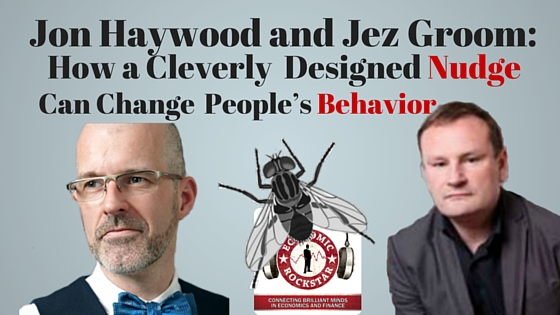
049: Jez Groom and Jon Haywood on How a Cleverly Designed Nudge Can Change People’s Behavior – Including How We Pee

September 10, 2015 by Frank

http://traffic.libsyn.com/economicrockstar/Jez_Groom_Final.mp3
Play in New WindowDownload

049: Jez Groom and Jon Haywood on How a Cleverly Designed Nudge Can Change People’s Behavior – Including How We Pee

Jez Groom is a behavioral economist and co-founder of the behavioral practice #ogilvychange in the United Kingdom.

Alongside Rory Sutherland, Jez has created the Nudge Awards and Nudgestock, bringing the best in behavioral economics to the mainstream.

Jon Haywood is the founder of Ambassadogs and has been working in the Advertising industry for almost 20 years.

Jon has specialised in taking a more consumer (human) perspective of the marketing challenge, working with the likes of Rory Sutherland of #ogilvychange on understanding how behavioural economics can add a significant competitive advantage to the creative ideation process.
Jez Groom and Jon Haywood

Economists:

Rory Sutherland, Paul Dolan, Richard Thaler, Cass Sunstein, Daniel Kahneman, Dan Ariely and Malcolm Gladwell.

Economics:

Behavioural economics, choice architecture, nudge, framing, heuristic, ’Fly in the Urinal’, ‘Piano Stairs’, ‘Stickman’, ‘The Religious Norming and The Begger’ and the ‘Facial Feedback Hypothesis’,

In this episode, you will learn:

  • how #ogilvychange is bringing Behavioural Economics into the mainstream.
  • about Nudgestock which brings academics and practitioners together to discuss the theoretical and practical intersection of behavioural economics.
  • how a ‘Fat Stickman’ pointing to an escalator and a ‘Thin Stickman’ pointing to the stairs can nudge a person to take the stairs.
  • about the bathroom tip-jar trick that could net you more tips than ever!
  • how re-arranging the choice architecture of a sales product can boost sales.
  • how #ogilvychange gave The Times newspaper a ROI of 250 in incremental sales on a 1 investment.
  • that offering customers too many choices can affect your bottom-line.
  • how changing the environment of sales agents can increase average sales by 185% simply by changing the colours of the walls.
  • how we can nudge people to take the stairs rather than the elevator by creating ‘The Piano Stairs’.
  • how we can encourage people to bin their litter by simply creating ‘The World’s Deepest Bin’.
  • how we can reduce the amount of urine that ends up on the floor by putting a sticker in the urinal.
  • why businesses and governments are now embracing behavioral economics.
  • and much more!

How a Clever Nudge Can Change People’s Behavior:

The Fun Theory, an initiative by Volkswagen, aims to create ways to encourage people to make a small change in their lives for the better. A nudge is a strategic approach by firms, governments and individuals to encourage people to behave in a way you would like them to behave. Nudging has become quite synonymous with behavioral economics lately, particularly since the release of Thaler’s book ‘Nudge’.

The Piano Stairs:

There is a general consensus that taking the stairs rather than the elevator or escalator can, overtime, make people lead a healthier and happier life. Perhaps that outcome is somewhat extreme, but people may ‘feel better’ if they take the stairs every time. However, how can we encourage people to take the stairs rather than the elevator?

Should we stop the escalator from moving or have an ‘Out of Order’ sign on an elevator? Not a good idea as this would possibly have an undesired outcome as people would end up infuriated. Although they are forced to the take the stairs, the path taken to get from A to B is not desirable. Problems would also arise for those unable to physically take the stairs. We should allow an option but encourage people, if they can, to take the stairs.

Should we send out messages outlining the health and well-being benefits of taking the stairs? Perhaps this could be effective but taking the stairs today will not make someone any fitter or healthier. People will more than likely delay or feel it is pointless.

https://www.youtube.com/watch?v=0Yu62StlsMY

Do you remember or have you seen the 1988 movie Big featuring Tom Hanks? Tom’s character had made a wish, the day before when he was a young boy, to be older. His wish comes true but his mind and behavior is that of his younger self. Tom’s character immortalizes the famous New York toy store, FAO Schwarz, by playing ‘Chopsticks’ on a large piano on the floor. This captured the imagination of many people who wathced his movie and I’m sure the behavioral scientists at The Fun Theory knew exactly how they could now encourage people to take the stairs rather than the escalator.

Enter The Piano Stairs, a fun and interactive experiment to nudge people to take the stairs and to, perhaps, feel better. Check out their video here and the interesting results achieved with this ‘nudge’ from The Fun Theory.

The Urinal Fly:

In this episode of the Economic Rockstar podcast, Jez Groom mentioned how placing a sticker of a fly in a urinal reduced the incidence of mis-direction of toileting by men. Subsequently, I reached out to Jon Haywood from ambassadogs.nl who explained the concept of the Urinal Fly and how a sticker or print of a fly within a urinal is a nudge that changed the behavior of those men in question.

Jon is from Amsterdam and this particular nudge is credited to Amsterdam’s Schiphol Airport. The manager of the cleaning department at Schiphol Airport, Jos van Bedaf, is credited to introducing the urinal fly in order to reduce the amount of spillage. According to Jon Haywood, this had the effect of reducing spillage, resulting in lower clean-up costs and improved toilet conditions. The fly was chosen as it appears insanitary and men can aim at the image. A butterfly couldn’t be chosen as men may aim around this image as it could conjure up an image of beauty that you wouldn’t like to harm.

The World’s Deepest Bin:

Another nudge was developed by The Fun Theory to encourage people to bin their litter and have a litter-free environment. Again, Jon Haywood talks to us about this particular nudge and how a piece of deposited litter passed an internal sensor which activated a sound giving the perception that the litter was falling for 10 seconds.

Recommended Books:

  • Thinking, Fast and Slow by Daniel Kahneman
  • Nudge by Richard H. Thaler
  • Blink by Malcolm Gladwell
  • Outliers by Malcom Gladwell
  • Freakonomics by Steven D. Levitt and Stephen Dubnar
  • SuperFreakonomics by Steven D. Levitt and Stephen J. Dubnar

Resources:

  • #nudgesinthewild
  • O Behave!
  • www.thenudgeawards.com

Where to Find Jez Groom:

www.ogilvychange.com

Where to Find Jon Haywood:

www.ambassadogs.nl

http://traffic.libsyn.com/economicrockstar/Jez_Groom_Final.mp3

Podcast: Play in new window | Download

  • facebook
  • linkedin
  • twitter
  • google+
  • pinterest

028: Alice Louise Kassens on Nudging Students to Study Economics and Why Mainstream Media Should Publish Research on Mental Health

April 16, 2015 by Frank

http://traffic.libsyn.com/economicrockstar/028_Alice_Louise_Kassens.mp3
Play in New WindowDownload

028: Alice Louise Kassens on Nudging Students to Study Economics and Why Mainstream Media Should Publish Research on Mental Health

Dr. Alice Louise Kassens is an Economics Professor at Roanoke College and has already built a notable
reputation in her profession.

Alice is the current recipient of Roanoke’s John S. Shannon Professorship in Economics, which honors and supports a faculty member who is an outstanding teacher and accomplished scholar and who is thoroughly committed to enriching the lives of Roanoke students.

Dr Kassens’ work at Roanoke includes creating and maintaining an economics program blog and a biannual newsletter, Roanomics. She also serves as the faculty advisor for the College’s Economics Club.

Alice’s areas of expertise include labor and health economics. She has won several awards and fellowships, and her work has been published in numerous academic journals.

Alice is one of three economists who won Cengage Learning’s 2013 Economist Educators Best in Class Award for her method of teaching using Twitter.

Dr Kassens is president of the Virginia Association of Economics, has recently been appointed by Governor McAuliffe to his Joint Advisory Board of Economists, is a senior analyst for the Institute for Policy and Opinion Research and is a Referee for the Journal of Economic  Education, the Journal of Economics and Finance Education, and the National Council on Undergraduate Research.

Alice is the author of Changing Perceptions and Waistlines – A Bayesian and Behavioral Approach and is known as the ‘Running Economist’ not because of her busy lifestyle but because she is a competitive runner.

Alice earned her bachelor’s degree from the College of William and Mary and her Ph.D. from North Carolina State University.

Personal Habits:

  • Running, swimming and looking after her five dogs and an 18 year old cat!

Economic Themes:

In this interview, Alice mentions and discusses: 

Supply-side and demand-side of the housing market, primary research methods, sample selection bias, surveys, employment, unemployment, the Great Recession and regression discontinuity design models.

Economists:

In this interview, Alice mentions: 

Milton Friedman, Thomas Sowell, William Rogers, Mark V. Pauly, Alvin Headen, Yana van der Meulen Rodgers, Luther Lawson, Dean Baker and Jadrian Wooten.

Takeaway:

Do a little something everyday, even if it’s as simple as downloading a dataset, making an outline for a paper, talking to a colleague about a project. Do something small and all of it adds up overtime.

Find out:

  • how Alice’s secrets to increasing an economics class size.
  • how Alice uses social media to encourage students to learn economics more effectively.
  • how Twitter can be used to remove the limitations to classroom-specific learning.
  • how Dr. Kassens collects data for the Consumer Sentiment Report for Virginia.
  • how to remove sample selection bias when collecting primary data.
  • how to analyse unobservables using observed data.
  • about the benefits of small-class sizes for learning.
  • which economist Dr. Kassens would love to collaborate with.
  • how being an athlete helped with a career decision to become a health economist.
  • why Dr. Kassens wrote a report on gender disparities in health care in Papa New Guinea.
  • about the gender disparity in depression levels upon losing a job.
  • whether men or women respond better to losing their jobs by continuing to job search.
  • if people lose their job because they were depressed or are they depressed because they’re unemployed?
  • how Dr. Kassens’ research can help people with depression if the media can report her findings to the masses.
  • if people reduce their expectations to live longer once they are diagnosed with Type II diabetes.
  • if obese people who are diagnosed with Type II diabetes respond by losing weight.
  • how writing a blog makes you accountable for what you do and helps you get things done.
  • the importance of why organisations should make their data freely accessible to academics.

Nudging Students to Study Economics at Roanoke College

  • Running Economist Blog.
  • Twitter Feeds.
  • Roanonomics Newsletter.
  • Economics Club.
  • Economics Reading Group.
  • Economics Study Trip.
  • Create a sense of community among Economic Students.
  • Working with Advanced Placement Teachers at High School.
  • Inviting High School students to Roanoke College Campus.

Dr. Kassens offers her best students the opportunity to teach economics weekly at the local Patrick Henry High School in Roanoke to help teach Mr. Hartman’s Advanced Placement Economics course. This is part of Dr. Kassens’ Service Learning Independent Study in which participating seniors are awarded academic credit for meeting the course requirements. Students teach the economics lesson plan of the day and sometimes run simulations, do group-work or show movies or tv programs like House of Cards, extracting economic concepts and themes from them. This helps reinforce the learning process both for the economic seniors and for the High School students.

To fulfil a whole credit, Dr. Kassens’ students are required to write reflective pieces based on a number of questions such as ‘What did you learn about yourself?’, ‘How do you think you’re helping the community?’ and ‘What challenges did you face?’. Dr. Kassens has identified research which shows that employers need students to be able to articulate what they learned and why their independent study or internship was important, not that they actually did one.

The Service Learning Independent Study at Roanoke College fulfils such a need. Not only does it give students the opportunity to gain invaluable experience but also prepares the student to be self-motivated, confident and above-all being able to demonstrate, in an articulate fashion, to potential employers what they have gained from such an experience.

This program is a win-win both for the senior at Roanoke College and the student at Patrick Henry High School. The senior, who is at this stage studying intermediate micro and macro, will go over principles of economics to teach the High School students. This only reinforces the learning process and makes them a more accomplished student. By reinforcing the material of principle micro and macro, the student can create a solid foundation to build upon, which will become invaluable at intermediate level economics.

Using Twitter in the Classroom to Teach Economics

Dr. Kassens uses Twitter as part of her assignments for her Principles of Micro and Macro classes. Students are given 10 different tasks to fulfil during this semester-long assignment in which they need to write and articulate an economic-related tweet based on the pre-assigned guidelines. For example, students are required to tweet about economic policy as outlined in the State of the Union address by the US President. Following this, students must then comment on or answer a question made by a fellow student. The hashtag #kassensecon122 must be used in order to keep the conversation going and for ease of tracking the students work. This can be challenging due to the limitation of articulating a tweet of up to 140 characters in length.

The students also helped Dr. Kassens in the development of a rubric so they knew how they were going to be graded. It was a short but well-defined rubric, which was important as it allowed Dr. Kassens to be responsive leading to a fast turn-around in grading results. This was considered vital since “the goal was to improve their writing”. Using Twitter to improve writing skills may, at first, appear a failed experiment but it is surprisingly “difficult to put into 140 characters something meaningful that’s going to score well on the rubric because they can’t use funny abbreviations”.

[Tweeting your way to improved writing, reflection, and community by Dr. Alice Louise Kassens]

The rubric was therefore important so that students could get feedback quickly allowing them to make improvements in their next assignment. Finding topics that Dr. Kassens believes her students would find interesting was also important. Dr. Kassens reached out to other economists on Twitter, some she didn’t know personally such as Dean Baker, and asked them to engage with her students by asking  a question. Once students answered this question, Dr. Kassens sent the answers back to the economist.

The benefits Dr. Kassens found with using Twitter in assessing economics was that students’ writing skills improved as evidenced by how the rubric scoring went but “it also broke down these barriers that you have with a classroom so that they could beyond the classroom walls and interact with well-known economists”.

The semester-long project at Roanoke College is worth 20 to 25% of the students’ final grade. However, Dr. Kassens found it interesting that half of her students did not have a Twitter account. She had believed that most young kids use Twitter. This statistic seemed consistent for each of the three semesters in which the assignment was delivered. Consequently, the first week of the semester was devoted to setting up an account, informing students of how to use Twitter and sending out ‘practice’ tweets that reflects an economic argument, concept or point-of-view within 140 characters.

Using Twitter to sharpen critical thinking and writing skills by Dr. Alice Louise Kassens

Favorite Internet Resource:

  • SAS: Visual Analytics for UN Comtrade

Recommended Book:

  • Keynes Hayek: The Clash that Defined Modern Economics by Nicholas Washout
  • Economic Facts and Fallacies by Thomas Sowell
  • How to Write A Lot: A Practical Guide to Productive Academic Writing by Paul J. Silvia
  • Changing Perceptions and Waistlines – A Bayesian and Behavioral Approach by Alice Kassens

Where to Find Alice Kassens:

  • Website: The Running Economist
  • Twitter: @RnningEconomist 
http://traffic.libsyn.com/economicrockstar/028_Alice_Louise_Kassens.mp3

Podcast: Play in new window | Download
  • facebook
  • linkedin
  • twitter
  • google+
  • pinterest

021: Paul Dolan on the Economics of Happiness

February 26, 2015 by Frank

http://traffic.libsyn.com/economicrockstar/021_Paul_Dolan.mp3
Play in New WindowDownload

021: Paul Dolan on the Economics of Happiness

Paul Dolan is an internationally renowned expert on happiness, behaviour and public policy. He is currently a Professor of Behavioural Science in the Department of Social Policy at the London School of Economics and Political Science.

Paul has previously held academic posts at York, Newcastle, Sheffield and Imperial and he has been a visiting scholar at Princeton University, working with Daniel Kahneman.

Professor Dolan has over 100 peer-reviewed publications which cover many topics including behavioural science, subjective wellbeing, equity in health and health valuation.

Paul is currently a Member of the World Economic Forum Panel on Behavioural Science, the Chief Academic Advisor on Economic Appraisal for the UK Government’s Economic Service. He is also a member of National Academy of Sciences Panel on Wellbeing and of the Measuring National Wellbeing Advisory Forum for the Office for National Statistics in the UK.

Paul is the author of ‘Happiness by Design’.

Economic Themes:

In this interview, Paul mentions and discusses:  behavioral economics, happiness, nudging, trade-off, pleasure-purpose principle, production function, utility models, causal relationships, priming effects, System 1, System 2

Economists:

In this interview, Paul mentions: Daniel Kahneman, Amos Tversky, Irving Fischer and Gregory Mankiw.

“2,500 years of ethical discourse hasn’t resolved the question what is the source of happiness” – Paul Dolan

Find Out:

  • how Paul evolved from a health economist to a behavioral economist.
  • how many years of your life would you be willing to give up to avoid being anxious or being down.
  • if Aristotle and other philosophers are right in saying that happiness can only be defined on a death-bed when reflecting upon your life.
  • how to create a pleasure-purpose balance that’s right for you.
  • how you can use the production function process to produce happiness.
  • what is this production process that makes us happy.
  • if money makes you happier.
  • how happiness studies influence policy decision-making.
  • about the limitations to happiness research and what can be done to make better research.
  • what nudging is.
  • how nudging by policy-makers can make you happier.
  • about the morality of nudging.
  • how supermarkets can nudge you into buying their breads and cakes.
  • why self-help books are a waste of money as they try to change your mindset.
  • why Paul’s book, ‘Happiness By Design’ will help you to change what you do.
  • about Paul’s ‘3 Pillars of Happiness’ – Deciding, Designing and Doing.
  • how designing your life to make things simple and easy can help you achieve your goals.
  • about the essence of mindfulness.
  • why people who are easily distracted are more likely to be less happy.
  • if your phone can make you unhappy and what you should do about it.
  • why Paul is a ‘Happy Hammer’ (West Ham fan) despite never winning the league.
  • how the power of ‘hope’ can make you happy by allowing your imagination run freely.

Pleasure-Purpose Principle

Alongside pleasure sits purpose. Happy lives are ones that have a good balance between experiences that are pleasurable on the one hand and purposeful on the other. You need to find out the right balance between pleasure and purpose that is right for you.

The creation of happiness is like a product function of a firm. A firm uses inputs, puts them through a production process to create outputs.  A person can equally use inputs like money, marriage, sex, jobs and watching television that are stimuli and we can convert them into happiness by a production process.

What is that production process? According to Paul this production process is called ‘Attention’. Attention is the ‘glue’ that keeps our lives together in terms of behaviour and happiness. The answer to the question ‘Does money make you happier?’ depends on how much attention you pay it.

“Most of economic modelling is based on looking at what people do, not what people say”

Challenges with Happiness Economics: “A lot of what we think we know comes from making inferences from associations. We need to to do more research and field experiments where we look at the causal impact of interventions on people’s happiness.”

You can beg, borrow and steal money, but you’re never going to get time that’s lost – Paul Dolan

Click To Tweet

Lost happiness is lost forever – Prof Paul Dolan

Click To Tweet

Nudging

Nudging can sometimes be overt and sometimes covert. It can take the form of financial incentives or below-conscious stimuli such as sounds, tastes and smells. The latter is known as priming effects.

According to Paul Dolan, the definition of a successful nudge is one where people, who are being nudged toward a particular direction with the expectation that they would be better-off, become happier as a result of being nudged.

Policy-makers assume after a nudge that people are better off, but research hasn’t captured the after-effects of these nudges to find out if they are indeed better off. Paul is all for designing nudges that make people happier, not by how he judges how they should be happier but according to what large datasets tell him what affects people’s happiness.

Listen to Paul’s 3 Pillars of Happiness: Deciding, Designing and Doing 

The Essence of Mindfulness: “We’re generally happier when we’re paying attention to what we’re doing and who we’re doing it with – living in the moment” – Paul Dolan.

“When you’re switching activities, your brain is using energy and it makes you more tired and less happy” – Paul Dolan.

“Being a football fan is a bit like faith. You can’t really change it once you’ve got it” – Paul Dolan.

Recommended Book:

  • Happiness By Design by Professor Paul Dolan

Where To Find Paul Dolan:

  • Twitter: @profpauldolan
  • Website: www.pauldolan.co.uk
  • Website: London School of Economics
http://traffic.libsyn.com/economicrockstar/021_Paul_Dolan.mp3

Podcast: Play in new window | Download

  • facebook
  • linkedin
  • twitter
  • google+
  • pinterest

Frank Conway

Frank Conway is founder of Economic Rockstar and lecturer of economics, finance and statistics. Read More…

View My Blog Posts

Youtube Sub

Become a Patron of the Economic Rockstar Podcast

patreon

Ireland’s Economy by the Numbers

Leaving Cert Economics: Ireland’s Economy  Click here to download a workbook on Ireland’s Economy so that you can add your own notes. [Original size] Ireland’s Economy by fconway

Categories

Subscribe and Never Miss An Episode

itunes-logo

Recent Posts

  • Ireland’s Economy by the Numbers April 8, 2019
  • 174: Wendy Carlin on The Core Project, Capitalism, Democracy and Normative Statements February 13, 2019
  • 173: Stephen Wright on Core Econ as a Learning Resource for Mainstream Economics January 28, 2019
  • 172: Best of 2018 Part 2: From the Great Depression to Futurism; Institutions, Individualism, Cooperation and Reciprocity January 22, 2019
  • 171: Best of 2018 Part 1 January 3, 2019

Copyright © 2026 · Podcast Pro Theme on Genesis Framework · WordPress · Log in

This website uses cookies to improve your experience. We'll assume you're ok with this, but you can opt-out if you wish. Accept Reject Read More
Privacy Policy

Privacy Overview

This website uses cookies to improve your experience while you navigate through the website. Out of these, the cookies that are categorized as necessary are stored on your browser as they are essential for the working of basic functionalities of the website. We also use third-party cookies that help us analyze and understand how you use this website. These cookies will be stored in your browser only with your consent. You also have the option to opt-out of these cookies. But opting out of some of these cookies may affect your browsing experience.
Necessary
Always Enabled
Necessary cookies are absolutely essential for the website to function properly. This category only includes cookies that ensures basic functionalities and security features of the website. These cookies do not store any personal information.
Non-necessary
Any cookies that may not be particularly necessary for the website to function and is used specifically to collect user personal data via analytics, ads, other embedded contents are termed as non-necessary cookies. It is mandatory to procure user consent prior to running these cookies on your website.
SAVE & ACCEPT