• ABOUT
  • RESOURCES
  • PODCAST
  • BOOKS
  • BLOG
  • SUPPORTERS
  • QFA Financial Advice
  • CONTACT

Economic Rockstar

Connecting Brilliant Minds in Economics and Finance

088: Denise Cummins on Fairness in Economics, Altruism and the Prisoners Dilemma

June 2, 2016 by Frank

http://traffic.libsyn.com/economicrockstar/088_Denise_Cummins_Final.mp3
Play in New WindowDownload

088: Denise Cummins on Fairness in Economics, Altruism and the Prisoners Dilemma

Dr. Denise Cummins is a research psychologist and an author. She has held faculty and research positions at Yale Denise Cummins Economic RockstarUniversity, the University of California, the University of Illinois, and the Center for Adaptive Behavior at the Max Planck Institute in Berlin. 
Dr Cummins is a respected cognitive scientist who has authored numerous scientific articles, and is an elected Fellow of the Association for Psychological Science. 

In her Psychology Today blog and PBS NewsHour articles, Denise writes about what she and other cognitive scientists are discovering about the way people think, solve problems, and make decisions.

Denise’s experimental investigations focus on social, moral, and causal decision-making. The aim of her social research is investigating  how perceived relative status impacts fairness in economic transactions. 

Denise is the author of four books, the most recent being Good Thinking: Seven powerful ideas that influence the way we think.

Denise received her PhD in Experimental Psychology from University of Colorado, Boulder and you can find her work at www.denisecummins.com and PsychologyToday.com.

Books:

Cummins, D.D (2012) Good Thinking: Seven powerful ideas that influence the way we think. Cambridge, MA: Cambridge University Press.

Cummins, R.C., & Cummins, D.D. (Eds.) (2000) Minds, brains, and computers: Foundations of Cognitive Science. London: Blackwell.

Cummins, D.D., & Allen, C. (Eds.) (1998) The Evolution of Mind. Oxford University Press.

Cummins, D.D. (1995) The other side of psychology: How experimental psychologists find out about the way we think and act. NY: St. Martin’s Press.

http://traffic.libsyn.com/economicrockstar/088_Denise_Cummins_Final.mp3

Podcast: Play in new window | Download

  • facebook
  • linkedin
  • twitter
  • google+
  • pinterest

050: Dan Ariely on Irrational Behavior and the Importance of Our Environment When Making Decisions

September 16, 2015 by Frank

http://traffic.libsyn.com/economicrockstar/050_Dan_Ariely_Final.mp3
Play in New WindowDownload

050: Dan Ariely on Irrational Behavior and the Importance of Our Environment When Making Decisions

Dan Ariely is Professor of Psychology & Behavioral Economics at Duke University in North Carolina. Dan’s interests spanDan Ariely a wide range of behaviors, and his sometimes unusual experiments are consistently interesting, amusing and informative, demonstrating profound ideas that fly in the face of common wisdom.

In addition to appointments at the Fuqua School of Business, the Center for Cognitive Neuroscience, the Department of Economics, and the School of Medicine at Duke University, Dan is also a founding member of the Center for Advanced Hindsight.

Dan is the author of the New York Times bestsellers Predictably Irrational, The Upside of Irrationality, and The Honest Truth About Dishonesty and his latest book Irrationally Yours is now available.

Dan has received numerous honors and awards in medicine, psychology and economics.

Dan received a B.A in Psychology from Tel Aviv University, an M.A and PhD in Cognitive Psychology from University of North Carolina and another PhD in Business Administration from Duke University.

Influencer:

Professor Hanan Frenk, Tel Aviv University

Economists:

In this interview, Dan mentions: Brian Wansink. 

Psychologists:

In this interview, Dan mentions: Mike Norton and Elizabeth Dunn.

Economics:

In this interview, Dan mentions and discusses: Tragedy of the Commons, behavioral economics, public goods, pricing, decision-making, choice architecture, Ulysses Contract, happiness, asymmetric dominance effect and choice.

Takeaway:

“Think about your environment and always experiment” – Dan Ariely

Click To Tweet

In this episode, you will learn:

  • about Dan Ariely’s traumatic experience resulting in severe burns.
  • how Dan Ariely found his love for psychology and behavioral economics.
  • why Dan will not be teaching his Irrational Behavior course on Coursera.
  • the problems with MOOCs like Coursera and why it is making the wrong choice regarding its open platform system.
  • why Dan was turned down for his first book – a cookbook and what advice he was given by a publisher.
  • why we as humans make very costly mistakes and what we can do about it.
  • how people eat more than they realise and how experiments in economics have shown this.
  • why we are bad at doing things that makes us happy.
  • the most common mistake companies make when making decisions or processing information.
  • how companies can avoid making mistakes.
  • if anger is a good or bad emotion.
  • the most surprising finding from Dan Ariely’s research.
  • the most surprising question put to Ask Ariely.
  • how to get poor people in Kenya to save.
  • how your environment matters when making decisions.

Quotes by Dan Ariely in Episode 50 of the Economic Rockstar Podcast:

“Choice architecture is this idea that our environment influences how we make decisions” – Dan Ariely

Click To Tweet

“In the process of trying to not make any mistakes, companies create environments that punish risk and therefore punish ingenuity and growth” – Dan Ariely

“Tim is a very interesting character and he is experimenting on himself. We have to realize that his experiments have the validity that they work very well for him” – Dan Ariely

On Coursera:

“I think we do need rules for trolls. I think that pricing is a very good mechanism for some things and I’m not sure it’s a mechanism for all for all things like this. The reality is that Coursera probably over samples from the people on the tail of the distribution in terms of mental stability.” – Dan Ariely

Books:

  • Predictably Irrational by Dan Ariely
  • The Upside of Irrationality by Dan Ariely
  • The Honest Truth About Dishonesty by Dan Ariely
  • Irrationally Yours by Dan Ariely
  • The 4 Hour Chef by Tim Ferriss
  • Happy Money: The Science of Smarter Spending by Elizabeth Dunn and Michael Norton

Resources Mentioned by Dan Ariely:

  • Kitchen Safe: www.thekitchensafe.com
  • Coursera: www.coursera.org

Where to Find Dan Ariely:

  • Website: www.danariely.com
  • Twitter: @danariely
  • LinkedIn: Dan Ariely
  • Ted: www.ted.com

Transcript:

The full transcript of this episode with Dan Ariely will be available shortly.

Thanks for Listening!

Thanks so much for joining me again this week. Have some feedback you’d like to share? Leave a note in the comment section below!

If you enjoyed this episode, please share it using the social media buttons you see at the bottom of the post.

Also, please leave an honest review for the Economic Rockstar Podcast on iTunes! Ratings and reviews are extremely helpful and greatly appreciated! They do matter in the rankings of the show, and I read each and every one of them.

http://traffic.libsyn.com/economicrockstar/050_Dan_Ariely_Final.mp3

Podcast: Play in new window | Download
  • facebook
  • linkedin
  • twitter
  • google+
  • pinterest

032: Joe Gladstone on the ‘Pay What You Want’ Pricing Model and Using Big Data to Understand You Better

May 14, 2015 by Frank

http://traffic.libsyn.com/economicrockstar/032_Joe_Gladstone_Final.mp3
Play in New WindowDownload

032: Joe Gladstone on the ‘Pay What You Want’ Pricing Model and Using Big Data to Understand You Better

Joe Gladstone is an academic researcher and consultant based at the University of Cambridge, where heJoe Gladstone applies insights from behavioral economics and psychological research to better understand consumer behaviour.

Joe partners with some of the world’s largest corporations, such as Twitter, Bupa and Visa, as well as government departments, to tackle challenges that deal with behaviour change.

Joe’s views on consumer behaviour have been featured in the BBC, Forbes, The Huffington Post and other media outlets.

Joe is founder of BE-events and BE-Recruit.  He received his Masters from Oxford University and his Phd from Cambridge University, and has been awarded a range of competitive grants and prizes.

Find Out:

  • about the link between the discipline of psychology and economics.
  • why Joe decided to do postgraduate research in behavioral economics.
  • how advances in technology, especially in social media, can help behavioral scientists understand human behaviour better.
  • why you do not know how much you spend on coffee.
  • how Joe has identified the relationship between psychology and money.
  • how Joe has used the ‘My Personality’ app to predict your personality from what you like.
  • how companies can use ‘Big Data’ to target messages directly to you.
  • why people are willing to pay for services that they could otherwise get for free.
  • if TIDAL will disrupt the online music industry by taking control of their own music.
  • if Spotify risks losing out to TIDAL.
  • how important is the price of zero?
  • how the ‘Pay What You Want’ pricing model defies classical economic theory.
  • why people pay even if they are given the option to take the product for free.
  • how Radiohead made more in sales when offering their album on a ‘Pay What You Want’ basis.
  • if the ‘Pay What You Want’ model is sustainable for a business in the long run?
  • how Jon Bon Jovi has successfully implemented the ‘Pay What You Want’ model in his Soul Kitchen restaurant in New Jersey.
  • how sitting with strangers to eat in Soul Kitchen can ‘nudge’ diners to pay more than what they were initially willing to pay.
  • about Joe’s passion for financial literacy and financial empowerment.
  • if you can become immune to nudging by having a deeper understanding of it.
  • if knowledge prevents you from being nudged.
  • about behavioral economics events that could be going on in your area with BE-events.org.
  • how Joe maximises his time by outsourcing his work on oDesk.
  • how to get girls in less-developed and poor countries to go to school.
  • how Joe built up a name for himself on LinkedIn by connecting with the main people in the banking sector and offering his services on a no cost basis.
  • what the five personality traits known as OCEAN stands for.

Economists Joe Would Love to Collaborate With:

Professor Dean Karlan of Yale University and Professor John List of University of Chicago.

Economists:

In this interview, Joe mentions: 

Daniel Kahneman, Amos Tversky, Cass Sunstein, Dean Karlan (Poverty Action), David Hagmann, George Loewenstein, Craig Fox (The Behavioral Science and Policy Association), John List and The Behavioural Insights Team in the UK.

Economics:

In this interview, Joe mentions and discusses:

Behavioral economics, experimental economics, factor analysis, microeconomics, poverty, banking, micro-finance, decision making, nudge, nudging, pricing, demand, supply, randomised control trials, field experiments and multi-variate testing.

The ‘Pay What You Want’ pricing model is a great example of where the Classical economic theory doesn’t do a great job of explaining real world behavior – Joe Gladstone.

Resources:

  • Upwork (formally oDesk)
  • Leadpages

Books:

  • The Behavioral Foundations of Public Policy by Eldar Shafir

Papers:

  • Warning: You Are About to be Nudged by David Hagmann and George Loewenstein.

Where to find Joe:

  • Website: www.joegladstone.com
  • BE-events.org
  • BE-recruit.com
  • LinkedIn: Joe Gladstone
http://traffic.libsyn.com/economicrockstar/032_Joe_Gladstone_Final.mp3

Podcast: Play in new window | Download

  • facebook
  • linkedin
  • twitter
  • google+
  • pinterest

002: Jason Stapleton on Trader Psychology and Why You Shouldn’t Listen to Financial News

November 11, 2014 by Frank

http://traffic.libsyn.com/economicrockstar/002_Jason_Stapleton.mp3
Play in New WindowDownload

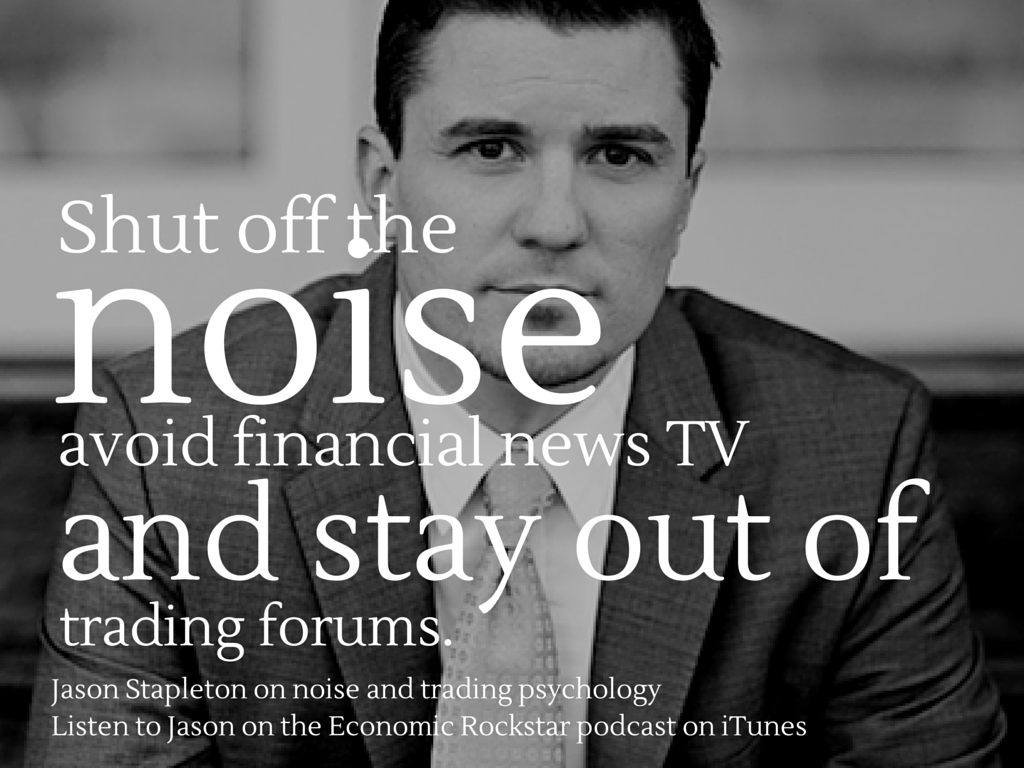
Episode 002: Jason Stapleton on Trader Psychology and Why You Shouldn’t Listen to Financial News

In this second part of the Economic Rockstar interview with Jason Stapleton, Jason shares with us some thoughts on trader psychology:Jason Stapleton

  • his thoughts on Richard Dennis’ Turtle Trader Program
  • why you shouldn’t trade and instead give your money to somebody else to manage.
  • noise that exists in the financial markets and what to do about it.
  • why you shouldn’t listen to financial news and what you can do instead to gain a competitive edge.
  • herding behaviors and trader psychology in markets.
  • why the markets are not fundamentally driven and what drives the markets instead.
  • why he believes that there is an inherent beauty in price patterns.
  • his thoughts on Fibonacci trading.
  • how being in the Marine Corp provided the discipline required to survive in the markets.
  • Some recommended books, such as Market Wizards by Jack Schwager.

You can check out and listen to the first part of this great interview with Jason Stapleton here.

About Jason Stapleton

Jason Stapleton is one of the founders of Trade Empowered and a managing partner of Harborsite Capital.  Jason’s heavy focus  on trader psychology, along with his in-depth knowledge of advanced technical analysis, gives him the unique opportunity to work with traders of all skills and levels, helping them to achieve a higher level of success and understanding in the foreign exchange market.

Recommended Books:

  • Trade What You See: How To Profit From Pattern Recognition by Larry Pesavento
  • Harmonic Trading, Volume One: Profiting from the Natural Order of the Financial Markets by Scott M. Carney
  • Harmonic Trading, Volume Two: Advanced Strategies for Profiting from the Natural Order of the Financial Markets by Scott M. Carney
  • Technical Analysis of the Financial Markets: A Comprehensive Guide to Trading Methods and Applications by John J. Murphy
  • Market Wizards by Jack Schwager
  • One Good Trade by Mike Bellafiore

Favorite Internet Resource:

  • Trading View

Where to Find Jason Stapleton:

  • Trade Empowered
  • Jason Stapleton on YouTube
  • The Live Show
  • Learn the Secret to Trading Fibonacci
toto togel situs togel situs toto situs toto situs toto situs toto situs toto toto slot situs toto situs togel situs toto slot gacor situs toto situs togel situs toto situs toto situs togel situs toto pam4d situs toto pam4d gimbal4d pam4d gimbal4d sangkarbet sangkarbet pam4d toto slot
http://traffic.libsyn.com/economicrockstar/002_Jason_Stapleton.mp3

Podcast: Play in new window | Download

  • facebook
  • linkedin
  • twitter
  • google+
  • pinterest

Frank Conway

Frank Conway is founder of Economic Rockstar and lecturer of economics, finance and statistics. Read More…

View My Blog Posts

Youtube Sub

Become a Patron of the Economic Rockstar Podcast

patreon

Ireland’s Economy by the Numbers

Leaving Cert Economics: Ireland’s Economy  Click here to download a workbook on Ireland’s Economy so that you can add your own notes. [Original size] Ireland’s Economy by fconway

Categories

Subscribe and Never Miss An Episode

itunes-logo

Recent Posts

  • Ireland’s Economy by the Numbers April 8, 2019
  • 174: Wendy Carlin on The Core Project, Capitalism, Democracy and Normative Statements February 13, 2019
  • 173: Stephen Wright on Core Econ as a Learning Resource for Mainstream Economics January 28, 2019
  • 172: Best of 2018 Part 2: From the Great Depression to Futurism; Institutions, Individualism, Cooperation and Reciprocity January 22, 2019
  • 171: Best of 2018 Part 1 January 3, 2019

Copyright © 2026 · Podcast Pro Theme on Genesis Framework · WordPress · Log in

This website uses cookies to improve your experience. We'll assume you're ok with this, but you can opt-out if you wish. Accept Reject Read More
Privacy Policy

Privacy Overview

This website uses cookies to improve your experience while you navigate through the website. Out of these, the cookies that are categorized as necessary are stored on your browser as they are essential for the working of basic functionalities of the website. We also use third-party cookies that help us analyze and understand how you use this website. These cookies will be stored in your browser only with your consent. You also have the option to opt-out of these cookies. But opting out of some of these cookies may affect your browsing experience.
Necessary
Always Enabled
Necessary cookies are absolutely essential for the website to function properly. This category only includes cookies that ensures basic functionalities and security features of the website. These cookies do not store any personal information.
Non-necessary
Any cookies that may not be particularly necessary for the website to function and is used specifically to collect user personal data via analytics, ads, other embedded contents are termed as non-necessary cookies. It is mandatory to procure user consent prior to running these cookies on your website.
SAVE & ACCEPT