• ABOUT
  • RESOURCES
  • PODCAST
  • BOOKS
  • BLOG
  • SUPPORTERS
  • QFA Financial Advice
  • CONTACT

Economic Rockstar

Connecting Brilliant Minds in Economics and Finance

056: Campbell Harvey on Improving Significance Tests, the Importance of Positive Skew and the Future of Blockchain

October 28, 2015 by Frank

http://traffic.libsyn.com/economicrockstar/056_Harvey_Campbell_Final.mp3
Play in New WindowDownload

056: Campbell Harvey on Improving Significance Tests, the Importance of Positive Skew and the Future of Blockchain

Campbell R. Harvey is Professor of Finance at the Fuqua School of Business at Duke University and a Research Campbell HarveyAssociate of the National Bureau of Economic Research in Cambridge, Massachusetts. He served as Editor of The Journal of Finance from 2006-2012 and is President-elect of the American Finance Association.
Professor Harvey obtained his doctorate at the University of Chicago in business finance. He has served on the faculties of the Stockholm School of Economics, the Helsinki School of Economics, and the Booth School of Business at the University of Chicago. He has also been a visiting scholar at the Board of Governors of the Federal Reserve System.

Campbell received the 2014 Reader’s Choice Award for the best paper published in the Financial Analysts Journal and the 2015 prize for the best paper published in the Journal of Portfolio Management. His recent work on evaluating trading strategies has won best paper awards.

Campbell’s research interests include statistical methods, risk management, asset allocation, real assets and cryptocurrencies. He is the Investment Strategy Advisor to the Man Group plc, the world’s largest, publicly listed, global hedge fund.

Economics:

In this interview, Campbell mentions: t-statistics, significance tests, trading strategies, investment premium, beta, correlation, standard deviation, confidence interval, P-value, Bonferroni multiple testing method, Type I error, Type II error, probability, normal distribution, optimal portfolio, volatility, expected returns, portfolio, pay-off, skew, over-fitting, regularisation, Efficient Market Hypothesis, Fractal Markets, stock market anomalies, Straw Man Model, momentum effect, mis-pricing and outliers.

Economists:

In this interview, Campbell mentions: Nassim Taleb, Benoit Mandlebrot, Peter Edgar, Yan Liu and Eugene Fama.

In this episode you will learn:

  • why it’s important to use t-statistics and significance tests and how it can be improved.
  • about the very simple idea Professor Campbell Harvey applies to his statistical modelling to improve the robustness of his tests.
  • why it’s wrong to use 2 standard deviations to have 95% confidence when running many tests.
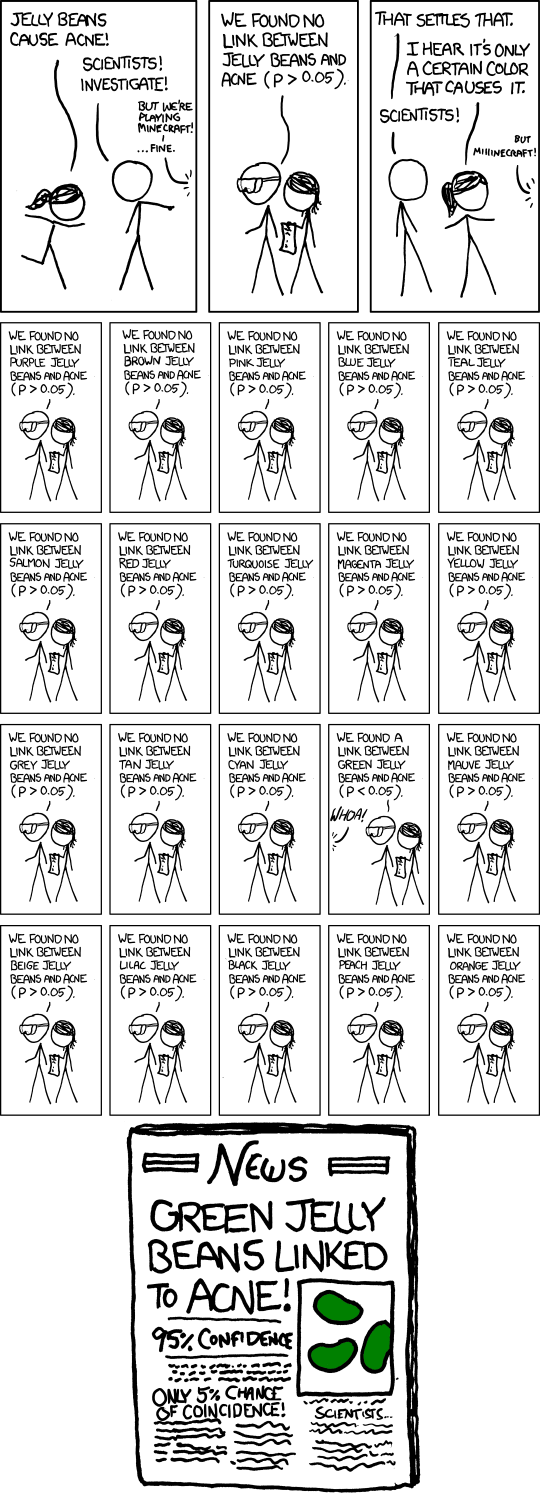
  • about ‘Significant’, the XKCD cartoon that illustrates the vulnerability of statistical significance testing.
  • do green jelly beans really cause acne? How significance tests can mislead with a fluke.
  • how a trading strategy based upon picking a portfolio of shares based upon the first letter of a ticker symbol showed that those tickers that began with the letter A outperformed other stocks.
  • how testing multiple times is effectively data mining and what should be done about it.
  • about the meaning of 95% confidence and 5% level of significance.
  • what a p-value is and why we ant it to be as small as possible.
  • if it’s important for the finance and economics profession to look at how other sciences are applying testing methods?
  • whether we need a tougher standard to lower the possibility of false discoveries?
  • if there is a chance of a fluke finding and why we should apply the Bonferroni multiple testing method solve this?
  • about the decay signature of the Higgs Boson and whether it is just background noise.
  • whether the findings of many published academic peer-reviewed papers are wrong.
  • about Type I and Type II errors and their trade-off.
  • about All Trials’ mission to make all randomised control trials made public.
  • the problems when measuring and using volatility in asset returns.
  • why the level of skew in a distribution must play more of an important role in risk management and portfolio selection.
  • why Taleb’s Black Swan only looks at one side of the distribution – the negative side, and why we must also look at the positive side.
  • how applying ‘regularization’ to portfolio selection avoids ‘over-fitting’ the data so that unexpected future outcomes can be considered.
  • about the efficient market hypothesis and the 316 anomalies that have been published to refute this hypothesis.
  • why the best traders are in Asia and how insider activity makes them so.
  • about the rise of crypto currencies and Bitcoin and why schools across US universities are introducing modules on it.
  • what is blockchain and why its is safe.
  • about the bank’s idea of creating a permission blockchain.

The Problem with Significance Testing and How to Solve It

If you’re trying to see if a variable Y is associated with a variable in a significant way, we usually think of looking at that correlation and determining whether you’re 95% confident that you’ve got it right. Usually what that means is that you’re 2 standard deviations away from zero. So, zero would be there’s no relation.

It turns out that that is perfectly acceptable if we’re looking at one correlation between Y and X. However, if it’s not X, it’s X1 you try. You try X2. You try X3, you try … X100. You try 100 different things. Then the criteria of using 2 standard deviations to have 95% confidence is just plain wrong.

The reason why this is wrong, is that when you’re running 100 tests, there is going to be a high probability that something will turn up that’s 2 standard deviations from zero just by chance.

The ‘Jelly Bean’ cartoon by XKCD called ‘Significant’ illustrates how testing a hypothesis can become misleading when conducting a significance test. The hypothesis being tested here is whether jelly beans causes acne.

A randomised control trial is ‘conducted’ by scientists. This is done where, say we have 50 people with jelly beans and 50 people with no jelly beans and we count the acne. And what basically happens is that there is no significance. So the scientists don’t achieve the 95% and conclude that there is no relation between jelly beans and acne.

However, the cartoon further illustrates what happens when the color of each jelly bean is tested to see if a particular color causes acne. 20 additional randomised control trials are conducted. The cartoon shows that the link between the Red Jelly Bean and acne is insignificant. Blue Jelly Bean – insignificant. Until you get to the last jelly bean, the 20th, which is the Green Jelly Bean. They find that there is a significant relation between Green Jelly Beans and acne. The final frame in the cartoon is a headline saying ‘Green Jelly Beans Linked to Acne’.

So, if you do 20 trials, one of those is likely to show up as significant using the standard criteria and it’s a fluke.

“The idea of my research is that we need to raise the bar that 2 standard deviations is no longer – that 2 sigma is no longer – something that should be considered. We need to go much higher.” – Professor Campbell Harvey

http://imgs.xkcd.com/comics/significant.png

The Bonferroni Multiple Testing Method

When we say that there is 95% confidence, we are saying that there is a 5% chance that the finding is a fluke. The 5% is called the p-value. What you would like is for that p-value to be as small as possible. You want as small as possible probability that the finding is a fluke. So the usual p-value for a single test with just X and Y for 5%, would imply 2 standard deviations. When you do multiple tests, you need more than 2 standard deviations from zero. If there is a chance of a fluke finding, then we should apply the Bonferroni multiple testing method solve this.

What the Bonferroni does is a simple correction. What it says is ‘you discover a p-value which is, say, 0.004 and you multiply by the number of things or X’s you’ve tried, which is, say, X1 to X100. All of a sudden, your p-value transforms to 0.4 or 40%. That means there is a 40% chance that in repeated trials that this thing you’ve identified, say X57, is a fluke. So when you use this adjustment, you discard that variable.

Quotes by Professor Campbell Harvey in Episode 56 of the Economic Rockstar Podcast:

In the practice of finance, some investment manager goes to a client and shows a great strategy and looks amazing. But they don’t tell the client or potential client that they tried 499 other possibilities and this is the only one out of 500 that worked – Professor Campbell Harvey. 

“Over half of what’s published in empirical asset pricing is probably incorrect” – Professor Campbell Harvey

Click To Tweet

“The problem with volatility is that it is a symmetric measure, that if you’re way above the average that contributes to the same volatility as if you’re way below the average” – Professor Campbell Harvey

“I’ve being pushing for the last 15 years to reform the way that we do our portfolio analysis, our standard models, to have the skew play a role.” – Professor Campbell Harvey

“It’s also a fact that it’s really hard to find any asset return that adheres to a normal distribution. If it does, it is very unusual.” – Professor Campbell Harvey

“What we want in economics and finance is repeatability.” – Professor Campbell Harvey

Click To Tweet

“I believe, just as Gene Fama believes, that markets are inefficient.” – Professor Campbell Harvey

Click To Tweet

“Blockchain provides a way to give unprecedented security. You’re immune effectively from this hacking.”

Click To Tweet

Books:

  • The New York Times Dictionary of Money and Investing: The Essential A-to-Z Guide to the Language of the New Market by Campbell Harvey and Gretchen Morgenson
  • The Black Swan by Nassim Taleb
  • The Ascent of Money by Neil Ferguson

Papers:

  • Evaluating Trading Strategies. by Campbell Harvey and Yan Lui
  • Where are the World’s Best Analysts? Campbell Harvey, Sam Radnor, Khalil Mohammed and William Ferreira
  • Conditional Skewness in Asset Pricing Tests. Campbell Harvey and Akhtar Siddique, Journal of Finance 55, (2000): 1263-1295. (P56)

Other Resources:

  • Garden of Econ podcast
  • Hypertextual Finance Glossary – Over 8,000 Entries and 18,000 Hyperlinks: The largest financial glossary on the Internet
  • The New York Times Dictionary of Money and Investing: The Essential A-to-Z Guide to the Language of the New Market by Campbell Harvey and Gretchen Morgenson

Websites:

  • www.alltrials.net

Where to Find Campbell: 

Website: Duke University

http://traffic.libsyn.com/economicrockstar/056_Harvey_Campbell_Final.mp3

Podcast: Play in new window | Download
Fundamental Analysis of Tesco and Facebook: A Case Study

October 25, 2014 by Frank

Fundamental Analysis:

Fundamental analysis is an approach used by some stock traders and stock market analysts to determine the valuation of a company or the stock market.  This is considered an important element in an analysts’ decision-making process as it is believed that such information can discern whether a stock or stock market is under or over-valued.

A recent webinar that I held in October 2014, titled “Using Fundamental Analysis in Stock Market Trading – Beta, P/E Ratio, Tobin’s q and More”, used Tesco and Facebook as a case study to determine whether these stocks would be considered a buying, selling or shorting opportunity. Fundamental analysis examined during this Tesco and Facebook case study were the price-earnings ratio, earnings per share, Tobin’s q, beta and some financial ratios.

Price-Earnings Ratio:

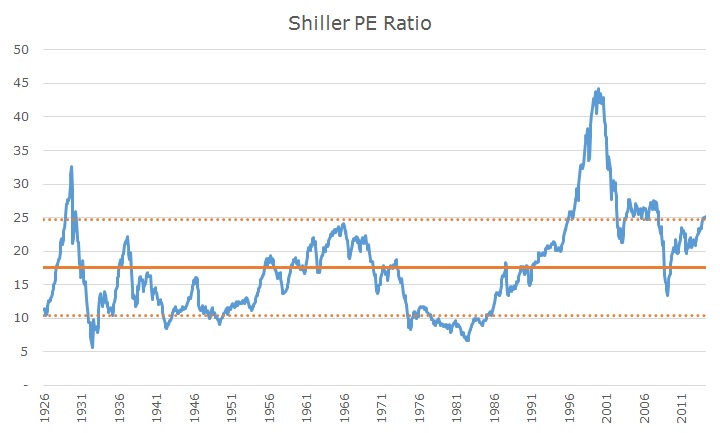
Shiller CAPE: 1926 - 2014

Source: Robert J. Shiller

The price-earnings ratio, or PE ratio for short, is a common value indicator, where a company’s share price is divided by its earnings per share (EPS). The PE ratio informs the investor of the number of years it will take to return each dollar invested, or alternatively it signals to the market the number of dollars an investor is willing to pay for $1 of earnings.

The PE ratio is found to have a historical average of approximately 16. Therefore, any number above this would be considered an over-valuation, while a number less than this is an under-valuation. However, problems arise if a company has negative earnings (the PE can only be interpreted when positive) or where the EPS is so small or almost zero (the PE becomes so large and irrelevant).

Robert J. Shiller and CAPE:

Yale economist and Nobel Laureate, Robert J. Shiller, developed the cyclically-adjusted PE [CAPE] to counter these problems by averaging 10 quarterly earnings. The possibility of a negative eps is removed. Shiller found the CAPE to average 17.5 over the period 1926 to 2014 for the S&P500 (see diagram 1 below).  CAPE was approximately 45 in 2001, which hugely over-valued the stock market , resulting in a stock market crash (see diagram 2). Shiller had warned of this impending crash for a number of years leading to this crash. This highlights another notable weakness of the PE ratio – it is not considered a good timing device, i.e. the ratio will fail to inform the trader of the optimal time to exit or enter the trade.

Tesco’s PE Ratio

Using advfn.com initially, it was found that the stock price of Tesco was 171 pence and its EPS was 12.07 pence, resulting in a PE ratio of 14.17.  This is quite a reasonable number and shouldn’t be of any concern.  However, events unfolded recently whereby Tesco failed to give an accurate account of its earnings and failed to inform investors of its performance. A look at Yahoo Finance seems to give an updated version of events, quoting the EPS at 0.12 pence – a significant difference to the 12.07 pence quoted by advfn.com. Based on the price of 171 pence, the PE ratio is 1413.22 (1425 based on my own calculations). This is way too high, and in order for the PE ratio to reflect the historical benchmark of 17.5, Tesco shares must collapse to 2.1 pence – a penny stock – to reflect the low EPS of 0.12 pence! Alternatively, the EPS must increase significantly to reflect the ‘justified’ price of 171 pence. This, however, is unlikely and, subsequently, the PE ratio becomes inconsequential and unreliable.

Facebook’s PE Ratio

Again, using advfn.com, Facebook’s PE ratio is an astonishing 124.1 based on the EPS of 0.62 cents and a share price of $80.18 (the PE ratio is found to be 129.32, but there may have been a time delay in updating the PE on advfn). Again, like our PE analysis of Tesco above, Facebook’ PE ratio is somewhat different to that quoted by Yahoo Finance. Based on an EPS of 0.94 and a share price of $80.04, the PE ratio is found to be 85.14, again indicating an over-valued company in terms of its stock price. Are investors willing to pay $85 for every $1 earned by Facebook? Not me! So, according to this valuation measure, Facebook is a sell. But remember, the PE ratio is not a good timing device, so shares could continue to increase for some time to come.

Confusion Over Differences in PE Ratios for the Same Stock

You may have noticed differences in the PE ratio as quoted by advfn.com and by Yahoo Finance. Ultimately, this boils down to the EPS quoted by each, since the stock price is commonly quoted. There is confusion as to what type of earnings a company should declare when releasing its results – GAAP or non-GAAP earnings? Likewise, there are differences in how analysts use earnings. Some quote actual earnings while others quote expected future earnings. There is no standard, and perhaps the SEC and others should create a standard practice.

Tobin’s q

Tobin’s q, another valuation measure, was developed by the late Nobel Laureate James Tobin, also another Yale economist.  He hypothesised that the market value of a stock should be equal to the replacement value of its assets, i.e. the stock price multiplied by the shares issues (i.e. market capitalisation) should have the same value as the assets of that company. Therefore, Tobin’s q has a theoretical value of 1.0 and any q value above this would indicate the stock price to be too high relative to the company’s assets.  Consequently, the share price should fall until the q ratio reverts back to unity. A q ratio below 1.0 indicates an under-valued company in terms of its market value, or more specifically, its share price. The stock price should rise as a result.

Again, using advfn.com, the Tobin’s q ratio for Tesco is 0.28. This is significantly low, suggesting that the company is considerably under-valued. The replacement value of Tesco’s assets are more than the market value of the company. In conclusion, based on this observation, Tesco’s recent share price plunge is unjustified. If Tesco were to sell off all its assets – both tangible and intangible – it would receive more that its market value as reflected in the share price of 171 pence.

PE Ratio and Tobin’s q for Tesco Are Incoherent

Tesco logoIt appears that both ratios are giving a conflicting message – the PE ratio of 1413.22 is over-valuing the company, whereas Tobin’s q is under-valuing the company. During the webinar (7:07 minutes into the discussion), I highlighted that both the PE ratio and Tobin’s q are correlated, meaning that they would typically be agreeable in terms of their conclusion. However, due to this disjointed interpretation and conclusion about whether Tesco should be a sell or short (according to the PE ratio) or a buy (according to Tobin’s q), it may be wise to consider other fundamentals such as the dividend yield, the beta coefficient and some financial ratios.

Understanding Facebook’s Tobin’s q

Facebook’s Tobin q is quoted at 11.43, indicating that the company is significantly over-valued. This confirms the PE over-valuation. The q of 11.43 suggests that the market value of Facebook far exceeds the replacement cost of its assets, i.e. if Facebook were to sell off its assets today, it would fail to match the market capitalisation of the firm. Facebook, being a tech company, does not have the physical or tangible assets of other companies like Tesco or Ford. However, the market values Facebook more than these and many other companies. Is the price of Facebook sustainable? According to Tobin’s q – No. However, further analysis of financial ratios indicate that Facebook is cash rich and is a low geared company. This is the complete opposite to Tesco.

Dividend Yield

The dividend yield is the amount of cash flow the investor receives from a company for every dollar invested in that company’s stock.  Tesco pays a dividend but Facebook does not. It can be argued that a company should retain its earnings and use the cash flow to invest in current and future projects. This will benefit the company and long-term investors as there is a growth and expansion expectation for the company, which may correlate with stock price appreciation. Investors, particularly value investors, prefer to invest in high dividend yielding stocks as they receive a return plus a possible equity gain.

Tesco Pays a Dividend But Facebook Does Not

Tesco paid an annual dividend yield of 8.63% based on the previous fiscal year dividends of 14.83 pence and the current share price of 171 pence (14.83/171). This appears to be a high yielding stock and great news for investors. However, since the tumultuous turn of events recently, interim dividends on October 23, are 1.16 pence – down from the previous interim dividend of 4.63 pence. As a crude estimation for full year dividend payments (in order to estimate the yield, I have assumed a final dividend of approximately 3 pence, resulting in a yield of 2.4% (total dividend of 4.16 divided by current share price). This seems realistic than the 8.63% yield. Since Facebook does not pay a dividend, it may be difficult to justify a buy or sell recommendation. It is not uncommon for company’s not to pay a dividend.

Beta

The beta of a stock signals the risk potential of the stock relative to the overall stock market. It is typically used by analysts or investors to match the risk profile of an investor with a stock. For example, traders and investors are not homogenous and their risk profiles differ. Some are risk averse, while others are more risk tolerant. Typically, the beta of a stock market or a large portfolio of shares has a value of 1.0. A company that has a beta below 1.0 is considered less risky and would suit risk averse investors, while a beta greater than 1.0 is a riskier investment. For example, a company with a beta of 1.4 will, on average, return 1.4% if the market returns 1.0%. The beta coefficient can be calculated by means of regression analysis, something I will demonstrate in the near future. The one criticism that I have about the beta coefficient is that it is based on historical data and is not indicative of the future risk profile of the company.

Tesco and Facebook are Low-Risk According to Their Beta

Tesco’s beta is 0.74 according to advfn.com, which indicates that Tesco is a low-risk investment (but N/A on Yahoo Finance). However, recent events has shown otherwise, hence my criticsm.  Facebook’s beta is 0.8 on Yahoo Finance also indicating a relative low-risk investment. Given thFacebooke high PE value for Facebook, I certainly would believe that this company is over-valued and I am personally surprised by its low beta value.
I speculate that the share price of Facebook has remained quite vigilant during recent stock market volatility. This is possibly due to the large shareholding that CEO and founder Mark Zuckerberg has, as well as the possible emotional attachment or herding behavior that some shareholders have in retaining their shares. This may have liquidity effects on share volume, as well as having net buyers in the market. This results in more stability in prices relative to the market or a continuation in share price increases. Confusing, right? But remember, I do speculate in explaining why Facebook’s PE is high but it’s share price continues to defy this over-valuation.

Financial Ratios

In the webinar, I briefly reviewed some common financial ratios for both companies, namely the current ratio and the acid test ratio.  A company is considered to have a healthy balance sheet if its Current ratio has a value of 2:1 and an Acid Test Ratio of 1:1, meaning that its assets can cover its liabilities. Tesco, however, has an extremely worrying Current Ratio of 0.84, whereas Facebook has an almost unheard of Current Ratio of 11.8.  Likewise, the Acid Test Ratio for both are 0.7 and 10.4. Tesco is considered an ‘unhealthy’ company, while Facebook has assets that more than covers its liabilities. Based on this alone, Tesco is a sell recommendation but Facebook should make its current investors quite happy.

A bar chart summarising Tesco’s Balance Sheet can be found at 11 minutes and 52 seconds into the webinar, while the same can be found for Facebook at 43 minutes and 26 seconds into the webinar. The ‘yellow’ shaded area in both bar charts indicate ‘Total Equity’ (on the left) and ‘Cash & Equivalents’ (on the right). Both companies significantly differ. Tesco’s ‘yellow’ areas are dwarfed by those of Facebook, meaning that Tesco is a highly geared company (more debt) and has very little cash, which is tied up in its fixed assets, debtors and stock. This is the nature of the type of business that Tesco finds itself in – it needs physical stores to sell its stock whereas Facebook’s business model is an online presence. Tobin’s q valuation of both companies could possibly be justified based on the assets of both companies.

Summary

On reflection, Tesco is a troubled company and its expansion plans into the Far East, as well as new markets such as insurance, telecoms and personal finance may have cost them dearly. They have lost market share in the retail space to German chains Aldi and Lidl. To meet debt obligations and fund current activities, Tesco may have to sell off some of its assets or perhaps a business arm, such as its banking operations. Since the market is undervaluing its shares according to Tobin’s q, this perhaps is a viable time to sell. The PE ratio can, in this case, be ignored and an investor looking to Tesco’s beta for an indication of a ‘safe bet’ can also ignore it as it places too much emphasis on historical returns relative to the market.

A question posed by an attendee during this webinar, Cristina Chase, asked if Warren Buffet had an effect on the current share price of Tesco due to his announcement of share selling. Reviewing the charts for Tesco, it was noted that the stock ‘gapped’ downward on two occasions possbly coinciding with his sell-off.

Another attendee, Lee Rock asked were Tesco and Facebook a buy or sell. To answer this, I reviewed the price chart patterns of both (technical analysis) to support the claims of the fundamental analysis discussed above. Tesco, has been trending downward since October 2013 but currently I noticed a double bottom formation at the 171 pence level for October 23, 2014. This double or, possibly, triple bottom could signal a reversal of the trend, particularly when the relative strength index is rising (for more on this and other technical trading indicators, please click here).

These indicators, together with Tobin’s q, suggest a buying opportunity. However, caution beckons in the near-term future for Tesco in dealing with the headwinds it faces. Regarding Facebook, the technical indicators is showing a drop in the price into a new trending pattern. The price of $80 is a critical resistance level and if Facebook fails to break above and settle above this level then the price could fall further. Both the PE ratio and Tobin’s q indicate an over-valuation of Facebook, therefore a sell recommendation. However, as stated above, Facebook is cash-rich and, coupled with the large equity holding of a few key personnel, the stock price may be supported at this high price.

If you would like to comment below, I would really appreciate it. Let me know of your opinions and suggestions and I will respond. For more posts like this, please visit www.economicrockstar.com or subscribe to our podcast on iTunes.

toto togel situs togel situs toto situs toto situs toto situs toto situs toto toto slot situs toto situs togel situs toto slot gacor situs toto situs togel situs toto situs toto situs togel situs toto pam4d situs toto pam4d gimbal4d pam4d gimbal4d sangkarbet sangkarbet pam4d toto slot

Frank Conway

Frank Conway is founder of Economic Rockstar and lecturer of economics, finance and statistics. Read More…

View My Blog Posts

Youtube Sub

Become a Patron of the Economic Rockstar Podcast

patreon

Ireland’s Economy by the Numbers

Leaving Cert Economics: Ireland’s Economy  Click here to download a workbook on Ireland’s Economy so that you can add your own notes. [Original size] Ireland’s Economy by fconway

Categories

Subscribe and Never Miss An Episode

itunes-logo

Recent Posts

  • Ireland’s Economy by the Numbers April 8, 2019
  • 174: Wendy Carlin on The Core Project, Capitalism, Democracy and Normative Statements February 13, 2019
  • 173: Stephen Wright on Core Econ as a Learning Resource for Mainstream Economics January 28, 2019
  • 172: Best of 2018 Part 2: From the Great Depression to Futurism; Institutions, Individualism, Cooperation and Reciprocity January 22, 2019
  • 171: Best of 2018 Part 1 January 3, 2019

Copyright © 2026 · Podcast Pro Theme on Genesis Framework · WordPress · Log in

This website uses cookies to improve your experience. We'll assume you're ok with this, but you can opt-out if you wish. Accept Reject Read More
Privacy Policy

Privacy Overview

This website uses cookies to improve your experience while you navigate through the website. Out of these, the cookies that are categorized as necessary are stored on your browser as they are essential for the working of basic functionalities of the website. We also use third-party cookies that help us analyze and understand how you use this website. These cookies will be stored in your browser only with your consent. You also have the option to opt-out of these cookies. But opting out of some of these cookies may affect your browsing experience.
Necessary
Always Enabled
Necessary cookies are absolutely essential for the website to function properly. This category only includes cookies that ensures basic functionalities and security features of the website. These cookies do not store any personal information.
Non-necessary
Any cookies that may not be particularly necessary for the website to function and is used specifically to collect user personal data via analytics, ads, other embedded contents are termed as non-necessary cookies. It is mandatory to procure user consent prior to running these cookies on your website.
SAVE & ACCEPT