• ABOUT
  • RESOURCES
  • PODCAST
  • BOOKS
  • BLOG
  • SUPPORTERS
  • QFA Financial Advice
  • CONTACT

Economic Rockstar

Connecting Brilliant Minds in Economics and Finance

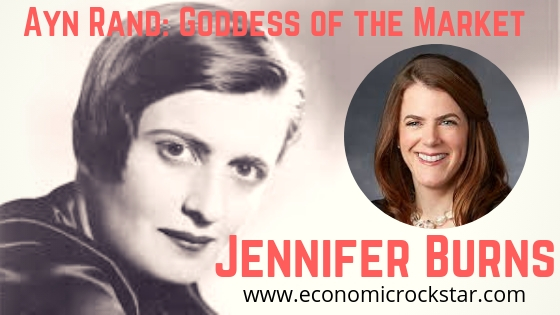
162: Jennifer Burns on Ayn Rand: Goddess of the Market and Objectivism
October 20, 2018 by Frank

http://traffic.libsyn.com/economicrockstar/162_Jennifer_Burns_Final.mp3
Play in New WindowDownload

162: Jennifer Burns on Ayn Rand: Goddess of the Market and Objectivism

Writing Advice:

Be happy with incrementalism. Write everyday. I have a schedule on and I’m very strict about it. I don’t try to force it, I don’t try to push it. I just try and do a little bit every day and I find if I’ve written everyday for a month, I’ve done this incredible amount of work.

So I think consistency is very much a part of it. And then you have to find a way to connect into why you’re writing and to really sort of feed that inner goal. So having questions or problems that are really intriguing to you because as a writer you have this unstructured time to write and you’re not going to write unless you’re really passionate about it.

Part of my writing practice is I don’t check my email and I don’t check the internet for certain times until I’ve done the writing. For me it works in the morning. And I do it by time and not by output.

Books:

Goddess of the Market: Ayn Rand and the American Right by Jennifer Burns

Atlas Shrugged by Ayn Rand

The Fountainhead by Ayn Rand

We the Living by Ayn Rand

Patreon

If you’re a fan of the podcast and would like to show your support in anyway, please check out my Patreon page at www.patreon.com/economicrockstar where you can sign up for any of the awards for as little as $1 a month or you can simply follow me on Instagram, the Economic Rockstar Facebook page or on Twitter or simply recommend the show to a friend, especially if they have never had the opportunity to study economics.

http://traffic.libsyn.com/economicrockstar/162_Jennifer_Burns_Final.mp3

Podcast: Play in new window | Download

146: David Kyle Johnson on Science Fiction as Philosophy and Finding Nietzsche’s Übermensch in Economics

June 30, 2018 by Frank

http://traffic.libsyn.com/economicrockstar/146_David_Kyle_Johnson_Final.mp3
Play in New WindowDownload

146: David Kyle Johnson on Science Fiction as Philosophy and Finding Nietzsche’s Übermensch in Economics

David Kyle Johnson is Associate Professor of Philosophy at King’s College in Wilkes-Barre, Pennsylvania. He earned a master’s degree and doctorate in philosophy from the University of Oklahoma.

At Oklahoma, he won the coveted Kenneth Merrill Graduate Teaching Award. In 2011, the American Philosophical Association’s committee on public philosophy gave him an award for his ability to make philosophy accessible to the general public.

Professor Johnson regularly teaches classes on metaphysics, philosophy of religion, philosophy of mind, and logic, as well as courses on critical thinking and scientific reasoning. He has published papers on human freedom, the problem of natural evil, the multiverse, the existence of souls, and many related topics in such journals as Religious Studies, Sophia, Philo, Philosophy and Literature, and Think. He also maintains two blogs for Psychology Today.

Professor Johnson also publishes on the intersection of pop culture and philosophy. One of his books, Inception and Philosophy: Because It’s Never Just a Dream, inspired an authors@Google talk with more than half-a-million YouTube views. He also has written numerous articles that explore the relationship between philosophical questions and such pop cultural phenomena as The Hobbit, Doctor Who, Batman, South Park, Johnny Cash, Quentin Tarantino, and Christmas.

Economics:

In this episode Kyle discusses/mentions: Mercantilism, Capitalism, Socialism, Marxism, free trade and poverty.

Economists mentioned in this Episode:

  • Adam Smith, Karl Marx and John Maynard Keynes.

Philosophers mentioned in this Episode:

  • John Locke, Nietzsche and John Rawls.

People mentioned in this Episode:

  • Bill Gates, Elon Musk, The Emperor, David X. Cohen and Christopher Nolan.

Shows/Movies mentioned in this Episode:

  • Black Mirror
  • Twilight Zone
  • Star Trek
  • Star Wars
  • Doctor Who
  • 2001: A Space Odyssey
  • Lord of the Rings
  • The Simpsons
  • Futurama

Books:

  • Inception and Philosophy by David Kyle Johnson
  • Introducing Philosophy Through Pop Culture: From Socrates to South Park, Hume to House by David Kyle Johnson
  • Heroes and Philosophy: Buy the Book, Save the World by David Kyle Johnson
  • The Wealth of Nations by Adam Smith
  • Lord of the Rings

Courses:

  • Sci-Phi: Science Fiction as Philosophy with David Kyle Johnson
  • The Big Questions of Philosophy
  • Exploring Metaphysics with David Kyle Johnson

http://traffic.libsyn.com/economicrockstar/146_David_Kyle_Johnson_Final.mp3

Podcast: Play in new window | Download
113: Jonathan McEvoy on Globalisation, National Autonomy, Capitalism and the Economic Resonance in Timeless Songs

November 25, 2016 by Frank

http://traffic.libsyn.com/economicrockstar/113-_Jonathan_McEvoy_Final.mp3
Play in New WindowDownload

113: Jonathan McEvoy on Globalisation, National Autonomy, Capitalism and the Economic Resonance in Timeless Songs

Jonathan McEvoy is currently an undergrad student of economics at Waterford Institute of Technology in jonathan-mcevoy-economic-rockstarIreland.

He was recently recognised for being in the top 5% of the Business School at W.I.T, earning the honour of being on the Deans List for Academic Achievement.

Jonathan has a unique understanding of the world around us and, together with his love of economics, has a unique perspective on the economics discipline.

Jonathan’s desire to discover and explore the multitude of economic thinking, from Keynesianism to Marxism, has resulted in him creating a blog called Economics – Thoughts of a Student which can be found at jonathanmcevoy888.blogspot.com.

His recent career history has prepared him well to be great public speaker and communicator.

Jonathan is also an athlete and a top soccer player, having spent time with English Premier League clubs Manchester City and Tottenham Hotspur.

Jonathan’s interests also include Health, Human Rights, Politics, Civil Rights, Poverty Alleviation and Science and Technology.

Economics:

In this episode, Jonathan discusses and mentions: production possibility frontier, comparative advantage, production, services, efficiency, technology, foreign direct investment, tariffs, income, vertical farming, externalities, capitalism, profit, inequality, welfare, labour costs, GDP, economics of war and economics of romance.

Economists:

In this episode, Jonathan discusses and mentions: Adam Smith, John Maynard Keynes, Karl Marx, Friedrich Engels and David Ricardo.

In this episode you will learn:

  • about the balance required between globalisation and national autonomy.
  • about Ireland’s role in CERN.
  • whether future-tech will improve humanity’s standard of living?

  • how economics and technology are inextricably interlinked.
  • why economists and technologists should increase collaboration for the betterment of society.
  • how the world’s production possibility frontier can move outward to reach once unimagined and unattainable outcomes.
  • whether ‘planetisation’ can be a reality.
  • the use of songs to capture the economic and social setting of an era.
  • and much much more.

People Mentioned in this Episode:

  • Cormac O’Rafferty
  • Stephen Hawking
  • Nikola Tesla
  • Elon Musk
  • John F. Kennedy
  • Neil deGrasse Tyson
  • Warren Buffett
  • Bob Dylan
  • Bruce Springsteen
  • Tupac Shakur
  • Bruce Hornsby

Links:

  • Finding the Balance Between Globalisation and National Autonomy by Jonathan McEvoy

  • Why Ireland Should Aspire to CERN Status – The Role of Economics in Science and Technology and How They Benefit One Another by Jonathan McEvoy

  • Will Future-Tech Improve Humanity’s Standards of Living? by Jonathan McEvoy
  • How to Write Timeless Songs like Springsteen and other Artists – The Economic Resonance in Timeless Songs and Creativity being born from Economics by Jonathan McEvoy

  • The Big Bang Theory

Where to Find Jonathan McEvoy:

  • Website: jonathanmcevoy888.blogspot.com
  • Twitter: @JonathanMcEv0y

Books:

  • Wealth of Nations by Adam Smith
  • Communist Manifesto by Karl Marx and Friedrich Engels
  • Game of Thrones by George R. R. Martin
http://traffic.libsyn.com/economicrockstar/113-_Jonathan_McEvoy_Final.mp3

Podcast: Play in new window | Download

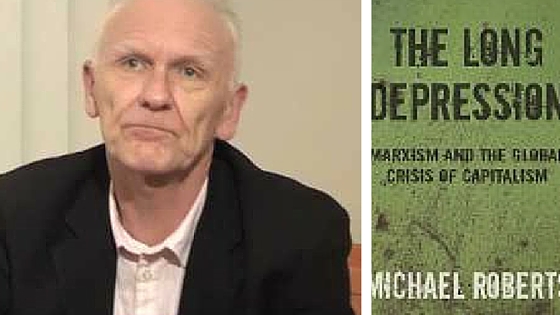
085: Michael Roberts on Understanding Karl Marx and His Thinking on Capitalism

May 12, 2016 by Frank

http://traffic.libsyn.com/economicrockstar/085_Michael_Roberts_Final_.mp3
Play in New WindowDownload

085: Michael Roberts on Understanding Karl Marx and His Thinking on Capitalism

Michael Roberts

Michael Roberts has worked as an economist for over 30 years in the City of London. He is author of The Great Recession: Profit cycles, economic crisis A Marxist View and The Long Depression: Marxism and the Global Crisis of Capitalism.

Economics:

In this episode, Michael mentions: Marxism, capitalism, Austrian economics, GDP, multinationals, inflation, printing of money, booms, busts, profitability, recession, depression, inequality, wealth, means of production, private property, competition, externalities, unintended consequences, bailout, austerity and unemployment.

Economists:

In this episode, Michael mentions: Karl Marx, Friedrich Hayek, Adam Smith, John Maynard Keynes, Brad DeLong and Paul Mattick.

Links:

  • www.thenextrecession.wordpress.com by Michael Roberts

Books:

  • The Great Recession: Profit cycles, economic crisis A Marxist View by Michael Roberts
  • The Long Depression: Marxism and the Global Crisis of Capitalism by Michael Roberts
  • The Communist Manifesto by Karl Marx and Friedrich Engels
  • Capital by Karl Marx
  • Business As Usual by Paul Mattick
  • Waiting for Godot by Samuel Beckett


http://traffic.libsyn.com/economicrockstar/085_Michael_Roberts_Final_.mp3

Podcast: Play in new window | Download
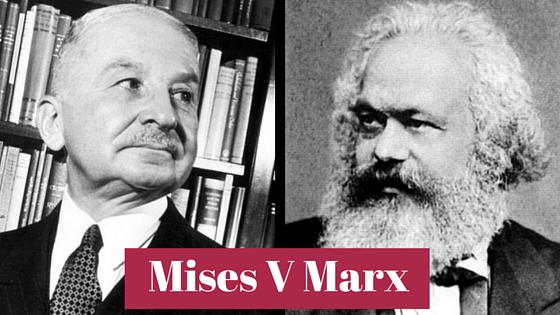
084: Mises v Marx: A Discussion with Peter Boettke

May 5, 2016 by Frank

http://traffic.libsyn.com/economicrockstar/084_Peter_Boettke_2_Final.mp3
Play in New WindowDownload

084: Mises v Marx: A Discussion with Peter Boettke

Mises V Marx

In this episode, Professor Peter Boettke, Professor of Economics and Philosophy at George Mason University, discusses the thinking of Ludwig von Mises and Karl Marx. Peter highlights the underlying theses behind both economists arguments – liberalism and socialism.

Read the first chapter to Living Economics by Peter Boettke here.

Economics:

In this episode, Peter mentions: Austrian economics, Marxism, liberalism, socialism, the Diamond-Water Paradox, instability of capitalism, private ownership, communal ownership, monopoly, financial crisis, leverage, 

Economists:

In this episode, Peter mentions: Ludwig von Mises, Karl Marx, Milton Friedman, Joan Robinson, Rosa Luxemburg, Elinor Ostrom, Adam Smith, F. A. Hayek, Milton Friedman, Paul Samuelson, John Cochrane, Paul Krugman, Joseph Stiglitz and J. K. Galbraith.

Books:

  • Living Economics: Yesterday, Today, and Tomorrow by Peter J. Boettke
  • The Communist Manifesto by Karl Marx
  • Karl Marx and the Close of His System  by Eugen von Böhm-Bawerk
  • Mises: The Last Knight of Liberalism Jörg Guido Hülsmann
  • Phishing for Phools: The Economics of Manipulation and Deception by George A. Akerlof and Robert Schiller
  • After War: The Political Economy of Exporting Democracy by Christopher J. Coyne
  • Doing Bad by Doing Good: Why Humanitarian Action Fails by Christopher J. Coyne
  • The Road to Serfdom: Text and Documents–The Definitive Edition by F. A. Hayek
  • How the Dismal Science Got Its Name: Classical Economics and the Ur-Text of Racial Politics by David M. Levy
  • The Soul of Man Under Socialism by Oscar Wilde
  • The Grapes of Wrath by John Steinbeck
http://traffic.libsyn.com/economicrockstar/084_Peter_Boettke_2_Final.mp3

Podcast: Play in new window | Download

076: Greg Ip on Foolproofing the Economy and Why Stability is Destabilizing

March 10, 2016 by Frank

http://traffic.libsyn.com/economicrockstar/076_Greg_Ip.mp3
Play in New WindowDownload

076: Greg Ip on Foolproofing the Economy and Why Stability is Destabilizing

Greg Ip is one of the best-known economics journalists in the US.Greg Ip Economic Rockstar

He is currently chief economics commentator of The Wall Street Journal and writes about U.S. and global economic developments and policy each week in the Capital Account column and on Real Time Economics, the Wall Street Journal’s economics blog.

From 2008 to January 2015, he was U.S. Economics Editor of The Economist magazine. Greg is the author of Foolproof: Why Safety Can Be Dangerous and How Danger Makes Us Safe as well as author of The Little Book of Economics: How the Economy Works in the Real World.

“Stability is Destabilising”- Hyman Minsky

Economics:

In this episode, Greg mentions and discusses: junk bonds, capitalism, investment, growth, financial crisis, bank deposits, loans, currency, gold, exchange rates, money market funds, bank run, exchange traded funds, recessions, unintended consequences and the Paradox of Thrift.

Economists:

In this episode, Greg mentions and discusses: Paul Volcker, Hyman Minsky, Gary Gorton, Joseph Schumpeter and John Maynard Keynes.


In this episode you will learn:

  • about the theme behind Greg Ip’s latest book Foolproof.

  • when the pursuit of safety lead us into danger?

  • what forest fires have to do with Wall Street.

  • about the relationship between the financial market (and its potential for a crisis) and ecological systems.
  • the way we publicly and privately try to cope with risk and danger and how those choices can create unintended consequences.

  • about the Fallacy of Composition: Things you do that are safe actually end up making other people less safe.
  • what American Football can teach us about the Fallacy of Composition.
  • how making American Football safe with the introduction of helmets has created increased risk taking and more injuries.
  • what past economic and financial crises have in common.
  • how the financial system succeeded too well in making people feel their money was safe.
  • how banking regulations and capital controls introduced after the financial crisis will create risks in other parts of the economy and financial markets.
  • if savings is actually bad for the economy.

  • about Keynes’ Paradox of Thrift and how savings forces others to borrow.

  • whether exchange traded funds (ETFs) will be the next financial catastrophe.
  • about the Peltzman Effect on anti-lock brakes.
  • how Paul Volcker‘s regulation of capital flows caused the growth of shadow banking.

  • how The Great Moderation changed attitudes about debt and how relaxed laws allowed high-risk households to borrow for mortgages.

  • about Gary Gorton of Yale and his explanation for a financial crisis.
  • how being present in danger can remind ourselves of the things that aren’t always safe.
  • whether the finance industry could take the lessons learned about safety and regulation in the airline industry.
  • why the Lehman Brothers collapse surprised many due to the US government indicating to the market that banks and mortgage companies would be bailed out.
  • how German savers were much to blame for the euro crisis than their European counterparts that borrowed.
  • why we continue to build cities near water which can cause devastation in the form of floods and tidal waves.
  • why The Netherlands, with their ‘Room For The River’ programme, is destroying dykes and allowing their lands to flood.
  • why Greg Ip is worried about the situation in China and how the stability that the government is trying to maintain will eventually lead to instability.

“If banks are limited from lending then lending activity will migrate elsewhere. We see this happening at exchange traded funds and other shadowy parts of the financial system. And you worry that risks are starting to grow there.” – Greg IP

“One way to protect ourselves against disaster is to make use of the presence of danger to remind ourselves that things aren’t always safe and to take steps that keep us safe”.  – Greg IP

“What I worry about more is that the pendulum has swung too far against risk taking. And the risks that are been taken are being channeled too far in the direction of financial risk and not real economy risk – people starting new businesses or buying new homes.” – Greg Ip

“What I worry about China is that they have leadership that is worried about political and economic stability.”

Where to Find Greg Ip:

  • The Wall Street Journal 
  • www.gregip.com

Books:

  • Foolproof: Why Safety Can Be Dangerous and How Danger Makes Us Safe by Greg Ip
  • The Little Book of Economics: How the Economy Works in the Real World by Greg Ip

Other Interesting Links:

  • Deregulation: The Expected and The Unexpected by Sam Peltzman
  • Do we really need more regulation of financial derivatives? by Merton H. Miller
  • Financial Innovation: The Last Twenty Years and the Next by Merton H. Miller
  • Peltzman, S. (1975). The Effects of Automobile Safety Regulation, Journal of Political Economy: 677 – 726.
  • National Center for Catastrophic Sport Injury Research 
  • Probability of a Hazardous Material Truck Accident in New Jersey by Damodaran, M., Daniel, J. and Luke, A. C. (2002)
http://traffic.libsyn.com/economicrockstar/076_Greg_Ip.mp3

Podcast: Play in new window | Download

061: Roger Whitney on the Myths to Retirement Planning and the Lazy Mans Method to Saving

December 3, 2015 by Frank

http://traffic.libsyn.com/economicrockstar/061_Roger_Whitney_Final.mp3
Play in New WindowDownload

061: Roger Whitney on the Myths to Retirement Planning and the Lazy Mans Method to Saving

Roger Whitney began his career as a Financial Advisor in 1991 and witnessed first-hand the rise and fall of the ‘New roger whitneyEconomy’ and the Dot-com bubble that ended in 2000.

This experience made Roger realise that financial management is about people, not money, and that they are served best by advisors that are fiduciaries to their clients and have the heart of a teacher.

In 2003 Roger left, at the time, the largest private bank in the world and co-founded WWK Wealth Advisors. Today, they are a firm of 14 professionals managing over $200 million in assets.

Roger is a lifelong learner and holds many degrees and certifications. He has a B.A. in International Relations, is a Certified Investment Management Analyst and a Certified Private Wealth Advisor.

Roger also teaches courses on Wealth Management, Retirement Planning and Employee Benefits.

Roger’s blog, The Retirement Answer Man, was recently awarded the 2015 PLUTUS award for the best Retirement focused blog and podcast. You can check it out at rogerwhitney.com as well as on iTunes.

Advice:

“Make sure you make the most of the only life you have. Retirement is part of that but don’t miss where you’re at today” – Roger Whitney

Economics/Finance:

In this interview, Roger mentions: the Permanent Income Hypothesis, retirement, retirement planning, pensions, social security, demographics, baby boomers, capitalism, growth, IRAs, Roth IRAs, 401k, quantitative easing, real estate, cash flow, investment, private placement memorandum and capital rates.

Economists:

In this interview, Roger mentions: Milton Freidman

In this episode you will learn:

  • the problem with budgeting.
  • develop one habit to control your budgeting needs and requirements.
  • lazy man’s method to saving.
  • four myths that could ruin your retirement and how to avoid them.
  • the Permanent Income Hypothesis.
  • how Roger got his cashflow in place when setting up his business.
  • that cutting your cable bill won’t create the opportunity to generate income.
  • the biggest regrets that people have when they retire.
  • the 3 Phases of Retirement.
  • whether we have a pension time bomb or if capitalism will reduce the risks.
  • what are IRAs and Roth IRAs work.
  • the possible scenario for the next generation to fund a bankrupt social security in the US.

Quotes by Roger in Episode 61 0f the Economic Rockstar podcast:

The bigger opportunity is how to generate extra income – Roger Whitney

Click To Tweet

“I know quantitative easing. I know how bad all this stuff might be. At the end of the day, we just have to have out own house in order. And if we have our own house in order, we can insulate ourselves from a lot of things. That’s the only way I know how to get through things.” – Roger Whitney

4 Myths that Could Ruin Your Retirement and How to Avoid Them:

  1. Retirement is not a number: How much do I need to save for retirement?
  2. You’re spending is going to be consistent throughout your retirement.
  3. Retirement means not working.
  4. Having a financial plan is enough.

3 Phases of Retirement:

  1. The Go-Go Years
  2. The Slow-Go Years
  3. The No-Go Years

Books:

  • QBQ! the Question Behind the Question: Practicing Personal Accountability at Work and in Life by John G. Miller

  • The How of Happiness: A New Approach to Getting the Life You Want by Sonja Lyubomirsky

Podcasts:

  • The Retirement Answer Man
  • Stacking Benjamins
http://traffic.libsyn.com/economicrockstar/061_Roger_Whitney_Final.mp3

Podcast: Play in new window | Download

060: Manu Saadia on Trekonomics – The Economics of Star Trek: Scarcity, Productivity and Public Goods

November 26, 2015 by Frank

http://traffic.libsyn.com/economicrockstar/Manu_Saadia_Final.mp3
Play in New WindowDownload

060: Manu Saadia on Trekonomics – The Economics of Star Trek: Scarcity, Productivity and Public Goods

Manu Saadia fell into science fiction and Star Trek fandom at the age of eight, back in Paris, France, where he was born and raised.Manu Saadia

Manu  studied history of science and economic history in Paris and Chicago. After many happy years in the Ivory Tower, he yielded to his childhood passion for the future.

Manu embarked on his continuing mission to explore strange new worlds by boldly going where many have gone before: Los Angeles, CA, where he advise and (occasionally) builds tech companies.

Manu received the 2005 Wayne C. Booth Graduate Student Prize for Excellence in Teaching at the University of Chicago.

His book, Trekonomics, is currently available for pre-order at www.inkshares.com and will be released in 2016.

Star Trek offers much more detail about its own world and the way its economics actually works – like the plumbing so to speak. So that’s what I wanted to do. Go into the plumbing of Star Trek. – Manu Saadia

Economics:

In this interview, Manu mentions:  trekonomics, crowd funding, labor, economic history, trade, robots, capitalism, comparative advantage, currency, money, Gold-Pressed Latinum, public goods, conspicuous consumption, scarcity, peak oil, productivity and opportunity costs.

Economists:

In this interview, Manu mentions: Brad DeLong, Felix Salmon, Adam Smith, Thomas Malthus, Hubbert, Paul Ehrlich, Julian Simon, Romer, Larry Summers, John Maynard Keynes and Angus Deaton,

In this episode you will learn:

  • why Manu Saadia wrote Trekonomics.
  • about the Star Trek Economics panel at Comic Con.
  • why economists love Star Trek.
  • about inkshares and how it can help authors publish their book.
  • how traditional media rather than social media boosted pre-order sales of Trekonomics – an ironic outcome.
  • when Manu’s interested in economics and Star Trek collided.
  • about the work of Isaac Asimov and how his stories are a discourse on economics.
  • how the stories of robots and the future by Asimov influenced and shaped the storyline in Star Trek.
  • about the replicators in Star Trek and how they solve the problem of economic scarcity.
  • about the Ferengi’s and how they represent capitalism and trade.
  • why The Federation or the humans in Star Trek do not use money but have a foreign account to trade with the Ferengi’s.
  • about the Ferengi’s currency, Gold-Pressed Latinum, which cannot be replicable.
  • why owning a replicator is a ‘pain in the ass’.
  • how things that cannot be replicated has value but those that can be replicated has no value.
  • if Keynes’ The Economic Possibilities of Our Grand Children is a rebuttal of the writings of H. G. Wells.
  • about GPS being a public good and the benefits it has brought to the public.
  • why making GPS a public good in 1983 was one of the best decisions Ronald Reagan made as US President.
  • Manu’s favourite Star Trek episode is Lower Decks (The Next Generation).

Quotes by Manu Saadia in Episode 60 of the Economic Rockstar Podcast:

Trekonomics got a lot of support and very nice feedback from a lot of economists – Manu Saadia

Click To Tweet

“It always baffles me when you have these very famous and serious economic thinkers were in fact  total Star Trek nerds. I was on a panel at New York Comic Con with Brad DeLong, Paul Krugman and Annalen Newitz from i09. There was Chris Black as well and Felix Salmon.” – Manu Saadia

Brad DeLong came to the panel with a Star Trek hoodie. – Manu Saadia

Click To Tweet

On Isaac Asimov: “All of his work is a long meditation on economics, either foundation where there is this science called psychohistory which is in fact a fictional mathematical modelling of human behaviours on the scale of societies on a galactic scale.” – Manu Saadia

“One of the reasons why I wanted to study economics was that I was fascinated by and really wanted to understand the transformation of humanity’s relation to its own labor. This is one of the great questions of political economy because it determines a lot of things when it comes to the shape society and the role of the state and how behaviors are determined and constructed over time. But it’s also the key to understanding where we’re going”. – Manu Saadia

“I would say the replicators are more of a metaphor. If you look at their status in the series, they do not help move the narratives forward. They’re just there to signify that there’s no need to work. They’re a little bit like robots in Asimov. They have the same narrative function, which is to show and demonstrate that post-scarcity does exist and is based on automation and artificial intelligence.” – Manu Saadia

The Ferengi’s are the capitalist, merchant traders of the galaxy – Manu Saadia

Click To Tweet

Most of the stuff in Star Trek is basically a public good – Manu Saadia

Click To Tweet

I think Star Trek is very much what Keynes described in The Economic Possibilities of Our Grand Children – Manu Saadia

Click To Tweet

Books:

  • Scatter, Adapt, and Remember by Annalen Newitz 
  • Isaac Asimov
  • Frankenstein by Mary Shelly
  • The Economic Possibilities of Our Grand Children by John Maynard Keynes

Papers:

  • Romer (1990) Productivity Gains

Links:

  • What I Learned Crowdfunding Trekonomics  by Manu Saadia
  • Trekonomics The economics of Star Trek: how does it work, and how do we get there?  by Manu Saadia
  • View the transcript to The Amazing Economics of Star Trek at New York Comic Con
  • www.i09.com 
  • www.inkshares.com
  • What the economics of Star Trek can teach us about the real world by Brian Fung, Andrea Peterson and Hayley Tsukayama Washington Post 
  • The Live Long and Prosper Edition Slate Money 
  • Club of Rome 

Manu’s Favorite Star Trek Epsiodes:

  • City on the Edge of Forever
  • Arena

Where to Find Manu:

  • inkshares.com
  • fusion.net

Music:

  • Star Trek Episode Amok Time
http://traffic.libsyn.com/economicrockstar/Manu_Saadia_Final.mp3

Podcast: Play in new window | Download

023: Loretta Napoleoni on Financing Terrorism and the Creation of the Islamic State

March 12, 2015 by Frank

http://traffic.libsyn.com/economicrockstar/023_Loretta_Napoleoni.mp3
Play in New WindowDownload

023: Loretta Napoleoni on Financing Terrorism and the Creation of the Islamic State

Loretta Napoleoni is an expert on terrorist financing and the IslLoretta Napoleoniamic State. She advises several governments and international organizations on counter-terrorism and money laundering.

As Chairman of the countering terrorism financing group for the Club de Madrid, Loretta brought heads of state from around the world together to create a new strategy for combating the financing of terror networks.

Loretta is a regular media commentator for CNN, Sky and the BBC and advises several banks on strategies to counter the current ongoing crisis. She lectures regularly around the world on economics, terrorism and money laundering.

Loretta is also a columnist and writes about terrorism, money laundering and the economy for several European financial papers including El Pais, The Guardian and Le Monde.

Loretta began her career as an economist, working for several banks and international organizations in Europe and the US. She has a Phd in economics and a Masters of Philosophy in International Relations and one in terrorism.

She is the bestselling author of numerous books including The Islamist Phoenix, Maoanomics, Rogue Economics, Terror Incorporated and Insurgent Iraq.

Her books are translated into 18 languages including Chinese and Arabic.

“I studied economics because I thought that economics was the way to change the world” – Loretta Napoleoni.

Economic Themes:

In this interview, Loretta mentions and discusses: Islamic Finance, gold, barter, quantitative easing, reserve currency, consumerism, the Marshall Plan, labor, wages, sex trade, slavery, demand, profit, trade unions, capitalism and growth.

Economists:

In this interview, Loretta mentions: Adam Smith, David Ricardo, Karl Marx, John Stuart Mills and John Maynard Keynes.

Advice:

The key is to always search for the truth. It is important to listen to the experts because otherwise you get the wrong picture – Loretta Napoleoni.

Find out:

  • about Loretta’s involvement in the feminist revolution in the 1970s in Italy where she was one of the founding members of the Italian Feminist Movement.
  • why she studied economics and the subsequent irony of working for a Russian bank.
  • why Loretta sold her company to do a PhD in terrorism at the London School of Economics.
  • about Loretta’s contact with the Italian Marxist organisation, The Red Brigade.
  • how terrorists fund their activities.
  • who initially sponsored ISIS or the Islamic State initially and how they may regret this.
  • why Jihadi John and others were attracted to the Islamic State.
  • how Saudi Arabia’s sponsor of a war by proxy against the Assad regime in Syria resulted in the creation of IS.
  • about The Caliphate and why IS wants to re-create a modern version of this region.
  • about the functioning economy of the Islamic State.
  • if the Islamic State has a functioning banking system.
  • if the Islamic State is using gold coins, dollars or a bartering system.
  • about the how women are treated in the Islamic State.
  • why Loretta believes that the feminist movement ultimately failed.
  • if the US policy of quantitative easing is making it easier to finance terrorism due to the increase in the money supply.
  • the meaning of the Patriot Act and how every transaction made in US dollars is tracked and traced everywhere in the world.
  • whether the US should stop their foreign policy in the Middle East and North Africa.
  • how the world is being shaped by dark economic forces based on the fantasy world of consumerism.
  • how an increase in the number of democratic countries has resulted in an increase in modern-day slavery.
  • about the sex trade and the fall of the Berlin Wall.
  • how the Chinese are better capitalists than Western countries.
  • how we can learn from the Chinese economy.
  • whether Africa will benefit from the Chinese model of capitalism.
  • why there is a ‘race to the bottom’ in todays economy.
  • why Loretta believes that we need a new theory in economics.
  • about the problem of mathematics in economics.
  • the advice Loretta gives for writing a book.

The Caliphate and Islamic State

The Caliphate is a way to formulate the Muslim political utopia, whereby for centuries, Muslims have dreamt of the creation of a State but have failed. The political reality of their world has been dictatorship, foreign power, colonization or the tribal system.

The Caliphate is the only political expression that the Muslims have produced. The ancient Caliphate was a splendid civilization, very different from the Caliphate of the Islamic State because it was very tolerant. Jews, Christians and Muslims lived together in peace without any problems.

Today, the economy of the Islamic State is a closed economy in which the trading of goods and services is done within the State. There is some degree of smuggling going on. Loretta Napoleoni believes that the rise of the Islamic State is a European problem because of colonialization.

Quantitative Easing, the US Dollar and the Illegal Arms Market

The US can borrow against the stock of dollars in circulation all over the world since the dollar is the reserve currency. What this means is that the US prints more dollars, not only for the demand inside the US but also for the demand outside the US. The illegal arms market is run in dollars. Since this is a market that grows, it therefore needs to be fed an increasing supply of dollars. If the Islamic State is using dollars, then they will benefit indirectly from the printing of money inside the United States.

Slavery and the Link with Consumerism

This economy, this rogue economics, is very much an economy that is driven on one end by consumption, this endless consumption. And to feed this monster of endless consumption, you have to produce at a cheaper level. So you use anything you can.  – Loretta Napoleoni.

The sex trade boomed with the fall of the Berlin Wall. Some women had no alternative but to prostitute themselves to feed their family because of the collapse of the Communist economy.

On economics:

“There is too much maths. Everything is reduced to mathematical models. They want to predict everything with numbers. Economics is a social science so you can’t predict people’s behavior.”

Advice:

“If you want to write a book, you start now and you stop when you finish. You don’t stop in the middle, you don’t do many things. All you do is work, work, work.” – Loretta Napoleoni.

Resources:

  • Scrivener 
  • Evernote

Recommended Books:

  • The Islamist Phoenix: Islamic State and the Redrawing of the Middle East by Loretta Napoleoni.
  • Maonomics: Why Chinese Communists Make Better Capitalists than We Do by Loretta Napoleoni.
  • 10 Years That Shook the World by Loretta Napoleoni.
  • Terrorism and the Economy: How the War on Terror is Bankrupting the World by Loretta Napoleoni.
  • Rogue Economics: Capitalism’s New Reality by Loretta Napoleoni.
  • Terror Incorporated: Tracing the Dollars Behind the Terror Networks by Loretta Napoleoni.
  • The Wealth of Nations by Adam Smith
  • The Theory of Moral Sentiments by Adam Smith

Where To Find Loretta Napoleoni:

  • www.lorettanapoleoni.net
http://traffic.libsyn.com/economicrockstar/023_Loretta_Napoleoni.mp3

Podcast: Play in new window | Download

Frank Conway

Frank Conway is founder of Economic Rockstar and lecturer of economics, finance and statistics. Read More…

View My Blog Posts

Youtube Sub

Become a Patron of the Economic Rockstar Podcast

patreon

Ireland’s Economy by the Numbers

Leaving Cert Economics: Ireland’s Economy  Click here to download a workbook on Ireland’s Economy so that you can add your own notes. [Original size] Ireland’s Economy by fconway

Categories

Subscribe and Never Miss An Episode

itunes-logo

Recent Posts

  • Ireland’s Economy by the Numbers April 8, 2019
  • 174: Wendy Carlin on The Core Project, Capitalism, Democracy and Normative Statements February 13, 2019
  • 173: Stephen Wright on Core Econ as a Learning Resource for Mainstream Economics January 28, 2019
  • 172: Best of 2018 Part 2: From the Great Depression to Futurism; Institutions, Individualism, Cooperation and Reciprocity January 22, 2019
  • 171: Best of 2018 Part 1 January 3, 2019

Copyright © 2026 · Podcast Pro Theme on Genesis Framework · WordPress · Log in

This website uses cookies to improve your experience. We'll assume you're ok with this, but you can opt-out if you wish. Accept Reject Read More
Privacy Policy

Privacy Overview

This website uses cookies to improve your experience while you navigate through the website. Out of these, the cookies that are categorized as necessary are stored on your browser as they are essential for the working of basic functionalities of the website. We also use third-party cookies that help us analyze and understand how you use this website. These cookies will be stored in your browser only with your consent. You also have the option to opt-out of these cookies. But opting out of some of these cookies may affect your browsing experience.
Necessary
Always Enabled
Necessary cookies are absolutely essential for the website to function properly. This category only includes cookies that ensures basic functionalities and security features of the website. These cookies do not store any personal information.
Non-necessary
Any cookies that may not be particularly necessary for the website to function and is used specifically to collect user personal data via analytics, ads, other embedded contents are termed as non-necessary cookies. It is mandatory to procure user consent prior to running these cookies on your website.
SAVE & ACCEPT