
• ABOUT
  • RESOURCES
  • PODCAST
  • BOOKS
  • BLOG
  • SUPPORTERS
  • QFA Financial Advice
  • CONTACT

Economic Rockstar

Connecting Brilliant Minds in Economics and Finance

067: Leigh Caldwell on Cognitive Economics and the Mathematics of Behavioral Economics
January 3, 2016 by Frank

http://traffic.libsyn.com/economicrockstar/067_Leigh_Caldwell_Final.mp3
Play in New WindowDownload

067: Leigh Caldwell on Cognitive Economics and the Mathematics of Behavioral Economics

leigh caldwellLeigh Caldwell is a behavioural economist based in London.

Leigh, together with Elina Halonen, runs the Irrational Agency, which takes the latest scientific discoveries in psychology and behavioural economics, blends it with their hands-on experience of marketing and business, and turns them into powerful, incisive market research techniques.

In 2012, Leigh condensed his experience in pricing and the marketing of several of his businesses into a new book The Psychology of Price: How to use price to increase demand, profit and customer satisfaction.

Leigh is co-founder of the London Behavioural Economics Network, writes for the Pricing Revolution and the Knowing and Making blogs, and regularly features as an economics commentator on BBC News, Radio 4, Research Magazine and other media.

My own background is all about intellectual challenge. I went to university early as a teenager. I studied maths and physics. I was always into pushing myself intellectually and finding the next challenge to take on – Leigh Caldwell

Economists: 

In this interview, Leigh mentions: Elina Halonen, Dan Ariely and George Lowenstein.

Economics:

In this interview, Leigh mentions: Behavioral economics, experimental economics, lab experiments, demand curve, equilibrium, utility, mathematics, rationality, nudge, choice architecture, cognitive economics, reference pricing model, anchoring, hyperbolic discounting, heuristics, neuroeconomics, Nudge Unit, organ donation, tax collection, productivity, GDP and unemployment.

In this episode you will learn:

  • why Leigh help co-found the London Behavioural Economics Network (LBEN).
  • the importance of academics and practitioners working together to further the discipline of economics.
  • why finding the sweet-spot between controlled experiments and realism is difficult yet important.
  • what cognitive economics is and how different it is the behavioral economics.
  • whether big data could influence an individuals consumption behaviors.
  • about the need to use the mathematics of computer science in behavioral economics.
  • why we shouldn’t use the current maths of economics to explain human behavior.
  • why a lack of mathematics is holding back the discipline of behavioral economics.
  • why mathematics is essential for theorising and modelling economics, especially behavioural economics.
  • about the paradox of self-awareness in cognitive economics when faced with choices.
  • how a consumers relationship with a material object is a unique experience and how putting a price on the good can ruin this experience.
  • why charging a higher price for your product or service would generate higher profits in a perceived perfectly competitive market.
  • whether the 99p or 99 cent pricing strategy works.
  • about the reference pricing model and why charging $39 for a product is better than charging $34 for the same product.
  • about the importance of setting prices when considering how numbers are spoken, i.e. numbers with more syllables are received to be more expensive than those with fewer syllables. 
  • how Leigh uses the findings in academic papers to make money for his business.
  • how Leigh uses economic conferences to network, to find out about the latest research and to discover the new academic societies that have been established.
  • about Leigh’s goal for 2016 to start a Cognitive Economics Society.
  • about the advice Leigh would give the UK government to apply cognitive and behavioral economics to deal with some aspects of social life.
  • how the UK government changed people’s behaviour about paying their taxes on time.
  • about the productivity challenge the UK government is facing today and what can be done about it.
  • about the current research Leigh is undertaking regarding where our preferences come from.

Conferences:

  • Judgement and Decision Making Conference
  • American Economics Association Conference

Books:

  • The Psychology of Price: How to use price to increase demand, profit and customer satisfaction by Leigh Caldwell.
  • Predictably Irrational by Dan Ariely.
  • Basic Instinct by Pete Luhn
  • Nudge by Richard Thaler
  • Thinking, Fast and Slow by Kahneman and Tversky

http://traffic.libsyn.com/economicrockstar/067_Leigh_Caldwell_Final.mp3

Podcast: Play in new window | Download

050: Dan Ariely on Irrational Behavior and the Importance of Our Environment When Making Decisions

September 16, 2015 by Frank

http://traffic.libsyn.com/economicrockstar/050_Dan_Ariely_Final.mp3
Play in New WindowDownload

050: Dan Ariely on Irrational Behavior and the Importance of Our Environment When Making Decisions

Dan Ariely is Professor of Psychology & Behavioral Economics at Duke University in North Carolina. Dan’s interests spanDan Ariely a wide range of behaviors, and his sometimes unusual experiments are consistently interesting, amusing and informative, demonstrating profound ideas that fly in the face of common wisdom.

In addition to appointments at the Fuqua School of Business, the Center for Cognitive Neuroscience, the Department of Economics, and the School of Medicine at Duke University, Dan is also a founding member of the Center for Advanced Hindsight.

Dan is the author of the New York Times bestsellers Predictably Irrational, The Upside of Irrationality, and The Honest Truth About Dishonesty and his latest book Irrationally Yours is now available.

Dan has received numerous honors and awards in medicine, psychology and economics.

Dan received a B.A in Psychology from Tel Aviv University, an M.A and PhD in Cognitive Psychology from University of North Carolina and another PhD in Business Administration from Duke University.

Influencer:

Professor Hanan Frenk, Tel Aviv University

Economists:

In this interview, Dan mentions: Brian Wansink. 

Psychologists:

In this interview, Dan mentions: Mike Norton and Elizabeth Dunn.

Economics:

In this interview, Dan mentions and discusses: Tragedy of the Commons, behavioral economics, public goods, pricing, decision-making, choice architecture, Ulysses Contract, happiness, asymmetric dominance effect and choice.

Takeaway:

“Think about your environment and always experiment” – Dan Ariely

Click To Tweet

In this episode, you will learn:

  • about Dan Ariely’s traumatic experience resulting in severe burns.
  • how Dan Ariely found his love for psychology and behavioral economics.
  • why Dan will not be teaching his Irrational Behavior course on Coursera.
  • the problems with MOOCs like Coursera and why it is making the wrong choice regarding its open platform system.
  • why Dan was turned down for his first book – a cookbook and what advice he was given by a publisher.
  • why we as humans make very costly mistakes and what we can do about it.
  • how people eat more than they realise and how experiments in economics have shown this.
  • why we are bad at doing things that makes us happy.
  • the most common mistake companies make when making decisions or processing information.
  • how companies can avoid making mistakes.
  • if anger is a good or bad emotion.
  • the most surprising finding from Dan Ariely’s research.
  • the most surprising question put to Ask Ariely.
  • how to get poor people in Kenya to save.
  • how your environment matters when making decisions.

Quotes by Dan Ariely in Episode 50 of the Economic Rockstar Podcast:

“Choice architecture is this idea that our environment influences how we make decisions” – Dan Ariely

Click To Tweet

“In the process of trying to not make any mistakes, companies create environments that punish risk and therefore punish ingenuity and growth” – Dan Ariely

“Tim is a very interesting character and he is experimenting on himself. We have to realize that his experiments have the validity that they work very well for him” – Dan Ariely

On Coursera:

“I think we do need rules for trolls. I think that pricing is a very good mechanism for some things and I’m not sure it’s a mechanism for all for all things like this. The reality is that Coursera probably over samples from the people on the tail of the distribution in terms of mental stability.” – Dan Ariely

Books:

  • Predictably Irrational by Dan Ariely
  • The Upside of Irrationality by Dan Ariely
  • The Honest Truth About Dishonesty by Dan Ariely
  • Irrationally Yours by Dan Ariely
  • The 4 Hour Chef by Tim Ferriss
  • Happy Money: The Science of Smarter Spending by Elizabeth Dunn and Michael Norton

Resources Mentioned by Dan Ariely:

  • Kitchen Safe: www.thekitchensafe.com
  • Coursera: www.coursera.org

Where to Find Dan Ariely:

  • Website: www.danariely.com
  • Twitter: @danariely
  • LinkedIn: Dan Ariely
  • Ted: www.ted.com

Transcript:

The full transcript of this episode with Dan Ariely will be available shortly.

Thanks for Listening!

Thanks so much for joining me again this week. Have some feedback you’d like to share? Leave a note in the comment section below!

If you enjoyed this episode, please share it using the social media buttons you see at the bottom of the post.

Also, please leave an honest review for the Economic Rockstar Podcast on iTunes! Ratings and reviews are extremely helpful and greatly appreciated! They do matter in the rankings of the show, and I read each and every one of them.

http://traffic.libsyn.com/economicrockstar/050_Dan_Ariely_Final.mp3

Podcast: Play in new window | Download
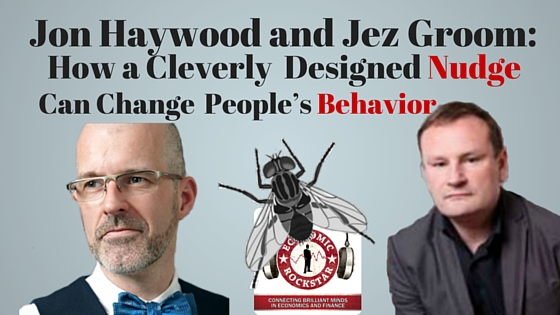
049: Jez Groom and Jon Haywood on How a Cleverly Designed Nudge Can Change People’s Behavior – Including How We Pee

September 10, 2015 by Frank

http://traffic.libsyn.com/economicrockstar/Jez_Groom_Final.mp3
Play in New WindowDownload

049: Jez Groom and Jon Haywood on How a Cleverly Designed Nudge Can Change People’s Behavior – Including How We Pee

Jez Groom is a behavioral economist and co-founder of the behavioral practice #ogilvychange in the United Kingdom.

Alongside Rory Sutherland, Jez has created the Nudge Awards and Nudgestock, bringing the best in behavioral economics to the mainstream.

Jon Haywood is the founder of Ambassadogs and has been working in the Advertising industry for almost 20 years.

Jon has specialised in taking a more consumer (human) perspective of the marketing challenge, working with the likes of Rory Sutherland of #ogilvychange on understanding how behavioural economics can add a significant competitive advantage to the creative ideation process.

Jez Groom and Jon Haywood

Economists:

Rory Sutherland, Paul Dolan, Richard Thaler, Cass Sunstein, Daniel Kahneman, Dan Ariely and Malcolm Gladwell.

Economics:

Behavioural economics, choice architecture, nudge, framing, heuristic, ’Fly in the Urinal’, ‘Piano Stairs’, ‘Stickman’, ‘The Religious Norming and The Begger’ and the ‘Facial Feedback Hypothesis’,

In this episode, you will learn:

  • how #ogilvychange is bringing Behavioural Economics into the mainstream.
  • about Nudgestock which brings academics and practitioners together to discuss the theoretical and practical intersection of behavioural economics.
  • how a ‘Fat Stickman’ pointing to an escalator and a ‘Thin Stickman’ pointing to the stairs can nudge a person to take the stairs.
  • about the bathroom tip-jar trick that could net you more tips than ever!
  • how re-arranging the choice architecture of a sales product can boost sales.
  • how #ogilvychange gave The Times newspaper a ROI of 250 in incremental sales on a 1 investment.
  • that offering customers too many choices can affect your bottom-line.
  • how changing the environment of sales agents can increase average sales by 185% simply by changing the colours of the walls.
  • how we can nudge people to take the stairs rather than the elevator by creating ‘The Piano Stairs’.
  • how we can encourage people to bin their litter by simply creating ‘The World’s Deepest Bin’.
  • how we can reduce the amount of urine that ends up on the floor by putting a sticker in the urinal.
  • why businesses and governments are now embracing behavioral economics.
  • and much more!

How a Clever Nudge Can Change People’s Behavior:

The Fun Theory, an initiative by Volkswagen, aims to create ways to encourage people to make a small change in their lives for the better. A nudge is a strategic approach by firms, governments and individuals to encourage people to behave in a way you would like them to behave. Nudging has become quite synonymous with behavioral economics lately, particularly since the release of Thaler’s book ‘Nudge’.

The Piano Stairs:

There is a general consensus that taking the stairs rather than the elevator or escalator can, overtime, make people lead a healthier and happier life. Perhaps that outcome is somewhat extreme, but people may ‘feel better’ if they take the stairs every time. However, how can we encourage people to take the stairs rather than the elevator?

Should we stop the escalator from moving or have an ‘Out of Order’ sign on an elevator? Not a good idea as this would possibly have an undesired outcome as people would end up infuriated. Although they are forced to the take the stairs, the path taken to get from A to B is not desirable. Problems would also arise for those unable to physically take the stairs. We should allow an option but encourage people, if they can, to take the stairs.

Should we send out messages outlining the health and well-being benefits of taking the stairs? Perhaps this could be effective but taking the stairs today will not make someone any fitter or healthier. People will more than likely delay or feel it is pointless.

https://www.youtube.com/watch?v=0Yu62StlsMY

Do you remember or have you seen the 1988 movie Big featuring Tom Hanks? Tom’s character had made a wish, the day before when he was a young boy, to be older. His wish comes true but his mind and behavior is that of his younger self. Tom’s character immortalizes the famous New York toy store, FAO Schwarz, by playing ‘Chopsticks’ on a large piano on the floor. This captured the imagination of many people who wathced his movie and I’m sure the behavioral scientists at The Fun Theory knew exactly how they could now encourage people to take the stairs rather than the escalator.

Enter The Piano Stairs, a fun and interactive experiment to nudge people to take the stairs and to, perhaps, feel better. Check out their video here and the interesting results achieved with this ‘nudge’ from The Fun Theory.

The Urinal Fly:

In this episode of the Economic Rockstar podcast, Jez Groom mentioned how placing a sticker of a fly in a urinal reduced the incidence of mis-direction of toileting by men. Subsequently, I reached out to Jon Haywood from ambassadogs.nl who explained the concept of the Urinal Fly and how a sticker or print of a fly within a urinal is a nudge that changed the behavior of those men in question.

Jon is from Amsterdam and this particular nudge is credited to Amsterdam’s Schiphol Airport. The manager of the cleaning department at Schiphol Airport, Jos van Bedaf, is credited to introducing the urinal fly in order to reduce the amount of spillage. According to Jon Haywood, this had the effect of reducing spillage, resulting in lower clean-up costs and improved toilet conditions. The fly was chosen as it appears insanitary and men can aim at the image. A butterfly couldn’t be chosen as men may aim around this image as it could conjure up an image of beauty that you wouldn’t like to harm.

The World’s Deepest Bin:

Another nudge was developed by The Fun Theory to encourage people to bin their litter and have a litter-free environment. Again, Jon Haywood talks to us about this particular nudge and how a piece of deposited litter passed an internal sensor which activated a sound giving the perception that the litter was falling for 10 seconds.

Recommended Books:

  • Thinking, Fast and Slow by Daniel Kahneman
  • Nudge by Richard H. Thaler
  • Blink by Malcolm Gladwell
  • Outliers by Malcom Gladwell
  • Freakonomics by Steven D. Levitt and Stephen Dubnar
  • SuperFreakonomics by Steven D. Levitt and Stephen J. Dubnar

Resources:

  • #nudgesinthewild
  • O Behave!
  • www.thenudgeawards.com

Where to Find Jez Groom:

www.ogilvychange.com

Where to Find Jon Haywood:

www.ambassadogs.nl

http://traffic.libsyn.com/economicrockstar/Jez_Groom_Final.mp3

Podcast: Play in new window | Download
035: Stephen Young on Being Car-Free and the Behavioural Economics of Owning A Car

June 4, 2015 by Frank

http://traffic.libsyn.com/economicrockstar/035_Stephen_Young_Final.mp3
Play in New WindowDownload

035: Stephen Young on Being Car-Free and the Behavioural Economics of Owning A Car

Stephen Young is a Senior Lecturer at Brighton Business School and is subject leader for behavioural economics.Stephen Young

He is also Visiting Lecturer at Brighton and Sussex Medical School, where he teaches Behavioural Economics to health professionals, including commissioners, public health practitioners and GPs.

As an independent consultant and trainer, Stephen also provides client workshops and presentations on behavioural economics and behaviour change.

Stephen is widely published and his research interests include behaviour change, climate change, health, sustainability, and Information and Communications Technology.

Stephen does not own a car and is so passionate about being car free that he writes regularly on his blog livingthecarfreelife.blogspot.com. 

Economists:

In this interview, Stephen mentions and discusses:

Paul Ormerod, Richard Thaler, Cass Sunstein, John Cochrane, Paul Dolan, Malcolm Gladwell, Phil Goodwin, Daniel Kahneman, Adam Smith, Karl Marx, Barry Schwartz, Richard Layard, Nassim Nicholas Taleb, Paul Krugman and Friedrich Hayek.

Economic Themes:

In this interview, Stephen mentions and discusses:

Bank run, financial crisis, risk, behavioural economics, nudge, rationality, incentives, tax, choice architecture, obesity, climate change, externalities, loss aversion and the endowment effect.

On Economic Theory:

“None of the models are completely perfect. None of them work to everybody’s benefit” – Stephen Young

Click To Tweet

Is behavioural economics storming the citadel or is it shoring up the ramparts? – Stephen Young

Click To Tweet

Find Out:

  • why Stephen decided to become an academic.
  • about the Northern Rock bank run in the UK in 2007.
  • why universities need to adapt or die when it comes to addressing relevant content.
  • what Stephen is doing to reduce his carbon footprint in college and how he’s responding to the digital needs of his students.
  • why health professionals are interested in behavioral economics.
  • about the Irish government’s fight against obesity.
  • how Stephen is encouraging a town in the UK to become pedestrian friendly.
  • about framing car ownership – status and perception of rank.
  • how by ditching your car you can burn calories.
  • how the average person is working two days a week to pay for their car.
  • about the emotional attachment that a car represents.
  • what major cities across Europe are doing to make them more pedestrian and bike-friendly.
  • about peak car ownership.
  • some advice from Stephen on how to give up your car and become car free.
  • about the pluralist approach to embracing economics.

“The externalities don’t work for car ownership because it’s not priced in because of the pollution emitted” – Stephen Young

Click To Tweet

You can live a better life without a car. You can be thinner. You  can be richer. You can be more sociable. You can be more flexible. You can get around just as easily – Stephen Young.

Reasons for Peak Car Ownership:

  1. The youth do not have the income to finance the ownership of a car due to the high unemployment rates.
  2. High cost of car insurance.
  3. The opportunity costs of owning the latest technology.
  4. You don’t need a car to participate in a lot of things today.

Behavior Economics in the Health Sector:

“We’re not just nudged by the other side, we’re being bombarded by the other side. There’s a lot of room to doubt the way public health policy is being transacted and implemented in a lot of economies” – Stephen Young.

Giving Up Your Car and Becoming Car Free:

  1. Try living without your car for a while before you give up.
  2. If you’re moving house, locate to an area where everything you need is close by.
  3. Don’t give up your car just because it’ll make the world a better place. Only do it to improve your own life.
  4. Take a ‘hike’ – go for a walk.
  5. Walking is a great way of forming your thoughts and ideas as it clears your head and frees your mind.
  6. Walking, rather than driving, improves your health and well-being. It connects you to where you live, to where you are.

“All truly great thoughts are conceived by walking” – Nietzcshe.

Click To Tweet

Recommended Books:

  • The Death of Economics by Paul Ormerod
  • Why Most Things Fail: Evolution, Extinction and Economics by Paul Ormerod
  • Nudge by Richard Thaler and Cass Sunstein
  • The Tipping Point by Malcolm Gladwell
  • Happiness by Design by Paul Dolan
  • Thinking, Fast and Slow by Daniel Kahneman
  • The Road to Serfdom by Friedrich Hayek
  • Capital: Volume 1 by Karl Marx
  • Misbehaving: The Making of Behavioural Economics by Richard Thaler
  • Poor Economics by Abhijit V. Banerjee and Esther Duflo
  • Scarcity by Sendil Mullainathan and Eldar Shafir
  • The Structure of Scientific Revolutions by Thomas Kuhn

Where to Find Stephen Young:

  • Website: stephenyoung.org.uk
  • Website: livingthecarfreelife.blogspot.com
  • LinkedIn: Stephen Young
  • Twitter: @stephenyounguk
  • BehaviourWorkshops Twitter: @BehaviourW
  • Behaviour Workshops Blog: http://www.behaviourworkshops.blogspot.co.uk/

Stephen Young’s Publications:

  • Young, S (2013). The Behavioural Economics of Owning A Car. eg magazine. Volume 18, Issue 5, March-April  2013. ISSN 2042-1990.
  • Other Publications.

Forthcoming

  • Young, S. and Caisey, V. Behavioral Economics and Social Marketing: Points of Contact?  Chapter in Volume II of Stewart, D. (Ed) Handbook of Persuasion and Social Marketing. NY: Praeger. 2015.
http://traffic.libsyn.com/economicrockstar/035_Stephen_Young_Final.mp3

Podcast: Play in new window | Download
Frank Conway

Frank Conway is founder of Economic Rockstar and lecturer of economics, finance and statistics. Read More…

View My Blog Posts

Youtube Sub

Become a Patron of the Economic Rockstar Podcast

patreon

Ireland’s Economy by the Numbers

Leaving Cert Economics: Ireland’s Economy  Click here to download a workbook on Ireland’s Economy so that you can add your own notes. [Original size] Ireland’s Economy by fconway

Categories

Subscribe and Never Miss An Episode

itunes-logo

Recent Posts

  • Ireland’s Economy by the Numbers April 8, 2019
  • 174: Wendy Carlin on The Core Project, Capitalism, Democracy and Normative Statements February 13, 2019
  • 173: Stephen Wright on Core Econ as a Learning Resource for Mainstream Economics January 28, 2019
  • 172: Best of 2018 Part 2: From the Great Depression to Futurism; Institutions, Individualism, Cooperation and Reciprocity January 22, 2019
  • 171: Best of 2018 Part 1 January 3, 2019

Copyright © 2026 · Podcast Pro Theme on Genesis Framework · WordPress · Log in

This website uses cookies to improve your experience. We'll assume you're ok with this, but you can opt-out if you wish. Accept Reject Read More
Privacy Policy

Privacy Overview

This website uses cookies to improve your experience while you navigate through the website. Out of these, the cookies that are categorized as necessary are stored on your browser as they are essential for the working of basic functionalities of the website. We also use third-party cookies that help us analyze and understand how you use this website. These cookies will be stored in your browser only with your consent. You also have the option to opt-out of these cookies. But opting out of some of these cookies may affect your browsing experience.
Necessary
Always Enabled
Necessary cookies are absolutely essential for the website to function properly. This category only includes cookies that ensures basic functionalities and security features of the website. These cookies do not store any personal information.
Non-necessary
Any cookies that may not be particularly necessary for the website to function and is used specifically to collect user personal data via analytics, ads, other embedded contents are termed as non-necessary cookies. It is mandatory to procure user consent prior to running these cookies on your website.
SAVE & ACCEPT