• ABOUT
  • RESOURCES
  • PODCAST
  • BOOKS
  • BLOG
  • SUPPORTERS
  • QFA Financial Advice
  • CONTACT

Economic Rockstar

Connecting Brilliant Minds in Economics and Finance

077: The Irish Economy 100 years on from the 1916 Easter Rising

March 17, 2016 by Frank

http://traffic.libsyn.com/economicrockstar/077_Ireland.mp3
Play in New WindowDownload

077: The Irish Economy 100 years on from the 1916 Easter Rising

This is a commemorative episode celebrating the 100 year anniversary of Ireland’s 1916 Easter Rising in which the Proclamation of the Republic was read by Padraig Pearse at four minutes past noon on Easter Monday, April 24th, from the steps of the General Post Office on Sackville Street (now known as O’Connell Street). The document proclaimed Ireland’s independence from Great Britain.

How was Ireland’s economy performing in 1916 and how far have we come 100 years on?
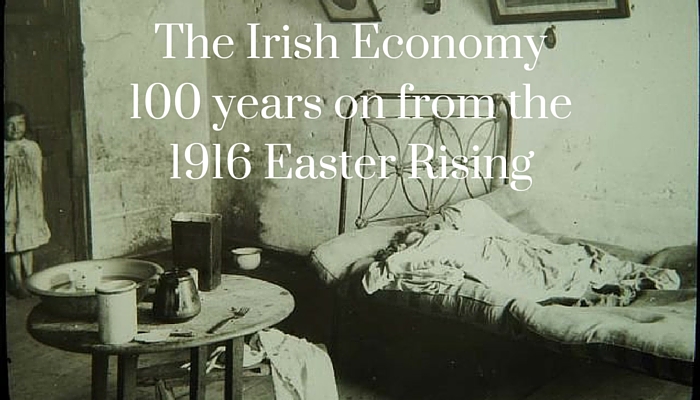
The Irish Economy 100 years on from the 1916 Easter Rising

Background:

Ireland in 1916, consisting of 32 counties, was ruled by Great Britain. The 32 county economy experienced a period of unprecedented prosperity mainly due to the positive economic effects of the First World War.

However, since the Great Irish Famine of 1846, Ireland experienced mass emigration and large numbers of deaths. The laissez-faire economic ideology was a failure. From the period 1851 to 1916, over 5 million Irish citizens emigrated reducing the population from a peak of approximately 8 million to 3 million.

The Irish economy was ruled by Great Britain and its economy became increasingly tied to trends in global markets. The cost of living increased and there were some rises in living standards. These were subject to sharp declines due to the recessions of 1859 to 1863 and 1877 to 1880. Poverty was widespread and tensions between landlords and tenant farmers escalated. Despite this poverty, Irish living standards were above most of Eastern and Central Europe but income levels remained below the UK and the US.

Ireland’s economy became increasingly reliant on four main industries: Agriculture, Linen production, Shipbuilding (where the Titanic was built) and Brewing and Distilling. However, agricultural exports were heavily dependent on Great Britain and Shipbuilding was dependent on an outdated industry. For example, it wasn’t long after the First World War that the Irish Shipbuilding industry collapsed.

The First World War of 1914 brought about a period of prosperity for Ireland, due to the increased demand for food, linen and ships that were directly linked to the war effort. However, this prosperity was not shared by all.

So what did the Irish economy of 1916 look like compared to its economy today 100 years on?
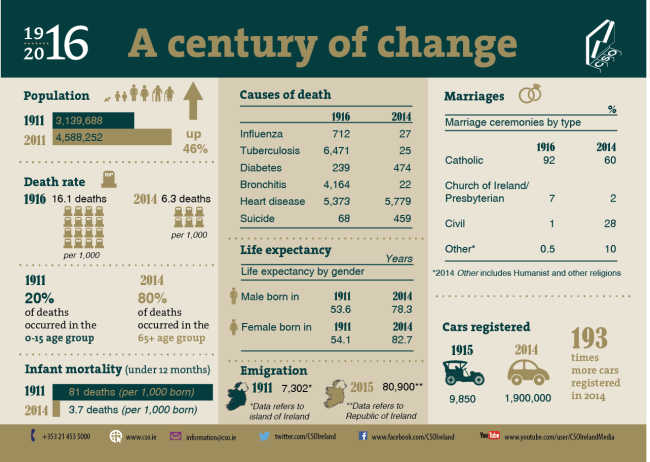
CSO 1916 - 2016 infographic

Source: Central Statistics Office

Population:

The population of Ireland in 1916 was one of the lowest recorded in its history. According to the population census of 1911, the population stood at just 3.14 million. It represented a country devastated by death caused by the famine over a half century previous and the subsequent mass emigration that ensued.

A 9-year-old Irish immigrant laborer shucks oysters in front of his foreman in the U.S. in 1911. pic.twitter.com/cOKICWk8Ta

— HISTORY (@HISTORY) April 12, 2016

Today, Ireland’s population has recovered to 4.59 million, an increase of 46%. However, many have emigrated due to the financial crisis of 2007, most notably Ireland’s youth. We have reverted to being a net emigration population after a period of becoming a net immigration population, attracting workers from overseas as well as bringing Irish people home.

Emigration for the whole island of Ireland in 1916 was 7,366 or 17 per 10,000 of the population. This had fallen from a substantial level before the outbreak of the Great War. The latest data for 2015 shows emigration for the Republic of Ireland at 80,900 representing 175 per 10,000 of the population.

Emigration in 1916 consisted of 5,580 females and only 1,786 males. This I found surprising.

The four main destinations for Irish emigrants in 1916 were the US, the UK, Canada and then Australia.

In 2015, the UK was the main destination for Irish emigrants. Only 7% of emigrants went to the US in 2015 compared to 58% emigrating in 1916.

The Irish diaspora abroad is quite large. Despite being a small island off Western Europe, Irish smiles have been welcomed all over the world. Ancestry can be traced back to Ireland particularly for those living in the United States, the UK, Argentina, Australia and Canada.

Today, it is estimated that there are 80 million people of Irish descent living around the world today. Other that the Republic of Ireland and Northern Ireland, Montserrat in the Caribbean is the only other country where St. Patrick’s Day is a public holiday.

Montserrat is known as the Emerald Isle of the Caribbean and it’s Irish heritage dates back to the 17th century when the island became a safe haven for the Irish who were originally sent to the Caribbean as slaves by Great Britain’s leader Oliver Cromwell. A census in 1678 showed that more than half of the population on the island were Irish.

Life Expectancy:

According to records for 1911, the life expectancy for a male born in Ireland was 53.6 years and for a female 54.1 years. Today, a male born in Ireland has a life expectancy of 78.3 years and a female 82.7 years.

Despite the period of prosperity, Ireland remained divided in terms of the gap between wealth and poor. Much of rural Ireland in the west of the country lived as an agrarian society, dependent on agriculture for a living. Living standards were much lower relative to other parts of the country.

Urban areas did not escape the ravishes of poverty. Inequality was more prevalent in urban towns, particularly in Dublin city. Despite a boom in food and linen exports in 1916, the Irish poor remained hungry.
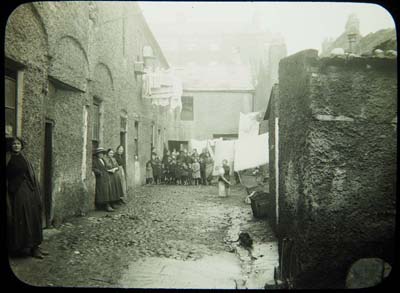
Henrietta Place, Dublin 1913. The flight of wealth to the suburbs often meant an escape from inner city squalor.

Henrietta Place, Dublin 1913. The flight of wealth to the suburbs often meant an escape from inner city squalor.

Poverty levels in Ireland today are at 8% with households consisting of one adult and one or more dependent children considered most at risk. Rural Ireland, including the West of Ireland, has a higher incidence of poverty than the rest of the country. As the saying goes, things change but always stay the same!

Many adults and children perished due to influenza, bronchitis and tuberculosis. These were the leading causes of death in Ireland along with heart disease. Today, heart disease is the leading cause of death in Ireland with few incidences of death from the other forms. The number of deaths by suicide that was officially recorded in 1916 were 68 compared to 459 for 2014, This represented 10 per 100,000 of the population compared to approximately 2 per 100,000 of the population.

Housing:

Ireland’s macro economy of 2016 is showing remarkable progress since it’s recession, bailout and financial crisis. The Irish have a love affair with housing. Perhaps it has its roots in history where many people were evicted from their homes during the Great Irish Famine.

During the boom from 1998 to 2007, Irish house prices soared only to come crashing down once the crisis hit. At its peak, over 90,000 houses were built but today only 11,000 houses were completed. The Irish housing market is under immense stress with demand outstripping supply. This shortage is resulting in much higher rents than what was recorded during the boom period. House prices are recovering but recent government legislation is making it difficult for landlords who are selling their property or evicting their tenants in order to capture the higher rental yields. Ireland is undergoing a housing crisis in today.

In 1916, Ireland experienced a severe housing crisis. Dublin and other cities became infamous for the living conditions of its citizens. The tenements, where many impoverished families lived, marked a bleak period in recent Irish history.

Multiple families shared large terraced houses with extremely poor sanitary and hygiene conditions. It was estimated at the time that 20,000 families in Dublin occupied single rooms and in some cases with other families. Family sizes of 8 or 10 children were not unusual. There were cases of 104 people occupying a single house built to accommodate one family.
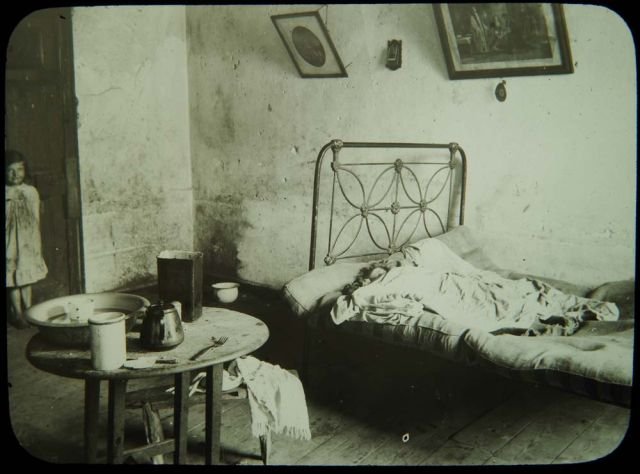
A Tenement Room on Francis Street, Dublin in 1913

A Tenement Room on Francis Street, Dublin in 1913

Many evictions took place as families fell behind in rent. Facing starvation, children queued for bread which was handed out by religious orders. Many people in the West of Ireland emigrated due to food shortages and abandoned their homes. Despite many empty homes in the rural parts of Ireland, many families suffered homelessness, extremely poor living conditions and starvation.

Due to the housing crisis that Ireland is experiencing today in 2016, there are some echoes of the past. Homelessness has jumped 100% since January 2015. Over 700 families are living in emergency accommodation in hotels and guest houses. Evictions are up significantly and there are currently 17,000 people in the courts who are at risk of losing their homes. Food parcels are being handed out each week and the number queuing is rising.

Employment:

The Irish economy in 1916 was transitioning toward becoming an industrial nation. It was by no means considered backward and was in fact placed in the group of middle-ranking industrialised countries along with the Netherlands, the Scandinavian countries, Italy and Portugal.  26.8% of workers in 1911 worked in manufacturing jobs compared to 8.6% in 2011.

An estimated 150,000 men had joined the British army and many men and women went to the UK to find employment in munition factories and hospitals. Wages had increased during this time.

Almost 50% of the working population were employed in the Agriculture sector in 1911. This compares to just 4.9% in 2011.

In 1911, 8.8% of the labour force in Ireland worked in the professional group of occupations. By 2011, these workers now account for over 40% of the Irish workforce.

Ireland’s unemployment rate today is 8.8% coming from a recent high of 14.4%. It is unsure what the level was in 1916.

Exports:

Ireland in 1916 mostly consisted of indigenous industries. 85,000 workers were employed in linen production with over 18 million pounds (weight) of linen yarn and 112 million pounds (weight) of finished linen goods exported. Prior to the outbreak of World War I in 1914, about 70% of these exports were to the United States of America. However between 1914 and 1918, linen was in great demand for military purposes by the British Army for items such as tents, haversacks, hospital equipment and aeroplane fabric.

Today much of its traditional industry gone today. Very few linen manufacturers and weavers exist today. To bring my own personal family history into this story, my family remains one of a few linen weavers in Ireland today, producing the best Irish linen in the market with exports to countries that include Japan, the US and Italy. I’m personally proud of my father for what he has achieved and for extending the Irish tradition of producing the finest linen in the world.

Ireland is considered a small open economy and the UK still remains one of our largest trading partners. The Irish economy attracts many multinationals companies to locate here. In 2016, Ireland ranks among the top countries regarding industrial competitiveness and ease of doing business.

The Guinness brewery was the main brewery in Ireland and in 1916 it had the largest output of any brewery in the world, brewing more than two-thirds of all beer brewed in Ireland.
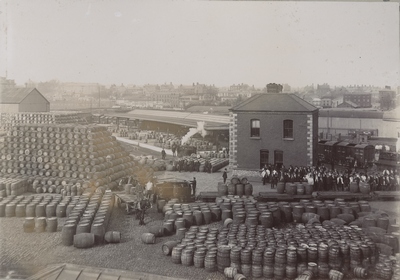
Cask Yard St. James' Gate Brewery 1906 - 1913

Cask Yard St. James’ Gate Brewery 1906 – 1913

The largest exporting sectors in Ireland during 1916 were woollens, brewing, butter, bacon, poultry, cattle, cotton goods and linen. The sectors that were in decline included horses, whiskey, pigs and sheep.

Ireland had a trade surplus of 1.5 million pounds (and a balance surplus of 11.1 million pounds) in 1916. For the latest data today, which is January 2016, Ireland is operating a trade surplus of 4.99 billion euro. Ireland’s largest exporting sectors are Medical and pharmaceutical products (representing 27% of total exports), Office machines and automatic data processing machines, and Food and live animals (representing 7.8% of our total exports).

The EU accounts for 56% of the total value of Irish goods exported. Belgium is Irelands largest export trading partner accounting for 15% of the total value of goods exported.

Great Britain remains Ireland’s single largest source of imports with 25% of the total value of goods imported to Ireland.

The USA remains Irelands largest non-EU destination for exports and imports.

GDP:

According to research by Kevin O’Rourke of the Department of Economics at University College Dublin a proxy measure for GDP per capita in Ireland was estimated to be 32.50 in 1913. This was based on a GDP estimate of 150 million. To put this into some context, the estimated GDP per capita in 1864 was 12.50 with GDP estimated at 60 million – over a 160% increase in nominal terms between the Famine and the Great War. Irish GDP per capita converged on the UK average during this time.

According to the International Geary-Khamis dollars, Ireland’s GDP per capita in 1913 was $2,736 whereas the US GDP per capita was $5,301 and the UK’s at $4,921, almost twice that of Ireland’s. This seems to suggest that incomes had yet to converge with those in Great Britain.
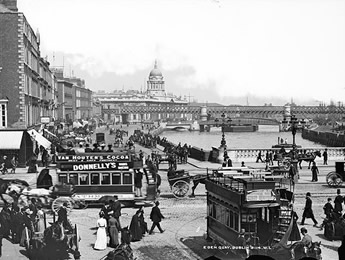
Eden Quay displays the bustle of turn of the century Dublin city life

Eden Quay displays the bustle of turn of the century Dublin city life

Ireland would have been considered one of the poorest Western European countries along with Greece, Italy, Portugal and Spain – yes there’s that familiar acronym of the financial crisis.

Today, Ireland is considered one of the richest countries in the world with GDP per capita of just under $49,000, placing the country in 10th position, with the US in 9th and the UK in 19th according to the World Bank.

GDP for Ireland was $11.9 million but this collapsed to $7.8 million by 1921 perhaps due to the Irish civil war. It was only in 1960 that Ireland recovered to pre-1916 levels.

There were 9,850 cars registered in Ireland in 1915 with now over 2 million registered today.
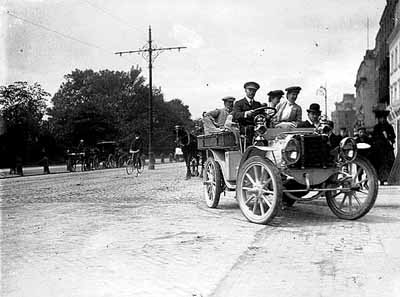
F_Horse, bicycle, Car_Stephen'sGreen_clar21t

Inflation:

Due to the outbreak of the First World War in 1914 and the resulting scarcity of goods, inflation in Ireland increased considerably by 200% over the wartime period as measured by the wholesale price index.

Unless wage inflation was outpacing price inflation in 1916, which is very unlikely, families must have experienced a real reduction in the purchasing power of their £.

These increases in prices were also due to Government policy which increased taxes and duties on various products.

The retail price of butter, tea and eggs were expensive in 1916. For example, the price of a pound of butter then would have cost 7 euro 35 cent updated to today’s consumer price index compared to today’s price of 2 euro 79 cent.

Links:

  • Data: Central Statistics Office
  • Data: International Geary-Khamis dollars by Professor Angus Maddison
  • Paper: Monetary Data and Proxy GDP Estimates: Ireland 1840 – 1921 by Kevin O’Rourke, UCD.
  • Read Ireland’s Proclamation of the Republic where equal rights for all men, women and children was declared along with the creation of a sovereign country.

Family History Research:

  • Ireland’s Census: Search for your Irish Heritage for the following Census years: 1911, 1901, 1851, 1841, 1831 and 1821.
  • National Library of Ireland: www.nli.ie

Images:

  • All images courtesy of the National Library of Ireland
  • Infographic courtesy of the Central Statistics Office
http://traffic.libsyn.com/economicrockstar/077_Ireland.mp3

Podcast: Play in new window | Download

069: Diane Coyle on GDP, Its Shortcomings and Alternative Measures

January 21, 2016 by Frank

http://traffic.libsyn.com/economicrockstar/069_Diane_Coyle.mp3
Play in New WindowDownload

069: Diane Coyle on GDP, Its Shortcomings and Alternative Measures

Diane Coyle is Professor of Economics at the University of Manchester and runs the consultancy Enlightenment Economics.diane coyle

Diane is Vice-Chair of the BBC Trust and was a member of the Migration Advisory Committee and a member of the Competition Commission. She is also a visiting research associate at the University of Oxford’s Smith School of Enterprise and the Environment. 

Diane specialises in competition analysis and the economics of new technologies and globalisation.

Diane is the author of several books, including GDP: A Brief But Affectionate History, The Economics of Enough, The Soulful Science, Sex, Drugs and Economics and Paradoxes of Prosperity.

She was previously Economics Editor of The Independent and before that worked at the Treasury and in the private sector as an economist.

Diane has a PhD from Harvard and was awarded the OBE in January 2009.

Using happiness is an excuse for inactivity – Diane Coyle

Click To Tweet

Influencers:

Peter Sinclair (University of Birmingham) and Ben Friedman (Harvard).

Economists:

In this interview, Diane mentions: Adam Smith, John Stuart Mill, Sir Charles Bean, Daron Acemoglu, Thomas Piketty, John McMillan, Tim Harford, Peter Sinclair (University of Birmingham) and Ben Friedman (Harvard).

Economics:

In this interview, Diane mentions: GDP, budget deficit, fiscal policy, monetary policy, interest rates, growth, employment, unemployment, Human Development Index, Gross National Happiness Index, happiness, hysteresis, inequality, financial markets, derivatives and leverage.

In this episode you will learn:

  • what is GDP and how it is measured.
  • the complications with understanding the meaning of GDP.
  • the historical origins of GDP and why it is used to measure our economy.
  • the complications in measuring GDP.
  • how GDP data is still collected in such an ‘old-fashioned’ way and the new methods to collecting data.
  • about the uncertainty and margin of error in GDP statistics.
  • why it is wrong to make fiscal policy, monetary policy and interest rate decisions on GDP statistics.
  • what proxy variables were used to measure economic activity before GDP was introduced.
  • why we should re-think the meaning of the economy.
  • why GDP today doesn’t work in its present form and if there is an alternative.
  • how countries can use GDP and GNP measures to portray different economic conditions.
  • the difference between GDP and GNP.
  • the concerning use of ‘administrative statistics’ by countries to falsify economic growth.
  • whether it’s correct to include illegal drug activity and prostitution in measuring GDP.
  • why measuring happiness and well-being should be of little importance when measuring GDP.
  • why Diane is sceptical about the Happiness Index.
  • the reason why economics was coined by Thomas Carlyle as the the ‘dismal science’.
  • who is to blame for the financial crisis of 2007/2008.
  • about the UK’s over-reliance on the financial sector and its role in measuring GDP.
  • about the uncertainty that would exist if the UK withdrew from the EU.
  • the policy factors required to create a sustainable society and a stable government.


It’s just so easy now to download data from the internet and run through statistical packages and get some results. And I think a lot of professional economists are guilty of not rethinking about their data enough – Diane Coyle

You cannot think about the economy mechanically – Diane Coyle

Click To Tweet

The way we measure GDP now is really closely linked to Keynesian macroeconomic theory and a very famous definition he gave of  what total output in the economy is, that it’s consumer spending, government spending, investment spending and the balance of payments – Diane Coyle

There is no benefit for society in a lot of what happens in the financial markets – Diane Coyle

Click To Tweet

Resources:

  • The Enlightenment Economist
  • Doomsday Book  – Earliest recording of economic activity.
  • Time to ditch GDP as a measure of economic well-being by Diane Coyle 
  • The Review of Economics and Statistics

Favorite Internet Resource:

  • Twitter

If you pick the right people to follow it acts as a brilliant editor of all the interesting information that you might want to know and it’s like having a personalised newspaper – Diane Coyle

Books:

  • GDP: A Brief But Affectionate History by Diane Coyle
  • The Soulful Science: What Economists Really Do and Why It Matters by Diane Coyle
  • The Economics of Enough: How to Run the Economy as If the Future Matters by Diane Coyle
  • Sex, Drugs and Economics: An Unconventional Introduction to Economics by Diane Coyle
  • Paradoxes of Prosperity: Why the New Capitalism Benefits All by Diane Coyle
  • Reinventing the Bazaar: A natural History of Markets by John McMillan
  • The Undercover Economist by Tim Harford
  • The Undercover Economist Strikes Back: How to Run or Ruin an Economy by Tim Harford


http://traffic.libsyn.com/economicrockstar/069_Diane_Coyle.mp3

Podcast: Play in new window | Download
062: Stephen Terry on Real Business Cycles, Total Factor Productivity, Short-Termism and Doing a PhD

December 10, 2015 by Frank

http://traffic.libsyn.com/economicrockstar/Stephen_Terry_Final.mp3
Play in New WindowDownload

062: Stephen Terry on Real Business Cycles, Total Factor Productivity, Short-Termism and DoiStephen_Terryng a PhD

Stephen Terry is Assistant Professor of Economics at Boston University.

In 2013 he was a Dissertation Intern, Federal Reserve Bank of Richmond and, from 2007 to 2009, Stephen was a Research Associate at the Federal Reserve Bank of Kansas City.

Stephen  received a PhD in Economics from Stanford University in 2015 as well as an  MA in Economics in 2011.

Stephen also has an MA in Mathematics from the University of Oklahoma and a BA in Economics from University of Texas at Arlington.

Stephens research interests include short-termism, uncertainty and real business cycles.

One of the most important summary statistics in macroeconomics is a measure known as TFP or total factor productivity of the economy as a whole – Stephen Terry

Economics:

In this interview, Stephen mentions: labor markets, double coincidence of wants, selection markets, matching markets, algebraic topology, total factor productivity, real business cycles, economic shocks, volatility, variance, risk, uncertainty, aggregate output, employment, investment, allocation of inputs, uncertainty, earnings, profits, short-termism and the Principle-Agent Problem.

Economists:

In this interview, Stephen mentions: Christine Exley, Nick Bloom, John Van Reenen and John Maynard Keynes.

In this episode you will learn:

  • about Stephen’s experience with the two-body or joint location problem.
  • about Stephen’s PhD process and the experience he developed along the way.
  • of some suggestions if you’re considering undertaking a PhD.
  • the differences and similarities in the mathematics of economics and the mathematics of other disciplines such as physics and chemistry.
  • if there is a divergence or a convergence in the branches of macroeconomics and microeconomics.
  • what really happens during recessions.
  • how firms can learn and react to the data provided at a micro level.
  • what Total Factor Productivity is.
  • about Real Business Cycle theory.
  • whether changes in uncertainty causes or amplifies recessions.
  • whether managers should forego the long-term objectives of the firm due to the pressures of short-termism.
  • whether rating agencies are beneficial to investors or if they potentially hinder the growth prospects of the firm due to short-term pressures and expectations.

Preparation for Life as a Research Economists into 2 Stages:

1) Useful things that you can be doing before graduate school.

You have to study Math. Economics at graduate level is increasingly dominated by the technical and quantitative research methods.

Having some practical experience in the application of mathematics in economics is not not only valuable for later on in your career but is now becoming a pre-condition to gaining access to research-intensive PhD programmes.

If your undergrad or Masters degree lacks math rigour, then you should consider building on your current level of math by undertaking a math PhD programme.

3) The ways in which you can maximise the benefits you get in your PhD training.

You should consider becoming a Research Assistant prior to starting your PhD so that you gain the practical experience.

This will put you in a situation in which you can be mentored and instructed by other economists who are undertaking economics and statistical research projects.

Being exposed to this will offer you an insight into the research process as well as ‘train’ you to become quite efficient and structured in terms of time management and application.

On the Use of Math in Economics:

At its core, math and applied mathematical techniques, but also pure mathematical proof-based reasoning, are ways to go from some set of assumptions to a coherent set of conclusions that you know follow logically without inconsistency from those assumptions.

By harnessing that logical consistency, economics is something, in the last few decades, that has been able to harness a great deal of precision in the statements that it’s able to make. But still at its core, where the debate centres, you have to understand that the assumptions that we make are primarily assumptions about people. Economic actors sometimes go their own way and don’t always follow perfectly the rules or logical coherent types of assumptions that we start with as an economist.

There’s a great deal of power and precision that is gained by math but this underlying realisation that we’re dealing with individuals rather than physical particles that you would use in physics is something that an economist has to keep in mind when they do think about the real world.

Papers:

  • Terry, S. (2015). The Macro Impact of Short-Termism. Working Paper.
  • Bloom, N.,  Floetotto, M., Jaimovich, N., Saporta-Eksten, I., and Terry, S. (2014). Really Uncertain Business Cycles. Working Paper.

Sources:

  • US Census Bureau
  • Institute for Fiscal Studies
  • McKinsey and Company
http://traffic.libsyn.com/economicrockstar/Stephen_Terry_Final.mp3

Podcast: Play in new window | Download

028: Alice Louise Kassens on Nudging Students to Study Economics and Why Mainstream Media Should Publish Research on Mental Health

April 16, 2015 by Frank

http://traffic.libsyn.com/economicrockstar/028_Alice_Louise_Kassens.mp3
Play in New WindowDownload

028: Alice Louise Kassens on Nudging Students to Study Economics and Why Mainstream Media Should Publish Research on Mental Health

Dr. Alice Louise Kassens is an Economics Professor at Roanoke College and has already built a notable
reputation in her profession.

Alice is the current recipient of Roanoke’s John S. Shannon Professorship in Economics, which honors and supports a faculty member who is an outstanding teacher and accomplished scholar and who is thoroughly committed to enriching the lives of Roanoke students.

Dr Kassens’ work at Roanoke includes creating and maintaining an economics program blog and a biannual newsletter, Roanomics. She also serves as the faculty advisor for the College’s Economics Club.

Alice’s areas of expertise include labor and health economics. She has won several awards and fellowships, and her work has been published in numerous academic journals.

Alice is one of three economists who won Cengage Learning’s 2013 Economist Educators Best in Class Award for her method of teaching using Twitter.

Dr Kassens is president of the Virginia Association of Economics, has recently been appointed by Governor McAuliffe to his Joint Advisory Board of Economists, is a senior analyst for the Institute for Policy and Opinion Research and is a Referee for the Journal of Economic  Education, the Journal of Economics and Finance Education, and the National Council on Undergraduate Research.

Alice is the author of Changing Perceptions and Waistlines – A Bayesian and Behavioral Approach and is known as the ‘Running Economist’ not because of her busy lifestyle but because she is a competitive runner.

Alice earned her bachelor’s degree from the College of William and Mary and her Ph.D. from North Carolina State University.

Personal Habits:

  • Running, swimming and looking after her five dogs and an 18 year old cat!

Economic Themes:

In this interview, Alice mentions and discusses: 

Supply-side and demand-side of the housing market, primary research methods, sample selection bias, surveys, employment, unemployment, the Great Recession and regression discontinuity design models.

Economists:

In this interview, Alice mentions: 

Milton Friedman, Thomas Sowell, William Rogers, Mark V. Pauly, Alvin Headen, Yana van der Meulen Rodgers, Luther Lawson, Dean Baker and Jadrian Wooten.

Takeaway:

Do a little something everyday, even if it’s as simple as downloading a dataset, making an outline for a paper, talking to a colleague about a project. Do something small and all of it adds up overtime.

Find out:

  • how Alice’s secrets to increasing an economics class size.
  • how Alice uses social media to encourage students to learn economics more effectively.
  • how Twitter can be used to remove the limitations to classroom-specific learning.
  • how Dr. Kassens collects data for the Consumer Sentiment Report for Virginia.
  • how to remove sample selection bias when collecting primary data.
  • how to analyse unobservables using observed data.
  • about the benefits of small-class sizes for learning.
  • which economist Dr. Kassens would love to collaborate with.
  • how being an athlete helped with a career decision to become a health economist.
  • why Dr. Kassens wrote a report on gender disparities in health care in Papa New Guinea.
  • about the gender disparity in depression levels upon losing a job.
  • whether men or women respond better to losing their jobs by continuing to job search.
  • if people lose their job because they were depressed or are they depressed because they’re unemployed?
  • how Dr. Kassens’ research can help people with depression if the media can report her findings to the masses.
  • if people reduce their expectations to live longer once they are diagnosed with Type II diabetes.
  • if obese people who are diagnosed with Type II diabetes respond by losing weight.
  • how writing a blog makes you accountable for what you do and helps you get things done.
  • the importance of why organisations should make their data freely accessible to academics.

Nudging Students to Study Economics at Roanoke College

  • Running Economist Blog.
  • Twitter Feeds.
  • Roanonomics Newsletter.
  • Economics Club.
  • Economics Reading Group.
  • Economics Study Trip.
  • Create a sense of community among Economic Students.
  • Working with Advanced Placement Teachers at High School.
  • Inviting High School students to Roanoke College Campus.

Dr. Kassens offers her best students the opportunity to teach economics weekly at the local Patrick Henry High School in Roanoke to help teach Mr. Hartman’s Advanced Placement Economics course. This is part of Dr. Kassens’ Service Learning Independent Study in which participating seniors are awarded academic credit for meeting the course requirements. Students teach the economics lesson plan of the day and sometimes run simulations, do group-work or show movies or tv programs like House of Cards, extracting economic concepts and themes from them. This helps reinforce the learning process both for the economic seniors and for the High School students.

To fulfil a whole credit, Dr. Kassens’ students are required to write reflective pieces based on a number of questions such as ‘What did you learn about yourself?’, ‘How do you think you’re helping the community?’ and ‘What challenges did you face?’. Dr. Kassens has identified research which shows that employers need students to be able to articulate what they learned and why their independent study or internship was important, not that they actually did one.

The Service Learning Independent Study at Roanoke College fulfils such a need. Not only does it give students the opportunity to gain invaluable experience but also prepares the student to be self-motivated, confident and above-all being able to demonstrate, in an articulate fashion, to potential employers what they have gained from such an experience.

This program is a win-win both for the senior at Roanoke College and the student at Patrick Henry High School. The senior, who is at this stage studying intermediate micro and macro, will go over principles of economics to teach the High School students. This only reinforces the learning process and makes them a more accomplished student. By reinforcing the material of principle micro and macro, the student can create a solid foundation to build upon, which will become invaluable at intermediate level economics.

Using Twitter in the Classroom to Teach Economics

Dr. Kassens uses Twitter as part of her assignments for her Principles of Micro and Macro classes. Students are given 10 different tasks to fulfil during this semester-long assignment in which they need to write and articulate an economic-related tweet based on the pre-assigned guidelines. For example, students are required to tweet about economic policy as outlined in the State of the Union address by the US President. Following this, students must then comment on or answer a question made by a fellow student. The hashtag #kassensecon122 must be used in order to keep the conversation going and for ease of tracking the students work. This can be challenging due to the limitation of articulating a tweet of up to 140 characters in length.

The students also helped Dr. Kassens in the development of a rubric so they knew how they were going to be graded. It was a short but well-defined rubric, which was important as it allowed Dr. Kassens to be responsive leading to a fast turn-around in grading results. This was considered vital since “the goal was to improve their writing”. Using Twitter to improve writing skills may, at first, appear a failed experiment but it is surprisingly “difficult to put into 140 characters something meaningful that’s going to score well on the rubric because they can’t use funny abbreviations”.

[Tweeting your way to improved writing, reflection, and community by Dr. Alice Louise Kassens]

The rubric was therefore important so that students could get feedback quickly allowing them to make improvements in their next assignment. Finding topics that Dr. Kassens believes her students would find interesting was also important. Dr. Kassens reached out to other economists on Twitter, some she didn’t know personally such as Dean Baker, and asked them to engage with her students by asking  a question. Once students answered this question, Dr. Kassens sent the answers back to the economist.

The benefits Dr. Kassens found with using Twitter in assessing economics was that students’ writing skills improved as evidenced by how the rubric scoring went but “it also broke down these barriers that you have with a classroom so that they could beyond the classroom walls and interact with well-known economists”.

The semester-long project at Roanoke College is worth 20 to 25% of the students’ final grade. However, Dr. Kassens found it interesting that half of her students did not have a Twitter account. She had believed that most young kids use Twitter. This statistic seemed consistent for each of the three semesters in which the assignment was delivered. Consequently, the first week of the semester was devoted to setting up an account, informing students of how to use Twitter and sending out ‘practice’ tweets that reflects an economic argument, concept or point-of-view within 140 characters.

Using Twitter to sharpen critical thinking and writing skills by Dr. Alice Louise Kassens

Favorite Internet Resource:

  • SAS: Visual Analytics for UN Comtrade

Recommended Book:

  • Keynes Hayek: The Clash that Defined Modern Economics by Nicholas Washout
  • Economic Facts and Fallacies by Thomas Sowell
  • How to Write A Lot: A Practical Guide to Productive Academic Writing by Paul J. Silvia
  • Changing Perceptions and Waistlines – A Bayesian and Behavioral Approach by Alice Kassens

Where to Find Alice Kassens:

  • Website: The Running Economist
  • Twitter: @RnningEconomist 
http://traffic.libsyn.com/economicrockstar/028_Alice_Louise_Kassens.mp3

Podcast: Play in new window | Download

Frank Conway

Frank Conway is founder of Economic Rockstar and lecturer of economics, finance and statistics. Read More…

View My Blog Posts

Youtube Sub

Become a Patron of the Economic Rockstar Podcast

patreon

Ireland’s Economy by the Numbers

Leaving Cert Economics: Ireland’s Economy  Click here to download a workbook on Ireland’s Economy so that you can add your own notes. [Original size] Ireland’s Economy by fconway

Categories

Subscribe and Never Miss An Episode

itunes-logo

Recent Posts

  • Ireland’s Economy by the Numbers April 8, 2019
  • 174: Wendy Carlin on The Core Project, Capitalism, Democracy and Normative Statements February 13, 2019
  • 173: Stephen Wright on Core Econ as a Learning Resource for Mainstream Economics January 28, 2019
  • 172: Best of 2018 Part 2: From the Great Depression to Futurism; Institutions, Individualism, Cooperation and Reciprocity January 22, 2019
  • 171: Best of 2018 Part 1 January 3, 2019

Copyright © 2026 · Podcast Pro Theme on Genesis Framework · WordPress · Log in

This website uses cookies to improve your experience. We'll assume you're ok with this, but you can opt-out if you wish. Accept Reject Read More
Privacy Policy

Privacy Overview

This website uses cookies to improve your experience while you navigate through the website. Out of these, the cookies that are categorized as necessary are stored on your browser as they are essential for the working of basic functionalities of the website. We also use third-party cookies that help us analyze and understand how you use this website. These cookies will be stored in your browser only with your consent. You also have the option to opt-out of these cookies. But opting out of some of these cookies may affect your browsing experience.
Necessary
Always Enabled
Necessary cookies are absolutely essential for the website to function properly. This category only includes cookies that ensures basic functionalities and security features of the website. These cookies do not store any personal information.
Non-necessary
Any cookies that may not be particularly necessary for the website to function and is used specifically to collect user personal data via analytics, ads, other embedded contents are termed as non-necessary cookies. It is mandatory to procure user consent prior to running these cookies on your website.
SAVE & ACCEPT