• ABOUT
  • RESOURCES
  • PODCAST
  • BOOKS
  • BLOG
  • SUPPORTERS
  • QFA Financial Advice
  • CONTACT

Economic Rockstar

Connecting Brilliant Minds in Economics and Finance

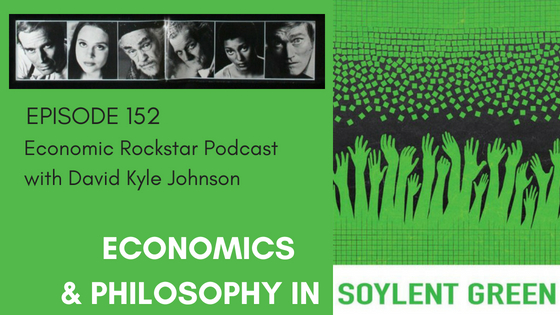
152: David Kyle Johnson on Economics and Philosophy in Soylent Green
August 10, 2018 by Frank

http://traffic.libsyn.com/economicrockstar/152_Kyle_Soylent_Green_Final.mp3
Play in New WindowDownload

152: David Kyle Johnson on Economics and Philosophy in Soylent Green

This is a 3rd instalment of my interviews with Professor David Kyle Johnson, an  Associate Professor of Philosophy at King’s College in Wilkes-Barre, Pennsylvania.

We catch up again after watching the 1973 dystopian movie ‘Soylent Green‘ and discuss some economics and philosophical themes that run through the movie.

In this Episode, we cover:

  • Scarcity
  • Choice
  • Over-population
  • Consumption
  • Inflation
  • Production
  • Automation
  • Altruism
  • Theft
  • Black market economy
  • Pricing
  • Equilibrium
  • The Invisible Hand

Social Issues Discussed Include:

  • Social class/status,
  • Feminism
  • Poverty

Philosophical Questions Addressed Include:

  • Should we resort to cannibalism to save the human race?
  • Should we have the right to die with dignity in the face of a terminal illness, the loss of hope or over our moral principles?
  • Is there a god?
  • And more.

Movies:

  • Soylent Green (1973) Directed by Richard Fleischer

Other Episodes to Check Out:

146: David Kyle Johnson on Science Fiction as Philosophy and Finding Nietzsche’s Übermensch in Economics

151: Unreleased Bonus Episode with David Kyle Johnson

Books:

  • Make Room, Make Room: The Classic Novel of an Overpopulated Future by Harry Harrison
  • The Population Bomb by Paul Erlich

Patreon

If you’re a fan of the podcast and would like to show your support in anyway, please check out my Patreon page at www.patreon.com/economicrockstar where you can sign up for any of the awards for as little as $1 a month or you can simply follow me on the Economic Rockstar Facebook page or on Twitter or simply recommend the show to a friend, especially if they have never had the opportunity to study economics.

http://traffic.libsyn.com/economicrockstar/152_Kyle_Soylent_Green_Final.mp3

Podcast: Play in new window | Download

067: Leigh Caldwell on Cognitive Economics and the Mathematics of Behavioral Economics

January 3, 2016 by Frank

http://traffic.libsyn.com/economicrockstar/067_Leigh_Caldwell_Final.mp3
Play in New WindowDownload

067: Leigh Caldwell on Cognitive Economics and the Mathematics of Behavioral Economics

leigh caldwellLeigh Caldwell is a behavioural economist based in London.

Leigh, together with Elina Halonen, runs the Irrational Agency, which takes the latest scientific discoveries in psychology and behavioural economics, blends it with their hands-on experience of marketing and business, and turns them into powerful, incisive market research techniques.

In 2012, Leigh condensed his experience in pricing and the marketing of several of his businesses into a new book The Psychology of Price: How to use price to increase demand, profit and customer satisfaction.

Leigh is co-founder of the London Behavioural Economics Network, writes for the Pricing Revolution and the Knowing and Making blogs, and regularly features as an economics commentator on BBC News, Radio 4, Research Magazine and other media.

My own background is all about intellectual challenge. I went to university early as a teenager. I studied maths and physics. I was always into pushing myself intellectually and finding the next challenge to take on – Leigh Caldwell

Economists: 

In this interview, Leigh mentions: Elina Halonen, Dan Ariely and George Lowenstein.

Economics:

In this interview, Leigh mentions: Behavioral economics, experimental economics, lab experiments, demand curve, equilibrium, utility, mathematics, rationality, nudge, choice architecture, cognitive economics, reference pricing model, anchoring, hyperbolic discounting, heuristics, neuroeconomics, Nudge Unit, organ donation, tax collection, productivity, GDP and unemployment.

In this episode you will learn:

  • why Leigh help co-found the London Behavioural Economics Network (LBEN).
  • the importance of academics and practitioners working together to further the discipline of economics.
  • why finding the sweet-spot between controlled experiments and realism is difficult yet important.
  • what cognitive economics is and how different it is the behavioral economics.
  • whether big data could influence an individuals consumption behaviors.
  • about the need to use the mathematics of computer science in behavioral economics.
  • why we shouldn’t use the current maths of economics to explain human behavior.
  • why a lack of mathematics is holding back the discipline of behavioral economics.
  • why mathematics is essential for theorising and modelling economics, especially behavioural economics.
  • about the paradox of self-awareness in cognitive economics when faced with choices.
  • how a consumers relationship with a material object is a unique experience and how putting a price on the good can ruin this experience.
  • why charging a higher price for your product or service would generate higher profits in a perceived perfectly competitive market.
  • whether the 99p or 99 cent pricing strategy works.
  • about the reference pricing model and why charging $39 for a product is better than charging $34 for the same product.
  • about the importance of setting prices when considering how numbers are spoken, i.e. numbers with more syllables are received to be more expensive than those with fewer syllables. 
  • how Leigh uses the findings in academic papers to make money for his business.
  • how Leigh uses economic conferences to network, to find out about the latest research and to discover the new academic societies that have been established.
  • about Leigh’s goal for 2016 to start a Cognitive Economics Society.
  • about the advice Leigh would give the UK government to apply cognitive and behavioral economics to deal with some aspects of social life.
  • how the UK government changed people’s behaviour about paying their taxes on time.
  • about the productivity challenge the UK government is facing today and what can be done about it.
  • about the current research Leigh is undertaking regarding where our preferences come from.

Conferences:

  • Judgement and Decision Making Conference
  • American Economics Association Conference

Books:

  • The Psychology of Price: How to use price to increase demand, profit and customer satisfaction by Leigh Caldwell.
  • Predictably Irrational by Dan Ariely.
  • Basic Instinct by Pete Luhn
  • Nudge by Richard Thaler
  • Thinking, Fast and Slow by Kahneman and Tversky

http://traffic.libsyn.com/economicrockstar/067_Leigh_Caldwell_Final.mp3

Podcast: Play in new window | Download
034: David Simon on Meatonomics and How the Meat and Dairy Industry Impose Substantial Negative Externalities on Society

May 28, 2015 by Frank

http://traffic.libsyn.com/economicrockstar/034_David_Simon_Final.mp3
Play in New WindowDownload

034: David Simon on Meatonomics and How the Meat and Dairy Industry Impose Substantial Negative Externalities on Society

David Robinson Simon is a lawyer and advocate for sustainable consumption.david simon

David works as general counsel for a healthcare company and serves on the board of the Animal Protection and Rescue League Fund, a non-profit dedicated to protecting animals.

David runs a website that keeps us up-to-date on matters arising from the farm animal industry as well as informing us of other animal-related causes.

David received his B.A. from U.C. Berkeley and his J.D. from the University of Southern California. He is the author of two books: New Millennium Law Dictionary, a full-length legal dictionary and Meatonomics.

He lives in Southern California with his partner, artist Tania Marie, and their rabbit, tortoise, and two cats.

Why David Wrote Meatonomics:

David’s reason to write ‘Meatonomics’ was the same reason why he turned vegan in the first place – the inhumane treatment of farm animals in factory farms.

150 years ago, many Western countries were agrarian-based economies. Farm animals lived on open pastures and were humanely treated. However, the transition to a factory-based system of farming resulted in these animals being removed from open farm lands and placed into a factory-type industrial environment which goes largely unnoticed by the general human population. These farm animals are treated inhumanely and are hidden from view. David wanted to share with us their story and to reveal some startling research and statistics that we must know.

“I think it is difficult to go vegan, but it’s only difficult in the same sense that it’s difficult to learn how to drive a car or ride a bike” – David Simon.

Simply changing my diet to a Vegan diet is one of the best things I’d ever done – David Robinson Simon

David Simon had a BMI that categorised him as being over-weight. He was suffering from high blood cholesterol levels that were always over 200 mg per decilitre, which is the heart-attack risk level. David also had acid reflux, also known as GERD.

When David turned vegan, it was due to his ethical concerns for the welfare of farm animals. However, the unintended consequences of transitioning to a vegan diet, showed remarkable health improvements. Soon after going vegan, David’s weight dropped by 15 pounds, his acid reflux had gone and never came back and his cholesterol has gone from 220 to as low as 140.

David also does some yoga each day to help alleviate the stresses of sitting at a desk all day. This is his way of preventing any foreseeable back and neck problems that otherwise would result from inactivity. Yoga is also a great way for David to focus and think about what was going on during his day.

Economic Themes:

In this interview, David mentions and discusses:

Negative externalities, cost-benefit analysis, supply, demand, equilibrium, prices, subsidies, quotas, consumption and the multiplier effect.

Find Out:

  • why David, a lawyer, turned to economics to explain how the meat industry is a cost to society.
  • about the lack of rights that exist for farm animals.
  • how the farming community set the standards on how farm animals are treated.
  • how the Customary Farming Extension was introduced to legally treat farm animals inhumanely.
  • about the environmental costs associated with producing animal products.
  • how to control or even reverse climate change by reducing meat consumption.
  • how taking shorter showers is not going to alleviate the drought in California.
  • what the true external cost to society is when someone consumes an animal product.
  • how deferring climate change measures today will impose greater costs on society in the future.
  • what David, who is a vegan, had for breakfast this morning.
  • the ingredients to David’s ‘power smoothie’ – a refreshing and nutrient dense meal in a glass!
  • how companies are being subsidised by government to lower the retail price of meat.
  • about the heavy subsidies being paid out to the meat industry.
  • how artificially-low meat and dairy prices are fuelled by out-of-whack farm subsidies.
  • about Ireland’s removal of milk quotas and what it means for market prices.
  • about the role of government in the promotion of milk consumption and how athletes are being used in adverts.
  • about the ubiquitous, powerful but misleading meat and dairy marketing campaigns.
  • about the causal connection between obesity and the consumption of milk, dairy and other animal products.
  • the correlation between some cancers and meat and dairy consumption.
  • why you should remove animal food products from your diet so as to remove the risk of cancer.
  • why you should switch to a plant-based diet and remove meat and dairy if you or a loved-one has cancer.
  • what the multiplier effect is for every $1 spent by government to promote dairy and meat consumption.
  • if consumers are being duped and manipulated by government into buying meat and dairy products.
  • the true cost of a Big Mac – would you pay $13 for one?
  • how the economics of institutional animal food production hold sway over our spending, eating, health, prosperity, economy, environment and longevity.
  • why David wrote his book ‘Meatonomics’.
  • where to source your protein if you decide to go vegan.
  • about Rich Roll, one of the fittest men in the US, who is vegan and lives on a plant-based diet.
  • about the largest animals on our planet – cow, gorilla, rhinoceros, giraffe and hippopotamus – that are all vegan and source there protein from plants.
  • how David changed his lifestyle to become vegan which reduced his risk of heart failure and lowered his BMI from over-weight to normal.
  • how future litigations against the meat and dairy industry could mirror the tobacco industry where once doctors advertised the health benefits of smoking tobacco.
  • about ‘Lobster Liberation’ in Ireland and how David is there to advise and help groups like these who may face criminal prosecution.
  • about David’s own successful liberation of lobsters who were unethically subjected to a vending machine claw game.

David’s ‘Power Vegan Smoothie’:

David starts his day with a raw power smoothie that is packed full of protein and anti-oxidants.

  • Fruit of the day
  • Kale
  • Flaxseed
  • Cinnamon
  • Cacao

David’s ‘Portobello Vegan Burger’:

For dinner, David recommends his ‘Portobello Vegan Burger’, an alternative to the beef burger, with no saturated fat and no cholesterol.

  • Bun of your choice – gluten-free or wholemeal
  • Portobello mushroom
  • Vegan cheese
  • Vegan bacon
  • Jalapeños
  • Tomatoes
  • Onions

Negative Externalities Associated with the Meat and Dairy Industry

Cow linkedIn

There are huge environmental costs associated with producing animal products. They include damage to soil, erosion, pesticide use, fertiliser use, pollution to eco-systems and  diminution in real estate values. Research has shown that if properties are located near factory farms, then the value of those properties fall in value.

There are also costs associated with climate change mitigation. Various studies have shown different values for the impact animal production has on climate change, with some reporting that it is responsible for up to 51% or as low as 14%. In the US alone, David has calculated that the environmental externalised cost of animal food production are about $37 billion. Who pays these costs? The farming community? No.

These costs have been externalised and society ends up paying for the damage being caused. However, David suggests that the payment of these costs are being delayed. It’s a deferred cost that is recognised in conventional economics but it’s something that will come back to ‘bite us on the nose’. For example the climate change mitigating cost is about $9 billion in the US but it is not being done right now. Because we’re not dealing with costs today, we’re allowing climate change to proceed along a path that will end up costing us a lot more in the future.

With the boom in farming and the ever increasing supply of meat products to cater for the demand, carbon emissions have soared. The cow population has grown exponentially as new markets have opened up in developing economies. Diets, such as the paleo diet, has added to this demand. The methane gas emitted from cattle is an astonishingly large contributor to green house gases. This has led to a larger carbon footprint per animal due to the associated transportation costs required to ferry these animals by land and sea. Carbon dioxide emissions also increases with the transportation of these animals.

“If we were to reduce our consumption of animal foods by say 40% to 45%, that would have the same effect on the emissions that drive climate change as if we were to garage all of our motor vehicles and motor vessels during the entire time that that reduction in consumption is in effect” (David Simon). This action alone could have a tremendous effect to control or even reverse climate change.

Negative externalities affect every living thing on the planet – humans, fish, fauna, primates, etc. You can be vegan or a herbivore. There is no way that you can avoid these costs be imposed on you. Reports have indicated that pesticides are airborne, which can be harmful to a persons health.  Our water table, our rivers and our oceans are being polluted by the slurry and manure that is being washed or dumped into these rivers. Fish are being affected with dead-zones appearing in our oceans, resulting in life being unsupported.  Plant-life, insect species and exotic animals are being displaced due to the landscape of the Amazon rainforest being forever altered to cater for cattle grazing. These are all costs borne on our society due to the serious impact it has on our environment and our planet. Much of the harm being done is irreversible. However, it can be stopped and further mistakes prevented if effective measures are introduced. Human diseases, such as MRSA, originates in livestock and spreads through the distribution of animal foods and, because of the antibiotic use in livestock, people are challenged to find antibiotics that can actually resist that disease.

Everyone is affected by current farming practices. For every $1 of animal foods sold at retail, there’s another $1.70 in externalised costs that is imposed on society. For example, for every $5 Big Mac sold by McDonalds, there’s another $8 imposed on every single person. These costs, which if absorbed by the producer, would result in higher retail prices for the consumer. To overcome these potentially high market prices, governments subsidise the meat industry. In the US alone, the government heavily subsidises the meat industry to the tune of $38 billion payments each year. To put that into perspective, that is half of what the US government pays in unemployment benefits every year to all the 320 million unemployed workers. At the moment, the fruit and vegetable industry in the US is being subsidised with only about $17 million. That’s a difference of circa $37.83 billion!

Counter-arguments by those suggesting that if these subsidies were removed from the meat industry, then higher prices would occur, followed by mass lay-offs and higher levels of unemployment. This outcome would occur due to consumers reducing their demand for animal products and getting their protein from different sources or substitutes. David foresees that if this were to occur, people would naturally transition toward a plant-based diet as a source for their protein. Consequently, plant-based agriculture would be then in a position to hire more workers and the numbers of lost jobs in the meat industry would be off-set by the levels of employment in the plant-based industry.

Why Do Animal Food Producers Receive So Much in Subsidies and Why Does the Inhumane Treatment of Animals Remain Legally Unchallenged?

The main reason why the meat production industry receives these subsidies and are allowed such farm practices is due to the powerful lobby group that represents them. In the US alone, estimated suggests that the farming lobbying group spend $100 million per year lobbying state and federal law makers. Also, some studies that examine such farming practices, as well as examining the economic and health benefits of the human consumption of meat, have been carried out or sponsored by groups that have a direct interest in the reported findings and recommendations.

The externalities that were outlined above are by no means localised. This has become a widespread phenomenon in so far as becoming a globalised concern. 90% of the planets rainforests have been removed, and flattened, with much of it being replaced with grazing pastures for cattle. David revealed a startling statistic of 3 acres per minute of rainforest being destroyed with 2 of these acres being dedicated to providing grazing land for beef cattle or for growing feed crops like soy or corn to feed beef cattle.

How ironic is it that the very trees that undergo a natural process of cleaning the air by absorbing carbon dioxide and producing oxygen is being overwhelmed by the amount of emissions from cattle. The ratio of trees to emissions is falling at an astonishing rate due to the destruction of these rainforests.

Ireland Removes its Milk Quota’s

Ireland have recently been given the go-ahead to remove the milk quota restrictions that were put in place by the EU. This is great news for Irish dairy farmers with 2 billion extra litres of milk being produced by the year 2020. To accommodate such a vast swell in milk production, 300,000 extra cows will join the national herd, resulting in a cow population of 1.3 million. Small farms will disappear resulting in large-scale farms. This will of course lead to economies of scale for these larger farms, an increase in employment, an increase in investments in new technologies, production processes and machinery and possibly better logistics and bargaining power.

A quota is essentially a tool for managing supply. Up until the 1990s, the US used supply management to stabilise prices for animal agriculture. Former President Ronald Reagan was a leading advocate for free market economics. He allowed agricultural markets to regulate themselves in the expectation that rational farmers would naturally find the market equilibrium by supplying the desired output which would lead to market equilibrium prices. However, it turned out that individual farmers think for themselves and produced at output levels that aggregated to exceedingly high levels of output at a national level. This resulted in lower prices.

This scenario could now be played out in Ireland whereby individual dairy farmers could increase their milk output levels, expecting and increase in income. However, incomes could fall if consumption or demand does not meet this new supply. Consequently, we may have a situation where farmers are being subsidised, just like in the US. Feed crops, such as corn, become heavily subsidised in order to reduce the costs to farmers.

The Role of Government in Influencing Consumer Meat and Dairy Buying Behaviors

Governments are harming the livelihood of people by promoting meat and dairy consumption. In the US alone, for every $1 spent by government there is a $9 or more multiplier effect on sales of meat and dairy. These programmes are quiet effective in the US. Most people are unaware of the ‘Check-Off Programmes’ that are overseen by the US Department of Agriculture. The average return on every $1 collected through these programmes is at least $8. In a typical year the US spent $557 million on these programmes, resulting in an increase in sales of $4.6 billion.

There is a concern that consumers are being manipulated at a subconscious level to increase their consumption of meat and dairy products. This is one of the themes of David’s book ‘Meatonomics’. Animal food producers are using their ability to deliver products at very low prices – prices that are artificially low – to manipulate consumers into buying more of these goods than they would otherwise. For example, a $5 Big Mac would cost $13 if the industry internalised all the costs associated with the production of beef. This would result in fewer Big Macs being sold.

Economists are interested in whether markets are demand-driven (by consumer traits in behaviour, by incomes or by tastes) or supply-driven (by producer behaviour and by pricing). The market for meat has grown so much in the last 100 years that consumer demand has increased from 100 pounds of meat per person per year to 200 pounds of meat per person per year. It could easily be mistaken that this increase in demand is a typical example of a demand-driven market and that producers are simply meeting that demand. However, due to agricultural subsidies and the ‘Check-Off Programmes’, farmers are able to keep prices artificially low. They are also engaging in behaviours that are diminishing the ability of consumers to actually make informed and independent decisions about how much meat and dairy to eat. This suggests that the market has become a supply-driven market.

“I just think it’s so bizarre that our governments are engaged in marketing to its own citizens to get them to buy products that the clinical research shows that are actually damaging our health” – David Simon.

Is there a Causal Link Between Obesity and Other Diseases and Animal Meat and Dairy Consumption?

Studies exist that show a worrying causal trend between obesity and animal food consumption. Due to over-supply and lower prices, we have increased our consumption of animal-related foods such as milk, dairy and beef. The World Health Organisation has recognised this link and it is only recently that the FDA has recommended a change in the Food Pyramid to accommodate an increase in the consumption of plant-based foods and to reduce the intake of animal-related foods in our diets. David Simon created the Meatonomics Index of 40 Numbers that Tell a Story and within this Index, I was startled to find the following statistics: the “factor by which US per-capita consumption of chicken and other meat exceeds world average is 3 and the factor by which US incidence of cancer exceeds world average is [also] 3”.

One must be careful with spurious relationships where correlation does not mean causation. However, these statistics cannot be ignored and US dependence on animal food products, and the widespread consumption and promotion of meat and dairy at a national level, corresponds to a trend in health-related problems. Clinical studies have shown that up to 1/3 of cancers, particularly in the West, can be attributable to a diet that is high in meat and dairy.

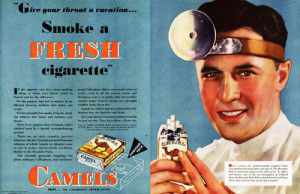
doctor smokes camel

Meat and dairy is being advertised both by local government and at a national level as being a healthy choice. Such promotion continues irrespective of the health risks associated with meat and dairy consumption, particularly when people over-consume. Parallels can be drawn between the animal food industry today and the tobacco industry prior to the 1960s. Old adverts show doctors smoking Camel cigarettes and claiming the health benefits of smoking. Clinical research has shown the health risks to smoking and subsequently litigations followed where the tobacco industry has been sued. Plaintiffs have been able to recover damage awards against tobacco companies. In the US alone, over the last several decades, Big Tobacco has paid more than $400 billion to States Attorney General who have sued them over medical costs. Over the next several decades, David foresees a similar action being taken against the animal food industry for medical costs associated with eating meat and dairy products.

Takeaway:

Think about what you’re putting into your body and don’t take for granted that certain foods are good for you just because the government is telling you that.

Recommended Books:

  • Meatonomics by David Robinson Simon

Receive your FREE copy of Meatonomics. For being an Economic Rockstar listener, you can get an audio copy of Meatonomics by David Simon for FREE. Just click on this link and you’ll be re-directed to Audiobooks.com.

  • The China Study by Colin Campbell

The China Study is the leading piece of clinical information on the differences between an animal-based diet and a plant-based diet. He has found that when you feed animal protein to an animal or a person, and if they had tumours, then those tumours will continue to grow. Conversely, if you take them off the animal food diet and put them on a plant-based diet, those tumours are likely to shrink.

Where to Find David Simon:

  • Website: meatonomics.com
  • Twitter: @meatonomics
http://traffic.libsyn.com/economicrockstar/034_David_Simon_Final.mp3

Podcast: Play in new window | Download
014: Shoshana Grossbard on Why Dry Cleaners Charge Women More, on the Economics of Love & Marriage and on Polygamy

January 8, 2015 by Frank

http://traffic.libsyn.com/economicrockstar/014_Shoshana_Grossbard.mp3
Play in New WindowDownload

014: Shoshana Grossbard on Why Dry Cleaners Charge Women More, on the Economics of Love & Marriage and on Polygamy

Shoshana GrossbardShoshana Grossbard is Professor of Economics at San Diego State University and founding editor of the Review of Economics of the Household.  Shoshana has been a fellow and visiting lecturer  at numerous universities including Stanford, Columbia University, the University of Zaragoza, Spain, Tel Aviv and Bar Ilan University, as well as in Munich and Bonn, Germany.

Shoshana obtained her Phd from the University of Chicago where she developed an interest in the New Home Economics from its founders, the late Nobel Laureate Gary Becker and the late Jacob Mincer. The main focus of Shoshana’s research is household economics, family economics and the economics of marriage and, as a student, developed her first non-unitary model of household decision-making. Shoshana is actively promoting the establishment of household economics as a separate specialty in economics. She is one of the first social scientists to have analyzed consequences of gender imbalance in the sex ratio for intra-household distribution, labor supply, fertility and cohabitation. The economics and social impact of polygamy is also a research interest.

Shoshana has published 5 books and more than 50 articles on the determinants of marriage, consumption and labor supply and on the law and economics of household decisions. She is fluent in English, French, Hebrew, Spanish, and Dutch and has presented her work at many universities in more than 13 countries.

Economic Themes:

In this interview, Shoshana mentions and discusses: household economics, family economics, economics of the household, household decision-making, sex-ratios, the economic and social impact of polygamy, determinants of marriage, opportunity cost, consumption and labor supply, immigration, population, marriage, price discrimination, government intervention and elasticity.

Economists and Economic Schools:

In this interview, Shoshana mentions: New Home Economics, Gary Becker, Jacob Mincer, Adam Smith, Arleen Leibowitz, Linda Edwards, Andrea Beller, Elizabeth Landes, Catalina Amuedo-Dorantes and Sankar Mukhopadhyay.

Shoshana’s Defining Moment/Affirmations/Mantra:

Shoshana is defined by the feminist movement of the 1960s/1970s in her early student days and her mother’s dislike of being a housewife.

I’ve remained a feminist for the rest of my life. It was always very clear to me that I was going to have a career in addition to having a family.

Personal Habits:

Hard work. I work very long hours, I work very hard and I’m very motivated to be successful. There’s no other way.

If you don’t work hard, things don’t just fall on your lap – Shoshana Grossbard

Click To Tweet

Advice:

It’s very important to have a critical eye. Whatever you read you have to realise that most research, including research by economists is biased by the point of view of the writer and they have an axe to grind typically. You have to try to figure out what’s the axe they’re grinding before you read it.

In this episode, you will learn:

  • about Shoshana being a 1970s hippie and her demonstrations against King Constantine of Greece.
  • about the differences in female educational participation between the 1960s and present day.
  • about the sexist advertisements that existed which placed the wife in the household.
  • about the origins of the New Home Economics.
  • about what the theory of household means.
  • how Shoshana transitioned herself from an interest in the economics of education to the economics of polygamy while a student of Gary Becker.
  • how Shoshana’s approach to the study of polygamy differed with Gary Becker’s.
  • what quasi-wages are for the stay-at-home mum or dad.
  • if there is an opportunity cost to marriage.
  • the implication on labor force participation as a result of marriage.
  • about WiHo or Work-in-Household.
  • about the importance of the sex-ratio in determining labor force participation.
  • how Shoshana calculates the sex-ratio.
  • how women’s participation in the labor force can be a direct result of fluctuations in the sex-ratio.
  • how a high sex-ratio (more men than women) can increase the bargaining power of men.
  • how a low sex-ratio (more women than men) can increase the bargaining power of women.
  • if Hilary Clinton‘s year of birth allowed her to be the successful and educated person she is today due to the low sex ratio in the US between 1946 and 1950.
  • about the marriage-squeeze hypothesis (in which there is a shortage of men or women for marriage).
  • about the detail of Ireland’s population pyramid, which indicates a male marriage squeeze for those aged 4 to 10 (more males due to births) and a female marriage squeeze for those aged 20 to 29 (more females due to male emigration).
  • about the relevance of the sex-ratio of immigrants and how the freedom of labor can solve the problem of a  marriage squeeze.
  • if the availability of polygamy translates into a higher bargaining power for women.
  • if polygamy solves a marriage market disequilibrium.
  • about the polygamy ruling in Canada.
  • how polygamy can be harmful for young men and why they are known as the lost boys.
  • about the Fundamentalist Latter Day Saints in British Columbia.
  • if the government should intervene in markets where gender price discrimination occurs.
  • who pays more for dry-cleaning services – males or females – based on their elasticity of demand.
  • if we should trust our spouse given the ideology behind economics that all market participants are self-interested and seek to gain wealth without any consideration of others.
  • if spousal love diminishes once you have children and that the love you have toward your child compensates for the lack of love from your spouse.

Origins of New Household Economics:

When Gary Becker and Jacob Mincer started New Home Economics, it was mostly their initiative but it was the students at the University of Columbia at that time who participated in the labor workshops that were very instrumental in promoting and developing it.

There were a high proportion of women who attended the workshop including Arleen Leibowitz and Linda Edwards and, later on, Andrea Beller and Elizabeth Landes.

It is wrong to view New Home Economics as ideologically motivated to maintain old-fashioned gender roles.

One of the major ideas of the New Home Economics is to consider households like firms where there is household production and to analyse them with the same tools economists analyse business firms.

So basically, households are non-profit firms but there are many small non-profit firms in the economy that are considered part of the economy that are counted in GNP. But the most prevalent non-profit firm, the household, is not counted in the GNP.

Jacob Mincer and Gary Becker were not concerned about what was counted in GNP but they were more micro-economists. So they wanted to use all the tool available from price theory and apply them to the analysis of what households do:

  • How do they divide the housework?
  • Do women participate in the labor force?
  • The trade-off between household production and participation in the labor force.

The Origins of Shoshana’s Work:

Shoshana‘s approach to the study of polygamy took account of the point of view of women whereas Gary Becker considered variables such as how men’s incomes determined the number of wives he would have.

Shoshana challenged Gary stating that it’s not just about men’s income but it’s also a matter of women’s education, the age of the women, the fertility of the women and the resources that they have because they can bargain with the men about what they’re willing to do.

Shoshana continued to work on economic development issues because polygamy is practiced mostly in less-developed countries where she examined data in Nigeria and then the study of consensual marriages in Guatemala.

Jacob Mincer advised Shoshana, when she was seeking a job, to do more mainstream economics rather than the exotic research mentioned above which may not be of interest to economists in general. That is when she switched to the study of labor force participation and developed a theory of allocation of time in markets for labor and marriage.

There is a major difference between the model developed by Grossbard and that developed by Becker and Mincer. When Becker and Mincer talk of household production, they refer to households as a unit or as an entity making decisions. However, in Grossbard’s model it is the individuals making decisions.

Household Decision-Making and Quasi-Wages

The fundamental question of New Household Economics: Is there an opportunity cost to marriage and what is the implication on labor force participation as a result of marriage?

Individuals, from an early age, have a concept and vision of how they want to live their lives.

Work in Household (WiHo) represents the willingness to work in a household to, say, raise children.

On Gender Price Discrimination:

“We should all be conscious that sometimes there is exploitation of the consumer and if you don’t like the subliminal advertising that companies use to make you buy perfume or aftershave well then just don’t buy it.”

I’m not a fan of regulation – Shoshana Grossbard

Click To Tweet

Dry cleaners charge more for women’s blouses than for men’s shirts, despite them being the same product, with perhaps the main difference being that the buttons on a blouse are typically located on one side of a blouse to that of a man’s shirt.

Dry cleaners are aware that the price elasticity of demand for a woman needing dry cleaning is less than that of a man, meaning that there is more of a need for women to use the dry cleaning services and would, hence pay more as no-one else would do it for them.

On the other hand, the elasticity of demand is more for men, meaning that dry cleaners may charge less for the same service so as to encourage men to dry clean.

Shoshana states that the reason for this gender price differential by dry cleaners is that the majority of men would not go to a dry cleaners as they have a wife, girlfriend or mother who would take on the task of cleaning their clothes. The WiHo or Work in Household is higher for these women as they have, in the majority of cases, taken on the responsibility of running the household chores.

The women who arrive at a dry cleaners are those who have a low WiHo perhaps due to a working career or an unwillingness to take on the responsibility of such chores or even due to the lack of people willing to do the work, such as a spouse.

How the Activities of a Home Differs to the Activities of a Market

Adam Smith stated: “It is not from the benevolence of the butcher, the brewer or the baker that we expect our dinner but from the regard of their own interest”.

If we view all participants in a household as economic agents who have a certain degree of self-interest, should we trust our spouse?

The statement by Adam Smith is about the functioning of the market and how the competition among the bakers and the other professionals brings down the prices and eventually the consumer benefits.

The problem with household production, which is a non-profit firm, is that most of what is produced at home is not going to be sold in the market, principally the children, the beauty of the  home, the harmony in the home. These are products that are being consumed by the producers themselves or by the people who pay for the WiHo. In this case, the market system doesn’t work.

The benevolence of the spouse is a very important element. Adam Smith also had a Theory of Moral Sentiments and in the framework of the household, altruism matters. So, benevolence and altruism matters.

Favorite Books:

  • Dollars and Sex by Marina Adshade
  • The Marriage Motive: The Price Theory of Marriage by Shoshana Grossbard
  • Publications of Shoshana Grossbard

Favorite Internet Resource:

  • marinaadshade.com  and on Twitter: @dollarsandsex
  • omgchronicles.vickilarson.com and on Twitter: @OMGchronicles
  • Gretchen Livingston on Twitter: @DrGMLivingston

Where To Find Shoshana Grossbard:

  • Facebook: Economics of Love
  • Twitter: @econoflove
http://traffic.libsyn.com/economicrockstar/014_Shoshana_Grossbard.mp3

Podcast: Play in new window | Download
Frank Conway

Frank Conway is founder of Economic Rockstar and lecturer of economics, finance and statistics. Read More…

View My Blog Posts

Youtube Sub

Become a Patron of the Economic Rockstar Podcast

patreon

Ireland’s Economy by the Numbers

Leaving Cert Economics: Ireland’s Economy  Click here to download a workbook on Ireland’s Economy so that you can add your own notes. [Original size] Ireland’s Economy by fconway

Categories

Subscribe and Never Miss An Episode

itunes-logo

Recent Posts

  • Ireland’s Economy by the Numbers April 8, 2019
  • 174: Wendy Carlin on The Core Project, Capitalism, Democracy and Normative Statements February 13, 2019
  • 173: Stephen Wright on Core Econ as a Learning Resource for Mainstream Economics January 28, 2019
  • 172: Best of 2018 Part 2: From the Great Depression to Futurism; Institutions, Individualism, Cooperation and Reciprocity January 22, 2019
  • 171: Best of 2018 Part 1 January 3, 2019

Copyright © 2026 · Podcast Pro Theme on Genesis Framework · WordPress · Log in

This website uses cookies to improve your experience. We'll assume you're ok with this, but you can opt-out if you wish. Accept Reject Read More
Privacy Policy

Privacy Overview

This website uses cookies to improve your experience while you navigate through the website. Out of these, the cookies that are categorized as necessary are stored on your browser as they are essential for the working of basic functionalities of the website. We also use third-party cookies that help us analyze and understand how you use this website. These cookies will be stored in your browser only with your consent. You also have the option to opt-out of these cookies. But opting out of some of these cookies may affect your browsing experience.
Necessary
Always Enabled
Necessary cookies are absolutely essential for the website to function properly. This category only includes cookies that ensures basic functionalities and security features of the website. These cookies do not store any personal information.
Non-necessary
Any cookies that may not be particularly necessary for the website to function and is used specifically to collect user personal data via analytics, ads, other embedded contents are termed as non-necessary cookies. It is mandatory to procure user consent prior to running these cookies on your website.
SAVE & ACCEPT