
• ABOUT
  • RESOURCES
  • PODCAST
  • BOOKS
  • BLOG
  • SUPPORTERS
  • QFA Financial Advice
  • CONTACT

Economic Rockstar

Connecting Brilliant Minds in Economics and Finance

067: Leigh Caldwell on Cognitive Economics and the Mathematics of Behavioral Economics
January 3, 2016 by Frank

http://traffic.libsyn.com/economicrockstar/067_Leigh_Caldwell_Final.mp3
Play in New WindowDownload

067: Leigh Caldwell on Cognitive Economics and the Mathematics of Behavioral Economics

leigh caldwellLeigh Caldwell is a behavioural economist based in London.

Leigh, together with Elina Halonen, runs the Irrational Agency, which takes the latest scientific discoveries in psychology and behavioural economics, blends it with their hands-on experience of marketing and business, and turns them into powerful, incisive market research techniques.

In 2012, Leigh condensed his experience in pricing and the marketing of several of his businesses into a new book The Psychology of Price: How to use price to increase demand, profit and customer satisfaction.

Leigh is co-founder of the London Behavioural Economics Network, writes for the Pricing Revolution and the Knowing and Making blogs, and regularly features as an economics commentator on BBC News, Radio 4, Research Magazine and other media.

My own background is all about intellectual challenge. I went to university early as a teenager. I studied maths and physics. I was always into pushing myself intellectually and finding the next challenge to take on – Leigh Caldwell

Economists: 

In this interview, Leigh mentions: Elina Halonen, Dan Ariely and George Lowenstein.

Economics:

In this interview, Leigh mentions: Behavioral economics, experimental economics, lab experiments, demand curve, equilibrium, utility, mathematics, rationality, nudge, choice architecture, cognitive economics, reference pricing model, anchoring, hyperbolic discounting, heuristics, neuroeconomics, Nudge Unit, organ donation, tax collection, productivity, GDP and unemployment.

In this episode you will learn:

  • why Leigh help co-found the London Behavioural Economics Network (LBEN).
  • the importance of academics and practitioners working together to further the discipline of economics.
  • why finding the sweet-spot between controlled experiments and realism is difficult yet important.
  • what cognitive economics is and how different it is the behavioral economics.
  • whether big data could influence an individuals consumption behaviors.
  • about the need to use the mathematics of computer science in behavioral economics.
  • why we shouldn’t use the current maths of economics to explain human behavior.
  • why a lack of mathematics is holding back the discipline of behavioral economics.
  • why mathematics is essential for theorising and modelling economics, especially behavioural economics.
  • about the paradox of self-awareness in cognitive economics when faced with choices.
  • how a consumers relationship with a material object is a unique experience and how putting a price on the good can ruin this experience.
  • why charging a higher price for your product or service would generate higher profits in a perceived perfectly competitive market.
  • whether the 99p or 99 cent pricing strategy works.
  • about the reference pricing model and why charging $39 for a product is better than charging $34 for the same product.
  • about the importance of setting prices when considering how numbers are spoken, i.e. numbers with more syllables are received to be more expensive than those with fewer syllables. 
  • how Leigh uses the findings in academic papers to make money for his business.
  • how Leigh uses economic conferences to network, to find out about the latest research and to discover the new academic societies that have been established.
  • about Leigh’s goal for 2016 to start a Cognitive Economics Society.
  • about the advice Leigh would give the UK government to apply cognitive and behavioral economics to deal with some aspects of social life.
  • how the UK government changed people’s behaviour about paying their taxes on time.
  • about the productivity challenge the UK government is facing today and what can be done about it.
  • about the current research Leigh is undertaking regarding where our preferences come from.

Conferences:

  • Judgement and Decision Making Conference
  • American Economics Association Conference

Books:

  • The Psychology of Price: How to use price to increase demand, profit and customer satisfaction by Leigh Caldwell.
  • Predictably Irrational by Dan Ariely.
  • Basic Instinct by Pete Luhn
  • Nudge by Richard Thaler
  • Thinking, Fast and Slow by Kahneman and Tversky

http://traffic.libsyn.com/economicrockstar/067_Leigh_Caldwell_Final.mp3

Podcast: Play in new window | Download
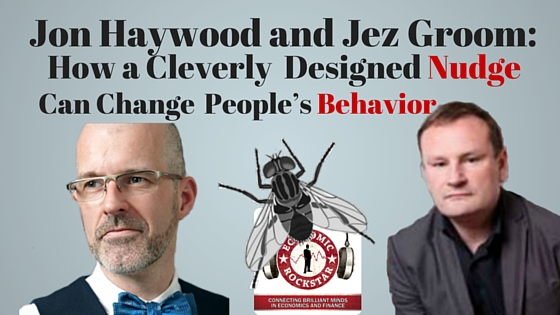
049: Jez Groom and Jon Haywood on How a Cleverly Designed Nudge Can Change People’s Behavior – Including How We Pee

September 10, 2015 by Frank

http://traffic.libsyn.com/economicrockstar/Jez_Groom_Final.mp3
Play in New WindowDownload

049: Jez Groom and Jon Haywood on How a Cleverly Designed Nudge Can Change People’s Behavior – Including How We Pee

Jez Groom is a behavioral economist and co-founder of the behavioral practice #ogilvychange in the United Kingdom.

Alongside Rory Sutherland, Jez has created the Nudge Awards and Nudgestock, bringing the best in behavioral economics to the mainstream.

Jon Haywood is the founder of Ambassadogs and has been working in the Advertising industry for almost 20 years.

Jon has specialised in taking a more consumer (human) perspective of the marketing challenge, working with the likes of Rory Sutherland of #ogilvychange on understanding how behavioural economics can add a significant competitive advantage to the creative ideation process.

Jez Groom and Jon Haywood

Economists:

Rory Sutherland, Paul Dolan, Richard Thaler, Cass Sunstein, Daniel Kahneman, Dan Ariely and Malcolm Gladwell.

Economics:

Behavioural economics, choice architecture, nudge, framing, heuristic, ’Fly in the Urinal’, ‘Piano Stairs’, ‘Stickman’, ‘The Religious Norming and The Begger’ and the ‘Facial Feedback Hypothesis’,

In this episode, you will learn:

  • how #ogilvychange is bringing Behavioural Economics into the mainstream.
  • about Nudgestock which brings academics and practitioners together to discuss the theoretical and practical intersection of behavioural economics.
  • how a ‘Fat Stickman’ pointing to an escalator and a ‘Thin Stickman’ pointing to the stairs can nudge a person to take the stairs.
  • about the bathroom tip-jar trick that could net you more tips than ever!
  • how re-arranging the choice architecture of a sales product can boost sales.
  • how #ogilvychange gave The Times newspaper a ROI of 250 in incremental sales on a 1 investment.
  • that offering customers too many choices can affect your bottom-line.
  • how changing the environment of sales agents can increase average sales by 185% simply by changing the colours of the walls.
  • how we can nudge people to take the stairs rather than the elevator by creating ‘The Piano Stairs’.
  • how we can encourage people to bin their litter by simply creating ‘The World’s Deepest Bin’.
  • how we can reduce the amount of urine that ends up on the floor by putting a sticker in the urinal.
  • why businesses and governments are now embracing behavioral economics.
  • and much more!

How a Clever Nudge Can Change People’s Behavior:

The Fun Theory, an initiative by Volkswagen, aims to create ways to encourage people to make a small change in their lives for the better. A nudge is a strategic approach by firms, governments and individuals to encourage people to behave in a way you would like them to behave. Nudging has become quite synonymous with behavioral economics lately, particularly since the release of Thaler’s book ‘Nudge’.

The Piano Stairs:

There is a general consensus that taking the stairs rather than the elevator or escalator can, overtime, make people lead a healthier and happier life. Perhaps that outcome is somewhat extreme, but people may ‘feel better’ if they take the stairs every time. However, how can we encourage people to take the stairs rather than the elevator?

Should we stop the escalator from moving or have an ‘Out of Order’ sign on an elevator? Not a good idea as this would possibly have an undesired outcome as people would end up infuriated. Although they are forced to the take the stairs, the path taken to get from A to B is not desirable. Problems would also arise for those unable to physically take the stairs. We should allow an option but encourage people, if they can, to take the stairs.

Should we send out messages outlining the health and well-being benefits of taking the stairs? Perhaps this could be effective but taking the stairs today will not make someone any fitter or healthier. People will more than likely delay or feel it is pointless.

https://www.youtube.com/watch?v=0Yu62StlsMY

Do you remember or have you seen the 1988 movie Big featuring Tom Hanks? Tom’s character had made a wish, the day before when he was a young boy, to be older. His wish comes true but his mind and behavior is that of his younger self. Tom’s character immortalizes the famous New York toy store, FAO Schwarz, by playing ‘Chopsticks’ on a large piano on the floor. This captured the imagination of many people who wathced his movie and I’m sure the behavioral scientists at The Fun Theory knew exactly how they could now encourage people to take the stairs rather than the escalator.

Enter The Piano Stairs, a fun and interactive experiment to nudge people to take the stairs and to, perhaps, feel better. Check out their video here and the interesting results achieved with this ‘nudge’ from The Fun Theory.

The Urinal Fly:

In this episode of the Economic Rockstar podcast, Jez Groom mentioned how placing a sticker of a fly in a urinal reduced the incidence of mis-direction of toileting by men. Subsequently, I reached out to Jon Haywood from ambassadogs.nl who explained the concept of the Urinal Fly and how a sticker or print of a fly within a urinal is a nudge that changed the behavior of those men in question.

Jon is from Amsterdam and this particular nudge is credited to Amsterdam’s Schiphol Airport. The manager of the cleaning department at Schiphol Airport, Jos van Bedaf, is credited to introducing the urinal fly in order to reduce the amount of spillage. According to Jon Haywood, this had the effect of reducing spillage, resulting in lower clean-up costs and improved toilet conditions. The fly was chosen as it appears insanitary and men can aim at the image. A butterfly couldn’t be chosen as men may aim around this image as it could conjure up an image of beauty that you wouldn’t like to harm.

The World’s Deepest Bin:

Another nudge was developed by The Fun Theory to encourage people to bin their litter and have a litter-free environment. Again, Jon Haywood talks to us about this particular nudge and how a piece of deposited litter passed an internal sensor which activated a sound giving the perception that the litter was falling for 10 seconds.

Recommended Books:

  • Thinking, Fast and Slow by Daniel Kahneman
  • Nudge by Richard H. Thaler
  • Blink by Malcolm Gladwell
  • Outliers by Malcom Gladwell
  • Freakonomics by Steven D. Levitt and Stephen Dubnar
  • SuperFreakonomics by Steven D. Levitt and Stephen J. Dubnar

Resources:

  • #nudgesinthewild
  • O Behave!
  • www.thenudgeawards.com

Where to Find Jez Groom:

www.ogilvychange.com

Where to Find Jon Haywood:

www.ambassadogs.nl

http://traffic.libsyn.com/economicrockstar/Jez_Groom_Final.mp3

Podcast: Play in new window | Download
047: Victor Ricciardi on The Psychology of Financial Planning and Investing

August 27, 2015 by Frank

http://traffic.libsyn.com/economicrockstar/047_Victor_Ricciardi_Final.mp3
Play in New WindowDownload

047: Victor Ricciardi on The Psychology of Financial Planning and Investing

Victor Ricciardi is Finance Professor at Goucher College, Baltimore, Maryland where he teaches courses in Victor Ricciardipersonal financial planning, corporate finance, investments, behavioral finance, and the psychology of money.

Victor is the Coordinator of Behavioral & Experimental Research for the Social Science Research Network also known as SSRN.

Victor is the current Editor for seven SSRN eJournals including Behavioral & Experimental Finance, History of Finance, and Behavioral & Experimental Economics.

He received his PhD from Golden Gate University and his MBA from St. John’s University.

Victor’s current book Investor Behavior: The Psychology of Financial Planning and Investing with co-editor Kent Baker is now available and has 30 chapters on emerging research in behavioral finance.

In this episode, you will learn:

  • the difference between Behavioral Economics and Behavioral Finance.
  • the rational approach to investing and whether it exists.
  • what bounded rationality really means.
  • if companies help you make decisions for their own personal benefit.
  • how framing can be a powerful tool to help customers make decisions.
  • the importance of financial literacy at different stages of your life.
  • the similarities between behavioral economics and marketing.
  • the future of Behavioral Economics and Behavioral Finance.
  • how your mood, good or bad, can influence your buying behaviour and increase risk-taking.
  • about the importance of studying the subconscious mind in finance or neurofinance.
  • why people generally do not take losses, known as loss aversion.
  • why Victor disagreed with the traditional views of economics and decided to study behavioral finance.
  • how and why some governments are using behavioural finance and economics techniques to nudge us to make better financial decisions in our lives.
  • how status quo bias makes it harder for employees to opt out of an automatically enrolled savings retirement plan.
  • how mounting student debt and high youth unemployment in the US could make it difficult to service pensions leading to a pension ‘ponzi’ scheme or a crisis.
  • why Victor Ricciardi believes that there should have been a law designed to make retirement planning easier for the employee.
  • what you should do when investing so as to manage bull and bear market cycles.

Economics:

In this interview, Victor mentions and discusses: behavioral Economics, Behavioral Finance, rational, bounded rationality, heuristics, framing, annuity puzzle, investment, consumption, self-control bias, nudging, consumer behavior, mutual returns, savings, investments, neurofinance, risk tolerance, over-confidence, loss aversion, nudging, status quo bias, retirement planning and wage inflation.

Economists:

In this interview, Victor mentions and discusses: Richard Peterson, Douglas Rice, Daniel Kahnemann, Amos Tversky, Robert Olson, Richard Thaler and Hersh Shefrin.

Influencers:

William Sharpe, Harry Markovicz, Terence Odean, Robert Olsen, Dan Ariely, Mair Stockman, Hersch Shefrin and John Nofsinger.

Quotes by Victor Ricciardi in Episode 047 of the Economic Rockstar Podcast:

Behavioural Finance is the notion of integrating psychology with finance. So you’re looking at some major themes where people are not only rational but they make decisions based on emotions. – Victor Ricciardi

Risk tolerance is the maximum amount of risk a person is willing to take in their overall portfolio or risky asset. Typically, people are either very conservative risk-takers, they’re average or they’re very aggressive. The component of risk tolerance that’s related to it is known as ‘Risk Perception’, in which our feelings and emotions will increase or have an impact on our overall risk tolerance. – Victor Ricciardi

Takeaway:

Meet with a financial planner and get a financial plan done. In terms of investing, try to understand what type of investor you are and come with an asset allocation that you are comfortable with. Rebalance your portfolio on a year basis which allows you to stay within your risk tolerance. – Victor Ricciardi

Recommend Resources:

  • Twitter

Recommend Books:

  • Investor Behavior: The Psychology of Financial Planning and Investing by Victor Ricciardi and Kent Baker
  • The Psychology of Investing by Jon Nofsinger
  • Irrationally Yours by Dan Ariely
  • Predictably Irrational by Dan Ariely
  • Misbehaving by Richard Thaler

Where to Find Victor Ricciardi:

  • Twitter
  • Goucher College
http://traffic.libsyn.com/economicrockstar/047_Victor_Ricciardi_Final.mp3

Podcast: Play in new window | Download

045: Jon Manning on the Art of Pricing and How Economic Theory Has Got Pricing All Wrong

August 13, 2015 by Frank

http://traffic.libsyn.com/economicrockstar/045_Jon_Manning_Final.mp3
Play in New WindowDownload

045: Jon Manning on the Art of Pricing and How Economic Theory Has Got Pricing All Wrong

Jon Manning is the Founder and Principal Consultant of Sans Prix and has over two decades of Pricing experiencejon manning in a wide variety of industries.

Since establishing Sans Prix, Jon (and his associates) have generated millions of dollars in incremental revenue for clients in places such as the UK, USA, India, and Australia.

Increasingly in demand as both a speaker and educator, Jon has spoken at many conferences, workshops, webinars and educational institutions across the Asia-Pacific, the Middle East and the United Kingdom.

In 2011, Jon and Greg Eyres established Pricing Prophets, the world’s first and only online pricing advisory service where clients can ask a panel of global pricing experts and thought-leaders what price to charge for a product or service and why.

Jon holds a Bachelor of Business (Applied Economics) from Deakin University (Australia), a Graduate Diploma of Business (Management) from Monash University (Australia) and a Master of Arts (European Studies), from The University of West London. He is a member of the Australian Institute of Management and the Professional Pricing Society.

In this episode, you will learn:

  • why Jon believes pricing is more of an a art than a science.
  • why pricing is based on human behavior that no scientific model can predict.
  • why there’s no such thing as Adam Smith’s Invisible Hand.
  • that 70% to 80% of companies use cost-based methods to set prices and few use a value-based method.
  • why customers don’t care about companies who use cost-based pricing and prefer companies that use value-based pricing methods.
  • why the best pricing strategy for a company is a value-based method.
  • the trials and tribulations of the pricing strategy adopted by Netflix and how it affected its share price.
  • how a $40 fine for returning a DVD late led to the founding of Netflix.
  • if the best strategy for companies to announce price increases to its customers is to do so a few years in advance.
  • how behavioral economics is opening up a minefield of exploration in pricing.
  • how Apple used anchoring techniques to sell their iWatch by offering a $10,000 iWatch. It makes the mainstream iWatch appear to be value for money.
  • how a $100 omelette was used by a restaurant to act as a decoy so it can influence your decision to pay for high-end or expensive goods.
  • how Goldilock Pricing helps a company, like Starbucks and Harvey Norman, sell more of a middle tiered product as it helps customers make decisions to buy.
  • how Starbucks found the that most of their customers have inelastic demand and decided to increase prices despite a recession in the US.
  • how the internet has changed the pricing model by offering freemium products and services and 30-Day money back guarantees.
  • if there are myths to pricing for companies.
  • how companies like Apple and Amazon price discriminate in order to capture market share and drive revenues upward.
  • how more and more companies are adopting dynamic pricing when selling into different markets.
  • the education pricing model in Ireland, Australia and the US.
  • about MOOCs and how it could have an impact on the future education model.
  • about Gaelic Football and how its players do not get paid unlike other sports.
  • how football games are using dynamic pricing models to charge for tickets based on opposition and weather.
  • that a 1% improvement in price leads to a 10% improvement in operating profit.
  • about the Banksy Experiment in New York where many passers-by failed to pick up an original for $60 that would otherwise fetch for $10,000 in an auction house.
  • how classical violinist Joshua Bell earned $26 in tips playing his $3.5 million violin but played to a packed audience for $100 per ticket the night before.
  • the 2 Golden Rules to Pricing.
  • about the ‘Pay What You Want’ model as followed by Radiohead and Jon Bon Jovi’s Soul Kitchen.

Economics:

In this interview, Jon mentions and discusses: pricing, the Invisible Hand, behavioral economics, heuristics, anchoring effects, framing, Extremeness Aversion, Goldilocks Pricing, demand, elasticity, elastic demand, inelastic demand, pricing architecture, consumer surplus, monopoly, price discrimination, dynamic pricing, marginal pricing and behavioral economics.

Economists:

In this interview, Jon mentions and discusses: Adam Smith, Dan Ariely, John H. Cochrane and Paul Samuelson.

Influencers:

Behavioral economists and marketers.

Quotes by Jon Manning in Episode 045 of the Economic Rockstar Podcast:

What they teach you in economics about pricing is true in theory but it’s irrelevant in practice – Jon Manning

Click To Tweet

I know why there is interest in price elasticity but I sort of think it’s a bit like the abominable snowman – Jon Manning.

Click To Tweet

There’s no formula to calculate the consumer surplus. You hear a lot of economists talk about the consumer surplus, which in the business community is known as leaving money on the table – Jon Manning.

There’s very few revolutionary monopolies around these days – Jon Manning.

Click To Tweet

There’s one thing that’s not a myth and that is you get what you pay for – Jon Manning.

Click To Tweet

The 2 Golden Rules to Pricing:

Rule #1: All value is subjective.

Value is in the eye of the customer. No matter what price you put onto something, at the end of the day, the customer is the single point of failure and if they don’t see value at the price you’ve attached to the product, they’re not going to buy. The ‘Pay What You Want’ pricing model is the purest form of value-based pricing since the customer can decide to pay for the product or service by attaching a value to it.

Rule #2: All value is contextual.

By placing a product or service in a certain context, people’s perceptions of its value change. A product placed in a high-end, up-market setting is more likely to command a higher price, whereas the exact same product placed in a low value setting or environment may only demand a smaller price. Joshua Bell and Banksy showed this golden rule of pricing in their experiments.

Companies Mentioned in this Episode Regarding their Pricing Methods:

Ryanair, EasyJet, Amazon, Apple, Uber, Starbucks, Harvey Norman and Netflix.

Recommended Books:

  • Meatonomics by David Simon
  • Priceless: The Myth of Fair Value (and How to Take Advantage of It) by William Poundstone
  • Information Rules: A Strategic Guide to the Network Economy by Carl Shapiro and Hal Varian
  • Pricing and Revenue Optimisation by Robert Phillips
  • Misbehaving by Richard Thaler
  • Butterfly Economics: A New General Theory of Social and Economic Behavior by Paul Omerod
  • New Ideas from Dead Economists by Todd G. Buchholz
  • The CEO of the Sofa by P. J. O’Rourke
  • Eat the Rich: A Treatise on Economics by PJ O’Rourke

Internet Resource:

  • 77 Inspirational Pricing Pages

Where to Find Jon Manning:

  • Sans Prix
  • Pricing Prophets
  • Twitter

http://traffic.libsyn.com/economicrockstar/045_Jon_Manning_Final.mp3

Podcast: Play in new window | Download
024: Greg Davies on Behavioral Finance and Controlling Your Emotions When Making Trading Decisions

March 19, 2015 by Frank

http://traffic.libsyn.com/economicrockstar/024_Greg_Davies.mp3
Play in New WindowDownload

024: Greg Davies on Behavioral Finance and Controlling Your Emotions When Making Trading Decisions

Greg Davies is Managing Director and Head of Behavioral Finance at Barclays.  He joined the firm in December 2006 to develop and implement commercial applications drawing on behavioural portfolio theory, the psychology of judgment and decision making, and decision sciences.

Today Greg leads a global team of behavioural and quantitative finance specialists, and is responsible for the design and global implementation of Barclays’ Investment Philosophy.

Greg is an Associate Fellow at Oxford University’s Saïd Business School and his first (co-authored) book, ‘Behavioral Investment Management: An Efficient Alternative to Modern Portfolio Theory’, was published in January 2012.

He is co-curator and co-creator of Open Outcry – a reality opera based on the stock market trading floor.

Greg has authored papers in multiple academic disciplines, presents at academic and industry conferences, and is a frequent media commentator on Behavioural Finance.  He is an Editorial Board Member of the Journal of Behavioural and Experimental Finance.

Greg studied at the University of Cape Town and obtained a degree in Economics, Philosophy and Finance. He followed this with an MPhil in Economics and a PhD in Decision Theory and Behavioural Finance from the University of Cambridge.

Economic Themes:

In this interview, Greg mentions and discusses:

Behavioral economics, behavioral finance, rationality, irrational behavior, heuristics, cognitive biases, system 1, system 2, homo economicus, trade-off, home bias, familiarity bias, risk, return, portfolio, efficient frontier, stochastic model, trading floor, noise, herding, bubbles, booms, bust, returns, standard deviation, deterministic model, decision theory, expected utility theory, mean variance and portfolio theory.

Economists:

In this interview, Greg mentions:

Danial Kahneman, Amos Tversky, Terence Odean, Warren Buffet, Charlie Munger and Harry Markowitz.

Influencers:

Jon Elster and Amos Tversky.

Advice:

Be multi-disciplinary. Look for links between fields. Be continuously curious.

Keep learning. Stay curious. Say ‘yes’ to things that are outside your comfort zone.

Find out:

  • what is Behavioral Economics/Finance
  • the disconnection between economics and psychology.
  • how Kahneman and Tversky were ‘swimming up-stream’ to bring common sense to economics.
  • why viewing the world through biases is harmful to behavioral finance.
  • why the ever-increasing list of biases may not be good for the behavioral finance field.
  • about System 1 and System 2 as popularised by Daniel Kahneman.
  • why it’s good to allow emotions to part of the portfolio decision-making process.
  • how to acquire the emotional comfort you need for your long-term financial objectives.
  • how to buy emotional insurance for your long-term investment portfolio.
  • how to avoid costly short-term emotional mistakes.
  • how psychometric tests can extract measures of financial personality.
  • why a set of nudges are designed to help high net-worth individuals to make better decisions.
  • how to build a tailored portfolio to meet your clients needs.
  • why you should consider including expected anxiety into your portfolio building along with risk and return.
  • what an opera experiment has to do with replicating the open outcry system of a trading floor.
  • how music can control your emotions while trading markets.
  • how Barclays Capital are improving the understanding of their clients by turning the lens on themselves.

Behavioral economics is the combination of finance theory and behavioral psychology. It’s about trying to understand how people actually do go about making financial decisions and, as a result, how we might make them better financial decisions.

Problems with Biases in Behavioral Finance:

  • Biases are only often biases if you view them through the lens of what economic theory very narrowly and mathematically deems to be rational.
  • There’s nothing irrational about having the need for a  short-term immediate emotional comfort.
  • A lot of deviations from narrow economic thinking are not irrational at all. They are perfectly reasonable. It is just that other people are bringing other objectives to bear on the decision.
  • The other problem is the tendency to look at the world through a list of biases.

Classical Finance would typically remove irrational behavior from its theories and models. However, the position of Behavioral Finance is much more subtle. As humans, we need emotional comfort. We need to be comfortable with the decisions we make and with the portfolio we hold. There is nothing irrational about that.

You need to find a way of not switching off your emotions but utilising them effectively – Greg Davies

Click To Tweet

Emotions are actually a very good source of information for us if we use them in a thoughtful way – Greg Davies

Resources:

Farnam Street by Shane Parish 

Recommended Books:

  • Thinking Fast and Slow by Daniel Kahneman
  • Explaining Social Behavior: More Nuts and Bolts for the Social Sciences by Jon Elster
  • Behavioral Investment Management: An Efficient Alternative to Modern Portfolio Theory by Greg Davies

Where To Find Greg Davies:

  • Website: Investment Philosophy 
  • Twitter: @GregBDavies
http://traffic.libsyn.com/economicrockstar/024_Greg_Davies.mp3

Podcast: Play in new window | Download

Frank Conway

Frank Conway is founder of Economic Rockstar and lecturer of economics, finance and statistics. Read More…

View My Blog Posts

Youtube Sub

Become a Patron of the Economic Rockstar Podcast

patreon

Ireland’s Economy by the Numbers

Leaving Cert Economics: Ireland’s Economy  Click here to download a workbook on Ireland’s Economy so that you can add your own notes. [Original size] Ireland’s Economy by fconway

Categories

Subscribe and Never Miss An Episode

itunes-logo

Recent Posts

  • Ireland’s Economy by the Numbers April 8, 2019
  • 174: Wendy Carlin on The Core Project, Capitalism, Democracy and Normative Statements February 13, 2019
  • 173: Stephen Wright on Core Econ as a Learning Resource for Mainstream Economics January 28, 2019
  • 172: Best of 2018 Part 2: From the Great Depression to Futurism; Institutions, Individualism, Cooperation and Reciprocity January 22, 2019
  • 171: Best of 2018 Part 1 January 3, 2019

Copyright © 2026 · Podcast Pro Theme on Genesis Framework · WordPress · Log in

This website uses cookies to improve your experience. We'll assume you're ok with this, but you can opt-out if you wish. Accept Reject Read More
Privacy Policy

Privacy Overview

This website uses cookies to improve your experience while you navigate through the website. Out of these, the cookies that are categorized as necessary are stored on your browser as they are essential for the working of basic functionalities of the website. We also use third-party cookies that help us analyze and understand how you use this website. These cookies will be stored in your browser only with your consent. You also have the option to opt-out of these cookies. But opting out of some of these cookies may affect your browsing experience.
Necessary
Always Enabled
Necessary cookies are absolutely essential for the website to function properly. This category only includes cookies that ensures basic functionalities and security features of the website. These cookies do not store any personal information.
Non-necessary
Any cookies that may not be particularly necessary for the website to function and is used specifically to collect user personal data via analytics, ads, other embedded contents are termed as non-necessary cookies. It is mandatory to procure user consent prior to running these cookies on your website.
SAVE & ACCEPT