• ABOUT
  • RESOURCES
  • PODCAST
  • BOOKS
  • BLOG
  • SUPPORTERS
  • QFA Financial Advice
  • CONTACT

Economic Rockstar

Connecting Brilliant Minds in Economics and Finance

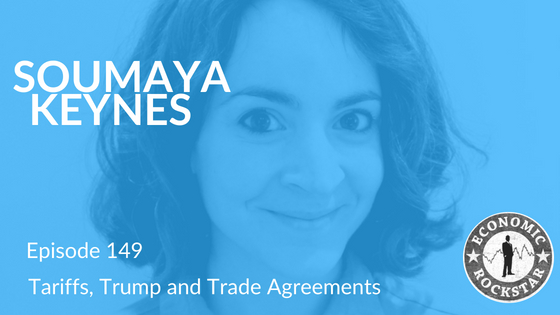
149: Soumaya Keynes on Tariffs, Trump and Trade Agreements
July 22, 2018 by Frank

http://traffic.libsyn.com/economicrockstar/149_Soumaya_Keynes_Final.mp3
Play in New WindowDownload

149: Soumaya Keynes on Tariffs, Trump and Trade Agreements


Soumaya Keynes is the economics and trade correspondent at The Economist. She writes for the print edition and the Free Exchange blog.

Before joining The Economist Soumaya did research on the public finances and pensions at the Institute for Fiscal Studies, an economic research institute.

Before that Soumaya worked in the Banking and Credit team at Her Majesty’s Treasury in London. Soumaya has an M.Phil. and B.A. in Economics from Trinity College, Cambridge.

She is co-host of a weekly podcast on trade economics called Trade Talks.

In this episode, Soumaya mentions and discusses:

  • Tariffs and Trade.
  • On the WTO: when they established and for what reason.
  • The General Agreement on Tariffs and Trade (GATT).
  • Trans-Pacific Partnership (TPP).
  • NATO.
  • EU blockage of US beef imports due to hormone induction but lacks scientific evidence.
  • Brexit: can Ireland and the UK create their own trade agreement as made permissible within the WTO which was also similar to those countries who created the TPP.
  • About NAFTA.
  • Why did Trump go after reforming or disrupting NAFTA?

Books:

Evicted: Poverty and Profit in the American City by Mathew Desmond.

Janesville: An American Story by Amy Goldstein

On Writing Well by William Zinsser


Writing Tips:

Excerpt from this episode with Soumaya Keynes

“Clear writing has value anywhere would be my first point. As someone who reads a lot of academic articles for my job, I think it has an impression that academic writing has to be wordier or more complicated essentially to demonstrate how clever you are. And as a reader of that I would argue that good writing is good wherever it is and there is huge value to being clear and having short sentences and being understandable. You know, jargon is often something that people hide behind. Do you really need to use the ten-letter version of the word where a five-letter version is available?

One thing that came to me relatively late is that essentially there are two kind of writers. There are the kind who other people think of as natural writers who can write out a first draft and it’s perfect. And for disclosure I am not one of those kind of writers. And then the other kind is the kind that basically needs three drafts to get what they are happy with. And I think before I came to The Economist that I would have thought that maybe because I need three drafts as I wasn’t as good a writer as the person who could do it first time. But that I think is really not the case. Just because it feels like it’s taken a lot of effort that you need to do a lot of re-writing to get it in the shape that you want that doesn’t say anything about the quality of the final product or just how good a writer you are.

The risk is that if you know that you need a few rounds of editing to get something in to the shape that you wanted that you label yourself a bad writer and that makes you worried or anxious about writing anything new.

And so, my words of wisdom would be ‘You’re still a great writer even if it takes you a few tries’, or at least that what I tell myself.”

Other Episodes that May Interest You:

  • 144: Donald Boudreaux on International Trade, Tariffs and Protectionism
  • 040: Rebecca Harding on Trade Finance and How Delta Economics Can Help Identify Growth Opportunities World-Wide

Links:

  • Soumaya Keynes personal website
  • The Economist
  • Trade Talks podcast
  • Peterson Institute for International Economics

Patreon

If you’re a fan of the podcast and would like to show your support in anyway, please check out my Patreon page at www.patreon.com/economicrockstar where you can sign up for any of the awards for as little as $1 a month or you can simply follow me on the Economic Rockstar Facebook page or on Twitter or simply recommend the show to a friend, especially if they have never had the opportunity to study economics.

http://traffic.libsyn.com/economicrockstar/149_Soumaya_Keynes_Final.mp3

Podcast: Play in new window | Download
102: Matías Vernengo on John Maynard Keynes and the Evolution of Keynesian Economic Thinking

September 8, 2016 by Frank

http://traffic.libsyn.com/economicrockstar/102_Matias_Vernango_Final.mp3
Play in New WindowDownload

102: Matías Vernengo on John Maynard Keynes and the Evolution of Keynesian Economic Thinking

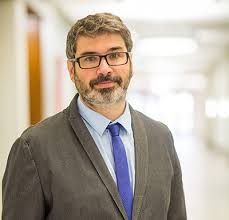
Matías Vernengo is Professor of Economics at Bucknell University, Pennsylvania, USA.matias-vernengo-economic-rockstar

Dr. Vernengo is co-author of ‘Conta de Juros Grande & Favela’ and has also edited four books including ‘Banking, Monetary Policy and the Political Economy of Financial Regulation – Essays in the Tradition of Jane D’Arista’.

He has published over fifty academic and popular articles, and contributes to the blogs Naked Keynesianism and Triple Crisis. He is also the co-editor of the Review of Keynesian Economics (ROKE).

Matías’ methodological view emphasizes the importance of the history of ideas for the development of economic theory, and is based on the surplus approach of the classical political economy authors and Marx and the heterodox followers of Keynes.

Dr. Vernengo has written on the effects of external liberalization in Latin America and alternatives to the Washington Consensus, on the international role of the dollar, on current monetary and fiscal policy, on macroeconomic policy during the 1930s and on the history of economic ideas.

Economics:

In this episode, Matías discusses and mentions: Keynesian economics, neo-Keynesianism, Animal Spirits, monetarists, uncertainty, rational expectations, wages, GDP< consumption, multiplier, 

Economists:

In this episode, Matías discusses and mentions: John Maynard Keynes, Joan Robinson, Karl Marx, Ricardo, Frank Knight, Joseph Schumpeter, Milton Friedman, Robert Lucas, Alvin Hansen, Robert Solow, James Tobin, Paul Samuelson, George Akerlof, Robert Shiller, Larry Summers, Alan Blinder, Ben Bernanke, Christina Romer and Janet Yellen.

Professor Matías Vernengo’s Writing Tips:

  1. Think of your audience and write for them.
  2. Present at conferences and get great feedback. It also gets your work out there.
  3. Plan carefully. Write your paper so that it is a good fit to each journal that you’re sending it to.

Where to Find Matías:

  • Website: Naked Keynesiansim
  • Website: Triple Crisis
  • Twitter: @nakedkeynes

Essay:

The Economic Consequences of Mr. Churchill by J. M. Keynes

Books:

  • The Cambridge Colloquium, 1916: Part 2, Analysis Situs by O. Veblen
  • Can Lloyd George Do It? An Examination of the Liberal Pledge by J.M. Keynes and H. D. Henderson
  • The General Theory of Employment, Interest, and Money by J. M. Keynes
  • A Treatise on Probability by J. M. Keynes
  • The Great Transformation: The Political and Economic Origins of Our Time by K. Polanyi
  • The American Economy by W. Greason, W. Gorman and M. Ziobro
  • Production of Commodities by Means of Commodities : Prelude to a Critique of Economic Theory by P. Sraffa
  • Animal Spirits: How Human Psychology Drives the Economy, and Why It Matters for Global Capitalism by G. Akerlof and R. Shiller
  • Phishing For Fools: The Economics of Manipulation and Deception by G. Akerlof and R. Shiller


http://traffic.libsyn.com/economicrockstar/102_Matias_Vernango_Final.mp3

Podcast: Play in new window | Download
016: Jack Schwager on How You Can Become a Market Wizard with Fundseeder.com

January 22, 2015 by Frank

http://traffic.libsyn.com/economicrockstar/016_Jack_Schwager.mp3
Play in New WindowDownload

016: Jack Schwager on How You Can Become a Market Wizard with Fundseeder.com

Untitled design (10)

Jack Schwager is a recognized industry expert in futures and hedge funds and the author of a number of widely acclaimed financial books. Mr. Schwager is one of the founders of Fund Seeder (FundSeeder.com), a platform designed to find undiscovered trading talent worldwide and connect unknown successful traders with sources of investment capital.

Previously, Mr. Schwager was a partner in the Fortune Group (2001-2010), a London-based hedge fund advisory firm. His prior experience also includes 22 years as Director of Futures research for some of Wall Street’s leading firms, most recently Prudential Securities.

Mr. Schwager has written extensively on the futures industry and great traders in all financial markets. He is perhaps best known for his best-selling series of interviews with the greatest hedge fund managers of the last three decades: Market Wizards (1989), The New Market Wizards (1992), Stock Market Wizards (2001), Hedge Fund Market Wizards (2012), and The Little Book of Market Wizards (2014).

His other books include Market Sense and Nonsense (2012), a compendium of investment misconceptions, and the three-volume series, Schwager on Futures, consisting of Fundamental Analysis (1995), Technical Analysis (1996), and Managed Trading (1996). He is also the author of Getting Started in Technical Analysis (1999), part of John Wiley’s popular Getting Started series.

Mr. Schwager is a frequent seminar speaker and has lectured on a range of analytical topics including the characteristics of great traders, investment fallacies, hedge fund portfolios, managed accounts, technical analysis, and trading system evaluation. He holds a BA in Economics from Brooklyn College (1970) and an MA in Economics from Brown University (1971).

Economic and Finance Themes:

In this interview, Jack mentions and discusses: chartists, technical analysis, fundamentals, futures, normal distribution curve, options, Black-Scholes Options Pricing Model, option warrant trading, efficient market hypothesis, probability, negative externalities, fiscal responsibility, Keynesianism, deficits and demand.

I chose economics because I wasn’t any good to major in physics or math. I just felt I would be mediocre if I went into those fields. On the positive side, I had a super professor for Econ1. He was just so clear and logical – Jack Schwager.

Economists and Traders:

In this interview, Jack mentions: David Shaw, Ed Thorp, John Bender, Michael Marcus, Fischer Black, Robert Merton, Myron Scholes, John Maynard Keynes, Michael Lewis, Nassim Nicholas Taleb, and Yoram Bauman.

In this episode, you will learn:

  • why Jack chose economics at University.
  • about the similarities between Physics and Economics and why they are so different as a science.
  • if there is a certain personality that is required in trading financial markets.
  • if there is a holy grail to trading the markets.
  • about the importance of discipline.
  • how an $18 ‘Job Wanted’ ad in the New York Times landed Jack a position as a key analyst.
  • the one trader that particularly impressed Jack.
  • about the different strategies of some of Jack’s Market Wizards.
  • why normal distribution tail events can have a higher probability of occurrence than is lead to believe.
  • about the tragic ending of Market Wizard John Bender and the current case against his wife by the Costa Rican authorities for his ‘murder’.
  • about Fund Seeder – the world’s first search engine for undiscovered trading talent.
  • about Jack’s forthcoming book with the working title ‘Undiscovered Market Wizards’ and how you could possibly feature it.
  • about the Market Wizards Roadshow coming soon in 2015.
  • why Jack wrote his book ‘Market Sense and Nonsense’.
  • about the debunking of the efficient market hypothesis.
  • what a negative externality is in the context of economic theory.

Physics, Economics and the Stock Market: A Connection

Economics is more complex from a quantitative standpoint because in physics at least the rules are well-defined and don’t change and in economics they’re not stable.

Many schools in economics get it wrong because they fail to appreciate the influence of human behavior which is not stable.

Because of the human element it becomes much more difficult to forecast in economics than it is using physical laws.

A lot of traders interviewed for the Market Wizards book come from the higher level mathematics and physics spectrum. That’s one type of person who is attracted to the markets. It’s solving analytical problems that intrigues them.

Other traders are very intuitive and have a completely different approach to trading markets.

Trading with  Discipline in the Markets

There are no secrets to trading the markets. There are an untold number of ways in which the markets can be successfully approached.

They are all very difficult and most people will fail. There is no common approach and it’s more of a matter of finding an approach that works for you.

On Trading: Regardless of how you do it, you better have discipline – Jack Schwager

Click To Tweet

It doesn’t matter if you’re quant or not quant, chart or fundamental,  long-term or short-term. Whatever approach you do use, you better be disciplined or it’s not going to work.

Once I got involved in futures, I quickly discovered that at that time, at least on the analytical side, there wasn’t much talent out there. I think I succeeded because competition was very easy at that time – Jack Schwager.

Life for almost all of us is tremendously influenced by chance more so than people would admit or realise – Jack Schwager.

Probability and Options

On Ed Thorp: He is the walking refutation of the Efficient Market Hypothesis – Jack Schwager

Click To Tweet

The options markets are pricing for the assumption of equal probabilities at all times on both sides.

Options are priced for neutrality all of the time and that’s not reality. There are certain circumstances in the markets where something happening is much more likely to occur on one side of the distribution curve than the other.

The markets may assume a log normal distribution. But when there is a critical stop level at some price then, when the market goes to that price, the probability that the market will go below that price, what is considered within the tail events, will be much greater. Just getting to that critical price can trigger an avalanche of orders.

Fundseeder: The World’s First Search Engine for Undiscovered Trading Talent

The concept of Fund Seeder is to create a central place on the web where all traders, particularly undiscovered traders can establish their track records, have them verified and then have investors who are looking to allocate new trading talent find them.

The trader links their brokerage accounts with their own account on Fund Seeder so the numbers come directly from the traders’ brokerage account. That critical verification step occurs on this central platform allowing the traders and potential investors to verify the numbers.

There are traders from over 60 countries on Fundseeder who now have the opportunity to get in front of potential investors and establish a track record.

There is also the ‘seeding’ side where investor groups will participate to find traders and offer seed funding. It acts like venture capital where traders will receive seed funding to allow them trade larger accounts, which otherwise would not have been available to them outside Fund Seeder.

Many brokerage firms can be connected to Fund Seeder, including Interactive Brokers, and many more will connect in the near future.

Fund Seeder is a place where traders go to be discovered and where investors go to look for traders. You trade, we connect, they invest – Jack Schwager

Problems Jack Sees with Economics and Finance

  • The Efficient Market Hypothesis.
  • The Sharpe Ratio.
  • Looking at past returns to pick investments.
  • Volatility as a satisfactory and complete measure of risk.
  • Risk management.
On writing Market Sense and Nonsense: ‘I really wanted to throw stones’ – Jack Schwager

Click To Tweet

Jack Schwager on Economists, Externalities and Fiscal Responsibility

I believe that 90% of economists will agree 90% of the time. Economists do agree on a lot of things. You can go from a liberal to a conservative spectrum in economics and still have wide agreement on a lot of things Jack Schwager.

The solution to global warming is a revenue-neutral carbon tax. You have a cost attached to the polluter side and you have a benefit attached to growth and expansion.

Keynes would never have argued for deficit spending in an expanding economy

Recommended Books:

  • Beat the Dealer by Ed Thorp
  • Market Wizards by Jack Schwager
  • Market Sense and Nonsense: How the Markets Really Work (and How They Don’t) by Jack Schwager
  • The Big Short by Michael Lewis
  • Liars Poker by Michael Lewis
  • Reminiscences if a Stock Operator by Edwin Lefèvre
  • Fooled by Randomness by Nassim Nicholas Taleb
  • The Black Swan by Nassim Nicholas Taleb
  • When Genius Failed: The Rise and Fall of Long Term Capital Management by Roger Lowenstein
  • Fortune’s Formula: The Untold Story of the Scientific Betting System that Beat the Casinos and Wall Street by William Poundstone
  • More Money Than God: Hedge Funds and the Making of a New Elite by Sebastian Mallaby
  • Endurance: Shackleton’s Incredible Voyage by Alfred Lansing

Where To Find Jack Schwager:

  • Fundseeder.com
  • Website: www.jackschwager.com
  • Twitter: @jackschwager

011: Steve Keen on Debunking Economics and the Misinterpretation of Keynes

December 18, 2014 by Frank

http://traffic.libsyn.com/economicrockstar/011_Steve_Keen.mp3
Play in New WindowDownload

011: Steve Keen on Debunking Economics and the Misinterpretation of Keynes

Prof Steve KingstonSteve Keen is Professor of Economics and Head of Department of Economics, History and Politics at Kingston University, London. Steve’s interpretative analysis is quite different to the norm. Steve likes to be known socially as an anti-economist and has spent 40 years fighting delusion in economics. That delusion has led us into a crisis and Steve may have finally won his battle… or has he? Steve is the winner of the Revere Award for being the economist who most convincingly warned of the economic crisis and whose work is most likely to prevent another one. He topped the poll beating Roubini, Shiller, Soros, Stiglitz and Krugman.

Economic Themes:

In this interview, Steve mentions and discusses: Keynesian economics, supply, demand and equilibrium, demand curves, Debt/GDP ratio, financial crisis, housing market bubble and IS-LM model.

Economists and Economic Schools:

In this interview, Steve mentions: Frank Stilwell, Neva Goodwin, Jack Reardon, John Maynard Keynes, Hyman Minsky, John Hicks, Paul Krugman, Paul Samuelson, Marshallian Economics (Alfred Marshall) and Walrasian Economics (Leon Walrasian).

In this episode, you will learn:

  • how Steve saw the 2008 financial crisis coming when he investigated Debt/GDP levels.
  • Steve’s views on current economic teachings in many school, colleges and universities around the world.
  • what should be done at these colleges and how a pluralist approach to teaching economics is best.
  • about Steve’s thoughts on the treatment of Keynesian economics.
  • about Steve’s involvement in a Marvel-style comic book dedicated to teaching economics.

‘Stability is Destabilising’ Steve Keen’s t-shirt from the MINSKY campaign

Economics deserves Comedy – Steve Keen

Click To Tweet

Keynesian Economics

“If you read the Keynes that I base my work on which is really Keynes in 1937, not the General Theory, but the papers from 1937 – read that and a lot of Austrians will think they’re reading Hayek. Keynes is being completely bastardised. What people when they are saying Keynesian they mean Samuelsonian”.

Keynes according to the Americans is what Samuelson said what Keynes said – Steve Keen

Click To Tweet

My vision of who Keynes is very different to the one that Paul Krugman has – Steve Keen

Click To Tweet

Recommended Books:

  • Debunking Economics: The Naked Emperor Dethroned by Steve Keen
  • Money, Blood and Revolution: How Darwin and the doctor of King Charles I could turn economics into a science by George Cooper
  • Dynamic Economic Systems: A Post-Keynesian Approach by John Markus Blatt
  • Introducing a New Economics: Pluralist, Sustainable, Progressive by Jack Reardon.

Favorite Internet Resources:

  • www.debtdeflation.com/blogs
  • Steve Keen on YouTube
  • www.ideaeconomics.org
http://traffic.libsyn.com/economicrockstar/011_Steve_Keen.mp3

Podcast: Play in new window | Download

006: Andrew Heaton on Using Comedy to Explain Economic Concepts

November 20, 2014 by Frank

http://traffic.libsyn.com/economicrockstar/006_Andrew_Heaton.mp3
Play in New WindowDownload

006: Andrew Heaton on Using Comedy to Explain Economic Concepts

Andrew Heaton

Andrew Heaton is a comedian, writer and political satirist. He is the presenter of the witty and entertaining economics podcast, EconPop and has a Masters degree in International Politics. Andrew has been featured in a Bollywood movie, plays a lead role in the sitcom Cap South and has been voted best new comedian of 2013 in New York. Andrew hails from Oklahoma, is an Officer to a Prince and plays the Ukelele to enhance the mood of his friends’ amorous endeavors.

Economic Themes:

In this interview, Andrew mentions and discusses: wheat quotas, comparative advantage, protectionism, relative and actual growth, free markets and limited government, Austrian Theory of Monetary Creation, supply and demand, signalling, subjective value, negative externalities, tariffs and import duty, protectionism, corporation tax, scarce resources, population, abundance of resources, the Great Depression, US deficit, unintended consequences, behavioral economics and risk aversion.

Economists and Economic Schools:

In this interview, Andrew mentions: the Chicago School, the Austrian School, Libertarianism, Adam Smith, Milton Friedman, Freidrich Hayek, John Maynard Keynes, Murray Rothbard, Frédéric Bastiat, Thomas Malthus, Gene Epstein, Steven Horwitz,

Andrew’s Influencers:

Gene Epstein and Milton Friedman.

Podcasts:

EconPop is hosted by Andrew, who is joined by economist Steven Horwitz and professor of literature Paul Cantor.

In this episode, you will learn:

  • how Andrew became interested in economics while studying abroad in Scotland.
  • what parallels Andrew draws between politics, economics and comedy.
  • what economists and school of thought Andrew draws inspiration from to carve out his own views.
  • where and from whom Andrew gets his inspiration for his anecdotal writings on economics concepts.
  • how economic concepts is in abundance in life and can be found in the many movies we may have watched.
  • what qualities Andrew believes makes a successful person.
  • about Andrew being an Officer to Prince Leonard of Hutt River.
  • what comparative advantage is and how Andrew explains it in an unusual but light-hearted way.
  • why Andrew believes we will never run out of resources and why we should not worry about scarcity.

Advice:

‘If you’re gonna have a lot of activities that you are doing, you need to be mentally organised and very good at prioritising.’

‘To supercharge your day, when you are getting to your tasks, do the one you hate most first… the rest of your day is a cinch.’

‘With books, the trick is you just write a thousand words a night… your subconscious mind works on it and when you sit down the following night it’s a little bit easier.  You have a full novel in two and half months.’

Personal Habits:

  • Andrew works extremely hard to get things done. He has blended comedy with economics to allow this dismal science to become enjoyable or entertaining.
  • Andrew believes that having the right mentor is hugely beneficial and such a relationship allows him to learn and focus on reaching small milestones. This has worked out favorably well for Andrew in the field of economics where he developed a strong set of opinions on some theoretical aspects of economics. By expanding his knowledge-base through economics books and the many discussions with his mentor, Gene Epstein, Andrew has opened new doors and created new opportunities that otherwise may not have been attainable. His love of economics, particularly the Austrian and Chicago Schools and libertarianism, has given Andrew a lot of material to work on for his comedic performances onstage, online and in books.
  • Andrew writes quite frequently and believes that constant writing will have a payoff in terms of the publication of a book.
  • Andrew writes ‘common sense economics for people who need to learn about common sense economics’ – Gene Epstein

    Click To Tweet

  • Andrew plays the ukelele but, unfortunately, it wasn’t ‘tuned’ correctly for him to give us a treat on this podcast. So, as an homage to Andrew, I changed the outro music theme of Economic Rockstar to one that uses a ukelele. I hope you enjoy it!

Takeaway:

On Economics and Comedy:

Economics is a dismal science, so if you can make it funny it sweetens it – Andrew Heaton

Click To Tweet

On Humor and Economic Differences:

‘When you start arguing with somebody your adrenaline level shoots up.  Just on a biochemical level, you become much less able to hear what they are saying because you are taking a defensive posture.  Conversely, when you’re laughing, you produce endorphins.  And, if I can make you laugh, for a moment you are willing to listen to me – just for a moment.’

On Human Innovation Outpacing Declining Resources:

“We didn’t end the Stone Age because we ran out of stones”. – Andrew Heaton

Click To Tweet

Recommended Books:

  • Laughter Is Better Than Communism by Andrew Heaton
  • Frank Got Abducted by Andrew Heaton
  • Re-Boot Grandpa by Andrew Heaton (coming soon in 2016)
  • Speech Trap Werewolf by Andrew Heaton (coming soon)
  • The Conscience of a Conservative by Barry Goldwater
  • Parliament of Whores: A Lone Humorist Attempts to Explain the Entire U.S.  Government by P.J. O’Rourke
  • Free To Choose by Milton Friedman and Rose Friedman
  • Life at the Bottom: The Worldview That Makes the Underclass by Theodore Dairymple
  • Economics In One Lesson by Henry Hazlitt
  • Nudge: Improving Decisions About Health, Wealth and Happiness by Richard H. Thaler and Cass R. Sunstein

Favorite Internet Resources:

  • Evernote

Where To Find Andrew Heaton:

  • Website: MightyHeaton
  • Twitter: @MightyHeaton

Contact Andrew and start a campaign if you would like him to create a ‘Mighty Heaton’ doll!

http://traffic.libsyn.com/economicrockstar/006_Andrew_Heaton.mp3

Podcast: Play in new window | Download

Frank Conway

Frank Conway is founder of Economic Rockstar and lecturer of economics, finance and statistics. Read More…

View My Blog Posts

Youtube Sub

Become a Patron of the Economic Rockstar Podcast

patreon

Ireland’s Economy by the Numbers

Leaving Cert Economics: Ireland’s Economy  Click here to download a workbook on Ireland’s Economy so that you can add your own notes. [Original size] Ireland’s Economy by fconway

Categories

Subscribe and Never Miss An Episode

itunes-logo

Recent Posts

  • Ireland’s Economy by the Numbers April 8, 2019
  • 174: Wendy Carlin on The Core Project, Capitalism, Democracy and Normative Statements February 13, 2019
  • 173: Stephen Wright on Core Econ as a Learning Resource for Mainstream Economics January 28, 2019
  • 172: Best of 2018 Part 2: From the Great Depression to Futurism; Institutions, Individualism, Cooperation and Reciprocity January 22, 2019
  • 171: Best of 2018 Part 1 January 3, 2019

Copyright © 2026 · Podcast Pro Theme on Genesis Framework · WordPress · Log in

This website uses cookies to improve your experience. We'll assume you're ok with this, but you can opt-out if you wish. Accept Reject Read More
Privacy Policy

Privacy Overview

This website uses cookies to improve your experience while you navigate through the website. Out of these, the cookies that are categorized as necessary are stored on your browser as they are essential for the working of basic functionalities of the website. We also use third-party cookies that help us analyze and understand how you use this website. These cookies will be stored in your browser only with your consent. You also have the option to opt-out of these cookies. But opting out of some of these cookies may affect your browsing experience.
Necessary
Always Enabled
Necessary cookies are absolutely essential for the website to function properly. This category only includes cookies that ensures basic functionalities and security features of the website. These cookies do not store any personal information.
Non-necessary
Any cookies that may not be particularly necessary for the website to function and is used specifically to collect user personal data via analytics, ads, other embedded contents are termed as non-necessary cookies. It is mandatory to procure user consent prior to running these cookies on your website.
SAVE & ACCEPT