• ABOUT
  • RESOURCES
  • PODCAST
  • BOOKS
  • BLOG
  • SUPPORTERS
  • QFA Financial Advice
  • CONTACT

Economic Rockstar

Connecting Brilliant Minds in Economics and Finance

084: Mises v Marx: A Discussion with Peter Boettke
May 5, 2016 by Frank

http://traffic.libsyn.com/economicrockstar/084_Peter_Boettke_2_Final.mp3
Play in New WindowDownload

084: Mises v Marx: A Discussion with Peter Boettke

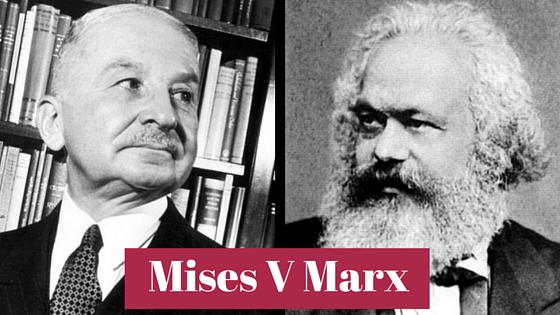
Mises V Marx

In this episode, Professor Peter Boettke, Professor of Economics and Philosophy at George Mason University, discusses the thinking of Ludwig von Mises and Karl Marx. Peter highlights the underlying theses behind both economists arguments – liberalism and socialism.

Read the first chapter to Living Economics by Peter Boettke here.

Economics:

In this episode, Peter mentions: Austrian economics, Marxism, liberalism, socialism, the Diamond-Water Paradox, instability of capitalism, private ownership, communal ownership, monopoly, financial crisis, leverage, 

Economists:

In this episode, Peter mentions: Ludwig von Mises, Karl Marx, Milton Friedman, Joan Robinson, Rosa Luxemburg, Elinor Ostrom, Adam Smith, F. A. Hayek, Milton Friedman, Paul Samuelson, John Cochrane, Paul Krugman, Joseph Stiglitz and J. K. Galbraith.

Books:

  • Living Economics: Yesterday, Today, and Tomorrow by Peter J. Boettke
  • The Communist Manifesto by Karl Marx
  • Karl Marx and the Close of His System  by Eugen von Böhm-Bawerk
  • Mises: The Last Knight of Liberalism Jörg Guido Hülsmann
  • Phishing for Phools: The Economics of Manipulation and Deception by George A. Akerlof and Robert Schiller
  • After War: The Political Economy of Exporting Democracy by Christopher J. Coyne
  • Doing Bad by Doing Good: Why Humanitarian Action Fails by Christopher J. Coyne
  • The Road to Serfdom: Text and Documents–The Definitive Edition by F. A. Hayek
  • How the Dismal Science Got Its Name: Classical Economics and the Ur-Text of Racial Politics by David M. Levy
  • The Soul of Man Under Socialism by Oscar Wilde
  • The Grapes of Wrath by John Steinbeck
http://traffic.libsyn.com/economicrockstar/084_Peter_Boettke_2_Final.mp3

Podcast: Play in new window | Download

043: Herbert Gintis on Game Theory and the Multidisciplinary Approach to Understanding Human Behavior

July 30, 2015 by Frank

http://traffic.libsyn.com/economicrockstar/043_Herbert_Gintis_Final.mp3
Play in New WindowDownload

043: Herbert Gintis on Game Theory and the Multidisciplinary Approach to Understanding Human Behavior

Herbert Gintis is Emeritus Professor of Economics at University of Massachusetts and visiting Professor at Central European University.Herbert Gintis

He is known for his theoretical contributions to sociobiology, especially altruism, cooperation, epistemic game theory and gene-culture co-evolution.

Herbert has a B.A and M.A in Mathematics but switched his PhD program at Harvard from mathematics to economics.

Professor Gintis was part of a group of economists who developed their ideas on a new economics which encompassed issues of alienation of labor, racism, sexism, and imperialism.

Herbert has worked extensively with economist Samuel Bowles, writing their landmark book, Schooling in Capitalist America.

One of Herbert’s latest books The Bounds of Reason emphasises the unification of economic theory with sociobiology and other behavioral sciences which, in the words of Nobel Prize-winning economist, Vernon L. Smith, “is firmly in the revolutionary tradition of David Hume (Convention) and Adam Smith (Sympathy)”.

In the episode you will learn:

  • about the importance of trans-disciplinary research and the importance of collaboration with other disciplines.
  • why economics is not the only social science that explains human behavior.
  • how biology, economics and sociology explain the behaviour of humans in different ways and which discipline is correct?
  • about the Ultimatum Game and how it shows the cooperative and non-cooperative behaviour of humans.
  • about the morality of humans and how we reciprocate kindness with kindness and unkindness with unkindness.
  • why reciprocity makes humans so successful as a species.
  • why some species have a symbiotic relationship with other species which is not the same as reciprocity.
  • how we can fit all the human feelings together to form a multi-disciplinary approach to understanding human behavior.
  • why we always need a system to punish free-riders and non-cooperators.
  • how the future structure of the University can be seen at Arizona State University today.
  • why we need a new generation of thinkers and research centres who are trans-disciplinary.
  • what projects Professor Herbert Gintis is working on right now.
  • why morality controls politics and your vote will not make a difference.
  • how Herbert gets things done in terms of writing books and journal articles.
  • why Herbert did not like The Black Swan by Nassim Nicholas Taleb.
  • about Herbert’s disagreement with Nassim Nicholas Taleb.
  • why Herbert believes that macroeconomics is wrong and is in agreement with Taleb on that issue.
  • the goal of economic policy is not to predict but to put in place economic and social policies that prevent really bad outcomes.

Influencers:

Kenneth Arrow, John Maynard Keynes, Adam Smith and Albert Einstein.

Economics:

In this interview, Herbert mentions and discusses: Marx, rationality, game theory, rational actor model, experimental economics, prisoners dilemma, the ultimatum game, labor market, reciprocity and morality.

Economists:

In this interview, Herbert mentions and discusses: Vernon Smith, Samuel Bowles, Ernst Fehr, Kenneth Arrow and Nassim Nicholas Taleb.

On Math Being the Core Link to Multi-Disciplinary Knowledge:

“It’s really hard in the Behavioral Sciences to get too close to any one thinker because they’re all tainted by disciplinarianism. We need a new generation of thinkers who really think in all of these disciplines at the same time. As long as you can do the math. If you can’t do the math, you can’t do economics or you can’t do biology. If you can do the math, and you know statistics, there’s no reason why you shouldn’t know all of the fields. We need a generation of people who do that. The reason it’s possible now is the internet. Now, there’s no reason for disciplinary isolation. I think the next generation of behavioral scientists is going to much more broad”.

Arizona State: The Next Generation University… Today

Arizona State University is organised trans-disciplinarily. They don’t have traditional disciplines. They have subject areas depending on who asks questions and subject areas there from all sorts of disciplines. Herbert Gintis believes that’s what the future is going to be like, where you abandon the disciplines and add new research centres based on asking questions like climate change, cooperation, epidemiology, warfare, political structure, etc. And then you just hire people who can do that and talk to each other. It is exciting. It will happen. But it will take a long time because the whole organisation of the university is in terms of disciplines.

All of the real advances in the Behavioral Sciences fall in between the disciplines. It requires you do it all at the same time. it’s likely that at the forefront of change in the Behavioral Sciences will be funding organisations, governmental organisations like the NFF in the United States and the ESF in Europe. 

Quotes by Professor Gintis in Episode 043 of the Economic Rockstar Podcast:

Disciplines are almost like a feudal fiefdom. So it’s very hard to do trans-disciplinary research but that’s where all the real action is these days. Not only in behavioral science but in natural science – Herbert Gintis.

As far as I’m concerned, all of life is game theory. It’s the interaction of strategic interaction of individuals of all discipline species and types and races. So game theory comes first – Herbert Gintis.

Human success is not based on selfishness. It’s based on our ability to cooperate – Herbert Gintis.

Click To Tweet

“The real enemy of understanding humans is the notion that we’re all selfish. It’s just not true – Herbert Gintis

To do creative work, you have to have time. Once you have time, you get a lot of work done – Herbert Gintis.

“What I like to do most in the world is to read and write. That’s what I do” – Herbert Gintis.

“I did not like The Black Swan at all. It made fun of science. It made fun of statistics. It capitalised on a unique event, the financial crisis of 2008, and he used it to say economics is a bunch of crap. I think that’s just a bad mistake and I had some run-ins with him on the web. He thinks that science is about prediction. Now prediction is important but that’s not what science is about. It’s about expectation” – Herbert Gintis.

Projects Herbert Gintis is Working on Right Now:

Non-consequential behaviour in politics: 

“People participate politically even when they don’t make any difference. In all English-speaking countries, no election with more then 40,000 voters has ever been won by one vote. Meaning that no individual has ever made a difference in a political booth. Political structures are moral structures and they don’t necessarily reflect particular self-interest concerns” – Herbert Gintis.

Resources:

  • Herbert created his own word processor and uses LaTex for mathematical equations.
  • The Web.
  • Evernote
  • Scrivener

Recommended Books:

  • The Bounds of Reason: Game Theory and the Unification of the Behavioral Sciences by Herbert Gintis
  • A Cooperative Species: Human Reciprocity and Its Evolution by Samuel Bowles and Herbert Gintis
  • Schooling in Capitalist America: Educational Reform and the Contradictions of Economic Life by Samuel Bowles and Herbert Gintis
http://traffic.libsyn.com/economicrockstar/043_Herbert_Gintis_Final.mp3

Podcast: Play in new window | Download
Frank Conway

Frank Conway is founder of Economic Rockstar and lecturer of economics, finance and statistics. Read More…

View My Blog Posts

Youtube Sub

Become a Patron of the Economic Rockstar Podcast

patreon

Ireland’s Economy by the Numbers

Leaving Cert Economics: Ireland’s Economy  Click here to download a workbook on Ireland’s Economy so that you can add your own notes. [Original size] Ireland’s Economy by fconway

Categories

Subscribe and Never Miss An Episode

itunes-logo

Recent Posts

  • Ireland’s Economy by the Numbers April 8, 2019
  • 174: Wendy Carlin on The Core Project, Capitalism, Democracy and Normative Statements February 13, 2019
  • 173: Stephen Wright on Core Econ as a Learning Resource for Mainstream Economics January 28, 2019
  • 172: Best of 2018 Part 2: From the Great Depression to Futurism; Institutions, Individualism, Cooperation and Reciprocity January 22, 2019
  • 171: Best of 2018 Part 1 January 3, 2019

Copyright © 2026 · Podcast Pro Theme on Genesis Framework · WordPress · Log in

This website uses cookies to improve your experience. We'll assume you're ok with this, but you can opt-out if you wish. Accept Reject Read More
Privacy Policy

Privacy Overview

This website uses cookies to improve your experience while you navigate through the website. Out of these, the cookies that are categorized as necessary are stored on your browser as they are essential for the working of basic functionalities of the website. We also use third-party cookies that help us analyze and understand how you use this website. These cookies will be stored in your browser only with your consent. You also have the option to opt-out of these cookies. But opting out of some of these cookies may affect your browsing experience.
Necessary
Always Enabled
Necessary cookies are absolutely essential for the website to function properly. This category only includes cookies that ensures basic functionalities and security features of the website. These cookies do not store any personal information.
Non-necessary
Any cookies that may not be particularly necessary for the website to function and is used specifically to collect user personal data via analytics, ads, other embedded contents are termed as non-necessary cookies. It is mandatory to procure user consent prior to running these cookies on your website.
SAVE & ACCEPT