
• ABOUT
  • RESOURCES
  • PODCAST
  • BOOKS
  • BLOG
  • SUPPORTERS
  • QFA Financial Advice
  • CONTACT

Economic Rockstar

Connecting Brilliant Minds in Economics and Finance

146: David Kyle Johnson on Science Fiction as Philosophy and Finding Nietzsche’s Übermensch in Economics
June 30, 2018 by Frank

http://traffic.libsyn.com/economicrockstar/146_David_Kyle_Johnson_Final.mp3
Play in New WindowDownload

146: David Kyle Johnson on Science Fiction as Philosophy and Finding Nietzsche’s Übermensch in Economics

David Kyle Johnson is Associate Professor of Philosophy at King’s College in Wilkes-Barre, Pennsylvania. He earned a master’s degree and doctorate in philosophy from the University of Oklahoma.

At Oklahoma, he won the coveted Kenneth Merrill Graduate Teaching Award. In 2011, the American Philosophical Association’s committee on public philosophy gave him an award for his ability to make philosophy accessible to the general public.

Professor Johnson regularly teaches classes on metaphysics, philosophy of religion, philosophy of mind, and logic, as well as courses on critical thinking and scientific reasoning. He has published papers on human freedom, the problem of natural evil, the multiverse, the existence of souls, and many related topics in such journals as Religious Studies, Sophia, Philo, Philosophy and Literature, and Think. He also maintains two blogs for Psychology Today.

Professor Johnson also publishes on the intersection of pop culture and philosophy. One of his books, Inception and Philosophy: Because It’s Never Just a Dream, inspired an authors@Google talk with more than half-a-million YouTube views. He also has written numerous articles that explore the relationship between philosophical questions and such pop cultural phenomena as The Hobbit, Doctor Who, Batman, South Park, Johnny Cash, Quentin Tarantino, and Christmas.

Economics:

In this episode Kyle discusses/mentions: Mercantilism, Capitalism, Socialism, Marxism, free trade and poverty.

Economists mentioned in this Episode:

  • Adam Smith, Karl Marx and John Maynard Keynes.

Philosophers mentioned in this Episode:

  • John Locke, Nietzsche and John Rawls.

People mentioned in this Episode:

  • Bill Gates, Elon Musk, The Emperor, David X. Cohen and Christopher Nolan.

Shows/Movies mentioned in this Episode:

  • Black Mirror
  • Twilight Zone
  • Star Trek
  • Star Wars
  • Doctor Who
  • 2001: A Space Odyssey
  • Lord of the Rings
  • The Simpsons
  • Futurama

Books:

  • Inception and Philosophy by David Kyle Johnson
  • Introducing Philosophy Through Pop Culture: From Socrates to South Park, Hume to House by David Kyle Johnson
  • Heroes and Philosophy: Buy the Book, Save the World by David Kyle Johnson
  • The Wealth of Nations by Adam Smith
  • Lord of the Rings

Courses:

  • Sci-Phi: Science Fiction as Philosophy with David Kyle Johnson
  • The Big Questions of Philosophy
  • Exploring Metaphysics with David Kyle Johnson

http://traffic.libsyn.com/economicrockstar/146_David_Kyle_Johnson_Final.mp3

Podcast: Play in new window | Download
085: Michael Roberts on Understanding Karl Marx and His Thinking on Capitalism

May 12, 2016 by Frank

http://traffic.libsyn.com/economicrockstar/085_Michael_Roberts_Final_.mp3
Play in New WindowDownload

085: Michael Roberts on Understanding Karl Marx and His Thinking on Capitalism

Michael Roberts

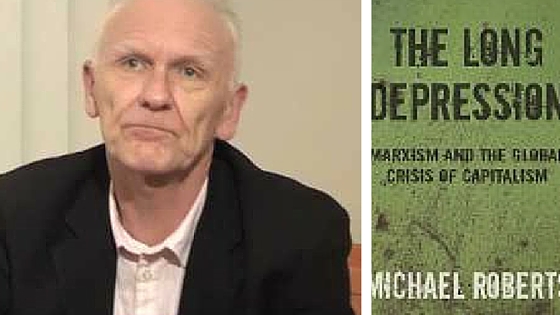
Michael Roberts has worked as an economist for over 30 years in the City of London. He is author of The Great Recession: Profit cycles, economic crisis A Marxist View and The Long Depression: Marxism and the Global Crisis of Capitalism.

Economics:

In this episode, Michael mentions: Marxism, capitalism, Austrian economics, GDP, multinationals, inflation, printing of money, booms, busts, profitability, recession, depression, inequality, wealth, means of production, private property, competition, externalities, unintended consequences, bailout, austerity and unemployment.

Economists:

In this episode, Michael mentions: Karl Marx, Friedrich Hayek, Adam Smith, John Maynard Keynes, Brad DeLong and Paul Mattick.

Links:

  • www.thenextrecession.wordpress.com by Michael Roberts

Books:

  • The Great Recession: Profit cycles, economic crisis A Marxist View by Michael Roberts
  • The Long Depression: Marxism and the Global Crisis of Capitalism by Michael Roberts
  • The Communist Manifesto by Karl Marx and Friedrich Engels
  • Capital by Karl Marx
  • Business As Usual by Paul Mattick
  • Waiting for Godot by Samuel Beckett


http://traffic.libsyn.com/economicrockstar/085_Michael_Roberts_Final_.mp3

Podcast: Play in new window | Download
068: Daron Acemoglu on Why Nations Fail and Why Inequality Exists Between Countries

January 14, 2016 by Frank

http://traffic.libsyn.com/economicrockstar/068_Daron_Acemoglu_.mp3
Play in New WindowDownload

068: Daron Acemoglu on Why Nations Fail and Why Inequality Exists Between Countries

Daron Acemoglu is the Elizabeth and James Killian Professor of Economics at Massachusetts Institute of daron acemoglu economic rockstarTechnology in Boston.

Daron’s principal interests are political economy, development economics, economic growth, technology, income and wage inequality, human capital and training, and labour economics.

Daron was the winner of the 2005 John Bates Clark Medal awarded to economists under forty judged to have made the most significant contribution to economic thought and knowledge.

His most recent works concentrate on the role of institutions in economic development and political economy.

Daron received his M.Sc. in Econometrics and Mathematical Economics and his Ph.D. from the London School of Economics.

Daron is co-author of ‘Why Nations Fail: The Origins of Power, Prosperity, and Poverty’ which can be found at whynationsfail.com

Markets are the foundation of long run economic growth but only if they are under guard by inclusive institutions – Daron Acemoglu

Economics: 

In this interview, Daron mentions: capitalism, marxism, inequality, inclusive institutions, extractive institutions, property, public finance,  rights, risks, cliometrics, econometrics, labor, technology, human capital, inequality, creative destruction and comparative advantage.

Economists: 

In this interview, Daron mentions: James Robinson, George Akerlof, Thomas Picketty, Douglass North and Joseph Schumpeter.

In this episode you will learn:

  • why nations fail and others prosper.
  • why Daron despises the term capitalism refereeing it as ‘and ugly term’.
  • why macro variables are second order to the type of institution when explaining the prosperity of a country.
  • why we should study political systems in an economics course.
  • how economic decisions get made.
  • if democracy is good for economic growth.
  • how Daron first became interested in institutions while growing up under a political dictatorship in Turkey.
  • if the political economy or the type of institution of a country explain inequality.
  • what explains inequality within a nation.
  • about Daron’s mixed views on philanthropy.
  • why empires, such as the Roman, Ottoman and British, collapse and whether we could witness the collapse of other institutions.
  • why China will ultimately fail in its present institutional form.
  • what China must do to maintain its economic growth.
  • about the Ireland and how its economy transitioned over the last 100 years.

I think, on the contrary, extractive institutions have great staying power – Daron Acemoglu

Books:

  • ‘Why Nations Fail: The Origins of Power, Prosperity, and Poverty’ by Daron Acemoglu.
  • Why the West Rules–for Now: The Patterns of History, and What They Reveal About the Future by Ian Morris.
  • War! What is It Good For? Conflict and the Progress of Civilization from Primates to Robots by Ian Morris
  • The Dynamics of Ancient Empires: State Power from Assyria to Byzantium by Ian Morris
  • The Secret of Our Success: How Culture Is Driving Human Evolution, Domesticating Our Species, and Making Us Smarter by Joseph Henrich

Where to Find Daron:

  • http://whynationsfail.com/
  • MIT academic page
http://traffic.libsyn.com/economicrockstar/068_Daron_Acemoglu_.mp3

Podcast: Play in new window | Download

Frank Conway

Frank Conway is founder of Economic Rockstar and lecturer of economics, finance and statistics. Read More…

View My Blog Posts

Youtube Sub

Become a Patron of the Economic Rockstar Podcast

patreon

Ireland’s Economy by the Numbers

Leaving Cert Economics: Ireland’s Economy  Click here to download a workbook on Ireland’s Economy so that you can add your own notes. [Original size] Ireland’s Economy by fconway

Categories

Subscribe and Never Miss An Episode

itunes-logo

Recent Posts

  • Ireland’s Economy by the Numbers April 8, 2019
  • 174: Wendy Carlin on The Core Project, Capitalism, Democracy and Normative Statements February 13, 2019
  • 173: Stephen Wright on Core Econ as a Learning Resource for Mainstream Economics January 28, 2019
  • 172: Best of 2018 Part 2: From the Great Depression to Futurism; Institutions, Individualism, Cooperation and Reciprocity January 22, 2019
  • 171: Best of 2018 Part 1 January 3, 2019

Copyright © 2026 · Podcast Pro Theme on Genesis Framework · WordPress · Log in

This website uses cookies to improve your experience. We'll assume you're ok with this, but you can opt-out if you wish. Accept Reject Read More
Privacy Policy

Privacy Overview

This website uses cookies to improve your experience while you navigate through the website. Out of these, the cookies that are categorized as necessary are stored on your browser as they are essential for the working of basic functionalities of the website. We also use third-party cookies that help us analyze and understand how you use this website. These cookies will be stored in your browser only with your consent. You also have the option to opt-out of these cookies. But opting out of some of these cookies may affect your browsing experience.
Necessary
Always Enabled
Necessary cookies are absolutely essential for the website to function properly. This category only includes cookies that ensures basic functionalities and security features of the website. These cookies do not store any personal information.
Non-necessary
Any cookies that may not be particularly necessary for the website to function and is used specifically to collect user personal data via analytics, ads, other embedded contents are termed as non-necessary cookies. It is mandatory to procure user consent prior to running these cookies on your website.
SAVE & ACCEPT