• ABOUT
  • RESOURCES
  • PODCAST
  • BOOKS
  • BLOG
  • SUPPORTERS
  • QFA Financial Advice
  • CONTACT

Economic Rockstar

Connecting Brilliant Minds in Economics and Finance

056: Campbell Harvey on Improving Significance Tests, the Importance of Positive Skew and the Future of Blockchain

October 28, 2015 by Frank

http://traffic.libsyn.com/economicrockstar/056_Harvey_Campbell_Final.mp3
Play in New WindowDownload

056: Campbell Harvey on Improving Significance Tests, the Importance of Positive Skew and the Future of Blockchain

Campbell R. Harvey is Professor of Finance at the Fuqua School of Business at Duke University and a Research Campbell HarveyAssociate of the National Bureau of Economic Research in Cambridge, Massachusetts. He served as Editor of The Journal of Finance from 2006-2012 and is President-elect of the American Finance Association.
Professor Harvey obtained his doctorate at the University of Chicago in business finance. He has served on the faculties of the Stockholm School of Economics, the Helsinki School of Economics, and the Booth School of Business at the University of Chicago. He has also been a visiting scholar at the Board of Governors of the Federal Reserve System.

Campbell received the 2014 Reader’s Choice Award for the best paper published in the Financial Analysts Journal and the 2015 prize for the best paper published in the Journal of Portfolio Management. His recent work on evaluating trading strategies has won best paper awards.

Campbell’s research interests include statistical methods, risk management, asset allocation, real assets and cryptocurrencies. He is the Investment Strategy Advisor to the Man Group plc, the world’s largest, publicly listed, global hedge fund.

Economics:

In this interview, Campbell mentions: t-statistics, significance tests, trading strategies, investment premium, beta, correlation, standard deviation, confidence interval, P-value, Bonferroni multiple testing method, Type I error, Type II error, probability, normal distribution, optimal portfolio, volatility, expected returns, portfolio, pay-off, skew, over-fitting, regularisation, Efficient Market Hypothesis, Fractal Markets, stock market anomalies, Straw Man Model, momentum effect, mis-pricing and outliers.

Economists:

In this interview, Campbell mentions: Nassim Taleb, Benoit Mandlebrot, Peter Edgar, Yan Liu and Eugene Fama.

In this episode you will learn:

  • why it’s important to use t-statistics and significance tests and how it can be improved.
  • about the very simple idea Professor Campbell Harvey applies to his statistical modelling to improve the robustness of his tests.
  • why it’s wrong to use 2 standard deviations to have 95% confidence when running many tests.
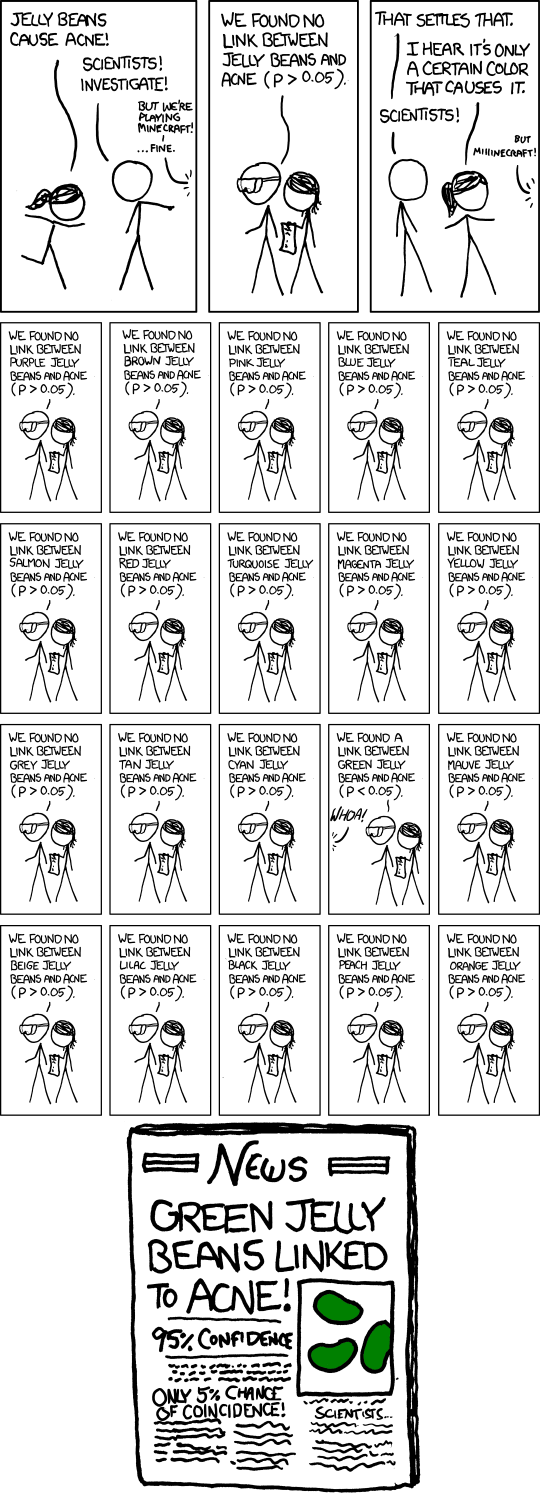
  • about ‘Significant’, the XKCD cartoon that illustrates the vulnerability of statistical significance testing.
  • do green jelly beans really cause acne? How significance tests can mislead with a fluke.
  • how a trading strategy based upon picking a portfolio of shares based upon the first letter of a ticker symbol showed that those tickers that began with the letter A outperformed other stocks.
  • how testing multiple times is effectively data mining and what should be done about it.
  • about the meaning of 95% confidence and 5% level of significance.
  • what a p-value is and why we ant it to be as small as possible.
  • if it’s important for the finance and economics profession to look at how other sciences are applying testing methods?
  • whether we need a tougher standard to lower the possibility of false discoveries?
  • if there is a chance of a fluke finding and why we should apply the Bonferroni multiple testing method solve this?
  • about the decay signature of the Higgs Boson and whether it is just background noise.
  • whether the findings of many published academic peer-reviewed papers are wrong.
  • about Type I and Type II errors and their trade-off.
  • about All Trials’ mission to make all randomised control trials made public.
  • the problems when measuring and using volatility in asset returns.
  • why the level of skew in a distribution must play more of an important role in risk management and portfolio selection.
  • why Taleb’s Black Swan only looks at one side of the distribution – the negative side, and why we must also look at the positive side.
  • how applying ‘regularization’ to portfolio selection avoids ‘over-fitting’ the data so that unexpected future outcomes can be considered.
  • about the efficient market hypothesis and the 316 anomalies that have been published to refute this hypothesis.
  • why the best traders are in Asia and how insider activity makes them so.
  • about the rise of crypto currencies and Bitcoin and why schools across US universities are introducing modules on it.
  • what is blockchain and why its is safe.
  • about the bank’s idea of creating a permission blockchain.

The Problem with Significance Testing and How to Solve It

If you’re trying to see if a variable Y is associated with a variable in a significant way, we usually think of looking at that correlation and determining whether you’re 95% confident that you’ve got it right. Usually what that means is that you’re 2 standard deviations away from zero. So, zero would be there’s no relation.

It turns out that that is perfectly acceptable if we’re looking at one correlation between Y and X. However, if it’s not X, it’s X1 you try. You try X2. You try X3, you try … X100. You try 100 different things. Then the criteria of using 2 standard deviations to have 95% confidence is just plain wrong.

The reason why this is wrong, is that when you’re running 100 tests, there is going to be a high probability that something will turn up that’s 2 standard deviations from zero just by chance.

The ‘Jelly Bean’ cartoon by XKCD called ‘Significant’ illustrates how testing a hypothesis can become misleading when conducting a significance test. The hypothesis being tested here is whether jelly beans causes acne.

A randomised control trial is ‘conducted’ by scientists. This is done where, say we have 50 people with jelly beans and 50 people with no jelly beans and we count the acne. And what basically happens is that there is no significance. So the scientists don’t achieve the 95% and conclude that there is no relation between jelly beans and acne.

However, the cartoon further illustrates what happens when the color of each jelly bean is tested to see if a particular color causes acne. 20 additional randomised control trials are conducted. The cartoon shows that the link between the Red Jelly Bean and acne is insignificant. Blue Jelly Bean – insignificant. Until you get to the last jelly bean, the 20th, which is the Green Jelly Bean. They find that there is a significant relation between Green Jelly Beans and acne. The final frame in the cartoon is a headline saying ‘Green Jelly Beans Linked to Acne’.

So, if you do 20 trials, one of those is likely to show up as significant using the standard criteria and it’s a fluke.

“The idea of my research is that we need to raise the bar that 2 standard deviations is no longer – that 2 sigma is no longer – something that should be considered. We need to go much higher.” – Professor Campbell Harvey

http://imgs.xkcd.com/comics/significant.png

The Bonferroni Multiple Testing Method

When we say that there is 95% confidence, we are saying that there is a 5% chance that the finding is a fluke. The 5% is called the p-value. What you would like is for that p-value to be as small as possible. You want as small as possible probability that the finding is a fluke. So the usual p-value for a single test with just X and Y for 5%, would imply 2 standard deviations. When you do multiple tests, you need more than 2 standard deviations from zero. If there is a chance of a fluke finding, then we should apply the Bonferroni multiple testing method solve this.

What the Bonferroni does is a simple correction. What it says is ‘you discover a p-value which is, say, 0.004 and you multiply by the number of things or X’s you’ve tried, which is, say, X1 to X100. All of a sudden, your p-value transforms to 0.4 or 40%. That means there is a 40% chance that in repeated trials that this thing you’ve identified, say X57, is a fluke. So when you use this adjustment, you discard that variable.

Quotes by Professor Campbell Harvey in Episode 56 of the Economic Rockstar Podcast:

In the practice of finance, some investment manager goes to a client and shows a great strategy and looks amazing. But they don’t tell the client or potential client that they tried 499 other possibilities and this is the only one out of 500 that worked – Professor Campbell Harvey. 

“Over half of what’s published in empirical asset pricing is probably incorrect” – Professor Campbell Harvey

Click To Tweet

“The problem with volatility is that it is a symmetric measure, that if you’re way above the average that contributes to the same volatility as if you’re way below the average” – Professor Campbell Harvey

“I’ve being pushing for the last 15 years to reform the way that we do our portfolio analysis, our standard models, to have the skew play a role.” – Professor Campbell Harvey

“It’s also a fact that it’s really hard to find any asset return that adheres to a normal distribution. If it does, it is very unusual.” – Professor Campbell Harvey

“What we want in economics and finance is repeatability.” – Professor Campbell Harvey

Click To Tweet

“I believe, just as Gene Fama believes, that markets are inefficient.” – Professor Campbell Harvey

Click To Tweet

“Blockchain provides a way to give unprecedented security. You’re immune effectively from this hacking.”

Click To Tweet

Books:

  • The New York Times Dictionary of Money and Investing: The Essential A-to-Z Guide to the Language of the New Market by Campbell Harvey and Gretchen Morgenson
  • The Black Swan by Nassim Taleb
  • The Ascent of Money by Neil Ferguson

Papers:

  • Evaluating Trading Strategies. by Campbell Harvey and Yan Lui
  • Where are the World’s Best Analysts? Campbell Harvey, Sam Radnor, Khalil Mohammed and William Ferreira
  • Conditional Skewness in Asset Pricing Tests. Campbell Harvey and Akhtar Siddique, Journal of Finance 55, (2000): 1263-1295. (P56)

Other Resources:

  • Garden of Econ podcast
  • Hypertextual Finance Glossary – Over 8,000 Entries and 18,000 Hyperlinks: The largest financial glossary on the Internet
  • The New York Times Dictionary of Money and Investing: The Essential A-to-Z Guide to the Language of the New Market by Campbell Harvey and Gretchen Morgenson

Websites:

  • www.alltrials.net

Where to Find Campbell: 

Website: Duke University

http://traffic.libsyn.com/economicrockstar/056_Harvey_Campbell_Final.mp3

Podcast: Play in new window | Download

024: Greg Davies on Behavioral Finance and Controlling Your Emotions When Making Trading Decisions

March 19, 2015 by Frank

http://traffic.libsyn.com/economicrockstar/024_Greg_Davies.mp3
Play in New WindowDownload

024: Greg Davies on Behavioral Finance and Controlling Your Emotions When Making Trading Decisions

Greg Davies is Managing Director and Head of Behavioral Finance at Barclays.  He joined the firm in December 2006 to develop and implement commercial applications drawing on behavioural portfolio theory, the psychology of judgment and decision making, and decision sciences.

Today Greg leads a global team of behavioural and quantitative finance specialists, and is responsible for the design and global implementation of Barclays’ Investment Philosophy.

Greg is an Associate Fellow at Oxford University’s Saïd Business School and his first (co-authored) book, ‘Behavioral Investment Management: An Efficient Alternative to Modern Portfolio Theory’, was published in January 2012.

He is co-curator and co-creator of Open Outcry – a reality opera based on the stock market trading floor.

Greg has authored papers in multiple academic disciplines, presents at academic and industry conferences, and is a frequent media commentator on Behavioural Finance.  He is an Editorial Board Member of the Journal of Behavioural and Experimental Finance.

Greg studied at the University of Cape Town and obtained a degree in Economics, Philosophy and Finance. He followed this with an MPhil in Economics and a PhD in Decision Theory and Behavioural Finance from the University of Cambridge.

Economic Themes:

In this interview, Greg mentions and discusses:

Behavioral economics, behavioral finance, rationality, irrational behavior, heuristics, cognitive biases, system 1, system 2, homo economicus, trade-off, home bias, familiarity bias, risk, return, portfolio, efficient frontier, stochastic model, trading floor, noise, herding, bubbles, booms, bust, returns, standard deviation, deterministic model, decision theory, expected utility theory, mean variance and portfolio theory.

Economists:

In this interview, Greg mentions:

Danial Kahneman, Amos Tversky, Terence Odean, Warren Buffet, Charlie Munger and Harry Markowitz.

Influencers:

Jon Elster and Amos Tversky.

Advice:

Be multi-disciplinary. Look for links between fields. Be continuously curious.

Keep learning. Stay curious. Say ‘yes’ to things that are outside your comfort zone.

Find out:

  • what is Behavioral Economics/Finance
  • the disconnection between economics and psychology.
  • how Kahneman and Tversky were ‘swimming up-stream’ to bring common sense to economics.
  • why viewing the world through biases is harmful to behavioral finance.
  • why the ever-increasing list of biases may not be good for the behavioral finance field.
  • about System 1 and System 2 as popularised by Daniel Kahneman.
  • why it’s good to allow emotions to part of the portfolio decision-making process.
  • how to acquire the emotional comfort you need for your long-term financial objectives.
  • how to buy emotional insurance for your long-term investment portfolio.
  • how to avoid costly short-term emotional mistakes.
  • how psychometric tests can extract measures of financial personality.
  • why a set of nudges are designed to help high net-worth individuals to make better decisions.
  • how to build a tailored portfolio to meet your clients needs.
  • why you should consider including expected anxiety into your portfolio building along with risk and return.
  • what an opera experiment has to do with replicating the open outcry system of a trading floor.
  • how music can control your emotions while trading markets.
  • how Barclays Capital are improving the understanding of their clients by turning the lens on themselves.

Behavioral economics is the combination of finance theory and behavioral psychology. It’s about trying to understand how people actually do go about making financial decisions and, as a result, how we might make them better financial decisions.

Problems with Biases in Behavioral Finance:

  • Biases are only often biases if you view them through the lens of what economic theory very narrowly and mathematically deems to be rational.
  • There’s nothing irrational about having the need for a  short-term immediate emotional comfort.
  • A lot of deviations from narrow economic thinking are not irrational at all. They are perfectly reasonable. It is just that other people are bringing other objectives to bear on the decision.
  • The other problem is the tendency to look at the world through a list of biases.

Classical Finance would typically remove irrational behavior from its theories and models. However, the position of Behavioral Finance is much more subtle. As humans, we need emotional comfort. We need to be comfortable with the decisions we make and with the portfolio we hold. There is nothing irrational about that.

You need to find a way of not switching off your emotions but utilising them effectively – Greg Davies

Click To Tweet

Emotions are actually a very good source of information for us if we use them in a thoughtful way – Greg Davies

Resources:

Farnam Street by Shane Parish 

Recommended Books:

  • Thinking Fast and Slow by Daniel Kahneman
  • Explaining Social Behavior: More Nuts and Bolts for the Social Sciences by Jon Elster
  • Behavioral Investment Management: An Efficient Alternative to Modern Portfolio Theory by Greg Davies

Where To Find Greg Davies:

  • Website: Investment Philosophy 
  • Twitter: @GregBDavies
http://traffic.libsyn.com/economicrockstar/024_Greg_Davies.mp3

Podcast: Play in new window | Download

015: Niels Kaastrup-Larsen on Trend Following Strategies and Stock Market Turmoil Ahead

January 14, 2015 by Frank

http://traffic.libsyn.com/economicrockstar/015_Niels_Kaastrup-Larsson_.mp3
Play in New WindowDownload

015: Niels Kaastrup-Larsen on Trend Following Strategies and Stock Market Turmoil Ahead

TopTraderPodcast NielsNiels Kaastrup-Larsen is Managing Director of Dunn Capital (Europe). Niels is a trend follower with more than 20 years experience in the hedge fund industry, working for some of the largest CTAs or Commodity Trading Advisors in the world, including Chesapeake Capital. Niels co-founded, built and managed three businesses within the alternative investment space, including Rho Asset Management.

Niels trades futures markets in a systematic and highly-automated way. He is the founder and host of the popular podcast ‘Top Traders Unplugged’, where he uses his experience and contacts in the industry to deliver insightful, engaging and passionate interviews with the most successful hedge fund managers and traders.

Economic and Finance Themes:

In this interview, Niels mentions and discusses: Trend following, futures markets, gold, anomalies, confirmation bias, efficient market hypothesis, fixed-income securities, treasuries, bonds, the Great Depression, stock market portfolio, diversification, equities, systematic trading, stop-losses, technical analysis.

Niels’ Influencers:

Jerry Parker of Chesapeake Capital, Michael Lewis and Jack Schwager

‘There’s no doubt that Jack Schwager’s book ‘Market Wizards’ was an inspiration’ – Niels Kaastrup-Larsson

Click To Tweet

Niels’ Affirmations:

  • ‘The trend is your friend’.
  • ‘KISS – Keep it Simple’.
  • ‘Cut your losses, let your profits run’.
  • ‘Diversification is so important because markets are very different animals and you’re going to have periods of time where types of markets are trending and easy to trade.’
  • Strict Risk Control.
  • Discipline: 
    ‘Without discipline you’re not going to get very far’ Niels Kaastrup-Larsson

    Click To Tweet

Niels’ Personal Habits:

Niels loves playing football on a Friday evening with a group of friends who all come from diverse backgrounds. It allows him to clear his mind and to think about things other than trading.

In todays world we really need to focus on WHY we do what we do and not just what we do and how we do it – Niels citing Simon Sinek (see recommended books below).

Find out:

  • about trend following and how to spot a trend.
  • what is a trend following strategy.
  • two ways in which we can take on market risk – one good and the other not so good.
  • how emotions can lead to losses.
  • why trend followers use computers with built-in trend following rules to make trades.
  • why we are more likely to buy a bar of soap that is reduced by 50% in a retail store than buy a stock that has fallen 50%.
  • how you should diversify a portfolio.
  • how global markets are beginning to diverge which is key for a trend following strategy.
  • why Niels believes that global markets will be in turmoil within the next 5 years.
  • why Niels believes the economic cycle will turn by October 2015.
  • why events will unfold just like 1929.
  • if the Swiss and Germans should take back their gold reserves from the United States.
  • about whether there are job opportunities in the trading industry today.

  • why the industry has become more scientific.

  • how to navigate through the noise when markets undergo a process of price discovery.

  • why Niels created the Top Traders Unplugged podcast rather than write a book.
  • Niels recommendation for a great market data resource.

Niels didn’t know what he wanted to do after High-School, but one thing he did know was that he didn’t want to go to university and try to learn from books. He was much more interested in doing things and being practical is his approach to learning.

A job in a bank seemed a good compromise – Niels would learn by doing and get paid for it!

Niels’ Defining Moment:

Niels took a job in a large bank in Denmark straight out of High-School and, during his induction week, he passed by a room full of young people waving their arms and shouting. He found out that they were trading currencies, stocks and bonds. Immediately, Niels knew that after his 2 years of training, that’s what he was going to do. At the age of 19 or 20, Niels began trading Danish government bonds.

Niels began reading international magazines about traders and came across tables of rankings based upon trader performance. These traders were systematic trend followers or Commodity Trading Advisors.

Trend-Following:

It was intriguing to me to see that these people [trend-followers] could continue to produce extraordinary returns.

Niels searched for and read books on interviews with traders in general and some were rule-based or systematic traders.

Niels got a chance to work with Jerry Parker of Chesapeake Capital who was once part of the well-publicized Turtle Trader experiment, which was run by Richard Dennis and Bill Eckhardt.

“It is the most consistent way of investing your money when you look at it in the very long-run”  – Niels Kaastrop-Larsen.

I see people like Jerry Parker and Bill Dunn with thirty or forty years track record still making all-time highs and they’re still going strong, There are not that many discretionary traders doing that. I think that there is something to this methodology.

Trend following comes down to the way we as human beings take on risk. There are two ways that we can do that:

1) a convergent risk-taking style.

2) a divergent risk-taking style.

A convergent risk-taking world is one where you believe that you know where all the risks are and you see the environment as being stable. Therefore, you are willing to bet a large proportion of your assets on a single or few investment themes because you really fell sure that you have it right. When assets go up based on on your expectations, you take your profits quickly as the movement confirms your theory.

On the other hand, when equities fall you still believe that you will be right at the end of the day. So what happens is that you are going to increase your risk and double-up – ‘you double in trouble’. Unfortunately, many investors make their decisions when prices are going against them.

In a convergent world, the profile of a trader is one who makes very small gains because you take your profit quickly. But once in a while you have a devastating loss with huge amounts because you won’t accept you’re wrong.

The equity curve or the returns profile for this trader is quite flat and then spikes downwards where you will lose most, if not all, of your money.

In a divergent risk-taking world, people confess that they don’t know what is going to happen tomorrow. So, the way they play these situations is that they are always unsure what they are going to do and, therefore, their risk-taking is generally small. But since their risks are small, it allows them to take risks in many different opportunities at the same time.

If people here are wrong and, because they feel unsure about their investment from the beginning, they cut there losses quickly just to get out. They didn’t feel good from the beginning and if they continue to lose money then it will feel worse.

When these people are right and their trades are working out for them, then they believe that something is right and they take on a little bit more risk because the movement is going in their favor. They increase their position size.

The equity curve of this trader can be flat or slightly down for some time but then spikes upward where they get a good run and increase their risk at the right time. They make a lot of money with these few investment opportunities.

‘The universe that I came from, the trend-followers or rule-based strategies, use a divergent strategy. We’re not trying to forecast what is going to happen tomorrow, we let the financial media try to that. Instead, we analyse historic price data and when data goes in a certain direction, then we essentially react to that price action’ – Niels Kaastrop-Larsen.

Trend Following Strategies:

Trend following is about ‘buying highs and selling lows’, which is the opposite to what most people would think. They buy the lows because they think it’s cheap and sell the highs as it’s more expensive.

Trend followers think completely opposite to the traditional investor.

Trend following strategies are also known as using price breakout methodologies.

If a stock, like Microsoft, was reaching a high, a trend-follower would buy or go long this stock with the belief that it could go higher. If the stock was at the lower end of a price range or band, then you would want to go short the stock.

Moving averages could also be used with the same effect, but their are small differences.

Once you’ve got your entry signal, then you need an exit because if you are wrong, you need to cut your losses. You want to have small losses and big winners.

Many traders lose money because they don’t know when to get out and even if they do, they usually don’t have the discipline to get out. This is why trend followers use computers to do it for them because, emotionally, it is not very easy to take a loss. It’s not very easy to take a profit either, so using rules and putting them into a computer.

‘The rules do not have to be complicated. But it’s the discipline of doing this day-in-day-out, even with 10 losing days in a row, you still keep doing it as you believe in the rules you created’ – Niels Kaastrop-Larsen.

Based on cognitive reasoning, our brains actually work quite opposite to our day-to-day decisions that we make.

A lot of people don’t make money in the stock market despite all the news and advice that they get.

Trading a Diversified Portfolio:

If you want others to trade for you then you need:

1) Different managers: Each manager trades different markets,

2) Speed: both short-term, medium-term and long-term periods.

3) Strategies: Then you can go into detail about the strategies.

‘You should certainly allocate to smaller managers who are more nimble, who maybe more innovative because they have more flexibility in their strategy, which the bigger firms don’t have. They can trade markets that the bigger firms can’t do.‘

If you want to trade for yourself you need to:

1) Consider whether you want to trade all markets – commodities and financials or just a few.

2) Know how you’re going to make your investments, not when.

‘You must have a prudent approach to risk and that really boils down to diversification.’

Click To Tweet

Market Turmoil Expected Soon:

‘The problem is going to start in the fixed-income market. It’s the bond market that I worry the most. The whole system has been pumped with liquidity and a lot of bad debt is sitting in places in the system that we probably don’t know about’ –Niels Kaastrop-Larsen.

‘The whole idea of creating a strong and more stable financial structure has back-fired because the banks have not become smaller, they’ve become bigger. So the systemic risk that the authorities wanted to combat back in 2009 has in fact increased’ – Niels Kaastrop-Larsen.

The economic cycle will turn by October 2015 and once they turn, that will have a major effect on the financial markets. Once this happens, the fixed-income markets around the world will burst, so the bubble in sovereign debt will burst.

This means the whole financial sector will get into much more serious problems than before because there is not any central bank in the world that can take interest rates from 5% to zero. The weapons in their armoury is much less. This will spill over to the equity markets, but you could see a steep increase in equity markets before this happens. This is what happened in 1929 before the Great Depression.

We could be in the first depressionary environment since 1929 when we get into 2016, 2017 and 2018. That’s a scary thought but it can create opportunity.

The losers in this will be retail investors who, by their bank and financial advisor, will be advised to buy more bonds or more stocks because that’s where we’ve seen the gains in the last 5 years.

If you don’t understand history, you’re likely to repeat your errors.

Click To Tweet

Gold Reserves and The Swiss Referendum:

The people of Switzerland made the wrong choice by not demanding that the Swiss National Bank should hold at least 20% of their reserves in gold and by not demanding that gold be returned to Switzerland.

Gold will get its shine back. It will fall a little before going back up.

There are a number of theories about the amount of gold in Fort Knox, with one of them being that there is no longer the amount of gold in the vaults there that we may once believed.

‘Many believe that gold is a hedge against inflation. To me gold is a hedge against government’ – Niels Kaastrup-Larsen

Click To Tweet

If you had an asset at a time of crisis, wouldn’t you want it at home? Countries should have their gold at home. The Americans told the Germans it would take them 8 years to deliver the gold. So maybe there is some truth about whether the gold is still there or not.

Are There Job Opportunities in Trading Today?

The approach to trading is more scientific now more than ever. Trading firms look for scientists who can work with large volumes of data in order to identify patterns.

‘There are less need for traders because machines have taken over’ – Niels Kaastrup-Larsen

Click To Tweet

You are more likely to get a job in the trading industry if you come from a more academic or scientific approach.

If you trade your own account and have found a system, then it could be a good idea to approach a large firm and tell them of your system and trading history. You should be honest that you do not know of all the answers. That way you could get a position with a firm.

‘90% of assets are managed by 10% of managers, and 10% of assets have to be divided by 90% of managers’

How to Navigate Through the Noise When Markets Undergo a Process of Price Discovery:

If you are using moving averages, you have the element of time involved meaning that the moving averages have to turn and cross before you get a signal to either enter or exit a trade.

When it comes to exiting a trade, using moving averages can be dangerous in some ways because if you have a very steep and fast change in trend you could give back a lot of your profit.

A price breakout strategy would allow you to use stop-loss rules that can allow you to move up underneath the trend.

The only thing you should look at is the price. Price is objective. It is probably the only thing we can rely on that in this very second the price of a financial futures market is what it is. Anything you start doing after price is a derivative of price whether it is volatility or something else. I would caution against using too many fancy indicators – KISS – Keep It Simple’

Favorite Books:

  • Liars Poker by Michael Lewis
  • Market Wizards by Jack Schwager
  • It Starts With Why by Simon Sinek

Favorite Internet Resource:

  • Commodity Systems Inc. – Market Data and Trading Software “Provides great data in a timely manners and it’s quite inexpensive compared to other providers

Where To Find Niels Kaastrup-Larsson:

  • Niels Website: TopTradersUnplugged.com
  • On Twitter: @TopTradersLive
  • Niels’ Podcast: Top Traders Unplugged
  • Dunn Capital: https://dunncapital.com/about/
http://traffic.libsyn.com/economicrockstar/015_Niels_Kaastrup-Larsson_.mp3

Podcast: Play in new window | Download

Frank Conway

Frank Conway is founder of Economic Rockstar and lecturer of economics, finance and statistics. Read More…

View My Blog Posts

Youtube Sub

Become a Patron of the Economic Rockstar Podcast

patreon

Ireland’s Economy by the Numbers

Leaving Cert Economics: Ireland’s Economy  Click here to download a workbook on Ireland’s Economy so that you can add your own notes. [Original size] Ireland’s Economy by fconway

Categories

Subscribe and Never Miss An Episode

itunes-logo

Recent Posts

  • Ireland’s Economy by the Numbers April 8, 2019
  • 174: Wendy Carlin on The Core Project, Capitalism, Democracy and Normative Statements February 13, 2019
  • 173: Stephen Wright on Core Econ as a Learning Resource for Mainstream Economics January 28, 2019
  • 172: Best of 2018 Part 2: From the Great Depression to Futurism; Institutions, Individualism, Cooperation and Reciprocity January 22, 2019
  • 171: Best of 2018 Part 1 January 3, 2019

Copyright © 2026 · Podcast Pro Theme on Genesis Framework · WordPress · Log in

This website uses cookies to improve your experience. We'll assume you're ok with this, but you can opt-out if you wish. Accept Reject Read More
Privacy Policy

Privacy Overview

This website uses cookies to improve your experience while you navigate through the website. Out of these, the cookies that are categorized as necessary are stored on your browser as they are essential for the working of basic functionalities of the website. We also use third-party cookies that help us analyze and understand how you use this website. These cookies will be stored in your browser only with your consent. You also have the option to opt-out of these cookies. But opting out of some of these cookies may affect your browsing experience.
Necessary
Always Enabled
Necessary cookies are absolutely essential for the website to function properly. This category only includes cookies that ensures basic functionalities and security features of the website. These cookies do not store any personal information.
Non-necessary
Any cookies that may not be particularly necessary for the website to function and is used specifically to collect user personal data via analytics, ads, other embedded contents are termed as non-necessary cookies. It is mandatory to procure user consent prior to running these cookies on your website.
SAVE & ACCEPT