• ABOUT
  • RESOURCES
  • PODCAST
  • BOOKS
  • BLOG
  • SUPPORTERS
  • QFA Financial Advice
  • CONTACT

Economic Rockstar

Connecting Brilliant Minds in Economics and Finance

101: Chris Coyne on the Opportunity Cost to War, Exporting Democracy and the Nirvana Fallacy

September 1, 2016 by Frank

http://traffic.libsyn.com/economicrockstar/101_Chris_Coyne_Final.mp3
Play in New WindowDownload

101: Chris Coyne on the Opportunity Cost of War, Exporting Democracy and the Nirvana Fallacy

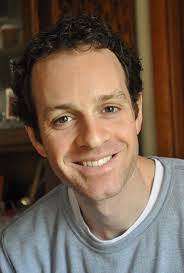
Christopher Coyne is an Associate Professor of Economics at George Mason University and the AssociateChris Coyne Economic Rockstar Director of the F. A. Hayek Program for Advanced Study in Philosophy, Politics, and Economics at the Mercatus Center.
He also serves as Director of Graduate Studies for the Department of Economics.

Professor Coyne serves as the Co-Editor of The Review of Austrian Economics, the Co-Editor of The Independent Review, the Co-Editor of Advances in Austrian Economics, and the Book Review Editor of Public Choice.

Chris has authored numerous academic articles, book chapters, and policy studies and his research interests include political economy and military intervention.

Professor Coyne is the author or co-author of numerous books including Future: Economic Peril or Prosperity? and After War: The Political Economy of Exporting Democracy.

He is also the co-editor of The Oxford Handbook of Austrian Economics and The Handbook on the Political Economy of War.

In 2016 Chris was selected as a recipient of George Mason University’s University Teaching Excellence Award.

His work can be found at www.ccoyne.com

Economics:

In this episode, Chris discusses and mentions: economics of war, the Nirvana Fallacy, incentives, knowledge constraints, unintended consequences, the Capitalist-Peace hypothesis, dependency effects, public goods, praxeology, prohibition and society.

Economists:

In this episode, Chris discusses and mentions: Ludwig von Mises, F. A. Hayek, Robert Higgs, Mike Munger, Peter Leeson, Rachel Coyne, James Buchanan, Gordon Tullock, Claude-Frédéric Bastiat and Henry Hazlitt.

Professor Coyne’s Daily Routine:

  • Everyday is the same. I wake up every morning between 5 and 6 am and work out in the garage for 1 to 2 hours. Then I eat breakfast and get to work.
  • I work in chunks – anywhere from 1 to 3 hours and I take little breaks in between.
  • When I find myself losing focus, I do little things like getting a cup of coffee or do a chore around the house or going outside for a few minutes. It resets my mind.
  • I’ll work from 8 or 9 am to lunch. I get lunch, maybe work a little more and then I shift more into administrative mode. It requires a different brain power than reading and writing.

Links:

  • Polity IV Index

Recommended Books:

Human Action by Mises: “That is an excellent book in terms of a systematic treatise on economics.” – Chris Coyne.

Crisis and Leviathan: Critical Episodes in the Growth of American Government by Robert Higgs: “It’s a wonderful treatment of how government grows through the onset of crises. He’s focused mainly on the United States. He talks about the evolution of the US government and he highlights these punctuated points of crises where government grew. Of course World War 2 and the Great Depression being among the main ones that he highlights. It’s excellent both for the history but also for the framework he lays out – called the ‘Ratchet Effect’ (how the government ratchets up in size. It’s a wonderful book that I highly recommend.” – Chris Coyne.

Papers Mentioned in the Episode:

  • Coyne, C. and Hall. A. (2014). The Political Economy of Drones, Defence and Peace Economics, 25(5): 445-460.
  • Coyne, C., Boettke, P. and Leeson, P. (2014). Earw(h)ig: I Can’t Hear You Because Your Ideas are Old, Cambridge Journal of Economics, 38(3): 531-544.
  • Coyne, C. and Coyne, R. (2014). The Identity Economics of Female Genital Mutilation,” Journal of Developing Areas, 48(2): 137-152.
  • Coyne, C., Boettke, P. and Hall, A. (2013). Keep Off the Grass: The Economics of Prohibition and U.S. Drug Policy, Oregon Law Review, 91(4): 1069-1096.
  • Coyne, C. and Leeson,P. (2012). Sassywood, Journal of Comparative Economics, 40(4): 608-620. 

Where to Find Professor Coyne:

  • Website: www.coyne.com
  • Twitter: @ccoyne1

Books:

  • Human Action by Ludwig von Mises
  • Crisis and Leviathan: Critical Episodes in the Growth of American Government by Robert Higgs
  • Future: Economic Peril or Prosperity? by Chris Coyne
  • Flaws and Ceilings: Price Controls and the Damage They Cause by Chris Coyne
  • Doing Bad by Doing Good: Why Humanitarian Action Fails by Chris Coyne
  • Media, Development and Institutional Change by Chris Coyne
  • After War: The Political Economy of Exporting Democracy by Chris Coyne
  • The Oxford Handbook of Austrian Economics
  • The Handbook on the Political Economy of War.
http://traffic.libsyn.com/economicrockstar/101_Chris_Coyne_Final.mp3

Podcast: Play in new window | Download
019: Mark Thornton on the Decriminalization of Marijuana and the Skyscraper Curse

February 12, 2015 by Frank

http://traffic.libsyn.com/economicrockstar/019_Mark_Thorton_Pt_2.mp3
Play in New WindowDownload

019: Mark Thornton on the Decriminalization of Marijuana and the Skyscraper Curse

This is the part 2 of an interview with Mark. Part 1 can be found as episode 18 on iTunes, Stitcher Radio or at www.economicrockstar.com/markthornton

Mark has withdrawn himself from politics and concentrates now on education, primarily of the general public because the Austrian perspective says:

the world works according to the ideology of the masses so we have to change that mindset of the masses before we’re ever going to get political reform of the type Austrians would like to see – Dr. Mark Thornton

Mark Thornton

In this episode, you will learn:

  • a little about Dr. Mark Thornton’s ancestral history.
  • Mark’s views on why Ron Paul should be the next US President or even the Speaker of the House of Representatives.
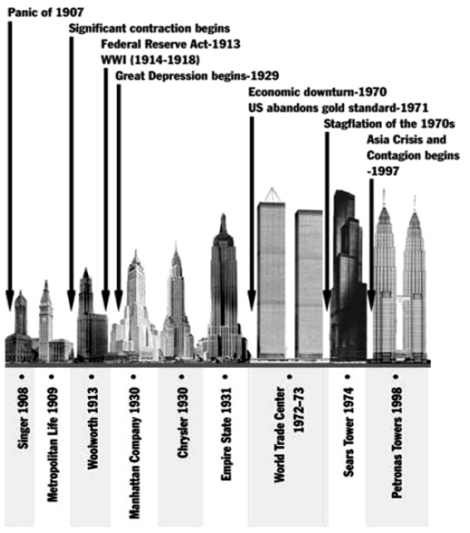
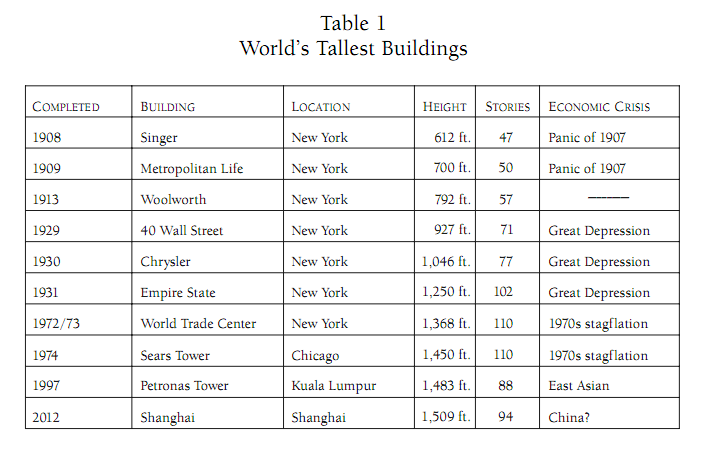
  • the Skyscraper Index and how a correlation exists between a record-setting height and a global economic crisis.
  • how Mark predicted the economic crises from 2007/08.
  • how the ending of the alcohol prohibition in 1933 cut homicides by 50% and how the countries can learn from this with the drugs industry.
  • the social-economic benefits of the decriminalization of drugs in Portugal.
  • the benefits of marijuana and why it should be legalized.

The Skyscraper Curse: How a Record-Breaking Skyscraper is Ominous for an Economic Crisis

There appears to be a correlation between record-setting skyscrapers and world economic crises (Table 1 below). There may not be any rational reasoning as to why this correlation may exist but it has implications of the Austrian Theory of the Business Cycle.

Source: Thornton, M. (2005). Skyscrapers and Business Cycles. The Quarterly Journal of Austrian Economics, 8 (1): 51-74

Source: Thornton, M. (2005). Skyscrapers and Business Cycles. The Quarterly Journal of Austrian Economics, 8 (1): 51-74

Mark, in his writings, outlines the theoretical reasons and history of why the Skyscraper Index and crises are related. He also explains why it takes artificially low interest rates by the central banks to cause prosperity, speculation and exuberance which leads to record-setting skyscrapers.

In 2006, the Burj Dubai Tower in the Middle East set the record for the highest building in the world. This skyscraper wasn’t open to the public until 2010, but the record was set in 2006.

The Skyscraper Curse is great tool to see what’s going on in the most significant bubbles and busts over the last 100 years. The diagram below shows the tallest buildings at Mark’s time of writing in 2004/05. He has highlighted the correlations between the record-setting heights and the economic crises that followed. In Table 1 above, Mark questioned whether the next tallest building was to occur in China. In hindsight, the Burj Dubai Tower set the record in 2006 signalling the Great Recession. China is currently building 40% of the world’s skyscrapers. It had planned to build the tallest building in the world, reaching 838 metres, 10 metres higher than the Burj Dubai Tower. This was planned to be completed in 90 days. However, building has been postponed until safety examinations have been passed and building permits gained. Is China postponing its inevitable economic crisis?

Source: Thornton, M. (2005). Skyscrapers and Business Cycles. The Quarterly Journal of Austrian Economics, 8 (1): 51-74

Source: Thornton, M. (2005). Skyscrapers and Business Cycles. The Quarterly Journal of Austrian Economics, 8 (1): 51-74

The Economics of Prohibition and The Case for Legalizing Drugs

In the 1920s, the US government introduced The Prohibition on the manufacture, trade and consumption of alcohol. Consequently, there was an upsurge in the illegal manufacture and distribution of alcohol, creating a black market economy and the formation of mafia gangs. Crime and homicide rates increased.

In his book, The Economics of Prohibition, Dr. Mark Thornton takes a look at the consequences of todays prohibition – that of drugs – and how this has impacted on the economy, the counterfeiting of money and the lives of people.

By 1933, murder rates in the United States doubled to 10 in 100,000 of the population. When Prohibition did come to an end then, the murder rate fell back to normal levels of 5 in 100,000. There were virtually no organised crime outside New Orleans and New York City prior to The Alcohol Prohibition but it was everywhere after prohibition was put in place. By repealing prohibition, organised crime was reduced. Crime, corruption and bribery was and still is greatly enhanced by prohibition.

Today we see the same thing in the United States, most prominently in Centra America and South America where the drugs are grown, manufactured and transported to the US and Europe. Drug traffickers use Mexico, the land bridge of South America, to bring drugs into California and Texas and the murder rate in these states have increased substantially.

Civil societies in countries such as Nicaragua, Guatemala and Honduras have broken down completely. The drug gangs and drug cartels dominate those areas and they either bride the politicians, police and military or they threaten them. It has come to the point that young children are emigrating from Central America to the United States through Mexico given how bad the situation is for them and their families.

Mark is in favor of decriminalising and legalizing drugs which would have the effect of reducing organised crime, corruption and bribery. Portugal, for example, have decriminalised all drugs and have experienced improvements in all social indicators. There is less drug abuse, less needle-bourn diseases, less addiction, less drug consumption and less crime.

American’s are waking up to the fact that it is insane to make marijuana illegal: Dr Thornton

Click To Tweet

Marijuana is now legalized for recreational use in four states in the US, including the District of Columbia where Washington is. It can be used for medicinal purposes, in industry and in textiles and has many commercial uses. People’s ideology about marijuana, the prohibition and the war on drugs has changed.

Close to 80% of Americans support legal medical marijuana in the US.

Books and Papers by Mark Thornton:

  • Housing: Too Good to be True (2004) by Dr. Mark Thornton [FREE Download]
  • Skyscrapers and Business Cycles (2005) by Dr. Mark Thornton [FREE Download]
  • The Economics of Prohibition by Dr. Mark Thornton

Where To Find Mark Thornton:

  • Website: Mises.org
  • Twitter: @DrMarkThornton
  • Facebook: Mises Institute
  • LinkenIn: Friends of Austrian Economics and Mises Institute
http://traffic.libsyn.com/economicrockstar/019_Mark_Thorton_Pt_2.mp3

Podcast: Play in new window | Download

Frank Conway

Frank Conway is founder of Economic Rockstar and lecturer of economics, finance and statistics. Read More…

View My Blog Posts

Youtube Sub

Become a Patron of the Economic Rockstar Podcast

patreon

Ireland’s Economy by the Numbers

Leaving Cert Economics: Ireland’s Economy  Click here to download a workbook on Ireland’s Economy so that you can add your own notes. [Original size] Ireland’s Economy by fconway

Categories

Subscribe and Never Miss An Episode

itunes-logo

Recent Posts

  • Ireland’s Economy by the Numbers April 8, 2019
  • 174: Wendy Carlin on The Core Project, Capitalism, Democracy and Normative Statements February 13, 2019
  • 173: Stephen Wright on Core Econ as a Learning Resource for Mainstream Economics January 28, 2019
  • 172: Best of 2018 Part 2: From the Great Depression to Futurism; Institutions, Individualism, Cooperation and Reciprocity January 22, 2019
  • 171: Best of 2018 Part 1 January 3, 2019

Copyright © 2026 · Podcast Pro Theme on Genesis Framework · WordPress · Log in

This website uses cookies to improve your experience. We'll assume you're ok with this, but you can opt-out if you wish. Accept Reject Read More
Privacy Policy

Privacy Overview

This website uses cookies to improve your experience while you navigate through the website. Out of these, the cookies that are categorized as necessary are stored on your browser as they are essential for the working of basic functionalities of the website. We also use third-party cookies that help us analyze and understand how you use this website. These cookies will be stored in your browser only with your consent. You also have the option to opt-out of these cookies. But opting out of some of these cookies may affect your browsing experience.
Necessary
Always Enabled
Necessary cookies are absolutely essential for the website to function properly. This category only includes cookies that ensures basic functionalities and security features of the website. These cookies do not store any personal information.
Non-necessary
Any cookies that may not be particularly necessary for the website to function and is used specifically to collect user personal data via analytics, ads, other embedded contents are termed as non-necessary cookies. It is mandatory to procure user consent prior to running these cookies on your website.
SAVE & ACCEPT