• ABOUT
  • RESOURCES
  • PODCAST
  • BOOKS
  • BLOG
  • SUPPORTERS
  • QFA Financial Advice
  • CONTACT

Economic Rockstar

Connecting Brilliant Minds in Economics and Finance

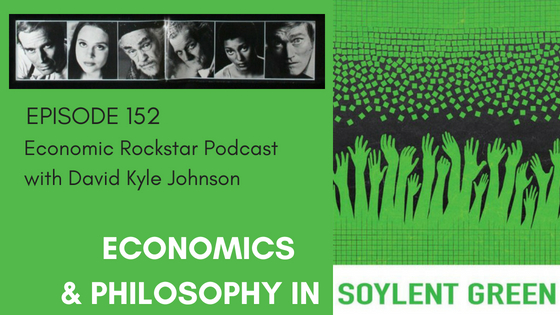
152: David Kyle Johnson on Economics and Philosophy in Soylent Green
August 10, 2018 by Frank

http://traffic.libsyn.com/economicrockstar/152_Kyle_Soylent_Green_Final.mp3
Play in New WindowDownload

152: David Kyle Johnson on Economics and Philosophy in Soylent Green

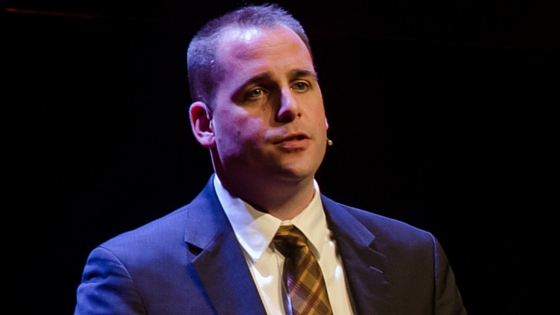
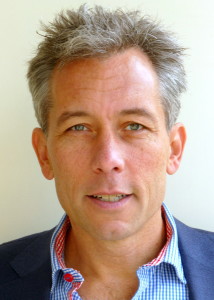
This is a 3rd instalment of my interviews with Professor David Kyle Johnson, an  Associate Professor of Philosophy at King’s College in Wilkes-Barre, Pennsylvania.

We catch up again after watching the 1973 dystopian movie ‘Soylent Green‘ and discuss some economics and philosophical themes that run through the movie.

In this Episode, we cover:

  • Scarcity
  • Choice
  • Over-population
  • Consumption
  • Inflation
  • Production
  • Automation
  • Altruism
  • Theft
  • Black market economy
  • Pricing
  • Equilibrium
  • The Invisible Hand

Social Issues Discussed Include:

  • Social class/status,
  • Feminism
  • Poverty

Philosophical Questions Addressed Include:

  • Should we resort to cannibalism to save the human race?
  • Should we have the right to die with dignity in the face of a terminal illness, the loss of hope or over our moral principles?
  • Is there a god?
  • And more.

Movies:

  • Soylent Green (1973) Directed by Richard Fleischer

Other Episodes to Check Out:

146: David Kyle Johnson on Science Fiction as Philosophy and Finding Nietzsche’s Übermensch in Economics

151: Unreleased Bonus Episode with David Kyle Johnson

Books:

  • Make Room, Make Room: The Classic Novel of an Overpopulated Future by Harry Harrison
  • The Population Bomb by Paul Erlich

Patreon

If you’re a fan of the podcast and would like to show your support in anyway, please check out my Patreon page at www.patreon.com/economicrockstar where you can sign up for any of the awards for as little as $1 a month or you can simply follow me on the Economic Rockstar Facebook page or on Twitter or simply recommend the show to a friend, especially if they have never had the opportunity to study economics.

http://traffic.libsyn.com/economicrockstar/152_Kyle_Soylent_Green_Final.mp3

Podcast: Play in new window | Download
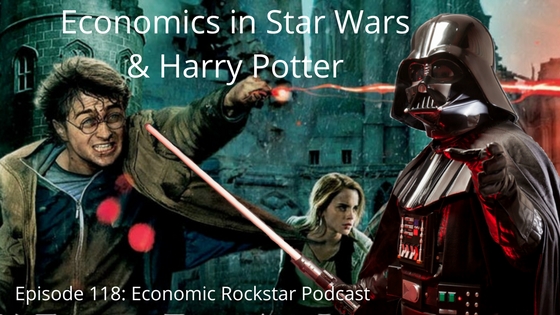
118: Zachary Feinstein on Systemic Risk and Economics in Star Wars and Harry Potter

December 30, 2016 by Frank

http://traffic.libsyn.com/economicrockstar/118_Zachery_Feinstein_Final.mp3
Play in New WindowDownload

118: Zachary Feinstein on Systemic Risk and Economics in Star Wars and Harry Potter

Zachary Feinstein is Professor joined the Preston M. Green Department of Electrical & Systems Engineering at Washington University in St. Louis in 2014.

While earning a doctorate at Princeton University, Zachary supervised the senior thesis-writing group and assisted in teaching several courses.

Previously, he conducted research at Hunan University in China and was an intern at Millennium Partners LP and Lehman Brothers Inc., both in New York City.

Professor Feinstein works in the broad fields of operations research and financial engineering and he heads The Operations Research and Financial Engineering Laboratory Washington University.

His research focus has been on the applications of set-optimization to financial risk measurement, with projects studying and defining dynamic risk measures in markets with transaction costs and measures of systemic risk.

You can find Professor Feinstein’s work on Star Wars and more at www.fictionomics.com.

On Systemic Crises and Contagion:

“This is something that comes up very regularly in modern economic history. And really it’s something that we talk about it for a year after the crisis and then we forget to think that this is a problem. So by bringing it up in Star Wars and by bringing it up in Harry Potter we can keep this in the public consciousness.” Professor Zachary Feinstein.

Economics:

In this episode, Zachary discusses and mentions: systemic risk, contagion, world GDP, Gross World Product, Gross Galactic Product (GGP), interstellar travel, economic stagnation, financial deregulation, resources, scarcity, bailout, bank failures, TARP, moral hazard and the Glass-Steagall Act.

In this Episode, you will Learn:

  • about the petition to White House to build the Death Star.
  • how the Death Star would cost $193 quintillion to build and World GDP is $70 trillion.
  • about how Professor Feinstein used the Manhattan Project to build the first Atomic Bomb as a proxy to calculate the cost of the second Death Star.
  • why people would go back to authoritarian rule like The First Order (economic depression).
  • how economic growth is linked to population growth.
  • what happens in a systemic crisis if it’s generated by currency exchanges.
  • the Economic System in the Star Wars Galaxy.
  • the systemic risk imposed by the Gringotts Bank in the Harry Potter series.
  • and much much more.

Movies/TV Series Mentioned in this Episode:

  • The Clone Wars
  • Rogue One
  • Star Wars: The Force Awakens
  • Star Wars: The Empire Strikes Back
  • Star Wars: Return of the Jedi
  • Harry Potter and the Cursed Child
  • Lord of The Rings: The Fellowship of the Ring
  • Game of Thrones
  • Sharknado
  • Back to the Future
  • Doctor Who

Writing Tips:

Just write it down. Get something on page and then afterward you can mark it up in red as much as you want. Don’t worry about getting the right sentence down, just get something on the page and then move it all around. Mark it up. Completely delete it if you want. But once it’s on the page, it’s much easier to move forward than worrying about the perfect sentence to start – Professor Zachary Feinstein.

Academic Papers:

  • Feinstein, Z. (2015). It’s a Trap: Emperor Palpatine’s Poison Pill. Washington University.
  • Other academic papers by Professor Zachery Feinstein.

Links:

  • Petition to White House to build the Death Star
  • Rogue One and Building the Death Star by Zachary Feinstein
  • Thoughts on the Operational Costs of the Death Star by Zachary Feinstein
  • The economics of Star Wars: How the Empire collapses by Erika Ebsworth-Goold
  • Harry Potter and the Goblin Bank of Gringotts by Zachary Feinstein
  • Harry Potter and the Economic Catastrophe: The Rise of Voldemort by Zachary Feinstein
  • Sharknado: The Deficit Spending We Need by Zachary Feinstein

Books:

  • Foundation by Isaac Asimov
  • Foundation and Empire by Isaac Asimov
  • Second Foundation by Isaac Asimov
  • Anathem byNeal Stephenson
  • Cryptomicon by Neal Stephenson
  • The Diamond Age by Neal Stephenson
  • Harry Potter and the Cursed Child by J. K. Rowling

http://traffic.libsyn.com/economicrockstar/118_Zachery_Feinstein_Final.mp3

Podcast: Play in new window | Download
082: Peter Boettke on Smith and Keynes and Why We Should Be ‘Living Economics’

April 21, 2016 by Frank

http://traffic.libsyn.com/economicrockstar/082_Peter_Boettke.mp3
Play in New WindowDownload

082: Peter Boettke on Smith and Keynes and Why We Should Be ‘Living Economics’

Peter Boettke is Professor of Economics and Philosophy at George Mason University, the BB&TPeter Boettke Economic Rockstar Professor for the Study of Capitalism, and the Director of the F.A. Hayek Program for Advanced Study in Philosophy, Politics, and Economics at the Mercatus Center at George Mason University.

Peter is now the co-author, along with David Prychitko, of the classic principles of economics texts of Paul Heyne’s The Economic Way of Thinking.

Professor Boettke’s most recent book, Living Economics, provides a resource for how teachers and students can engage in many fascinating questions in economics and illuminates the core principles that should guide our thinking.

Peter’s efforts in the classroom have earned him a number of distinctions including the Golden Dozen Award for Excellence in Teaching from the College of Arts and Sciences at New York University and the George Mason University Alumni Association’s 2009 Faculty Member of the Year award.

Peter’s research has primarily been in the area of comparative political and economic systems and the consequences with regard to material progress and political freedom.

Economics:

In this episode, Peter mentions: Classical economics, Austrian economics, Keynesian economics, credit transmission, institutions, the invisible hand, mainline economics, mainstream economics, private property, public choice, rent-seeking, opportunity cost, scarcity, exchange, markets, negative externalities, laissez-faire, Coase theorem, Pigouvian tax, reciprocity, inflation, stagflation and Malthus’ theory of The General Glut.

Economists:

In this episode, Peter mentions: Adam Smith, F. A. Hayek, Ludwig von Mises, Milton Friedman, Paul Samuelson, John Maynard Keynes,Frédéric Bastiat, David Hume, Vernon Smith, Thomas Robert Malthus, J. K. Galbraith, Paul Heyne, Hyman Minsky, Thorstein Veblen, Steve Keen, Ben Bernanke, Arthur Pigou, Gordon Tullock, James Buchanan, Robert Coase, Elinor Ostrom, Vincent Ostrom and Major Douglas.

Papers:

  • Teaching Austrian Economics to Graduate Students
  • Beyond Equilibrium Economics: Reflections on the Uniqueness of the Austrian Tradition

Books:

  • Living Economics: Yesterday, Today, and Tomorrow by Peter J. Boettke
  • The Economic Consequences of Peace by J. M. Keynes
  • The End of Laissez-Faire by J. M. Keynes
  • The Rogue Gallery of Economic Thinkers by J. M. Keynes
  • The Road to Serfdom by F. A. Hayek
  • Challenging Institutional Analysis and Development: The Bloomington School by Paul Dragos Aligica and Peter Boettke
http://traffic.libsyn.com/economicrockstar/082_Peter_Boettke.mp3

Podcast: Play in new window | Download

060: Manu Saadia on Trekonomics – The Economics of Star Trek: Scarcity, Productivity and Public Goods

November 26, 2015 by Frank

http://traffic.libsyn.com/economicrockstar/Manu_Saadia_Final.mp3
Play in New WindowDownload

060: Manu Saadia on Trekonomics – The Economics of Star Trek: Scarcity, Productivity and Public Goods

Manu Saadia fell into science fiction and Star Trek fandom at the age of eight, back in Paris, France, where he was born and raised.Manu Saadia

Manu  studied history of science and economic history in Paris and Chicago. After many happy years in the Ivory Tower, he yielded to his childhood passion for the future.

Manu embarked on his continuing mission to explore strange new worlds by boldly going where many have gone before: Los Angeles, CA, where he advise and (occasionally) builds tech companies.

Manu received the 2005 Wayne C. Booth Graduate Student Prize for Excellence in Teaching at the University of Chicago.

His book, Trekonomics, is currently available for pre-order at www.inkshares.com and will be released in 2016.

Star Trek offers much more detail about its own world and the way its economics actually works – like the plumbing so to speak. So that’s what I wanted to do. Go into the plumbing of Star Trek. – Manu Saadia

Economics:

In this interview, Manu mentions:  trekonomics, crowd funding, labor, economic history, trade, robots, capitalism, comparative advantage, currency, money, Gold-Pressed Latinum, public goods, conspicuous consumption, scarcity, peak oil, productivity and opportunity costs.

Economists:

In this interview, Manu mentions: Brad DeLong, Felix Salmon, Adam Smith, Thomas Malthus, Hubbert, Paul Ehrlich, Julian Simon, Romer, Larry Summers, John Maynard Keynes and Angus Deaton,

In this episode you will learn:

  • why Manu Saadia wrote Trekonomics.
  • about the Star Trek Economics panel at Comic Con.
  • why economists love Star Trek.
  • about inkshares and how it can help authors publish their book.
  • how traditional media rather than social media boosted pre-order sales of Trekonomics – an ironic outcome.
  • when Manu’s interested in economics and Star Trek collided.
  • about the work of Isaac Asimov and how his stories are a discourse on economics.
  • how the stories of robots and the future by Asimov influenced and shaped the storyline in Star Trek.
  • about the replicators in Star Trek and how they solve the problem of economic scarcity.
  • about the Ferengi’s and how they represent capitalism and trade.
  • why The Federation or the humans in Star Trek do not use money but have a foreign account to trade with the Ferengi’s.
  • about the Ferengi’s currency, Gold-Pressed Latinum, which cannot be replicable.
  • why owning a replicator is a ‘pain in the ass’.
  • how things that cannot be replicated has value but those that can be replicated has no value.
  • if Keynes’ The Economic Possibilities of Our Grand Children is a rebuttal of the writings of H. G. Wells.
  • about GPS being a public good and the benefits it has brought to the public.
  • why making GPS a public good in 1983 was one of the best decisions Ronald Reagan made as US President.
  • Manu’s favourite Star Trek episode is Lower Decks (The Next Generation).

Quotes by Manu Saadia in Episode 60 of the Economic Rockstar Podcast:

Trekonomics got a lot of support and very nice feedback from a lot of economists – Manu Saadia

Click To Tweet

“It always baffles me when you have these very famous and serious economic thinkers were in fact  total Star Trek nerds. I was on a panel at New York Comic Con with Brad DeLong, Paul Krugman and Annalen Newitz from i09. There was Chris Black as well and Felix Salmon.” – Manu Saadia

Brad DeLong came to the panel with a Star Trek hoodie. – Manu Saadia

Click To Tweet

On Isaac Asimov: “All of his work is a long meditation on economics, either foundation where there is this science called psychohistory which is in fact a fictional mathematical modelling of human behaviours on the scale of societies on a galactic scale.” – Manu Saadia

“One of the reasons why I wanted to study economics was that I was fascinated by and really wanted to understand the transformation of humanity’s relation to its own labor. This is one of the great questions of political economy because it determines a lot of things when it comes to the shape society and the role of the state and how behaviors are determined and constructed over time. But it’s also the key to understanding where we’re going”. – Manu Saadia

“I would say the replicators are more of a metaphor. If you look at their status in the series, they do not help move the narratives forward. They’re just there to signify that there’s no need to work. They’re a little bit like robots in Asimov. They have the same narrative function, which is to show and demonstrate that post-scarcity does exist and is based on automation and artificial intelligence.” – Manu Saadia

The Ferengi’s are the capitalist, merchant traders of the galaxy – Manu Saadia

Click To Tweet

Most of the stuff in Star Trek is basically a public good – Manu Saadia

Click To Tweet

I think Star Trek is very much what Keynes described in The Economic Possibilities of Our Grand Children – Manu Saadia

Click To Tweet

Books:

  • Scatter, Adapt, and Remember by Annalen Newitz 
  • Isaac Asimov
  • Frankenstein by Mary Shelly
  • The Economic Possibilities of Our Grand Children by John Maynard Keynes

Papers:

  • Romer (1990) Productivity Gains

Links:

  • What I Learned Crowdfunding Trekonomics  by Manu Saadia
  • Trekonomics The economics of Star Trek: how does it work, and how do we get there?  by Manu Saadia
  • View the transcript to The Amazing Economics of Star Trek at New York Comic Con
  • www.i09.com 
  • www.inkshares.com
  • What the economics of Star Trek can teach us about the real world by Brian Fung, Andrea Peterson and Hayley Tsukayama Washington Post 
  • The Live Long and Prosper Edition Slate Money 
  • Club of Rome 

Manu’s Favorite Star Trek Epsiodes:

  • City on the Edge of Forever
  • Arena

Where to Find Manu:

  • inkshares.com
  • fusion.net

Music:

  • Star Trek Episode Amok Time
http://traffic.libsyn.com/economicrockstar/Manu_Saadia_Final.mp3

Podcast: Play in new window | Download

055: David Skarbek on the Economics of Prison Gangs and The Social Order of the Underworld

October 22, 2015 by Frank

http://traffic.libsyn.com/economicrockstar/055_David_Skarbek_Final.mp3
Play in New WindowDownload

055: David Skarbek on the Economics of Prison Gangs and The Social Order of the Underworld

Dr David Skarbek is a Senior Lecturer in Political Economy and Undergraduate Exam Board Chair in the Department of Political Economy at Kings College, London.

David’s research interest is to understand how people define and enforce property rights in the absence of strong, effective governments. His work has examined incarceration, gangs, and crime in the United States.

David received a BS in Economics from San Jose State University and a MA and PhD in Economics from George Mason University. He previously taught in the political science department at Duke University.

David’s teaching include ‘Research Methods for Politics’, ‘Economics of Crime’ and ‘Political Economy of Organized Crime’

David’s new book is The Social Order of the Underworld: How Prison Gangs Govern the American Penal System (Oxford University Press). It examines how inmates create self-governance institutions to promote economic and social interactions behind bars.

Economists:

In this interview, David mentions: Alex Tabarrok, Peter Leeson and Peter Boettke.

Economics:

In this interview, David mentions: Scarcity, rationality, irrationality, incentives, governance, social economics, black market economy, gang taxes, drug taxes, marginal cost, correlation, constitutional economics, the collective action problem, free-rider problem, monopoly, trade and protection.

Economics explains everything when properly applied and that discovering how it does so is the most delightful intellectual project that one can imagine – David Skarbek

“Gangs formed because the prison population became very large” – David Skarbek

Click To Tweet

Prison is a very strategic environment. In some ways prison is somewhat an excellent context to apply the rational choice approach – David Skarbek

In this episode you will learn:

  • what makes states stable.
  • how prisoners trade in a black market economy.
  • why gang-based governance in prisons looks very different today than 100 years ago.
  • why big prison systems have serious prison gang problems compared to small prison systems.
  • how women prisons are better controlled as they are governed in a decentralised way.
  • about the control that prisoners in adult correctional facilities have control over minors in juvenile correctional facilities.
  • whether private prisons result in a larger prison population.
  • diminishing returns to prison years.
  • how do prison guards feel about prison gangs.
  • how the costs of having prison gangs is externalised to the taxpayer.
  • how the availability of resources that are provided by prisons could determine the level of prison gang culture.
  • why didn’t slaves revolt when being shipped to other countries.
  • how the free-rider problem was the main reason why slaves did not revolt on ships.
  • whether having weapons is necessary in reducing crime.

Books:

  • The Social Order of the Underworld: How Prison Gangs Govern the American Penal System by David Skerbek
  • The Invisible Hook: The Hidden Economics of Pirates by Peter Leeson
  • Enforcing the Convict Code: Violence and Prison Culture by Rebecca Trammell
  • The Better Angels of Our Nature: Why Violence Has Declined by Steven Pinker

Papers:

  • Why Didn’t Slaves Revolt More Often During the Middle Passage? (D. Skarbek and A. Marcum) Rationality & Society 26(2) 2014: 232-262.

Movies:

  • The Godfather
  • The Godfather II

Where to Find David:

  • Website: www.davidskarbek.com
  • Twitter: @DavidSkarbek
http://traffic.libsyn.com/economicrockstar/055_David_Skarbek_Final.mp3

Podcast: Play in new window | Download

041: Dermot Hayes on Comparative Advantage, Feeding the Chinese and the Malthusian Catastrophe

July 16, 2015 by Frank

http://traffic.libsyn.com/economicrockstar/041_Dermot_Hayes_Final.mp3
Play in New WindowDownload

041: Dermot Hayes on Comparative Advantage, Feeding the Chinese and the Malthusian Catastrophe

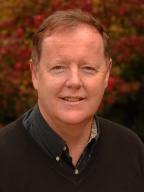
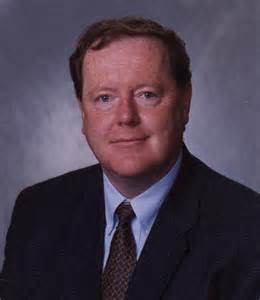
Dermot Hayes is the Pioneer Chair of Agribusiness, professor of economics, and professor of finance at Iowa State University. He heads theDermot Hayes 2 Trade and Agricultural Policy Division at CARD, a position he also held from 1990 through 1998.

He is co-director of the Food and Agricultural Policy Research Institute, a research center dually administered through the Centre for Agricultural and Rural Development (CARD) at Iowa State and at the University of Missouri at Columbia. He is also a leader of the Policy Task Force of the Plant Science Institute at Iowa State.

A native of the Republic of Ireland, Dermot obtained his degree in agriculture science from University College, Dublin and his Ph.D. from University of California, Berkeley with a major in international trade.

Dermot has distinguished himself with many awards at the college and university levels for his work as a teacher and researcher.

In 2006 he received a Publication of Enduring Quality award from the American Agricultural Economics Association, who subsequently named him a Fellow in 2007.

Besides his analysis of U.S. farm policy and international agricultural trade, Dermot’s other research interests include food safety, livestock modelling, demand analysis, and commodity markets.

Economics:

In this interview, Dermot mentions and discusses: market inefficiencies, government intervention, agricultural economics, property rights, comparative advantage, autarky, incentives, scarcity, Malthusian Catastrophe, free-trade, unemployment, subsidies and taxes.

Economists:

In this interview, Dermot mentions and discusses: Jason Shogren, Paul Dolan, David Zetland, David Simon, Adam Smith, Thomas Malthus, David Zilberman, Milton Friedman and Josh Angrist.

Influencer:

Milton Firedman

“Whenever prices rise, farmers and technology companies have an incentive to work harder to take advantage of high prices. And of course they do that by producing more and that brings prices back down again.” – Dermot Hayes

“Malthus was wrong. He was a negative person. But having said that, with more people and less efficient use of land, we are going to have to bring more land into cultivation – this is devastating to the environment.” – Dermot Hayes

In this episode, you will learn:

  • how China is finding ways to feed its people and how self-sufficiency no longer works.
  • about China’s ever-increasing demands for soybeans, sugar, wine, etc and how this is putting demands on the global agricultural industry.
  • how Ireland lost its comparative advantage in milk production by joining the EU.
  • about Kerrygold Irish grass-fed butter and Bullet-proof coffee.
  • why Kerry Group are only ‘scratching the surface’ in the US market.
  • what high-value, labor-intensive products China should concentrate on producing in order to feed their population and trade with other countries.
  • about if the Chinese government owns much of the land and property rights in China.
  • ‘terminator seeds’ and how private companies could be incentivised to manufacture them.
  • about the use of beta agonists, such as ractopomine, in the use of animal food production.
  • why Europe’s method of testing agricultural technologies frustrates Dermot.
  • about Dermot’s work on free-trade agreements between countries.
  • about Dermot’s ‘controversial’ ethanol research paper.
  • why Dermot created a formula that allowed the price of corn to track crude oil prices and how he bought agricultural land based on his findings.
  • how academic research can open up hatred and attacks amongst your peers and the industry to which you maybe researching.
  • what advice Dermot would give a government regarding the taxing and subsidies of goods and services for the purpose of trade.

Takeaway:

“If you haven’t travelled to strange places like Burma or Uruguay, find a way to do so and you’l come back a changed person.” – Dermot Hayes

Recommended Books:

  • Free to Choose by Milton Firedman

http://traffic.libsyn.com/economicrockstar/041_Dermot_Hayes_Final.mp3

Podcast: Play in new window | Download

039: David Zetland on Aguanomics, Water Scarcity, Water Wars and ‘Toilet-to-Tap’

July 1, 2015 by Frank

http://traffic.libsyn.com/economicrockstar/039_David_Zetland_Final.mp3
Play in New WindowDownload

039: David Zetland on Aguanomics, Water Scarcity, Water Wars and ‘Toilet-to-Tap’

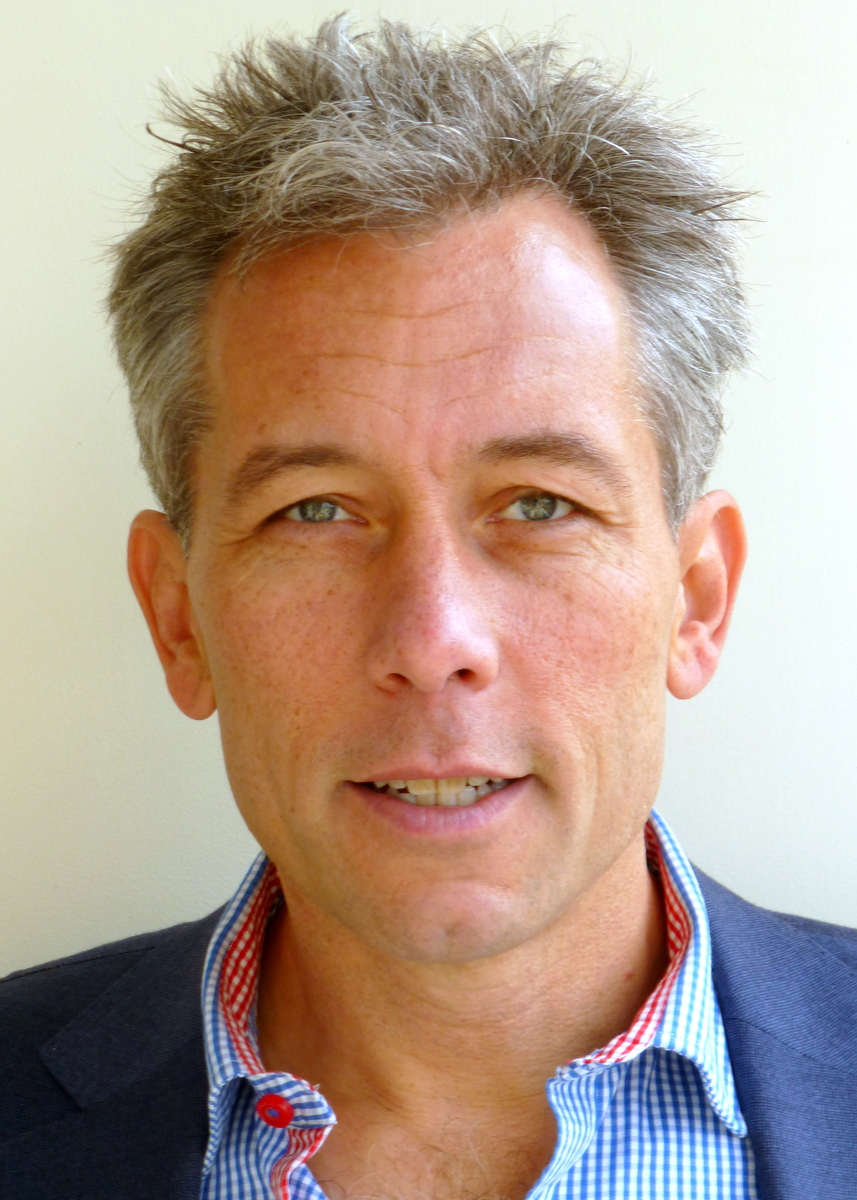
David Zetland is an assistant professor at Leiden University College, where he teaches various classes on economics. He was a PostdoctoralDavid Zetland Fellow in Natural Resource Economics and Political Economy at UC Berkeley (2008-2010) and a Senior Water Economist at Wageningen University (2011-2013). David blogs on water, economics and politics at aguanomics.com and gives many talks to public, professional and academic audiences.

David has two books The End of Abundance: economic solutions to water scarcity (2011)  and Living with Water Scarcity (2014). He received his PhD in Agricultural and Resource Economics from UC Davis in 2008. David lives in Amsterdam.

Influencers:

Adam Smith, Friedrich Hayek and Nassim Taleb.

Economics:

In this interview, David mentions and discusses: scarcity, shortage, commodity, supply, demand, marginal cost, opportunity cost, unintended consequences, monopoly, common-carrier system, the water-diamond paradox, development economics, governance, probability, fat tails, Buddhist economics, the problem of over-consumption, non-satiation assumption, GDP, pricing, fairness and efficiency.

Economists:

In this interview, David mentions and discusses: Adam Smith, Friedrich Hayek, Nassim Nicholas Taleb and Ernst Friedrich Schumacher.

The Water-Diamond Paradox (23rd minute in this Episode)

Find out:

  • if we should be worried more about a shortage of water or a scarcity of water.
  • if we should learn from the oil industry and develop the technology-equivalent of extracting oil from oil sands and desalinate the ocean water?
  • if we can tell whether we know the water footprint of a cow and if it’s different in California than Ireland.
  • why water is actually free and what you pay is for the delivery.
  • if there is an opportunity costs to acquiring water?
  • why people living in the slums of India pay up to 50 times the price for water than those who have cheaper piped water.
  • if a water monopoly is an effective market structure.
  • if price competition in the market for water would result in the over-use of water consumption.
  • about Scottish Water and how other utilities across the UK and adopting their distribution and pricing structure.
  • about the water-diamond paradox.
  • why David decided to do a PhD in economics after failing to get rich in the dotcom era.
  • how David came to get his family name ‘Zetland’.
  • about the coming ‘Water Wars’ and how it has already started.
  • about Sao Paulo’s troubled water situation and how it’s creating gang warfare on the streets.
  • who we should assign the property rights to water.
  • about Chile‘s exemplary assigning of water property rights.
  • what David proposes to be the most effective way of managing water.
  • how Singapore are becoming independent in creating their supply of water and are no longer depending on imports from Malaysia.
  • how Singapore are building technologies to recycle water from waste.
  • why the ‘toilet-to-tap’ water recycling initiative has failed in the US but is working in Singapore.
  • how marketing recycled water works in Singapore and not in the US – one known as ‘New Water’ and the other ‘Toilet-to-Tap Water’.
  • why Singapore treats water as a national security issue.
  • why it will take 20 years to build a desalination plant and why San Diego will need 15 of these plants to serve the water needs of the locals.
  • about the new Irish water utility, Irish Water, and how the management decided to ‘award’ themselves bonuses even before the Irish people payed for their water.
  • about ‘Buddhist Economics’ and the assumption of non-satiation.
  • what David would suggest if he was an Economic Advisor to any country regarding water policy.

Why David Studied Economics:

When I was between 25 and 30 years old, I travelled to 65 countries and when I came back to the States I was looking around and figuring out what to do. I tried to get rich in the dotcom era and that totally failed and I started to work with a bunch of academic mathematicians and they were really kinda cool people. But they were pretty cool and I thought ‘well this is interesting. Maybe I should go and do something academic’. I went back to grad school to get a PhD and I wanted to do development economics. My research project, which was to go and study cocaine production in South America, sounded to my advisors a littlest dangerous. Then one of my advisors said that there was this really strange case in Southern California where San Diego is in a big fight with other water utilities and maybe you should look into that. So that ended up being my dissertation – David Zetland.

David’s Advice to a Country Implementing a Water Policy:

“You have to take care of your environment. Then you have to commodify all the rest of the water. But all that revenue really should go to the citizens of that country. Other than that, I’m open to any other discussion about what’s a better system in terms of balancing between efficiency, which is pricing and fairness which is the distribution of those revenues” – David Zetland.

‘Water Water Everywhere and Not a Drop to Drink’: The Right to Water – It’s a Necessity After All

The ‘Right to Water’ is an important part of the conversation but it tends to confuse things. People need water for drinking, cleaning, washing and so on. But is there a right to water to put on your garden? Is there a right to water to wash your car? Do farmers have a right to water that goes on their fields if that means the river is going to be dry? So, there comes a point where the ‘Right to Water’ runs out and we have to start talking about water as a scarce good or an economic commodity. That’s the separation you need to start with.

Shortage is worse than scarcity because you can’t get any of what you want, even if you have time or money – David Zetland

David Zetland’s book ‘Living with Water Scarcity’ is about learning how to manage water scarcity, the same way we have learned to manage land scarcity, time scarcity and money scarcity. Water scarcity is not confined to any particular region or country. This is a global phenomenon. We can generalise water scarcity in terms of the lack of water available. But there exists specific concerns such as the scarcity of clean water, which is becoming a problem in northern European countries and eastern United States, where there’s lots of water but a lot of it is polluted.

Ireland's Anti-Water Charges Protest 2014

Ireland’s Anti-Water Charges Protest 2014

The irony for people living in Ireland, for example, is that the country is surrounded by water but yet availability of fresh, clean water can be scarce in some regions. There are a few towns and villages in Ireland who have been buying bottled water or are on boiling notices due the presence of cryptosporidium in their water. Water shortages is not necessarily an immediate concern for Ireland. However, California, on the other hand, is experiencing their 4th year of drought. This is something that is being experienced in many regions around the world, but ‘California has more reporters hanging around’ and other regions’ grief remain unreported.

The ‘Water Water Everywhere and Not a Drop to Drink’ problem leads people to think that we should desalinate the ocean and get all the water that we want from the ocean. This, however, would be a great physical and expensive task to undertake and the conversation on desalination tends to stop. Should we learn from the oil industry and develop the technology-equivalent of extracting oil from oil sands and desalinate the ocean water?

Adam Smith explained the value in exchange as being determined by labor: ‘The real price of every thing, what every thing really costs to the man who wants to acquire it, is the toil and trouble of acquiring it’.

David frames this as ‘Technologies and Techniques’; techniques meaning how we use technologies and how we use water. “In the case where you have scarcity, you could say we’re going to build a desalination plant, drill a deeper well, build aqueducts, take shorter showers or stop watering our lawns. We should try and help people use as many ways as possible instead of focusing on one particular silver bullet.”

Who’s the Straw that Broke the Camels Back?

Numerous groups are pointing the finger at each other and casting blame each others way for causing pollution, drought and water scarcity. Besides the natural precipitation, farmers use half as much water as people in the city, such as industries and municipalities. In California, farmers use four times as much water as cities, say in the UK. Farmers obviously use water in various forms, but they’re not necessarily using more than the cities.

Then there’s the big discussion about who should be allowed to or who has the right to us water and that’s where the politics and mudslinging comes in. However, the level of precipitation is different in Arizona and California, as well as in Spain and Cyprus, compared to regions in Ireland and the UK.

Quotes from David in this Episode:

“These pro-poor policies can end up being so anti-poor. It’s terrible, it’s actually almost a crime” – David Zetland

Click To Tweet

on how cheap water in India results in water utilities not having the infrastructure to deliver water to the slum areas. These people end up paying up to 50 times for their water from tankards. This water is dirty and people, particularly children, queue up for hours to collect and carry this water to their homes which can often be on the 3rd or 4th floor of a building.

“The customer is vulnerable to being exploited by the monopoly and the monopoly is vulnerable to being exploited by the customer. And that’s where regulations come in” – David Zetland on the need for regulation in the market for water.

Why is water, which is something we need to live, so cheap, whereas diamonds, which are a pure frivolous luxury, so expensive? – David Zetland on the Water-Diamond Paradox.

Water Wars in Sao Paulo, Brazil

Sao Paulo’s reservoirs have fallen to such low levels that their supply fails to meet with their expected demand. There were a lot of ways in which Sao Paulo could’ve dealt with this risk, such as fixing their leaky networks. They cannot get water from somewhere else. You’ve got a limited amount of water and 10 to 20 million people who need water to drink. The utility can shut off the water supply at various locations if they like and that raises the question of rich versus poor. That kind of decision is not going to please anybody. There have been protests over this.

David’s assessment of this is that if Sao Paulo wants to avoid a war on the streets, they need to shut of everybody’s water and have tankard trucks distributing water in Jerry cans in the corners – one man, one bottle. And that’s because you’d be addressing the concern of social equality and human rights.

Israel is not going to invade Turkey for their water. You can’t win that battle. You can’t bring back the water – it’s too heavy.There won’t be wars of plunder, there’ll be just conflicts over who’s going to get the water. Water gangs will form and they will take your water.


Recommended Books:

  • The End of Abundance: economic solutions to water scarcity (2011)  by David Zetland.
  • Living with Water Scarcity (2014) by David Zetland.
  • Small is Beautiful by Ernst Friedrich Schumacher.
  • The Theory of Moral Sentiments by Adam Smith.
  • Check out David’s review of ‘Small is Beautiful’ by E. F. Schumacher.
  • Find out here why David decided to give his book away for FREE.

Where to Find David Zetland:

  • Blog: aguanomics
  • Twitter: @aguonomics
http://traffic.libsyn.com/economicrockstar/039_David_Zetland_Final.mp3

Podcast: Play in new window | Download

036: Jason Shogren on Music and Endogenous Risk and Rationality in the Environmental Goods Market

June 11, 2015 by Frank

http://traffic.libsyn.com/economicrockstar/Jason_Shogren_Final.mp3
Play in New WindowDownload

036: Jason Shogren on Music and Endogenous Risk and Rationality in the Environmental Goods Market

Jason Shogren is the Stroock Professor of Natural Resource Conservation and Management and Chair of the Department of Economics and Finance at the University of Wyoming.Jason Shogren

Professor Shogren’s background and research interests include the economics of environmental and natural resource policy, experimental methods; endangered species; invasive species; climate change; agricultural and forest management; energy; health; regulation; and paleoeconomics.

Jason has been named a fellow of the Association of Environmental and Resource Economists (AERE), the nation’s pre-eminent professional society for environmental economists and policy.

Jason served as professor to Sweden’s King Carl Gustaf XVI in 2012 and is a 2007 Nobel Peace Prize winner (shared with Al Gore) as a member of the United Nations team working on climate change.

He has also served as a senior economist on the Council of Economic Advisers in the White House under the Clinton Administration.

Professor Shogren’s teaching include Global Economic Issues, Natural Resource and Environmental Economics, Environmental Risk and Conflict and Experimental Economics.

Jason is well published with over 200 articles and is the author and editor-in-chief of numerous books including Encyclopedia on Resource, Environmental, and Energy Economics, Experimental Auctions and Fat Economics: Nutrition, Health, and Economic Policy

Jason loves fishing and music. He spends his time composing acoustic roots songs that he describes as catawampus Americana music, has five albums and will be touring this summer.

Economists:

In this interview, Jason mentions and discusses:

Janet Yellen, Thomas Sowell, Daniel Kahneman, Amos Tversky, Gary Becker, Isaac Ehrlich, Ralph C. D’Arge, Tom Crocker, Peter Baum, Karl-Göran Mäler, Vernon Smith and Charlie Plott.

Economic Themes:

In this interview, Jason mentions and discusses:

Carbon tax, cap and trade market, the Coase Theorem, probability, general equilibrium models, expected utility, nudge, rationality, irrationality, risk aversion, loss aversion, homo economicus, soft paternalism, trade-off, scarcity, endogenous risk and extreme tail-end events.

“I spent most of my life before becoming a PhD economist as a musician” -Jason Shogren.

Click To Tweet

“I like to think of economics as applied philosophy”- Jason Shogren.

Click To Tweet

Find Out:

  • about the Cap and Trade Market for carbon emissions is a failure and would only work in a micro-management setting.
  • why its best to implement a carbon tax.
  • the difference between luxury emissions and survival emissions and why it maybe difficult for China and India to reduce their carbon.
  • how Jason’s depiction of a low probability-high severity event influenced Janet Yellen to take action on climate change.
  • if we are acting rationally or irrationally toward the environment.
  • how we can exploit rationality ‘for the good’.
  • how, over the last 30 years, we have become averse to just about everything.
  • how we can take advantage of peoples’ status quo to increase their contribution of paying a carbon tax.
  • how designing the right system can nudge people to do the right thing – just like soft paternalism.
  • how Jason sought inspiration about rationality from other disciplines, such as English literature and music composition, rather than from economics.
  • how Jason uses music as a form of escapism.
  • about the inspiration Jason gets for writing songs from economics.
  • who the talented people are behind the creation of Jason’s amazing artwork and photography.
  • about the concerts that Jason Shogren will be playing at each year.
  • about Jason’s hitch-hiking experience in Ireland in 1985 from the Giants Causeway and down along the West Coast (now known as the Wild Atlantic Way).
  • about Jason theoretical thought process regarding endogenous risk and  how he applies it to different environmental risks.
  • what Jason would do if he was once again Economic Advisor to the US government.
  • a little about the Endangered Species Act.
  • what I saw on Professor Shogren’s whiteboard when I spoke to him on Skype. Hint: It’s his next economic model.
  • about the 25% chance you have in meeting Jason in Centennial, Wyoming – it involves the population and the number of pubs!
  • about Jason’s plastic Nobel Prize keychain and where he hangs it.

Jason Shogren band

Influencers:

Ralph C. D’Arge, Tom Crocker (Wyoming), Peter Baum (University of Stockholm) , Karl-Göran Mäler, Vernon Smith  and Charlie Plott.

An Economic Theory that Influenced Jason Shogren:

A paper by Ehrlich and Becker on self-protection and self-insurance, i.e. endogenous risk, where people invest to change the lottery they face in life, influenced Professor Shogren’s theoretical approach to economics. Once Jason started looking at economics from that perspective, he began to see a lot of models in which the states of nature where independent. To Jason, that seemed too fatalistic for how we spend our resources and how we invest. Most environmental policies are a lottery because we can’t guarantee that somebody’s going to live or not get sick based on exposure (to environmental risk).

We have an estimate and ‘safe’ minimum standards, but there’s no guarantee. So we’re really talking about policies at a collective level that are moving probabilities and damages around. We also have investment at a private level in which we’re doing the same thing – Jason Shogren

What, therefore, struck Jason was asking people about their value of reducing risk and they giving him a value of zero. He questioned people’s decision of applying a value of zero to reducing risk. The reason was that they valued the ‘collective’ reduction as zero and not their ‘individual’ reduction because they took care of the risk themselves.

Applying this theoretical thought process to climate change, endangered species, health risks, pandemics, invasive species or any other problem, will most likely have some element of endogenous risk. Once you add that element to it, the model gets a little richer and once the model gets a little richer, then you can explain a little more behaviour. By adding the behavioural element to the model, the question is ‘What drives things more? Technology of reducing risk? Tastes? How do they work together or how they work apart?’.

“If you can strip it down to that level, then you can really look at a lot of different problems using that type of kit”– Jason Shogren. It can become very flexible as a theoretical framework and model, that it is the reason why Jason, his peers and his students were able to look at a lot of different problems in terms of endogenous risk. It allows for focus on a particular research topic, otherwise it would be too scattered.

Jason on Carbon Emissions:

“We still have to figure out a Plan B, because there is no Planet B” – Jason Shogren.

Click To Tweet

Putting a price on carbon has been the way to reduce carbon emissions. Trying to set up cap and trade markets has been too hard. The cap and trade market has allowed the supply to increase – Jason Shogren.

“If you’re waiting for people to do the right thing for the right reason, you can wait a long time. We’ve seen that throughout history. Economists would say that ‘if you want to do the right thing at the right time, let’s get the prices right and then people will make their own choices’. But if you get prices to reflect true costs and reveal hidden costs that are being imposed on others, then hopefully we don’t have to job-own them and nudge them. Maybe we have to nudge people and get the price right. Both theoretical aspects of economics should be complementary and we should not substitute one for the other” – Jason Shogren.

Before we start calling it nudging, there was a saying “The target is the target and the costs are regrettable but not really decisive” – Thomas Sowell.

Rationality in the Environmental Goods Market:

Rationality in psychology is very different to rationality in economics, in that when we think about rationality in economics we think about a social construct. People are making choices within an active exchange institution like a market and if they start making their emotions run wild, then there are people to arbitrage them. Either they like less money to more or they adjust and they start looking for opportunities themselves. It’s not that we all have to be 100% rational. As long as the folks at the margin who are making those trades pay attention, the market is powerful enough to move it along as if everybody was rational. But they don’t have to be.

The problem with environmental goods is that we don’t have markets like that. So now we have to figure out the problem of how to aggregate up in a way that would incorporate both economic monetary decisions and economic non-monetary decisions. That becomes trickier. Up to quite recently, the only thing economists were dealing with in terms of aversion was risk aversion. Typically it was believed that risk was the only thing that people were averse of. And then Kahneman and Tversky came along and we were now averse to losses and we treated gains and losses differently.

Over the last 30 years, we have become averse to just about everything – ambiguity, inflation aversion, equity aversion, disappointment aversion, envy aversion, lying aversion, guilt aversion. And so by adding all of these emotions into our typical economic model, the question is ‘How and when do we stop?’. Do we add all 40 emotions into our models? And now how do we sort out cross-partial derivatives between equity and envy and disappointment and suspicion and regret? And those are jobs that economists have not been typically trained to deal with – assigning complementarities or substitutabilities between different emotional factors.

So part of this working on nudges is trying to understand that if we tweak the models so that we can take advantage of how people feel guilty about this or how they opt-in or opt-out about different things, we can exploit that irrationality ‘for the good’. For example, people like status quo, so let’s take advantage of that. So instead of buying an airline ticket, nowadays you have to opt-in to add in a carbon price or you can buy a carbon off-set. What we should do is get all the airlines to opt out of buying that carbon off-set. And giving our tendencies not to want to opt out of things, we would probably buy a whole lot more carbon off-sets.

If we can exploit those at the same time as having an active market for those off-sets and a price, then it’s not irrational or rational. It’s understanding that there is some instinctual behaviour that people at a ground level will stick with. That’s the whole soft paternalism idea that we know that you know what’s right and we’re just designing the system to help you get there as opposed to us telling you what’s right.

It is extremely difficult to single out one emotion and to identify it as the one emotion that is driving homo economicus away from our rational base-line. It’s going to take us a while to say ‘Here are the ten big emotions that we can live with and let’s just work on those’.

On Human Behavior:

“If I really want to understand human behaviour, who should I read – Shakespeare or Gary Becker?” – Jason Shogren.

Click To Tweet

If we really want to study emotions we should study literature. If you really want to be economical about how people think, then you should study poetry. Then if you want to convey all of that in a compact form that people will pay attention to then you add music. Now you’ve got a melody and lyrics  and you have a path where essentially you are projecting what you are considering to be an important story to tell. Song writing has its structures and its forms that you can easily translate into guidelines and rules and math models, just like we do in economics. To me, arts and science – I don’t know if they’re ying and yang – to me they go parallel and spillover all over each other – Jason Shogren.

What Professor Shogren Would Do Today as Economic Advisor to the US Government:

  1. Figure out a way to introduce a carbon tax but difficulty would lie with the Senate and the House of Representatives since they are essentially run by the Republicans.
  1. Take on the Endangered Species Act because it’s being waiting to be revised for almost 22 years. The way that it is written is that any species has to be protected at any cost. That type pf pressure can’t hold without the economy bursting at the seams. It would be worth going through this Act and add safety valves in a systematic and coherent way. It’s too important for this Act to just sit idly by when people using discretion as to when it holds and when it doesn’t.

josh shogren

Takeaway:

As a younger man, everybody sort of hits that wall of maturity that you don’t really want to go through. Sometime you get forced through it and sometimes you walk through it and sometimes you fall through it. Once you get there and you decide you can’t control the universe, that’s a good place to be – Jason Shogren.

At the same time, you take care of what you can’t control. You know, it’s the oldest story in the book. Once you come to the realisation and you find that balance, things are just way more interesting, way easier to deal with and just, in general, happier. Being a good Scandinavian doesn’t mean I have my gloomy dark moments – Jason Shogren.

Songs Mentioned and Played in this Episode:

  • Works by Jason Shogren
  • Exit In Flames by Jason Shogren
  • Broken Every Vow by Jason Shogren
  • Me and Genghis Khan by Jason Shogren

Concerts Where You Can See Jason Shogren:

  • WHAT fest
  • Nowoodstock
  • Snowy Range

On Ireland:

“I spent a month hitch-hiking in Ireland way back in ’85. I started up in Larne, went up through the Causeway, then all the way down the West coast. It was a great month of hitch-hiking, Guinness, rain, people and adventure. So, yeah, I’m ready to come again” – Jason Shogren.

On Conferences:

“It’s supposed to be fun. You’re supposed to live and learn and try to pass on something better. Sometimes it’s ideas and sometimes it’s ideas through songs” – Jason Shogren.

Musicians Mentioned in this Episode:

  • Mumford and Sons
  • Gordon Barry

Recommended Book:

  • What Work Is by Philip Levine (Poet) 

Where to Find Jason Shogren:

  • Website: www.jshogren.com
  • CDBaby
http://traffic.libsyn.com/economicrockstar/Jason_Shogren_Final.mp3

Podcast: Play in new window | Download

006: Andrew Heaton on Using Comedy to Explain Economic Concepts

November 20, 2014 by Frank

http://traffic.libsyn.com/economicrockstar/006_Andrew_Heaton.mp3
Play in New WindowDownload

006: Andrew Heaton on Using Comedy to Explain Economic Concepts

Andrew Heaton

Andrew Heaton is a comedian, writer and political satirist. He is the presenter of the witty and entertaining economics podcast, EconPop and has a Masters degree in International Politics. Andrew has been featured in a Bollywood movie, plays a lead role in the sitcom Cap South and has been voted best new comedian of 2013 in New York. Andrew hails from Oklahoma, is an Officer to a Prince and plays the Ukelele to enhance the mood of his friends’ amorous endeavors.

Economic Themes:

In this interview, Andrew mentions and discusses: wheat quotas, comparative advantage, protectionism, relative and actual growth, free markets and limited government, Austrian Theory of Monetary Creation, supply and demand, signalling, subjective value, negative externalities, tariffs and import duty, protectionism, corporation tax, scarce resources, population, abundance of resources, the Great Depression, US deficit, unintended consequences, behavioral economics and risk aversion.

Economists and Economic Schools:

In this interview, Andrew mentions: the Chicago School, the Austrian School, Libertarianism, Adam Smith, Milton Friedman, Freidrich Hayek, John Maynard Keynes, Murray Rothbard, Frédéric Bastiat, Thomas Malthus, Gene Epstein, Steven Horwitz,

Andrew’s Influencers:

Gene Epstein and Milton Friedman.

Podcasts:

EconPop is hosted by Andrew, who is joined by economist Steven Horwitz and professor of literature Paul Cantor.

In this episode, you will learn:

  • how Andrew became interested in economics while studying abroad in Scotland.
  • what parallels Andrew draws between politics, economics and comedy.
  • what economists and school of thought Andrew draws inspiration from to carve out his own views.
  • where and from whom Andrew gets his inspiration for his anecdotal writings on economics concepts.
  • how economic concepts is in abundance in life and can be found in the many movies we may have watched.
  • what qualities Andrew believes makes a successful person.
  • about Andrew being an Officer to Prince Leonard of Hutt River.
  • what comparative advantage is and how Andrew explains it in an unusual but light-hearted way.
  • why Andrew believes we will never run out of resources and why we should not worry about scarcity.

Advice:

‘If you’re gonna have a lot of activities that you are doing, you need to be mentally organised and very good at prioritising.’

‘To supercharge your day, when you are getting to your tasks, do the one you hate most first… the rest of your day is a cinch.’

‘With books, the trick is you just write a thousand words a night… your subconscious mind works on it and when you sit down the following night it’s a little bit easier.  You have a full novel in two and half months.’

Personal Habits:

  • Andrew works extremely hard to get things done. He has blended comedy with economics to allow this dismal science to become enjoyable or entertaining.
  • Andrew believes that having the right mentor is hugely beneficial and such a relationship allows him to learn and focus on reaching small milestones. This has worked out favorably well for Andrew in the field of economics where he developed a strong set of opinions on some theoretical aspects of economics. By expanding his knowledge-base through economics books and the many discussions with his mentor, Gene Epstein, Andrew has opened new doors and created new opportunities that otherwise may not have been attainable. His love of economics, particularly the Austrian and Chicago Schools and libertarianism, has given Andrew a lot of material to work on for his comedic performances onstage, online and in books.
  • Andrew writes quite frequently and believes that constant writing will have a payoff in terms of the publication of a book.
  • Andrew writes ‘common sense economics for people who need to learn about common sense economics’ – Gene Epstein

    Click To Tweet

  • Andrew plays the ukelele but, unfortunately, it wasn’t ‘tuned’ correctly for him to give us a treat on this podcast. So, as an homage to Andrew, I changed the outro music theme of Economic Rockstar to one that uses a ukelele. I hope you enjoy it!

Takeaway:

On Economics and Comedy:

Economics is a dismal science, so if you can make it funny it sweetens it – Andrew Heaton

Click To Tweet

On Humor and Economic Differences:

‘When you start arguing with somebody your adrenaline level shoots up.  Just on a biochemical level, you become much less able to hear what they are saying because you are taking a defensive posture.  Conversely, when you’re laughing, you produce endorphins.  And, if I can make you laugh, for a moment you are willing to listen to me – just for a moment.’

On Human Innovation Outpacing Declining Resources:

“We didn’t end the Stone Age because we ran out of stones”. – Andrew Heaton

Click To Tweet

Recommended Books:

  • Laughter Is Better Than Communism by Andrew Heaton
  • Frank Got Abducted by Andrew Heaton
  • Re-Boot Grandpa by Andrew Heaton (coming soon in 2016)
  • Speech Trap Werewolf by Andrew Heaton (coming soon)
  • The Conscience of a Conservative by Barry Goldwater
  • Parliament of Whores: A Lone Humorist Attempts to Explain the Entire U.S.  Government by P.J. O’Rourke
  • Free To Choose by Milton Friedman and Rose Friedman
  • Life at the Bottom: The Worldview That Makes the Underclass by Theodore Dairymple
  • Economics In One Lesson by Henry Hazlitt
  • Nudge: Improving Decisions About Health, Wealth and Happiness by Richard H. Thaler and Cass R. Sunstein

Favorite Internet Resources:

  • Evernote

Where To Find Andrew Heaton:

  • Website: MightyHeaton
  • Twitter: @MightyHeaton

Contact Andrew and start a campaign if you would like him to create a ‘Mighty Heaton’ doll!

http://traffic.libsyn.com/economicrockstar/006_Andrew_Heaton.mp3

Podcast: Play in new window | Download

Frank Conway

Frank Conway is founder of Economic Rockstar and lecturer of economics, finance and statistics. Read More…

View My Blog Posts

Youtube Sub

Become a Patron of the Economic Rockstar Podcast

patreon

Ireland’s Economy by the Numbers

Leaving Cert Economics: Ireland’s Economy  Click here to download a workbook on Ireland’s Economy so that you can add your own notes. [Original size] Ireland’s Economy by fconway

Categories

Subscribe and Never Miss An Episode

itunes-logo

Recent Posts

  • Ireland’s Economy by the Numbers April 8, 2019
  • 174: Wendy Carlin on The Core Project, Capitalism, Democracy and Normative Statements February 13, 2019
  • 173: Stephen Wright on Core Econ as a Learning Resource for Mainstream Economics January 28, 2019
  • 172: Best of 2018 Part 2: From the Great Depression to Futurism; Institutions, Individualism, Cooperation and Reciprocity January 22, 2019
  • 171: Best of 2018 Part 1 January 3, 2019

Copyright © 2026 · Podcast Pro Theme on Genesis Framework · WordPress · Log in

This website uses cookies to improve your experience. We'll assume you're ok with this, but you can opt-out if you wish. Accept Reject Read More
Privacy Policy

Privacy Overview

This website uses cookies to improve your experience while you navigate through the website. Out of these, the cookies that are categorized as necessary are stored on your browser as they are essential for the working of basic functionalities of the website. We also use third-party cookies that help us analyze and understand how you use this website. These cookies will be stored in your browser only with your consent. You also have the option to opt-out of these cookies. But opting out of some of these cookies may affect your browsing experience.
Necessary
Always Enabled
Necessary cookies are absolutely essential for the website to function properly. This category only includes cookies that ensures basic functionalities and security features of the website. These cookies do not store any personal information.
Non-necessary
Any cookies that may not be particularly necessary for the website to function and is used specifically to collect user personal data via analytics, ads, other embedded contents are termed as non-necessary cookies. It is mandatory to procure user consent prior to running these cookies on your website.
SAVE & ACCEPT