• ABOUT
  • RESOURCES
  • PODCAST
  • BOOKS
  • BLOG
  • SUPPORTERS
  • QFA Financial Advice
  • CONTACT

Economic Rockstar

Connecting Brilliant Minds in Economics and Finance

094: Daniel Crosby on Stock Market Investment Errors and the Price Earnings Ratio

July 14, 2016 by Frank

http://traffic.libsyn.com/economicrockstar/094_Daniel_Crosby_Final.mp3
Play in New WindowDownload

094: Daniel Crosby on Stock Market Investment Errors and the Price Earnings Ratio

Dr. Daniel Crosby is a psychologist, behavioral finance expert and asset manager who daniel crosby economic rockstarapplies his study of market psychology to everything from financial product design to security selection. 
Daniel is author of 2 books – The Laws of Wealth: Psychology and the secret to investing success and You’re not that Great. He is co-author of the New York Times bestseller Personal Benchmark: Integrating Behavioral Finance and Investment Management.

Dr. Crosby is founder of Nocturne Capital. His ideas have appeared in the Huffington Post and Risk Management Magazine, as well as his monthly columns for WealthManagement.com and Investment News.

Daniel was named one of the “12 Thinkers to Watch” by Monster.com, a “Financial Blogger You Should Be Reading” by AARP and in the “Top 40 Under 40” by Investment News.

Daniel was educated at Brigham Young and Emory Universities.

Economics:

Volatility, stock markets, behavioral finance, investments, human error, behavioral bias, money, confirmation bias, loss aversion, price earnings ratio, CAPE, Quantitative Easing and central banks.

Economists:

Benjamin Graham, Christopher Geczy, Jeremy Siegel, Robert Shiller and John Paulson.

We lose 13% of our IQ when we are under stress, so even if you know all of these great lessons about the way the markets work, you tend to have least access to them when you need those lessons the most. – Daniel Crosby

5 consistent factors that underlie the 100 ways that we can make mistakes:

1. Ego – The belief that we are special or different.

2. Emotion – Allowing our feelings to drive our perception of risk.

When we’re in a good mood, the world seems to be a safe place to be. Equity markets seem to be a safe place to be. The opposite is also true.

3. Conservation – A preference for the status quo & Asymmetry – the way we see loses versus gains.

We are much more upset with a loss than a similarly sized gain.

4. Information – We have too much data available for our brains to absorb.

The Fed releases 45,000 pieces of economic data each month. There is no way that we can comprehend all of that. We have information processing problems and we mis-weight data.

5. Attention – Salience trumps probability.

The more vividly we’re able to think  about something, the more probable it seems

Books:

  • The Laws of Wealth: Psychology and the Secret to Investing Success by Daniel Crosby
  • You’re Not That Great by Daniel Crosby
  • Personal Benchmark: Integrating Behavioral Finance and Investment Management by Chuck Widger and Daniel Crosby
  • The Behavioral Finance Reading List featured on Nocturne Capital.

Links:

  • Nocturne Capital
  • 212 Years of Price Momentum (The World’s Longest Back Test: 1801 – 2012) by Christopher Geczy and Mikhail Samonov

Weatherman, Michael Fish gets it wrong with the 1987 Storm in England

http://traffic.libsyn.com/economicrockstar/094_Daniel_Crosby_Final.mp3

Podcast: Play in new window | Download

062: Stephen Terry on Real Business Cycles, Total Factor Productivity, Short-Termism and Doing a PhD

December 10, 2015 by Frank

http://traffic.libsyn.com/economicrockstar/Stephen_Terry_Final.mp3
Play in New WindowDownload

062: Stephen Terry on Real Business Cycles, Total Factor Productivity, Short-Termism and DoiStephen_Terryng a PhD

Stephen Terry is Assistant Professor of Economics at Boston University.

In 2013 he was a Dissertation Intern, Federal Reserve Bank of Richmond and, from 2007 to 2009, Stephen was a Research Associate at the Federal Reserve Bank of Kansas City.

Stephen  received a PhD in Economics from Stanford University in 2015 as well as an  MA in Economics in 2011.

Stephen also has an MA in Mathematics from the University of Oklahoma and a BA in Economics from University of Texas at Arlington.

Stephens research interests include short-termism, uncertainty and real business cycles.

One of the most important summary statistics in macroeconomics is a measure known as TFP or total factor productivity of the economy as a whole – Stephen Terry

Economics:

In this interview, Stephen mentions: labor markets, double coincidence of wants, selection markets, matching markets, algebraic topology, total factor productivity, real business cycles, economic shocks, volatility, variance, risk, uncertainty, aggregate output, employment, investment, allocation of inputs, uncertainty, earnings, profits, short-termism and the Principle-Agent Problem.

Economists:

In this interview, Stephen mentions: Christine Exley, Nick Bloom, John Van Reenen and John Maynard Keynes.

In this episode you will learn:

  • about Stephen’s experience with the two-body or joint location problem.
  • about Stephen’s PhD process and the experience he developed along the way.
  • of some suggestions if you’re considering undertaking a PhD.
  • the differences and similarities in the mathematics of economics and the mathematics of other disciplines such as physics and chemistry.
  • if there is a divergence or a convergence in the branches of macroeconomics and microeconomics.
  • what really happens during recessions.
  • how firms can learn and react to the data provided at a micro level.
  • what Total Factor Productivity is.
  • about Real Business Cycle theory.
  • whether changes in uncertainty causes or amplifies recessions.
  • whether managers should forego the long-term objectives of the firm due to the pressures of short-termism.
  • whether rating agencies are beneficial to investors or if they potentially hinder the growth prospects of the firm due to short-term pressures and expectations.

Preparation for Life as a Research Economists into 2 Stages:

1) Useful things that you can be doing before graduate school.

You have to study Math. Economics at graduate level is increasingly dominated by the technical and quantitative research methods.

Having some practical experience in the application of mathematics in economics is not not only valuable for later on in your career but is now becoming a pre-condition to gaining access to research-intensive PhD programmes.

If your undergrad or Masters degree lacks math rigour, then you should consider building on your current level of math by undertaking a math PhD programme.

3) The ways in which you can maximise the benefits you get in your PhD training.

You should consider becoming a Research Assistant prior to starting your PhD so that you gain the practical experience.

This will put you in a situation in which you can be mentored and instructed by other economists who are undertaking economics and statistical research projects.

Being exposed to this will offer you an insight into the research process as well as ‘train’ you to become quite efficient and structured in terms of time management and application.

On the Use of Math in Economics:

At its core, math and applied mathematical techniques, but also pure mathematical proof-based reasoning, are ways to go from some set of assumptions to a coherent set of conclusions that you know follow logically without inconsistency from those assumptions.

By harnessing that logical consistency, economics is something, in the last few decades, that has been able to harness a great deal of precision in the statements that it’s able to make. But still at its core, where the debate centres, you have to understand that the assumptions that we make are primarily assumptions about people. Economic actors sometimes go their own way and don’t always follow perfectly the rules or logical coherent types of assumptions that we start with as an economist.

There’s a great deal of power and precision that is gained by math but this underlying realisation that we’re dealing with individuals rather than physical particles that you would use in physics is something that an economist has to keep in mind when they do think about the real world.

Papers:

  • Terry, S. (2015). The Macro Impact of Short-Termism. Working Paper.
  • Bloom, N.,  Floetotto, M., Jaimovich, N., Saporta-Eksten, I., and Terry, S. (2014). Really Uncertain Business Cycles. Working Paper.

Sources:

  • US Census Bureau
  • Institute for Fiscal Studies
  • McKinsey and Company
http://traffic.libsyn.com/economicrockstar/Stephen_Terry_Final.mp3

Podcast: Play in new window | Download
056: Campbell Harvey on Improving Significance Tests, the Importance of Positive Skew and the Future of Blockchain

October 28, 2015 by Frank

http://traffic.libsyn.com/economicrockstar/056_Harvey_Campbell_Final.mp3
Play in New WindowDownload

056: Campbell Harvey on Improving Significance Tests, the Importance of Positive Skew and the Future of Blockchain

Campbell R. Harvey is Professor of Finance at the Fuqua School of Business at Duke University and a Research Campbell HarveyAssociate of the National Bureau of Economic Research in Cambridge, Massachusetts. He served as Editor of The Journal of Finance from 2006-2012 and is President-elect of the American Finance Association.

Professor Harvey obtained his doctorate at the University of Chicago in business finance. He has served on the faculties of the Stockholm School of Economics, the Helsinki School of Economics, and the Booth School of Business at the University of Chicago. He has also been a visiting scholar at the Board of Governors of the Federal Reserve System.

Campbell received the 2014 Reader’s Choice Award for the best paper published in the Financial Analysts Journal and the 2015 prize for the best paper published in the Journal of Portfolio Management. His recent work on evaluating trading strategies has won best paper awards.

Campbell’s research interests include statistical methods, risk management, asset allocation, real assets and cryptocurrencies. He is the Investment Strategy Advisor to the Man Group plc, the world’s largest, publicly listed, global hedge fund.

Economics:

In this interview, Campbell mentions: t-statistics, significance tests, trading strategies, investment premium, beta, correlation, standard deviation, confidence interval, P-value, Bonferroni multiple testing method, Type I error, Type II error, probability, normal distribution, optimal portfolio, volatility, expected returns, portfolio, pay-off, skew, over-fitting, regularisation, Efficient Market Hypothesis, Fractal Markets, stock market anomalies, Straw Man Model, momentum effect, mis-pricing and outliers.

Economists:

In this interview, Campbell mentions: Nassim Taleb, Benoit Mandlebrot, Peter Edgar, Yan Liu and Eugene Fama.

In this episode you will learn:

  • why it’s important to use t-statistics and significance tests and how it can be improved.
  • about the very simple idea Professor Campbell Harvey applies to his statistical modelling to improve the robustness of his tests.
  • why it’s wrong to use 2 standard deviations to have 95% confidence when running many tests.
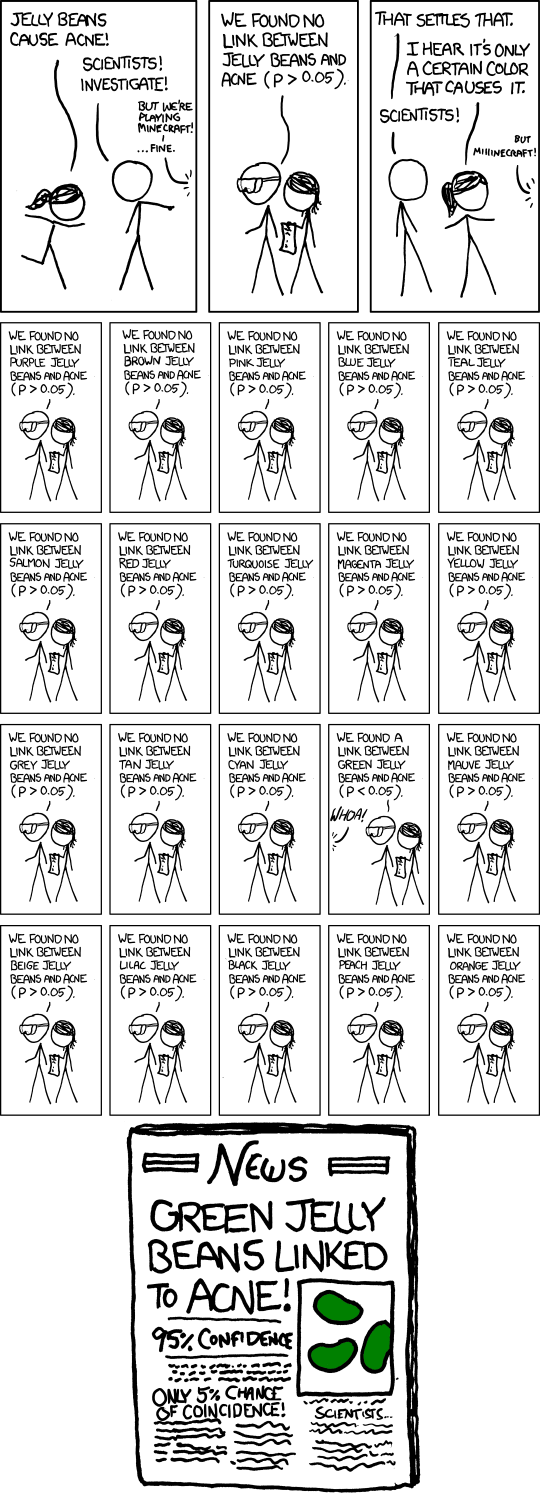
  • about ‘Significant’, the XKCD cartoon that illustrates the vulnerability of statistical significance testing.
  • do green jelly beans really cause acne? How significance tests can mislead with a fluke.
  • how a trading strategy based upon picking a portfolio of shares based upon the first letter of a ticker symbol showed that those tickers that began with the letter A outperformed other stocks.
  • how testing multiple times is effectively data mining and what should be done about it.
  • about the meaning of 95% confidence and 5% level of significance.
  • what a p-value is and why we ant it to be as small as possible.
  • if it’s important for the finance and economics profession to look at how other sciences are applying testing methods?
  • whether we need a tougher standard to lower the possibility of false discoveries?
  • if there is a chance of a fluke finding and why we should apply the Bonferroni multiple testing method solve this?
  • about the decay signature of the Higgs Boson and whether it is just background noise.
  • whether the findings of many published academic peer-reviewed papers are wrong.
  • about Type I and Type II errors and their trade-off.
  • about All Trials’ mission to make all randomised control trials made public.
  • the problems when measuring and using volatility in asset returns.
  • why the level of skew in a distribution must play more of an important role in risk management and portfolio selection.
  • why Taleb’s Black Swan only looks at one side of the distribution – the negative side, and why we must also look at the positive side.
  • how applying ‘regularization’ to portfolio selection avoids ‘over-fitting’ the data so that unexpected future outcomes can be considered.
  • about the efficient market hypothesis and the 316 anomalies that have been published to refute this hypothesis.
  • why the best traders are in Asia and how insider activity makes them so.
  • about the rise of crypto currencies and Bitcoin and why schools across US universities are introducing modules on it.
  • what is blockchain and why its is safe.
  • about the bank’s idea of creating a permission blockchain.

The Problem with Significance Testing and How to Solve It

If you’re trying to see if a variable Y is associated with a variable in a significant way, we usually think of looking at that correlation and determining whether you’re 95% confident that you’ve got it right. Usually what that means is that you’re 2 standard deviations away from zero. So, zero would be there’s no relation.

It turns out that that is perfectly acceptable if we’re looking at one correlation between Y and X. However, if it’s not X, it’s X1 you try. You try X2. You try X3, you try … X100. You try 100 different things. Then the criteria of using 2 standard deviations to have 95% confidence is just plain wrong.

The reason why this is wrong, is that when you’re running 100 tests, there is going to be a high probability that something will turn up that’s 2 standard deviations from zero just by chance.

The ‘Jelly Bean’ cartoon by XKCD called ‘Significant’ illustrates how testing a hypothesis can become misleading when conducting a significance test. The hypothesis being tested here is whether jelly beans causes acne.

A randomised control trial is ‘conducted’ by scientists. This is done where, say we have 50 people with jelly beans and 50 people with no jelly beans and we count the acne. And what basically happens is that there is no significance. So the scientists don’t achieve the 95% and conclude that there is no relation between jelly beans and acne.

However, the cartoon further illustrates what happens when the color of each jelly bean is tested to see if a particular color causes acne. 20 additional randomised control trials are conducted. The cartoon shows that the link between the Red Jelly Bean and acne is insignificant. Blue Jelly Bean – insignificant. Until you get to the last jelly bean, the 20th, which is the Green Jelly Bean. They find that there is a significant relation between Green Jelly Beans and acne. The final frame in the cartoon is a headline saying ‘Green Jelly Beans Linked to Acne’.

So, if you do 20 trials, one of those is likely to show up as significant using the standard criteria and it’s a fluke.

“The idea of my research is that we need to raise the bar that 2 standard deviations is no longer – that 2 sigma is no longer – something that should be considered. We need to go much higher.” – Professor Campbell Harvey

http://imgs.xkcd.com/comics/significant.png

The Bonferroni Multiple Testing Method

When we say that there is 95% confidence, we are saying that there is a 5% chance that the finding is a fluke. The 5% is called the p-value. What you would like is for that p-value to be as small as possible. You want as small as possible probability that the finding is a fluke. So the usual p-value for a single test with just X and Y for 5%, would imply 2 standard deviations. When you do multiple tests, you need more than 2 standard deviations from zero. If there is a chance of a fluke finding, then we should apply the Bonferroni multiple testing method solve this.

What the Bonferroni does is a simple correction. What it says is ‘you discover a p-value which is, say, 0.004 and you multiply by the number of things or X’s you’ve tried, which is, say, X1 to X100. All of a sudden, your p-value transforms to 0.4 or 40%. That means there is a 40% chance that in repeated trials that this thing you’ve identified, say X57, is a fluke. So when you use this adjustment, you discard that variable.

Quotes by Professor Campbell Harvey in Episode 56 of the Economic Rockstar Podcast:

In the practice of finance, some investment manager goes to a client and shows a great strategy and looks amazing. But they don’t tell the client or potential client that they tried 499 other possibilities and this is the only one out of 500 that worked – Professor Campbell Harvey. 

“Over half of what’s published in empirical asset pricing is probably incorrect” – Professor Campbell Harvey

Click To Tweet

“The problem with volatility is that it is a symmetric measure, that if you’re way above the average that contributes to the same volatility as if you’re way below the average” – Professor Campbell Harvey

“I’ve being pushing for the last 15 years to reform the way that we do our portfolio analysis, our standard models, to have the skew play a role.” – Professor Campbell Harvey

“It’s also a fact that it’s really hard to find any asset return that adheres to a normal distribution. If it does, it is very unusual.” – Professor Campbell Harvey

“What we want in economics and finance is repeatability.” – Professor Campbell Harvey

Click To Tweet

“I believe, just as Gene Fama believes, that markets are inefficient.” – Professor Campbell Harvey

Click To Tweet

“Blockchain provides a way to give unprecedented security. You’re immune effectively from this hacking.”

Click To Tweet

Books:

  • The New York Times Dictionary of Money and Investing: The Essential A-to-Z Guide to the Language of the New Market by Campbell Harvey and Gretchen Morgenson
  • The Black Swan by Nassim Taleb
  • The Ascent of Money by Neil Ferguson

Papers:

  • Evaluating Trading Strategies. by Campbell Harvey and Yan Lui
  • Where are the World’s Best Analysts? Campbell Harvey, Sam Radnor, Khalil Mohammed and William Ferreira
  • Conditional Skewness in Asset Pricing Tests. Campbell Harvey and Akhtar Siddique, Journal of Finance 55, (2000): 1263-1295. (P56)

Other Resources:

  • Garden of Econ podcast
  • Hypertextual Finance Glossary – Over 8,000 Entries and 18,000 Hyperlinks: The largest financial glossary on the Internet
  • The New York Times Dictionary of Money and Investing: The Essential A-to-Z Guide to the Language of the New Market by Campbell Harvey and Gretchen Morgenson

Websites:

  • www.alltrials.net

Where to Find Campbell: 

Website: Duke University

http://traffic.libsyn.com/economicrockstar/056_Harvey_Campbell_Final.mp3

Podcast: Play in new window | Download

037: Noah Smith on Austrian Theory Being a ‘Bad Joke’, Heterodox Models and Efficient Markets

June 18, 2015 by Frank

http://traffic.libsyn.com/economicrockstar/037_Noah_Smith.mp3
Play in New WindowDownload

037: Noah Smith on Austrian Theory Being a ‘Bad Joke’, Heterodox Models and Efficient Markets

Noah Smith is Assistant Professor of Finance at Stony Brook University, New York where he is also a member of the Center for Behavioral Noah SmithFinance research team. Noah’s research Interests include Experimental Finance, Behavioral Finance and Macroeconomics Noah was panel discussant for the Institute for New Economic Thinking Task Force and has received numerous research awards and fellowships. 

Noah is a regular contributor to Bloomberg View where he writes extensively on economics and finance related topics. He also writes at his fantastic economics blog Noahpinion.

Noah received his PhD in economics from the University of Michigan, graduating in 2012. His dissertation examined expectation formation in financial markets. Noah majored in physics as an undergraduate at Stanford University, and spent three years working in Japan, where he still returns from time to time to do research.

Everyone who meets in the public sphere, unless you’re extremely dry and technical, is going to piss people off. Econ is one of those fields where everyone has their own opinion and position and their models that they like. Traditionally, it was this very closed discipline. Econ was for economists and they didn’t often interface with the outside world except through official policy advice and the occasional op-ed. People start talking in the public sphere and I think that disturbs a lot of people. So all the blogs are bad boys really – Noah Smith.

Economics:

GDP, inflation, Central Bank, consumption, microeconomics, macroeconomics, behavioral economics, DSGE, game theory, decision theory, supply, demand, time series, interest rates, linear regression, forecasting, Quantitative Easing, money, gold, Federal Reserve, efficient markets hypothesis, extrapolative expectations, hedge funds, adverse selection, random walk, fat tails and volatility.

Economists:

Paul Samuelson, Brad DeLong, Steve Keen, Greg Mankiw, John H. Cochrane, Jack Schwager, Josh Angrist, Steve Pischke, Ed Phelps, Robert Lucas, Ed Prescott, Paul Volcker, Ludwig von Mises, Friedrich Hayek, Hyman Minsky, Andrei Schleifer, Alok Kumar, Kelly Schuh,  Jonathan Burke, Burton Malkiel, Marcus Brunnermeier, Mark Thoma, Tyler Cowen and Alex Tabarrok.

Find out:

  • whether economists suffer from ‘Physics Envy’.
  • if we should remove mathematics from economics.
  • how math took over economics.
  • if there is a connection between economics and physics.
  • how economics is becoming a more data-driven field.
  • about the micro foundations to macro theory and why these models don’t work.
  • why theory and math-focused economics papers are waning in the academic publishing field.
  • how to approach teaching micro and macro when the theoretical models may not explain much.
  • about whether Economics is moving away from the orthodox method of teaching toward a heterodox method.
  • about the difference between Heterodox and Orthodox teaching in Economics.
  • why Noah considers Austrian Economics to be a bad joke.
  • where Noah falls within the economic spectrum.
  • why Noah believes that heterodox economics is not the future.
  • Noah’s recommended economics blogs to follow.
  • why the Efficient Market Hypothesis is a good starting model for finance students to understand.
  • and much much more

Physics Envy and the Mathematisation of Economics:

At one point economics was a literary discipline. It was philosophical. It was people writing down verbal description of how they thought things worked. Then people started writing down equations. At first it was just a couple of people doing it who were obscure and then, with Paul Samuelson, they really started putting everything in terms of equations and mathematising everything. It was at that point people started to mention that economists had ‘Physics Envy’ because physicists write everything in equations. Maybe that was true as Samuelson had also studied Physics. This was probably a misnomer.

There were new mathematical tools and people were just trying to apply them to things. Math really took over economics and the style of math they did was sometimes similar to physics. Mathematicians are very rigorous. They start with axioms and they have this really formal proof structure. A physicists approach to working with equations is a lot more ad hoc and informal. So in economics, you see both styles. Noah doesn’t think there’s a lot of connection between economics and physics. He also doesn’t believe there is any particular pieces of math in economics that were inspired by physics.

Math helps you organise your thoughts. It makes your economic theory more internally consistent because math always has to work out perfectly and all the logic has to work out. But in practice it rarely does that. What usually happens is that people usually end up sticking in the assumptions they need to get the conclusions they want to see in the theories. So there’s essentially no discipline provided by math on theory, but math is useful when you want to get actual numbers.

Economics is becoming a more and more data-driven field. Now that we have information technology, we have so much data. We have macro data and industry-level data that we can keep track of with electronic records. Government can easily keep track of statistics on all kinds of variables on the economy. We have a lot more financial data. It is easier to get people surveyed so you have a lot more survey data. So you have huge amounts of data that is easily transferable and easily manipulatable in statistics programs. Economists are basically rolling in data. What we’ve seen from that is that data and empirics has become so much central  to the economics field in recent years. The number of published papers that are data and empiric-focused has soared, whereas the percent that is just theory and math-focused has gone down in the last twenty years.

On Teaching Micro and Macro When Theoretical Models Fail:

Economics is not data-free. You can use data to help you teach. But in terms of giving students a hands-on thing where they can predict some outcome something, well for lower-level students, there’s not much you can do. But for upper-level students there are some things you can do with linear regression that help you make a prediction or forecast. Certainly with graduate-level students you can do things with time series econometrics. Then you can have them make forecasts and see how well their forecasts come out. There’s things you can do but it doesn’t work as beautifully as it does in Physics – Noah Smith

Noah Smith on Why He Considers Austrian Economics to be a Bad Joke and Why Heterodox Economics is Not the Future:

The idea that economics is substantially divided between the orthodox and the heterodox is wrong. That’s just not the way it is. There’s only a very few people in the world who call themselves heterodox. For any science you’re going to get some people somewhere who are doing something totally different. There’s probably somebody out there using physics models that look nothing like quantum mechanics or Newton’s Laws or any of the core physics models we think of as real physics. There’s probably someone out there doing some model of a type you and I never heard of and will never hear of. And that’s basically what the heterodox economics guys are.

The people who call themselves heterodox in economics, include some people who are nakedly political. All they really are is political, well I could say hacks but they’re not paid by parties, but they’re trying to make economics into a politicised discipline. So, the most prominent group of these is people who call themselves Austrians.

There were these guys, called the Austrians, who wrote some ideas down. All of those ideas were later taken up by the mathematical economists and put into math language. Most were tested in some way. They were developed further on. But then what happened was there was a tribe of people who declared that all the mathematical economics was bullshit and that what we had to do was pay attention to the wisdom of the ‘Old Masters’. So they spend a lot of time reading the old wisdom of Mises and Hayek and those guys. And the only way this group could survive when economics itself had moved on was to take donations from political people who agree with their politics.

So they politicise themselves in order to survive. And in the wilderness where they deserve to be, their method of analysis they use are a joke. A lot of mainstream normal economics might also be a joke but the Austrian stuff is definitely a joke. And the problem is with the addition of politics to the mix, it really becomes a bad joke.

Most of what they do is advocating through their version of free markets or advocating for various conservative policies and politics. And that’s what they spend most of their time doing. It’s clear that what they really want to do is just turn economics into a mouthpiece for conservative ideas.

I haven’t spent hundreds of hours reading Mises because that would be robbing me of many many valuable hours of my life-span and I’m mortal and my life-span is ticking away and I can’t spend my time reading Mises. I’ve read a little bit. It was obviously silly. It was like reading Jacques Derrida.

It’s so dense and confusing and self-referential and full of neologisms and just, frankly, badly written that what it descends into this infinite recursion where you have people who read the ‘Old Master’ and write some interpretation of the ‘Old Master’ and then someone reads what that person wrote and mis-interprets that and then writes their own interpretation of that. Then you just have this infinite recurring commentary where nobody really knows what the hell anyone else is talking about and they all just sort of talk about their own distorted, twisted perception of what these other people talk about. It gives no insight and no understanding. People ‘parrot’ the words of the ‘Old Masters’ without understanding what the ‘Old Masters ‘ were necessarily meant or what those ideas would even imply.

If you criticise the ‘Old Masters’ or criticise this paradigm of relying on the ‘Old Masters’, They say “Oh, you have to go read everything the ‘Old Masters’ wrote before you are qualified to comment on this. How dare you comment on this when you haven’t read this and this and this. I’ve spent time reading this.” What do you say to that. That’s not scientific. That’s scholastic.

Sometimes you look at Minsky and you look at Hayek and you say these guys aren’t saying such different things after all actually. But the thing is you have the right-wingers in the modern day who think that Hayek and Mises are gods and left-wing guys who think Minsky is a god and they fight like cats and dogs.

The mere fact of these kind of battles is one thing that convinces me that so-called heterodox economics is not the future at all.

Austrians have a lot of blogs. They have a big mouth-piece; much bigger than their academic footprint. Austrians took a huge hit in 2011 and 2012. Those are absolute critical years for this sort of ‘pop-Austrianism’ that has become very popular on sites like zerohedge. All the Austrians are saying is the Fed is printing all this money doing Quantitative Easing. There’s going to be big inflation. And this never happened. That was like a thunderbolt that really discredited Austrians. They were saying things were going to happen by gold now. There was a gold bubble and gold is quite a bit off its peak. A lot of people lost some of their savings on that. People are not happy to lose their savings. If you bought gold collectibles in 2011, well you were a sad puppy when it crashed. That’s God’s punishment. That’s the market’s punishment anyway. It’s the markets punishment for making bets on silliness.

Where does Noah Fall within the Economic Spectrum:

I really don’t know. I suspect something that would look like demand is responsible for most recessions. And I suspect something that they call a limit cycle is going on where something in a boom actually causes a bust to become more likely. So booms lead to busts. Austrians said that, absolutely. The ‘Old Masters’ definitely said that and Minsky said that too – Noah Smith

Recommended Blogs:

  • Economists’ View by Mark Thoma
  • Marginal Revolution by Tyler Cowen and Alex Tabarrok
  • Grasping Reality by Brad DeLong

Recommended Book:

  • The Myth of the Rational Market by Justin Fox
http://traffic.libsyn.com/economicrockstar/037_Noah_Smith.mp3

Podcast: Play in new window | Download
Frank Conway

Frank Conway is founder of Economic Rockstar and lecturer of economics, finance and statistics. Read More…

View My Blog Posts

Youtube Sub

Become a Patron of the Economic Rockstar Podcast

patreon

Ireland’s Economy by the Numbers

Leaving Cert Economics: Ireland’s Economy  Click here to download a workbook on Ireland’s Economy so that you can add your own notes. [Original size] Ireland’s Economy by fconway

Categories

Subscribe and Never Miss An Episode

itunes-logo

Recent Posts

  • Ireland’s Economy by the Numbers April 8, 2019
  • 174: Wendy Carlin on The Core Project, Capitalism, Democracy and Normative Statements February 13, 2019
  • 173: Stephen Wright on Core Econ as a Learning Resource for Mainstream Economics January 28, 2019
  • 172: Best of 2018 Part 2: From the Great Depression to Futurism; Institutions, Individualism, Cooperation and Reciprocity January 22, 2019
  • 171: Best of 2018 Part 1 January 3, 2019

Copyright © 2026 · Podcast Pro Theme on Genesis Framework · WordPress · Log in

This website uses cookies to improve your experience. We'll assume you're ok with this, but you can opt-out if you wish. Accept Reject Read More
Privacy Policy

Privacy Overview

This website uses cookies to improve your experience while you navigate through the website. Out of these, the cookies that are categorized as necessary are stored on your browser as they are essential for the working of basic functionalities of the website. We also use third-party cookies that help us analyze and understand how you use this website. These cookies will be stored in your browser only with your consent. You also have the option to opt-out of these cookies. But opting out of some of these cookies may affect your browsing experience.
Necessary
Always Enabled
Necessary cookies are absolutely essential for the website to function properly. This category only includes cookies that ensures basic functionalities and security features of the website. These cookies do not store any personal information.
Non-necessary
Any cookies that may not be particularly necessary for the website to function and is used specifically to collect user personal data via analytics, ads, other embedded contents are termed as non-necessary cookies. It is mandatory to procure user consent prior to running these cookies on your website.
SAVE & ACCEPT