• ABOUT
  • RESOURCES
  • PODCAST
  • BOOKS
  • BLOG
  • SUPPORTERS
  • QFA Financial Advice
  • CONTACT

Economic Rockstar

Connecting Brilliant Minds in Economics and Finance

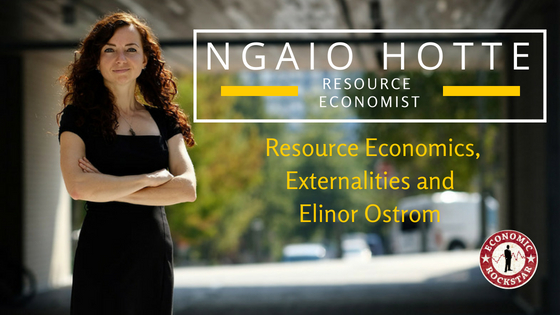
147: Ngaio Hotte on Resource Economics, Externalities and Elinor Ostrom
July 8, 2018 by Frank

http://traffic.libsyn.com/economicrockstar/147_Ngaio_Hotte_Final.mp3
Play in New WindowDownload

147: Ngaio Hotte on Resource Economics, Externalities and Elinor Ostrom


Ngaio Hotte is co-founder of the consultancy firm Resource Economics Group, which is based in British Columbia in Canada. Resource Economics Group specializes in natural resources policy, planning and management. They do research and support decision-making related to the many values of natural resources and trade-offs associated with managing these values for the benefit of people and the planet.

Ngaio is a Ph.D candidate at the University of British Columbia. Her research title is ‘How can trust be built among parties engaged in collaborative natural resource governance?’ and she draws influence from the work of the only female Nobel laureate in economics, Elinor Ostrom.

Ngaio’s Research Interests include trust, government-to-government relations, Indigenous communities, collaboration and natural resources and we touch on some of these topics in out conversation in this episode.

You can find out more about Ngaio’s work at www.resource-economics.ca.

Economics:

In this episode, Ngaio mentions and/or discusses: Elasticity of demand, externalities, substitutes, meat tax, carbon tax, resource extraction, resource management, tanker spills, New Institutional Economics, game theory, private ownership, the Tragedy of the Commons, the Broken Window Fallacy, reciprocity, trust and self-interest. 

Economists:

This episode mentions and/or discusses: Elinor Ostrom, Garrett Harden (Tragedy of the Commons), Donald J. Boudreaux, Cameron Murray, Jason Shogren and Herbert Gintis.

  • What is an externality and examples of negative and positive externalities.
  • The market value for the pollination that is created by the honey bees – people will pay bee keepers to bring their hives to certain areas so that they can pollinate the plants.
  • Addressing the negative externality of oil spillages using a carbon tax.
  • The Broken Window Fallacy.
  • Is it better for the environment and for the minimisation of pollution to have the private ownership rather than the public ownership of lands and waters?
  • Collective action by Elinor Ostrom.
  • Crack Gardens in Tokyo and Guerrilla Gardening in parkways between sidewalks and parking spots.
  • Ron Finley: Gangsta Gardener for the Urban Community– all in search for organic apples nearby and failed.
  • How tax breaks in Vancouver can beautify the landscape and generate positive externalities.
  • Writing advice.

Papers:

  • Hotte, N. and U. Rashid Sumaila, (2014). How much could a tanker spill cost British Columbians? Environment, Development and Sustainability, February 2014, Volume 16, Issue 1, pp 159–180.
  • Garrett Harden (1968). The Tragedy of the Commons. Science, New Series, Vol. 162, No. 3859 (Dec. 13, 1968), pp. 1243-1248 

Organisations:

  • Resource Economics Group: Check out the list of projects, op-eds and articles written by Ngaio Hotte here.
  • Shifting Growth

Other Links:

  • Hotte, N. (November 2, 2015). Urban forestry and the greening of Canadian cities. Spacing.

  • Nobel Speech by Elinor Ostrom: Beyond Markets and States: Polycentric Governance of Complex Economic Systems

  • Ostrom’s the Movie: Elinor Ostrom’s Governing the Commons and the Cooperative Enterprise Movement by Barbara Allen

  • Ron Finley: Gangsta Gardener for the Urban Community: www.ronfinley.com
  • TED: Ron Finley A guerilla gardener in South Central LA

Books:

  • Governing the Commons: The Evolution of Institutions for Collective Action by Elinor Ostrom

Patreon:

If you’re a fan of the podcast and would like to show your support in anyway, please check out my Patreon page at www.patreon.com/economicrockstar where you can sign up for any of the awards for as little as $1 a month or you can simply follow me on the Economic Rockstar Facebook page or on Twitter or simply recommend the show to a friend, especially if they have never had the opportunity to study economics.

http://traffic.libsyn.com/economicrockstar/147_Ngaio_Hotte_Final.mp3

Podcast: Play in new window | Download

114: Deirdre McCloskey on Equality and Greed and How To Be a Very Good Economist

December 2, 2016 by Frank

http://traffic.libsyn.com/economicrockstar/114_Deirdre_McCloskey_Final.mp3
Play in New WindowDownload

114: Deirdre McCloskey on Equality and Greed and How To Be a Very Good Economist

Deirdre McCloskey taught at the University of Illinois at Chicago and was a Distinguished Professor of Economics, History, English, and Communication.

She was also adjunct professor of Philosophy and Classics there, and for five years was a visiting Professor of philosophy at Erasmus University in Rotterdam.

Since October 2007 Deirdre has received six honorary doctorates. In 2013, she received the Julian L. Simon Memorial Award from the Competitive Enterprise Institute for her work examining factors in history that led to advancement in human achievement and prosperity.

Deirdre’s main research interests include the origins of the modern world, the misuse of statistical significance in economics and other sciences, and the study of capitalism, among many others.

Deirdre has written 17 books and around 400 scholarly pieces on topics ranging from technical economics and statistical theory to transgender advocacy and the ethics of the bourgeois virtues.

Her latest book, Bourgeois Equality: How Ideas, Not Capital or Institutions, Enriched the World is part of the Bourgeois Era trilogy described as an “apology” for capitalism.

Deirdre describes herself as a “post-modern, quantitative, free-market, feminist, Episcopalian, Midwestern, gender-crossing, literary woman”.

Deirdre’s website deirdremccloskey.org contains information and links to her books, articles, interviews and much more.

Economics:

In this episode, Deirdre discusses and mentions: blackboard economics, poverty, game theory, inequality, education, healthcare, economic growth, trade, production possibility frontier, gains from trade, liberty, greed, equality, utility maximisation, covered interest arbitrage, theory of marriage.

Economists:

In this episode, Deirdre discusses and mentions: Adam Smith, John Mayanrd Keynes, Karl Marx, David Hume, Gary Becker, Shoshana Grossbard, Nancy Folbre, Herbert Gintis, Jonathan McEvoy, Sam Bowles, Nassim Taleb, Paul Samuelson, Kenneth Arrow, Thomas Piketty, Joseph Schumpeter and David Ricardo.

On the Economics Discipline:

“It’s not to soften the science. It’s to harden the science. We’ve got to stop talking about this softening. That’s not going to persuade the guys to take this stuff seriously. It’s harder to do it correctly than to do it by going on and on with Game Theory and Max. U. As Keynes said ‘A person who is only an economist is not going to be a very good economist’. And I think that’s correct. You need to be a statistician and a mathematician of course and I’m not against that. But you also need to be a historian and a philosopher and a sociologist and a psychologist and a serious person who knows the world. And the way we know the world is mainly through the humanities, through theology, through religion, through novels. through poetry, song, country music where the river meets the road. It’s through films, through gossip, through going to a football game with their mates. That’s how we learn how societies really work. And it’s harder to bring that to bare our human experience into the economic science. But to get a good economic science, and like any thoughtful person agrees, you have to have all of that.” – Deirdre McCloskey

On Greed and Envy:

“Greed is a corrosive sin. Greed is the sin of the conservatives and envy is the sin of the socialists. And both of them is corrosive of the human soul. What happens in both greed and envy is that possessions, if you allow me I am a Christian,  take the place of God or to take the place, to put it more generally, of some dignified transcendent outside yourself. Both of them are selfish.”  – Deirdre McCloskey

On Liberalism:

“Liberalism is under attack everywhere, this populism that we see all over the place is anti-liberal above all. But I believe on the long run all societies will become liberal democracies. And the reason is the incredible magnitude of the economic gain from adopting liberal policies as in Singapore, as in Hong Kong, as in South Korea andTaiwan, as in Botswana, as in most spectacularity China and India. And then, if I can persuade people, in the longer sweep of history I make the point of Holland in the 17th century and England and Scotland in the 18th in the New World. And this liberal experiment that we engaged in then and is being repeated now in China and India is so productive that I think that it will win in the end.”  – Deirdre McCloskey

People Mentioned in this Episode:

  • Lillian Bettencourt 
  • The Clancy Brothers 
  • St Thomas Aquinas

Writing Tips:

  • Put pen to paper and keep going. – Deirdre McCloskey
  • Read Deirdre’s book Economical Writing for amazing writing tips for economists.

Recommended Books:

  • Economical Writing by Deirdre McCloskey
  • Crossing: A Memoir by Deirdre McCloskey


http://traffic.libsyn.com/economicrockstar/114_Deirdre_McCloskey_Final.mp3

Podcast: Play in new window | Download
110: Beatrice Cherrier on the Economics of ‘The Wire’ and the Beginning of Economics at MIT

November 4, 2016 by Frank

http://traffic.libsyn.com/economicrockstar/110_Beatrice_Cherrier_Final.mp3
Play in New WindowDownload

economics-of-the-wire

110: Beatrice Cherrier on the Economics of ‘The Wire’ and the Beginning of Economics at MIT

Beatrice Cherrier is an assistant professor at the University of Caen, France.

Professor Cherrier’s research includes the history of postwar economics and how economists’ individual visions combine in collective “styles” of doing economics.

Her current research project is aimed at understanding the rise of applied economics from the mid-1960s onwards.

Beatrice is affiliated with CREM, the Centre for Research in Economics and Management, where she researches alongside social choice theorists.

She teaches in a urban studies department, and is experimenting on her students to figure out how to get non-economists interested in the “dismal” science.

Professor Cherrier blogs on her personal website beatricecherrier.wordpress.com as well as for the Institute for New Economic Thinking.

These students have to understand economics, but not in the way of how to use it. You have to understand why they get that course and how they approach social science. For example urban study students work on the field all of the time, so introducing them to economics with a load of statistics is not the right way. They just won’t get it. They want tools to go into the field and to make sense of social behaviour. The solution is to bring the field into the classroom. The Wire is a great way to analyse these social behaviours, particularly in the city – Professor Beatrice Cherrier.

Economics:

In this episode, Beatrice discusses and mentions: Supply and demand, game theory, cooperation, prisoners dilemma, rationality, experimental economics, sunspots, monetary policy, animal spirits and bibliometric analysis.

Economists:

In this episode, Beatrice discusses and mentions: Kevin Hoover, Berger, Robert Solow, Paul Samuelson, John Maynard Keynes, John Hicks, Edward Prescott, Hanson, F. A. Hayek, Angus Deaton, Arthur Charpentier, Vernon Smith, Paul Krugman, Brad DeLong, Paul Romer, Franco Modigliani and Herbert Simon.

In this episode you will learn:

  • how to teach economics to non-economic students.
  • how to model the drug market using ‘The Wire‘ as a social analysis.
  • using The Wire as a tool to teach economics.
  • where is the rationality in gang warfare.
  • the benefits of using pop culture to teach economics.
  • the beginning of economics at MIT.
  • whether Samuelson and Solow ‘invented’ the economics we know today through their mathematics?
  • on the computerisation of economics using big data.
  • the evolution of economics.
  • the history of experimental economics.
  • and much much more.

Writing Tips:

  • “Writing has never been my strength. It’s the part of my job I don’t like.”
  • Do it. To force yourself to do it you have to do it publicly.
  • Write in a smaller format to try to put your ideas together and be convincing.
  • Blog.
  • Do not write for a public audience but rather write in public. If you put this stuff that you’re thinking online, you have to be better at organising your ideas even if you don’t like that.
  • “My tip is really for people who don’t like writing. Write on a blog because you can write small, it’s not consequential. Maybe people will read you and give you tips and you’re going to improve yourself.”

Links:

  • Introductory Economics for the Real World: Lessons from Teaching with “The Wire” TV Show by Beatrice Cherrier
  • The Most Intolerant Wins: The Dictatorship of the Small Minority by N. N. Taleb on Medium
  • The Wire
  • Breaking Bad
  • The Walking Dead
  • Russell-Sage Foundation
  • Freakonomics
  • Freakonometrics

Recommended Books:

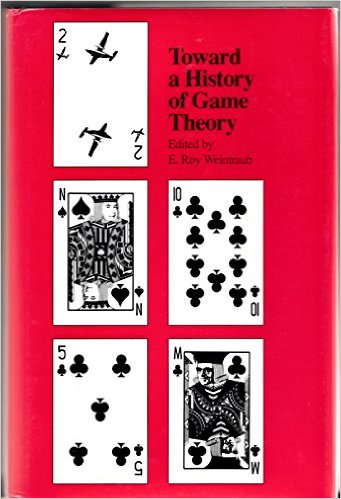
  • Toward a History of Game Theory by E. Roy Weintraub

toward-a-history-of-game-theory-economic-rockstar

http://traffic.libsyn.com/economicrockstar/110_Beatrice_Cherrier_Final.mp3

Podcast: Play in new window | Download

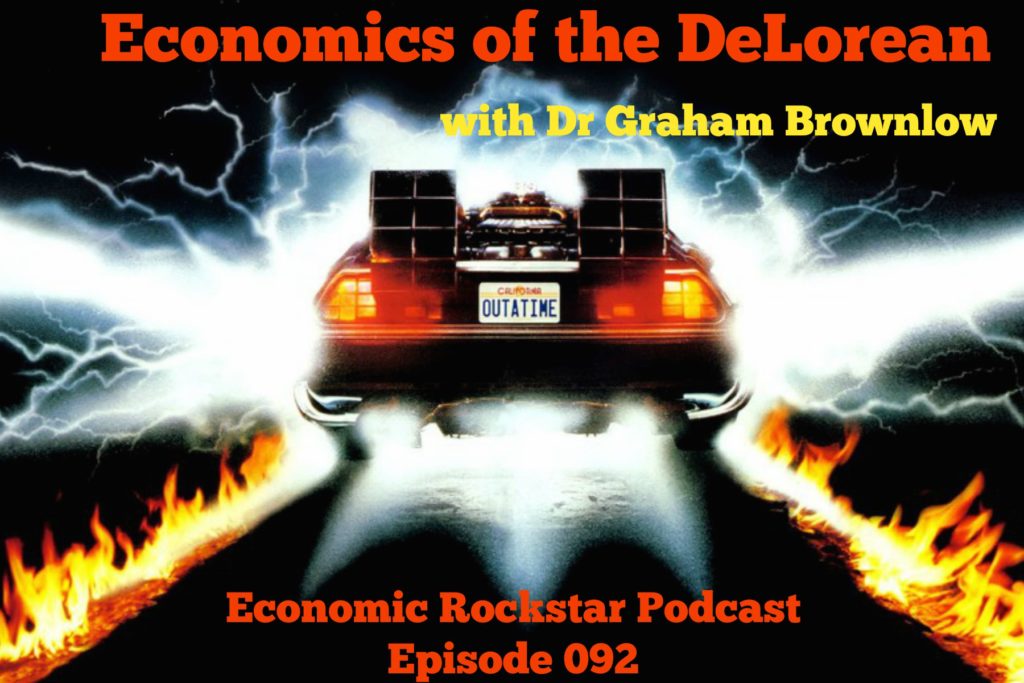
092: Graham Brownlow on Rent Seeking, Cliometrics and the Economics of the DeLorean

June 30, 2016 by Frank

http://traffic.libsyn.com/economicrockstar/092_Graham_Brownlow_Final.mp3
Play in New WindowDownload

092: Graham Brownlow on Rent Seeking, Cliometrics and the Economics of the DeLorean

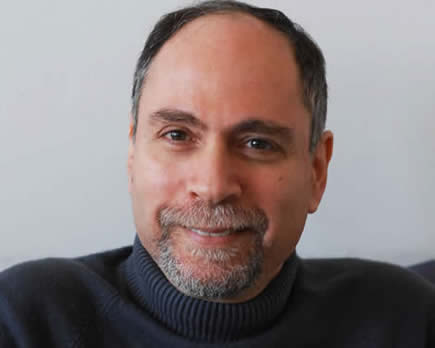
Dr. Graham Brownlow (PhD, QUB) is a Lecturer in Economics at Queen’s University in Belfast, Northern Ireland.Graham Brownlow Economic Rockstar

Dr. Brownlow’s research focuses primarily on economic history and institutions, evolutionary economics, Irish economic and business performance and violence. He also has an interest in methodology in economic and business history.

Graham edits the journal Irish Economic and Social History.

I’m very eclectic and pragmatic – Dr. Graham Brownlow

Economics:

In this episode, Graham mentions: rent seeking, cliometrics, inefficiency, corruption, institutions, subsidies, Brexit, monopolies, sharing economy, fast money, game theory, bargaining, public choice, regional economics and economic history. 

Economists:

In this episode, Graham mentions: Peter Boettke, Peter Leeson, Gary Becker, William Baumal, Douglass North, Robert Hamilton, Eli Hecksher, Adam Smith, John Maynard Keynes, Joseph Schumpeter, Friedrich Hayek, Milton Friedman, George Duncan, Tim Harford, Steven Landsburg and G. L. S. Shackle.

Using Analytic Narratives in Economic Research

Looking to balance the details of fact and yet keep the rigour of an economic model – Graham Brownlow

  1. Identify the problem or puzzle.
  2. Immerse yourself in the topic or resources.
  3. Move to more formal aspects.
  4. Don’t start with the model and then use it to explain your findings.
  5. You actually first look at the historical issue under investigation and then apply it to the model.

Links:

  • Mont Pelerin Society

Research by Dr. Graham Brownlow:

  • Back to the Failure: An Analytic Narrative of the De Lorean Debacle (2015).
  • Soft Budget Constraints and Regional Industrial Policy: Reinterpreting the Rise and Fall of De Lorean (2015).
  • ‘Review of Cullen Economy, Trade and Irish Merchants at Home and Abroad, 1600-1988’ (2013).
  • How do we Ensure a Useful Future for Irish Cliometrics? (2012).
  • A complete list of Graham’s research can be found here.

Economics of the DeLorean Economic Rockstar

Where to Find Graham:

  • Queen’s University, Belfast, Northern Ireland
  • Twitter: @GrahamBrownlow

Books:

  • The Undercover Economist by Tim Harford
  • The Undercover Economist Strikes Back: How to Run – or Ruin – an Economy by Tim Harford

  • The Undercover Economist, Revised and Updated Edition: Exposing Why the Rich Are Rich, the Poor Are Poor – and Why You Can Never Buy a Decent Used Car! by Tim Harford
  • The Logic of Life: The Rational Economics of an Irrational World by Tim Harford
  • Adapt: Why Success Always Starts with Failure by Tim Harford
  • Messy: The Power of Disorder to Transform Our Lives by Tim Harford
  • The Armchair Economist: Economics and Everyday Life by Steven Landsburg
  • Economics for Pleasure by G. L. S. Shackle
  • The New Geography of Jobs by Enrico Moretti


http://traffic.libsyn.com/economicrockstar/092_Graham_Brownlow_Final.mp3

Podcast: Play in new window | Download

057: Alvin Roth on Match-Making, Repugnant Markets and Market Design

November 5, 2015 by Frank

http://traffic.libsyn.com/economicrockstar/057_Alvin_Roth_Final.mp3
Play in New WindowDownload

057: Alvin Roth on Match-Making, Repugnant Markets and Market Design

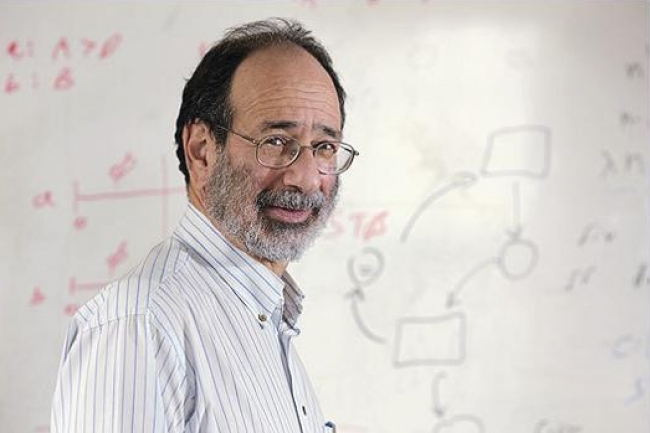
Alvin Roth is the Craig and Susan McCaw Professor of Economics at Stanford University.Alvin Roth

Professor Roth has made significant contributions to the fields of game theory, experimental economics and market design and is known for his emphasis on applying economic theory to solutions for “real-world” problems.

In 2012, Alvin won the Nobel Memorial Prize in Economic Sciences jointly with Lloyd Shapley “for the theory of stable allocations and the practice of market design.”

Alvin Roth has a B.S form Columbia University,  and earned his MS and Ph.D. from Stanford University.

Alvin’s latest book Who Gets What and Why: The New Economics of Matchmaking and Market Design is now available on Amazon.

Economics:

In this interview, Alvin mentions: money, barter, matching markets, supply, demand, price discovery, labor markets, marriage markets, market design, double coincidence of wants, property rights and game theory.

Economists:

In this interview, Alvin mentions: Gary Becker, Christien Exley, Lloyd Shapley, David Gayle, Herb Scarf, Hal R. Varian,  Preston McAfee, Fuhito Kojima, Muriel Niederle, Paul Milgrom, John Levin, Ilya Segal and Oskar Morgenstern.

In this episode you will learn:

  • what economics is and if we need money to allow a market to operate efficiently.
  • about the price discovery process in economics.
  • what is match-making markets and how similar the labor market is to the dating market.
  • what is market design and why it is important.
  • how entrepreneurs and start-ups, like Airbnb and Uber, use market failure to solve a problem.
  • what is a repugnant market.
  • the difference between a thick and a thin market.
  • what makes a market thick.
  • about the black market for kidneys.
  • how kidney exchange works.
  • about the double coincidence of wants in the kidney exchange market.
  • about the problem in the market for water in California.
  • some of the unintended consequences from the war on drugs.

Books:

  • Who Gets What and Why: The New Economics of Matchmaking and Market Design by Alvin Roth
  • Thinking, Fast and Slow by Daniel Kahneman
  • Theory of Games in Economic Behaviour by John von Neumann and Oskar Morgenstern

Papers:

  • Gayle, D. and L. Shapley (1962). College Admissions and the Stability of Marriage, The American Mathematical Monthly, Vol. 69, No. 1, pp: 9 – 15.  
  • Scarf, H. and L. Shapley. (1974). On Cores and Indivisibility. Journal of Mathematical Economics 1: 23-37.

Websites Mentioned in this Episode:

  • Market Design: Alvin Roth’s blog
  • Angel Flight: People Helping People in Need
http://traffic.libsyn.com/economicrockstar/057_Alvin_Roth_Final.mp3

Podcast: Play in new window | Download

051: Eyal Winter on How Excessive Giving Ensures the Survival of the Human Race and on the Beautiful Mind of John Nash

September 23, 2015 by Frank

http://traffic.libsyn.com/economicrockstar/Eyal_Winter_Final.mp3
Play in New WindowDownload

051: Eyal Winter on How Excessive Giving Ensures the Survival of the Human Race and on the Beautiful Mind of John Nash

eyal winter

Eyal Winter is the Silverzweig Professor of Economics at the Hebrew University and Economics Professor at Leicester University.

He is a member and a former director of the Center for the Study of Rationality, an elected council member of the International Game Theory Society and an elected fellow of the Economic Theory Society.

Eyal was awarded the Humboldt Prize for excellence in research by the German government in 2010. He has presented his work in more than 120 research institutes in 26 countries around the world including Harvard, Stanford, Princeton, Berkeley, Cambridge, and Oxford.

Eyal’s book Feeling Smart: Why our Emotions are More Rational Than We Think was published in January 2015.

Eyal graduated from the Hebrew University of Jerusalem in Mathematics, Statistics and Economics before going on to study his doctorate in Game Theory.

In this episode you will learn:

  • if there is a link between game theory and behavioral economics.
  • how the perceptions of human behaviour vary greatly across all disciplines.
  • if there is a need to have divisions in universities regarding the disciplines being taught.
  • how we can use emotion in a strategic way to make us better off.
  • why human evolution has not removed emotion if it’s considered a hindrance in economics.
  • the importance of training your rationality and emotions to work together.
  • why you should look at something from an outsiders perspective when dealing with an emotional situation.
  • how anger can be an emotion that can make you financially better off.
  • why love, empathy and sympathy can make you better-off in the way how other people treat us.
  • what Eyal Winter means when he says that there is logic in emotion and emotion in logic.
  • how subjective information is more powerful than evidence-based information.
  • why intuition should be taken into consideration in the decision-making process rather than using evidence alone.
  • why you should invoke your rationality into the decision-making process rather than rely on your gut instinct.
  • how game theory is not always about choosing the most optimal outcome for an individual.
  • how we can learn why humans give excessively by observing the behavior of ants and bees.
  • about the incentives of suicide bombers and why their behavior is not irrational if you think about their community.
  • why we treat each other much better than we treat animals.
  • about the incentive to donate and how mixed ethnic communities donate less than more homogenous communities.
  • why the Scandinavian countries are willing to pay the highest taxes and yet have the lowest tax evasion in the world.
  • why it was fascinating yet frustrating for Eyal Winter when he met John Nash.
  • why John Nash developed the Nash Equilibrium to reflect his own way of dealing with people and situations.
  • if we can change people’s behaviour with incentives or social pressure.
  • whether children have a higher emotional intelligence than adults.
  • if seeing a comedian live would be better than seeing your doctor if you feel sad.
  • whether employees should be subjected to ‘Emotional Labor’ by their employers.

Influencers:

Nobel Laureate Bob Aumann

Economics:

In this interview, Eyal mentions: game theory, rationality, irrationality, human behavior, donations, incentives,

Economists:

In this interview, Eyal mentions: Herbert Gintis, Bob Aumann and John Nash.

Personal Habits:

Play Guitar – Traditional Israeli songs and rock, listens to classical music and travel.

“The human race has only one effective weapon, and that is laughter.” -Mark Twain

Click To Tweet

Books:

  • Feeling Smart: Why our Emotions are More Rational Than We Think by Eyal Winter
  • Mapping Human History: Genes, Race and Our Common Origins by Stephen Olson

Resources:

  • Psychology Today 
  • Haaretz Newspaper 

Song:

  • The Famous Blue Raincoat by Leonard Cohen sung by Professor Eyal Winter
http://traffic.libsyn.com/economicrockstar/Eyal_Winter_Final.mp3

Podcast: Play in new window | Download

043: Herbert Gintis on Game Theory and the Multidisciplinary Approach to Understanding Human Behavior

July 30, 2015 by Frank

http://traffic.libsyn.com/economicrockstar/043_Herbert_Gintis_Final.mp3
Play in New WindowDownload

043: Herbert Gintis on Game Theory and the Multidisciplinary Approach to Understanding Human Behavior

Herbert Gintis is Emeritus Professor of Economics at University of Massachusetts and visiting Professor at Central European University.Herbert Gintis

He is known for his theoretical contributions to sociobiology, especially altruism, cooperation, epistemic game theory and gene-culture co-evolution.

Herbert has a B.A and M.A in Mathematics but switched his PhD program at Harvard from mathematics to economics.

Professor Gintis was part of a group of economists who developed their ideas on a new economics which encompassed issues of alienation of labor, racism, sexism, and imperialism.

Herbert has worked extensively with economist Samuel Bowles, writing their landmark book, Schooling in Capitalist America.

One of Herbert’s latest books The Bounds of Reason emphasises the unification of economic theory with sociobiology and other behavioral sciences which, in the words of Nobel Prize-winning economist, Vernon L. Smith, “is firmly in the revolutionary tradition of David Hume (Convention) and Adam Smith (Sympathy)”.

In the episode you will learn:

  • about the importance of trans-disciplinary research and the importance of collaboration with other disciplines.
  • why economics is not the only social science that explains human behavior.
  • how biology, economics and sociology explain the behaviour of humans in different ways and which discipline is correct?
  • about the Ultimatum Game and how it shows the cooperative and non-cooperative behaviour of humans.
  • about the morality of humans and how we reciprocate kindness with kindness and unkindness with unkindness.
  • why reciprocity makes humans so successful as a species.
  • why some species have a symbiotic relationship with other species which is not the same as reciprocity.
  • how we can fit all the human feelings together to form a multi-disciplinary approach to understanding human behavior.
  • why we always need a system to punish free-riders and non-cooperators.
  • how the future structure of the University can be seen at Arizona State University today.
  • why we need a new generation of thinkers and research centres who are trans-disciplinary.
  • what projects Professor Herbert Gintis is working on right now.
  • why morality controls politics and your vote will not make a difference.
  • how Herbert gets things done in terms of writing books and journal articles.
  • why Herbert did not like The Black Swan by Nassim Nicholas Taleb.
  • about Herbert’s disagreement with Nassim Nicholas Taleb.
  • why Herbert believes that macroeconomics is wrong and is in agreement with Taleb on that issue.
  • the goal of economic policy is not to predict but to put in place economic and social policies that prevent really bad outcomes.

Influencers:

Kenneth Arrow, John Maynard Keynes, Adam Smith and Albert Einstein.

Economics:

In this interview, Herbert mentions and discusses: Marx, rationality, game theory, rational actor model, experimental economics, prisoners dilemma, the ultimatum game, labor market, reciprocity and morality.

Economists:

In this interview, Herbert mentions and discusses: Vernon Smith, Samuel Bowles, Ernst Fehr, Kenneth Arrow and Nassim Nicholas Taleb.

On Math Being the Core Link to Multi-Disciplinary Knowledge:

“It’s really hard in the Behavioral Sciences to get too close to any one thinker because they’re all tainted by disciplinarianism. We need a new generation of thinkers who really think in all of these disciplines at the same time. As long as you can do the math. If you can’t do the math, you can’t do economics or you can’t do biology. If you can do the math, and you know statistics, there’s no reason why you shouldn’t know all of the fields. We need a generation of people who do that. The reason it’s possible now is the internet. Now, there’s no reason for disciplinary isolation. I think the next generation of behavioral scientists is going to much more broad”.

Arizona State: The Next Generation University… Today

Arizona State University is organised trans-disciplinarily. They don’t have traditional disciplines. They have subject areas depending on who asks questions and subject areas there from all sorts of disciplines. Herbert Gintis believes that’s what the future is going to be like, where you abandon the disciplines and add new research centres based on asking questions like climate change, cooperation, epidemiology, warfare, political structure, etc. And then you just hire people who can do that and talk to each other. It is exciting. It will happen. But it will take a long time because the whole organisation of the university is in terms of disciplines.

All of the real advances in the Behavioral Sciences fall in between the disciplines. It requires you do it all at the same time. it’s likely that at the forefront of change in the Behavioral Sciences will be funding organisations, governmental organisations like the NFF in the United States and the ESF in Europe. 

Quotes by Professor Gintis in Episode 043 of the Economic Rockstar Podcast:

Disciplines are almost like a feudal fiefdom. So it’s very hard to do trans-disciplinary research but that’s where all the real action is these days. Not only in behavioral science but in natural science – Herbert Gintis.

As far as I’m concerned, all of life is game theory. It’s the interaction of strategic interaction of individuals of all discipline species and types and races. So game theory comes first – Herbert Gintis.

Human success is not based on selfishness. It’s based on our ability to cooperate – Herbert Gintis.

Click To Tweet

“The real enemy of understanding humans is the notion that we’re all selfish. It’s just not true – Herbert Gintis

To do creative work, you have to have time. Once you have time, you get a lot of work done – Herbert Gintis.

“What I like to do most in the world is to read and write. That’s what I do” – Herbert Gintis.

“I did not like The Black Swan at all. It made fun of science. It made fun of statistics. It capitalised on a unique event, the financial crisis of 2008, and he used it to say economics is a bunch of crap. I think that’s just a bad mistake and I had some run-ins with him on the web. He thinks that science is about prediction. Now prediction is important but that’s not what science is about. It’s about expectation” – Herbert Gintis.

Projects Herbert Gintis is Working on Right Now:

Non-consequential behaviour in politics: 

“People participate politically even when they don’t make any difference. In all English-speaking countries, no election with more then 40,000 voters has ever been won by one vote. Meaning that no individual has ever made a difference in a political booth. Political structures are moral structures and they don’t necessarily reflect particular self-interest concerns” – Herbert Gintis.

Resources:

  • Herbert created his own word processor and uses LaTex for mathematical equations.
  • The Web.
  • Evernote
  • Scrivener

Recommended Books:

  • The Bounds of Reason: Game Theory and the Unification of the Behavioral Sciences by Herbert Gintis
  • A Cooperative Species: Human Reciprocity and Its Evolution by Samuel Bowles and Herbert Gintis
  • Schooling in Capitalist America: Educational Reform and the Contradictions of Economic Life by Samuel Bowles and Herbert Gintis
http://traffic.libsyn.com/economicrockstar/043_Herbert_Gintis_Final.mp3

Podcast: Play in new window | Download

037: Noah Smith on Austrian Theory Being a ‘Bad Joke’, Heterodox Models and Efficient Markets

June 18, 2015 by Frank

http://traffic.libsyn.com/economicrockstar/037_Noah_Smith.mp3
Play in New WindowDownload

037: Noah Smith on Austrian Theory Being a ‘Bad Joke’, Heterodox Models and Efficient Markets

Noah Smith is Assistant Professor of Finance at Stony Brook University, New York where he is also a member of the Center for Behavioral Noah SmithFinance research team. Noah’s research Interests include Experimental Finance, Behavioral Finance and Macroeconomics Noah was panel discussant for the Institute for New Economic Thinking Task Force and has received numerous research awards and fellowships. 

Noah is a regular contributor to Bloomberg View where he writes extensively on economics and finance related topics. He also writes at his fantastic economics blog Noahpinion.

Noah received his PhD in economics from the University of Michigan, graduating in 2012. His dissertation examined expectation formation in financial markets. Noah majored in physics as an undergraduate at Stanford University, and spent three years working in Japan, where he still returns from time to time to do research.

Everyone who meets in the public sphere, unless you’re extremely dry and technical, is going to piss people off. Econ is one of those fields where everyone has their own opinion and position and their models that they like. Traditionally, it was this very closed discipline. Econ was for economists and they didn’t often interface with the outside world except through official policy advice and the occasional op-ed. People start talking in the public sphere and I think that disturbs a lot of people. So all the blogs are bad boys really – Noah Smith.

Economics:

GDP, inflation, Central Bank, consumption, microeconomics, macroeconomics, behavioral economics, DSGE, game theory, decision theory, supply, demand, time series, interest rates, linear regression, forecasting, Quantitative Easing, money, gold, Federal Reserve, efficient markets hypothesis, extrapolative expectations, hedge funds, adverse selection, random walk, fat tails and volatility.

Economists:

Paul Samuelson, Brad DeLong, Steve Keen, Greg Mankiw, John H. Cochrane, Jack Schwager, Josh Angrist, Steve Pischke, Ed Phelps, Robert Lucas, Ed Prescott, Paul Volcker, Ludwig von Mises, Friedrich Hayek, Hyman Minsky, Andrei Schleifer, Alok Kumar, Kelly Schuh,  Jonathan Burke, Burton Malkiel, Marcus Brunnermeier, Mark Thoma, Tyler Cowen and Alex Tabarrok.

Find out:

  • whether economists suffer from ‘Physics Envy’.
  • if we should remove mathematics from economics.
  • how math took over economics.
  • if there is a connection between economics and physics.
  • how economics is becoming a more data-driven field.
  • about the micro foundations to macro theory and why these models don’t work.
  • why theory and math-focused economics papers are waning in the academic publishing field.
  • how to approach teaching micro and macro when the theoretical models may not explain much.
  • about whether Economics is moving away from the orthodox method of teaching toward a heterodox method.
  • about the difference between Heterodox and Orthodox teaching in Economics.
  • why Noah considers Austrian Economics to be a bad joke.
  • where Noah falls within the economic spectrum.
  • why Noah believes that heterodox economics is not the future.
  • Noah’s recommended economics blogs to follow.
  • why the Efficient Market Hypothesis is a good starting model for finance students to understand.
  • and much much more

Physics Envy and the Mathematisation of Economics:

At one point economics was a literary discipline. It was philosophical. It was people writing down verbal description of how they thought things worked. Then people started writing down equations. At first it was just a couple of people doing it who were obscure and then, with Paul Samuelson, they really started putting everything in terms of equations and mathematising everything. It was at that point people started to mention that economists had ‘Physics Envy’ because physicists write everything in equations. Maybe that was true as Samuelson had also studied Physics. This was probably a misnomer.

There were new mathematical tools and people were just trying to apply them to things. Math really took over economics and the style of math they did was sometimes similar to physics. Mathematicians are very rigorous. They start with axioms and they have this really formal proof structure. A physicists approach to working with equations is a lot more ad hoc and informal. So in economics, you see both styles. Noah doesn’t think there’s a lot of connection between economics and physics. He also doesn’t believe there is any particular pieces of math in economics that were inspired by physics.

Math helps you organise your thoughts. It makes your economic theory more internally consistent because math always has to work out perfectly and all the logic has to work out. But in practice it rarely does that. What usually happens is that people usually end up sticking in the assumptions they need to get the conclusions they want to see in the theories. So there’s essentially no discipline provided by math on theory, but math is useful when you want to get actual numbers.

Economics is becoming a more and more data-driven field. Now that we have information technology, we have so much data. We have macro data and industry-level data that we can keep track of with electronic records. Government can easily keep track of statistics on all kinds of variables on the economy. We have a lot more financial data. It is easier to get people surveyed so you have a lot more survey data. So you have huge amounts of data that is easily transferable and easily manipulatable in statistics programs. Economists are basically rolling in data. What we’ve seen from that is that data and empirics has become so much central  to the economics field in recent years. The number of published papers that are data and empiric-focused has soared, whereas the percent that is just theory and math-focused has gone down in the last twenty years.

On Teaching Micro and Macro When Theoretical Models Fail:

Economics is not data-free. You can use data to help you teach. But in terms of giving students a hands-on thing where they can predict some outcome something, well for lower-level students, there’s not much you can do. But for upper-level students there are some things you can do with linear regression that help you make a prediction or forecast. Certainly with graduate-level students you can do things with time series econometrics. Then you can have them make forecasts and see how well their forecasts come out. There’s things you can do but it doesn’t work as beautifully as it does in Physics – Noah Smith

Noah Smith on Why He Considers Austrian Economics to be a Bad Joke and Why Heterodox Economics is Not the Future:

The idea that economics is substantially divided between the orthodox and the heterodox is wrong. That’s just not the way it is. There’s only a very few people in the world who call themselves heterodox. For any science you’re going to get some people somewhere who are doing something totally different. There’s probably somebody out there using physics models that look nothing like quantum mechanics or Newton’s Laws or any of the core physics models we think of as real physics. There’s probably someone out there doing some model of a type you and I never heard of and will never hear of. And that’s basically what the heterodox economics guys are.

The people who call themselves heterodox in economics, include some people who are nakedly political. All they really are is political, well I could say hacks but they’re not paid by parties, but they’re trying to make economics into a politicised discipline. So, the most prominent group of these is people who call themselves Austrians.

There were these guys, called the Austrians, who wrote some ideas down. All of those ideas were later taken up by the mathematical economists and put into math language. Most were tested in some way. They were developed further on. But then what happened was there was a tribe of people who declared that all the mathematical economics was bullshit and that what we had to do was pay attention to the wisdom of the ‘Old Masters’. So they spend a lot of time reading the old wisdom of Mises and Hayek and those guys. And the only way this group could survive when economics itself had moved on was to take donations from political people who agree with their politics.

So they politicise themselves in order to survive. And in the wilderness where they deserve to be, their method of analysis they use are a joke. A lot of mainstream normal economics might also be a joke but the Austrian stuff is definitely a joke. And the problem is with the addition of politics to the mix, it really becomes a bad joke.

Most of what they do is advocating through their version of free markets or advocating for various conservative policies and politics. And that’s what they spend most of their time doing. It’s clear that what they really want to do is just turn economics into a mouthpiece for conservative ideas.

I haven’t spent hundreds of hours reading Mises because that would be robbing me of many many valuable hours of my life-span and I’m mortal and my life-span is ticking away and I can’t spend my time reading Mises. I’ve read a little bit. It was obviously silly. It was like reading Jacques Derrida.

It’s so dense and confusing and self-referential and full of neologisms and just, frankly, badly written that what it descends into this infinite recursion where you have people who read the ‘Old Master’ and write some interpretation of the ‘Old Master’ and then someone reads what that person wrote and mis-interprets that and then writes their own interpretation of that. Then you just have this infinite recurring commentary where nobody really knows what the hell anyone else is talking about and they all just sort of talk about their own distorted, twisted perception of what these other people talk about. It gives no insight and no understanding. People ‘parrot’ the words of the ‘Old Masters’ without understanding what the ‘Old Masters ‘ were necessarily meant or what those ideas would even imply.

If you criticise the ‘Old Masters’ or criticise this paradigm of relying on the ‘Old Masters’, They say “Oh, you have to go read everything the ‘Old Masters’ wrote before you are qualified to comment on this. How dare you comment on this when you haven’t read this and this and this. I’ve spent time reading this.” What do you say to that. That’s not scientific. That’s scholastic.

Sometimes you look at Minsky and you look at Hayek and you say these guys aren’t saying such different things after all actually. But the thing is you have the right-wingers in the modern day who think that Hayek and Mises are gods and left-wing guys who think Minsky is a god and they fight like cats and dogs.

The mere fact of these kind of battles is one thing that convinces me that so-called heterodox economics is not the future at all.

Austrians have a lot of blogs. They have a big mouth-piece; much bigger than their academic footprint. Austrians took a huge hit in 2011 and 2012. Those are absolute critical years for this sort of ‘pop-Austrianism’ that has become very popular on sites like zerohedge. All the Austrians are saying is the Fed is printing all this money doing Quantitative Easing. There’s going to be big inflation. And this never happened. That was like a thunderbolt that really discredited Austrians. They were saying things were going to happen by gold now. There was a gold bubble and gold is quite a bit off its peak. A lot of people lost some of their savings on that. People are not happy to lose their savings. If you bought gold collectibles in 2011, well you were a sad puppy when it crashed. That’s God’s punishment. That’s the market’s punishment anyway. It’s the markets punishment for making bets on silliness.

Where does Noah Fall within the Economic Spectrum:

I really don’t know. I suspect something that would look like demand is responsible for most recessions. And I suspect something that they call a limit cycle is going on where something in a boom actually causes a bust to become more likely. So booms lead to busts. Austrians said that, absolutely. The ‘Old Masters’ definitely said that and Minsky said that too – Noah Smith

Recommended Blogs:

  • Economists’ View by Mark Thoma
  • Marginal Revolution by Tyler Cowen and Alex Tabarrok
  • Grasping Reality by Brad DeLong

Recommended Book:

  • The Myth of the Rational Market by Justin Fox
http://traffic.libsyn.com/economicrockstar/037_Noah_Smith.mp3

Podcast: Play in new window | Download

031: Matt Rousu on Experimental Auctions and the Need for Peer-Reviewed Economic Impact Studies.

May 6, 2015 by Frank

http://traffic.libsyn.com/economicrockstar/031_Matthew_Roussu_Final.mp3
Play in New WindowDownload

031: Matt Rousu on Experimental Auctions and the Need for Peer-Reviewed Economic Impact Studies.

Dr. Matthew Rousu is a Professor and Warehime Chair in the Department of Economics atMatthew Rousu Susquehanna University. His main teaching interests include microeconomics, political economic thought, and game theory.

Matt is an expert on experimental auction design and implementation. He uses his expertise on experimental auctions to study problems in agricultural economics, environmental economics, and public health.  He has published over 40 scholarly articles, as well as book chapters, non-technical articles and Op-eds.

Matt has been quoted widely on many issues by The Chicago Tribune, Forbes, The NY Daily News, The Philadelphia Inquirer, US News and World Report, The Washington Post, Wikipedia, and Yahoo.com.

He has also been a guest for local radio stations mainly to discuss the local, state, and national economy.

Matt runs his own blog known as paeconomist.blogspot and is founder of the Economic Impact Review. He is the author of Political Trivia.

Matt earned a Bachelor’s degree from the University of South Dakota and a Ph.D. in Economics from Iowa State University.

Find Out:

  • the benefits of lecturing at a liberal arts college – switch up your research interests.
  • about experimental auctions and their design.
  • what is consumer demand for Genetically Modified Products.
  • how demand for GMOs change due to differences in packaging.
  • how print advertisement for e-cigarettes increases their demand.
  • whether e-cigarettes are a ‘healthy’ alternative to traditional cigarettes.
  • about the impact of plain package cigarettes on consumer demand.
  • if the Irish government correct in enforcing plain packaged cigarettes.
  • how much less buyers were willing to pay for plain packaged cigarettes.
  • how a picture of smoking-related diseases on cigarette packaging decreases demand for cigarettes.
  • why Matt set up The Economic Impact Review.
  • why economic impact studies should go through a peer-review process.
  • about the lack of transparency in economic impact studies.
  • about Matt’s libertarian stance and why he’s for fracking.
  • what you get when a libertarian and socialist collaborate on an economics fracking paper.
  • about the beautiful campus of Susquehanna University.
  • why small class sizes are beneficial to both student and teacher.
  • about Matt’s exploits in the World Series of Poker.
  • how an understanding of statistics and behavioral economics can benefit a poker player.
  • how Chris Moneymaker influenced Matt’s love of poker.
  • the economics of what makes a winning poker player.
  • if poker is a game of chance or a game of skill.
  • how poker is akin to economic game theory.
  • about people’s willingness to pay for GM foods versus non-GM foods.
  • if there is a need for an independent 3rd party to disseminate information on GM foods.
  • what annoys Matt the most.
  • why Matt switched to a flipped classroom style of teaching.
  • about deceptions in economic research and why journals will not publish such research.
  • why research in psychology accepts deception of the subjects but economics does not.
  • why a lot of economics journals will not publish your work.

Economists:

In this interview, Matt mentions: Milton Friedman, Wally Huffman (Iowa State), Jason Shogren (Wyoming) and Dan Ariely.

Economics:

In this interview, Matt mentions and discusses: Consumer demand, experimental auctions, bias, incentives, pricing, demand curve, sample size, economic impact of fracking, socialism, libertarianism, microeconomics, macroeconomics, game theory, political economic thought, forensics economics, positive analysis and normative analysis.

You can disagree without being disagreeable Matt Rousu.

Click To Tweet

Are you Willing to Pay More for Genetically-Modified Foods?

The goal of experimental auction is to assess consumers demand for some particular product.

If consumers receive information from a group, such as Green Peace, who were against GM foods, then those consumers were willing to pay up to 50% less for foods that were genetically modified compared to a plain-labelled product.

If consumers got information from an agri-business company, such as Monsanto, about the benefits of GM foods, then they would pay just as much for these foods as conventional food products.

What would the impact be on consumer’s willingness to pay if there were scientific information or, what Professor Rousu called ‘Objective Verifiable Information’ available in the decision-making process? The objective information ‘dampened’ the effects on either side.

Where to find Matt:

  • Website: Economic Impact Review
  • Blog: paeconomist
  • YouTube: Matthew’s Channel
  • Twitter: @matthewrousu
  • Research: What Makes a Winning Poker Player? Evidence From Online Poker. Gaming Law Review and Economics, 14 (9), Pages 677-683. (2010). With M. Smith.
  • Other Research Papers: http://www.susqu.edu/facstaff/r/rousu/research

http://traffic.libsyn.com/economicrockstar/031_Matthew_Roussu_Final.mp3

Podcast: Play in new window | Download

008: Robbie Butler on Using Sports to Teach Entry-Level Economics

November 26, 2014 by Frank

http://traffic.libsyn.com/economicrockstar/008_Robbie_Butler.mp3
Play in New WindowDownload

008: Robbie Butler on Using Sports to Teach Entry-Level Economics

Robbie Butler is a lecturer of economics at University College Cork in Ireland. He combines his love of sports with economics to explain many economic concepts. He lectures on a multitude of modules, such as Microeconomics, Macroeconomics, Growth Economics and Corporate Strategy.  Robbie received his PhD from University of Hertfordshire in England, is published in a number of internationally renowned academic journals and is a regular economics contributor on media. Robbie’s primary passion is in sports, namely football (soccer) and he has a Junior International cap for Ireland. Robbie managed to bridge his passion for sports with his career in economics and, along with his brother David and other colleagues, created and runs the popular website www.sportseconomics.org.

Economic Themes:

In this interview, Robbie mentions and discusses: economic growth, institutional economics, the logic of collective action in society, the rise and decline of nations, sports economics, theory of Multiple Intelligence, incentives, game theory, the volunteers dilemma, decision-making, competition, government funding, laissez-faire and sabermetrics.

Economists and Economic Schools:

In this interview, Robbie mentions: Professor Geoffrey Hodgeson, Mancur Olson, David Kahneman, Stefan Szymanski, Ignacio Palacios-Huerta, Jadrian Wooten, Rodney Fort, Brad Humphreys, Seamus Coffey, John Considine, David, Butler, Declan Jordan and John Eakins.

Robbie’s Influencers:

His PhD supervisor/mentor Professor Geoffrey Hodgeson who recently established the World Institutional Network for Interdisciplinary Research (WINIR), the works of Mancur Olson, Stefan Szymanski, Rodney Fort and Brad Humphreys.

Find Out:

  • who lectured Robbie as an undergrad. Hint: He’s the host of this show!
  • how Robbie’s use of sports in explaining economics grew from fun and a personal interest into something that has grown and evolved into something quite serious.
  • how playing football at a highly competitive level has allowed Robbie view economics in quite a unique way.
  • how this unique view has given Robbie an ability to delve into economics with many sports analogies and examples in which students can relate.
  • how having played sports competitively has given Robbie a level of respect and credibility when using sports-related themes in economics.
  • the importance of working with like-minded people and how it makes life so much easier.
  • why a coffee break with colleagues can have the most intellectually-stimulating conversations bursting with ideas.
  • a great tip before publishing a blog post when working with others who share the same website – it cuts out the use of Google Docs, Dropbox, etc.
  • how working with a sibling makes the feedback on your work more critical and raw – something that could help with perfecting the right article.
  • about the Theory of Multiple Intelligence by  Harvard educationalist Howard Gardner – we have 8 ways of learning.
  • how sports can be used as “a lens to the economic world” that empowers the student when learning and understanding economic theory.
  • how a change to the rules of a football/soccer game in the Caribbean between Barbados and Granada created incentives that reflects the behaviour of rational economic agent.
  • how a penalty shoot-out between Manchester United and Chelsea in the Champions League Final showcases the Volunteers Dilemma in economic game theory (Chelsea are instructed to take all penalties to Manchester United keeper’s left but he finds out Chelsea’s strategy when faced with the last penalty-taker by pointing to his own left – game theory demonstrated in football).
  • how watching the Simpsons can expose us to economic theory with its many parodies.
  • why Robbie believes that the English Premier League is in trouble and has all the hallmarks of a bubble.
  • how the different economic structures of the US (free market) and Europe (socialist) are reversed when it comes to the economic model of sports.
  • how the debt/GDP ratio imposed on EU countries is similar to the debt/income rules imposed on football clubs.
  • why big clubs may be willing to break the spending rules of the game despite the imposition of monetary fines.
  • about the use of metrics by Billy Bean’s Oakland A’s and how a ‘mediocre’ team could beat the cash-rich New York Yankees and Boston Red Sox.

Advice:

On Learning and Teaching Economics:

“We all have to develop ourselves and our understanding”.

If you work hard, you get the returns – there are no shortcuts @RobbieButlerUCC

Click To Tweet

On Research:

“Try and keep the material as current as you possibly can”.

Personal Habits:

  • Robbie, like all great educators, is always learning about the most optimal ways to teaching economics.
  • When working with a group who share the same website, it is best to leave each post unpublished as a draft so that your colleagues can give some critical advice or recommendations before being published.
  • Constantly updating the teaching material.

Takeaway:

On Hard Work:

“Hard work is everything. Nobody is born with an innate ability to do something. The harder you work, the easier things become. Thant applies to college, studying, sports and life in general” – Robbie Butler, UCC.

On the Value of Informal Meet-ups:

Some of our coffee meetings can be quite vicious, but it’s a good sounding board for ideas @RobbieButlerUCC

Click To Tweet

On Ways of Learning:

“People develop their understanding of different concepts in different ways. Some people have very good spatial recognition and may not be good at logical reasoning. Other people are fantastic musicians or artists. some people are very good numerically. So, because we all learn in very different ways, we need to teach in such a way that tries to capture as many forms of multiple intelligence theory as we can. We use sports as a lens to the economic world”.

On Sports in Economics:

We use sport as a lens to the economic world – @RobbieButlerUCC

Click To Tweet

On the Use of Data:

“When you’re teaching economics or doing research, data is key and lots of data in sport is collected for us. There are so many things we can analyse from an economic perspective using the lens of sport”.

Recommended Books:

  • Soccernomics by Simon Kuper and Stefan Szymanski
  • Homer Economicus: The Simpsons and Economics by Joshua Hall
  • The Wealth and Poverty of Nations: Why Some Nations Are So Rich and Some So Poor by David Landes
  • Thinking, Fast and Slow by Daniel KahnemanAudible
  • Moneyball: The Art of Winning an Unfair Game by Michael Lewis

Favorite Internet Resources:

  • Sports Economics
  • Economic Incentives

Where To Find Robbie Butler:

  • Website: www.sportseconomics.org
http://traffic.libsyn.com/economicrockstar/008_Robbie_Butler.mp3

Podcast: Play in new window | Download

  • 1
  • 2
  • ...Next Page

Frank Conway

Frank Conway is founder of Economic Rockstar and lecturer of economics, finance and statistics. Read More…

View My Blog Posts

Youtube Sub

Become a Patron of the Economic Rockstar Podcast

patreon

Ireland’s Economy by the Numbers

Leaving Cert Economics: Ireland’s Economy  Click here to download a workbook on Ireland’s Economy so that you can add your own notes. [Original size] Ireland’s Economy by fconway

Categories

Subscribe and Never Miss An Episode

itunes-logo

Recent Posts

  • Ireland’s Economy by the Numbers April 8, 2019
  • 174: Wendy Carlin on The Core Project, Capitalism, Democracy and Normative Statements February 13, 2019
  • 173: Stephen Wright on Core Econ as a Learning Resource for Mainstream Economics January 28, 2019
  • 172: Best of 2018 Part 2: From the Great Depression to Futurism; Institutions, Individualism, Cooperation and Reciprocity January 22, 2019
  • 171: Best of 2018 Part 1 January 3, 2019

Copyright © 2026 · Podcast Pro Theme on Genesis Framework · WordPress · Log in

This website uses cookies to improve your experience. We'll assume you're ok with this, but you can opt-out if you wish. Accept Reject Read More
Privacy Policy

Privacy Overview

This website uses cookies to improve your experience while you navigate through the website. Out of these, the cookies that are categorized as necessary are stored on your browser as they are essential for the working of basic functionalities of the website. We also use third-party cookies that help us analyze and understand how you use this website. These cookies will be stored in your browser only with your consent. You also have the option to opt-out of these cookies. But opting out of some of these cookies may affect your browsing experience.
Necessary
Always Enabled
Necessary cookies are absolutely essential for the website to function properly. This category only includes cookies that ensures basic functionalities and security features of the website. These cookies do not store any personal information.
Non-necessary
Any cookies that may not be particularly necessary for the website to function and is used specifically to collect user personal data via analytics, ads, other embedded contents are termed as non-necessary cookies. It is mandatory to procure user consent prior to running these cookies on your website.
SAVE & ACCEPT