• ABOUT
  • RESOURCES
  • PODCAST
  • BOOKS
  • BLOG
  • SUPPORTERS
  • QFA Financial Advice
  • CONTACT

Economic Rockstar

Connecting Brilliant Minds in Economics and Finance

113: Jonathan McEvoy on Globalisation, National Autonomy, Capitalism and the Economic Resonance in Timeless Songs

November 25, 2016 by Frank

http://traffic.libsyn.com/economicrockstar/113-_Jonathan_McEvoy_Final.mp3
Play in New WindowDownload

113: Jonathan McEvoy on Globalisation, National Autonomy, Capitalism and the Economic Resonance in Timeless Songs

Jonathan McEvoy is currently an undergrad student of economics at Waterford Institute of Technology in jonathan-mcevoy-economic-rockstarIreland.
He was recently recognised for being in the top 5% of the Business School at W.I.T, earning the honour of being on the Deans List for Academic Achievement.

Jonathan has a unique understanding of the world around us and, together with his love of economics, has a unique perspective on the economics discipline.

Jonathan’s desire to discover and explore the multitude of economic thinking, from Keynesianism to Marxism, has resulted in him creating a blog called Economics – Thoughts of a Student which can be found at jonathanmcevoy888.blogspot.com.

His recent career history has prepared him well to be great public speaker and communicator.

Jonathan is also an athlete and a top soccer player, having spent time with English Premier League clubs Manchester City and Tottenham Hotspur.

Jonathan’s interests also include Health, Human Rights, Politics, Civil Rights, Poverty Alleviation and Science and Technology.

Economics:

In this episode, Jonathan discusses and mentions: production possibility frontier, comparative advantage, production, services, efficiency, technology, foreign direct investment, tariffs, income, vertical farming, externalities, capitalism, profit, inequality, welfare, labour costs, GDP, economics of war and economics of romance.

Economists:

In this episode, Jonathan discusses and mentions: Adam Smith, John Maynard Keynes, Karl Marx, Friedrich Engels and David Ricardo.

In this episode you will learn:

  • about the balance required between globalisation and national autonomy.
  • about Ireland’s role in CERN.
  • whether future-tech will improve humanity’s standard of living?

  • how economics and technology are inextricably interlinked.
  • why economists and technologists should increase collaboration for the betterment of society.
  • how the world’s production possibility frontier can move outward to reach once unimagined and unattainable outcomes.
  • whether ‘planetisation’ can be a reality.
  • the use of songs to capture the economic and social setting of an era.
  • and much much more.

People Mentioned in this Episode:

  • Cormac O’Rafferty
  • Stephen Hawking
  • Nikola Tesla
  • Elon Musk
  • John F. Kennedy
  • Neil deGrasse Tyson
  • Warren Buffett
  • Bob Dylan
  • Bruce Springsteen
  • Tupac Shakur
  • Bruce Hornsby

Links:

  • Finding the Balance Between Globalisation and National Autonomy by Jonathan McEvoy

  • Why Ireland Should Aspire to CERN Status – The Role of Economics in Science and Technology and How They Benefit One Another by Jonathan McEvoy

  • Will Future-Tech Improve Humanity’s Standards of Living? by Jonathan McEvoy
  • How to Write Timeless Songs like Springsteen and other Artists – The Economic Resonance in Timeless Songs and Creativity being born from Economics by Jonathan McEvoy

  • The Big Bang Theory

Where to Find Jonathan McEvoy:

  • Website: jonathanmcevoy888.blogspot.com
  • Twitter: @JonathanMcEv0y

Books:

  • Wealth of Nations by Adam Smith
  • Communist Manifesto by Karl Marx and Friedrich Engels
  • Game of Thrones by George R. R. Martin
http://traffic.libsyn.com/economicrockstar/113-_Jonathan_McEvoy_Final.mp3

Podcast: Play in new window | Download

103: Brian Mills on the Labor Market in Baseball, the Umpire Strikes Back and R

September 15, 2016 by Frank

http://traffic.libsyn.com/economicrockstar/103_Brian_Mills_Final.mp3
Play in New WindowDownload

103: Brian Mills on the Labor Market in Baseball, the Umpire Strikes Back and R

Brian Mills is an Assistant Professor at the University of Florida within the Department of Tourism, brian-mills-economic-rockstarRecreation, and Sport Management specializing in Managerial Sports Economics.

Professor Mills is also Associate Research Faculty within the Eric Friedheim Tourism Institute (EFTI).

Brian’s research interests encompass topics such as the sports labor market, industrial organization and sports league policy, public policy and economic development related to sport, and advanced analytics in the sports business. He is especially interested in applying economic lessons and quantitative analysis to problems that sport managers face in their everyday decision making.

Dr. Mills has also worked on consulting projects for professional sports teams and municipalities both in the U.S. and Canada.

Before arriving at Florida, Brian received his PhD and MA in Sport Management from the University of Michigan.  During that time, he also completed MA degrees in Statistics and in Applied Economics.  Brian earned his BA in Psychology in 2006 from St. Mary’s College of Maryland where he played NCAA Division III baseball.

Brian’s work and research interests can be found at brianmmills.com and at princeofslides.blogspot

Brian is now offering a new course called Exploring Pitch Data with R over at www.datacamp.com.

Check it out. You’ll have lots of fun learning basic data manipulation, summarization, and visualization in R using Statcast data.

Economics:

In this episode, Brian discusses and mentions: sports economics, labor market, externalities, incentives, wages, allocation of time, R, population, GDP and incomes.

Economists:

In this episode, Brian discusses and mentions: Rodney Fort, Stefan Szymanski, Lawrence Kahn and Bill Gerrard.

Links:

  • 090: Stefan Szymanski on Soccernomics and How Sabermetrics, Inequality and Finance Rules the Sport
  • 096: Cameron Murray on the Robinson Crusoe Economy and Blogging toward your PhD
  • 099: Rodney Fort on Sport Economics, Big Data in Baseball and the Value of Hosting an Olympic Games
  • Freakonomics
  • Fastball Movie
  • Trackman Baseball
  • Trackman Golf

Brian Mills’ Writing Tips:

  1. Always be reading and writing.
  2. Give or receive feedback and re-write.
  3. Develop a habit of note-taking.
  4. Turn your idea into a good story.

Resources:

  • Sabermetrics, Scouting, and the Science of Baseball
  • Data Camp
  • Exploring Pitch Data with R
  • A Guide to Sabermetric Research: How to Find Raw Data by the Society for American Baseball Research
  • Number Munchers game

Artilces:

Scoring in Baseball Is Down. Blame the Umpires: A Study Found That Umpires Have Expanded Their Strike Zone in Recent Years in The Wall Street Journal

Books:

  • Pay Dirt by Rodeny Fort
http://traffic.libsyn.com/economicrockstar/103_Brian_Mills_Final.mp3

Podcast: Play in new window | Download
095: Scott Burns on Mobile Money Banking in Africa and the Success of M-Pesa

July 20, 2016 by Frank

http://traffic.libsyn.com/economicrockstar/095_Scott_Burns_Final.mp3
Play in New WindowDownload

095: Scott Burns on Mobile Money Banking in Africa and the Success of M-Pesa

Scott Burns is a Mercatus PhD Dissertation Fellow in the Economics PhD Program at George Mason Scott Burns Economic RockstarUniversity.

Scott earned his BS in Economics from Louisiana State University where he was part of the Speech and Debate Club and the Phi Eta Sigma Honors Society.

His current publications include The War on Drugs in Afghanistan: Another Failed Experiment in Interdiction and Old (Chicago) school, new century: the link between Knight and Simons’ Chicago plan to Buchanan’s constitutional money.

Scott’s PhD dissertation topic has to do with one of the most exciting yet under-appreciated miracles of the market going on in the world today, the “mobile money revolution” in Sub-Saharan Africa.

Scott writes for the blog Alt-M, which is a blog run by free banking scholars on the theme ‘Ideas for an Alternative Monetary Future’.

Scott, along with fellow Econ PhD student at GMU, David Lucas, started a band inspired by Adam Smith called ‘The Butcher and the Baker’.

Economics:

In this episode, Scott mentions: banking, monopolies, natural monopoly, market failure, savings, investment, development economics, finance, GDP, laissez-faire, mobile money, unintended consequences, bitcoins and hyper-inflation.

Economists:

In this episode, Scott mentions: Adam Smith, Ludwig von Mises, F. A. Hayek, Joseph Schumpeter, Scott Sumner, David Beckworth, Lawrence H. White and George A. Selgin,

Links:

  • Finance for All: Kenya’s M-PESA
  • Alt-M
  • Top 12 Economics Books as Recommended by Economic Rockstar Guests
  • Monetary Workshop at Cato Institute

Papers:

  • Coyne, C., Hall-Blanco , A. and Burns, S. (2016). The War on Drugs in Afghanistan: Another Failed Experiment with Interdiction. The Independent Review.
  • Burns, S. (2016). Old (Chicago) school, new century: the link between Knight and Simons’ Chicago plan to Buchanan’s constitutional money. Constitutional Political Economy.

Articles:

  • Burns, S. (2016). The Road Less Traveled: Austrian Macro, Monetary Disequilibrium Theory, and Free Banking. Research on the History of Economic Thought and Methodology, Volume 348: pp 337 – 363.
  • Burns, S. and Michel, N. J. (2016). Choosing Your Own Money Central to Economic Freedom. Cayman Financial Review, Issue 42.

Books:

  • Economics in One Lesson by Henry Hazlitt
  • The Law by Frederic Bastiat
  • Human Action by Ludwig von Mises
  • Free Banking in Britain: Theory, Experience and Debate 1800-1845 by Lawrence H. White
  • The Theory of Free Banking by George A. Selgin


Companies Mentioned in this Episode:

  • Uber, Airbnb, Amazon and Safaricom.
http://traffic.libsyn.com/economicrockstar/095_Scott_Burns_Final.mp3

Podcast: Play in new window | Download

085: Michael Roberts on Understanding Karl Marx and His Thinking on Capitalism

May 12, 2016 by Frank

http://traffic.libsyn.com/economicrockstar/085_Michael_Roberts_Final_.mp3
Play in New WindowDownload

085: Michael Roberts on Understanding Karl Marx and His Thinking on Capitalism

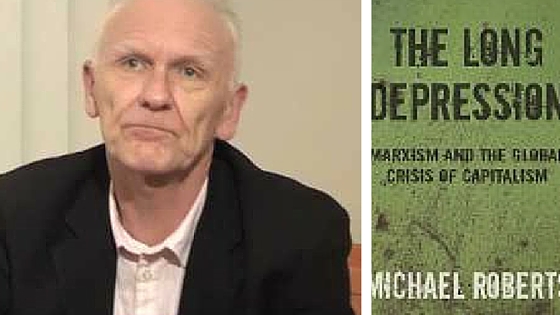
Michael Roberts

Michael Roberts has worked as an economist for over 30 years in the City of London. He is author of The Great Recession: Profit cycles, economic crisis A Marxist View and The Long Depression: Marxism and the Global Crisis of Capitalism.

Economics:

In this episode, Michael mentions: Marxism, capitalism, Austrian economics, GDP, multinationals, inflation, printing of money, booms, busts, profitability, recession, depression, inequality, wealth, means of production, private property, competition, externalities, unintended consequences, bailout, austerity and unemployment.

Economists:

In this episode, Michael mentions: Karl Marx, Friedrich Hayek, Adam Smith, John Maynard Keynes, Brad DeLong and Paul Mattick.

Links:

  • www.thenextrecession.wordpress.com by Michael Roberts

Books:

  • The Great Recession: Profit cycles, economic crisis A Marxist View by Michael Roberts
  • The Long Depression: Marxism and the Global Crisis of Capitalism by Michael Roberts
  • The Communist Manifesto by Karl Marx and Friedrich Engels
  • Capital by Karl Marx
  • Business As Usual by Paul Mattick
  • Waiting for Godot by Samuel Beckett


http://traffic.libsyn.com/economicrockstar/085_Michael_Roberts_Final_.mp3

Podcast: Play in new window | Download

083: Stephen Kinsella on Stock Flow Models, Rent Controls and Being the Green Lantern of Economics

April 28, 2016 by Frank

http://traffic.libsyn.com/economicrockstar/083_Stephen_Kinsella.mp3
Play in New WindowDownload

083: Stephen Kinsella on Stock Flow Models, Rent Controls and Being the Green Lantern of Economics

Stephen Kinsella is a Senior Lecturer in Economics at the Kemmy Business School, the University of Stephen KinsellaLimerick in Ireland and a Research Fellow at the Geary Institute at University College Dublin. He is currently visiting Professor of Economics at Université Paris.

Stephen has two PhD’s, is well published in many Economics Journals and has won several grants worth around 1.5 million Euro.

Stephen’s area of expertise is in the study of the Irish and European economies.

He has written 4 books:

  • Ireland in 2050: How we will be Living
  • Understanding Ireland’s Economic Crisis: Prospects for Recovery
  • QuickWin Economics and
  • Computable Economics.

Stephen is a weekly columnist for the Sunday Business Post newspaper and he also has his own website stephenkinsella.net which is amazingly rich in content, covering issues on the Irish and European economy as well as material he covers in his lectures.

Economics:

In this episode, Stephen mentions: stock flow consistent models, rent controls, GDP, wealth, consumption, government expenditure, investment, net exports, debt-to-GDP, stock of unemployed-to-flow of the labor force, taxes, austerity, QE, pro-cyclical policy, unemployment, automatic stabilizers, Brexit, foreign direct investment, hyperinflation, purchasing power of money, housing, pricing mechanism and money supply.

Economists:

In this episode, Stephen mentions: Wynne Godley, Lance Taylor, Marc Lavoie, Kevin O’Rourke, Philip Lane, Dermot McAleese, Edward Nell, Carmen M. Reinhart, Kenneth S. Rogoff and Joseph Stiglitz.

In this episode you will learn:

  • how and why Stephen completed two PhD’s and how he completed his first within 12 months.
  • about stock flow consistent models.
  • about the features of a stock flow model.
  • why the Irish government bailed out the banks.
  • how Ireland received ‘help’ from international economies, particularly the US and the UK, to quickly move out of a recession since the Great Financial Crisis.
  • whether Ireland will suffer if the UK left the EU in the so-called Brexit.
  • how rent controls lead to an inefficient market outcome.

Links:

  • Institute of New Economic Thinking

Papers:

  • Stephen Kinsella (2001). Hedgehog Logic – the Problems of Econometrics Today. Student Economic Review.
  • Stephen Kinsella (2007). Logarithms: A Tutorial.

Books: 

  • QuickWin Economics-Answers to Your Top 100 Economics Questions by Stephen Kinsella
  • Ireland in 2050: How we will be Living by Stephen Kinsella
  • Understanding Ireland’s Economic Crisis: Prospects for Recovery by Stephen Kinsella
  • Monetary Economics An Integrated Approach to Credit, Money, Income, Production and Wealth by Wynne Godley and Marc Lavoie
  • Swimming with Sharks: My Journey into the World of the Bankers by Joris Luyendijk
  • This Time Is Different: Eight Centuries of Financial Folly by Carmen M. Reinhart and Kenneth S. Rogoff
  • Seeing Like a State: How Certain Schemes to Improve the Human Condition Have Failed by James Scott
http://traffic.libsyn.com/economicrockstar/083_Stephen_Kinsella.mp3

Podcast: Play in new window | Download

081: Julie Nelson on the Importance of Ecology in Economics and the Misconception of Gender Roles in the Economy

April 14, 2016 by Frank

http://traffic.libsyn.com/economicrockstar/081_Julie_Nelson.mp3
Play in New WindowDownload

081: Julie Nelson on the Importance of Ecology in Economics and the Misconception of Gender Roles in the Economy

Julie Nelson is Professor of Economics at University of Massachusetts Boston and Senior Research Fellow at Global Development and Environment Institute, Tufts University, also in the USA.Julie Nelson Economic Rockstar

Julie’s research areas include feminist economics, ecological economics, the philosophy and methodology of economics, ethics and economics, the teaching of economics, and the empirical study of individual and household behavior.

Professor Nelson has also served as a Research Economist at the U.S. Bureau of Labor Statistics and a Visiting Associate Professor at Harvard University amongst others.

Julie is the author of Economics for Humans and author, co-author, or co-editor of several other books including Beyond Economic Man: Feminist Theory and Economics.

She has also authored numerous articles in journals ranging from Econometrica, the American Economic Review, and the Journal of Political Economy, to Signs: Journal of Women in Culture and Society, Feminist Economics, and Ecological Economics.

Professor Nelson earned a B.A. degree in Economics from St. Olaf College and an M.A. and Ph.D. in Economics from the University of Wisconsin, Madison, USA.

Julie, along with Mark Maier, runs the website introducingeconomics.org

Economics:

In this episode, Julie mentions: statistical inference, bias, production function, land, labor, capital, resource maintenance, feminist economics, care, GDP, Pigouvian tax, carbon, welfare gains, negative externality and Kyoto Agreement.

Economists:

In this episode, Julie mentions: John Stuart Mill, Gary Becker and Amartya Sen.

Quotes by Julie in Episode 81:

“Math gives you internal consistency. It does not give you objectivity and reliability.” – Julie Nelson

Click To Tweet

“Most economic textbooks tell you there are three basic economic activities… production, distribution and consumption. We added one at the beginning and what we called ‘resource maintenance’. That is, how are you ever going to produce anything if you don’t have the resources and if you haven’t taken care of them and sustained them in a way that they’ll be productive in the future” – Julie Nelson

“No one would be so silly to try to address an economic problem without looking at its social, ethical, physical and political dimensions. But later economists didn’t remember those cautions of Mills and just ran with the math aspect of it.” – Julie Nelson

“There’s still a long way to go to think of gender in an intelligent and equitable way.” – Julie Nelson

Click To Tweet

Takeaway:

“Be careful about what you believe that economists are telling you.” – Julie Nelson

“Wherever we are in our life whether we’re at work in a business or at home or bringing our whole selves with us. We don’t just bring parts of ourselves. So if you want to be an ethical person anywhere, we need to do that when we’re at work.” – Julie Nelson

Books:

  • Men are from Mars. Women are from Venus by John Gray
  • ECONned: How Unenlightened Self Interest Undermined Democracy and Corrupted Capitalism by Yves Smith
  • The Shareholder Value Myth by Lynn Stout

Links:

  • www.julieanelson.com
http://traffic.libsyn.com/economicrockstar/081_Julie_Nelson.mp3

Podcast: Play in new window | Download

077: The Irish Economy 100 years on from the 1916 Easter Rising

March 17, 2016 by Frank

http://traffic.libsyn.com/economicrockstar/077_Ireland.mp3
Play in New WindowDownload

077: The Irish Economy 100 years on from the 1916 Easter Rising

This is a commemorative episode celebrating the 100 year anniversary of Ireland’s 1916 Easter Rising in which the Proclamation of the Republic was read by Padraig Pearse at four minutes past noon on Easter Monday, April 24th, from the steps of the General Post Office on Sackville Street (now known as O’Connell Street). The document proclaimed Ireland’s independence from Great Britain.

How was Ireland’s economy performing in 1916 and how far have we come 100 years on?

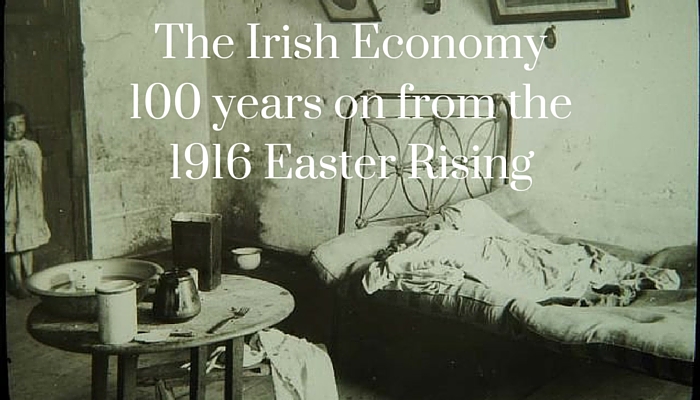
The Irish Economy 100 years on from the 1916 Easter Rising

Background:

Ireland in 1916, consisting of 32 counties, was ruled by Great Britain. The 32 county economy experienced a period of unprecedented prosperity mainly due to the positive economic effects of the First World War.

However, since the Great Irish Famine of 1846, Ireland experienced mass emigration and large numbers of deaths. The laissez-faire economic ideology was a failure. From the period 1851 to 1916, over 5 million Irish citizens emigrated reducing the population from a peak of approximately 8 million to 3 million.

The Irish economy was ruled by Great Britain and its economy became increasingly tied to trends in global markets. The cost of living increased and there were some rises in living standards. These were subject to sharp declines due to the recessions of 1859 to 1863 and 1877 to 1880. Poverty was widespread and tensions between landlords and tenant farmers escalated. Despite this poverty, Irish living standards were above most of Eastern and Central Europe but income levels remained below the UK and the US.

Ireland’s economy became increasingly reliant on four main industries: Agriculture, Linen production, Shipbuilding (where the Titanic was built) and Brewing and Distilling. However, agricultural exports were heavily dependent on Great Britain and Shipbuilding was dependent on an outdated industry. For example, it wasn’t long after the First World War that the Irish Shipbuilding industry collapsed.

The First World War of 1914 brought about a period of prosperity for Ireland, due to the increased demand for food, linen and ships that were directly linked to the war effort. However, this prosperity was not shared by all.

So what did the Irish economy of 1916 look like compared to its economy today 100 years on?

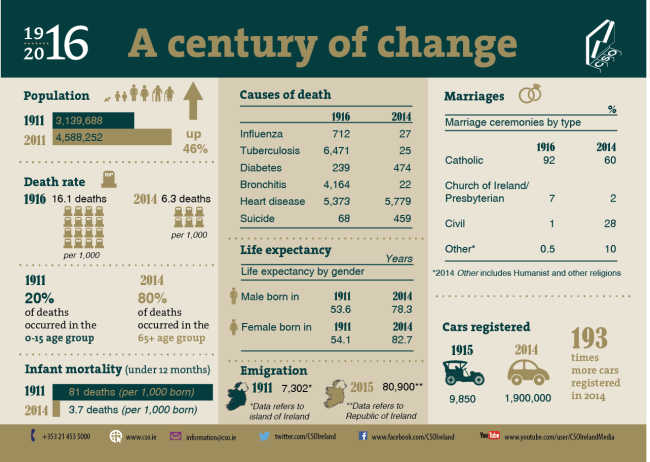
CSO 1916 - 2016 infographic

Source: Central Statistics Office

Population:

The population of Ireland in 1916 was one of the lowest recorded in its history. According to the population census of 1911, the population stood at just 3.14 million. It represented a country devastated by death caused by the famine over a half century previous and the subsequent mass emigration that ensued.

A 9-year-old Irish immigrant laborer shucks oysters in front of his foreman in the U.S. in 1911. pic.twitter.com/cOKICWk8Ta

— HISTORY (@HISTORY) April 12, 2016

Today, Ireland’s population has recovered to 4.59 million, an increase of 46%. However, many have emigrated due to the financial crisis of 2007, most notably Ireland’s youth. We have reverted to being a net emigration population after a period of becoming a net immigration population, attracting workers from overseas as well as bringing Irish people home.

Emigration for the whole island of Ireland in 1916 was 7,366 or 17 per 10,000 of the population. This had fallen from a substantial level before the outbreak of the Great War. The latest data for 2015 shows emigration for the Republic of Ireland at 80,900 representing 175 per 10,000 of the population.

Emigration in 1916 consisted of 5,580 females and only 1,786 males. This I found surprising.

The four main destinations for Irish emigrants in 1916 were the US, the UK, Canada and then Australia.

In 2015, the UK was the main destination for Irish emigrants. Only 7% of emigrants went to the US in 2015 compared to 58% emigrating in 1916.

The Irish diaspora abroad is quite large. Despite being a small island off Western Europe, Irish smiles have been welcomed all over the world. Ancestry can be traced back to Ireland particularly for those living in the United States, the UK, Argentina, Australia and Canada.

Today, it is estimated that there are 80 million people of Irish descent living around the world today. Other that the Republic of Ireland and Northern Ireland, Montserrat in the Caribbean is the only other country where St. Patrick’s Day is a public holiday.

Montserrat is known as the Emerald Isle of the Caribbean and it’s Irish heritage dates back to the 17th century when the island became a safe haven for the Irish who were originally sent to the Caribbean as slaves by Great Britain’s leader Oliver Cromwell. A census in 1678 showed that more than half of the population on the island were Irish.

Life Expectancy:

According to records for 1911, the life expectancy for a male born in Ireland was 53.6 years and for a female 54.1 years. Today, a male born in Ireland has a life expectancy of 78.3 years and a female 82.7 years.

Despite the period of prosperity, Ireland remained divided in terms of the gap between wealth and poor. Much of rural Ireland in the west of the country lived as an agrarian society, dependent on agriculture for a living. Living standards were much lower relative to other parts of the country.

Urban areas did not escape the ravishes of poverty. Inequality was more prevalent in urban towns, particularly in Dublin city. Despite a boom in food and linen exports in 1916, the Irish poor remained hungry.

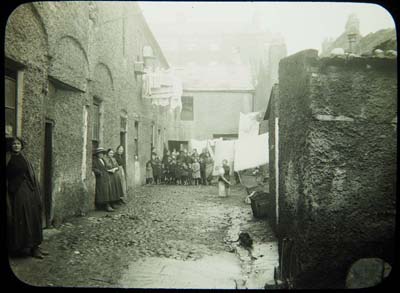
Henrietta Place, Dublin 1913. The flight of wealth to the suburbs often meant an escape from inner city squalor.

Henrietta Place, Dublin 1913. The flight of wealth to the suburbs often meant an escape from inner city squalor.

Poverty levels in Ireland today are at 8% with households consisting of one adult and one or more dependent children considered most at risk. Rural Ireland, including the West of Ireland, has a higher incidence of poverty than the rest of the country. As the saying goes, things change but always stay the same!

Many adults and children perished due to influenza, bronchitis and tuberculosis. These were the leading causes of death in Ireland along with heart disease. Today, heart disease is the leading cause of death in Ireland with few incidences of death from the other forms. The number of deaths by suicide that was officially recorded in 1916 were 68 compared to 459 for 2014, This represented 10 per 100,000 of the population compared to approximately 2 per 100,000 of the population.

Housing:

Ireland’s macro economy of 2016 is showing remarkable progress since it’s recession, bailout and financial crisis. The Irish have a love affair with housing. Perhaps it has its roots in history where many people were evicted from their homes during the Great Irish Famine.

During the boom from 1998 to 2007, Irish house prices soared only to come crashing down once the crisis hit. At its peak, over 90,000 houses were built but today only 11,000 houses were completed. The Irish housing market is under immense stress with demand outstripping supply. This shortage is resulting in much higher rents than what was recorded during the boom period. House prices are recovering but recent government legislation is making it difficult for landlords who are selling their property or evicting their tenants in order to capture the higher rental yields. Ireland is undergoing a housing crisis in today.

In 1916, Ireland experienced a severe housing crisis. Dublin and other cities became infamous for the living conditions of its citizens. The tenements, where many impoverished families lived, marked a bleak period in recent Irish history.

Multiple families shared large terraced houses with extremely poor sanitary and hygiene conditions. It was estimated at the time that 20,000 families in Dublin occupied single rooms and in some cases with other families. Family sizes of 8 or 10 children were not unusual. There were cases of 104 people occupying a single house built to accommodate one family.

A Tenement Room on Francis Street, Dublin in 1913

A Tenement Room on Francis Street, Dublin in 1913

Many evictions took place as families fell behind in rent. Facing starvation, children queued for bread which was handed out by religious orders. Many people in the West of Ireland emigrated due to food shortages and abandoned their homes. Despite many empty homes in the rural parts of Ireland, many families suffered homelessness, extremely poor living conditions and starvation.

Due to the housing crisis that Ireland is experiencing today in 2016, there are some echoes of the past. Homelessness has jumped 100% since January 2015. Over 700 families are living in emergency accommodation in hotels and guest houses. Evictions are up significantly and there are currently 17,000 people in the courts who are at risk of losing their homes. Food parcels are being handed out each week and the number queuing is rising.

Employment:

The Irish economy in 1916 was transitioning toward becoming an industrial nation. It was by no means considered backward and was in fact placed in the group of middle-ranking industrialised countries along with the Netherlands, the Scandinavian countries, Italy and Portugal.  26.8% of workers in 1911 worked in manufacturing jobs compared to 8.6% in 2011.

An estimated 150,000 men had joined the British army and many men and women went to the UK to find employment in munition factories and hospitals. Wages had increased during this time.

Almost 50% of the working population were employed in the Agriculture sector in 1911. This compares to just 4.9% in 2011.

In 1911, 8.8% of the labour force in Ireland worked in the professional group of occupations. By 2011, these workers now account for over 40% of the Irish workforce.

Ireland’s unemployment rate today is 8.8% coming from a recent high of 14.4%. It is unsure what the level was in 1916.

Exports:

Ireland in 1916 mostly consisted of indigenous industries. 85,000 workers were employed in linen production with over 18 million pounds (weight) of linen yarn and 112 million pounds (weight) of finished linen goods exported. Prior to the outbreak of World War I in 1914, about 70% of these exports were to the United States of America. However between 1914 and 1918, linen was in great demand for military purposes by the British Army for items such as tents, haversacks, hospital equipment and aeroplane fabric.

Today much of its traditional industry gone today. Very few linen manufacturers and weavers exist today. To bring my own personal family history into this story, my family remains one of a few linen weavers in Ireland today, producing the best Irish linen in the market with exports to countries that include Japan, the US and Italy. I’m personally proud of my father for what he has achieved and for extending the Irish tradition of producing the finest linen in the world.

Ireland is considered a small open economy and the UK still remains one of our largest trading partners. The Irish economy attracts many multinationals companies to locate here. In 2016, Ireland ranks among the top countries regarding industrial competitiveness and ease of doing business.

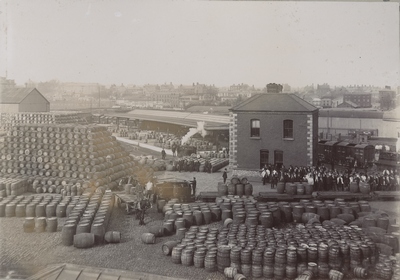
The Guinness brewery was the main brewery in Ireland and in 1916 it had the largest output of any brewery in the world, brewing more than two-thirds of all beer brewed in Ireland.

Cask Yard St. James' Gate Brewery 1906 - 1913

Cask Yard St. James’ Gate Brewery 1906 – 1913

The largest exporting sectors in Ireland during 1916 were woollens, brewing, butter, bacon, poultry, cattle, cotton goods and linen. The sectors that were in decline included horses, whiskey, pigs and sheep.

Ireland had a trade surplus of 1.5 million pounds (and a balance surplus of 11.1 million pounds) in 1916. For the latest data today, which is January 2016, Ireland is operating a trade surplus of 4.99 billion euro. Ireland’s largest exporting sectors are Medical and pharmaceutical products (representing 27% of total exports), Office machines and automatic data processing machines, and Food and live animals (representing 7.8% of our total exports).

The EU accounts for 56% of the total value of Irish goods exported. Belgium is Irelands largest export trading partner accounting for 15% of the total value of goods exported.

Great Britain remains Ireland’s single largest source of imports with 25% of the total value of goods imported to Ireland.

The USA remains Irelands largest non-EU destination for exports and imports.

GDP:

According to research by Kevin O’Rourke of the Department of Economics at University College Dublin a proxy measure for GDP per capita in Ireland was estimated to be 32.50 in 1913. This was based on a GDP estimate of 150 million. To put this into some context, the estimated GDP per capita in 1864 was 12.50 with GDP estimated at 60 million – over a 160% increase in nominal terms between the Famine and the Great War. Irish GDP per capita converged on the UK average during this time.

According to the International Geary-Khamis dollars, Ireland’s GDP per capita in 1913 was $2,736 whereas the US GDP per capita was $5,301 and the UK’s at $4,921, almost twice that of Ireland’s. This seems to suggest that incomes had yet to converge with those in Great Britain.

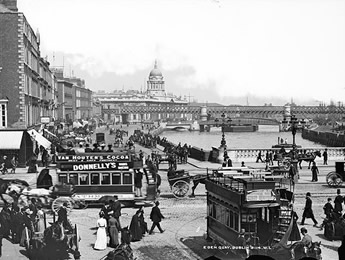
Eden Quay displays the bustle of turn of the century Dublin city life

Eden Quay displays the bustle of turn of the century Dublin city life

Ireland would have been considered one of the poorest Western European countries along with Greece, Italy, Portugal and Spain – yes there’s that familiar acronym of the financial crisis.

Today, Ireland is considered one of the richest countries in the world with GDP per capita of just under $49,000, placing the country in 10th position, with the US in 9th and the UK in 19th according to the World Bank.

GDP for Ireland was $11.9 million but this collapsed to $7.8 million by 1921 perhaps due to the Irish civil war. It was only in 1960 that Ireland recovered to pre-1916 levels.

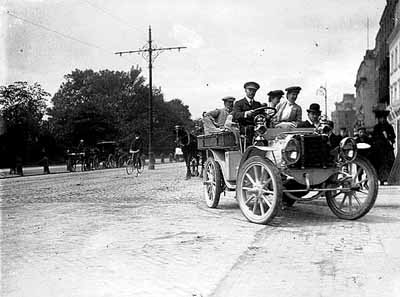
There were 9,850 cars registered in Ireland in 1915 with now over 2 million registered today.

F_Horse, bicycle, Car_Stephen'sGreen_clar21t

Inflation:

Due to the outbreak of the First World War in 1914 and the resulting scarcity of goods, inflation in Ireland increased considerably by 200% over the wartime period as measured by the wholesale price index.

Unless wage inflation was outpacing price inflation in 1916, which is very unlikely, families must have experienced a real reduction in the purchasing power of their £.

These increases in prices were also due to Government policy which increased taxes and duties on various products.

The retail price of butter, tea and eggs were expensive in 1916. For example, the price of a pound of butter then would have cost 7 euro 35 cent updated to today’s consumer price index compared to today’s price of 2 euro 79 cent.

Links:

  • Data: Central Statistics Office
  • Data: International Geary-Khamis dollars by Professor Angus Maddison
  • Paper: Monetary Data and Proxy GDP Estimates: Ireland 1840 – 1921 by Kevin O’Rourke, UCD.
  • Read Ireland’s Proclamation of the Republic where equal rights for all men, women and children was declared along with the creation of a sovereign country.

Family History Research:

  • Ireland’s Census: Search for your Irish Heritage for the following Census years: 1911, 1901, 1851, 1841, 1831 and 1821.
  • National Library of Ireland: www.nli.ie

Images:

  • All images courtesy of the National Library of Ireland
  • Infographic courtesy of the Central Statistics Office
http://traffic.libsyn.com/economicrockstar/077_Ireland.mp3

Podcast: Play in new window | Download

069: Diane Coyle on GDP, Its Shortcomings and Alternative Measures

January 21, 2016 by Frank

http://traffic.libsyn.com/economicrockstar/069_Diane_Coyle.mp3
Play in New WindowDownload

069: Diane Coyle on GDP, Its Shortcomings and Alternative Measures

Diane Coyle is Professor of Economics at the University of Manchester and runs the consultancy Enlightenment Economics.diane coyle

Diane is Vice-Chair of the BBC Trust and was a member of the Migration Advisory Committee and a member of the Competition Commission. She is also a visiting research associate at the University of Oxford’s Smith School of Enterprise and the Environment. 

Diane specialises in competition analysis and the economics of new technologies and globalisation.

Diane is the author of several books, including GDP: A Brief But Affectionate History, The Economics of Enough, The Soulful Science, Sex, Drugs and Economics and Paradoxes of Prosperity.

She was previously Economics Editor of The Independent and before that worked at the Treasury and in the private sector as an economist.

Diane has a PhD from Harvard and was awarded the OBE in January 2009.

Using happiness is an excuse for inactivity – Diane Coyle

Click To Tweet

Influencers:

Peter Sinclair (University of Birmingham) and Ben Friedman (Harvard).

Economists:

In this interview, Diane mentions: Adam Smith, John Stuart Mill, Sir Charles Bean, Daron Acemoglu, Thomas Piketty, John McMillan, Tim Harford, Peter Sinclair (University of Birmingham) and Ben Friedman (Harvard).

Economics:

In this interview, Diane mentions: GDP, budget deficit, fiscal policy, monetary policy, interest rates, growth, employment, unemployment, Human Development Index, Gross National Happiness Index, happiness, hysteresis, inequality, financial markets, derivatives and leverage.

In this episode you will learn:

  • what is GDP and how it is measured.
  • the complications with understanding the meaning of GDP.
  • the historical origins of GDP and why it is used to measure our economy.
  • the complications in measuring GDP.
  • how GDP data is still collected in such an ‘old-fashioned’ way and the new methods to collecting data.
  • about the uncertainty and margin of error in GDP statistics.
  • why it is wrong to make fiscal policy, monetary policy and interest rate decisions on GDP statistics.
  • what proxy variables were used to measure economic activity before GDP was introduced.
  • why we should re-think the meaning of the economy.
  • why GDP today doesn’t work in its present form and if there is an alternative.
  • how countries can use GDP and GNP measures to portray different economic conditions.
  • the difference between GDP and GNP.
  • the concerning use of ‘administrative statistics’ by countries to falsify economic growth.
  • whether it’s correct to include illegal drug activity and prostitution in measuring GDP.
  • why measuring happiness and well-being should be of little importance when measuring GDP.
  • why Diane is sceptical about the Happiness Index.
  • the reason why economics was coined by Thomas Carlyle as the the ‘dismal science’.
  • who is to blame for the financial crisis of 2007/2008.
  • about the UK’s over-reliance on the financial sector and its role in measuring GDP.
  • about the uncertainty that would exist if the UK withdrew from the EU.
  • the policy factors required to create a sustainable society and a stable government.


It’s just so easy now to download data from the internet and run through statistical packages and get some results. And I think a lot of professional economists are guilty of not rethinking about their data enough – Diane Coyle

You cannot think about the economy mechanically – Diane Coyle

Click To Tweet

The way we measure GDP now is really closely linked to Keynesian macroeconomic theory and a very famous definition he gave of  what total output in the economy is, that it’s consumer spending, government spending, investment spending and the balance of payments – Diane Coyle

There is no benefit for society in a lot of what happens in the financial markets – Diane Coyle

Click To Tweet

Resources:

  • The Enlightenment Economist
  • Doomsday Book  – Earliest recording of economic activity.
  • Time to ditch GDP as a measure of economic well-being by Diane Coyle 
  • The Review of Economics and Statistics

Favorite Internet Resource:

  • Twitter

If you pick the right people to follow it acts as a brilliant editor of all the interesting information that you might want to know and it’s like having a personalised newspaper – Diane Coyle

Books:

  • GDP: A Brief But Affectionate History by Diane Coyle
  • The Soulful Science: What Economists Really Do and Why It Matters by Diane Coyle
  • The Economics of Enough: How to Run the Economy as If the Future Matters by Diane Coyle
  • Sex, Drugs and Economics: An Unconventional Introduction to Economics by Diane Coyle
  • Paradoxes of Prosperity: Why the New Capitalism Benefits All by Diane Coyle
  • Reinventing the Bazaar: A natural History of Markets by John McMillan
  • The Undercover Economist by Tim Harford
  • The Undercover Economist Strikes Back: How to Run or Ruin an Economy by Tim Harford


http://traffic.libsyn.com/economicrockstar/069_Diane_Coyle.mp3

Podcast: Play in new window | Download

067: Leigh Caldwell on Cognitive Economics and the Mathematics of Behavioral Economics

January 3, 2016 by Frank

http://traffic.libsyn.com/economicrockstar/067_Leigh_Caldwell_Final.mp3
Play in New WindowDownload

067: Leigh Caldwell on Cognitive Economics and the Mathematics of Behavioral Economics

leigh caldwellLeigh Caldwell is a behavioural economist based in London.

Leigh, together with Elina Halonen, runs the Irrational Agency, which takes the latest scientific discoveries in psychology and behavioural economics, blends it with their hands-on experience of marketing and business, and turns them into powerful, incisive market research techniques.

In 2012, Leigh condensed his experience in pricing and the marketing of several of his businesses into a new book The Psychology of Price: How to use price to increase demand, profit and customer satisfaction.

Leigh is co-founder of the London Behavioural Economics Network, writes for the Pricing Revolution and the Knowing and Making blogs, and regularly features as an economics commentator on BBC News, Radio 4, Research Magazine and other media.

My own background is all about intellectual challenge. I went to university early as a teenager. I studied maths and physics. I was always into pushing myself intellectually and finding the next challenge to take on – Leigh Caldwell

Economists: 

In this interview, Leigh mentions: Elina Halonen, Dan Ariely and George Lowenstein.

Economics:

In this interview, Leigh mentions: Behavioral economics, experimental economics, lab experiments, demand curve, equilibrium, utility, mathematics, rationality, nudge, choice architecture, cognitive economics, reference pricing model, anchoring, hyperbolic discounting, heuristics, neuroeconomics, Nudge Unit, organ donation, tax collection, productivity, GDP and unemployment.

In this episode you will learn:

  • why Leigh help co-found the London Behavioural Economics Network (LBEN).
  • the importance of academics and practitioners working together to further the discipline of economics.
  • why finding the sweet-spot between controlled experiments and realism is difficult yet important.
  • what cognitive economics is and how different it is the behavioral economics.
  • whether big data could influence an individuals consumption behaviors.
  • about the need to use the mathematics of computer science in behavioral economics.
  • why we shouldn’t use the current maths of economics to explain human behavior.
  • why a lack of mathematics is holding back the discipline of behavioral economics.
  • why mathematics is essential for theorising and modelling economics, especially behavioural economics.
  • about the paradox of self-awareness in cognitive economics when faced with choices.
  • how a consumers relationship with a material object is a unique experience and how putting a price on the good can ruin this experience.
  • why charging a higher price for your product or service would generate higher profits in a perceived perfectly competitive market.
  • whether the 99p or 99 cent pricing strategy works.
  • about the reference pricing model and why charging $39 for a product is better than charging $34 for the same product.
  • about the importance of setting prices when considering how numbers are spoken, i.e. numbers with more syllables are received to be more expensive than those with fewer syllables. 
  • how Leigh uses the findings in academic papers to make money for his business.
  • how Leigh uses economic conferences to network, to find out about the latest research and to discover the new academic societies that have been established.
  • about Leigh’s goal for 2016 to start a Cognitive Economics Society.
  • about the advice Leigh would give the UK government to apply cognitive and behavioral economics to deal with some aspects of social life.
  • how the UK government changed people’s behaviour about paying their taxes on time.
  • about the productivity challenge the UK government is facing today and what can be done about it.
  • about the current research Leigh is undertaking regarding where our preferences come from.

Conferences:

  • Judgement and Decision Making Conference
  • American Economics Association Conference

Books:

  • The Psychology of Price: How to use price to increase demand, profit and customer satisfaction by Leigh Caldwell.
  • Predictably Irrational by Dan Ariely.
  • Basic Instinct by Pete Luhn
  • Nudge by Richard Thaler
  • Thinking, Fast and Slow by Kahneman and Tversky

http://traffic.libsyn.com/economicrockstar/067_Leigh_Caldwell_Final.mp3

Podcast: Play in new window | Download

058: Morten Jerven on Poor Numbers and Why Economists Get It Wrong With Africa

November 11, 2015 by Frank

http://traffic.libsyn.com/economicrockstar/058_Morten_Jerven_Final.mp3
Play in New WindowDownload

058: Morten Jerven on Poor Numbers and Why Economists Get It Wrong With Africa

Morton Jerven is Professor of Economic History and Development at the School for International Studies at Simon Fraser University in Vancouver, Canada.

In 2014, Morton was appointed Associate Professor in Global Change and International Relations at Noragrica at the Norwegian University of Life Sciences.

Morton has published widely on African economic development, and particularly on patterns of economic growth and on economic development statistics.

Upon the release of his book, Poor Numbers: How We Are Misled by African Development Statistics and What to Do about It, Morton caused uproar across Africa and had been expelled from two conferences. His latest book Africa: Why Economists Get It Wrong is now available on Amazon.

Morton is an economic historian, with an MSc and PhD from the London School of Economics.

Economics:

In this interview, Morten mentions: capital markets, sovereign bonds, National Income Statistics, GDP, demographics, wages, rents, profits, consumption, investment, exports, imports, population growth, m-pesa, debt-to-GDP ratio, poverty and GDP per capita.

Economists:

In this interview, Morten mentions: Jonathan Temple, Stephen Durlauf, Simon Johnson, Shanta Deverajan, Neil Fantom (World Bank) and Wolfgang Stolper.

In this episode you will learn:

  • why Morten was expelled from two conferences in Africa.
  • about the knowledge problem that exists in economic statistical data.
  • if economic statistics is underfunded relative to other social sciences.
  • whether economic data from African countries is intentionally misleading or if it’s a methodology and availability problem.
  • what is GDP and why is it used.
  • the problems with measuring GDP.
  • why the production approach is really the only valid method to measuring GDP.
  • why a country’s GDP is estimate by proxy and how productivity data is difficult to collect.
  • how population growth is used as a proxy for GDP.
  • whether we should allow Google and other companies that store big data to provide economic data.
  • whether cooperation or conflict between big data and official statistics will emerge.
  • how observing the brightness of countries from space is now being used to measure economic growth.
  • what the IMF does to missing data, such as GDP.
  • why Morten collected his own data for a number of African countries since the IMF wouldn’t share their own.
  • whether papers written by the IMF and the World Bank undergo a peer-review process.
  • how the ‘branding’ of statistics by the World Bank and the IMF can mislead the user.
  • how using the 3 methods of calculating GDP for all African countries shows significant differences when ranking each from poorest to wealthiest.

Quotes by Morten Jerven:

Statistics is the archetypal way of generalising from complex social realities to a very orderly aggregate picture – Morten Jerven

Make everything count. If you write something, make sure it’s going somewhere. If you prepare a lecture to speak about something, make sure you have an idea about how that can become a publishable unit – Morten Jerven

Make sure, as an academic working, it’s important not to think that working long hours is the key to being effective. Start writing early. It’s important – Morten Jerven

Organisations Mentioned in this Episode:

  • African Development Bank
  • IMF
  • World Bank
  • Centers for Disease Control and Prevention

Books:

  • Poor Numbers: How We Are Misled by African Development Statistics and What to Do About It by Morton Jerven
  • Africa: Why Economists Get It Wrong by Morton Jerven
  • How to Lie with Statistics by Darryl Huff
  • Handbook of Econometrics by Stephen Durlof and Jonathan Temple
  • Planning Without Facts: Lessons in Resource Allocation from Nigeria’s Development by Wolfgang Stolper

Papers/Articles:

  • Henderson, V., Storeygard, A. and Weil, D. (2012) “Measuring economic growth from outer space” American Economic Review 102(2): 994-1028.
  • Financial Times: Africa Counts the Costs of Miscalculation by Andrew Jack

Resources:

  • World Bank Development Database
http://traffic.libsyn.com/economicrockstar/058_Morten_Jerven_Final.mp3

Podcast: Play in new window | Download

  • 1
  • 2
  • ...Next Page

Frank Conway

Frank Conway is founder of Economic Rockstar and lecturer of economics, finance and statistics. Read More…

View My Blog Posts

Youtube Sub

Become a Patron of the Economic Rockstar Podcast

patreon

Ireland’s Economy by the Numbers

Leaving Cert Economics: Ireland’s Economy  Click here to download a workbook on Ireland’s Economy so that you can add your own notes. [Original size] Ireland’s Economy by fconway

Categories

Subscribe and Never Miss An Episode

itunes-logo

Recent Posts

  • Ireland’s Economy by the Numbers April 8, 2019
  • 174: Wendy Carlin on The Core Project, Capitalism, Democracy and Normative Statements February 13, 2019
  • 173: Stephen Wright on Core Econ as a Learning Resource for Mainstream Economics January 28, 2019
  • 172: Best of 2018 Part 2: From the Great Depression to Futurism; Institutions, Individualism, Cooperation and Reciprocity January 22, 2019
  • 171: Best of 2018 Part 1 January 3, 2019

Copyright © 2026 · Podcast Pro Theme on Genesis Framework · WordPress · Log in

This website uses cookies to improve your experience. We'll assume you're ok with this, but you can opt-out if you wish. Accept Reject Read More
Privacy Policy

Privacy Overview

This website uses cookies to improve your experience while you navigate through the website. Out of these, the cookies that are categorized as necessary are stored on your browser as they are essential for the working of basic functionalities of the website. We also use third-party cookies that help us analyze and understand how you use this website. These cookies will be stored in your browser only with your consent. You also have the option to opt-out of these cookies. But opting out of some of these cookies may affect your browsing experience.
Necessary
Always Enabled
Necessary cookies are absolutely essential for the website to function properly. This category only includes cookies that ensures basic functionalities and security features of the website. These cookies do not store any personal information.
Non-necessary
Any cookies that may not be particularly necessary for the website to function and is used specifically to collect user personal data via analytics, ads, other embedded contents are termed as non-necessary cookies. It is mandatory to procure user consent prior to running these cookies on your website.
SAVE & ACCEPT