• ABOUT
  • RESOURCES
  • PODCAST
  • BOOKS
  • BLOG
  • SUPPORTERS
  • QFA Financial Advice
  • CONTACT

Economic Rockstar

Connecting Brilliant Minds in Economics and Finance

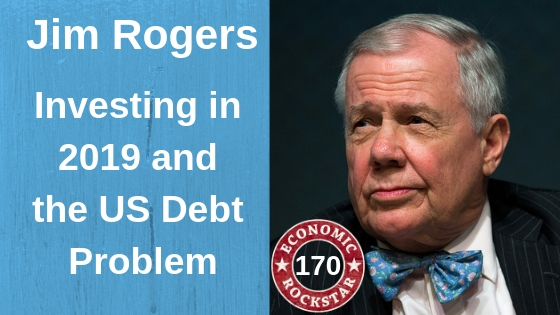
170: Jim Rogers on Investing in 2019 and the US Debt Problem
December 24, 2018 by Frank

http://traffic.libsyn.com/economicrockstar/170_Jim_Rogers_Final.mp3
Play in New WindowDownload

170: Jim Rogers on Investing in 2019 and the US Debt Problem

Jim Rogers is an American businessman and financial commentator based in Singapore.  He is the Chairman of Rogers Holdings and Beeland Interests, Inc.

In 1973, Jim co-founded of the Quantum Fund with George Soros and having retired at the age of 37, Jim spent some of his time traveling on a motorcycle around the world – a Guinness World Record and one which is documented in Investment Biker, a international bestselling book.

He has been a guest professor of finance at the Columbia Business School.

In 1998 he created the Rogers International Commodities Index (RICI) and has been an outspoken advocate of agriculture investments.

Between 1999 and 2002, Jim and his wife did another Guinness World Record journey travelling 116 countries in a custom-made Mercedes. He wrote Adventure Capitalist following this around-the-world adventure.

In 2007, Jim moved to Singapore due to the investment growth potential in Asia.

In this episode:

Jim shares some excellent advice about how you should approach investing and what the next 10 to 20 years could turn out for the global economy.

He suggests that North Korea, Russia and agriculture are contrarian bets that will have positive payoffs for those of us willing to go against the crowd.

Also, I ask him about his views on cryptos and blockchain and whether he as any advice for you if you feel stuck in your job or if you’re undecided about what you should do if starting out on your career path.

Links:

  • Jim Rogers website: www.jimrogers.com 
  • Rogers International Commodities Index: www.rogersrawmaterials.com 
  • Beeland Interests Inc: www.beelandinterests.com 
  • Quantum Fund
  • George Soros website: www.georgesoros.com

Books by Jim Rogers:

  • Investment Biker: Around the World with Jim Rogers (1994).
  • Adventure Capitalist: The Ultimate Road Trip (2003).
  • Hot Commodities: How Anyone Can Invest Profitably in the World’s Best Market (2004).
  • A Bull in China: Investing Profitably in the World’s Greatest Market (2007).
  • A Gift to My Children: A Father’s Lessons For Life And Investing (2009).
  • Street Smarts: Adventures on the Road and in the Markets (2013).

Patreon

If you’re a fan of the podcast and would like to show your support in anyway, please check out my Patreon page at www.patreon.com/economicrockstar where you can sign up for any of the awards for as little as $1 a month or you can simply follow me on Instagram, the Economic Rockstar Facebook page or on Twitter or simply recommend the show to a friend, especially if they have never had the opportunity to study economics.

http://traffic.libsyn.com/economicrockstar/170_Jim_Rogers_Final.mp3

Podcast: Play in new window | Download

095: Scott Burns on Mobile Money Banking in Africa and the Success of M-Pesa

July 20, 2016 by Frank

http://traffic.libsyn.com/economicrockstar/095_Scott_Burns_Final.mp3
Play in New WindowDownload

095: Scott Burns on Mobile Money Banking in Africa and the Success of M-Pesa

Scott Burns is a Mercatus PhD Dissertation Fellow in the Economics PhD Program at George Mason Scott Burns Economic RockstarUniversity.

Scott earned his BS in Economics from Louisiana State University where he was part of the Speech and Debate Club and the Phi Eta Sigma Honors Society.

His current publications include The War on Drugs in Afghanistan: Another Failed Experiment in Interdiction and Old (Chicago) school, new century: the link between Knight and Simons’ Chicago plan to Buchanan’s constitutional money.

Scott’s PhD dissertation topic has to do with one of the most exciting yet under-appreciated miracles of the market going on in the world today, the “mobile money revolution” in Sub-Saharan Africa.

Scott writes for the blog Alt-M, which is a blog run by free banking scholars on the theme ‘Ideas for an Alternative Monetary Future’.

Scott, along with fellow Econ PhD student at GMU, David Lucas, started a band inspired by Adam Smith called ‘The Butcher and the Baker’.

Economics:

In this episode, Scott mentions: banking, monopolies, natural monopoly, market failure, savings, investment, development economics, finance, GDP, laissez-faire, mobile money, unintended consequences, bitcoins and hyper-inflation.

Economists:

In this episode, Scott mentions: Adam Smith, Ludwig von Mises, F. A. Hayek, Joseph Schumpeter, Scott Sumner, David Beckworth, Lawrence H. White and George A. Selgin,

Links:

  • Finance for All: Kenya’s M-PESA
  • Alt-M
  • Top 12 Economics Books as Recommended by Economic Rockstar Guests
  • Monetary Workshop at Cato Institute

Papers:

  • Coyne, C., Hall-Blanco , A. and Burns, S. (2016). The War on Drugs in Afghanistan: Another Failed Experiment with Interdiction. The Independent Review.
  • Burns, S. (2016). Old (Chicago) school, new century: the link between Knight and Simons’ Chicago plan to Buchanan’s constitutional money. Constitutional Political Economy.

Articles:

  • Burns, S. (2016). The Road Less Traveled: Austrian Macro, Monetary Disequilibrium Theory, and Free Banking. Research on the History of Economic Thought and Methodology, Volume 348: pp 337 – 363.
  • Burns, S. and Michel, N. J. (2016). Choosing Your Own Money Central to Economic Freedom. Cayman Financial Review, Issue 42.

Books:

  • Economics in One Lesson by Henry Hazlitt
  • The Law by Frederic Bastiat
  • Human Action by Ludwig von Mises
  • Free Banking in Britain: Theory, Experience and Debate 1800-1845 by Lawrence H. White
  • The Theory of Free Banking by George A. Selgin


Companies Mentioned in this Episode:

  • Uber, Airbnb, Amazon and Safaricom.
http://traffic.libsyn.com/economicrockstar/095_Scott_Burns_Final.mp3

Podcast: Play in new window | Download
083: Stephen Kinsella on Stock Flow Models, Rent Controls and Being the Green Lantern of Economics

April 28, 2016 by Frank

http://traffic.libsyn.com/economicrockstar/083_Stephen_Kinsella.mp3
Play in New WindowDownload

083: Stephen Kinsella on Stock Flow Models, Rent Controls and Being the Green Lantern of Economics

Stephen Kinsella is a Senior Lecturer in Economics at the Kemmy Business School, the University of Stephen KinsellaLimerick in Ireland and a Research Fellow at the Geary Institute at University College Dublin. He is currently visiting Professor of Economics at Université Paris.

Stephen has two PhD’s, is well published in many Economics Journals and has won several grants worth around 1.5 million Euro.

Stephen’s area of expertise is in the study of the Irish and European economies.

He has written 4 books:

  • Ireland in 2050: How we will be Living
  • Understanding Ireland’s Economic Crisis: Prospects for Recovery
  • QuickWin Economics and
  • Computable Economics.

Stephen is a weekly columnist for the Sunday Business Post newspaper and he also has his own website stephenkinsella.net which is amazingly rich in content, covering issues on the Irish and European economy as well as material he covers in his lectures.

Economics:

In this episode, Stephen mentions: stock flow consistent models, rent controls, GDP, wealth, consumption, government expenditure, investment, net exports, debt-to-GDP, stock of unemployed-to-flow of the labor force, taxes, austerity, QE, pro-cyclical policy, unemployment, automatic stabilizers, Brexit, foreign direct investment, hyperinflation, purchasing power of money, housing, pricing mechanism and money supply.

Economists:

In this episode, Stephen mentions: Wynne Godley, Lance Taylor, Marc Lavoie, Kevin O’Rourke, Philip Lane, Dermot McAleese, Edward Nell, Carmen M. Reinhart, Kenneth S. Rogoff and Joseph Stiglitz.

In this episode you will learn:

  • how and why Stephen completed two PhD’s and how he completed his first within 12 months.
  • about stock flow consistent models.
  • about the features of a stock flow model.
  • why the Irish government bailed out the banks.
  • how Ireland received ‘help’ from international economies, particularly the US and the UK, to quickly move out of a recession since the Great Financial Crisis.
  • whether Ireland will suffer if the UK left the EU in the so-called Brexit.
  • how rent controls lead to an inefficient market outcome.

Links:

  • Institute of New Economic Thinking

Papers:

  • Stephen Kinsella (2001). Hedgehog Logic – the Problems of Econometrics Today. Student Economic Review.
  • Stephen Kinsella (2007). Logarithms: A Tutorial.

Books: 

  • QuickWin Economics-Answers to Your Top 100 Economics Questions by Stephen Kinsella
  • Ireland in 2050: How we will be Living by Stephen Kinsella
  • Understanding Ireland’s Economic Crisis: Prospects for Recovery by Stephen Kinsella
  • Monetary Economics An Integrated Approach to Credit, Money, Income, Production and Wealth by Wynne Godley and Marc Lavoie
  • Swimming with Sharks: My Journey into the World of the Bankers by Joris Luyendijk
  • This Time Is Different: Eight Centuries of Financial Folly by Carmen M. Reinhart and Kenneth S. Rogoff
  • Seeing Like a State: How Certain Schemes to Improve the Human Condition Have Failed by James Scott
http://traffic.libsyn.com/economicrockstar/083_Stephen_Kinsella.mp3

Podcast: Play in new window | Download

076: Greg Ip on Foolproofing the Economy and Why Stability is Destabilizing

March 10, 2016 by Frank

http://traffic.libsyn.com/economicrockstar/076_Greg_Ip.mp3
Play in New WindowDownload

076: Greg Ip on Foolproofing the Economy and Why Stability is Destabilizing

Greg Ip is one of the best-known economics journalists in the US.Greg Ip Economic Rockstar

He is currently chief economics commentator of The Wall Street Journal and writes about U.S. and global economic developments and policy each week in the Capital Account column and on Real Time Economics, the Wall Street Journal’s economics blog.

From 2008 to January 2015, he was U.S. Economics Editor of The Economist magazine. Greg is the author of Foolproof: Why Safety Can Be Dangerous and How Danger Makes Us Safe as well as author of The Little Book of Economics: How the Economy Works in the Real World.

“Stability is Destabilising”- Hyman Minsky

Economics:

In this episode, Greg mentions and discusses: junk bonds, capitalism, investment, growth, financial crisis, bank deposits, loans, currency, gold, exchange rates, money market funds, bank run, exchange traded funds, recessions, unintended consequences and the Paradox of Thrift.

Economists:

In this episode, Greg mentions and discusses: Paul Volcker, Hyman Minsky, Gary Gorton, Joseph Schumpeter and John Maynard Keynes.


In this episode you will learn:

  • about the theme behind Greg Ip’s latest book Foolproof.

  • when the pursuit of safety lead us into danger?

  • what forest fires have to do with Wall Street.

  • about the relationship between the financial market (and its potential for a crisis) and ecological systems.
  • the way we publicly and privately try to cope with risk and danger and how those choices can create unintended consequences.

  • about the Fallacy of Composition: Things you do that are safe actually end up making other people less safe.
  • what American Football can teach us about the Fallacy of Composition.
  • how making American Football safe with the introduction of helmets has created increased risk taking and more injuries.
  • what past economic and financial crises have in common.
  • how the financial system succeeded too well in making people feel their money was safe.
  • how banking regulations and capital controls introduced after the financial crisis will create risks in other parts of the economy and financial markets.
  • if savings is actually bad for the economy.

  • about Keynes’ Paradox of Thrift and how savings forces others to borrow.

  • whether exchange traded funds (ETFs) will be the next financial catastrophe.
  • about the Peltzman Effect on anti-lock brakes.
  • how Paul Volcker‘s regulation of capital flows caused the growth of shadow banking.

  • how The Great Moderation changed attitudes about debt and how relaxed laws allowed high-risk households to borrow for mortgages.

  • about Gary Gorton of Yale and his explanation for a financial crisis.
  • how being present in danger can remind ourselves of the things that aren’t always safe.
  • whether the finance industry could take the lessons learned about safety and regulation in the airline industry.
  • why the Lehman Brothers collapse surprised many due to the US government indicating to the market that banks and mortgage companies would be bailed out.
  • how German savers were much to blame for the euro crisis than their European counterparts that borrowed.
  • why we continue to build cities near water which can cause devastation in the form of floods and tidal waves.
  • why The Netherlands, with their ‘Room For The River’ programme, is destroying dykes and allowing their lands to flood.
  • why Greg Ip is worried about the situation in China and how the stability that the government is trying to maintain will eventually lead to instability.

“If banks are limited from lending then lending activity will migrate elsewhere. We see this happening at exchange traded funds and other shadowy parts of the financial system. And you worry that risks are starting to grow there.” – Greg IP

“One way to protect ourselves against disaster is to make use of the presence of danger to remind ourselves that things aren’t always safe and to take steps that keep us safe”.  – Greg IP

“What I worry about more is that the pendulum has swung too far against risk taking. And the risks that are been taken are being channeled too far in the direction of financial risk and not real economy risk – people starting new businesses or buying new homes.” – Greg Ip

“What I worry about China is that they have leadership that is worried about political and economic stability.”

Where to Find Greg Ip:

  • The Wall Street Journal 
  • www.gregip.com

Books:

  • Foolproof: Why Safety Can Be Dangerous and How Danger Makes Us Safe by Greg Ip
  • The Little Book of Economics: How the Economy Works in the Real World by Greg Ip

Other Interesting Links:

  • Deregulation: The Expected and The Unexpected by Sam Peltzman
  • Do we really need more regulation of financial derivatives? by Merton H. Miller
  • Financial Innovation: The Last Twenty Years and the Next by Merton H. Miller
  • Peltzman, S. (1975). The Effects of Automobile Safety Regulation, Journal of Political Economy: 677 – 726.
  • National Center for Catastrophic Sport Injury Research 
  • Probability of a Hazardous Material Truck Accident in New Jersey by Damodaran, M., Daniel, J. and Luke, A. C. (2002)
http://traffic.libsyn.com/economicrockstar/076_Greg_Ip.mp3

Podcast: Play in new window | Download

062: Stephen Terry on Real Business Cycles, Total Factor Productivity, Short-Termism and Doing a PhD

December 10, 2015 by Frank

http://traffic.libsyn.com/economicrockstar/Stephen_Terry_Final.mp3
Play in New WindowDownload

062: Stephen Terry on Real Business Cycles, Total Factor Productivity, Short-Termism and DoiStephen_Terryng a PhD

Stephen Terry is Assistant Professor of Economics at Boston University.

In 2013 he was a Dissertation Intern, Federal Reserve Bank of Richmond and, from 2007 to 2009, Stephen was a Research Associate at the Federal Reserve Bank of Kansas City.

Stephen  received a PhD in Economics from Stanford University in 2015 as well as an  MA in Economics in 2011.

Stephen also has an MA in Mathematics from the University of Oklahoma and a BA in Economics from University of Texas at Arlington.

Stephens research interests include short-termism, uncertainty and real business cycles.

One of the most important summary statistics in macroeconomics is a measure known as TFP or total factor productivity of the economy as a whole – Stephen Terry

Economics:

In this interview, Stephen mentions: labor markets, double coincidence of wants, selection markets, matching markets, algebraic topology, total factor productivity, real business cycles, economic shocks, volatility, variance, risk, uncertainty, aggregate output, employment, investment, allocation of inputs, uncertainty, earnings, profits, short-termism and the Principle-Agent Problem.

Economists:

In this interview, Stephen mentions: Christine Exley, Nick Bloom, John Van Reenen and John Maynard Keynes.

In this episode you will learn:

  • about Stephen’s experience with the two-body or joint location problem.
  • about Stephen’s PhD process and the experience he developed along the way.
  • of some suggestions if you’re considering undertaking a PhD.
  • the differences and similarities in the mathematics of economics and the mathematics of other disciplines such as physics and chemistry.
  • if there is a divergence or a convergence in the branches of macroeconomics and microeconomics.
  • what really happens during recessions.
  • how firms can learn and react to the data provided at a micro level.
  • what Total Factor Productivity is.
  • about Real Business Cycle theory.
  • whether changes in uncertainty causes or amplifies recessions.
  • whether managers should forego the long-term objectives of the firm due to the pressures of short-termism.
  • whether rating agencies are beneficial to investors or if they potentially hinder the growth prospects of the firm due to short-term pressures and expectations.

Preparation for Life as a Research Economists into 2 Stages:

1) Useful things that you can be doing before graduate school.

You have to study Math. Economics at graduate level is increasingly dominated by the technical and quantitative research methods.

Having some practical experience in the application of mathematics in economics is not not only valuable for later on in your career but is now becoming a pre-condition to gaining access to research-intensive PhD programmes.

If your undergrad or Masters degree lacks math rigour, then you should consider building on your current level of math by undertaking a math PhD programme.

3) The ways in which you can maximise the benefits you get in your PhD training.

You should consider becoming a Research Assistant prior to starting your PhD so that you gain the practical experience.

This will put you in a situation in which you can be mentored and instructed by other economists who are undertaking economics and statistical research projects.

Being exposed to this will offer you an insight into the research process as well as ‘train’ you to become quite efficient and structured in terms of time management and application.

On the Use of Math in Economics:

At its core, math and applied mathematical techniques, but also pure mathematical proof-based reasoning, are ways to go from some set of assumptions to a coherent set of conclusions that you know follow logically without inconsistency from those assumptions.

By harnessing that logical consistency, economics is something, in the last few decades, that has been able to harness a great deal of precision in the statements that it’s able to make. But still at its core, where the debate centres, you have to understand that the assumptions that we make are primarily assumptions about people. Economic actors sometimes go their own way and don’t always follow perfectly the rules or logical coherent types of assumptions that we start with as an economist.

There’s a great deal of power and precision that is gained by math but this underlying realisation that we’re dealing with individuals rather than physical particles that you would use in physics is something that an economist has to keep in mind when they do think about the real world.

Papers:

  • Terry, S. (2015). The Macro Impact of Short-Termism. Working Paper.
  • Bloom, N.,  Floetotto, M., Jaimovich, N., Saporta-Eksten, I., and Terry, S. (2014). Really Uncertain Business Cycles. Working Paper.

Sources:

  • US Census Bureau
  • Institute for Fiscal Studies
  • McKinsey and Company
http://traffic.libsyn.com/economicrockstar/Stephen_Terry_Final.mp3

Podcast: Play in new window | Download

061: Roger Whitney on the Myths to Retirement Planning and the Lazy Mans Method to Saving

December 3, 2015 by Frank

http://traffic.libsyn.com/economicrockstar/061_Roger_Whitney_Final.mp3
Play in New WindowDownload

061: Roger Whitney on the Myths to Retirement Planning and the Lazy Mans Method to Saving

Roger Whitney began his career as a Financial Advisor in 1991 and witnessed first-hand the rise and fall of the ‘New roger whitneyEconomy’ and the Dot-com bubble that ended in 2000.

This experience made Roger realise that financial management is about people, not money, and that they are served best by advisors that are fiduciaries to their clients and have the heart of a teacher.

In 2003 Roger left, at the time, the largest private bank in the world and co-founded WWK Wealth Advisors. Today, they are a firm of 14 professionals managing over $200 million in assets.

Roger is a lifelong learner and holds many degrees and certifications. He has a B.A. in International Relations, is a Certified Investment Management Analyst and a Certified Private Wealth Advisor.

Roger also teaches courses on Wealth Management, Retirement Planning and Employee Benefits.

Roger’s blog, The Retirement Answer Man, was recently awarded the 2015 PLUTUS award for the best Retirement focused blog and podcast. You can check it out at rogerwhitney.com as well as on iTunes.

Advice:

“Make sure you make the most of the only life you have. Retirement is part of that but don’t miss where you’re at today” – Roger Whitney

Economics/Finance:

In this interview, Roger mentions: the Permanent Income Hypothesis, retirement, retirement planning, pensions, social security, demographics, baby boomers, capitalism, growth, IRAs, Roth IRAs, 401k, quantitative easing, real estate, cash flow, investment, private placement memorandum and capital rates.

Economists:

In this interview, Roger mentions: Milton Freidman

In this episode you will learn:

  • the problem with budgeting.
  • develop one habit to control your budgeting needs and requirements.
  • lazy man’s method to saving.
  • four myths that could ruin your retirement and how to avoid them.
  • the Permanent Income Hypothesis.
  • how Roger got his cashflow in place when setting up his business.
  • that cutting your cable bill won’t create the opportunity to generate income.
  • the biggest regrets that people have when they retire.
  • the 3 Phases of Retirement.
  • whether we have a pension time bomb or if capitalism will reduce the risks.
  • what are IRAs and Roth IRAs work.
  • the possible scenario for the next generation to fund a bankrupt social security in the US.

Quotes by Roger in Episode 61 0f the Economic Rockstar podcast:

The bigger opportunity is how to generate extra income – Roger Whitney

Click To Tweet

“I know quantitative easing. I know how bad all this stuff might be. At the end of the day, we just have to have out own house in order. And if we have our own house in order, we can insulate ourselves from a lot of things. That’s the only way I know how to get through things.” – Roger Whitney

4 Myths that Could Ruin Your Retirement and How to Avoid Them:

  1. Retirement is not a number: How much do I need to save for retirement?
  2. You’re spending is going to be consistent throughout your retirement.
  3. Retirement means not working.
  4. Having a financial plan is enough.

3 Phases of Retirement:

  1. The Go-Go Years
  2. The Slow-Go Years
  3. The No-Go Years

Books:

  • QBQ! the Question Behind the Question: Practicing Personal Accountability at Work and in Life by John G. Miller

  • The How of Happiness: A New Approach to Getting the Life You Want by Sonja Lyubomirsky

Podcasts:

  • The Retirement Answer Man
  • Stacking Benjamins
http://traffic.libsyn.com/economicrockstar/061_Roger_Whitney_Final.mp3

Podcast: Play in new window | Download

058: Morten Jerven on Poor Numbers and Why Economists Get It Wrong With Africa

November 11, 2015 by Frank

http://traffic.libsyn.com/economicrockstar/058_Morten_Jerven_Final.mp3
Play in New WindowDownload

058: Morten Jerven on Poor Numbers and Why Economists Get It Wrong With Africa

Morton Jerven is Professor of Economic History and Development at the School for International Studies at Simon Fraser University in Vancouver, Canada.

In 2014, Morton was appointed Associate Professor in Global Change and International Relations at Noragrica at the Norwegian University of Life Sciences.

Morton has published widely on African economic development, and particularly on patterns of economic growth and on economic development statistics.

Upon the release of his book, Poor Numbers: How We Are Misled by African Development Statistics and What to Do about It, Morton caused uproar across Africa and had been expelled from two conferences. His latest book Africa: Why Economists Get It Wrong is now available on Amazon.

Morton is an economic historian, with an MSc and PhD from the London School of Economics.

Economics:

In this interview, Morten mentions: capital markets, sovereign bonds, National Income Statistics, GDP, demographics, wages, rents, profits, consumption, investment, exports, imports, population growth, m-pesa, debt-to-GDP ratio, poverty and GDP per capita.

Economists:

In this interview, Morten mentions: Jonathan Temple, Stephen Durlauf, Simon Johnson, Shanta Deverajan, Neil Fantom (World Bank) and Wolfgang Stolper.

In this episode you will learn:

  • why Morten was expelled from two conferences in Africa.
  • about the knowledge problem that exists in economic statistical data.
  • if economic statistics is underfunded relative to other social sciences.
  • whether economic data from African countries is intentionally misleading or if it’s a methodology and availability problem.
  • what is GDP and why is it used.
  • the problems with measuring GDP.
  • why the production approach is really the only valid method to measuring GDP.
  • why a country’s GDP is estimate by proxy and how productivity data is difficult to collect.
  • how population growth is used as a proxy for GDP.
  • whether we should allow Google and other companies that store big data to provide economic data.
  • whether cooperation or conflict between big data and official statistics will emerge.
  • how observing the brightness of countries from space is now being used to measure economic growth.
  • what the IMF does to missing data, such as GDP.
  • why Morten collected his own data for a number of African countries since the IMF wouldn’t share their own.
  • whether papers written by the IMF and the World Bank undergo a peer-review process.
  • how the ‘branding’ of statistics by the World Bank and the IMF can mislead the user.
  • how using the 3 methods of calculating GDP for all African countries shows significant differences when ranking each from poorest to wealthiest.

Quotes by Morten Jerven:

Statistics is the archetypal way of generalising from complex social realities to a very orderly aggregate picture – Morten Jerven

Make everything count. If you write something, make sure it’s going somewhere. If you prepare a lecture to speak about something, make sure you have an idea about how that can become a publishable unit – Morten Jerven

Make sure, as an academic working, it’s important not to think that working long hours is the key to being effective. Start writing early. It’s important – Morten Jerven

Organisations Mentioned in this Episode:

  • African Development Bank
  • IMF
  • World Bank
  • Centers for Disease Control and Prevention

Books:

  • Poor Numbers: How We Are Misled by African Development Statistics and What to Do About It by Morton Jerven
  • Africa: Why Economists Get It Wrong by Morton Jerven
  • How to Lie with Statistics by Darryl Huff
  • Handbook of Econometrics by Stephen Durlof and Jonathan Temple
  • Planning Without Facts: Lessons in Resource Allocation from Nigeria’s Development by Wolfgang Stolper

Papers/Articles:

  • Henderson, V., Storeygard, A. and Weil, D. (2012) “Measuring economic growth from outer space” American Economic Review 102(2): 994-1028.
  • Financial Times: Africa Counts the Costs of Miscalculation by Andrew Jack

Resources:

  • World Bank Development Database
http://traffic.libsyn.com/economicrockstar/058_Morten_Jerven_Final.mp3

Podcast: Play in new window | Download

048: Steve Hanke on Currency Boards, Moral Hazard and the Benefits of Privatization

September 3, 2015 by Frank

http://traffic.libsyn.com/economicrockstar/048_Steve_Hanke_Final.mp3
Play in New WindowDownload

048: Steve Hanke on Currency Boards, Moral Hazard and the Benefits of Privatization

Steve Hanke is a Professor of Applied Economics, specializing in currency boards. He is Co-Director of the Institutesteve hanke for Applied Economics, Global Health, and the Study of Business Enterprise at The Johns Hopkins University in Baltimore.

Steve is a Senior Fellow and Director of the Troubled Currencies Project at the Cato Institute in Washington, D.C. and a member of the Charter Council of the Society of Economic Measurement and the Financial Advisory Council of the United Arab Emirates.

Previously, Professor Hanke was a Senior Economist on President Reagan’s Council of Economic Advisers and was also an Advisor to the Presidents of Bulgaria, Venezuela, and Indonesia.

He played an important role in establishing new currency regimes in Argentina, Estonia, Bulgaria, Bosnia-Herzegovina, Ecuador, Lithuania, and Montenegro. Professor Hanke has also advised the governments of many other countries, including Albania, Kazakhstan and Yugoslavia.

In 1998, Steve was named one of the twenty-five most influential people in the world by World Trade Magazine.

Professor Hanke is a well-known currency and commodity trader and serves as Chairman of Hanke-Guttridge Capital Management, LLC.

Steve Hanke’s most recent books are Zimbabwe: Hyperinflation to Growth (2008) and A Blueprint for a Safe, Sound Georgian Lari (2010).

Influencers:

Friedrich Hayek, Kenneth Boulding of the University of Colorado  and Bob Mundell

Economics:

In this interview, Steve mentions and discusses: currency boards, monetary policy, inflation, hyper-inflation, interest rates, currency reserves, optimum currency area, common currency, fiscal policy, moral hazard, eurozone, ECB, the World Bank, property rights, investment, central bank, dollarisation, interventionist policy, privatisation, hedging, Chicago Mercantile Exchange, futures contract and bitcoin.

Economists:

In this interview, Steve mentions and discusses: Kirk Schuller, Milton Friedman, Friedrich Hayek, Adam Smith, Robert Mundell and Kenneth Boulding.

There have only been 56 hyper-inflations in world history and I think I’ve stopped more of them than any living economist – Professor Steve Hanke

In this episode, you will learn:

  • what is a currency board and the reason why a country should resort to one.
  • about Bulgaria’s currency crisis in 1997, how hyper-inflation hit 142 percent per month and what Steve Hanke did to solve the problem.
  • the successful use of currency boards in Bulgaria in 1997 to significantly reduce inflation and interest rates.
  • why Bulgaria has one of the lowest fiscal deficits of any country.
  • about Yugoslavia’s hyper-inflation of 313 million percent in 1994.
  • why Montenegro dumped the Yugolsav Dinar for the Deutschmark during Slobodan Milosevic’s presidency of Yugoslavia.
  • how Montenegro will join the euro currency without having to do a currency changeover.
  • if it makes sense to leave a currency board to join a monetary union and giving up fiscal autonomy.
  • why it’s best for Bulgaria to stay outside the eurozone due to the issue of moral hazard.
  • why Greece ran up a fiscal deficit of 12.7% of GDP when the Maastricht Treaty stated a strict adherence to a maximum level of 3%.
  • about the Greek bailout of $472 billion and how it amounts to almost $43,000 for every man, woman and child in Greece.
  • how a currency board removes the moral hazard of a unified currency area by financing spending with current taxes or the private bond market.
  • if Greece should abandon the euro and set up a currency board and pegging their currency with the euro.
  • how a Greek currency board would operate if Greece left the eurozone.
  • about the success of the Hong Kong currency board and how it operates without a central bank.
  • if we are heading toward a one world currency.
  • why most small countries should abandon their currency and anchor it to the euro, dollar, yen or yuan.
  • whether Greece should sell off its ports, lands and other property to private investors just as Hayek proposed and Ronald Reagan did in the US in the 1980s.
  • about Ronald Reagan’s privatisation programme in the US in the early 1980s.
  • about the Bureaucratic Rule of Two and why privatisation is an optimal outcome for government, enterprise and society.
  • what Hayek was like as a person and what he thought of Ronald Reagan, The Intellectual.
  • about candling in the old days when grading eggs for futures contracts.

On Currency Boards:

A currency board system is a system in which you issue a domestic currency, which is anchored to a sound currency at a fixed exchange rate that’s fully convertible. The local currency is backed up with a 100% anchor currency’s reserves. So the local currency really becomes a clone of whatever the anchor currency happens to be.

The currency board is not allowed to emit credit to the government. If the government needs money for fiscal expansion, the only way to get this finance (in the form of your local currency) is to take hard currency in (like the euro) and exchange it for the local currency. Bulgaria has been doing this since 1997. The government cannot sell bonds to raise finance. They convert the euro (previously the Deutschmark) into their local currency, the lev, and can then carry out fiscal stimulus. Consequently, Bulgaria has one of the lowest fiscal deficits in Europe.

On Bulgaria and Why It Should Not Join the Eurozone:

“With the currency board, they (Bulgaria) ‘clone’ the euro, so they’re in a unified currency area with the eurozone but they’re not formally part of the eurozone itself. I’ve counselled the Bulgarians, and the best thing to do is to stay with that arrangement. And the reason why is that the eurozone, the common currency area, has a huge moral hazard associated with it. That is, something that creates bad behaviour encourages bad behaviour and Greece is a perfect example.” – Professor Steve Hanke

On the Greek Deceit and Its Fiscal Deficit:

“Greece entered the eurozone in 2001 on false pretences. They cooked the books and got in. They were allowed in the club even though the club knew the Greeks were lying in terms of their economics statistics.”

“The Greeks calculated that they could spend like drunken sailors, which they did and ran a completely irresponsible fiscal operation.”

“The moral hazard is you join a club and if you think the club won’t enforce its rules and won’t force you to tow the line, you will just go on your merry way spending and deficit spending and knowing, or at least thinking that, in this case the eurozone, would bail you out.”

Greece ranks 151 out of 189 countries for the ability of doing business. If you make a contract in Greece, the probability of having that contract enforced is very low by international standards. It’s like being in Zimbabwe. Greece is supposed to be part of the European Union and a modern country but it isn’t.

Greece should leave the eurozone, set up a currency board and re-introduce the Drachma. This would create fiscal discipline just like the situation in Bulgaria.

Quotes by Steve Hanke in Episode 048 of the Economic Rockstar Podcast:

I was hedging and trading when I was 14 years of age. I was trading with my grandfather – @steve_hanke

Click To Tweet

Hong Kong was aways a unilateralist free trader. That encourages competition, entrepreneurship and productivity. The countries with open trade tend to be more free market in general and they grow more rapidly. – Steve Hanke

“About 90 Central Banks should just be done away with completely and either a currency board be put in or a stronger foreign currency like the dollar, the euro or the yen.” – Steve Hanke

“If you want lower fiscal deficits, lower inflation and higher rates of growth you adopt with a currency board system or dollarize” – Steve Hanke

If you want to reduce corruption you privatise. But the potential gains in terms of economic prosperity are enormous – @steve_hanke

Click To Tweet

Europe’s lands are “a mere waste and loss of country in respect both of produce and population.” – Adam Smith

Click To Tweet

Bitcoin has a unit of account problem – @steve_hanke

Click To Tweet

On Hayek:

“He was delightful and charming and very interesting, particularly for Mrs Hanke and myself. One of Mrs Hanke’s Great Aunts was one of Hayek’s earlier loves of his life.”

Recommended Books:

  • Zimbabwe: Hyperinflation to Growth by Steve Hanke (Free download)
  • The Wealth of Nations by Adam Smith
  • Reagan, In His Own Hand by Ronald Reagan, edited by Marty Andersson et al.
  • The Advanced Introduction To The Austrian School of Economics by Randall Holcombe
  • The Essential Hayek by Donald Boudreaux (Free Kindle download)

Resources:

  • Case Studies written by Steve Hanke
  • Troubled Currencies Project
  • The Hanke-Krus Hyperinflation Index
  • http://econographic.com/hyperinflation
  • On the Measurement of Zimbabwe’s Hyperinflation by S. Hanke and A. Kwok
  • Friedman: Float or Fix? by Steve H. Hanke
  • Reflections on Currency Reform and the Euro by Steve H. Hanke
  • The Privatization Debate: An Insider’s View by Steve H. Hanke
  • Could Greece Adopt the Dollar? by Steve H. Hanke
  • Reflections on Reagan the Intellectual by Steve H. Hanke
  • On the Fall of the Rupiah and Suharto by Steve H. Hanke
  • Doing Business 2015 Report by The World Bank

Where to Find Steve Hanke:

  • Cato Institute: http://www.cato.org/people/steve-hanke
  • Johns Hopkins Institute: http://krieger.jhu.edu/iae/co-directors
  • Twitter: @steve_hanke
http://traffic.libsyn.com/economicrockstar/048_Steve_Hanke_Final.mp3

Podcast: Play in new window | Download

047: Victor Ricciardi on The Psychology of Financial Planning and Investing

August 27, 2015 by Frank

http://traffic.libsyn.com/economicrockstar/047_Victor_Ricciardi_Final.mp3
Play in New WindowDownload

047: Victor Ricciardi on The Psychology of Financial Planning and Investing

Victor Ricciardi is Finance Professor at Goucher College, Baltimore, Maryland where he teaches courses in Victor Ricciardipersonal financial planning, corporate finance, investments, behavioral finance, and the psychology of money.

Victor is the Coordinator of Behavioral & Experimental Research for the Social Science Research Network also known as SSRN.

Victor is the current Editor for seven SSRN eJournals including Behavioral & Experimental Finance, History of Finance, and Behavioral & Experimental Economics.

He received his PhD from Golden Gate University and his MBA from St. John’s University.

Victor’s current book Investor Behavior: The Psychology of Financial Planning and Investing with co-editor Kent Baker is now available and has 30 chapters on emerging research in behavioral finance.

In this episode, you will learn:

  • the difference between Behavioral Economics and Behavioral Finance.
  • the rational approach to investing and whether it exists.
  • what bounded rationality really means.
  • if companies help you make decisions for their own personal benefit.
  • how framing can be a powerful tool to help customers make decisions.
  • the importance of financial literacy at different stages of your life.
  • the similarities between behavioral economics and marketing.
  • the future of Behavioral Economics and Behavioral Finance.
  • how your mood, good or bad, can influence your buying behaviour and increase risk-taking.
  • about the importance of studying the subconscious mind in finance or neurofinance.
  • why people generally do not take losses, known as loss aversion.
  • why Victor disagreed with the traditional views of economics and decided to study behavioral finance.
  • how and why some governments are using behavioural finance and economics techniques to nudge us to make better financial decisions in our lives.
  • how status quo bias makes it harder for employees to opt out of an automatically enrolled savings retirement plan.
  • how mounting student debt and high youth unemployment in the US could make it difficult to service pensions leading to a pension ‘ponzi’ scheme or a crisis.
  • why Victor Ricciardi believes that there should have been a law designed to make retirement planning easier for the employee.
  • what you should do when investing so as to manage bull and bear market cycles.

Economics:

In this interview, Victor mentions and discusses: behavioral Economics, Behavioral Finance, rational, bounded rationality, heuristics, framing, annuity puzzle, investment, consumption, self-control bias, nudging, consumer behavior, mutual returns, savings, investments, neurofinance, risk tolerance, over-confidence, loss aversion, nudging, status quo bias, retirement planning and wage inflation.

Economists:

In this interview, Victor mentions and discusses: Richard Peterson, Douglas Rice, Daniel Kahnemann, Amos Tversky, Robert Olson, Richard Thaler and Hersh Shefrin.

Influencers:

William Sharpe, Harry Markovicz, Terence Odean, Robert Olsen, Dan Ariely, Mair Stockman, Hersch Shefrin and John Nofsinger.

Quotes by Victor Ricciardi in Episode 047 of the Economic Rockstar Podcast:

Behavioural Finance is the notion of integrating psychology with finance. So you’re looking at some major themes where people are not only rational but they make decisions based on emotions. – Victor Ricciardi

Risk tolerance is the maximum amount of risk a person is willing to take in their overall portfolio or risky asset. Typically, people are either very conservative risk-takers, they’re average or they’re very aggressive. The component of risk tolerance that’s related to it is known as ‘Risk Perception’, in which our feelings and emotions will increase or have an impact on our overall risk tolerance. – Victor Ricciardi

Takeaway:

Meet with a financial planner and get a financial plan done. In terms of investing, try to understand what type of investor you are and come with an asset allocation that you are comfortable with. Rebalance your portfolio on a year basis which allows you to stay within your risk tolerance. – Victor Ricciardi

Recommend Resources:

  • Twitter

Recommend Books:

  • Investor Behavior: The Psychology of Financial Planning and Investing by Victor Ricciardi and Kent Baker
  • The Psychology of Investing by Jon Nofsinger
  • Irrationally Yours by Dan Ariely
  • Predictably Irrational by Dan Ariely
  • Misbehaving by Richard Thaler

Where to Find Victor Ricciardi:

  • Twitter
  • Goucher College
http://traffic.libsyn.com/economicrockstar/047_Victor_Ricciardi_Final.mp3

Podcast: Play in new window | Download

015: Niels Kaastrup-Larsen on Trend Following Strategies and Stock Market Turmoil Ahead

January 14, 2015 by Frank

http://traffic.libsyn.com/economicrockstar/015_Niels_Kaastrup-Larsson_.mp3
Play in New WindowDownload

015: Niels Kaastrup-Larsen on Trend Following Strategies and Stock Market Turmoil Ahead

TopTraderPodcast NielsNiels Kaastrup-Larsen is Managing Director of Dunn Capital (Europe). Niels is a trend follower with more than 20 years experience in the hedge fund industry, working for some of the largest CTAs or Commodity Trading Advisors in the world, including Chesapeake Capital. Niels co-founded, built and managed three businesses within the alternative investment space, including Rho Asset Management.

Niels trades futures markets in a systematic and highly-automated way. He is the founder and host of the popular podcast ‘Top Traders Unplugged’, where he uses his experience and contacts in the industry to deliver insightful, engaging and passionate interviews with the most successful hedge fund managers and traders.

Economic and Finance Themes:

In this interview, Niels mentions and discusses: Trend following, futures markets, gold, anomalies, confirmation bias, efficient market hypothesis, fixed-income securities, treasuries, bonds, the Great Depression, stock market portfolio, diversification, equities, systematic trading, stop-losses, technical analysis.

Niels’ Influencers:

Jerry Parker of Chesapeake Capital, Michael Lewis and Jack Schwager

‘There’s no doubt that Jack Schwager’s book ‘Market Wizards’ was an inspiration’ – Niels Kaastrup-Larsson

Click To Tweet

Niels’ Affirmations:

  • ‘The trend is your friend’.
  • ‘KISS – Keep it Simple’.
  • ‘Cut your losses, let your profits run’.
  • ‘Diversification is so important because markets are very different animals and you’re going to have periods of time where types of markets are trending and easy to trade.’
  • Strict Risk Control.
  • Discipline: 
    ‘Without discipline you’re not going to get very far’ Niels Kaastrup-Larsson

    Click To Tweet

Niels’ Personal Habits:

Niels loves playing football on a Friday evening with a group of friends who all come from diverse backgrounds. It allows him to clear his mind and to think about things other than trading.

In todays world we really need to focus on WHY we do what we do and not just what we do and how we do it – Niels citing Simon Sinek (see recommended books below).

Find out:

  • about trend following and how to spot a trend.
  • what is a trend following strategy.
  • two ways in which we can take on market risk – one good and the other not so good.
  • how emotions can lead to losses.
  • why trend followers use computers with built-in trend following rules to make trades.
  • why we are more likely to buy a bar of soap that is reduced by 50% in a retail store than buy a stock that has fallen 50%.
  • how you should diversify a portfolio.
  • how global markets are beginning to diverge which is key for a trend following strategy.
  • why Niels believes that global markets will be in turmoil within the next 5 years.
  • why Niels believes the economic cycle will turn by October 2015.
  • why events will unfold just like 1929.
  • if the Swiss and Germans should take back their gold reserves from the United States.
  • about whether there are job opportunities in the trading industry today.

  • why the industry has become more scientific.

  • how to navigate through the noise when markets undergo a process of price discovery.

  • why Niels created the Top Traders Unplugged podcast rather than write a book.
  • Niels recommendation for a great market data resource.

Niels didn’t know what he wanted to do after High-School, but one thing he did know was that he didn’t want to go to university and try to learn from books. He was much more interested in doing things and being practical is his approach to learning.

A job in a bank seemed a good compromise – Niels would learn by doing and get paid for it!

Niels’ Defining Moment:

Niels took a job in a large bank in Denmark straight out of High-School and, during his induction week, he passed by a room full of young people waving their arms and shouting. He found out that they were trading currencies, stocks and bonds. Immediately, Niels knew that after his 2 years of training, that’s what he was going to do. At the age of 19 or 20, Niels began trading Danish government bonds.

Niels began reading international magazines about traders and came across tables of rankings based upon trader performance. These traders were systematic trend followers or Commodity Trading Advisors.

Trend-Following:

It was intriguing to me to see that these people [trend-followers] could continue to produce extraordinary returns.

Niels searched for and read books on interviews with traders in general and some were rule-based or systematic traders.

Niels got a chance to work with Jerry Parker of Chesapeake Capital who was once part of the well-publicized Turtle Trader experiment, which was run by Richard Dennis and Bill Eckhardt.

“It is the most consistent way of investing your money when you look at it in the very long-run”  – Niels Kaastrop-Larsen.

I see people like Jerry Parker and Bill Dunn with thirty or forty years track record still making all-time highs and they’re still going strong, There are not that many discretionary traders doing that. I think that there is something to this methodology.

Trend following comes down to the way we as human beings take on risk. There are two ways that we can do that:

1) a convergent risk-taking style.

2) a divergent risk-taking style.

A convergent risk-taking world is one where you believe that you know where all the risks are and you see the environment as being stable. Therefore, you are willing to bet a large proportion of your assets on a single or few investment themes because you really fell sure that you have it right. When assets go up based on on your expectations, you take your profits quickly as the movement confirms your theory.

On the other hand, when equities fall you still believe that you will be right at the end of the day. So what happens is that you are going to increase your risk and double-up – ‘you double in trouble’. Unfortunately, many investors make their decisions when prices are going against them.

In a convergent world, the profile of a trader is one who makes very small gains because you take your profit quickly. But once in a while you have a devastating loss with huge amounts because you won’t accept you’re wrong.

The equity curve or the returns profile for this trader is quite flat and then spikes downwards where you will lose most, if not all, of your money.

In a divergent risk-taking world, people confess that they don’t know what is going to happen tomorrow. So, the way they play these situations is that they are always unsure what they are going to do and, therefore, their risk-taking is generally small. But since their risks are small, it allows them to take risks in many different opportunities at the same time.

If people here are wrong and, because they feel unsure about their investment from the beginning, they cut there losses quickly just to get out. They didn’t feel good from the beginning and if they continue to lose money then it will feel worse.

When these people are right and their trades are working out for them, then they believe that something is right and they take on a little bit more risk because the movement is going in their favor. They increase their position size.

The equity curve of this trader can be flat or slightly down for some time but then spikes upward where they get a good run and increase their risk at the right time. They make a lot of money with these few investment opportunities.

‘The universe that I came from, the trend-followers or rule-based strategies, use a divergent strategy. We’re not trying to forecast what is going to happen tomorrow, we let the financial media try to that. Instead, we analyse historic price data and when data goes in a certain direction, then we essentially react to that price action’ – Niels Kaastrop-Larsen.

Trend Following Strategies:

Trend following is about ‘buying highs and selling lows’, which is the opposite to what most people would think. They buy the lows because they think it’s cheap and sell the highs as it’s more expensive.

Trend followers think completely opposite to the traditional investor.

Trend following strategies are also known as using price breakout methodologies.

If a stock, like Microsoft, was reaching a high, a trend-follower would buy or go long this stock with the belief that it could go higher. If the stock was at the lower end of a price range or band, then you would want to go short the stock.

Moving averages could also be used with the same effect, but their are small differences.

Once you’ve got your entry signal, then you need an exit because if you are wrong, you need to cut your losses. You want to have small losses and big winners.

Many traders lose money because they don’t know when to get out and even if they do, they usually don’t have the discipline to get out. This is why trend followers use computers to do it for them because, emotionally, it is not very easy to take a loss. It’s not very easy to take a profit either, so using rules and putting them into a computer.

‘The rules do not have to be complicated. But it’s the discipline of doing this day-in-day-out, even with 10 losing days in a row, you still keep doing it as you believe in the rules you created’ – Niels Kaastrop-Larsen.

Based on cognitive reasoning, our brains actually work quite opposite to our day-to-day decisions that we make.

A lot of people don’t make money in the stock market despite all the news and advice that they get.

Trading a Diversified Portfolio:

If you want others to trade for you then you need:

1) Different managers: Each manager trades different markets,

2) Speed: both short-term, medium-term and long-term periods.

3) Strategies: Then you can go into detail about the strategies.

‘You should certainly allocate to smaller managers who are more nimble, who maybe more innovative because they have more flexibility in their strategy, which the bigger firms don’t have. They can trade markets that the bigger firms can’t do.‘

If you want to trade for yourself you need to:

1) Consider whether you want to trade all markets – commodities and financials or just a few.

2) Know how you’re going to make your investments, not when.

‘You must have a prudent approach to risk and that really boils down to diversification.’

Click To Tweet

Market Turmoil Expected Soon:

‘The problem is going to start in the fixed-income market. It’s the bond market that I worry the most. The whole system has been pumped with liquidity and a lot of bad debt is sitting in places in the system that we probably don’t know about’ –Niels Kaastrop-Larsen.

‘The whole idea of creating a strong and more stable financial structure has back-fired because the banks have not become smaller, they’ve become bigger. So the systemic risk that the authorities wanted to combat back in 2009 has in fact increased’ – Niels Kaastrop-Larsen.

The economic cycle will turn by October 2015 and once they turn, that will have a major effect on the financial markets. Once this happens, the fixed-income markets around the world will burst, so the bubble in sovereign debt will burst.

This means the whole financial sector will get into much more serious problems than before because there is not any central bank in the world that can take interest rates from 5% to zero. The weapons in their armoury is much less. This will spill over to the equity markets, but you could see a steep increase in equity markets before this happens. This is what happened in 1929 before the Great Depression.

We could be in the first depressionary environment since 1929 when we get into 2016, 2017 and 2018. That’s a scary thought but it can create opportunity.

The losers in this will be retail investors who, by their bank and financial advisor, will be advised to buy more bonds or more stocks because that’s where we’ve seen the gains in the last 5 years.

If you don’t understand history, you’re likely to repeat your errors.

Click To Tweet

Gold Reserves and The Swiss Referendum:

The people of Switzerland made the wrong choice by not demanding that the Swiss National Bank should hold at least 20% of their reserves in gold and by not demanding that gold be returned to Switzerland.

Gold will get its shine back. It will fall a little before going back up.

There are a number of theories about the amount of gold in Fort Knox, with one of them being that there is no longer the amount of gold in the vaults there that we may once believed.

‘Many believe that gold is a hedge against inflation. To me gold is a hedge against government’ – Niels Kaastrup-Larsen

Click To Tweet

If you had an asset at a time of crisis, wouldn’t you want it at home? Countries should have their gold at home. The Americans told the Germans it would take them 8 years to deliver the gold. So maybe there is some truth about whether the gold is still there or not.

Are There Job Opportunities in Trading Today?

The approach to trading is more scientific now more than ever. Trading firms look for scientists who can work with large volumes of data in order to identify patterns.

‘There are less need for traders because machines have taken over’ – Niels Kaastrup-Larsen

Click To Tweet

You are more likely to get a job in the trading industry if you come from a more academic or scientific approach.

If you trade your own account and have found a system, then it could be a good idea to approach a large firm and tell them of your system and trading history. You should be honest that you do not know of all the answers. That way you could get a position with a firm.

‘90% of assets are managed by 10% of managers, and 10% of assets have to be divided by 90% of managers’

How to Navigate Through the Noise When Markets Undergo a Process of Price Discovery:

If you are using moving averages, you have the element of time involved meaning that the moving averages have to turn and cross before you get a signal to either enter or exit a trade.

When it comes to exiting a trade, using moving averages can be dangerous in some ways because if you have a very steep and fast change in trend you could give back a lot of your profit.

A price breakout strategy would allow you to use stop-loss rules that can allow you to move up underneath the trend.

The only thing you should look at is the price. Price is objective. It is probably the only thing we can rely on that in this very second the price of a financial futures market is what it is. Anything you start doing after price is a derivative of price whether it is volatility or something else. I would caution against using too many fancy indicators – KISS – Keep It Simple’

Favorite Books:

  • Liars Poker by Michael Lewis
  • Market Wizards by Jack Schwager
  • It Starts With Why by Simon Sinek

Favorite Internet Resource:

  • Commodity Systems Inc. – Market Data and Trading Software “Provides great data in a timely manners and it’s quite inexpensive compared to other providers

Where To Find Niels Kaastrup-Larsson:

  • Niels Website: TopTradersUnplugged.com
  • On Twitter: @TopTradersLive
  • Niels’ Podcast: Top Traders Unplugged
  • Dunn Capital: https://dunncapital.com/about/
http://traffic.libsyn.com/economicrockstar/015_Niels_Kaastrup-Larsson_.mp3

Podcast: Play in new window | Download

  • 1
  • 2
  • ...Next Page

Frank Conway

Frank Conway is founder of Economic Rockstar and lecturer of economics, finance and statistics. Read More…

View My Blog Posts

Youtube Sub

Become a Patron of the Economic Rockstar Podcast

patreon

Ireland’s Economy by the Numbers

Leaving Cert Economics: Ireland’s Economy  Click here to download a workbook on Ireland’s Economy so that you can add your own notes. [Original size] Ireland’s Economy by fconway

Categories

Subscribe and Never Miss An Episode

itunes-logo

Recent Posts

  • Ireland’s Economy by the Numbers April 8, 2019
  • 174: Wendy Carlin on The Core Project, Capitalism, Democracy and Normative Statements February 13, 2019
  • 173: Stephen Wright on Core Econ as a Learning Resource for Mainstream Economics January 28, 2019
  • 172: Best of 2018 Part 2: From the Great Depression to Futurism; Institutions, Individualism, Cooperation and Reciprocity January 22, 2019
  • 171: Best of 2018 Part 1 January 3, 2019

Copyright © 2026 · Podcast Pro Theme on Genesis Framework · WordPress · Log in

This website uses cookies to improve your experience. We'll assume you're ok with this, but you can opt-out if you wish. Accept Reject Read More

Privacy Policy

Privacy Overview

This website uses cookies to improve your experience while you navigate through the website. Out of these, the cookies that are categorized as necessary are stored on your browser as they are essential for the working of basic functionalities of the website. We also use third-party cookies that help us analyze and understand how you use this website. These cookies will be stored in your browser only with your consent. You also have the option to opt-out of these cookies. But opting out of some of these cookies may affect your browsing experience.
Necessary
Always Enabled
Necessary cookies are absolutely essential for the website to function properly. This category only includes cookies that ensures basic functionalities and security features of the website. These cookies do not store any personal information.
Non-necessary
Any cookies that may not be particularly necessary for the website to function and is used specifically to collect user personal data via analytics, ads, other embedded contents are termed as non-necessary cookies. It is mandatory to procure user consent prior to running these cookies on your website.
SAVE & ACCEPT