• ABOUT
  • RESOURCES
  • PODCAST
  • BOOKS
  • BLOG
  • SUPPORTERS
  • QFA Financial Advice
  • CONTACT

Economic Rockstar

Connecting Brilliant Minds in Economics and Finance

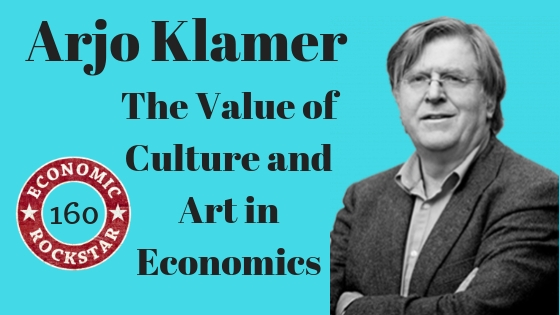
160: Arjo Klamer on the Value of Culture and Art in Economics
October 4, 2018 by Frank

http://traffic.libsyn.com/economicrockstar/160_Arjo_Klamer__Final.mp3
Play in New WindowDownload

160: Arjo Klamer on the Value of Culture and Art in Economics


Arjo Klamer is professor of the Economics of Art and Culture at Erasmus University in Rotterdam, The Netherlands, and holds the world’s only chair in the field of cultural economics. Prior to that and after acquiring his PhD at Duke University, he taught for many years at several universities in the US, including Wellesley College and George Washington University.

In 1984, he attracted a great deal of attention with his Conversations with Economists. He has collaborated with Deirdre McCloskey to promote the rhetorical perspective on economics.

His current research focuses on the cultural dimension of economic life and the values of art.

His latest book ‘Doing the Right Thing: A Value Based Economy’ is part of the conversation in this episode. This book is for all those who are seeking a human perspective on economic and organizational processes. It lays the foundations for a value based approach to the economy.

The value based approach is another economics; it focuses on values and on the most important goods such as families, homes, communities, knowledge, and art. It places economic processes in their cultural context.

The value based approach restores the ancient idea that quality of life and of society is what the economy is all about. It advocates shifting the focus from quantities (“how much?”) to qualities (“what is important?”).

Economics:

In this episode Arjo mentions: Altruism, reciprocity, externalities and animal spirits,

Economists:

In this episode Arjo mentions: Deirdre McCloskey, Russ Roberts, Adam Smith, John Maynard Keynes, F. A. Hayek,

Other Episodes Mentioned in this Conversation:

  • 104: Russ Roberts on How Adam Smith Can Change Your Life and the Theory of Moral Sentiments
  • 114: Deirdre McCloskey on Equality and Greed and How To Be a Very Good Economist

Books:

  • Doing the Right Thing: A Value Based Economy by Arjo Klamer
  • The value of culture: On the Relationship Between Economics and Arts by Arjo Klamer
  • Conversations with economists by Arjo Klamer
  • Bourgeois Equality: How Ideas, Not Capital or Institutions, Enriched the World by Deirdre McCloskey
  • Emotional Intelligence: Why It Can Matter More Than IQ by Daniel Coleman

Patreon

If you’re a fan of the podcast and would like to show your support in anyway, please check out my Patreon page at www.patreon.com/economicrockstar where you can sign up for any of the awards for as little as $1 a month or you can simply follow me on Instagram, the Economic Rockstar Facebook page or on Twitter or simply recommend the show to a friend, especially if they have never had the opportunity to study economics.

http://traffic.libsyn.com/economicrockstar/160_Arjo_Klamer__Final.mp3

Podcast: Play in new window | Download
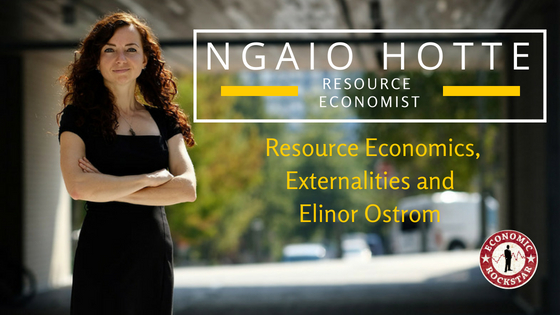
147: Ngaio Hotte on Resource Economics, Externalities and Elinor Ostrom

July 8, 2018 by Frank

http://traffic.libsyn.com/economicrockstar/147_Ngaio_Hotte_Final.mp3
Play in New WindowDownload

147: Ngaio Hotte on Resource Economics, Externalities and Elinor Ostrom


Ngaio Hotte is co-founder of the consultancy firm Resource Economics Group, which is based in British Columbia in Canada. Resource Economics Group specializes in natural resources policy, planning and management. They do research and support decision-making related to the many values of natural resources and trade-offs associated with managing these values for the benefit of people and the planet.

Ngaio is a Ph.D candidate at the University of British Columbia. Her research title is ‘How can trust be built among parties engaged in collaborative natural resource governance?’ and she draws influence from the work of the only female Nobel laureate in economics, Elinor Ostrom.

Ngaio’s Research Interests include trust, government-to-government relations, Indigenous communities, collaboration and natural resources and we touch on some of these topics in out conversation in this episode.

You can find out more about Ngaio’s work at www.resource-economics.ca.

Economics:

In this episode, Ngaio mentions and/or discusses: Elasticity of demand, externalities, substitutes, meat tax, carbon tax, resource extraction, resource management, tanker spills, New Institutional Economics, game theory, private ownership, the Tragedy of the Commons, the Broken Window Fallacy, reciprocity, trust and self-interest. 

Economists:

This episode mentions and/or discusses: Elinor Ostrom, Garrett Harden (Tragedy of the Commons), Donald J. Boudreaux, Cameron Murray, Jason Shogren and Herbert Gintis.

  • What is an externality and examples of negative and positive externalities.
  • The market value for the pollination that is created by the honey bees – people will pay bee keepers to bring their hives to certain areas so that they can pollinate the plants.
  • Addressing the negative externality of oil spillages using a carbon tax.
  • The Broken Window Fallacy.
  • Is it better for the environment and for the minimisation of pollution to have the private ownership rather than the public ownership of lands and waters?
  • Collective action by Elinor Ostrom.
  • Crack Gardens in Tokyo and Guerrilla Gardening in parkways between sidewalks and parking spots.
  • Ron Finley: Gangsta Gardener for the Urban Community– all in search for organic apples nearby and failed.
  • How tax breaks in Vancouver can beautify the landscape and generate positive externalities.
  • Writing advice.

Papers:

  • Hotte, N. and U. Rashid Sumaila, (2014). How much could a tanker spill cost British Columbians? Environment, Development and Sustainability, February 2014, Volume 16, Issue 1, pp 159–180.
  • Garrett Harden (1968). The Tragedy of the Commons. Science, New Series, Vol. 162, No. 3859 (Dec. 13, 1968), pp. 1243-1248 

Organisations:

  • Resource Economics Group: Check out the list of projects, op-eds and articles written by Ngaio Hotte here.
  • Shifting Growth

Other Links:

  • Hotte, N. (November 2, 2015). Urban forestry and the greening of Canadian cities. Spacing.

  • Nobel Speech by Elinor Ostrom: Beyond Markets and States: Polycentric Governance of Complex Economic Systems

  • Ostrom’s the Movie: Elinor Ostrom’s Governing the Commons and the Cooperative Enterprise Movement by Barbara Allen

  • Ron Finley: Gangsta Gardener for the Urban Community: www.ronfinley.com
  • TED: Ron Finley A guerilla gardener in South Central LA

Books:

  • Governing the Commons: The Evolution of Institutions for Collective Action by Elinor Ostrom

Patreon:

If you’re a fan of the podcast and would like to show your support in anyway, please check out my Patreon page at www.patreon.com/economicrockstar where you can sign up for any of the awards for as little as $1 a month or you can simply follow me on the Economic Rockstar Facebook page or on Twitter or simply recommend the show to a friend, especially if they have never had the opportunity to study economics.

http://traffic.libsyn.com/economicrockstar/147_Ngaio_Hotte_Final.mp3

Podcast: Play in new window | Download
082: Peter Boettke on Smith and Keynes and Why We Should Be ‘Living Economics’

April 21, 2016 by Frank

http://traffic.libsyn.com/economicrockstar/082_Peter_Boettke.mp3
Play in New WindowDownload

082: Peter Boettke on Smith and Keynes and Why We Should Be ‘Living Economics’

Peter Boettke is Professor of Economics and Philosophy at George Mason University, the BB&TPeter Boettke Economic Rockstar Professor for the Study of Capitalism, and the Director of the F.A. Hayek Program for Advanced Study in Philosophy, Politics, and Economics at the Mercatus Center at George Mason University.

Peter is now the co-author, along with David Prychitko, of the classic principles of economics texts of Paul Heyne’s The Economic Way of Thinking.

Professor Boettke’s most recent book, Living Economics, provides a resource for how teachers and students can engage in many fascinating questions in economics and illuminates the core principles that should guide our thinking.

Peter’s efforts in the classroom have earned him a number of distinctions including the Golden Dozen Award for Excellence in Teaching from the College of Arts and Sciences at New York University and the George Mason University Alumni Association’s 2009 Faculty Member of the Year award.

Peter’s research has primarily been in the area of comparative political and economic systems and the consequences with regard to material progress and political freedom.

Economics:

In this episode, Peter mentions: Classical economics, Austrian economics, Keynesian economics, credit transmission, institutions, the invisible hand, mainline economics, mainstream economics, private property, public choice, rent-seeking, opportunity cost, scarcity, exchange, markets, negative externalities, laissez-faire, Coase theorem, Pigouvian tax, reciprocity, inflation, stagflation and Malthus’ theory of The General Glut.

Economists:

In this episode, Peter mentions: Adam Smith, F. A. Hayek, Ludwig von Mises, Milton Friedman, Paul Samuelson, John Maynard Keynes,Frédéric Bastiat, David Hume, Vernon Smith, Thomas Robert Malthus, J. K. Galbraith, Paul Heyne, Hyman Minsky, Thorstein Veblen, Steve Keen, Ben Bernanke, Arthur Pigou, Gordon Tullock, James Buchanan, Robert Coase, Elinor Ostrom, Vincent Ostrom and Major Douglas.

Papers:

  • Teaching Austrian Economics to Graduate Students
  • Beyond Equilibrium Economics: Reflections on the Uniqueness of the Austrian Tradition

Books:

  • Living Economics: Yesterday, Today, and Tomorrow by Peter J. Boettke
  • The Economic Consequences of Peace by J. M. Keynes
  • The End of Laissez-Faire by J. M. Keynes
  • The Rogue Gallery of Economic Thinkers by J. M. Keynes
  • The Road to Serfdom by F. A. Hayek
  • Challenging Institutional Analysis and Development: The Bloomington School by Paul Dragos Aligica and Peter Boettke
http://traffic.libsyn.com/economicrockstar/082_Peter_Boettke.mp3

Podcast: Play in new window | Download

043: Herbert Gintis on Game Theory and the Multidisciplinary Approach to Understanding Human Behavior

July 30, 2015 by Frank

http://traffic.libsyn.com/economicrockstar/043_Herbert_Gintis_Final.mp3
Play in New WindowDownload

043: Herbert Gintis on Game Theory and the Multidisciplinary Approach to Understanding Human Behavior

Herbert Gintis is Emeritus Professor of Economics at University of Massachusetts and visiting Professor at Central European University.Herbert Gintis

He is known for his theoretical contributions to sociobiology, especially altruism, cooperation, epistemic game theory and gene-culture co-evolution.

Herbert has a B.A and M.A in Mathematics but switched his PhD program at Harvard from mathematics to economics.

Professor Gintis was part of a group of economists who developed their ideas on a new economics which encompassed issues of alienation of labor, racism, sexism, and imperialism.

Herbert has worked extensively with economist Samuel Bowles, writing their landmark book, Schooling in Capitalist America.

One of Herbert’s latest books The Bounds of Reason emphasises the unification of economic theory with sociobiology and other behavioral sciences which, in the words of Nobel Prize-winning economist, Vernon L. Smith, “is firmly in the revolutionary tradition of David Hume (Convention) and Adam Smith (Sympathy)”.

In the episode you will learn:

  • about the importance of trans-disciplinary research and the importance of collaboration with other disciplines.
  • why economics is not the only social science that explains human behavior.
  • how biology, economics and sociology explain the behaviour of humans in different ways and which discipline is correct?
  • about the Ultimatum Game and how it shows the cooperative and non-cooperative behaviour of humans.
  • about the morality of humans and how we reciprocate kindness with kindness and unkindness with unkindness.
  • why reciprocity makes humans so successful as a species.
  • why some species have a symbiotic relationship with other species which is not the same as reciprocity.
  • how we can fit all the human feelings together to form a multi-disciplinary approach to understanding human behavior.
  • why we always need a system to punish free-riders and non-cooperators.
  • how the future structure of the University can be seen at Arizona State University today.
  • why we need a new generation of thinkers and research centres who are trans-disciplinary.
  • what projects Professor Herbert Gintis is working on right now.
  • why morality controls politics and your vote will not make a difference.
  • how Herbert gets things done in terms of writing books and journal articles.
  • why Herbert did not like The Black Swan by Nassim Nicholas Taleb.
  • about Herbert’s disagreement with Nassim Nicholas Taleb.
  • why Herbert believes that macroeconomics is wrong and is in agreement with Taleb on that issue.
  • the goal of economic policy is not to predict but to put in place economic and social policies that prevent really bad outcomes.

Influencers:

Kenneth Arrow, John Maynard Keynes, Adam Smith and Albert Einstein.

Economics:

In this interview, Herbert mentions and discusses: Marx, rationality, game theory, rational actor model, experimental economics, prisoners dilemma, the ultimatum game, labor market, reciprocity and morality.

Economists:

In this interview, Herbert mentions and discusses: Vernon Smith, Samuel Bowles, Ernst Fehr, Kenneth Arrow and Nassim Nicholas Taleb.

On Math Being the Core Link to Multi-Disciplinary Knowledge:

“It’s really hard in the Behavioral Sciences to get too close to any one thinker because they’re all tainted by disciplinarianism. We need a new generation of thinkers who really think in all of these disciplines at the same time. As long as you can do the math. If you can’t do the math, you can’t do economics or you can’t do biology. If you can do the math, and you know statistics, there’s no reason why you shouldn’t know all of the fields. We need a generation of people who do that. The reason it’s possible now is the internet. Now, there’s no reason for disciplinary isolation. I think the next generation of behavioral scientists is going to much more broad”.

Arizona State: The Next Generation University… Today

Arizona State University is organised trans-disciplinarily. They don’t have traditional disciplines. They have subject areas depending on who asks questions and subject areas there from all sorts of disciplines. Herbert Gintis believes that’s what the future is going to be like, where you abandon the disciplines and add new research centres based on asking questions like climate change, cooperation, epidemiology, warfare, political structure, etc. And then you just hire people who can do that and talk to each other. It is exciting. It will happen. But it will take a long time because the whole organisation of the university is in terms of disciplines.

All of the real advances in the Behavioral Sciences fall in between the disciplines. It requires you do it all at the same time. it’s likely that at the forefront of change in the Behavioral Sciences will be funding organisations, governmental organisations like the NFF in the United States and the ESF in Europe. 

Quotes by Professor Gintis in Episode 043 of the Economic Rockstar Podcast:

Disciplines are almost like a feudal fiefdom. So it’s very hard to do trans-disciplinary research but that’s where all the real action is these days. Not only in behavioral science but in natural science – Herbert Gintis.

As far as I’m concerned, all of life is game theory. It’s the interaction of strategic interaction of individuals of all discipline species and types and races. So game theory comes first – Herbert Gintis.

Human success is not based on selfishness. It’s based on our ability to cooperate – Herbert Gintis.

Click To Tweet

“The real enemy of understanding humans is the notion that we’re all selfish. It’s just not true – Herbert Gintis

To do creative work, you have to have time. Once you have time, you get a lot of work done – Herbert Gintis.

“What I like to do most in the world is to read and write. That’s what I do” – Herbert Gintis.

“I did not like The Black Swan at all. It made fun of science. It made fun of statistics. It capitalised on a unique event, the financial crisis of 2008, and he used it to say economics is a bunch of crap. I think that’s just a bad mistake and I had some run-ins with him on the web. He thinks that science is about prediction. Now prediction is important but that’s not what science is about. It’s about expectation” – Herbert Gintis.

Projects Herbert Gintis is Working on Right Now:

Non-consequential behaviour in politics: 

“People participate politically even when they don’t make any difference. In all English-speaking countries, no election with more then 40,000 voters has ever been won by one vote. Meaning that no individual has ever made a difference in a political booth. Political structures are moral structures and they don’t necessarily reflect particular self-interest concerns” – Herbert Gintis.

Resources:

  • Herbert created his own word processor and uses LaTex for mathematical equations.
  • The Web.
  • Evernote
  • Scrivener

Recommended Books:

  • The Bounds of Reason: Game Theory and the Unification of the Behavioral Sciences by Herbert Gintis
  • A Cooperative Species: Human Reciprocity and Its Evolution by Samuel Bowles and Herbert Gintis
  • Schooling in Capitalist America: Educational Reform and the Contradictions of Economic Life by Samuel Bowles and Herbert Gintis
http://traffic.libsyn.com/economicrockstar/043_Herbert_Gintis_Final.mp3

Podcast: Play in new window | Download

Frank Conway

Frank Conway is founder of Economic Rockstar and lecturer of economics, finance and statistics. Read More…

View My Blog Posts

Youtube Sub

Become a Patron of the Economic Rockstar Podcast

patreon

Ireland’s Economy by the Numbers

Leaving Cert Economics: Ireland’s Economy  Click here to download a workbook on Ireland’s Economy so that you can add your own notes. [Original size] Ireland’s Economy by fconway

Categories

Subscribe and Never Miss An Episode

itunes-logo

Recent Posts

  • Ireland’s Economy by the Numbers April 8, 2019
  • 174: Wendy Carlin on The Core Project, Capitalism, Democracy and Normative Statements February 13, 2019
  • 173: Stephen Wright on Core Econ as a Learning Resource for Mainstream Economics January 28, 2019
  • 172: Best of 2018 Part 2: From the Great Depression to Futurism; Institutions, Individualism, Cooperation and Reciprocity January 22, 2019
  • 171: Best of 2018 Part 1 January 3, 2019

Copyright © 2026 · Podcast Pro Theme on Genesis Framework · WordPress · Log in

This website uses cookies to improve your experience. We'll assume you're ok with this, but you can opt-out if you wish. Accept Reject Read More
Privacy Policy

Privacy Overview

This website uses cookies to improve your experience while you navigate through the website. Out of these, the cookies that are categorized as necessary are stored on your browser as they are essential for the working of basic functionalities of the website. We also use third-party cookies that help us analyze and understand how you use this website. These cookies will be stored in your browser only with your consent. You also have the option to opt-out of these cookies. But opting out of some of these cookies may affect your browsing experience.
Necessary
Always Enabled
Necessary cookies are absolutely essential for the website to function properly. This category only includes cookies that ensures basic functionalities and security features of the website. These cookies do not store any personal information.
Non-necessary
Any cookies that may not be particularly necessary for the website to function and is used specifically to collect user personal data via analytics, ads, other embedded contents are termed as non-necessary cookies. It is mandatory to procure user consent prior to running these cookies on your website.
SAVE & ACCEPT