• ABOUT
  • RESOURCES
  • PODCAST
  • BOOKS
  • BLOG
  • SUPPORTERS
  • QFA Financial Advice
  • CONTACT

Economic Rockstar

Connecting Brilliant Minds in Economics and Finance

085: Michael Roberts on Understanding Karl Marx and His Thinking on Capitalism
May 12, 2016 by Frank

http://traffic.libsyn.com/economicrockstar/085_Michael_Roberts_Final_.mp3
Play in New WindowDownload

085: Michael Roberts on Understanding Karl Marx and His Thinking on Capitalism

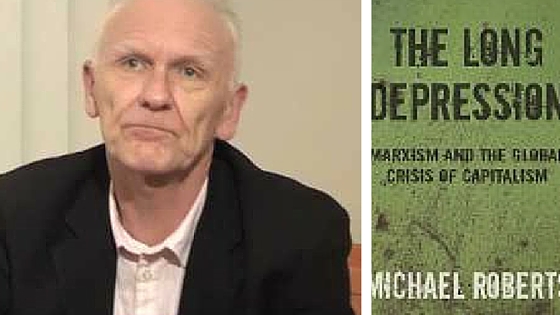
Michael Roberts

Michael Roberts has worked as an economist for over 30 years in the City of London. He is author of The Great Recession: Profit cycles, economic crisis A Marxist View and The Long Depression: Marxism and the Global Crisis of Capitalism.

Economics:

In this episode, Michael mentions: Marxism, capitalism, Austrian economics, GDP, multinationals, inflation, printing of money, booms, busts, profitability, recession, depression, inequality, wealth, means of production, private property, competition, externalities, unintended consequences, bailout, austerity and unemployment.

Economists:

In this episode, Michael mentions: Karl Marx, Friedrich Hayek, Adam Smith, John Maynard Keynes, Brad DeLong and Paul Mattick.

Links:

  • www.thenextrecession.wordpress.com by Michael Roberts

Books:

  • The Great Recession: Profit cycles, economic crisis A Marxist View by Michael Roberts
  • The Long Depression: Marxism and the Global Crisis of Capitalism by Michael Roberts
  • The Communist Manifesto by Karl Marx and Friedrich Engels
  • Capital by Karl Marx
  • Business As Usual by Paul Mattick
  • Waiting for Godot by Samuel Beckett


http://traffic.libsyn.com/economicrockstar/085_Michael_Roberts_Final_.mp3

Podcast: Play in new window | Download
083: Stephen Kinsella on Stock Flow Models, Rent Controls and Being the Green Lantern of Economics

April 28, 2016 by Frank

http://traffic.libsyn.com/economicrockstar/083_Stephen_Kinsella.mp3
Play in New WindowDownload

083: Stephen Kinsella on Stock Flow Models, Rent Controls and Being the Green Lantern of Economics

Stephen Kinsella is a Senior Lecturer in Economics at the Kemmy Business School, the University of Stephen KinsellaLimerick in Ireland and a Research Fellow at the Geary Institute at University College Dublin. He is currently visiting Professor of Economics at Université Paris.

Stephen has two PhD’s, is well published in many Economics Journals and has won several grants worth around 1.5 million Euro.

Stephen’s area of expertise is in the study of the Irish and European economies.

He has written 4 books:

  • Ireland in 2050: How we will be Living
  • Understanding Ireland’s Economic Crisis: Prospects for Recovery
  • QuickWin Economics and
  • Computable Economics.

Stephen is a weekly columnist for the Sunday Business Post newspaper and he also has his own website stephenkinsella.net which is amazingly rich in content, covering issues on the Irish and European economy as well as material he covers in his lectures.

Economics:

In this episode, Stephen mentions: stock flow consistent models, rent controls, GDP, wealth, consumption, government expenditure, investment, net exports, debt-to-GDP, stock of unemployed-to-flow of the labor force, taxes, austerity, QE, pro-cyclical policy, unemployment, automatic stabilizers, Brexit, foreign direct investment, hyperinflation, purchasing power of money, housing, pricing mechanism and money supply.

Economists:

In this episode, Stephen mentions: Wynne Godley, Lance Taylor, Marc Lavoie, Kevin O’Rourke, Philip Lane, Dermot McAleese, Edward Nell, Carmen M. Reinhart, Kenneth S. Rogoff and Joseph Stiglitz.

In this episode you will learn:

  • how and why Stephen completed two PhD’s and how he completed his first within 12 months.
  • about stock flow consistent models.
  • about the features of a stock flow model.
  • why the Irish government bailed out the banks.
  • how Ireland received ‘help’ from international economies, particularly the US and the UK, to quickly move out of a recession since the Great Financial Crisis.
  • whether Ireland will suffer if the UK left the EU in the so-called Brexit.
  • how rent controls lead to an inefficient market outcome.

Links:

  • Institute of New Economic Thinking

Papers:

  • Stephen Kinsella (2001). Hedgehog Logic – the Problems of Econometrics Today. Student Economic Review.
  • Stephen Kinsella (2007). Logarithms: A Tutorial.

Books: 

  • QuickWin Economics-Answers to Your Top 100 Economics Questions by Stephen Kinsella
  • Ireland in 2050: How we will be Living by Stephen Kinsella
  • Understanding Ireland’s Economic Crisis: Prospects for Recovery by Stephen Kinsella
  • Monetary Economics An Integrated Approach to Credit, Money, Income, Production and Wealth by Wynne Godley and Marc Lavoie
  • Swimming with Sharks: My Journey into the World of the Bankers by Joris Luyendijk
  • This Time Is Different: Eight Centuries of Financial Folly by Carmen M. Reinhart and Kenneth S. Rogoff
  • Seeing Like a State: How Certain Schemes to Improve the Human Condition Have Failed by James Scott
http://traffic.libsyn.com/economicrockstar/083_Stephen_Kinsella.mp3

Podcast: Play in new window | Download
077: The Irish Economy 100 years on from the 1916 Easter Rising

March 17, 2016 by Frank

http://traffic.libsyn.com/economicrockstar/077_Ireland.mp3
Play in New WindowDownload

077: The Irish Economy 100 years on from the 1916 Easter Rising

This is a commemorative episode celebrating the 100 year anniversary of Ireland’s 1916 Easter Rising in which the Proclamation of the Republic was read by Padraig Pearse at four minutes past noon on Easter Monday, April 24th, from the steps of the General Post Office on Sackville Street (now known as O’Connell Street). The document proclaimed Ireland’s independence from Great Britain.

How was Ireland’s economy performing in 1916 and how far have we come 100 years on?

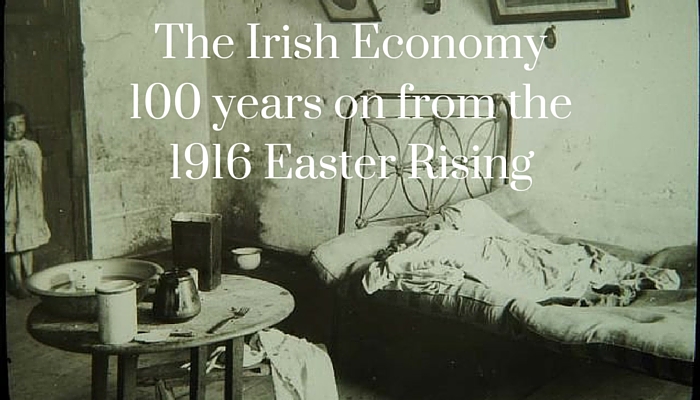
The Irish Economy 100 years on from the 1916 Easter Rising

Background:

Ireland in 1916, consisting of 32 counties, was ruled by Great Britain. The 32 county economy experienced a period of unprecedented prosperity mainly due to the positive economic effects of the First World War.

However, since the Great Irish Famine of 1846, Ireland experienced mass emigration and large numbers of deaths. The laissez-faire economic ideology was a failure. From the period 1851 to 1916, over 5 million Irish citizens emigrated reducing the population from a peak of approximately 8 million to 3 million.

The Irish economy was ruled by Great Britain and its economy became increasingly tied to trends in global markets. The cost of living increased and there were some rises in living standards. These were subject to sharp declines due to the recessions of 1859 to 1863 and 1877 to 1880. Poverty was widespread and tensions between landlords and tenant farmers escalated. Despite this poverty, Irish living standards were above most of Eastern and Central Europe but income levels remained below the UK and the US.

Ireland’s economy became increasingly reliant on four main industries: Agriculture, Linen production, Shipbuilding (where the Titanic was built) and Brewing and Distilling. However, agricultural exports were heavily dependent on Great Britain and Shipbuilding was dependent on an outdated industry. For example, it wasn’t long after the First World War that the Irish Shipbuilding industry collapsed.

The First World War of 1914 brought about a period of prosperity for Ireland, due to the increased demand for food, linen and ships that were directly linked to the war effort. However, this prosperity was not shared by all.

So what did the Irish economy of 1916 look like compared to its economy today 100 years on?

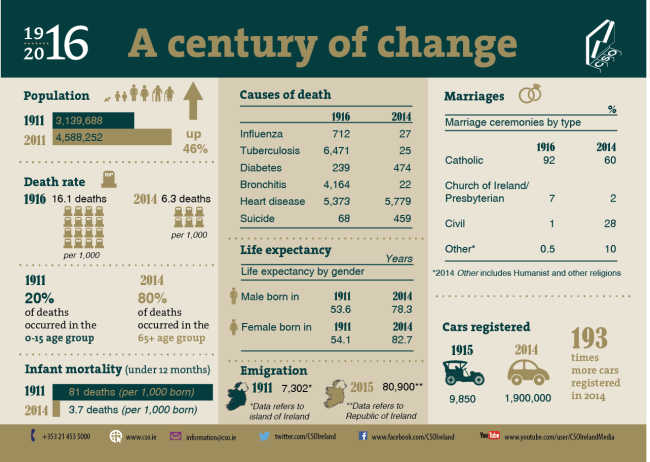
CSO 1916 - 2016 infographic

Source: Central Statistics Office

Population:

The population of Ireland in 1916 was one of the lowest recorded in its history. According to the population census of 1911, the population stood at just 3.14 million. It represented a country devastated by death caused by the famine over a half century previous and the subsequent mass emigration that ensued.

A 9-year-old Irish immigrant laborer shucks oysters in front of his foreman in the U.S. in 1911. pic.twitter.com/cOKICWk8Ta

— HISTORY (@HISTORY) April 12, 2016

Today, Ireland’s population has recovered to 4.59 million, an increase of 46%. However, many have emigrated due to the financial crisis of 2007, most notably Ireland’s youth. We have reverted to being a net emigration population after a period of becoming a net immigration population, attracting workers from overseas as well as bringing Irish people home.

Emigration for the whole island of Ireland in 1916 was 7,366 or 17 per 10,000 of the population. This had fallen from a substantial level before the outbreak of the Great War. The latest data for 2015 shows emigration for the Republic of Ireland at 80,900 representing 175 per 10,000 of the population.

Emigration in 1916 consisted of 5,580 females and only 1,786 males. This I found surprising.

The four main destinations for Irish emigrants in 1916 were the US, the UK, Canada and then Australia.

In 2015, the UK was the main destination for Irish emigrants. Only 7% of emigrants went to the US in 2015 compared to 58% emigrating in 1916.

The Irish diaspora abroad is quite large. Despite being a small island off Western Europe, Irish smiles have been welcomed all over the world. Ancestry can be traced back to Ireland particularly for those living in the United States, the UK, Argentina, Australia and Canada.

Today, it is estimated that there are 80 million people of Irish descent living around the world today. Other that the Republic of Ireland and Northern Ireland, Montserrat in the Caribbean is the only other country where St. Patrick’s Day is a public holiday.

Montserrat is known as the Emerald Isle of the Caribbean and it’s Irish heritage dates back to the 17th century when the island became a safe haven for the Irish who were originally sent to the Caribbean as slaves by Great Britain’s leader Oliver Cromwell. A census in 1678 showed that more than half of the population on the island were Irish.

Life Expectancy:

According to records for 1911, the life expectancy for a male born in Ireland was 53.6 years and for a female 54.1 years. Today, a male born in Ireland has a life expectancy of 78.3 years and a female 82.7 years.

Despite the period of prosperity, Ireland remained divided in terms of the gap between wealth and poor. Much of rural Ireland in the west of the country lived as an agrarian society, dependent on agriculture for a living. Living standards were much lower relative to other parts of the country.

Urban areas did not escape the ravishes of poverty. Inequality was more prevalent in urban towns, particularly in Dublin city. Despite a boom in food and linen exports in 1916, the Irish poor remained hungry.

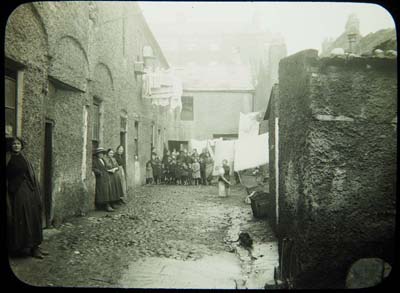
Henrietta Place, Dublin 1913. The flight of wealth to the suburbs often meant an escape from inner city squalor.

Henrietta Place, Dublin 1913. The flight of wealth to the suburbs often meant an escape from inner city squalor.

Poverty levels in Ireland today are at 8% with households consisting of one adult and one or more dependent children considered most at risk. Rural Ireland, including the West of Ireland, has a higher incidence of poverty than the rest of the country. As the saying goes, things change but always stay the same!

Many adults and children perished due to influenza, bronchitis and tuberculosis. These were the leading causes of death in Ireland along with heart disease. Today, heart disease is the leading cause of death in Ireland with few incidences of death from the other forms. The number of deaths by suicide that was officially recorded in 1916 were 68 compared to 459 for 2014, This represented 10 per 100,000 of the population compared to approximately 2 per 100,000 of the population.

Housing:

Ireland’s macro economy of 2016 is showing remarkable progress since it’s recession, bailout and financial crisis. The Irish have a love affair with housing. Perhaps it has its roots in history where many people were evicted from their homes during the Great Irish Famine.

During the boom from 1998 to 2007, Irish house prices soared only to come crashing down once the crisis hit. At its peak, over 90,000 houses were built but today only 11,000 houses were completed. The Irish housing market is under immense stress with demand outstripping supply. This shortage is resulting in much higher rents than what was recorded during the boom period. House prices are recovering but recent government legislation is making it difficult for landlords who are selling their property or evicting their tenants in order to capture the higher rental yields. Ireland is undergoing a housing crisis in today.

In 1916, Ireland experienced a severe housing crisis. Dublin and other cities became infamous for the living conditions of its citizens. The tenements, where many impoverished families lived, marked a bleak period in recent Irish history.

Multiple families shared large terraced houses with extremely poor sanitary and hygiene conditions. It was estimated at the time that 20,000 families in Dublin occupied single rooms and in some cases with other families. Family sizes of 8 or 10 children were not unusual. There were cases of 104 people occupying a single house built to accommodate one family.

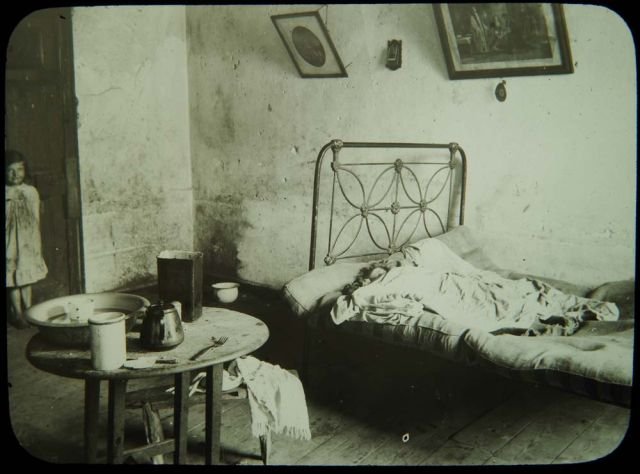
A Tenement Room on Francis Street, Dublin in 1913

A Tenement Room on Francis Street, Dublin in 1913

Many evictions took place as families fell behind in rent. Facing starvation, children queued for bread which was handed out by religious orders. Many people in the West of Ireland emigrated due to food shortages and abandoned their homes. Despite many empty homes in the rural parts of Ireland, many families suffered homelessness, extremely poor living conditions and starvation.

Due to the housing crisis that Ireland is experiencing today in 2016, there are some echoes of the past. Homelessness has jumped 100% since January 2015. Over 700 families are living in emergency accommodation in hotels and guest houses. Evictions are up significantly and there are currently 17,000 people in the courts who are at risk of losing their homes. Food parcels are being handed out each week and the number queuing is rising.

Employment:

The Irish economy in 1916 was transitioning toward becoming an industrial nation. It was by no means considered backward and was in fact placed in the group of middle-ranking industrialised countries along with the Netherlands, the Scandinavian countries, Italy and Portugal.  26.8% of workers in 1911 worked in manufacturing jobs compared to 8.6% in 2011.

An estimated 150,000 men had joined the British army and many men and women went to the UK to find employment in munition factories and hospitals. Wages had increased during this time.

Almost 50% of the working population were employed in the Agriculture sector in 1911. This compares to just 4.9% in 2011.

In 1911, 8.8% of the labour force in Ireland worked in the professional group of occupations. By 2011, these workers now account for over 40% of the Irish workforce.

Ireland’s unemployment rate today is 8.8% coming from a recent high of 14.4%. It is unsure what the level was in 1916.

Exports:

Ireland in 1916 mostly consisted of indigenous industries. 85,000 workers were employed in linen production with over 18 million pounds (weight) of linen yarn and 112 million pounds (weight) of finished linen goods exported. Prior to the outbreak of World War I in 1914, about 70% of these exports were to the United States of America. However between 1914 and 1918, linen was in great demand for military purposes by the British Army for items such as tents, haversacks, hospital equipment and aeroplane fabric.

Today much of its traditional industry gone today. Very few linen manufacturers and weavers exist today. To bring my own personal family history into this story, my family remains one of a few linen weavers in Ireland today, producing the best Irish linen in the market with exports to countries that include Japan, the US and Italy. I’m personally proud of my father for what he has achieved and for extending the Irish tradition of producing the finest linen in the world.

Ireland is considered a small open economy and the UK still remains one of our largest trading partners. The Irish economy attracts many multinationals companies to locate here. In 2016, Ireland ranks among the top countries regarding industrial competitiveness and ease of doing business.

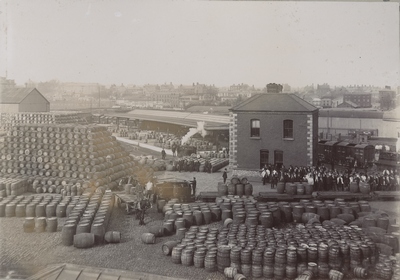
The Guinness brewery was the main brewery in Ireland and in 1916 it had the largest output of any brewery in the world, brewing more than two-thirds of all beer brewed in Ireland.

Cask Yard St. James' Gate Brewery 1906 - 1913

Cask Yard St. James’ Gate Brewery 1906 – 1913

The largest exporting sectors in Ireland during 1916 were woollens, brewing, butter, bacon, poultry, cattle, cotton goods and linen. The sectors that were in decline included horses, whiskey, pigs and sheep.

Ireland had a trade surplus of 1.5 million pounds (and a balance surplus of 11.1 million pounds) in 1916. For the latest data today, which is January 2016, Ireland is operating a trade surplus of 4.99 billion euro. Ireland’s largest exporting sectors are Medical and pharmaceutical products (representing 27% of total exports), Office machines and automatic data processing machines, and Food and live animals (representing 7.8% of our total exports).

The EU accounts for 56% of the total value of Irish goods exported. Belgium is Irelands largest export trading partner accounting for 15% of the total value of goods exported.

Great Britain remains Ireland’s single largest source of imports with 25% of the total value of goods imported to Ireland.

The USA remains Irelands largest non-EU destination for exports and imports.

GDP:

According to research by Kevin O’Rourke of the Department of Economics at University College Dublin a proxy measure for GDP per capita in Ireland was estimated to be 32.50 in 1913. This was based on a GDP estimate of 150 million. To put this into some context, the estimated GDP per capita in 1864 was 12.50 with GDP estimated at 60 million – over a 160% increase in nominal terms between the Famine and the Great War. Irish GDP per capita converged on the UK average during this time.

According to the International Geary-Khamis dollars, Ireland’s GDP per capita in 1913 was $2,736 whereas the US GDP per capita was $5,301 and the UK’s at $4,921, almost twice that of Ireland’s. This seems to suggest that incomes had yet to converge with those in Great Britain.

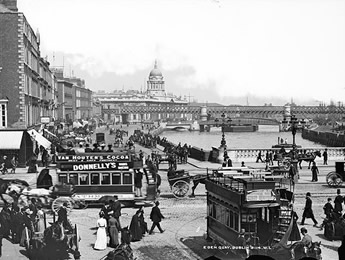
Eden Quay displays the bustle of turn of the century Dublin city life

Eden Quay displays the bustle of turn of the century Dublin city life

Ireland would have been considered one of the poorest Western European countries along with Greece, Italy, Portugal and Spain – yes there’s that familiar acronym of the financial crisis.

Today, Ireland is considered one of the richest countries in the world with GDP per capita of just under $49,000, placing the country in 10th position, with the US in 9th and the UK in 19th according to the World Bank.

GDP for Ireland was $11.9 million but this collapsed to $7.8 million by 1921 perhaps due to the Irish civil war. It was only in 1960 that Ireland recovered to pre-1916 levels.

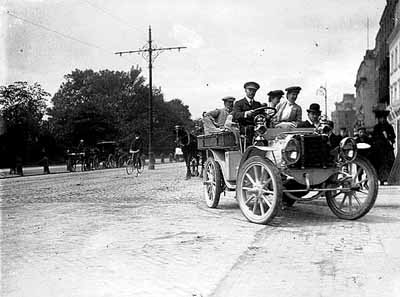
There were 9,850 cars registered in Ireland in 1915 with now over 2 million registered today.

F_Horse, bicycle, Car_Stephen'sGreen_clar21t

Inflation:

Due to the outbreak of the First World War in 1914 and the resulting scarcity of goods, inflation in Ireland increased considerably by 200% over the wartime period as measured by the wholesale price index.

Unless wage inflation was outpacing price inflation in 1916, which is very unlikely, families must have experienced a real reduction in the purchasing power of their £.

These increases in prices were also due to Government policy which increased taxes and duties on various products.

The retail price of butter, tea and eggs were expensive in 1916. For example, the price of a pound of butter then would have cost 7 euro 35 cent updated to today’s consumer price index compared to today’s price of 2 euro 79 cent.

Links:

  • Data: Central Statistics Office
  • Data: International Geary-Khamis dollars by Professor Angus Maddison
  • Paper: Monetary Data and Proxy GDP Estimates: Ireland 1840 – 1921 by Kevin O’Rourke, UCD.
  • Read Ireland’s Proclamation of the Republic where equal rights for all men, women and children was declared along with the creation of a sovereign country.

Family History Research:

  • Ireland’s Census: Search for your Irish Heritage for the following Census years: 1911, 1901, 1851, 1841, 1831 and 1821.
  • National Library of Ireland: www.nli.ie

Images:

  • All images courtesy of the National Library of Ireland
  • Infographic courtesy of the Central Statistics Office
http://traffic.libsyn.com/economicrockstar/077_Ireland.mp3

Podcast: Play in new window | Download

074: Peter Leeson on The Invisible Hook: The Hidden Economics of Pirates

February 24, 2016 by Frank

http://traffic.libsyn.com/economicrockstar/074_Peter_Leeson_.mp3
Play in New WindowDownload

074: Peter Leeson on The Invisible Hook: The Hidden Economics of Pirates

Peter T. Leeson is Duncan Black Professor of Economics and Law at George Mason University.Peter Leeson

He is also a Senior Fellow at the F.A. Hayek Program for the Advanced Study of Philosophy, Politics, and Economics as well as the North American Editor of Public Choice.

Formerly, Peter was Visiting Professor of Economics at the University of Chicago, Visiting Fellow in Political Economy and Government at Harvard University, and F.A. Hayek Fellow at the London School of Economics.

Peter is author of The Invisible Hook: The Hidden Economics of Pirates and Anarchy Unbound: Why Self-Governance Works Better Than You Think.

Peter can be found at PeterLeeson.com.

Economists:

In this episode, Peter mentions and discusses: Ludwig von Miss, F. A. Hayek, Gary Becker, Karl Menger, Steven Levitt, Robin Hanson, Karl Marx, Adam Smith and Peter Boettke.

Economics:

In this episode, Peter mentions and discusses: price theory, human behaviour, Austrian Economics, Chicago School of Economics, economics of self-governance, rational thinking, profit maximisation, incentives, social insurance, externalities, unemployment, governance, self-governance, public goods and rational choice theory.

Pirates were economic actors but they were criminals. Criminal behaviour, as some had suggested, is not very amenable to the economic way of thinking.But Gary Becker pioneered research demonstrating that that wasn’t so.

In this episode you will learn:

  • about the similarities and differences between Austrian Economics and Becker’s thinking in the Chicago School of Economics.
  • why Peter decided to study the economics of pirates.
  • about the scientific approach to economic thinking.
  • how limitations to data restrict analytical research and how historical economic thinking can be used as a form of empirical analysis.
  • how using the economic narrative is just as effective as the mathematical regressions to explain theoretical concepts.
  • the similarities between The Invisible Hand and The Invisible Hook.
  • how pirates were rational thinkers and social revolutionaries.
  • how a hierarchy was established on a pirate ship using the Pirate Code.
  • how the Pirate Code created a social order that was economically beneficial to the crew.
  • about the constitutional democracy that pirates established onboard their ship and the misperceptions we had of an autocratic captain.
  • about some rules, codes of conduct and dispute resolution mechanisms that existed on a pirate ship.
  • how pirates were incentivised to engage in battle with a social fund (moral hazard) that was a predecessor to today’s social insurance policy.
  • how the pirate code minimised or eliminated the impact of a negative externality on a crew member or the whole crew.
  • how Peter’s book dedication, in the form of a marriage proposal, worked out.
  • when did piracy at sea begin and when did the romanticised period of piracy, as we know it, occur.
  • how are the pirates of the early 18th Century, such as Captain Blackbeard, so different to the pirates of today, such as the Somali pirates.
  • how sailors found solace and refuge as buccaneers and pirates after wars, such as the War of the Spanish Succession.
  • why unemployed sailors became buccaneers and pirates.
  • the risk-reward ratio of becoming a pirate.
  • whether pirates actually buried their treasure.
  • how an enterprising society was established at the land bases of pirates.
  • what pirates spent their spoils and treasures on.
  • the signalling effect of the Jolly Roger flag and why pirates used it as they approached a merchant ship.
  • how an ‘honor among thieves’ and collusive agreements between pirate groups allowed them to avoid attacking each other.
  • how coast guards, who were legally allowed to plunder merchant ships, often used the Jolly Roger flag as a signal to deceive their subjects into thinking they were pirates for the purpose of avoiding a bloody battle.
  • why coast guards used the Jolly Roger flag to cash in on the reputation of pirates.
  • if self-governance is effective and more successful that government.
  • whether the free-rider problem would exist in a self-governed economy regarding public goods.

Links:

  • Gary Becker’s Centre on Chicago Price Theory
  • Becker Friedman Institute for Research in Economics: The University of Chicago
  • Episode 072: F. A. Hayek
  • Episode 073: Robin Hanson
  • Episode 055: David Skarbek
  • Journal of Political Economy

Papers:

  • The Invisible Hook: The Law and Economics of Pirate Tolerance by Peter T. Leeson
  • Human Sacrifice by Peter T. Leeson in Review of Behavioral Economics. 

Books:

  • The Invisible Hook by Peter Leeson
  • Anarchy Unbound by Peter Leeson
  • Living Economics by Peter Boettke
  • Economic Approach to Human Behaviour by Gary Becker
  • Human Action: A Treatise on Economics by Ludwig von Mises
http://traffic.libsyn.com/economicrockstar/074_Peter_Leeson_.mp3

Podcast: Play in new window | Download

069: Diane Coyle on GDP, Its Shortcomings and Alternative Measures

January 21, 2016 by Frank

http://traffic.libsyn.com/economicrockstar/069_Diane_Coyle.mp3
Play in New WindowDownload

069: Diane Coyle on GDP, Its Shortcomings and Alternative Measures

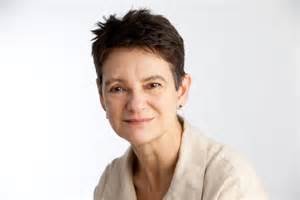
Diane Coyle is Professor of Economics at the University of Manchester and runs the consultancy Enlightenment Economics.diane coyle

Diane is Vice-Chair of the BBC Trust and was a member of the Migration Advisory Committee and a member of the Competition Commission. She is also a visiting research associate at the University of Oxford’s Smith School of Enterprise and the Environment. 

Diane specialises in competition analysis and the economics of new technologies and globalisation.

Diane is the author of several books, including GDP: A Brief But Affectionate History, The Economics of Enough, The Soulful Science, Sex, Drugs and Economics and Paradoxes of Prosperity.

She was previously Economics Editor of The Independent and before that worked at the Treasury and in the private sector as an economist.

Diane has a PhD from Harvard and was awarded the OBE in January 2009.

Using happiness is an excuse for inactivity – Diane Coyle

Click To Tweet

Influencers:

Peter Sinclair (University of Birmingham) and Ben Friedman (Harvard).

Economists:

In this interview, Diane mentions: Adam Smith, John Stuart Mill, Sir Charles Bean, Daron Acemoglu, Thomas Piketty, John McMillan, Tim Harford, Peter Sinclair (University of Birmingham) and Ben Friedman (Harvard).

Economics:

In this interview, Diane mentions: GDP, budget deficit, fiscal policy, monetary policy, interest rates, growth, employment, unemployment, Human Development Index, Gross National Happiness Index, happiness, hysteresis, inequality, financial markets, derivatives and leverage.

In this episode you will learn:

  • what is GDP and how it is measured.
  • the complications with understanding the meaning of GDP.
  • the historical origins of GDP and why it is used to measure our economy.
  • the complications in measuring GDP.
  • how GDP data is still collected in such an ‘old-fashioned’ way and the new methods to collecting data.
  • about the uncertainty and margin of error in GDP statistics.
  • why it is wrong to make fiscal policy, monetary policy and interest rate decisions on GDP statistics.
  • what proxy variables were used to measure economic activity before GDP was introduced.
  • why we should re-think the meaning of the economy.
  • why GDP today doesn’t work in its present form and if there is an alternative.
  • how countries can use GDP and GNP measures to portray different economic conditions.
  • the difference between GDP and GNP.
  • the concerning use of ‘administrative statistics’ by countries to falsify economic growth.
  • whether it’s correct to include illegal drug activity and prostitution in measuring GDP.
  • why measuring happiness and well-being should be of little importance when measuring GDP.
  • why Diane is sceptical about the Happiness Index.
  • the reason why economics was coined by Thomas Carlyle as the the ‘dismal science’.
  • who is to blame for the financial crisis of 2007/2008.
  • about the UK’s over-reliance on the financial sector and its role in measuring GDP.
  • about the uncertainty that would exist if the UK withdrew from the EU.
  • the policy factors required to create a sustainable society and a stable government.


It’s just so easy now to download data from the internet and run through statistical packages and get some results. And I think a lot of professional economists are guilty of not rethinking about their data enough – Diane Coyle

You cannot think about the economy mechanically – Diane Coyle

Click To Tweet

The way we measure GDP now is really closely linked to Keynesian macroeconomic theory and a very famous definition he gave of  what total output in the economy is, that it’s consumer spending, government spending, investment spending and the balance of payments – Diane Coyle

There is no benefit for society in a lot of what happens in the financial markets – Diane Coyle

Click To Tweet

Resources:

  • The Enlightenment Economist
  • Doomsday Book  – Earliest recording of economic activity.
  • Time to ditch GDP as a measure of economic well-being by Diane Coyle 
  • The Review of Economics and Statistics

Favorite Internet Resource:

  • Twitter

If you pick the right people to follow it acts as a brilliant editor of all the interesting information that you might want to know and it’s like having a personalised newspaper – Diane Coyle

Books:

  • GDP: A Brief But Affectionate History by Diane Coyle
  • The Soulful Science: What Economists Really Do and Why It Matters by Diane Coyle
  • The Economics of Enough: How to Run the Economy as If the Future Matters by Diane Coyle
  • Sex, Drugs and Economics: An Unconventional Introduction to Economics by Diane Coyle
  • Paradoxes of Prosperity: Why the New Capitalism Benefits All by Diane Coyle
  • Reinventing the Bazaar: A natural History of Markets by John McMillan
  • The Undercover Economist by Tim Harford
  • The Undercover Economist Strikes Back: How to Run or Ruin an Economy by Tim Harford


http://traffic.libsyn.com/economicrockstar/069_Diane_Coyle.mp3

Podcast: Play in new window | Download

067: Leigh Caldwell on Cognitive Economics and the Mathematics of Behavioral Economics

January 3, 2016 by Frank

http://traffic.libsyn.com/economicrockstar/067_Leigh_Caldwell_Final.mp3
Play in New WindowDownload

067: Leigh Caldwell on Cognitive Economics and the Mathematics of Behavioral Economics

leigh caldwellLeigh Caldwell is a behavioural economist based in London.

Leigh, together with Elina Halonen, runs the Irrational Agency, which takes the latest scientific discoveries in psychology and behavioural economics, blends it with their hands-on experience of marketing and business, and turns them into powerful, incisive market research techniques.

In 2012, Leigh condensed his experience in pricing and the marketing of several of his businesses into a new book The Psychology of Price: How to use price to increase demand, profit and customer satisfaction.

Leigh is co-founder of the London Behavioural Economics Network, writes for the Pricing Revolution and the Knowing and Making blogs, and regularly features as an economics commentator on BBC News, Radio 4, Research Magazine and other media.

My own background is all about intellectual challenge. I went to university early as a teenager. I studied maths and physics. I was always into pushing myself intellectually and finding the next challenge to take on – Leigh Caldwell

Economists: 

In this interview, Leigh mentions: Elina Halonen, Dan Ariely and George Lowenstein.

Economics:

In this interview, Leigh mentions: Behavioral economics, experimental economics, lab experiments, demand curve, equilibrium, utility, mathematics, rationality, nudge, choice architecture, cognitive economics, reference pricing model, anchoring, hyperbolic discounting, heuristics, neuroeconomics, Nudge Unit, organ donation, tax collection, productivity, GDP and unemployment.

In this episode you will learn:

  • why Leigh help co-found the London Behavioural Economics Network (LBEN).
  • the importance of academics and practitioners working together to further the discipline of economics.
  • why finding the sweet-spot between controlled experiments and realism is difficult yet important.
  • what cognitive economics is and how different it is the behavioral economics.
  • whether big data could influence an individuals consumption behaviors.
  • about the need to use the mathematics of computer science in behavioral economics.
  • why we shouldn’t use the current maths of economics to explain human behavior.
  • why a lack of mathematics is holding back the discipline of behavioral economics.
  • why mathematics is essential for theorising and modelling economics, especially behavioural economics.
  • about the paradox of self-awareness in cognitive economics when faced with choices.
  • how a consumers relationship with a material object is a unique experience and how putting a price on the good can ruin this experience.
  • why charging a higher price for your product or service would generate higher profits in a perceived perfectly competitive market.
  • whether the 99p or 99 cent pricing strategy works.
  • about the reference pricing model and why charging $39 for a product is better than charging $34 for the same product.
  • about the importance of setting prices when considering how numbers are spoken, i.e. numbers with more syllables are received to be more expensive than those with fewer syllables. 
  • how Leigh uses the findings in academic papers to make money for his business.
  • how Leigh uses economic conferences to network, to find out about the latest research and to discover the new academic societies that have been established.
  • about Leigh’s goal for 2016 to start a Cognitive Economics Society.
  • about the advice Leigh would give the UK government to apply cognitive and behavioral economics to deal with some aspects of social life.
  • how the UK government changed people’s behaviour about paying their taxes on time.
  • about the productivity challenge the UK government is facing today and what can be done about it.
  • about the current research Leigh is undertaking regarding where our preferences come from.

Conferences:

  • Judgement and Decision Making Conference
  • American Economics Association Conference

Books:

  • The Psychology of Price: How to use price to increase demand, profit and customer satisfaction by Leigh Caldwell.
  • Predictably Irrational by Dan Ariely.
  • Basic Instinct by Pete Luhn
  • Nudge by Richard Thaler
  • Thinking, Fast and Slow by Kahneman and Tversky

http://traffic.libsyn.com/economicrockstar/067_Leigh_Caldwell_Final.mp3

Podcast: Play in new window | Download

053: Helena Norberg-Hodge on Localisation, Trade Treaties and the Economics of Happiness

October 8, 2015 by Frank

http://traffic.libsyn.com/economicrockstar/Helena_Norberg_Hodge_Final.mp3
Play in New WindowDownload

053: Helena Norberg-Hodge on Localisation, Trade Treaties and the Economics of Happiness

Helena Norberg-Hodge is the founder and director of Local Futures. A pioneer of the ‘new economy’ movement, she has been promoting an economics of personal, social and ecological well-being for more than 30 years.Helena Norberg Hodge

Helena is the producer and co-director of the award-winning documentary The Economics of Happiness, and is the author of Ancient Futures: Learning from Ladakh, described as “an inspirational classic”.

Helena has given public lectures in seven languages, and has appeared in broadcast, print, and online media worldwide.

She was honored with the Right Livelihood Award (or ‘Alternative Nobel Prize’) for her groundbreaking work in Ladakh, and received the 2012 Goi Peace Prize for contributing to “the revitalization of cultural and biological diversity, and the strengthening of local communities and economies worldwide”.

Economics:

In this interview, Helena mentions: localisation, globalisation, deregulation, finance, banking, money, real economy, price, demand, subsidies, tax, business alliances, lobbying, competition, trade treaties, unemployment, poverty, natural environment, growth, climate, energy consumption, comparative advantage and GDP.

Economists:

In this interview, Helena mentions: Alex Tabarrok, Adam Smith, David Riccardo,

In this episode you will learn:

  • how and why Helena decided to advocate for and promote localisation.
  • about Ladakh and how it was removed from the rest of the world.
  • how the global market was very destructive to the local market in Ladakh.
  • how globalisation destroyed the livelihood of farms and local businesses and created unemployment.
  • how the happiness and high self-esteem among the people of Ladakh was destroyed after a decade of economic development.
  • why extreme tensions between buddhists and muslims erupted after living in peace for over 500 years in Ladakh.
  • about Ladakh, where the Dalai Lama is the spiritual head.
  • how Ladakh has become a case study on how a local economy has been quickly affected by globalisation.
  • about the phenomenal work Helena is doing to highlight the changing lives and economy of Ladakh and other regions.
  • about the true meaning of the real economy and how cheap money and speculation is destroying it.
  • why the earth is so precious and must be protected before we see irreversible and horrific damage.
  • about the terrific work being undertaken by Local Futures to highlight the need for economic change to protect our earth.
  • why we need to make the local food market a global initiative.
  • how small towns and villages are taking initiatives to feed their community with fresh, organic foods.
  • how schools are integrating nature into their infrastructure to increase the well-being of staff and pupils.
  • how nature provides profound and important psychological healing benefits.
  • how diversifying and staying local can provide more diversified foods per unit of land and water than the large monocultures.
  • why farmers prefer to work closely with the customer than with large-scale supermarkets.
  • whether small farmers and businesses should create a group to represent the their interests and to lobby governments in much the same way as large companies like Volkswagen and Monsanto.
  • how to make small and local businesses more visible.
  • about Helena’s mantra for resistance and renewal – resisting trade treaties and renewing localisation.
  • about the law that was passed in Sweden to have trade treaties to be discussed in secret.
  • how, under the new trade agreements, multinational corporations can sue governments if they inhibit their profit-making ability of that governments country.
  • whether GDP is a good measure of progress and how Helena interprets its true meaning.

Quotes by Helena on the Economic Rockstar Podcast:

“The EU is essentially an economic union and it’s bringing with it a centralised bureaucracy” – Helena Norberg-Hodge

About Earth Being Our Only Economy:

“The earth is our only economy. There’s nothing we use that doesn’t come from the earth. Nothing, nothing. Every iPad, every shoe, every television. And that economy, the real economy, is diversity. It requires and can only continue to live by respecting the uniqueness of every leaf, of every human being. Everything that lives is unique and is changing from moment to moment.” – Helena Norberg-Hodge

“I describe Nature as the economy, but it’s also our Mother. It’s our spiritual home” – Helena Norberg-Hodge

Click To Tweet

“Usually when people talk about the economy, they’re just thinking about paper money. They don’t think about culture and farming as having anything to do with the economy.” – Helena Norberg-Hodge

“The global food economy, from beginning to end, is the biggest contributor to CO2 emissions, and it’s not just because of the factory farming with animals. It’s across the board.” – Helena Norberg-Hodge

About the Stock Market and Cheap Money:

“The market is really young lads sitting in front of computers speculating with huge amounts of money. And they inevitably have to and do favour the giant. They’re betting on the giants ‘horses’ like Monsanto, McDonalds and Walmart. And so this connection between that flood of cheap money created out of thin air, now has become a sort of a ‘blind machinery’ that is eating up the real economy, the earth, extremely rapidly and we’re going to see more horrific examples.” – Helena Norberg-Hodge

Other Quotes:

There is a growing local food market that is going global – Helena Norberg-Hodge

Click To Tweet

GDP is an outrageous measure of progress. It is simply a measure of commercialisation – Helena Norberg-Hodge

With Riccardo and the notion of comparative advantage, it sounds good on the surface. But let’s remember it was brought in in a time of slavery – Helena Norberg-Hodge

Where to Find Helena:

  • Local Futures: www.localfutures.org
  • Economics of Happiness
http://traffic.libsyn.com/economicrockstar/Helena_Norberg_Hodge_Final.mp3

Podcast: Play in new window | Download

046: Shanta Devarajan on The World Bank, Quiet Corruption, Government Failure and Comparative Advantage in the MENA Region

August 20, 2015 by Frank

http://traffic.libsyn.com/economicrockstar/046_Shanta_Devarajan_Final.mp3
Play in New WindowDownload

046: Shanta Devarajan on The World Bank, Quiet Corruption, Government Failure and Comparative Advantage

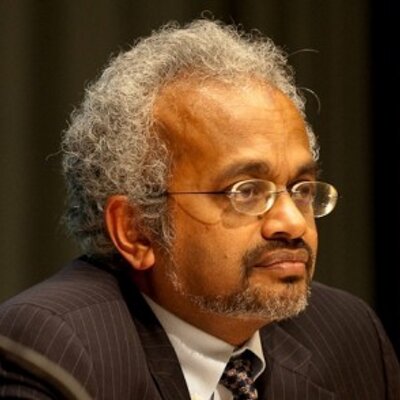
Shantayanan Devarajan is the former Chief Economist of the World Banshanta devarajank’s Middle East and North Africa Region. Since joining the World Bank in 1991, he has been a Principal Economist and Research Manager for Public Economics in the Development Research Group, and the Chief Economist of the Human Development Network, South Asia, and Africa Region.

Shanta was the director of the World Development Report 2004, ‘Making Services Work for Poor People’. Before 1991, he was on the faculty of Harvard University’s John F. Kennedy School of Government.

Shanta is the author and co-author of over 100 publications, with his research covering public economics, trade policy, natural resources and the environment, and general equilibrium modeling of developing countries.

Born in Sri Lanka, Shanta received his B.A. in Mathematics from Princeton University and his Ph.D. in Economics from University of California, Berkeley.

People care so much about education. They will not eat if they can send their kid to a better school – Shanta Devarajan

In this episode, you will learn:

  • why Shanta decided to take a sabbatical from lecturing and never went back.
  • about Shanta’s passion to end world poverty.
  • how experiencing living on a $1 a day with a poor family made Shanta realize that the failure lies with government.
  • how empowering people in poverty-stricken countries with information could be the catalyst to end poverty.
  • the huge government failures and market distortions threatening the economy in India.
  • why teachers and doctors in India are absent from work 25% and 40% of the time respectively and how this is affecting progress.
  • how the powerful medical union in India are making healthcare inaccessible to the poor.
  • why poor people in India think that the reason why doctors do not show up at clinics is because ‘the rain didn’t come’.
  • why politicians in India do not have an incentive to fix the problem of doctor absenteeism.
  • what the solutions to corruption in India.
  • about unemployment being the biggest problem in the Middle East and North Africa.
  • that the reason why unemployment is so high in the MENA region is due the industrial sector being highly monopolised.
  • about how crony capitalism is preventing SMEs from growing in the MENA region.
  • why Tunisia has failed to develop into an export-oriented economy due the legacy of the Ben Ali family and their connections to firms operating in heavily protected markets.
  • that the failure for governments to continue with social contracts due to high deficits triggered the Arab Spring.
  • about Colonel Gaddafi’s regime and how he managed to keep peace between tribes.
  • how water subsidies and water-intensive crops are depleting water resources in Yemen.
  • why the addictive habit of chewing qat or khat in Yemen is causing water shortages.
  • why Yemen, who doesn’t have a comparative advantage in qat, continues to use resources to produce the commodity.
  • what is the main purpose of the World Bank and how different is it to the IMF.
  • where the World Bank gets its finance from and how much interest they charge.
  • how the money trickles down to the unbanked people in low and middle-income countries.
  • about biometric identification smart cards and how the unbanked in low-income countries can access capital.

Takeaway:

The problems of poor people are man-made and we as economists can actually help solve them. The way in which we can solve them is by carrying our work toward empowering them. The reason they’re man-made is that poor people lack political power. We can actually strengthen their clout, their political power, by providing economic analysis and making it accessible to them – Shanta Devarajan

Economics:

In this interview, Shanta mentions and discusses: poverty, development, capital markets, government failure, policy distortion, structural adjustment, debt crisis, macroeconomic environment, incentives, quiet corruption, unemployment, monopoly, social contracts, crowding out, finance capital, subsidies, water subsidies, energy subsidies, comparative advantage, imports, exports, budget expenditures, IMF, the World Bank, MENA, public goods, leakages, multiple effect, dynamic stochastic general equilibrium model, savings, investments, sovereign wealth funds and consumption.

Economists:

In this interview, Shanta mentions and discusses: Chris Blattman, Gerard Debreu , Joseph Stiglitz, Sherman Robinson and Paul Collier 

Influencers:

Gerard Debreu , Joseph Stiglitz, Sherman Robinson , Paul Collier 

Quotes by Shanta Devarajan in Episode 046 of the Economic Rockstar Podcast:

The marginal product of writing an additional paper was lower than my actually trying to go out there and apply what I know to reduce poverty. I became quite passionate about this quest to reduce this poverty. – Shanta Devarajan

The problems of poverty under development are problems of government failure. The problem of government failure is because the political system is one where poor people don’t have sufficient voice and sufficient ability to make sure that politicians take decisions in their interest. – Shanta Devarajan

“The World Banks’ mission is a world free of poverty” – Shanta Devarajan

Click To Tweet

On the changing views of The World Bank:

The traditional view of development in the 1950s and 60s was a belief that it was a market failure. Their capital markets weren’t working. Poor countries didn’t have access to capital and so the World Bank had to provide capital. However, in the 1970s and 80s there was a realisation that the problem was not the result of a lack of capital. There  were policy distortions in these countries that made this capital unproductive. The challenge became trying to remove these policy distortions or try to improve these policies so that capital could be productive. – Shanta Devarajan

On Quite Corruption in India:

Quite corruption in India is a deep political problem. There is nothing illegal about this corruption. It is a failure of the system. The political system is geared so that it creates this kind of corruption. – Shanta Devarajan

On Crony Capitalism in Tunisia:

It’s a little bit of a puzzle why Tunisia, which has a very highly educated population, a very nice location right across from Europe and a pretty good infrastructure, hasn’t been able to be a manufacturing, export-driven power-house. The reason is the industrial structure is being monopolised by the cronies of the political elite. – Shanta Devarajan

On Tunisia: “We must protect this economy from elite capture” – Shanta Devarajan

Click To Tweet

On Capital Leakages in Chad:

The leakages are higher in resource-rich countries. For instance in Chad, the money that was intended for public primary clinics, that actually arrives at the clinic is 1%. So the leakage is 99%. Chad is an oil-rich country. The reason for that is there is very little accountability – Shanta Devarajan

Reasons Why Yemen is Producing Khat (Qat) Inefficiently

Yemen produces its own qat despite not having a comparative advantage in the commodity. Factors of production, such as land, labor and capital, are used inefficiently to produce khat. So, the question remains as to why Yemen does not import qat. There are two main reasons why the continue to produce it domestically.

The first is that qat is consumed fresh. Domestic production allows qat to be distributed and sold throughout Yemen once it is picked. Freshness is required and it is expected that any imported khat could reduce its quality.

The second reason is that the president’s wife manages the qat monopoly and made a lot of money from it. Any imports would be competition. Given that khat is an addictive substance, the revenue made by this monopoly would have been so large that using resources inefficiently, particularly water, outweighed the costs.

The Difference Between the World Bank and the IMF

  • The World Bank only works on developing countries and the IMF works on all countries.
  • The IMF is concerned with short-term macroeconomic development, whereas the World Bank is concerned about long-term development.
  • Anything that is in the order of one to two years is when the IMF will become involved in order to solve a macroeconomic crisis.  Whereas, if it’s a question of building a road or a bridge or educating children, that’s when the World Bank comes in. Both  the IMF and the World Bank, because they’re across the street from each other in Washington DC, communicate quite intensively.
  • In the past, it may have been viewed that the IMF, because it is more macro-focused, was more interested in the aggregate budget rather than the composition of the budget. In the late 1990s, there were many countries that had fiscal crises. The IMF insisted that they cut their budget in order to maintain fiscal balance. However, just cutting the budget rather than cutting wasteful expenditures and protecting some valuable expenditures makes a big difference.
  • It got to the stage where the World Bank would come in and look at the composition of the budget and suggest where it’s better to cut rather than simply take the targets that the IMF had set.
  • Both institutions have evolved quite a bit since the 1990s. The IMF now looks quite closely at the composition of budget expenditures and the World Bank worries a lot about macroeconomic stability.

How The World Bank Funds its Operations

  • The finance that the World Bank accumulates is obtained by World Bank bonds.
  • The World Bank uses the ‘paid-in capital’ which the original members of the World Bank pledged back in 1947. This has now grown to about $300 billion.
  • This capital is used as collateral to float bonds and because of this capital, the World Bank can get bonds at three-quarters of a percent below the market rate.
  • This capital is then lent to middle-income countries at about half to a quarter of a precent below the market rate. The difference between these rates is what pays the salaries of those working for the World Bank.
  • For low-income countries, mostly in Sub-Saharan Africa, there is a separate window called the International Development Association (IDA) where concessional loans are offered. These loans are pledged every three years by donor countries. The World Bank collects this IDA money, which is about $50 billion, and lends it to these low-income countries at virtually zero percent interest with a 35 year grace period.

Recommended Resource:

The World Bank Database

Recommended Book:

  • Dubliners by James Joyce

Where to Find Shanta Devarajan:

  • Blog: Future Development
  • Twitter: @Shanta_WB
  • Email: sd294 [at] georgetown [dot] edu

Meeting Up With Shanta in Waterford City, Ireland (August, 2015):

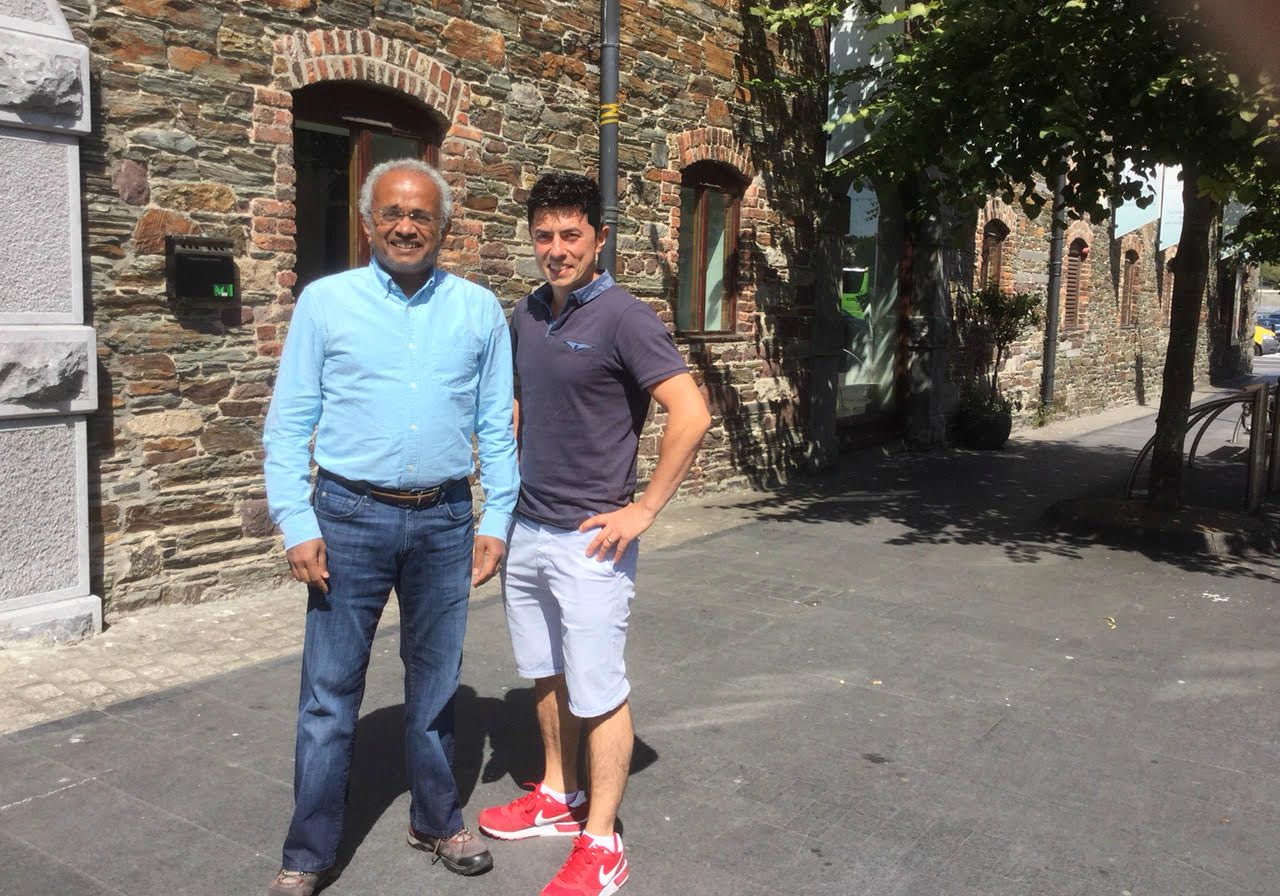
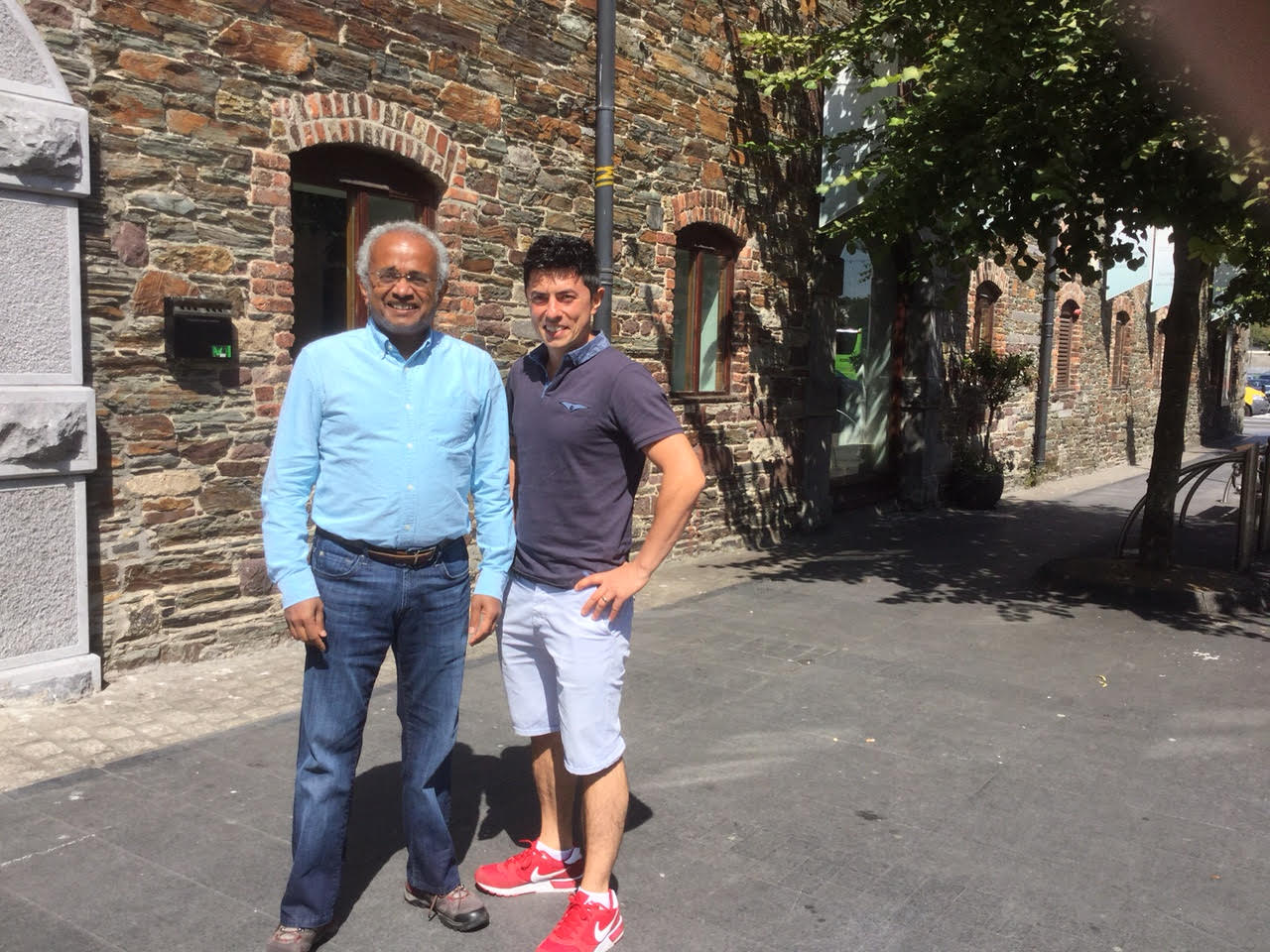
Since our conversation in episode 046 of the Economic Rockstar podcast, myself and Shanta met up for a brief period in Waterford City, Ireland. Shanta was on a visit form Washington DC (not work-related, just in case you think the The World Bank are coming in to Ireland!). Check back for a new blog post on what we chatted about.


Frank and Shanta

http://traffic.libsyn.com/economicrockstar/046_Shanta_Devarajan_Final.mp3

Podcast: Play in new window | Download

041: Dermot Hayes on Comparative Advantage, Feeding the Chinese and the Malthusian Catastrophe

July 16, 2015 by Frank

http://traffic.libsyn.com/economicrockstar/041_Dermot_Hayes_Final.mp3
Play in New WindowDownload

041: Dermot Hayes on Comparative Advantage, Feeding the Chinese and the Malthusian Catastrophe

Dermot Hayes is the Pioneer Chair of Agribusiness, professor of economics, and professor of finance at Iowa State University. He heads theDermot Hayes 2 Trade and Agricultural Policy Division at CARD, a position he also held from 1990 through 1998.

He is co-director of the Food and Agricultural Policy Research Institute, a research center dually administered through the Centre for Agricultural and Rural Development (CARD) at Iowa State and at the University of Missouri at Columbia. He is also a leader of the Policy Task Force of the Plant Science Institute at Iowa State.

A native of the Republic of Ireland, Dermot obtained his degree in agriculture science from University College, Dublin and his Ph.D. from University of California, Berkeley with a major in international trade.

Dermot has distinguished himself with many awards at the college and university levels for his work as a teacher and researcher.

In 2006 he received a Publication of Enduring Quality award from the American Agricultural Economics Association, who subsequently named him a Fellow in 2007.

Besides his analysis of U.S. farm policy and international agricultural trade, Dermot’s other research interests include food safety, livestock modelling, demand analysis, and commodity markets.

Economics:

In this interview, Dermot mentions and discusses: market inefficiencies, government intervention, agricultural economics, property rights, comparative advantage, autarky, incentives, scarcity, Malthusian Catastrophe, free-trade, unemployment, subsidies and taxes.

Economists:

In this interview, Dermot mentions and discusses: Jason Shogren, Paul Dolan, David Zetland, David Simon, Adam Smith, Thomas Malthus, David Zilberman, Milton Friedman and Josh Angrist.

Influencer:

Milton Firedman

“Whenever prices rise, farmers and technology companies have an incentive to work harder to take advantage of high prices. And of course they do that by producing more and that brings prices back down again.” – Dermot Hayes

“Malthus was wrong. He was a negative person. But having said that, with more people and less efficient use of land, we are going to have to bring more land into cultivation – this is devastating to the environment.” – Dermot Hayes

In this episode, you will learn:

  • how China is finding ways to feed its people and how self-sufficiency no longer works.
  • about China’s ever-increasing demands for soybeans, sugar, wine, etc and how this is putting demands on the global agricultural industry.
  • how Ireland lost its comparative advantage in milk production by joining the EU.
  • about Kerrygold Irish grass-fed butter and Bullet-proof coffee.
  • why Kerry Group are only ‘scratching the surface’ in the US market.
  • what high-value, labor-intensive products China should concentrate on producing in order to feed their population and trade with other countries.
  • about if the Chinese government owns much of the land and property rights in China.
  • ‘terminator seeds’ and how private companies could be incentivised to manufacture them.
  • about the use of beta agonists, such as ractopomine, in the use of animal food production.
  • why Europe’s method of testing agricultural technologies frustrates Dermot.
  • about Dermot’s work on free-trade agreements between countries.
  • about Dermot’s ‘controversial’ ethanol research paper.
  • why Dermot created a formula that allowed the price of corn to track crude oil prices and how he bought agricultural land based on his findings.
  • how academic research can open up hatred and attacks amongst your peers and the industry to which you maybe researching.
  • what advice Dermot would give a government regarding the taxing and subsidies of goods and services for the purpose of trade.

Takeaway:

“If you haven’t travelled to strange places like Burma or Uruguay, find a way to do so and you’l come back a changed person.” – Dermot Hayes

Recommended Books:

  • Free to Choose by Milton Firedman

http://traffic.libsyn.com/economicrockstar/041_Dermot_Hayes_Final.mp3

Podcast: Play in new window | Download

033: Abdullah Al-Bahrani on the Economy of Oman and How Racial Discrimination Empowered Him to Succeed in Life and in Economics.

May 22, 2015 by Frank

http://traffic.libsyn.com/economicrockstar/033_Abdullah_Al_Bahrani_Final.mp3
Play in New WindowDownload

033: Abdullah Al-Bahrani on the Economy of Oman and How Racial Discrimination Empowered Him to Succeed in Life and in Economics.

Dr. Abdullah Al Bahrani is an Assistant Professor of Economics at Northern Kentucky University,Abdullah al Bahrani where he serves as the Principles of Economics Coordinator.

Abdullah’s research interests are in the fields of Industrial Organization and Education of Economics. Currently, his primary focus is on innovative approaches to teaching Economics. In Industrial Organization, his research examines market structure and competition in the banking and real estate industries.

Prior to joining academia, Dr. Al Bahrani worked in the mortgage industry from 2003-2006. He has also served as outside economic consult to the Ministry of Education, Sultanate of Oman and new business ventures entering Oman.

Abdullah received his Ph.D. in Economics from the University of Kentucky in 2010, where he received an award for Best Economics Graduate Teaching Assistant.

His Master degree in Economic Theory was awarded by American University in Washington D.C. in 2003 and he earned a Bachelor of Science in Business Economics from the University of Louisville in 2002.

Influencers:

My parents are big advocates of education and they instil the value of education and the value of curiosity – Abdullah Al-Bahrani

Personal Habits:

Abdullah has a 5am start and gets to the gym most mornings. It is at the gym where Abdullah creates his to-do list, becomes super-organized and listens to Economic Rockstar!

On dealing with racial discrimination:

You roll up your sleeves and you keep on trying – Abdullah Al-Bahrani

Abdullah’s Philosophy and Affirmations:

Failure is the opportunity to begin again more intelligently

Click To Tweet

Failing in a business does not need to mean that you failed as a person – Abdullah Al-Bahrani

Click To Tweet

Whatever you do, allow your personality to shine – Abdullah Al-Bahrani

Click To Tweet

The thing that I appreciate is people that push the boundaries that create new paths – to me that’s what growth is – Abdullah Al-Bahrani

My philosophy is to embrace technology – Abdullah Al-Bahrani

Click To Tweet

Find Out:

  • why Abdullah decided to do a Phd in Economics in 2006 and left the mortgage industry just before it imploded.
  • about Abdullah’s economic consultancy work with the Sultanate of Oman.
  • about Abdullah’s connection when reviewing labor market studies in Oman (Hint: She is the Director General of the National Centre of Career Guidance and is as maternal to Abdullah as Oman as a country is to him).
  • how Oman are creating an entrepreneurial spirit to drive is economy in the future.
  • why Oman is faced with difficulties in transitioning to an entrepreneurial economy.
  • how Omani culture is preventing it’s people to take on risk and why incentives do not work.
  • about Abdullah’s suggestion that to create an entrepreneurial spirit in Oman, the labor market must first be liberalised.
  • how ‘Omanization’ has made it costly for foreign firms to set up subsidiaries in Oman.
  • why Omani’s are not hired by foreign firms setting up in Oman.
  • why discrimination exists in the Omani labor market and why US and UK ex-pats would be a preferred employee.
  • how data limitations for Oman make it difficult to conduct an empirical analysis of the labor market.
  • how labor market regulations in Oman is making it costly for firms to hire Omani’s.
  • about some economic indicators for Oman.
  • about Oman’s free trade agreements, the Gulf Corporation Council and the potential Oman offers.
  • about Oman’s tourism initiative to create Oman as an eco-friendly destination.
  • how Abdullah is integrating social media into the classroom, making education a more interactive and conducive learning environment for students.
  • about Abdullah’s clever way of using a students’ mobile phone in explaining the concept of a negative externality.
  • how to create a sense of community in a classroom.
  • why Abdullah received an Easter basket of goodies from a student’s mother.
  • why Abdullah is ‘helping his students to ‘clean’ their social media footprint.
  • how Abdullah encourages his students to connect with him on whatever platform they choose to use.
  • how using ESPN 30 for 30 to teach economics and to keep the economics student engaged.
  • how to teach economics with no math and no graphs.
  • about the research Abdullah is doing on racial discrimination in the labor market.
  • how Abdullah is identifying how racial discrimination is evident in online markets where, unlike traditional markets,  the color of your skin is not a factor.
  • if your last name prevent you from getting a loan, employment or from being priced out of a market.
  • how dropping a letter from your name can get you a job if you’re being racially discriminated against.
  • how Abdullah was racially discriminated against in both the labor market and when selling mortgage loans in the USA.
  • how Abdullah dealt with racial discrimination and how it gave him his Phd dissertation question.
  • how online price comparison websites may actually be anti-competitive.
  • how online stores are eating into the consumer surplus.

Economists:

In this interview, Abdullah mentions:

Darshak Patel, Kim Holder, Gary Becker, Steven Levitt, Stephen Dubnar, Frank Scott, Chris Bollinger and Gail Hoyt, Brandon Sheridan and Roland Fryer.

Economics:

In this interview, Abdullah mentions and discusses:

Labor market, incentives, entrepreneurship, small and medium sized enterprise, venture capital, unintended consequences, business cycle, unemployment, GDP per capita, trade agreements, indigenous industries, multinational companies, Gulf Corporation Council, tourism, factor endowments, negative externality, comparative advantage, search cost, marginal cost, competition and consumer surplus.

Papers:

  • Al-Bahrani, Abdullah and Darshak Patel (2014). Using ESPN 30 for 30 to Teach Economics. Southern Economic Journal. 81:3. 829-842.
  • Al-Bahrani, Abdullah. Competition in Online Markets: When Banks, Compete do Consumers Really Win? Journal of Housing Research. Forthcoming (Accepted October 2014).
  • Al-Bahrani, Abdullah and Darshak Patel (2015). Incorporating Twitter, Instagram and Facebook in Economics Classrooms. Journal of Economic Education. 44:1. 56-67.

Books:

  • The Color of Credit: Mortgage Discrimination, Research Methodology, and Fair-Lending Enforcement by Stephen Ross and John Yinger.
  • Chicago by Alaa Al-Aswani

Resources:

  • Twitter

Where to find Abdullah:

  • Twitter: @teach_econ
  • Website: www.teach-econ.com


http://traffic.libsyn.com/economicrockstar/033_Abdullah_Al_Bahrani_Final.mp3

Podcast: Play in new window | Download

  • 1
  • 2
  • ...Next Page

Frank Conway

Frank Conway is founder of Economic Rockstar and lecturer of economics, finance and statistics. Read More…

View My Blog Posts

Youtube Sub

Become a Patron of the Economic Rockstar Podcast

patreon

Ireland’s Economy by the Numbers

Leaving Cert Economics: Ireland’s Economy  Click here to download a workbook on Ireland’s Economy so that you can add your own notes. [Original size] Ireland’s Economy by fconway

Categories

Subscribe and Never Miss An Episode

itunes-logo

Recent Posts

  • Ireland’s Economy by the Numbers April 8, 2019
  • 174: Wendy Carlin on The Core Project, Capitalism, Democracy and Normative Statements February 13, 2019
  • 173: Stephen Wright on Core Econ as a Learning Resource for Mainstream Economics January 28, 2019
  • 172: Best of 2018 Part 2: From the Great Depression to Futurism; Institutions, Individualism, Cooperation and Reciprocity January 22, 2019
  • 171: Best of 2018 Part 1 January 3, 2019

Copyright © 2026 · Podcast Pro Theme on Genesis Framework · WordPress · Log in

This website uses cookies to improve your experience. We'll assume you're ok with this, but you can opt-out if you wish. Accept Reject Read More
Privacy Policy

Privacy Overview

This website uses cookies to improve your experience while you navigate through the website. Out of these, the cookies that are categorized as necessary are stored on your browser as they are essential for the working of basic functionalities of the website. We also use third-party cookies that help us analyze and understand how you use this website. These cookies will be stored in your browser only with your consent. You also have the option to opt-out of these cookies. But opting out of some of these cookies may affect your browsing experience.
Necessary
Always Enabled
Necessary cookies are absolutely essential for the website to function properly. This category only includes cookies that ensures basic functionalities and security features of the website. These cookies do not store any personal information.
Non-necessary
Any cookies that may not be particularly necessary for the website to function and is used specifically to collect user personal data via analytics, ads, other embedded contents are termed as non-necessary cookies. It is mandatory to procure user consent prior to running these cookies on your website.
SAVE & ACCEPT