• ABOUT
  • RESOURCES
  • PODCAST
  • BOOKS
  • BLOG
  • SUPPORTERS
  • QFA Financial Advice
  • CONTACT

Economic Rockstar

Connecting Brilliant Minds in Economics and Finance

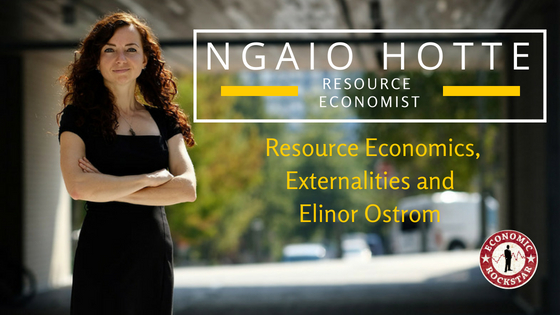
147: Ngaio Hotte on Resource Economics, Externalities and Elinor Ostrom
July 8, 2018 by Frank

http://traffic.libsyn.com/economicrockstar/147_Ngaio_Hotte_Final.mp3
Play in New WindowDownload

147: Ngaio Hotte on Resource Economics, Externalities and Elinor Ostrom


Ngaio Hotte is co-founder of the consultancy firm Resource Economics Group, which is based in British Columbia in Canada. Resource Economics Group specializes in natural resources policy, planning and management. They do research and support decision-making related to the many values of natural resources and trade-offs associated with managing these values for the benefit of people and the planet.

Ngaio is a Ph.D candidate at the University of British Columbia. Her research title is ‘How can trust be built among parties engaged in collaborative natural resource governance?’ and she draws influence from the work of the only female Nobel laureate in economics, Elinor Ostrom.

Ngaio’s Research Interests include trust, government-to-government relations, Indigenous communities, collaboration and natural resources and we touch on some of these topics in out conversation in this episode.

You can find out more about Ngaio’s work at www.resource-economics.ca.

Economics:

In this episode, Ngaio mentions and/or discusses: Elasticity of demand, externalities, substitutes, meat tax, carbon tax, resource extraction, resource management, tanker spills, New Institutional Economics, game theory, private ownership, the Tragedy of the Commons, the Broken Window Fallacy, reciprocity, trust and self-interest. 

Economists:

This episode mentions and/or discusses: Elinor Ostrom, Garrett Harden (Tragedy of the Commons), Donald J. Boudreaux, Cameron Murray, Jason Shogren and Herbert Gintis.

  • What is an externality and examples of negative and positive externalities.
  • The market value for the pollination that is created by the honey bees – people will pay bee keepers to bring their hives to certain areas so that they can pollinate the plants.
  • Addressing the negative externality of oil spillages using a carbon tax.
  • The Broken Window Fallacy.
  • Is it better for the environment and for the minimisation of pollution to have the private ownership rather than the public ownership of lands and waters?
  • Collective action by Elinor Ostrom.
  • Crack Gardens in Tokyo and Guerrilla Gardening in parkways between sidewalks and parking spots.
  • Ron Finley: Gangsta Gardener for the Urban Community– all in search for organic apples nearby and failed.
  • How tax breaks in Vancouver can beautify the landscape and generate positive externalities.
  • Writing advice.

Papers:

  • Hotte, N. and U. Rashid Sumaila, (2014). How much could a tanker spill cost British Columbians? Environment, Development and Sustainability, February 2014, Volume 16, Issue 1, pp 159–180.
  • Garrett Harden (1968). The Tragedy of the Commons. Science, New Series, Vol. 162, No. 3859 (Dec. 13, 1968), pp. 1243-1248 

Organisations:

  • Resource Economics Group: Check out the list of projects, op-eds and articles written by Ngaio Hotte here.
  • Shifting Growth

Other Links:

  • Hotte, N. (November 2, 2015). Urban forestry and the greening of Canadian cities. Spacing.

  • Nobel Speech by Elinor Ostrom: Beyond Markets and States: Polycentric Governance of Complex Economic Systems

  • Ostrom’s the Movie: Elinor Ostrom’s Governing the Commons and the Cooperative Enterprise Movement by Barbara Allen

  • Ron Finley: Gangsta Gardener for the Urban Community: www.ronfinley.com
  • TED: Ron Finley A guerilla gardener in South Central LA

Books:

  • Governing the Commons: The Evolution of Institutions for Collective Action by Elinor Ostrom

Patreon:

If you’re a fan of the podcast and would like to show your support in anyway, please check out my Patreon page at www.patreon.com/economicrockstar where you can sign up for any of the awards for as little as $1 a month or you can simply follow me on the Economic Rockstar Facebook page or on Twitter or simply recommend the show to a friend, especially if they have never had the opportunity to study economics.

http://traffic.libsyn.com/economicrockstar/147_Ngaio_Hotte_Final.mp3

Podcast: Play in new window | Download
  • facebook
  • linkedin
  • twitter
  • google+
  • pinterest

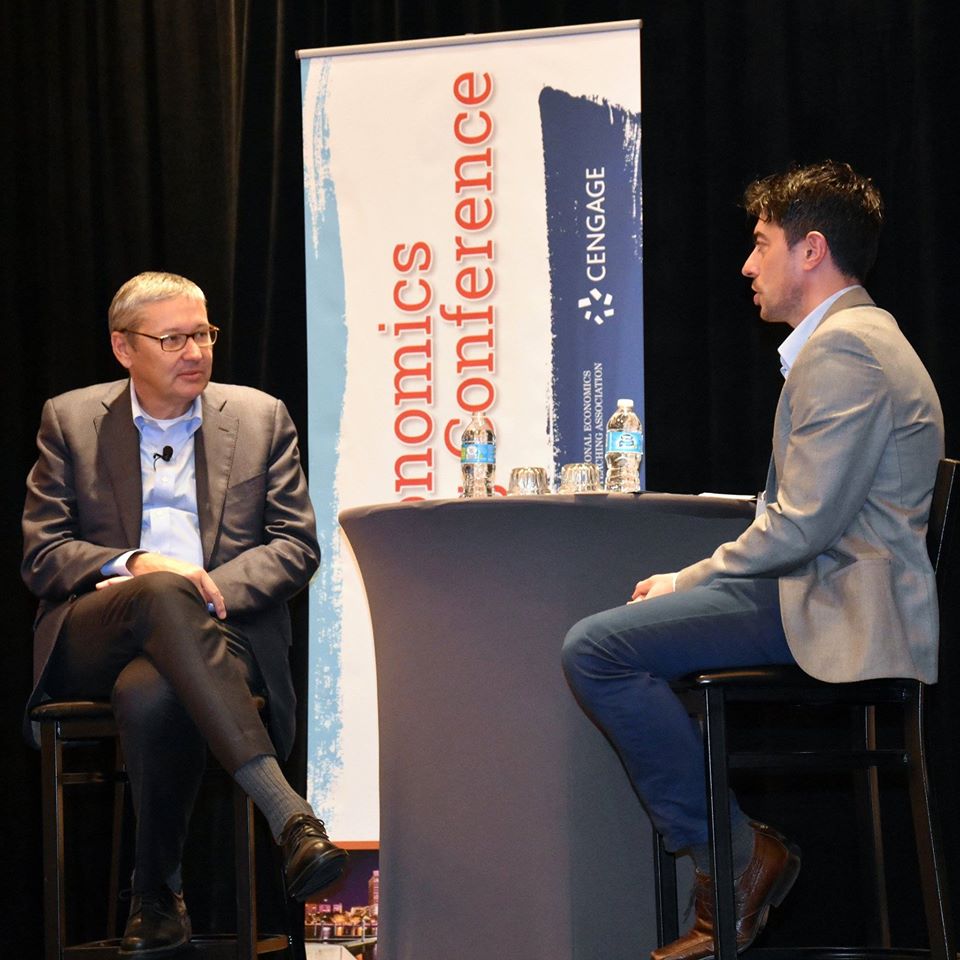
111: Greg Mankiw on Writing, Carbon Tax, Health Care and Education at the Economics Teaching Conference in Florida 2016

November 10, 2016 by Frank

http://traffic.libsyn.com/economicrockstar/111_Greg_Mankiw_Final.mp3
Play in New WindowDownload

111: Greg Mankiw on Writing, Carbon Tax, Health Care and Education at the Economics Teaching Conference in Florida 2016

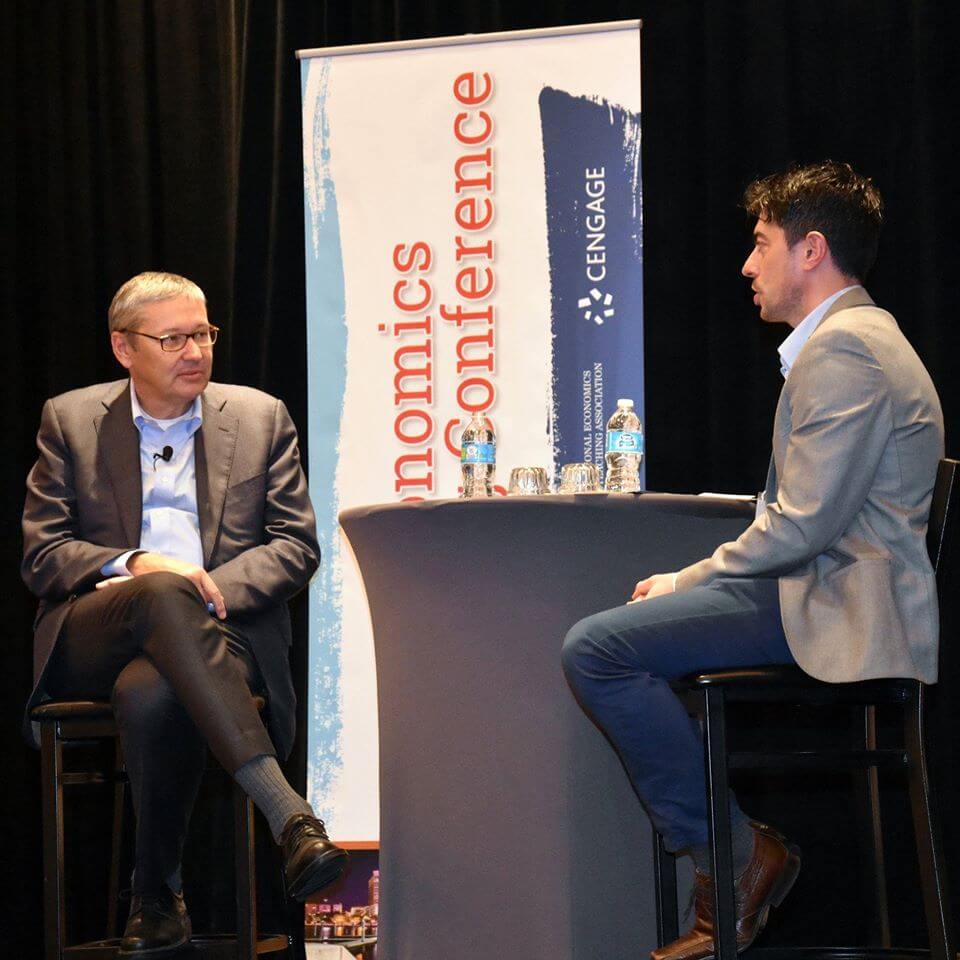
greg-mankiw-and-frank-conway-economic-rockstar-01

Greg Mankiw is the Robert M. Beren Professor of Economics at Harvard University. His research includes work on price adjustment, consumer behavior, financial markets, monetary and fiscal policy, and economic growth.

He has written two popular textbooks—the intermediate-level textbook Macroeconomics and the introductory textbook Principles of Economics. Principles of Economics has sold over two million copies and has been translated into twenty languages.

In addition to his teaching, research, and writing, Professor Mankiw has been a research associate of the National Bureau of Economic Research, an adviser to the Congressional Budget Office and the Federal Reserve Banks of Boston and New York, and a member of the ETS test development committee for the advanced placement exam in economics. From 2003 to 2005 he served as Chairman of the President’s Council of Economic Advisers.

I sometimes describe myself as a libertarian at the margin. When I take the libertarian party, they seem a little to extreme for me. But given where we’re starting today, I think a little bit more reliance on free markets, individual responsibility and personal liberty will be a good thing – Greg Mankiw.

Economics:

In this episode, Greg discusses and mentions: New Keynesian economics, micrcofoundations to macroeconomics, rational expectations, real business cycles, stochastic DSG models, Pigou Tax, carbon tax, externalities, refundable tax credits, subsidies, healthcare, inequality, unintended consequences, student debt and the Baumol disease.

Economists:

In this episode, Greg discusses and mentions: Richard Lispey, Peter Steiner, Harvey Rosen (Princeton), John Maynard Keynes, James Tobin, Stanley Fischer, Tom Sargeant, Robert Lucas, Alan Blinder, David Romer, Olivier Blanchard, Janet Yellen, Arthur Pigou, Karl Marx, Adam Smith and John Kenneth Galbraith

On Writing Books:

  • It does require a fair amount of discipline. That’s the hardest part. I have friends who try to write who have said ‘I’m behind schedule and I’m going to spend the weekend writing three chapters’. That’s a recipe for failure.
  • I try to be extremely disciplined about my writing. When I’m writing the books, I wake up and, after I send my kids off to school, it’s the first thing I do everyday.
  • I force myself to basically write two pages every day. Two pages is not that much. But if you write literally two pages every single day for a year – 365 days – that’d be a good-sized book at the end of the year. So that’s the hardest part – staying disciplined and keeping at it everyday.

On Pedagogy and Technology:

The technology has changed radically [since the first edition of Mankiw’s Intermediate Macro book]. The pedagogy is electronic where increasingly the number of people using online books has been rising. I’m actually kind of old-fashioned – a bit of a Luddite when it comes to these things but actually for the first time this year at Harvard we’re using the online book with the MindTap product.

Links:

  • Cengage Learning 
  • MindTap 
  • Pigou Club
  • Before the Flood (a movie about climate change) by Leonardo DiCaprio
  • Revenue-Neutral Carbon Tax in Washington State

http://traffic.libsyn.com/economicrockstar/111_Greg_Mankiw_Final.mp3

Podcast: Play in new window | Download
  • facebook
  • linkedin
  • twitter
  • google+
  • pinterest

081: Julie Nelson on the Importance of Ecology in Economics and the Misconception of Gender Roles in the Economy

April 14, 2016 by Frank

http://traffic.libsyn.com/economicrockstar/081_Julie_Nelson.mp3
Play in New WindowDownload

081: Julie Nelson on the Importance of Ecology in Economics and the Misconception of Gender Roles in the Economy

Julie Nelson is Professor of Economics at University of Massachusetts Boston and Senior Research Fellow at Global Development and Environment Institute, Tufts University, also in the USA.Julie Nelson Economic Rockstar

Julie’s research areas include feminist economics, ecological economics, the philosophy and methodology of economics, ethics and economics, the teaching of economics, and the empirical study of individual and household behavior.

Professor Nelson has also served as a Research Economist at the U.S. Bureau of Labor Statistics and a Visiting Associate Professor at Harvard University amongst others.

Julie is the author of Economics for Humans and author, co-author, or co-editor of several other books including Beyond Economic Man: Feminist Theory and Economics.

She has also authored numerous articles in journals ranging from Econometrica, the American Economic Review, and the Journal of Political Economy, to Signs: Journal of Women in Culture and Society, Feminist Economics, and Ecological Economics.

Professor Nelson earned a B.A. degree in Economics from St. Olaf College and an M.A. and Ph.D. in Economics from the University of Wisconsin, Madison, USA.

Julie, along with Mark Maier, runs the website introducingeconomics.org

Economics:

In this episode, Julie mentions: statistical inference, bias, production function, land, labor, capital, resource maintenance, feminist economics, care, GDP, Pigouvian tax, carbon, welfare gains, negative externality and Kyoto Agreement.

Economists:

In this episode, Julie mentions: John Stuart Mill, Gary Becker and Amartya Sen.

Quotes by Julie in Episode 81:

“Math gives you internal consistency. It does not give you objectivity and reliability.” – Julie Nelson

Click To Tweet

“Most economic textbooks tell you there are three basic economic activities… production, distribution and consumption. We added one at the beginning and what we called ‘resource maintenance’. That is, how are you ever going to produce anything if you don’t have the resources and if you haven’t taken care of them and sustained them in a way that they’ll be productive in the future” – Julie Nelson

“No one would be so silly to try to address an economic problem without looking at its social, ethical, physical and political dimensions. But later economists didn’t remember those cautions of Mills and just ran with the math aspect of it.” – Julie Nelson

“There’s still a long way to go to think of gender in an intelligent and equitable way.” – Julie Nelson

Click To Tweet

Takeaway:

“Be careful about what you believe that economists are telling you.” – Julie Nelson

“Wherever we are in our life whether we’re at work in a business or at home or bringing our whole selves with us. We don’t just bring parts of ourselves. So if you want to be an ethical person anywhere, we need to do that when we’re at work.” – Julie Nelson

Books:

  • Men are from Mars. Women are from Venus by John Gray
  • ECONned: How Unenlightened Self Interest Undermined Democracy and Corrupted Capitalism by Yves Smith
  • The Shareholder Value Myth by Lynn Stout

Links:

  • www.julieanelson.com
http://traffic.libsyn.com/economicrockstar/081_Julie_Nelson.mp3

Podcast: Play in new window | Download

  • facebook
  • linkedin
  • twitter
  • google+
  • pinterest

036: Jason Shogren on Music and Endogenous Risk and Rationality in the Environmental Goods Market

June 11, 2015 by Frank

http://traffic.libsyn.com/economicrockstar/Jason_Shogren_Final.mp3
Play in New WindowDownload

036: Jason Shogren on Music and Endogenous Risk and Rationality in the Environmental Goods Market

Jason Shogren is the Stroock Professor of Natural Resource Conservation and Management and Chair of the Department of Economics and Finance at the University of Wyoming.Jason Shogren

Professor Shogren’s background and research interests include the economics of environmental and natural resource policy, experimental methods; endangered species; invasive species; climate change; agricultural and forest management; energy; health; regulation; and paleoeconomics.

Jason has been named a fellow of the Association of Environmental and Resource Economists (AERE), the nation’s pre-eminent professional society for environmental economists and policy.

Jason served as professor to Sweden’s King Carl Gustaf XVI in 2012 and is a 2007 Nobel Peace Prize winner (shared with Al Gore) as a member of the United Nations team working on climate change.

He has also served as a senior economist on the Council of Economic Advisers in the White House under the Clinton Administration.

Professor Shogren’s teaching include Global Economic Issues, Natural Resource and Environmental Economics, Environmental Risk and Conflict and Experimental Economics.

Jason is well published with over 200 articles and is the author and editor-in-chief of numerous books including Encyclopedia on Resource, Environmental, and Energy Economics, Experimental Auctions and Fat Economics: Nutrition, Health, and Economic Policy

Jason loves fishing and music. He spends his time composing acoustic roots songs that he describes as catawampus Americana music, has five albums and will be touring this summer.

Economists:

In this interview, Jason mentions and discusses:

Janet Yellen, Thomas Sowell, Daniel Kahneman, Amos Tversky, Gary Becker, Isaac Ehrlich, Ralph C. D’Arge, Tom Crocker, Peter Baum, Karl-Göran Mäler, Vernon Smith and Charlie Plott.

Economic Themes:

In this interview, Jason mentions and discusses:

Carbon tax, cap and trade market, the Coase Theorem, probability, general equilibrium models, expected utility, nudge, rationality, irrationality, risk aversion, loss aversion, homo economicus, soft paternalism, trade-off, scarcity, endogenous risk and extreme tail-end events.

“I spent most of my life before becoming a PhD economist as a musician” -Jason Shogren.

Click To Tweet

“I like to think of economics as applied philosophy”- Jason Shogren.

Click To Tweet

Find Out:

  • about the Cap and Trade Market for carbon emissions is a failure and would only work in a micro-management setting.
  • why its best to implement a carbon tax.
  • the difference between luxury emissions and survival emissions and why it maybe difficult for China and India to reduce their carbon.
  • how Jason’s depiction of a low probability-high severity event influenced Janet Yellen to take action on climate change.
  • if we are acting rationally or irrationally toward the environment.
  • how we can exploit rationality ‘for the good’.
  • how, over the last 30 years, we have become averse to just about everything.
  • how we can take advantage of peoples’ status quo to increase their contribution of paying a carbon tax.
  • how designing the right system can nudge people to do the right thing – just like soft paternalism.
  • how Jason sought inspiration about rationality from other disciplines, such as English literature and music composition, rather than from economics.
  • how Jason uses music as a form of escapism.
  • about the inspiration Jason gets for writing songs from economics.
  • who the talented people are behind the creation of Jason’s amazing artwork and photography.
  • about the concerts that Jason Shogren will be playing at each year.
  • about Jason’s hitch-hiking experience in Ireland in 1985 from the Giants Causeway and down along the West Coast (now known as the Wild Atlantic Way).
  • about Jason theoretical thought process regarding endogenous risk and  how he applies it to different environmental risks.
  • what Jason would do if he was once again Economic Advisor to the US government.
  • a little about the Endangered Species Act.
  • what I saw on Professor Shogren’s whiteboard when I spoke to him on Skype. Hint: It’s his next economic model.
  • about the 25% chance you have in meeting Jason in Centennial, Wyoming – it involves the population and the number of pubs!
  • about Jason’s plastic Nobel Prize keychain and where he hangs it.

Jason Shogren band

Influencers:

Ralph C. D’Arge, Tom Crocker (Wyoming), Peter Baum (University of Stockholm) , Karl-Göran Mäler, Vernon Smith  and Charlie Plott.

An Economic Theory that Influenced Jason Shogren:

A paper by Ehrlich and Becker on self-protection and self-insurance, i.e. endogenous risk, where people invest to change the lottery they face in life, influenced Professor Shogren’s theoretical approach to economics. Once Jason started looking at economics from that perspective, he began to see a lot of models in which the states of nature where independent. To Jason, that seemed too fatalistic for how we spend our resources and how we invest. Most environmental policies are a lottery because we can’t guarantee that somebody’s going to live or not get sick based on exposure (to environmental risk).

We have an estimate and ‘safe’ minimum standards, but there’s no guarantee. So we’re really talking about policies at a collective level that are moving probabilities and damages around. We also have investment at a private level in which we’re doing the same thing – Jason Shogren

What, therefore, struck Jason was asking people about their value of reducing risk and they giving him a value of zero. He questioned people’s decision of applying a value of zero to reducing risk. The reason was that they valued the ‘collective’ reduction as zero and not their ‘individual’ reduction because they took care of the risk themselves.

Applying this theoretical thought process to climate change, endangered species, health risks, pandemics, invasive species or any other problem, will most likely have some element of endogenous risk. Once you add that element to it, the model gets a little richer and once the model gets a little richer, then you can explain a little more behaviour. By adding the behavioural element to the model, the question is ‘What drives things more? Technology of reducing risk? Tastes? How do they work together or how they work apart?’.

“If you can strip it down to that level, then you can really look at a lot of different problems using that type of kit”– Jason Shogren. It can become very flexible as a theoretical framework and model, that it is the reason why Jason, his peers and his students were able to look at a lot of different problems in terms of endogenous risk. It allows for focus on a particular research topic, otherwise it would be too scattered.

Jason on Carbon Emissions:

“We still have to figure out a Plan B, because there is no Planet B” – Jason Shogren.

Click To Tweet

Putting a price on carbon has been the way to reduce carbon emissions. Trying to set up cap and trade markets has been too hard. The cap and trade market has allowed the supply to increase – Jason Shogren.

“If you’re waiting for people to do the right thing for the right reason, you can wait a long time. We’ve seen that throughout history. Economists would say that ‘if you want to do the right thing at the right time, let’s get the prices right and then people will make their own choices’. But if you get prices to reflect true costs and reveal hidden costs that are being imposed on others, then hopefully we don’t have to job-own them and nudge them. Maybe we have to nudge people and get the price right. Both theoretical aspects of economics should be complementary and we should not substitute one for the other” – Jason Shogren.

Before we start calling it nudging, there was a saying “The target is the target and the costs are regrettable but not really decisive” – Thomas Sowell.

Rationality in the Environmental Goods Market:

Rationality in psychology is very different to rationality in economics, in that when we think about rationality in economics we think about a social construct. People are making choices within an active exchange institution like a market and if they start making their emotions run wild, then there are people to arbitrage them. Either they like less money to more or they adjust and they start looking for opportunities themselves. It’s not that we all have to be 100% rational. As long as the folks at the margin who are making those trades pay attention, the market is powerful enough to move it along as if everybody was rational. But they don’t have to be.

The problem with environmental goods is that we don’t have markets like that. So now we have to figure out the problem of how to aggregate up in a way that would incorporate both economic monetary decisions and economic non-monetary decisions. That becomes trickier. Up to quite recently, the only thing economists were dealing with in terms of aversion was risk aversion. Typically it was believed that risk was the only thing that people were averse of. And then Kahneman and Tversky came along and we were now averse to losses and we treated gains and losses differently.

Over the last 30 years, we have become averse to just about everything – ambiguity, inflation aversion, equity aversion, disappointment aversion, envy aversion, lying aversion, guilt aversion. And so by adding all of these emotions into our typical economic model, the question is ‘How and when do we stop?’. Do we add all 40 emotions into our models? And now how do we sort out cross-partial derivatives between equity and envy and disappointment and suspicion and regret? And those are jobs that economists have not been typically trained to deal with – assigning complementarities or substitutabilities between different emotional factors.

So part of this working on nudges is trying to understand that if we tweak the models so that we can take advantage of how people feel guilty about this or how they opt-in or opt-out about different things, we can exploit that irrationality ‘for the good’. For example, people like status quo, so let’s take advantage of that. So instead of buying an airline ticket, nowadays you have to opt-in to add in a carbon price or you can buy a carbon off-set. What we should do is get all the airlines to opt out of buying that carbon off-set. And giving our tendencies not to want to opt out of things, we would probably buy a whole lot more carbon off-sets.

If we can exploit those at the same time as having an active market for those off-sets and a price, then it’s not irrational or rational. It’s understanding that there is some instinctual behaviour that people at a ground level will stick with. That’s the whole soft paternalism idea that we know that you know what’s right and we’re just designing the system to help you get there as opposed to us telling you what’s right.

It is extremely difficult to single out one emotion and to identify it as the one emotion that is driving homo economicus away from our rational base-line. It’s going to take us a while to say ‘Here are the ten big emotions that we can live with and let’s just work on those’.

On Human Behavior:

“If I really want to understand human behaviour, who should I read – Shakespeare or Gary Becker?” – Jason Shogren.

Click To Tweet

If we really want to study emotions we should study literature. If you really want to be economical about how people think, then you should study poetry. Then if you want to convey all of that in a compact form that people will pay attention to then you add music. Now you’ve got a melody and lyrics  and you have a path where essentially you are projecting what you are considering to be an important story to tell. Song writing has its structures and its forms that you can easily translate into guidelines and rules and math models, just like we do in economics. To me, arts and science – I don’t know if they’re ying and yang – to me they go parallel and spillover all over each other – Jason Shogren.

What Professor Shogren Would Do Today as Economic Advisor to the US Government:

  1. Figure out a way to introduce a carbon tax but difficulty would lie with the Senate and the House of Representatives since they are essentially run by the Republicans.
  1. Take on the Endangered Species Act because it’s being waiting to be revised for almost 22 years. The way that it is written is that any species has to be protected at any cost. That type pf pressure can’t hold without the economy bursting at the seams. It would be worth going through this Act and add safety valves in a systematic and coherent way. It’s too important for this Act to just sit idly by when people using discretion as to when it holds and when it doesn’t.

josh shogren

Takeaway:

As a younger man, everybody sort of hits that wall of maturity that you don’t really want to go through. Sometime you get forced through it and sometimes you walk through it and sometimes you fall through it. Once you get there and you decide you can’t control the universe, that’s a good place to be – Jason Shogren.

At the same time, you take care of what you can’t control. You know, it’s the oldest story in the book. Once you come to the realisation and you find that balance, things are just way more interesting, way easier to deal with and just, in general, happier. Being a good Scandinavian doesn’t mean I have my gloomy dark moments – Jason Shogren.

Songs Mentioned and Played in this Episode:

  • Works by Jason Shogren
  • Exit In Flames by Jason Shogren
  • Broken Every Vow by Jason Shogren
  • Me and Genghis Khan by Jason Shogren

Concerts Where You Can See Jason Shogren:

  • WHAT fest
  • Nowoodstock
  • Snowy Range

On Ireland:

“I spent a month hitch-hiking in Ireland way back in ’85. I started up in Larne, went up through the Causeway, then all the way down the West coast. It was a great month of hitch-hiking, Guinness, rain, people and adventure. So, yeah, I’m ready to come again” – Jason Shogren.

On Conferences:

“It’s supposed to be fun. You’re supposed to live and learn and try to pass on something better. Sometimes it’s ideas and sometimes it’s ideas through songs” – Jason Shogren.

Musicians Mentioned in this Episode:

  • Mumford and Sons
  • Gordon Barry

Recommended Book:

  • What Work Is by Philip Levine (Poet) 

Where to Find Jason Shogren:

  • Website: www.jshogren.com
  • CDBaby
http://traffic.libsyn.com/economicrockstar/Jason_Shogren_Final.mp3

Podcast: Play in new window | Download
  • facebook
  • linkedin
  • twitter
  • google+
  • pinterest

034: David Simon on Meatonomics and How the Meat and Dairy Industry Impose Substantial Negative Externalities on Society

May 28, 2015 by Frank

http://traffic.libsyn.com/economicrockstar/034_David_Simon_Final.mp3
Play in New WindowDownload

034: David Simon on Meatonomics and How the Meat and Dairy Industry Impose Substantial Negative Externalities on Society

David Robinson Simon is a lawyer and advocate for sustainable consumption.david simon

David works as general counsel for a healthcare company and serves on the board of the Animal Protection and Rescue League Fund, a non-profit dedicated to protecting animals.

David runs a website that keeps us up-to-date on matters arising from the farm animal industry as well as informing us of other animal-related causes.

David received his B.A. from U.C. Berkeley and his J.D. from the University of Southern California. He is the author of two books: New Millennium Law Dictionary, a full-length legal dictionary and Meatonomics.

He lives in Southern California with his partner, artist Tania Marie, and their rabbit, tortoise, and two cats.

Why David Wrote Meatonomics:

David’s reason to write ‘Meatonomics’ was the same reason why he turned vegan in the first place – the inhumane treatment of farm animals in factory farms.

150 years ago, many Western countries were agrarian-based economies. Farm animals lived on open pastures and were humanely treated. However, the transition to a factory-based system of farming resulted in these animals being removed from open farm lands and placed into a factory-type industrial environment which goes largely unnoticed by the general human population. These farm animals are treated inhumanely and are hidden from view. David wanted to share with us their story and to reveal some startling research and statistics that we must know.

“I think it is difficult to go vegan, but it’s only difficult in the same sense that it’s difficult to learn how to drive a car or ride a bike” – David Simon.

Simply changing my diet to a Vegan diet is one of the best things I’d ever done – David Robinson Simon

David Simon had a BMI that categorised him as being over-weight. He was suffering from high blood cholesterol levels that were always over 200 mg per decilitre, which is the heart-attack risk level. David also had acid reflux, also known as GERD.

When David turned vegan, it was due to his ethical concerns for the welfare of farm animals. However, the unintended consequences of transitioning to a vegan diet, showed remarkable health improvements. Soon after going vegan, David’s weight dropped by 15 pounds, his acid reflux had gone and never came back and his cholesterol has gone from 220 to as low as 140.

David also does some yoga each day to help alleviate the stresses of sitting at a desk all day. This is his way of preventing any foreseeable back and neck problems that otherwise would result from inactivity. Yoga is also a great way for David to focus and think about what was going on during his day.

Economic Themes:

In this interview, David mentions and discusses:

Negative externalities, cost-benefit analysis, supply, demand, equilibrium, prices, subsidies, quotas, consumption and the multiplier effect.

Find Out:

  • why David, a lawyer, turned to economics to explain how the meat industry is a cost to society.
  • about the lack of rights that exist for farm animals.
  • how the farming community set the standards on how farm animals are treated.
  • how the Customary Farming Extension was introduced to legally treat farm animals inhumanely.
  • about the environmental costs associated with producing animal products.
  • how to control or even reverse climate change by reducing meat consumption.
  • how taking shorter showers is not going to alleviate the drought in California.
  • what the true external cost to society is when someone consumes an animal product.
  • how deferring climate change measures today will impose greater costs on society in the future.
  • what David, who is a vegan, had for breakfast this morning.
  • the ingredients to David’s ‘power smoothie’ – a refreshing and nutrient dense meal in a glass!
  • how companies are being subsidised by government to lower the retail price of meat.
  • about the heavy subsidies being paid out to the meat industry.
  • how artificially-low meat and dairy prices are fuelled by out-of-whack farm subsidies.
  • about Ireland’s removal of milk quotas and what it means for market prices.
  • about the role of government in the promotion of milk consumption and how athletes are being used in adverts.
  • about the ubiquitous, powerful but misleading meat and dairy marketing campaigns.
  • about the causal connection between obesity and the consumption of milk, dairy and other animal products.
  • the correlation between some cancers and meat and dairy consumption.
  • why you should remove animal food products from your diet so as to remove the risk of cancer.
  • why you should switch to a plant-based diet and remove meat and dairy if you or a loved-one has cancer.
  • what the multiplier effect is for every $1 spent by government to promote dairy and meat consumption.
  • if consumers are being duped and manipulated by government into buying meat and dairy products.
  • the true cost of a Big Mac – would you pay $13 for one?
  • how the economics of institutional animal food production hold sway over our spending, eating, health, prosperity, economy, environment and longevity.
  • why David wrote his book ‘Meatonomics’.
  • where to source your protein if you decide to go vegan.
  • about Rich Roll, one of the fittest men in the US, who is vegan and lives on a plant-based diet.
  • about the largest animals on our planet – cow, gorilla, rhinoceros, giraffe and hippopotamus – that are all vegan and source there protein from plants.
  • how David changed his lifestyle to become vegan which reduced his risk of heart failure and lowered his BMI from over-weight to normal.
  • how future litigations against the meat and dairy industry could mirror the tobacco industry where once doctors advertised the health benefits of smoking tobacco.
  • about ‘Lobster Liberation’ in Ireland and how David is there to advise and help groups like these who may face criminal prosecution.
  • about David’s own successful liberation of lobsters who were unethically subjected to a vending machine claw game.

David’s ‘Power Vegan Smoothie’:

David starts his day with a raw power smoothie that is packed full of protein and anti-oxidants.

  • Fruit of the day
  • Kale
  • Flaxseed
  • Cinnamon
  • Cacao

David’s ‘Portobello Vegan Burger’:

For dinner, David recommends his ‘Portobello Vegan Burger’, an alternative to the beef burger, with no saturated fat and no cholesterol.

  • Bun of your choice – gluten-free or wholemeal
  • Portobello mushroom
  • Vegan cheese
  • Vegan bacon
  • Jalapeños
  • Tomatoes
  • Onions

Negative Externalities Associated with the Meat and Dairy Industry

Cow linkedIn

There are huge environmental costs associated with producing animal products. They include damage to soil, erosion, pesticide use, fertiliser use, pollution to eco-systems and  diminution in real estate values. Research has shown that if properties are located near factory farms, then the value of those properties fall in value.

There are also costs associated with climate change mitigation. Various studies have shown different values for the impact animal production has on climate change, with some reporting that it is responsible for up to 51% or as low as 14%. In the US alone, David has calculated that the environmental externalised cost of animal food production are about $37 billion. Who pays these costs? The farming community? No.

These costs have been externalised and society ends up paying for the damage being caused. However, David suggests that the payment of these costs are being delayed. It’s a deferred cost that is recognised in conventional economics but it’s something that will come back to ‘bite us on the nose’. For example the climate change mitigating cost is about $9 billion in the US but it is not being done right now. Because we’re not dealing with costs today, we’re allowing climate change to proceed along a path that will end up costing us a lot more in the future.

With the boom in farming and the ever increasing supply of meat products to cater for the demand, carbon emissions have soared. The cow population has grown exponentially as new markets have opened up in developing economies. Diets, such as the paleo diet, has added to this demand. The methane gas emitted from cattle is an astonishingly large contributor to green house gases. This has led to a larger carbon footprint per animal due to the associated transportation costs required to ferry these animals by land and sea. Carbon dioxide emissions also increases with the transportation of these animals.

“If we were to reduce our consumption of animal foods by say 40% to 45%, that would have the same effect on the emissions that drive climate change as if we were to garage all of our motor vehicles and motor vessels during the entire time that that reduction in consumption is in effect” (David Simon). This action alone could have a tremendous effect to control or even reverse climate change.

Negative externalities affect every living thing on the planet – humans, fish, fauna, primates, etc. You can be vegan or a herbivore. There is no way that you can avoid these costs be imposed on you. Reports have indicated that pesticides are airborne, which can be harmful to a persons health.  Our water table, our rivers and our oceans are being polluted by the slurry and manure that is being washed or dumped into these rivers. Fish are being affected with dead-zones appearing in our oceans, resulting in life being unsupported.  Plant-life, insect species and exotic animals are being displaced due to the landscape of the Amazon rainforest being forever altered to cater for cattle grazing. These are all costs borne on our society due to the serious impact it has on our environment and our planet. Much of the harm being done is irreversible. However, it can be stopped and further mistakes prevented if effective measures are introduced. Human diseases, such as MRSA, originates in livestock and spreads through the distribution of animal foods and, because of the antibiotic use in livestock, people are challenged to find antibiotics that can actually resist that disease.

Everyone is affected by current farming practices. For every $1 of animal foods sold at retail, there’s another $1.70 in externalised costs that is imposed on society. For example, for every $5 Big Mac sold by McDonalds, there’s another $8 imposed on every single person. These costs, which if absorbed by the producer, would result in higher retail prices for the consumer. To overcome these potentially high market prices, governments subsidise the meat industry. In the US alone, the government heavily subsidises the meat industry to the tune of $38 billion payments each year. To put that into perspective, that is half of what the US government pays in unemployment benefits every year to all the 320 million unemployed workers. At the moment, the fruit and vegetable industry in the US is being subsidised with only about $17 million. That’s a difference of circa $37.83 billion!

Counter-arguments by those suggesting that if these subsidies were removed from the meat industry, then higher prices would occur, followed by mass lay-offs and higher levels of unemployment. This outcome would occur due to consumers reducing their demand for animal products and getting their protein from different sources or substitutes. David foresees that if this were to occur, people would naturally transition toward a plant-based diet as a source for their protein. Consequently, plant-based agriculture would be then in a position to hire more workers and the numbers of lost jobs in the meat industry would be off-set by the levels of employment in the plant-based industry.

Why Do Animal Food Producers Receive So Much in Subsidies and Why Does the Inhumane Treatment of Animals Remain Legally Unchallenged?

The main reason why the meat production industry receives these subsidies and are allowed such farm practices is due to the powerful lobby group that represents them. In the US alone, estimated suggests that the farming lobbying group spend $100 million per year lobbying state and federal law makers. Also, some studies that examine such farming practices, as well as examining the economic and health benefits of the human consumption of meat, have been carried out or sponsored by groups that have a direct interest in the reported findings and recommendations.

The externalities that were outlined above are by no means localised. This has become a widespread phenomenon in so far as becoming a globalised concern. 90% of the planets rainforests have been removed, and flattened, with much of it being replaced with grazing pastures for cattle. David revealed a startling statistic of 3 acres per minute of rainforest being destroyed with 2 of these acres being dedicated to providing grazing land for beef cattle or for growing feed crops like soy or corn to feed beef cattle.

How ironic is it that the very trees that undergo a natural process of cleaning the air by absorbing carbon dioxide and producing oxygen is being overwhelmed by the amount of emissions from cattle. The ratio of trees to emissions is falling at an astonishing rate due to the destruction of these rainforests.

Ireland Removes its Milk Quota’s

Ireland have recently been given the go-ahead to remove the milk quota restrictions that were put in place by the EU. This is great news for Irish dairy farmers with 2 billion extra litres of milk being produced by the year 2020. To accommodate such a vast swell in milk production, 300,000 extra cows will join the national herd, resulting in a cow population of 1.3 million. Small farms will disappear resulting in large-scale farms. This will of course lead to economies of scale for these larger farms, an increase in employment, an increase in investments in new technologies, production processes and machinery and possibly better logistics and bargaining power.

A quota is essentially a tool for managing supply. Up until the 1990s, the US used supply management to stabilise prices for animal agriculture. Former President Ronald Reagan was a leading advocate for free market economics. He allowed agricultural markets to regulate themselves in the expectation that rational farmers would naturally find the market equilibrium by supplying the desired output which would lead to market equilibrium prices. However, it turned out that individual farmers think for themselves and produced at output levels that aggregated to exceedingly high levels of output at a national level. This resulted in lower prices.

This scenario could now be played out in Ireland whereby individual dairy farmers could increase their milk output levels, expecting and increase in income. However, incomes could fall if consumption or demand does not meet this new supply. Consequently, we may have a situation where farmers are being subsidised, just like in the US. Feed crops, such as corn, become heavily subsidised in order to reduce the costs to farmers.

The Role of Government in Influencing Consumer Meat and Dairy Buying Behaviors

Governments are harming the livelihood of people by promoting meat and dairy consumption. In the US alone, for every $1 spent by government there is a $9 or more multiplier effect on sales of meat and dairy. These programmes are quiet effective in the US. Most people are unaware of the ‘Check-Off Programmes’ that are overseen by the US Department of Agriculture. The average return on every $1 collected through these programmes is at least $8. In a typical year the US spent $557 million on these programmes, resulting in an increase in sales of $4.6 billion.

There is a concern that consumers are being manipulated at a subconscious level to increase their consumption of meat and dairy products. This is one of the themes of David’s book ‘Meatonomics’. Animal food producers are using their ability to deliver products at very low prices – prices that are artificially low – to manipulate consumers into buying more of these goods than they would otherwise. For example, a $5 Big Mac would cost $13 if the industry internalised all the costs associated with the production of beef. This would result in fewer Big Macs being sold.

Economists are interested in whether markets are demand-driven (by consumer traits in behaviour, by incomes or by tastes) or supply-driven (by producer behaviour and by pricing). The market for meat has grown so much in the last 100 years that consumer demand has increased from 100 pounds of meat per person per year to 200 pounds of meat per person per year. It could easily be mistaken that this increase in demand is a typical example of a demand-driven market and that producers are simply meeting that demand. However, due to agricultural subsidies and the ‘Check-Off Programmes’, farmers are able to keep prices artificially low. They are also engaging in behaviours that are diminishing the ability of consumers to actually make informed and independent decisions about how much meat and dairy to eat. This suggests that the market has become a supply-driven market.

“I just think it’s so bizarre that our governments are engaged in marketing to its own citizens to get them to buy products that the clinical research shows that are actually damaging our health” – David Simon.

Is there a Causal Link Between Obesity and Other Diseases and Animal Meat and Dairy Consumption?

Studies exist that show a worrying causal trend between obesity and animal food consumption. Due to over-supply and lower prices, we have increased our consumption of animal-related foods such as milk, dairy and beef. The World Health Organisation has recognised this link and it is only recently that the FDA has recommended a change in the Food Pyramid to accommodate an increase in the consumption of plant-based foods and to reduce the intake of animal-related foods in our diets. David Simon created the Meatonomics Index of 40 Numbers that Tell a Story and within this Index, I was startled to find the following statistics: the “factor by which US per-capita consumption of chicken and other meat exceeds world average is 3 and the factor by which US incidence of cancer exceeds world average is [also] 3”.

One must be careful with spurious relationships where correlation does not mean causation. However, these statistics cannot be ignored and US dependence on animal food products, and the widespread consumption and promotion of meat and dairy at a national level, corresponds to a trend in health-related problems. Clinical studies have shown that up to 1/3 of cancers, particularly in the West, can be attributable to a diet that is high in meat and dairy.

doctor smokes camel

Meat and dairy is being advertised both by local government and at a national level as being a healthy choice. Such promotion continues irrespective of the health risks associated with meat and dairy consumption, particularly when people over-consume. Parallels can be drawn between the animal food industry today and the tobacco industry prior to the 1960s. Old adverts show doctors smoking Camel cigarettes and claiming the health benefits of smoking. Clinical research has shown the health risks to smoking and subsequently litigations followed where the tobacco industry has been sued. Plaintiffs have been able to recover damage awards against tobacco companies. In the US alone, over the last several decades, Big Tobacco has paid more than $400 billion to States Attorney General who have sued them over medical costs. Over the next several decades, David foresees a similar action being taken against the animal food industry for medical costs associated with eating meat and dairy products.

Takeaway:

Think about what you’re putting into your body and don’t take for granted that certain foods are good for you just because the government is telling you that.

Recommended Books:

  • Meatonomics by David Robinson Simon

Receive your FREE copy of Meatonomics. For being an Economic Rockstar listener, you can get an audio copy of Meatonomics by David Simon for FREE. Just click on this link and you’ll be re-directed to Audiobooks.com.

  • The China Study by Colin Campbell

The China Study is the leading piece of clinical information on the differences between an animal-based diet and a plant-based diet. He has found that when you feed animal protein to an animal or a person, and if they had tumours, then those tumours will continue to grow. Conversely, if you take them off the animal food diet and put them on a plant-based diet, those tumours are likely to shrink.

Where to Find David Simon:

  • Website: meatonomics.com
  • Twitter: @meatonomics
http://traffic.libsyn.com/economicrockstar/034_David_Simon_Final.mp3

Podcast: Play in new window | Download

  • facebook
  • linkedin
  • twitter
  • google+
  • pinterest

Frank Conway

Frank Conway is founder of Economic Rockstar and lecturer of economics, finance and statistics. Read More…

View My Blog Posts

Youtube Sub

Become a Patron of the Economic Rockstar Podcast

patreon

Ireland’s Economy by the Numbers

Leaving Cert Economics: Ireland’s Economy  Click here to download a workbook on Ireland’s Economy so that you can add your own notes. [Original size] Ireland’s Economy by fconway

Categories

Subscribe and Never Miss An Episode

itunes-logo

Recent Posts

  • Ireland’s Economy by the Numbers April 8, 2019
  • 174: Wendy Carlin on The Core Project, Capitalism, Democracy and Normative Statements February 13, 2019
  • 173: Stephen Wright on Core Econ as a Learning Resource for Mainstream Economics January 28, 2019
  • 172: Best of 2018 Part 2: From the Great Depression to Futurism; Institutions, Individualism, Cooperation and Reciprocity January 22, 2019
  • 171: Best of 2018 Part 1 January 3, 2019

Copyright © 2026 · Podcast Pro Theme on Genesis Framework · WordPress · Log in

This website uses cookies to improve your experience. We'll assume you're ok with this, but you can opt-out if you wish. Accept Reject Read More
Privacy Policy

Privacy Overview

This website uses cookies to improve your experience while you navigate through the website. Out of these, the cookies that are categorized as necessary are stored on your browser as they are essential for the working of basic functionalities of the website. We also use third-party cookies that help us analyze and understand how you use this website. These cookies will be stored in your browser only with your consent. You also have the option to opt-out of these cookies. But opting out of some of these cookies may affect your browsing experience.
Necessary
Always Enabled
Necessary cookies are absolutely essential for the website to function properly. This category only includes cookies that ensures basic functionalities and security features of the website. These cookies do not store any personal information.
Non-necessary
Any cookies that may not be particularly necessary for the website to function and is used specifically to collect user personal data via analytics, ads, other embedded contents are termed as non-necessary cookies. It is mandatory to procure user consent prior to running these cookies on your website.
SAVE & ACCEPT