• ABOUT
  • RESOURCES
  • PODCAST
  • BOOKS
  • BLOG
  • SUPPORTERS
  • QFA Financial Advice
  • CONTACT

Economic Rockstar

Connecting Brilliant Minds in Economics and Finance

Ireland’s Economy by the Numbers

April 8, 2019 by Frank

Leaving Cert Economics: Ireland’s Economy 

Click here to download a workbook on Ireland’s Economy so that you can add your own notes.
[Original size] Ireland’s Economy by fconway

  • facebook
  • linkedin
  • twitter
  • google+
  • pinterest

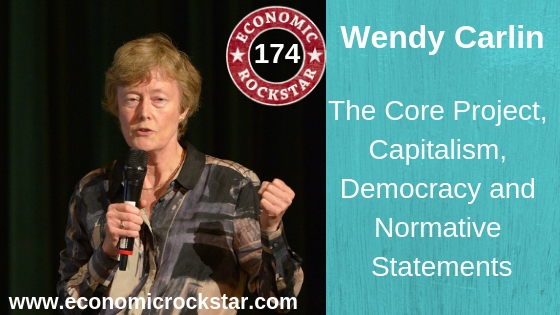
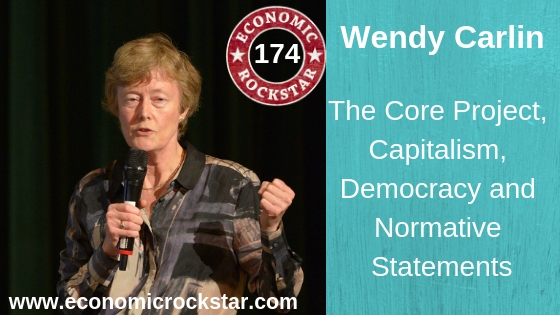
174: Wendy Carlin on The Core Project, Capitalism, Democracy and Normative Statements

February 13, 2019 by Frank

http://traffic.libsyn.com/economicrockstar/174_Wendy_Carlin.mp3
Play in New WindowDownload


Wendy Carlin is Professor of Economics at University College London (UCL), Research Fellow of the Centre for Economic Policy Research (CEPR), London, and Fellow of the European Economic Association. 

Her research focuses on macroeconomics, institutions and economic performance, and the economics of transition. 

She is a member of the Expert Advisory Panel of the UK’s Office for Budget Responsibility. 

She has acted as a consultant for international organizations such as the European Bank for Reconstruction and Development (EBRD), London, and the World Bank. 

She has co-authored three macroeconomics books with David Soskice. Macroeconomics and the Wage Bargain (1990),
Macroeconomics: Imperfections, Institutions and Policies (2006) and
Macroeconomics: Institutions, Instability and the Financial System (2015).

The third book integrates the financial system into the macroeconomic model to allow for analysis of financial cycles as well as business cycles and growth.

Professor Carlin is leading an international project – the CORE project – currently funded by a number of organisations which can be found here. The CORE project has published The Economy, which is free on-line at www.core-econ.org.

In 2016 Wendy was awarded the CBE for services to economics and public finance. 

http://traffic.libsyn.com/economicrockstar/174_Wendy_Carlin.mp3

Podcast: Play in new window | Download

  • facebook
  • linkedin
  • twitter
  • google+
  • pinterest

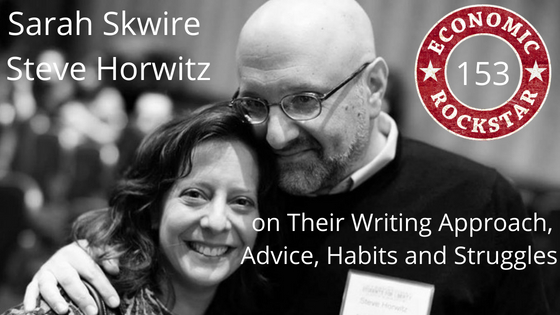
153: Sarah Skwire and Steve Horwitz on Their Writing Approach, Advice, Habits and Struggles

August 12, 2018 by Frank

http://traffic.libsyn.com/economicrockstar/153_Sarah_and_Steve_Final.mp3
Play in New WindowDownload

153: Sarah Skwire and Steve Horwitz on Their Writing Approach, Advice, Habits and Struggles


I catch up once again with Sarah Skwire and Steve Horwitz but this episode is a little different and was inspired by my previous conversation with Sarah back in episode 129.

Sarah Skwire is the Literary Editor of FEE.org and a senior fellow at Liberty Fund, Inc. She is a poet and author of the writing textbook Writing with a Thesis. She is a member of the FEE Faculty Network. 

Steve Horwitz is the Charles A. Dana Professor of Economics at St. Lawrence University and the author of Hayek’s Modern Family: Classical Liberalism and the Evolution of Social Institutions. He spent the 2016-17 academic year as a Visiting Scholar at the John H. Schnatter Institute for Entrepreneurship and Free Enterprise at Ball State University.

Other Episodes:

  • 129: Sarah Skwire on the Sensibility of Literature for Economic Thinking
  • 108: Steve Horwitz on Spontaneous Order, the Microfoundations of Macroeconomics and Three Economic Myths

Books:

  • Writing with a Thesis by Sarah Skwire and David Skwire
  • Hayek’s Modern Family: Classical Liberalism and the Evolution of Social Institutions by Steve Horwitz

Patreon

If you’re a fan of the podcast and would like to show your support in anyway, please check out my Patreon page at www.patreon.com/economicrockstar where you can sign up for any of the awards for as little as $1 a month or you can simply follow me on the Economic Rockstar Facebook page or on Twitter or simply recommend the show to a friend, especially if they have never had the opportunity to study economics.

http://traffic.libsyn.com/economicrockstar/153_Sarah_and_Steve_Final.mp3

Podcast: Play in new window | Download

  • facebook
  • linkedin
  • twitter
  • google+
  • pinterest

138: Rebecca Moryl on Using Economics Podcasts in the Classroom to Connect to the Real World

April 29, 2018 by Frank

http://traffic.libsyn.com/economicrockstar/138_Rebecca_Moryl_Final.mp3
Play in New WindowDownload

138: Rebecca Moryl on Using Economics Podcasts in the Classroom to Connect to the Real World

Rebecca Moryl is Assistant Professor of Economics at Emmanuel College, Boston.

In addition to experience as an economist and public policy analyst, Professor Moryl has professional experience in operations management, fundraising management, efficiency evaluation and improvement, and program marketing.

Rebecca has served as a professional consultant to nonprofit organizations, government agencies, and small businesses.

She integrates her work in nonprofits with teaching through student service projects and community events.

Professor Moryl runs the site www.audioecon.com which provides teaching resources based on economics podcast episodes from EconTalk, Freaknomics, This American Life and Planet Money.

Professor Moryl’s Website:

  • www.audioecon.com

Podcasts Mentioned in this Epsiode:

  • EconTalk, Freakonomics, Planet Money and This American Life.

Economic Rockstar Episodes Mentioned in this Episode:

  • 030: Kim Holder on Rockonomix and Teaching Economics Through the Lens of Sport, Music and Movies
  • 033: Abdullah Al-Bahrani on the Economy of Oman and How Racial Discrimination Empowered Him to Succeed in Life and in Economics
  • 048: Steve Hanke on Currency Boards, Moral Hazard and the Benefits of Privatization
  • 071: Darshak Patel on Using Popular Culture to Engage Economics Students in the Classroom and Online
  • 116: Brian O’Roark on The Economics of Superheroes and The Hunger Games

Resources:

  • ClassPulse for Android
  • ClassPulse for iOS

Books:

  • Travels of a T-Shirt in the Global Economy: An Economist Examines the Markets, Power, and Politics of World Trade by Pietra Rivoli

Patreon

If you’re a fan of the podcast and would like to show your support in anyway, please check out my Patreon page at www.patreon.com/economicrockstar where you can sign up for any of the awards for as little as $1 a month or you can simply follow me on the Economic Rockstar Facebook page or on Twitter or simply recommend the show to a friend, especially if they have never had the opportunity to study economics.

http://www.patreon.com/economicrockstar

http://traffic.libsyn.com/economicrockstar/138_Rebecca_Moryl_Final.mp3

Podcast: Play in new window | Download

  • facebook
  • linkedin
  • twitter
  • google+
  • pinterest

128: Sarah Smith on the Economics of Charitable Giving and Gender Roles in Economics

February 16, 2018 by Frank

http://traffic.libsyn.com/economicrockstar/128_Sarah_Smith_Final.mp3
Play in New WindowDownload

128: Sarah Smith on the Economics of Charitable Giving and Gender Roles in Economics

Sarah Smith is Professor of Economics and Head of the Department of Economics at the University of Bristol. Her research interests are in applied micro – specifically consumer behaviour and public economics.

Sarah has worked on pensions, saving and retirement and welfare policy and her main focus now is the economics of not-for-profit organisations.

Professor Smith has been working with a number of charity organisations (JustGiving, Charities Aid Foundation, Remember a Charity, Big Lottery) to understand what motivates individuals to give and how donations respond to different economic and non-economic incentives.   

Sarah is a research associate at the Institute for Fiscal Studies, where she started her career and at the Centre for Economic Policy Research. Sarah has also worked at HM Treasury, the Financial Services Authority and the London School of Economics.

Sarah received her PhD from University College, London and an MSc Economics from the London School of Economics and Political Science.

Patreon

If you’re a fan of the podcast and would like to show your support in anyway, please check out my Patreon page at patreon.com/economicrockstar where you can sign up for any of the awards for as little as $1 a month or you can simply follow me on the Economic Rockstar Facebook page or on Twitter or simply recommend the show to a friend, especially if they have never had the opportunity to study economics.

http://traffic.libsyn.com/economicrockstar/128_Sarah_Smith_Final.mp3

Podcast: Play in new window | Download

  • facebook
  • linkedin
  • twitter
  • google+
  • pinterest

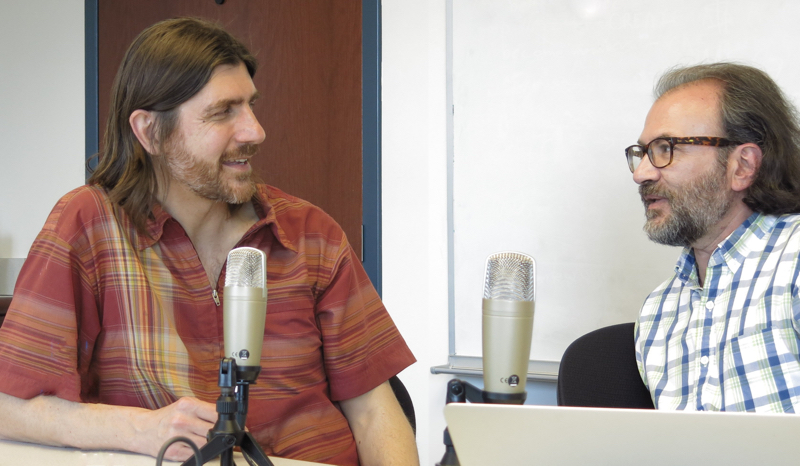
121: Doug McKee and Edward O’Neill on Teach Better and Using Technology in the Classroom

January 30, 2017 by Frank

http://traffic.libsyn.com/economicrockstar/121_Doug_and_Edward_Final.mp3
Play in New WindowDownload

121: Doug McKee and Edward O’Neill on Teach Better and Using Technology in the Classroom


Douglas McKee is a senior lecturer at the Department of Economics at Cornell University. Dr McKee teaches Econometrics, Probability and Statistics and has previously taught at Yale.

Doug’s research interests include Development Economics, Labor Economics, Health Economics and Structural Estimation

Edward O’Neill consults and serves to solve teaching & learning problems for professors, and supports academic and other projects with learning design and technology services.

Both Doug and Edward cohost the ‘Teach Better’ podcast focusing on expert-level university teaching & pedagogy.

You can check out the podcast over at teachbetter.co and on iTunes where there are currently 45 amazing episodes on teaching in the classroom and the education system.

Resources:

  • Panopto – the Lecture Capture System
  • i>clicker Buy the i>clicker from Amazon
  • Google Hangouts
  • Camtasia

Links:

  • Teach Better Podcast
  • Educause – helping higher education elevate the impact of IT
  • Mayer, R. E. and Moreno, R. (2003). Nine Ways to Reduce Cognitive Load in Multimedia Learning. Educational Psychologist, 38(1), 43–52.
  • Professor Jonathan Holloway
  • Carla M. Horwitz, Yale Child Study Centre 

Writing Tips:

  • Write the first sentence first. Brain storm. Organise, cull and finally edit. Write everyday – Doug McKee.
  • Always Be Done (the ABD method) – Edward O’Neill.

Recommended Books:

  • Brain-Based Design Thinking by Edward O’Neill
  • Dune by Frank Herbert
  • What the Best College Students Do by Ken Bain
  • Building Expertise: Cognitive Methods for Training and Performance Improvement by Ruth Colvin Clarke

http://traffic.libsyn.com/economicrockstar/121_Doug_and_Edward_Final.mp3

Podcast: Play in new window | Download

  • facebook
  • linkedin
  • twitter
  • google+
  • pinterest

120: Best of 2016 Part 2

January 30, 2017 by Frank


  • facebook
  • linkedin
  • twitter
  • google+
  • pinterest

117: Courtney Conrad on Broadway Economics and What We Can Learn Through Musicals

December 22, 2016 by Frank

http://traffic.libsyn.com/economicrockstar/117_Courtney_Conrad_Final.mp3
Play in New WindowDownload

117: Courtney Conrad on Broadway Economics and What We Can Learn Through Musicals

broadway-economics-economic-rockstar

Courtney Conrad is a senior undergraduate economics major at Susquehanna University.courtney-conrad-economic-rockstar

At Susquehanna, Courtney serves as a research assistant, teaching assistant for principles of microeconomics, and tutor.

Courtney’s research interests include labor economics, experimental economics, behavioral economics, and the economics of education.

After completing her Bachelor’s degree in economics, Courtney plans on furthering her economics studies and research at the graduate school level with the aspiration of becoming an academic.

Since being hand-picked as a research assistant during her first year at SU, Courtney has actively assisted her mentor, professor and department chair Dr. Matthew Rousu, on a variety of projects over the years.

As a first-year and sophomore, Courtney managed and conducted experimental auctions for a National Institute of Health grant-funded study in which tobacco smokers’ demand for e-cigarettes was assessed.

Additionally, Courtney collaborates with Dr. Rousu in creating the videos and accompanying economics concept call-outs, discussion questions, and video descriptions for BroadwayEconomics.com.

Links:

  • www.broadwayeconomics.com
  • “My Shot” from Hamilton the Musical
  • “Piragua (Reprise)” from In The Heights
  • “The World Will Know” from Newsies
http://traffic.libsyn.com/economicrockstar/117_Courtney_Conrad_Final.mp3

Podcast: Play in new window | Download

  • facebook
  • linkedin
  • twitter
  • google+
  • pinterest

116: Brian O’Roark on The Economics of Superheroes and The Hunger Games

December 17, 2016 by Frank

http://traffic.libsyn.com/economicrockstar/116_Brian_ORoark_Final.mp3
Play in New WindowDownload

116: Brian O’Roark on The Economics of Superheroes and The Hunger Games

Brian O’Roark is University Professor of Economics at Robert Morris University in Pittsburgh. He is the Co-Director of the Robert Morris Center for Economics Education and has a Ph.D. from George Mason University.

In 2014, Brian was given the Undergraduate Teaching Innovation Award by the Middle Atlantic Association of Colleges of Business Administration. He teaches the Survey of Economics course, and Principles of Micro and Macro Economics.

Brian is the co-author of The Ultimate Guide to Teaching Essentials of Economics where hundreds of teaching tips is compiled into one essential, thoughtfully designed teaching resource making it easy for new instructors to incorporate best teaching practices into their courses and for veteran teachers to find inspiration to enliven their lectures.

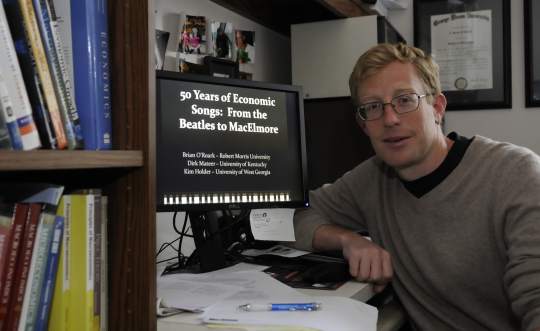
Professor O’Roark has integrated economic content in songs with many topics being covered in the music videos available at  http://www.criticalcommons.org/author/oroark.

To me Brian has become synonymous with superheroes and I could be forgiven for calling him Super Econ Man.

Economics:

In this episode, Brian discusses and mentions: comparative advantage, institutions, production possibility frontier, inequality, opportunity costs and choices.

Economists:

In this episode, Brian discusses and mentions: Jeff Cleveland, Kim Holder, Matt Rousu, Deirdre McClosky, Andrew Heaton, Beatrice Cherrier, Manu Saadia, Peter Leeson, Steve Horwitz, James Tierney, Dirk Mateer, James Buchanan and Walter Williams.

Links:

  • Music For Econ

Movies for Economics:

  • Matewan by Rebecca J. Bailey
  • It’s a Wonderful Life
  • A Clockwork Orange by Stanley Kubrick
  • Mad Max


TV Shows:

  • The Flash
  • The Green Arrow
  • Super Girl

Superheros:

  • Batman (DC)
  • Superman (DC)
  • Deadpool (Marvel)
  • Wonder Woman (DC)
  • Super Girl (DC)
  • Nate Grey (Marvel)
  • Doctor Manhattan (Marvel)
  • Scarlett Witch (Marvel)
  • Black Bull (Marvel)

Writing Tips:

  1. Write on things that you’re interested in. Once you lose that interest, it makes writing so much more difficult. For me right now,  I’m writing on dystopian literature and writing about superheroes and hopefully writing more on information security. Those are things that I’m really really interested in and that makes the job of writing so much easier.
  2. Do the writing and get your ideas down on paper first. Don’t worry about what other people have said on the topic before you start writing yourself. When I was at Mason, James Buchanan was still there. And he made this comment that stuck with me more so than anything that I have learned in any of the classes that I had there. He would write the paper first and then do the literature review later. Because he didn’t want anybody else’s opinion’s to affect what he was writing. He wanted all of the ideas that he put down on paper to be his own. And if other people had written about it he could weave what they said into what he said. But he didn’t want to work it the other way around. He didn’t want to have his ideas be the offspring of somebody else’s work.
  3. Make sure you carve out time to write. If you carve out time to get your writing done it doesn’t become the last thing on your to-do list. When it becomes the last thing on your to-do list it tends to keep getting pushed back and pushed back and then it doesn’t get done at all.

Books:

  • Matewan by Rebecca J. Bailey
  • The Grapes of Wrath by John Steinbeck
  • The Hunger Games by Suzanne Collins
  • Catching Fire by Suzanne Collins
  • Mockingjay by Suzanne Collins
  • Homer Economicus: The Simpsons and Economics by Joshua Hall
  • We Are Anonymous: Inside the Hacker World of LulzSec, Anonymous, and the Global Cyber Insurgency by Parmy Olson

http://traffic.libsyn.com/economicrockstar/116_Brian_ORoark_Final.mp3

Podcast: Play in new window | Download

  • facebook
  • linkedin
  • twitter
  • google+
  • pinterest

113: Jonathan McEvoy on Globalisation, National Autonomy, Capitalism and the Economic Resonance in Timeless Songs

November 25, 2016 by Frank

http://traffic.libsyn.com/economicrockstar/113-_Jonathan_McEvoy_Final.mp3
Play in New WindowDownload

113: Jonathan McEvoy on Globalisation, National Autonomy, Capitalism and the Economic Resonance in Timeless Songs

Jonathan McEvoy is currently an undergrad student of economics at Waterford Institute of Technology in jonathan-mcevoy-economic-rockstarIreland.

He was recently recognised for being in the top 5% of the Business School at W.I.T, earning the honour of being on the Deans List for Academic Achievement.

Jonathan has a unique understanding of the world around us and, together with his love of economics, has a unique perspective on the economics discipline.

Jonathan’s desire to discover and explore the multitude of economic thinking, from Keynesianism to Marxism, has resulted in him creating a blog called Economics – Thoughts of a Student which can be found at jonathanmcevoy888.blogspot.com.

His recent career history has prepared him well to be great public speaker and communicator.

Jonathan is also an athlete and a top soccer player, having spent time with English Premier League clubs Manchester City and Tottenham Hotspur.

Jonathan’s interests also include Health, Human Rights, Politics, Civil Rights, Poverty Alleviation and Science and Technology.

Economics:

In this episode, Jonathan discusses and mentions: production possibility frontier, comparative advantage, production, services, efficiency, technology, foreign direct investment, tariffs, income, vertical farming, externalities, capitalism, profit, inequality, welfare, labour costs, GDP, economics of war and economics of romance.

Economists:

In this episode, Jonathan discusses and mentions: Adam Smith, John Maynard Keynes, Karl Marx, Friedrich Engels and David Ricardo.

In this episode you will learn:

  • about the balance required between globalisation and national autonomy.
  • about Ireland’s role in CERN.
  • whether future-tech will improve humanity’s standard of living?

  • how economics and technology are inextricably interlinked.
  • why economists and technologists should increase collaboration for the betterment of society.
  • how the world’s production possibility frontier can move outward to reach once unimagined and unattainable outcomes.
  • whether ‘planetisation’ can be a reality.
  • the use of songs to capture the economic and social setting of an era.
  • and much much more.

People Mentioned in this Episode:

  • Cormac O’Rafferty
  • Stephen Hawking
  • Nikola Tesla
  • Elon Musk
  • John F. Kennedy
  • Neil deGrasse Tyson
  • Warren Buffett
  • Bob Dylan
  • Bruce Springsteen
  • Tupac Shakur
  • Bruce Hornsby

Links:

  • Finding the Balance Between Globalisation and National Autonomy by Jonathan McEvoy

  • Why Ireland Should Aspire to CERN Status – The Role of Economics in Science and Technology and How They Benefit One Another by Jonathan McEvoy

  • Will Future-Tech Improve Humanity’s Standards of Living? by Jonathan McEvoy
  • How to Write Timeless Songs like Springsteen and other Artists – The Economic Resonance in Timeless Songs and Creativity being born from Economics by Jonathan McEvoy

  • The Big Bang Theory

Where to Find Jonathan McEvoy:

  • Website: jonathanmcevoy888.blogspot.com
  • Twitter: @JonathanMcEv0y

Books:

  • Wealth of Nations by Adam Smith
  • Communist Manifesto by Karl Marx and Friedrich Engels
  • Game of Thrones by George R. R. Martin
http://traffic.libsyn.com/economicrockstar/113-_Jonathan_McEvoy_Final.mp3

Podcast: Play in new window | Download

  • facebook
  • linkedin
  • twitter
  • google+
  • pinterest
  • 1
  • 2
  • 3
  • ...Next Page

Frank Conway

Frank Conway is founder of Economic Rockstar and lecturer of economics, finance and statistics. Read More…

View My Blog Posts

Youtube Sub

Become a Patron of the Economic Rockstar Podcast

patreon

Ireland’s Economy by the Numbers

Leaving Cert Economics: Ireland’s Economy  Click here to download a workbook on Ireland’s Economy so that you can add your own notes. [Original size] Ireland’s Economy by fconway
Categories

Subscribe and Never Miss An Episode

itunes-logo

Recent Posts

  • Ireland’s Economy by the Numbers April 8, 2019
  • 174: Wendy Carlin on The Core Project, Capitalism, Democracy and Normative Statements February 13, 2019
  • 173: Stephen Wright on Core Econ as a Learning Resource for Mainstream Economics January 28, 2019
  • 172: Best of 2018 Part 2: From the Great Depression to Futurism; Institutions, Individualism, Cooperation and Reciprocity January 22, 2019
  • 171: Best of 2018 Part 1 January 3, 2019

Copyright © 2026 · Podcast Pro Theme on Genesis Framework · WordPress · Log in

This website uses cookies to improve your experience. We'll assume you're ok with this, but you can opt-out if you wish. Accept Reject Read More
Privacy Policy

Privacy Overview

This website uses cookies to improve your experience while you navigate through the website. Out of these, the cookies that are categorized as necessary are stored on your browser as they are essential for the working of basic functionalities of the website. We also use third-party cookies that help us analyze and understand how you use this website. These cookies will be stored in your browser only with your consent. You also have the option to opt-out of these cookies. But opting out of some of these cookies may affect your browsing experience.
Necessary
Always Enabled
Necessary cookies are absolutely essential for the website to function properly. This category only includes cookies that ensures basic functionalities and security features of the website. These cookies do not store any personal information.
Non-necessary
Any cookies that may not be particularly necessary for the website to function and is used specifically to collect user personal data via analytics, ads, other embedded contents are termed as non-necessary cookies. It is mandatory to procure user consent prior to running these cookies on your website.
SAVE & ACCEPT