• ABOUT
  • RESOURCES
  • PODCAST
  • BOOKS
  • BLOG
  • SUPPORTERS
  • QFA Financial Advice
  • CONTACT

Economic Rockstar

Connecting Brilliant Minds in Economics and Finance

111: Greg Mankiw on Writing, Carbon Tax, Health Care and Education at the Economics Teaching Conference in Florida 2016
November 10, 2016 by Frank

http://traffic.libsyn.com/economicrockstar/111_Greg_Mankiw_Final.mp3
Play in New WindowDownload

111: Greg Mankiw on Writing, Carbon Tax, Health Care and Education at the Economics Teaching Conference in Florida 2016

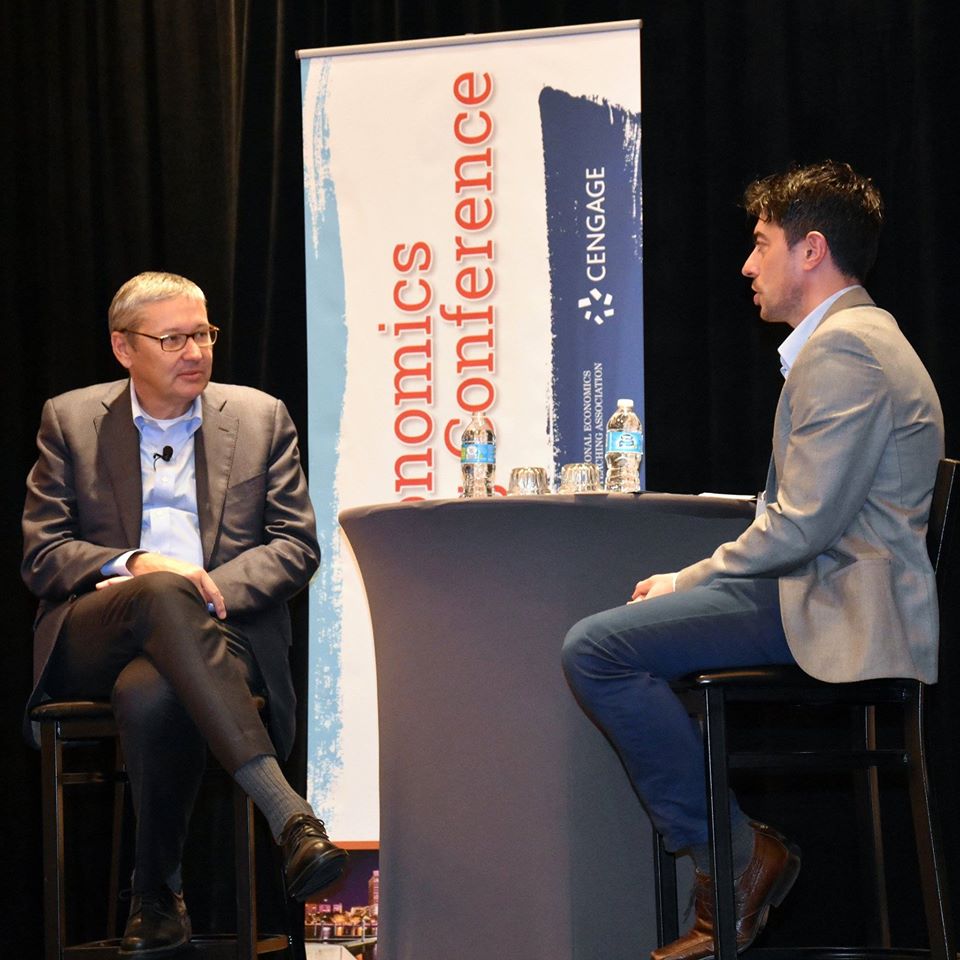
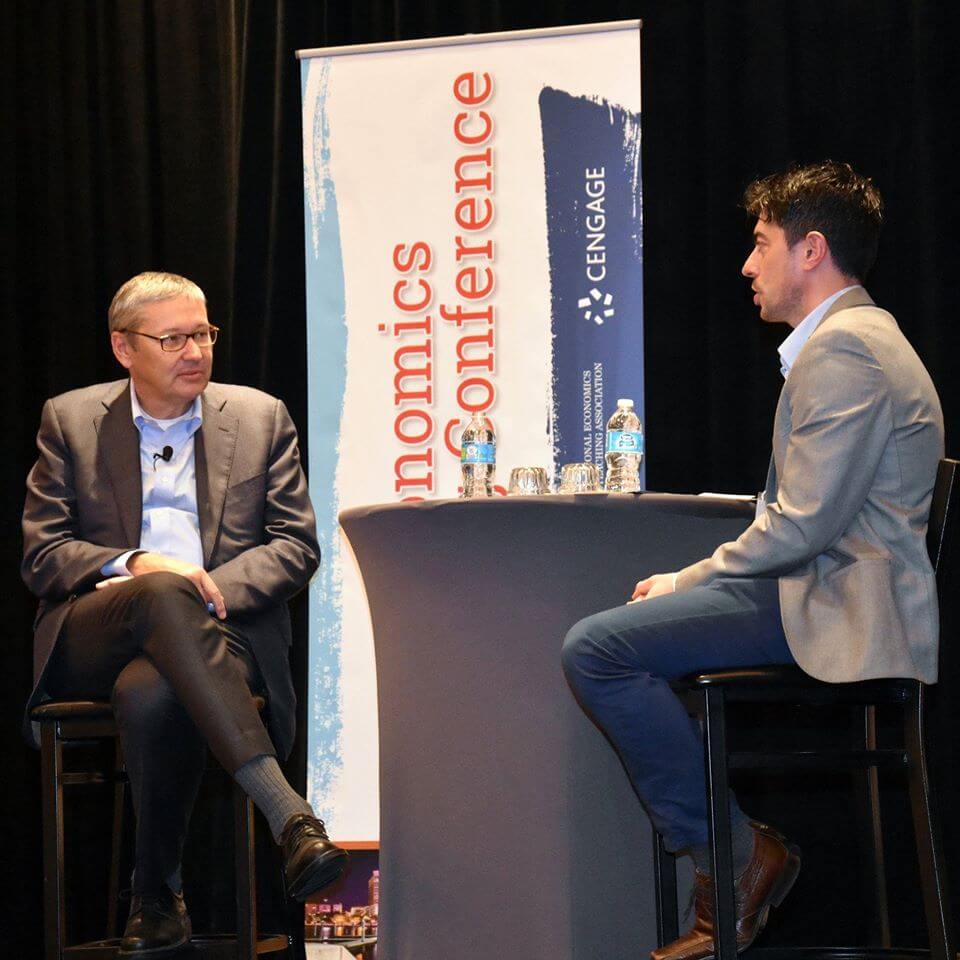
greg-mankiw-and-frank-conway-economic-rockstar-01

Greg Mankiw is the Robert M. Beren Professor of Economics at Harvard University. His research includes work on price adjustment, consumer behavior, financial markets, monetary and fiscal policy, and economic growth.

He has written two popular textbooks—the intermediate-level textbook Macroeconomics and the introductory textbook Principles of Economics. Principles of Economics has sold over two million copies and has been translated into twenty languages.

In addition to his teaching, research, and writing, Professor Mankiw has been a research associate of the National Bureau of Economic Research, an adviser to the Congressional Budget Office and the Federal Reserve Banks of Boston and New York, and a member of the ETS test development committee for the advanced placement exam in economics. From 2003 to 2005 he served as Chairman of the President’s Council of Economic Advisers.

I sometimes describe myself as a libertarian at the margin. When I take the libertarian party, they seem a little to extreme for me. But given where we’re starting today, I think a little bit more reliance on free markets, individual responsibility and personal liberty will be a good thing – Greg Mankiw.

Economics:

In this episode, Greg discusses and mentions: New Keynesian economics, micrcofoundations to macroeconomics, rational expectations, real business cycles, stochastic DSG models, Pigou Tax, carbon tax, externalities, refundable tax credits, subsidies, healthcare, inequality, unintended consequences, student debt and the Baumol disease.

Economists:

In this episode, Greg discusses and mentions: Richard Lispey, Peter Steiner, Harvey Rosen (Princeton), John Maynard Keynes, James Tobin, Stanley Fischer, Tom Sargeant, Robert Lucas, Alan Blinder, David Romer, Olivier Blanchard, Janet Yellen, Arthur Pigou, Karl Marx, Adam Smith and John Kenneth Galbraith

On Writing Books:

  • It does require a fair amount of discipline. That’s the hardest part. I have friends who try to write who have said ‘I’m behind schedule and I’m going to spend the weekend writing three chapters’. That’s a recipe for failure.
  • I try to be extremely disciplined about my writing. When I’m writing the books, I wake up and, after I send my kids off to school, it’s the first thing I do everyday.
  • I force myself to basically write two pages every day. Two pages is not that much. But if you write literally two pages every single day for a year – 365 days – that’d be a good-sized book at the end of the year. So that’s the hardest part – staying disciplined and keeping at it everyday.

On Pedagogy and Technology:

The technology has changed radically [since the first edition of Mankiw’s Intermediate Macro book]. The pedagogy is electronic where increasingly the number of people using online books has been rising. I’m actually kind of old-fashioned – a bit of a Luddite when it comes to these things but actually for the first time this year at Harvard we’re using the online book with the MindTap product.

Links:

  • Cengage Learning 
  • MindTap 
  • Pigou Club
  • Before the Flood (a movie about climate change) by Leonardo DiCaprio
  • Revenue-Neutral Carbon Tax in Washington State

http://traffic.libsyn.com/economicrockstar/111_Greg_Mankiw_Final.mp3

Podcast: Play in new window | Download
  • facebook
  • linkedin
  • twitter
  • google+
  • pinterest

062: Stephen Terry on Real Business Cycles, Total Factor Productivity, Short-Termism and Doing a PhD

December 10, 2015 by Frank

http://traffic.libsyn.com/economicrockstar/Stephen_Terry_Final.mp3
Play in New WindowDownload

062: Stephen Terry on Real Business Cycles, Total Factor Productivity, Short-Termism and DoiStephen_Terryng a PhD

Stephen Terry is Assistant Professor of Economics at Boston University.

In 2013 he was a Dissertation Intern, Federal Reserve Bank of Richmond and, from 2007 to 2009, Stephen was a Research Associate at the Federal Reserve Bank of Kansas City.

Stephen  received a PhD in Economics from Stanford University in 2015 as well as an  MA in Economics in 2011.

Stephen also has an MA in Mathematics from the University of Oklahoma and a BA in Economics from University of Texas at Arlington.

Stephens research interests include short-termism, uncertainty and real business cycles.

One of the most important summary statistics in macroeconomics is a measure known as TFP or total factor productivity of the economy as a whole – Stephen Terry

Economics:

In this interview, Stephen mentions: labor markets, double coincidence of wants, selection markets, matching markets, algebraic topology, total factor productivity, real business cycles, economic shocks, volatility, variance, risk, uncertainty, aggregate output, employment, investment, allocation of inputs, uncertainty, earnings, profits, short-termism and the Principle-Agent Problem.

Economists:

In this interview, Stephen mentions: Christine Exley, Nick Bloom, John Van Reenen and John Maynard Keynes.

In this episode you will learn:

  • about Stephen’s experience with the two-body or joint location problem.
  • about Stephen’s PhD process and the experience he developed along the way.
  • of some suggestions if you’re considering undertaking a PhD.
  • the differences and similarities in the mathematics of economics and the mathematics of other disciplines such as physics and chemistry.
  • if there is a divergence or a convergence in the branches of macroeconomics and microeconomics.
  • what really happens during recessions.
  • how firms can learn and react to the data provided at a micro level.
  • what Total Factor Productivity is.
  • about Real Business Cycle theory.
  • whether changes in uncertainty causes or amplifies recessions.
  • whether managers should forego the long-term objectives of the firm due to the pressures of short-termism.
  • whether rating agencies are beneficial to investors or if they potentially hinder the growth prospects of the firm due to short-term pressures and expectations.

Preparation for Life as a Research Economists into 2 Stages:

1) Useful things that you can be doing before graduate school.

You have to study Math. Economics at graduate level is increasingly dominated by the technical and quantitative research methods.

Having some practical experience in the application of mathematics in economics is not not only valuable for later on in your career but is now becoming a pre-condition to gaining access to research-intensive PhD programmes.

If your undergrad or Masters degree lacks math rigour, then you should consider building on your current level of math by undertaking a math PhD programme.

3) The ways in which you can maximise the benefits you get in your PhD training.

You should consider becoming a Research Assistant prior to starting your PhD so that you gain the practical experience.

This will put you in a situation in which you can be mentored and instructed by other economists who are undertaking economics and statistical research projects.

Being exposed to this will offer you an insight into the research process as well as ‘train’ you to become quite efficient and structured in terms of time management and application.

On the Use of Math in Economics:

At its core, math and applied mathematical techniques, but also pure mathematical proof-based reasoning, are ways to go from some set of assumptions to a coherent set of conclusions that you know follow logically without inconsistency from those assumptions.

By harnessing that logical consistency, economics is something, in the last few decades, that has been able to harness a great deal of precision in the statements that it’s able to make. But still at its core, where the debate centres, you have to understand that the assumptions that we make are primarily assumptions about people. Economic actors sometimes go their own way and don’t always follow perfectly the rules or logical coherent types of assumptions that we start with as an economist.

There’s a great deal of power and precision that is gained by math but this underlying realisation that we’re dealing with individuals rather than physical particles that you would use in physics is something that an economist has to keep in mind when they do think about the real world.

Papers:

  • Terry, S. (2015). The Macro Impact of Short-Termism. Working Paper.
  • Bloom, N.,  Floetotto, M., Jaimovich, N., Saporta-Eksten, I., and Terry, S. (2014). Really Uncertain Business Cycles. Working Paper.

Sources:

  • US Census Bureau
  • Institute for Fiscal Studies
  • McKinsey and Company
http://traffic.libsyn.com/economicrockstar/Stephen_Terry_Final.mp3

Podcast: Play in new window | Download
  • facebook
  • linkedin
  • twitter
  • google+
  • pinterest

Frank Conway

Frank Conway is founder of Economic Rockstar and lecturer of economics, finance and statistics. Read More…

View My Blog Posts

Youtube Sub

Become a Patron of the Economic Rockstar Podcast

patreon

Ireland’s Economy by the Numbers

Leaving Cert Economics: Ireland’s Economy  Click here to download a workbook on Ireland’s Economy so that you can add your own notes. [Original size] Ireland’s Economy by fconway

Categories

Subscribe and Never Miss An Episode

itunes-logo

Recent Posts

  • Ireland’s Economy by the Numbers April 8, 2019
  • 174: Wendy Carlin on The Core Project, Capitalism, Democracy and Normative Statements February 13, 2019
  • 173: Stephen Wright on Core Econ as a Learning Resource for Mainstream Economics January 28, 2019
  • 172: Best of 2018 Part 2: From the Great Depression to Futurism; Institutions, Individualism, Cooperation and Reciprocity January 22, 2019
  • 171: Best of 2018 Part 1 January 3, 2019

Copyright © 2026 · Podcast Pro Theme on Genesis Framework · WordPress · Log in

This website uses cookies to improve your experience. We'll assume you're ok with this, but you can opt-out if you wish. Accept Reject Read More
Privacy Policy

Privacy Overview

This website uses cookies to improve your experience while you navigate through the website. Out of these, the cookies that are categorized as necessary are stored on your browser as they are essential for the working of basic functionalities of the website. We also use third-party cookies that help us analyze and understand how you use this website. These cookies will be stored in your browser only with your consent. You also have the option to opt-out of these cookies. But opting out of some of these cookies may affect your browsing experience.
Necessary
Always Enabled
Necessary cookies are absolutely essential for the website to function properly. This category only includes cookies that ensures basic functionalities and security features of the website. These cookies do not store any personal information.
Non-necessary
Any cookies that may not be particularly necessary for the website to function and is used specifically to collect user personal data via analytics, ads, other embedded contents are termed as non-necessary cookies. It is mandatory to procure user consent prior to running these cookies on your website.
SAVE & ACCEPT