• ABOUT
  • RESOURCES
  • PODCAST
  • BOOKS
  • BLOG
  • SUPPORTERS
  • QFA Financial Advice
  • CONTACT

Economic Rockstar

Connecting Brilliant Minds in Economics and Finance

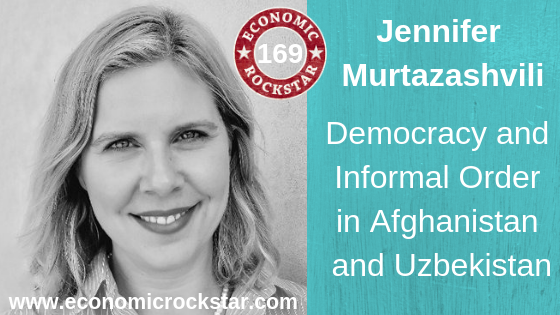
169: Jennifer Murtazashvili on Democracy and Informal Order in Afghanistan and Uzbekistan
December 16, 2018 by Frank

http://traffic.libsyn.com/economicrockstar/169_Jennifer_Murtazashvili_Final.mp3
Play in New WindowDownload

169: Jennifer Murtazashvili on Democracy and Informal Order in Afghanistan and Uzbekistan

Jennifer Murtazashvili is professor and director of the International Development Program at the Graduate School of Public and International Affairs at the University of Pittsburgh.

Her research explores questions of governance, public administration, and local institutions with a geographical focus on Central and South Asia and the former Soviet Union.

Jennifer’s first book, Informal Order and the State in Afghanistan, was published by Cambridge University Press in 2016.

A second book, Land, the State, and War: Property Rights and Political Order in Afghanistan (with husband Ilia Murtazashvili) is under revision.

Professor Murtazashvili’s current projects include research related to the (unexpected) role of bureaucracy in conflict-affected states, local governance and social institutions in Central Asia, and the geopolitics of Central Eurasia.

Jennifer also serves as an elected member of the Central Eurasian Studies Society executive board.

Her research reflects extensive field experience where she has lived on the ground for five years in former Soviet Central Asia and about three years in Afghanistan.

She has collected diverse types of original data employing a wide range of tools to answer important policy questions ranging from ethnographic fieldwork, interviews, focus group discussions, public opinion surveys, as well as field experiments.

In addition to academic endeavors, Professor Murtazashvili remains deeply engaged in public policy.

For three years, she served as a democracy and governance officer for the U.S. Agency for International Development in Tashkent, Uzbekistan, a Peace Corps Volunteer for two years in Samarkand, Uzbekistan, and for more than a year as a Senior Research Officer at the Afghanistan Research and Evaluation Unit.

Jennifer has also served as an advisor for a number of organizations including the World Bank, U.S. Agency for International Development, U.S. Department of Defense, the United Nations Development Program, and UNICEF.

She has a Ph.D. in Political Science and a M.A. in Agricultural and Applied Economics from the University of Wisconsin-Madison

Books:

Informal Order and the State in Afghanistan by Jennifer Murtazashvili

The Underground Girls of Kabul: In Search of a Hidden Resistance in Afghanistan by Jenny Norberg

Private Truths, Public Lies: The Social Consequences of Preference Falsification by Timur Kuran

Charlie Wilson’s War : The Extraordinary Story of How the Wildest Man in Congress and a Rogue CIA Agent Changed the History by George Crile

Paradigms and Sand Castles: Theory Building and Research Design in Comparative Politics (Analytical Perspectives On Politics) by Barbara Geddes

Patreon

If you’re a fan of the podcast and would like to show your support in anyway, please check out my Patreon page at www.patreon.com/economicrockstar where you can sign up for any of the awards for as little as $1 a month or you can simply follow me on Instagram, the Economic Rockstar Facebook page or on Twitter or simply recommend the show to a friend, especially if they have never had the opportunity to study economics.

http://traffic.libsyn.com/economicrockstar/169_Jennifer_Murtazashvili_Final.mp3

Podcast: Play in new window | Download
167: James Kenneth Galbraith on Inequality, Democracy and the Impact of the Financial Crisis on Greece

November 25, 2018 by Frank

http://traffic.libsyn.com/economicrockstar/167_James_Kenneth_Galbraith_Final.mp3
Play in New WindowDownload

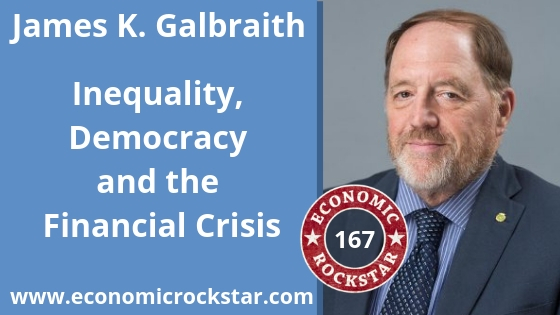
167: James Kenneth Galbraith on Inequality, Democracy and the Impact of the Financial Crisis on Greece

James Kenneth Galbraith is the Lloyd M. Bentsen Jr. Chair in Government/Business Relations and Professor of Government at Lyndon B. Johnson School of Business Affairs at The University of Texas at Austin.

James was executive director of the Joint Economic Committee of the U.S. Congress in the early 1980s. He chaired the board of Economists for Peace and Security (1996–2016) and directs the University of Texas Inequality Project. He is a managing editor of Structural Change and Economic Dynamics.

From 1993 to 1997, he served as chief technical adviser to China’s State Planning Commission for macroeconomic reform, and in 2016 he advised the presidential campaign of Senator Bernie Sanders. 

In 2014 he was co-winner, with Angus Deaton, of the Leontief Prize for Advancing the Frontiers of Economics. James has a PhD from Yale University.

James Galbraith‘s books include “Welcome to the Poisoned Chalice: The Destruction of Greece and the Future of Europe” (2016); “Inequality: What Everyone Needs to Know” (2016); “The End of Normal: The Great Crisis and the Future of Growth” (2014);

James is the son of the late John Kenneth Galbraith, renowned economist, public official and diplomat.

In this episode we discuss James’ views on the teachings of mainstream economics today, his work on inequality, democracy, the financial crisis of 2008 and the impact it has had on Greece as well as, of course, his father John.

Economists:

In this episode, James K. Galbraith mentions: John Kenneth Galbraith, John Maynard Keynes, Karl Marx, Joseph Schumpeter, Yanis Varoufakis, Wassily Leontief, James Tobin and Branko Milanovic.

Philosophers:

In this episode, James K. Galbraith mentions: Charles Saunders Peirce and William James.

In this Episode Find Out About:

  • James K. Galbraith’s thoughts on the economics discipline and how mainstream economics is failing in academia.
  • How academics may have lost the ‘sense of adventure’ by the time they get a tenured position.
  • Does economic growth result in increasing inequality or are there other causes?
  • About the University of Texas Inequality Project (UTIP).
  • Does growing inequality lead to economic instability?
  • Rental crisis in Ireland as a result of the property crash of 2008.
  • How Iceland faired after the Great Recession in comparison to Ireland.
  • The Greek economy and the Poison Chalice.
  • The ‘Extend and Pretend’ approach (lend now and pretend to pay later) to fixing the Greek economy after the financial crisis which will lead to economic stagnation and removing the social fabric of the country.
  • Were the loans to Greece a mistake and what happened to the money that was lent to Greece?
  • Were the privatisation of Greek ports and airports the best way for Greece to overcome it’s economic collapse or was it a way of satisfying its creditors?
  • If the League of Nations was never established, could there have been military consequences for those countries that endured economic collapse?
  • About the ‘Democracy in Europe Movement’  and the ‘New Deal’ to maintain democracy, tackle the problems of climate change, the problem to renovate investment and stabilise the human situation across the crisis-ridden countries across Europe.
  • Why the Chinese were interested in Wassily Leontief and John Kenneth Galbraith.

Links:

  • University of Texas Inequality Project 
  • Democracy in Europe Movement
  • Links to James K. Galbraith’s publications

Books:

  • The Affluent Society by John Kenneth Galbraith
  • The Great Crash 1929 by John Kenneth Galbraith 
  • The New Industrial State by John Kenneth Galbraith
  • American Capitalism
  • Welcome to the Poisoned Chalice: The Destruction of Greece and the Future of Europe by John Kenneth Galbraith
  • Inequality: What Everyone Needs to Know by James Kenneth Galbraith
  • The End of Normal: The Great Crisis and the Future of Growth by James Kenneth Galbraith
  • Global Inequality: A New Approach for the Age of Globalization by Branko Milanovic
  • The Haves and the Have-Nots: A Brief and Idiosyncratic History of Global Inequality by Branko Milanovic
  • The Metaphysical Club: The Story of Ideas in America by Louis Menand

Patreon

If you’re a fan of the podcast and would like to show your support in anyway, please check out my Patreon page at www.patreon.com/economicrockstar where you can sign up for any of the awards for as little as $1 a month or you can simply follow me on Instagram, the Economic Rockstar Facebook page or on Twitter or simply recommend the show to a friend, especially if they have never had the opportunity to study economics.

http://traffic.libsyn.com/economicrockstar/167_James_Kenneth_Galbraith_Final.mp3

Podcast: Play in new window | Download
164: Nicholas Gruen on Data Sharing and Reform in Economic Thinking

November 2, 2018 by Frank

http://traffic.libsyn.com/economicrockstar/164_Nicholas_Gruen_Final.mp3
Play in New WindowDownload

164: Nicholas Gruen on Data Sharing and Reform in Economic Thinking

Nicholas Gruen is CEO of Lateral Economics and is a widely published policy economist, entrepreneur and commentator.

In this episode Professor Gruen discusses the need for reform in economics at both academic and policy level.

He also explains the importance of information and how information is poorly managed at the central planning stage but can be used effectively under the right direction if this information or data can be shareable both from the private and the public sector.

Links:

  • Lateral Economics by Nicholas Gruen
  • Kilkenomics Festival where economics and comedy collide
  • Kaggle: Your Home for Data Science
  • Breezedocs
  • Slant.co
  • HealthKit
  • Lendable

Books:

  • Superforecasting: The Art and Science of Prediction by Philip E. Tetlock
  • Truth About Markets: Why Some Countries Are Rich And Others Remain Poor by John Kay

Blogs:

  • Interfluidity by Steve Randy Waldman  
  • Synthentic Assets by Carolyn Sissoko
  • Krugman Online by Paul Krugman

Patreon

If you’re a fan of the podcast and would like to show your support in anyway, please check out my Patreon page at www.patreon.com/economicrockstar where you can sign up for any of the awards for as little as $1 a month or you can simply follow me on Instagram, the Economic Rockstar Facebook page or on Twitter or simply recommend the show to a friend, especially if they have never had the opportunity to study economics.

http://traffic.libsyn.com/economicrockstar/164_Nicholas_Gruen_Final.mp3

Podcast: Play in new window | Download

101: Chris Coyne on the Opportunity Cost to War, Exporting Democracy and the Nirvana Fallacy

September 1, 2016 by Frank

http://traffic.libsyn.com/economicrockstar/101_Chris_Coyne_Final.mp3
Play in New WindowDownload

101: Chris Coyne on the Opportunity Cost of War, Exporting Democracy and the Nirvana Fallacy

Christopher Coyne is an Associate Professor of Economics at George Mason University and the AssociateChris Coyne Economic Rockstar Director of the F. A. Hayek Program for Advanced Study in Philosophy, Politics, and Economics at the Mercatus Center.

He also serves as Director of Graduate Studies for the Department of Economics.

Professor Coyne serves as the Co-Editor of The Review of Austrian Economics, the Co-Editor of The Independent Review, the Co-Editor of Advances in Austrian Economics, and the Book Review Editor of Public Choice.

Chris has authored numerous academic articles, book chapters, and policy studies and his research interests include political economy and military intervention.

Professor Coyne is the author or co-author of numerous books including Future: Economic Peril or Prosperity? and After War: The Political Economy of Exporting Democracy.

He is also the co-editor of The Oxford Handbook of Austrian Economics and The Handbook on the Political Economy of War.

In 2016 Chris was selected as a recipient of George Mason University’s University Teaching Excellence Award.

His work can be found at www.ccoyne.com

Economics:

In this episode, Chris discusses and mentions: economics of war, the Nirvana Fallacy, incentives, knowledge constraints, unintended consequences, the Capitalist-Peace hypothesis, dependency effects, public goods, praxeology, prohibition and society.

Economists:

In this episode, Chris discusses and mentions: Ludwig von Mises, F. A. Hayek, Robert Higgs, Mike Munger, Peter Leeson, Rachel Coyne, James Buchanan, Gordon Tullock, Claude-Frédéric Bastiat and Henry Hazlitt.

Professor Coyne’s Daily Routine:

  • Everyday is the same. I wake up every morning between 5 and 6 am and work out in the garage for 1 to 2 hours. Then I eat breakfast and get to work.
  • I work in chunks – anywhere from 1 to 3 hours and I take little breaks in between.
  • When I find myself losing focus, I do little things like getting a cup of coffee or do a chore around the house or going outside for a few minutes. It resets my mind.
  • I’ll work from 8 or 9 am to lunch. I get lunch, maybe work a little more and then I shift more into administrative mode. It requires a different brain power than reading and writing.

Links:

  • Polity IV Index

Recommended Books:

Human Action by Mises: “That is an excellent book in terms of a systematic treatise on economics.” – Chris Coyne.

Crisis and Leviathan: Critical Episodes in the Growth of American Government by Robert Higgs: “It’s a wonderful treatment of how government grows through the onset of crises. He’s focused mainly on the United States. He talks about the evolution of the US government and he highlights these punctuated points of crises where government grew. Of course World War 2 and the Great Depression being among the main ones that he highlights. It’s excellent both for the history but also for the framework he lays out – called the ‘Ratchet Effect’ (how the government ratchets up in size. It’s a wonderful book that I highly recommend.” – Chris Coyne.

Papers Mentioned in the Episode:

  • Coyne, C. and Hall. A. (2014). The Political Economy of Drones, Defence and Peace Economics, 25(5): 445-460.
  • Coyne, C., Boettke, P. and Leeson, P. (2014). Earw(h)ig: I Can’t Hear You Because Your Ideas are Old, Cambridge Journal of Economics, 38(3): 531-544.
  • Coyne, C. and Coyne, R. (2014). The Identity Economics of Female Genital Mutilation,” Journal of Developing Areas, 48(2): 137-152.
  • Coyne, C., Boettke, P. and Hall, A. (2013). Keep Off the Grass: The Economics of Prohibition and U.S. Drug Policy, Oregon Law Review, 91(4): 1069-1096.
  • Coyne, C. and Leeson,P. (2012). Sassywood, Journal of Comparative Economics, 40(4): 608-620. 

Where to Find Professor Coyne:

  • Website: www.coyne.com
  • Twitter: @ccoyne1

Books:

  • Human Action by Ludwig von Mises
  • Crisis and Leviathan: Critical Episodes in the Growth of American Government by Robert Higgs
  • Future: Economic Peril or Prosperity? by Chris Coyne
  • Flaws and Ceilings: Price Controls and the Damage They Cause by Chris Coyne
  • Doing Bad by Doing Good: Why Humanitarian Action Fails by Chris Coyne
  • Media, Development and Institutional Change by Chris Coyne
  • After War: The Political Economy of Exporting Democracy by Chris Coyne
  • The Oxford Handbook of Austrian Economics
  • The Handbook on the Political Economy of War.
http://traffic.libsyn.com/economicrockstar/101_Chris_Coyne_Final.mp3

Podcast: Play in new window | Download

079: Bryan Caplan on Parenting, the Case Against Education and the Rational Voter

March 31, 2016 by Frank

http://traffic.libsyn.com/economicrockstar/079_Bryan_Caplan.mp3
Play in New WindowDownload

079: Bryan Caplan on Parenting, the Case Against Education and the Rational Voter

Bryan Caplan is Professor of Economics at George Mason University and Senior Scholar at the Mercatus Center.Bryan Caplan Economic Rockstar

Bryan is the author of The Myth of the Rational Voter: Why Democracies Choose Bad Policies, named “the best political book of the year” by the New York Times, and Selfish Reasons to Have More Kids: Why Being a Great Parent Is Less Work and More Fun Than You Think. He also blogs at EconLog.

Bryan has published in the New York Times, the Washington Post, the Wall Street Journal, the American Economic Review, the Economic Journal, the Journal of Law and Economics, and Intelligence, and has appeared on 20/20, FoxNews, and C-SPAN. He is now working on a new book, The Case Against Education.

His webpage, bcaplan.com, features both his academic research and his numerous other interests, including the online Museum of Communism.

Bryan has a B.A. in Economics from University of California, Berkeley and a Ph.D. in Economics from Princeton University.

Economists and Influencers:

In this episode, Bryan mentions: Milton Friedman, Gary Becker, Daniel Kahneman and Tyler Cowen.

Economics:

In this episode, Bryan mentions: the signaling effect, behavioral genetics, fertility rates, immigration, open borders, productivity and democracy.

Where to Find Bryan Caplan:

  • www.bryancaplan.com
  • EconLog

Books:

  • The Myth of the Rational Voter: Why Democracies Choose Bad Policies by Bryan Caplan
  • Selfish Reasons to Have More Kids: Why Being a Great Parent Is Less Work and More Fun Than You Think by Bryan Caplan
  • Understanding Comics: The Invisible Art by Scott McCloud
http://traffic.libsyn.com/economicrockstar/079_Bryan_Caplan.mp3

Podcast: Play in new window | Download

Frank Conway

Frank Conway is founder of Economic Rockstar and lecturer of economics, finance and statistics. Read More…

View My Blog Posts

Youtube Sub

Become a Patron of the Economic Rockstar Podcast

patreon

Ireland’s Economy by the Numbers

Leaving Cert Economics: Ireland’s Economy  Click here to download a workbook on Ireland’s Economy so that you can add your own notes. [Original size] Ireland’s Economy by fconway

Categories

Subscribe and Never Miss An Episode

itunes-logo

Recent Posts

  • Ireland’s Economy by the Numbers April 8, 2019
  • 174: Wendy Carlin on The Core Project, Capitalism, Democracy and Normative Statements February 13, 2019
  • 173: Stephen Wright on Core Econ as a Learning Resource for Mainstream Economics January 28, 2019
  • 172: Best of 2018 Part 2: From the Great Depression to Futurism; Institutions, Individualism, Cooperation and Reciprocity January 22, 2019
  • 171: Best of 2018 Part 1 January 3, 2019

Copyright © 2026 · Podcast Pro Theme on Genesis Framework · WordPress · Log in

This website uses cookies to improve your experience. We'll assume you're ok with this, but you can opt-out if you wish. Accept Reject Read More
Privacy Policy

Privacy Overview

This website uses cookies to improve your experience while you navigate through the website. Out of these, the cookies that are categorized as necessary are stored on your browser as they are essential for the working of basic functionalities of the website. We also use third-party cookies that help us analyze and understand how you use this website. These cookies will be stored in your browser only with your consent. You also have the option to opt-out of these cookies. But opting out of some of these cookies may affect your browsing experience.
Necessary
Always Enabled
Necessary cookies are absolutely essential for the website to function properly. This category only includes cookies that ensures basic functionalities and security features of the website. These cookies do not store any personal information.
Non-necessary
Any cookies that may not be particularly necessary for the website to function and is used specifically to collect user personal data via analytics, ads, other embedded contents are termed as non-necessary cookies. It is mandatory to procure user consent prior to running these cookies on your website.
SAVE & ACCEPT