• ABOUT
  • RESOURCES
  • PODCAST
  • BOOKS
  • BLOG
  • SUPPORTERS
  • QFA Financial Advice
  • CONTACT

Economic Rockstar

Connecting Brilliant Minds in Economics and Finance

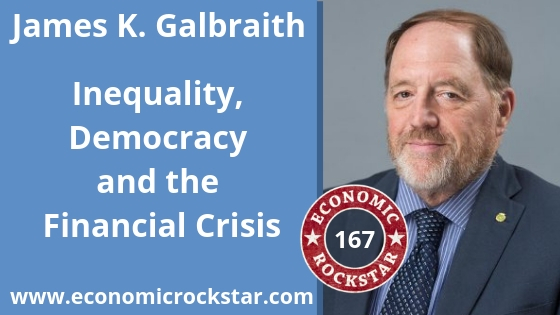
167: James Kenneth Galbraith on Inequality, Democracy and the Impact of the Financial Crisis on Greece
November 25, 2018 by Frank

http://traffic.libsyn.com/economicrockstar/167_James_Kenneth_Galbraith_Final.mp3
Play in New WindowDownload

167: James Kenneth Galbraith on Inequality, Democracy and the Impact of the Financial Crisis on Greece

James Kenneth Galbraith is the Lloyd M. Bentsen Jr. Chair in Government/Business Relations and Professor of Government at Lyndon B. Johnson School of Business Affairs at The University of Texas at Austin.

James was executive director of the Joint Economic Committee of the U.S. Congress in the early 1980s. He chaired the board of Economists for Peace and Security (1996–2016) and directs the University of Texas Inequality Project. He is a managing editor of Structural Change and Economic Dynamics.

From 1993 to 1997, he served as chief technical adviser to China’s State Planning Commission for macroeconomic reform, and in 2016 he advised the presidential campaign of Senator Bernie Sanders. 

In 2014 he was co-winner, with Angus Deaton, of the Leontief Prize for Advancing the Frontiers of Economics. James has a PhD from Yale University.

James Galbraith‘s books include “Welcome to the Poisoned Chalice: The Destruction of Greece and the Future of Europe” (2016); “Inequality: What Everyone Needs to Know” (2016); “The End of Normal: The Great Crisis and the Future of Growth” (2014);

James is the son of the late John Kenneth Galbraith, renowned economist, public official and diplomat.

In this episode we discuss James’ views on the teachings of mainstream economics today, his work on inequality, democracy, the financial crisis of 2008 and the impact it has had on Greece as well as, of course, his father John.

Economists:

In this episode, James K. Galbraith mentions: John Kenneth Galbraith, John Maynard Keynes, Karl Marx, Joseph Schumpeter, Yanis Varoufakis, Wassily Leontief, James Tobin and Branko Milanovic.

Philosophers:

In this episode, James K. Galbraith mentions: Charles Saunders Peirce and William James.

In this Episode Find Out About:

  • James K. Galbraith’s thoughts on the economics discipline and how mainstream economics is failing in academia.
  • How academics may have lost the ‘sense of adventure’ by the time they get a tenured position.
  • Does economic growth result in increasing inequality or are there other causes?
  • About the University of Texas Inequality Project (UTIP).
  • Does growing inequality lead to economic instability?
  • Rental crisis in Ireland as a result of the property crash of 2008.
  • How Iceland faired after the Great Recession in comparison to Ireland.
  • The Greek economy and the Poison Chalice.
  • The ‘Extend and Pretend’ approach (lend now and pretend to pay later) to fixing the Greek economy after the financial crisis which will lead to economic stagnation and removing the social fabric of the country.
  • Were the loans to Greece a mistake and what happened to the money that was lent to Greece?
  • Were the privatisation of Greek ports and airports the best way for Greece to overcome it’s economic collapse or was it a way of satisfying its creditors?
  • If the League of Nations was never established, could there have been military consequences for those countries that endured economic collapse?
  • About the ‘Democracy in Europe Movement’  and the ‘New Deal’ to maintain democracy, tackle the problems of climate change, the problem to renovate investment and stabilise the human situation across the crisis-ridden countries across Europe.
  • Why the Chinese were interested in Wassily Leontief and John Kenneth Galbraith.

Links:

  • University of Texas Inequality Project 
  • Democracy in Europe Movement
  • Links to James K. Galbraith’s publications

Books:

  • The Affluent Society by John Kenneth Galbraith
  • The Great Crash 1929 by John Kenneth Galbraith 
  • The New Industrial State by John Kenneth Galbraith
  • American Capitalism
  • Welcome to the Poisoned Chalice: The Destruction of Greece and the Future of Europe by John Kenneth Galbraith
  • Inequality: What Everyone Needs to Know by James Kenneth Galbraith
  • The End of Normal: The Great Crisis and the Future of Growth by James Kenneth Galbraith
  • Global Inequality: A New Approach for the Age of Globalization by Branko Milanovic
  • The Haves and the Have-Nots: A Brief and Idiosyncratic History of Global Inequality by Branko Milanovic
  • The Metaphysical Club: The Story of Ideas in America by Louis Menand

Patreon

If you’re a fan of the podcast and would like to show your support in anyway, please check out my Patreon page at www.patreon.com/economicrockstar where you can sign up for any of the awards for as little as $1 a month or you can simply follow me on Instagram, the Economic Rockstar Facebook page or on Twitter or simply recommend the show to a friend, especially if they have never had the opportunity to study economics.

http://traffic.libsyn.com/economicrockstar/167_James_Kenneth_Galbraith_Final.mp3

Podcast: Play in new window | Download

087: Asgeir B. Torfason on the Economy of Iceland and Explaining Negative Cashflows in Banks

May 26, 2016 by Frank

http://traffic.libsyn.com/economicrockstar/087_Asgeir_Torfason_Final.mp3
Play in New WindowDownload

087: Asgeir B. Torfason on the Economy of Iceland and Explaining Negative Cashflows in Banks

Asgeir B. Torfason is Assistant Professor in the School of Business at the University of Iceland where he teaches asgeir torfasonFinance, Accounting and Financial Statement Analysis. Asgeir is also Postdoc Research Fellow, as well as an Assistant Professor at Gothenburg Research Institute.

Asgeir defended his PhD at Gothenburg University in May 2014 with dissertation: Cash Flow Accounting in Banks – A study of practice.

His research combines bank management, finance theory, monetary economics and accounting studies.

Previous research has focused on asset values and long-term investment in real estate, a field where Asgeir has extensive practical experience, covering the Nordics as VP for a REIT listed on NYSE.

Prior to that he worked in university management after getting an MBA from Norwegian Business School in Oslo, and studied earlier Philosophy and Economics in Iceland.

Economics:

In this episode, Asgeir mentions: Iceland’s economy, IT bubble, Tulip Mania, banks, capital controls, devaluation, tourism, resources, trade, cashflows, assets, liabilities, revenue, equity, income statements, bankruptcy, lending, negative cashflows, money multiplier, reserve requirement, central banks, quantitative easing, swap lines and housing bubbles.

Economists:

In this episode, Asgeir mentions: Joseph Schumpeter, John Maynard Keynes, Hyman Minsky, Perry G Mehrling, 

Links:

  • Economics of Money andBanking, Part One by Perry G Mehrling
  • Economics of Money andBanking, Part Two by Perry G Mehrling
  • Money View by Institute for New Economic Thinking
  • Katharina Pistor, Professor of Law at Columbia Law School

Papers:

  • The difference between cash flows in banks and non-financial firms by Asgeir B. Torfason
  • Methods for Making Sense of Cash Flow in Banks by Asgeir B. Torfason
  • Cash flow accounting in banks – a study of practice (PhD) by Asgeir B. Torfason

Books:

  • The New Lombard Street: How the Fed Became the Dealer of Last Resort by Perry Mehrling
  • Lombard Street-A Description of the Money Market by Walter Bagehot
  • Manias, Panics and Crashes: A History of Financial Crises, Sixth Edition by Charles P. Kindleberger
  • The Economic Consequences of the Peace by John Maynard Keynes

Where to Find Asgeir:

  • Twitter:  @asgeirbt
  • About.me
http://traffic.libsyn.com/economicrockstar/087_Asgeir_Torfason_Final.mp3

Podcast: Play in new window | Download
076: Greg Ip on Foolproofing the Economy and Why Stability is Destabilizing

March 10, 2016 by Frank

http://traffic.libsyn.com/economicrockstar/076_Greg_Ip.mp3
Play in New WindowDownload

076: Greg Ip on Foolproofing the Economy and Why Stability is Destabilizing

Greg Ip is one of the best-known economics journalists in the US.Greg Ip Economic Rockstar

He is currently chief economics commentator of The Wall Street Journal and writes about U.S. and global economic developments and policy each week in the Capital Account column and on Real Time Economics, the Wall Street Journal’s economics blog.

From 2008 to January 2015, he was U.S. Economics Editor of The Economist magazine. Greg is the author of Foolproof: Why Safety Can Be Dangerous and How Danger Makes Us Safe as well as author of The Little Book of Economics: How the Economy Works in the Real World.

“Stability is Destabilising”- Hyman Minsky

Economics:

In this episode, Greg mentions and discusses: junk bonds, capitalism, investment, growth, financial crisis, bank deposits, loans, currency, gold, exchange rates, money market funds, bank run, exchange traded funds, recessions, unintended consequences and the Paradox of Thrift.

Economists:

In this episode, Greg mentions and discusses: Paul Volcker, Hyman Minsky, Gary Gorton, Joseph Schumpeter and John Maynard Keynes.


In this episode you will learn:

  • about the theme behind Greg Ip’s latest book Foolproof.

  • when the pursuit of safety lead us into danger?

  • what forest fires have to do with Wall Street.

  • about the relationship between the financial market (and its potential for a crisis) and ecological systems.
  • the way we publicly and privately try to cope with risk and danger and how those choices can create unintended consequences.

  • about the Fallacy of Composition: Things you do that are safe actually end up making other people less safe.
  • what American Football can teach us about the Fallacy of Composition.
  • how making American Football safe with the introduction of helmets has created increased risk taking and more injuries.
  • what past economic and financial crises have in common.
  • how the financial system succeeded too well in making people feel their money was safe.
  • how banking regulations and capital controls introduced after the financial crisis will create risks in other parts of the economy and financial markets.
  • if savings is actually bad for the economy.

  • about Keynes’ Paradox of Thrift and how savings forces others to borrow.

  • whether exchange traded funds (ETFs) will be the next financial catastrophe.
  • about the Peltzman Effect on anti-lock brakes.
  • how Paul Volcker‘s regulation of capital flows caused the growth of shadow banking.

  • how The Great Moderation changed attitudes about debt and how relaxed laws allowed high-risk households to borrow for mortgages.

  • about Gary Gorton of Yale and his explanation for a financial crisis.
  • how being present in danger can remind ourselves of the things that aren’t always safe.
  • whether the finance industry could take the lessons learned about safety and regulation in the airline industry.
  • why the Lehman Brothers collapse surprised many due to the US government indicating to the market that banks and mortgage companies would be bailed out.
  • how German savers were much to blame for the euro crisis than their European counterparts that borrowed.
  • why we continue to build cities near water which can cause devastation in the form of floods and tidal waves.
  • why The Netherlands, with their ‘Room For The River’ programme, is destroying dykes and allowing their lands to flood.
  • why Greg Ip is worried about the situation in China and how the stability that the government is trying to maintain will eventually lead to instability.

“If banks are limited from lending then lending activity will migrate elsewhere. We see this happening at exchange traded funds and other shadowy parts of the financial system. And you worry that risks are starting to grow there.” – Greg IP

“One way to protect ourselves against disaster is to make use of the presence of danger to remind ourselves that things aren’t always safe and to take steps that keep us safe”.  – Greg IP

“What I worry about more is that the pendulum has swung too far against risk taking. And the risks that are been taken are being channeled too far in the direction of financial risk and not real economy risk – people starting new businesses or buying new homes.” – Greg Ip

“What I worry about China is that they have leadership that is worried about political and economic stability.”

Where to Find Greg Ip:

  • The Wall Street Journal 
  • www.gregip.com

Books:

  • Foolproof: Why Safety Can Be Dangerous and How Danger Makes Us Safe by Greg Ip
  • The Little Book of Economics: How the Economy Works in the Real World by Greg Ip

Other Interesting Links:

  • Deregulation: The Expected and The Unexpected by Sam Peltzman
  • Do we really need more regulation of financial derivatives? by Merton H. Miller
  • Financial Innovation: The Last Twenty Years and the Next by Merton H. Miller
  • Peltzman, S. (1975). The Effects of Automobile Safety Regulation, Journal of Political Economy: 677 – 726.
  • National Center for Catastrophic Sport Injury Research 
  • Probability of a Hazardous Material Truck Accident in New Jersey by Damodaran, M., Daniel, J. and Luke, A. C. (2002)
http://traffic.libsyn.com/economicrockstar/076_Greg_Ip.mp3

Podcast: Play in new window | Download

070: Chronis Lalas on Prospect Theory and ‘Making a Behavioral Economist’

January 28, 2016 by Frank

http://traffic.libsyn.com/economicrockstar/070_Chronis_Lalas__Update.mp3
Play in New WindowDownload

070: Chronis Lalas on Prospect Theory and ‘Making a Behavioral Economist’

Chronis Lalas is an aspiring Behavioral Economist who is researching and publishing about the applications of chronis lalasBehavioral Economics in the real world. Chronis is a recent graduate of the University of Macedonia, Greece with a BA in Economics.

Chronis blogs at The Newbie Economist and aspires to be a behavioral economist that will optimize Fortune 500 corporations’ marketing campaigns through analyzing their existing customers’ behavior.

He aims to bring a fresh perspective to traditional economics by optimizing in consumer behavior analysis and brand management. As a young economist, his vision is to inspire students and the young generation to take on Behavioral Economics. His work has been published, amongst others, in the Online Political and Economic Newspaper The European Sting.

Economists:

In this interview, Chronis mentions: George Lowenstein, Dilip Soman, Leigh Caldwell, Yoram Bauman, Steve Keen and Dan Ariely.

Economics:

In this interview, Chronis mentions: behavioral economics, prospect theory, confirmation bias, loss aversion, financial crisis, capital controls, austerity, nudge and utility theory.

Who Chronis Would Love to Collaborate with:

Dan Ariely, Rory Sutherland of Ogilvy and Nir Eyal.

In this episode you will learn:

  • what is Prospect Theory.
  • about the infamous Prospect Theory graph.
  • about loss aversion and how Prospect Theory differs to Bernoulli’s Utility Theory.
  • how Prospect Theory is observed in Greece post the financial crisis.
  • about the reciprocity shown by TOMS shoes in Thessaloniki.
  • what makes consumers buy.
  • how consumer behavior can be influenced by manipulating their subconscious through a creatively built environment.
  • How playing French music influences the purchase of French wine.
  • How the names of products and how they are pronounced can change the way consumers think about the product.
  • why and how companies should consider a brand name for their product or service so as to maintain long-term customer loyalty.
  • about the plans that Chronis is undertaking including his behavioral economics comic.

Prospect Theory Paper and Graph:

  • Kahneman, D. and Tversky, A. (1979). Prospect Theory: An Analysis of Decision under Risk. Econometrica, 47(2), pp. 263-291.

Books:

  • Thinking, Fast and Slow by Kahneman and Tversky
  • Predictably Irrational by Dan Ariely
  • Nudge by Thaler and Sunstein
  • Misbehaving by Richard Thaler
  • Hooked: How to Build Habit-Forming Products by Nir Eyal
  • Why We Buy: The Science of Shopping by Paco Underhill
  • Decoded: The Science Behind Why We Buy by Phil Barden

Blog:

  • www.nirandfar.com by Nir Eyal
  • www.behavioraleconomics.com by Alain Samson
  • www.thebehaviouraleconomicslab.co.uk

Links:

  • Episode 067 of the Economic Rockstar podcast with Leigh Caldwell 
  • Behavioral Economics in Action by Dilip Soman 
  • The Behavioral Economics Guide 2015

Research:

  • North, A. C. The Effect of Background Music on the Taste of Wine.
  • North, A. C., Hargreaves, D. C. and McKendrick, J. (1997). In-store music affects product choice. Nature
  • Maglio, S. J., Rabaglia, C. D., Feder, M. A., Krehm, M. and Trope, Y. (2014). Vowel Sounds in Words Affect Mental Construal and Shift Preferences for Targets. Journal of Experimental Psychology: General.

Where to Find Chronis:

  • Website: The Newbie Economist
  • Email: chronis@lalas.info

Credits:

  • Parisian Kevin MacLeod (incompetech.com)
    Licensed under Creative Commons: By Attribution 3.0 License
    http://creativecommons.org/licenses/by/3.0/
http://traffic.libsyn.com/economicrockstar/070_Chronis_Lalas.mp3

Podcast: Play in new window | Download

035: Stephen Young on Being Car-Free and the Behavioural Economics of Owning A Car

June 4, 2015 by Frank

http://traffic.libsyn.com/economicrockstar/035_Stephen_Young_Final.mp3
Play in New WindowDownload

035: Stephen Young on Being Car-Free and the Behavioural Economics of Owning A Car

Stephen Young is a Senior Lecturer at Brighton Business School and is subject leader for behavioural economics.Stephen Young

He is also Visiting Lecturer at Brighton and Sussex Medical School, where he teaches Behavioural Economics to health professionals, including commissioners, public health practitioners and GPs.

As an independent consultant and trainer, Stephen also provides client workshops and presentations on behavioural economics and behaviour change.

Stephen is widely published and his research interests include behaviour change, climate change, health, sustainability, and Information and Communications Technology.

Stephen does not own a car and is so passionate about being car free that he writes regularly on his blog livingthecarfreelife.blogspot.com. 

Economists:

In this interview, Stephen mentions and discusses:

Paul Ormerod, Richard Thaler, Cass Sunstein, John Cochrane, Paul Dolan, Malcolm Gladwell, Phil Goodwin, Daniel Kahneman, Adam Smith, Karl Marx, Barry Schwartz, Richard Layard, Nassim Nicholas Taleb, Paul Krugman and Friedrich Hayek.

Economic Themes:

In this interview, Stephen mentions and discusses:

Bank run, financial crisis, risk, behavioural economics, nudge, rationality, incentives, tax, choice architecture, obesity, climate change, externalities, loss aversion and the endowment effect.

On Economic Theory:

“None of the models are completely perfect. None of them work to everybody’s benefit” – Stephen Young

Click To Tweet

Is behavioural economics storming the citadel or is it shoring up the ramparts? – Stephen Young

Click To Tweet

Find Out:

  • why Stephen decided to become an academic.
  • about the Northern Rock bank run in the UK in 2007.
  • why universities need to adapt or die when it comes to addressing relevant content.
  • what Stephen is doing to reduce his carbon footprint in college and how he’s responding to the digital needs of his students.
  • why health professionals are interested in behavioral economics.
  • about the Irish government’s fight against obesity.
  • how Stephen is encouraging a town in the UK to become pedestrian friendly.
  • about framing car ownership – status and perception of rank.
  • how by ditching your car you can burn calories.
  • how the average person is working two days a week to pay for their car.
  • about the emotional attachment that a car represents.
  • what major cities across Europe are doing to make them more pedestrian and bike-friendly.
  • about peak car ownership.
  • some advice from Stephen on how to give up your car and become car free.
  • about the pluralist approach to embracing economics.

“The externalities don’t work for car ownership because it’s not priced in because of the pollution emitted” – Stephen Young

Click To Tweet

You can live a better life without a car. You can be thinner. You  can be richer. You can be more sociable. You can be more flexible. You can get around just as easily – Stephen Young.

Reasons for Peak Car Ownership:

  1. The youth do not have the income to finance the ownership of a car due to the high unemployment rates.
  2. High cost of car insurance.
  3. The opportunity costs of owning the latest technology.
  4. You don’t need a car to participate in a lot of things today.

Behavior Economics in the Health Sector:

“We’re not just nudged by the other side, we’re being bombarded by the other side. There’s a lot of room to doubt the way public health policy is being transacted and implemented in a lot of economies” – Stephen Young.

Giving Up Your Car and Becoming Car Free:

  1. Try living without your car for a while before you give up.
  2. If you’re moving house, locate to an area where everything you need is close by.
  3. Don’t give up your car just because it’ll make the world a better place. Only do it to improve your own life.
  4. Take a ‘hike’ – go for a walk.
  5. Walking is a great way of forming your thoughts and ideas as it clears your head and frees your mind.
  6. Walking, rather than driving, improves your health and well-being. It connects you to where you live, to where you are.

“All truly great thoughts are conceived by walking” – Nietzcshe.

Click To Tweet

Recommended Books:

  • The Death of Economics by Paul Ormerod
  • Why Most Things Fail: Evolution, Extinction and Economics by Paul Ormerod
  • Nudge by Richard Thaler and Cass Sunstein
  • The Tipping Point by Malcolm Gladwell
  • Happiness by Design by Paul Dolan
  • Thinking, Fast and Slow by Daniel Kahneman
  • The Road to Serfdom by Friedrich Hayek
  • Capital: Volume 1 by Karl Marx
  • Misbehaving: The Making of Behavioural Economics by Richard Thaler
  • Poor Economics by Abhijit V. Banerjee and Esther Duflo
  • Scarcity by Sendil Mullainathan and Eldar Shafir
  • The Structure of Scientific Revolutions by Thomas Kuhn

Where to Find Stephen Young:

  • Website: stephenyoung.org.uk
  • Website: livingthecarfreelife.blogspot.com
  • LinkedIn: Stephen Young
  • Twitter: @stephenyounguk
  • BehaviourWorkshops Twitter: @BehaviourW
  • Behaviour Workshops Blog: http://www.behaviourworkshops.blogspot.co.uk/

Stephen Young’s Publications:

  • Young, S (2013). The Behavioural Economics of Owning A Car. eg magazine. Volume 18, Issue 5, March-April  2013. ISSN 2042-1990.
  • Other Publications.

Forthcoming

  • Young, S. and Caisey, V. Behavioral Economics and Social Marketing: Points of Contact?  Chapter in Volume II of Stewart, D. (Ed) Handbook of Persuasion and Social Marketing. NY: Praeger. 2015.
http://traffic.libsyn.com/economicrockstar/035_Stephen_Young_Final.mp3

Podcast: Play in new window | Download

011: Steve Keen on Debunking Economics and the Misinterpretation of Keynes

December 18, 2014 by Frank

http://traffic.libsyn.com/economicrockstar/011_Steve_Keen.mp3
Play in New WindowDownload

011: Steve Keen on Debunking Economics and the Misinterpretation of Keynes

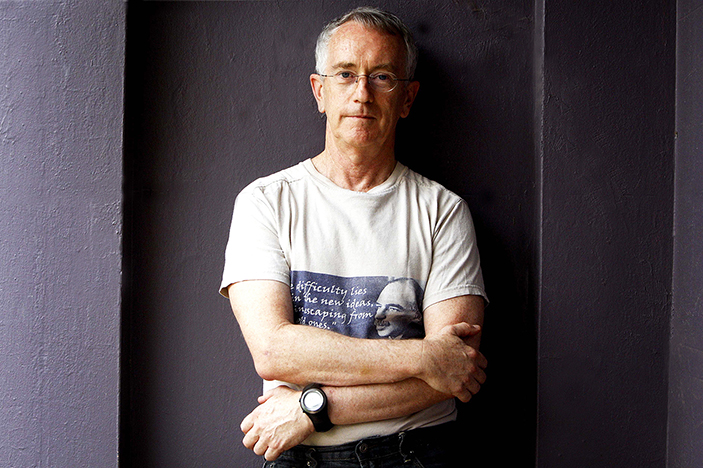
Prof Steve KingstonSteve Keen is Professor of Economics and Head of Department of Economics, History and Politics at Kingston University, London. Steve’s interpretative analysis is quite different to the norm. Steve likes to be known socially as an anti-economist and has spent 40 years fighting delusion in economics. That delusion has led us into a crisis and Steve may have finally won his battle… or has he? Steve is the winner of the Revere Award for being the economist who most convincingly warned of the economic crisis and whose work is most likely to prevent another one. He topped the poll beating Roubini, Shiller, Soros, Stiglitz and Krugman.

Economic Themes:

In this interview, Steve mentions and discusses: Keynesian economics, supply, demand and equilibrium, demand curves, Debt/GDP ratio, financial crisis, housing market bubble and IS-LM model.

Economists and Economic Schools:

In this interview, Steve mentions: Frank Stilwell, Neva Goodwin, Jack Reardon, John Maynard Keynes, Hyman Minsky, John Hicks, Paul Krugman, Paul Samuelson, Marshallian Economics (Alfred Marshall) and Walrasian Economics (Leon Walrasian).

In this episode, you will learn:

  • how Steve saw the 2008 financial crisis coming when he investigated Debt/GDP levels.
  • Steve’s views on current economic teachings in many school, colleges and universities around the world.
  • what should be done at these colleges and how a pluralist approach to teaching economics is best.
  • about Steve’s thoughts on the treatment of Keynesian economics.
  • about Steve’s involvement in a Marvel-style comic book dedicated to teaching economics.

‘Stability is Destabilising’ Steve Keen’s t-shirt from the MINSKY campaign

Economics deserves Comedy – Steve Keen

Click To Tweet

Keynesian Economics

“If you read the Keynes that I base my work on which is really Keynes in 1937, not the General Theory, but the papers from 1937 – read that and a lot of Austrians will think they’re reading Hayek. Keynes is being completely bastardised. What people when they are saying Keynesian they mean Samuelsonian”.

Keynes according to the Americans is what Samuelson said what Keynes said – Steve Keen

Click To Tweet

My vision of who Keynes is very different to the one that Paul Krugman has – Steve Keen

Click To Tweet

Recommended Books:

  • Debunking Economics: The Naked Emperor Dethroned by Steve Keen
  • Money, Blood and Revolution: How Darwin and the doctor of King Charles I could turn economics into a science by George Cooper
  • Dynamic Economic Systems: A Post-Keynesian Approach by John Markus Blatt
  • Introducing a New Economics: Pluralist, Sustainable, Progressive by Jack Reardon.

Favorite Internet Resources:

  • www.debtdeflation.com/blogs
  • Steve Keen on YouTube
  • www.ideaeconomics.org
http://traffic.libsyn.com/economicrockstar/011_Steve_Keen.mp3

Podcast: Play in new window | Download

Frank Conway

Frank Conway is founder of Economic Rockstar and lecturer of economics, finance and statistics. Read More…

View My Blog Posts

Youtube Sub

Become a Patron of the Economic Rockstar Podcast

patreon

Ireland’s Economy by the Numbers

Leaving Cert Economics: Ireland’s Economy  Click here to download a workbook on Ireland’s Economy so that you can add your own notes. [Original size] Ireland’s Economy by fconway

Categories

Subscribe and Never Miss An Episode

itunes-logo

Recent Posts

  • Ireland’s Economy by the Numbers April 8, 2019
  • 174: Wendy Carlin on The Core Project, Capitalism, Democracy and Normative Statements February 13, 2019
  • 173: Stephen Wright on Core Econ as a Learning Resource for Mainstream Economics January 28, 2019
  • 172: Best of 2018 Part 2: From the Great Depression to Futurism; Institutions, Individualism, Cooperation and Reciprocity January 22, 2019
  • 171: Best of 2018 Part 1 January 3, 2019

Copyright © 2026 · Podcast Pro Theme on Genesis Framework · WordPress · Log in

This website uses cookies to improve your experience. We'll assume you're ok with this, but you can opt-out if you wish. Accept Reject Read More
Privacy Policy

Privacy Overview

This website uses cookies to improve your experience while you navigate through the website. Out of these, the cookies that are categorized as necessary are stored on your browser as they are essential for the working of basic functionalities of the website. We also use third-party cookies that help us analyze and understand how you use this website. These cookies will be stored in your browser only with your consent. You also have the option to opt-out of these cookies. But opting out of some of these cookies may affect your browsing experience.
Necessary
Always Enabled
Necessary cookies are absolutely essential for the website to function properly. This category only includes cookies that ensures basic functionalities and security features of the website. These cookies do not store any personal information.
Non-necessary
Any cookies that may not be particularly necessary for the website to function and is used specifically to collect user personal data via analytics, ads, other embedded contents are termed as non-necessary cookies. It is mandatory to procure user consent prior to running these cookies on your website.
SAVE & ACCEPT