• ABOUT
  • RESOURCES
  • PODCAST
  • BOOKS
  • BLOG
  • SUPPORTERS
  • QFA Financial Advice
  • CONTACT

Economic Rockstar

Connecting Brilliant Minds in Economics and Finance

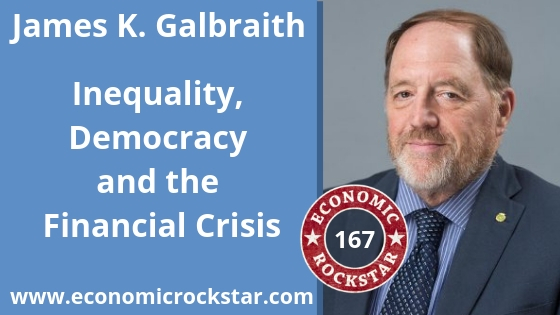
167: James Kenneth Galbraith on Inequality, Democracy and the Impact of the Financial Crisis on Greece
November 25, 2018 by Frank

http://traffic.libsyn.com/economicrockstar/167_James_Kenneth_Galbraith_Final.mp3
Play in New WindowDownload

167: James Kenneth Galbraith on Inequality, Democracy and the Impact of the Financial Crisis on Greece

James Kenneth Galbraith is the Lloyd M. Bentsen Jr. Chair in Government/Business Relations and Professor of Government at Lyndon B. Johnson School of Business Affairs at The University of Texas at Austin.

James was executive director of the Joint Economic Committee of the U.S. Congress in the early 1980s. He chaired the board of Economists for Peace and Security (1996–2016) and directs the University of Texas Inequality Project. He is a managing editor of Structural Change and Economic Dynamics.

From 1993 to 1997, he served as chief technical adviser to China’s State Planning Commission for macroeconomic reform, and in 2016 he advised the presidential campaign of Senator Bernie Sanders. 

In 2014 he was co-winner, with Angus Deaton, of the Leontief Prize for Advancing the Frontiers of Economics. James has a PhD from Yale University.

James Galbraith‘s books include “Welcome to the Poisoned Chalice: The Destruction of Greece and the Future of Europe” (2016); “Inequality: What Everyone Needs to Know” (2016); “The End of Normal: The Great Crisis and the Future of Growth” (2014);

James is the son of the late John Kenneth Galbraith, renowned economist, public official and diplomat.

In this episode we discuss James’ views on the teachings of mainstream economics today, his work on inequality, democracy, the financial crisis of 2008 and the impact it has had on Greece as well as, of course, his father John.

Economists:

In this episode, James K. Galbraith mentions: John Kenneth Galbraith, John Maynard Keynes, Karl Marx, Joseph Schumpeter, Yanis Varoufakis, Wassily Leontief, James Tobin and Branko Milanovic.

Philosophers:

In this episode, James K. Galbraith mentions: Charles Saunders Peirce and William James.

In this Episode Find Out About:

  • James K. Galbraith’s thoughts on the economics discipline and how mainstream economics is failing in academia.
  • How academics may have lost the ‘sense of adventure’ by the time they get a tenured position.
  • Does economic growth result in increasing inequality or are there other causes?
  • About the University of Texas Inequality Project (UTIP).
  • Does growing inequality lead to economic instability?
  • Rental crisis in Ireland as a result of the property crash of 2008.
  • How Iceland faired after the Great Recession in comparison to Ireland.
  • The Greek economy and the Poison Chalice.
  • The ‘Extend and Pretend’ approach (lend now and pretend to pay later) to fixing the Greek economy after the financial crisis which will lead to economic stagnation and removing the social fabric of the country.
  • Were the loans to Greece a mistake and what happened to the money that was lent to Greece?
  • Were the privatisation of Greek ports and airports the best way for Greece to overcome it’s economic collapse or was it a way of satisfying its creditors?
  • If the League of Nations was never established, could there have been military consequences for those countries that endured economic collapse?
  • About the ‘Democracy in Europe Movement’  and the ‘New Deal’ to maintain democracy, tackle the problems of climate change, the problem to renovate investment and stabilise the human situation across the crisis-ridden countries across Europe.
  • Why the Chinese were interested in Wassily Leontief and John Kenneth Galbraith.

Links:

  • University of Texas Inequality Project 
  • Democracy in Europe Movement
  • Links to James K. Galbraith’s publications

Books:

  • The Affluent Society by John Kenneth Galbraith
  • The Great Crash 1929 by John Kenneth Galbraith 
  • The New Industrial State by John Kenneth Galbraith
  • American Capitalism
  • Welcome to the Poisoned Chalice: The Destruction of Greece and the Future of Europe by John Kenneth Galbraith
  • Inequality: What Everyone Needs to Know by James Kenneth Galbraith
  • The End of Normal: The Great Crisis and the Future of Growth by James Kenneth Galbraith
  • Global Inequality: A New Approach for the Age of Globalization by Branko Milanovic
  • The Haves and the Have-Nots: A Brief and Idiosyncratic History of Global Inequality by Branko Milanovic
  • The Metaphysical Club: The Story of Ideas in America by Louis Menand

Patreon

If you’re a fan of the podcast and would like to show your support in anyway, please check out my Patreon page at www.patreon.com/economicrockstar where you can sign up for any of the awards for as little as $1 a month or you can simply follow me on Instagram, the Economic Rockstar Facebook page or on Twitter or simply recommend the show to a friend, especially if they have never had the opportunity to study economics.

http://traffic.libsyn.com/economicrockstar/167_James_Kenneth_Galbraith_Final.mp3

Podcast: Play in new window | Download

115: Edward Conard on The Upside of Inequality: How Good Intentions Undermine the Middle Class

December 12, 2016 by Frank

http://traffic.libsyn.com/economicrockstar/115_Ed_Conard_Final.mp3
Play in New WindowDownload

115: Edward Conard on The Upside of Inequality: How Good Intentions Undermine the Middle Class

Edward Conard is the author of the New York Times top-ten bestselling book, Unintended Consequences: Why ed-conard-economic-rockstarEverything You’ve Been Told About the Economy Is Wrong (2012), and his recent book The Upside of Inequality: How Good Intentions Undermine the Middle Class which reached #7 on the New York Times Bestsellers list and is #1  on the New York Times business book list month. He is a visiting scholar at the American Enterprise Institute. and former Bain Capital partner.

Ed Conard has debated economists, policymakers and journalists on topics related to inequality, the 2008 mortgage crisis, and the U.S. budget. He has appeared on television over 150 times, most notably when he debated Jon Stewart in one of the longest interviews in the Daily Show’s history. Ed has also written opinion pieces for the Wall Street Journal, The New York Times, Foreign Affairs and many other respected publications.

You can check out interviews, op-eds and articles by Ed at his website www.edwardconard.com.

Links:

  • Edward Conard’s Website: www.edwardconard.com
  • Facebook: www.facebook.com/EdwardConard/
  • Twitter: @EdwardConard
  • American Enterprise Institute

Books:

  • Unintended Consequences: Why Everything You’ve Been Told About the Economy Is Wrong by Edward Conard
  • The Upside of Inequality: How Good Intentions Undermine the Middle Class by Edward Conard
http://traffic.libsyn.com/economicrockstar/115_Ed_Conard_Final.mp3

Podcast: Play in new window | Download
114: Deirdre McCloskey on Equality and Greed and How To Be a Very Good Economist

December 2, 2016 by Frank

http://traffic.libsyn.com/economicrockstar/114_Deirdre_McCloskey_Final.mp3
Play in New WindowDownload

114: Deirdre McCloskey on Equality and Greed and How To Be a Very Good Economist

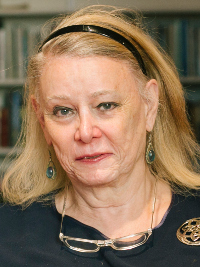
Deirdre McCloskey taught at the University of Illinois at Chicago and was a Distinguished Professor of Economics, History, English, and Communication.

She was also adjunct professor of Philosophy and Classics there, and for five years was a visiting Professor of philosophy at Erasmus University in Rotterdam.

Since October 2007 Deirdre has received six honorary doctorates. In 2013, she received the Julian L. Simon Memorial Award from the Competitive Enterprise Institute for her work examining factors in history that led to advancement in human achievement and prosperity.

Deirdre’s main research interests include the origins of the modern world, the misuse of statistical significance in economics and other sciences, and the study of capitalism, among many others.

Deirdre has written 17 books and around 400 scholarly pieces on topics ranging from technical economics and statistical theory to transgender advocacy and the ethics of the bourgeois virtues.

Her latest book, Bourgeois Equality: How Ideas, Not Capital or Institutions, Enriched the World is part of the Bourgeois Era trilogy described as an “apology” for capitalism.

Deirdre describes herself as a “post-modern, quantitative, free-market, feminist, Episcopalian, Midwestern, gender-crossing, literary woman”.

Deirdre’s website deirdremccloskey.org contains information and links to her books, articles, interviews and much more.

Economics:

In this episode, Deirdre discusses and mentions: blackboard economics, poverty, game theory, inequality, education, healthcare, economic growth, trade, production possibility frontier, gains from trade, liberty, greed, equality, utility maximisation, covered interest arbitrage, theory of marriage.

Economists:

In this episode, Deirdre discusses and mentions: Adam Smith, John Mayanrd Keynes, Karl Marx, David Hume, Gary Becker, Shoshana Grossbard, Nancy Folbre, Herbert Gintis, Jonathan McEvoy, Sam Bowles, Nassim Taleb, Paul Samuelson, Kenneth Arrow, Thomas Piketty, Joseph Schumpeter and David Ricardo.

On the Economics Discipline:

“It’s not to soften the science. It’s to harden the science. We’ve got to stop talking about this softening. That’s not going to persuade the guys to take this stuff seriously. It’s harder to do it correctly than to do it by going on and on with Game Theory and Max. U. As Keynes said ‘A person who is only an economist is not going to be a very good economist’. And I think that’s correct. You need to be a statistician and a mathematician of course and I’m not against that. But you also need to be a historian and a philosopher and a sociologist and a psychologist and a serious person who knows the world. And the way we know the world is mainly through the humanities, through theology, through religion, through novels. through poetry, song, country music where the river meets the road. It’s through films, through gossip, through going to a football game with their mates. That’s how we learn how societies really work. And it’s harder to bring that to bare our human experience into the economic science. But to get a good economic science, and like any thoughtful person agrees, you have to have all of that.” – Deirdre McCloskey

On Greed and Envy:

“Greed is a corrosive sin. Greed is the sin of the conservatives and envy is the sin of the socialists. And both of them is corrosive of the human soul. What happens in both greed and envy is that possessions, if you allow me I am a Christian,  take the place of God or to take the place, to put it more generally, of some dignified transcendent outside yourself. Both of them are selfish.”  – Deirdre McCloskey

On Liberalism:

“Liberalism is under attack everywhere, this populism that we see all over the place is anti-liberal above all. But I believe on the long run all societies will become liberal democracies. And the reason is the incredible magnitude of the economic gain from adopting liberal policies as in Singapore, as in Hong Kong, as in South Korea andTaiwan, as in Botswana, as in most spectacularity China and India. And then, if I can persuade people, in the longer sweep of history I make the point of Holland in the 17th century and England and Scotland in the 18th in the New World. And this liberal experiment that we engaged in then and is being repeated now in China and India is so productive that I think that it will win in the end.”  – Deirdre McCloskey

People Mentioned in this Episode:

  • Lillian Bettencourt 
  • The Clancy Brothers 
  • St Thomas Aquinas

Writing Tips:

  • Put pen to paper and keep going. – Deirdre McCloskey
  • Read Deirdre’s book Economical Writing for amazing writing tips for economists.

Recommended Books:

  • Economical Writing by Deirdre McCloskey
  • Crossing: A Memoir by Deirdre McCloskey


http://traffic.libsyn.com/economicrockstar/114_Deirdre_McCloskey_Final.mp3

Podcast: Play in new window | Download

113: Jonathan McEvoy on Globalisation, National Autonomy, Capitalism and the Economic Resonance in Timeless Songs

November 25, 2016 by Frank

http://traffic.libsyn.com/economicrockstar/113-_Jonathan_McEvoy_Final.mp3
Play in New WindowDownload

113: Jonathan McEvoy on Globalisation, National Autonomy, Capitalism and the Economic Resonance in Timeless Songs

Jonathan McEvoy is currently an undergrad student of economics at Waterford Institute of Technology in jonathan-mcevoy-economic-rockstarIreland.

He was recently recognised for being in the top 5% of the Business School at W.I.T, earning the honour of being on the Deans List for Academic Achievement.

Jonathan has a unique understanding of the world around us and, together with his love of economics, has a unique perspective on the economics discipline.

Jonathan’s desire to discover and explore the multitude of economic thinking, from Keynesianism to Marxism, has resulted in him creating a blog called Economics – Thoughts of a Student which can be found at jonathanmcevoy888.blogspot.com.

His recent career history has prepared him well to be great public speaker and communicator.

Jonathan is also an athlete and a top soccer player, having spent time with English Premier League clubs Manchester City and Tottenham Hotspur.

Jonathan’s interests also include Health, Human Rights, Politics, Civil Rights, Poverty Alleviation and Science and Technology.

Economics:

In this episode, Jonathan discusses and mentions: production possibility frontier, comparative advantage, production, services, efficiency, technology, foreign direct investment, tariffs, income, vertical farming, externalities, capitalism, profit, inequality, welfare, labour costs, GDP, economics of war and economics of romance.

Economists:

In this episode, Jonathan discusses and mentions: Adam Smith, John Maynard Keynes, Karl Marx, Friedrich Engels and David Ricardo.

In this episode you will learn:

  • about the balance required between globalisation and national autonomy.
  • about Ireland’s role in CERN.
  • whether future-tech will improve humanity’s standard of living?

  • how economics and technology are inextricably interlinked.
  • why economists and technologists should increase collaboration for the betterment of society.
  • how the world’s production possibility frontier can move outward to reach once unimagined and unattainable outcomes.
  • whether ‘planetisation’ can be a reality.
  • the use of songs to capture the economic and social setting of an era.
  • and much much more.

People Mentioned in this Episode:

  • Cormac O’Rafferty
  • Stephen Hawking
  • Nikola Tesla
  • Elon Musk
  • John F. Kennedy
  • Neil deGrasse Tyson
  • Warren Buffett
  • Bob Dylan
  • Bruce Springsteen
  • Tupac Shakur
  • Bruce Hornsby

Links:

  • Finding the Balance Between Globalisation and National Autonomy by Jonathan McEvoy

  • Why Ireland Should Aspire to CERN Status – The Role of Economics in Science and Technology and How They Benefit One Another by Jonathan McEvoy

  • Will Future-Tech Improve Humanity’s Standards of Living? by Jonathan McEvoy
  • How to Write Timeless Songs like Springsteen and other Artists – The Economic Resonance in Timeless Songs and Creativity being born from Economics by Jonathan McEvoy

  • The Big Bang Theory

Where to Find Jonathan McEvoy:

  • Website: jonathanmcevoy888.blogspot.com
  • Twitter: @JonathanMcEv0y

Books:

  • Wealth of Nations by Adam Smith
  • Communist Manifesto by Karl Marx and Friedrich Engels
  • Game of Thrones by George R. R. Martin
http://traffic.libsyn.com/economicrockstar/113-_Jonathan_McEvoy_Final.mp3

Podcast: Play in new window | Download

089: James Brusseau on Wealth Inequality and the Accursed Share

June 9, 2016 by Frank

http://traffic.libsyn.com/economicrockstar/089_James_Brusseau_Final.mp3
Play in New WindowDownload

089: James Brusseau on Wealth Inequality and the Accursed Share

Dr. James Brusseau is a philosopher specializing in contemporary Continental philosophy, history of philosophy and james brusseau economic rockstarethics.

In 1994 James joined the faculty of Philosophy and Letters at the Mexican National University in Mexico City teaching graduate courses in Philosophy and Comparative Literature.

He has also taught in Europe and the California State University.

Dr. James Brusseau currently teaches at Pace University in New York City.

James is the author of four books: Isolated Experiences, Decadence of the French (Nietzsche), Empire of Humiliation and Business Ethics Workshop, Flat World Knowledge, 2011

He is also the host for The Wealth Inequality Workshop at wealthinequalityworkshop.org

Links:

  • www.jamesbrusseau.net
  • The Business Ethics Workshop
  • www.wealthinequalityworkshop.org

Books:

  • Decadence of the French Nietzsche by James Brusseau
  • Isolated Experiences by James Brusseau
  • Business Ethics Workshop by James Brusseau
  • Empire of Humiliation by James Brusseau
  • The Accursed Share: An Essay on General Economy by Georges Bataille

http://traffic.libsyn.com/economicrockstar/089_James_Brusseau_Final.mp3

Podcast: Play in new window | Download

085: Michael Roberts on Understanding Karl Marx and His Thinking on Capitalism

May 12, 2016 by Frank

http://traffic.libsyn.com/economicrockstar/085_Michael_Roberts_Final_.mp3
Play in New WindowDownload

085: Michael Roberts on Understanding Karl Marx and His Thinking on Capitalism

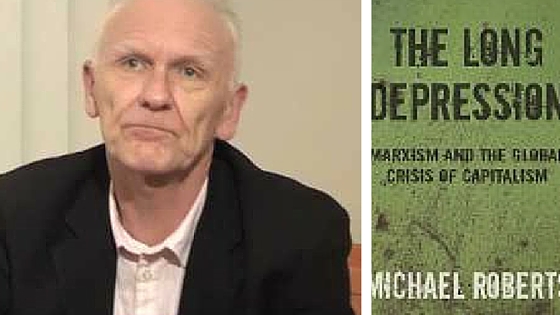
Michael Roberts

Michael Roberts has worked as an economist for over 30 years in the City of London. He is author of The Great Recession: Profit cycles, economic crisis A Marxist View and The Long Depression: Marxism and the Global Crisis of Capitalism.

Economics:

In this episode, Michael mentions: Marxism, capitalism, Austrian economics, GDP, multinationals, inflation, printing of money, booms, busts, profitability, recession, depression, inequality, wealth, means of production, private property, competition, externalities, unintended consequences, bailout, austerity and unemployment.

Economists:

In this episode, Michael mentions: Karl Marx, Friedrich Hayek, Adam Smith, John Maynard Keynes, Brad DeLong and Paul Mattick.

Links:

  • www.thenextrecession.wordpress.com by Michael Roberts

Books:

  • The Great Recession: Profit cycles, economic crisis A Marxist View by Michael Roberts
  • The Long Depression: Marxism and the Global Crisis of Capitalism by Michael Roberts
  • The Communist Manifesto by Karl Marx and Friedrich Engels
  • Capital by Karl Marx
  • Business As Usual by Paul Mattick
  • Waiting for Godot by Samuel Beckett


http://traffic.libsyn.com/economicrockstar/085_Michael_Roberts_Final_.mp3

Podcast: Play in new window | Download

069: Diane Coyle on GDP, Its Shortcomings and Alternative Measures

January 21, 2016 by Frank

http://traffic.libsyn.com/economicrockstar/069_Diane_Coyle.mp3
Play in New WindowDownload

069: Diane Coyle on GDP, Its Shortcomings and Alternative Measures

Diane Coyle is Professor of Economics at the University of Manchester and runs the consultancy Enlightenment Economics.diane coyle

Diane is Vice-Chair of the BBC Trust and was a member of the Migration Advisory Committee and a member of the Competition Commission. She is also a visiting research associate at the University of Oxford’s Smith School of Enterprise and the Environment. 

Diane specialises in competition analysis and the economics of new technologies and globalisation.

Diane is the author of several books, including GDP: A Brief But Affectionate History, The Economics of Enough, The Soulful Science, Sex, Drugs and Economics and Paradoxes of Prosperity.

She was previously Economics Editor of The Independent and before that worked at the Treasury and in the private sector as an economist.

Diane has a PhD from Harvard and was awarded the OBE in January 2009.

Using happiness is an excuse for inactivity – Diane Coyle

Click To Tweet

Influencers:

Peter Sinclair (University of Birmingham) and Ben Friedman (Harvard).

Economists:

In this interview, Diane mentions: Adam Smith, John Stuart Mill, Sir Charles Bean, Daron Acemoglu, Thomas Piketty, John McMillan, Tim Harford, Peter Sinclair (University of Birmingham) and Ben Friedman (Harvard).

Economics:

In this interview, Diane mentions: GDP, budget deficit, fiscal policy, monetary policy, interest rates, growth, employment, unemployment, Human Development Index, Gross National Happiness Index, happiness, hysteresis, inequality, financial markets, derivatives and leverage.

In this episode you will learn:

  • what is GDP and how it is measured.
  • the complications with understanding the meaning of GDP.
  • the historical origins of GDP and why it is used to measure our economy.
  • the complications in measuring GDP.
  • how GDP data is still collected in such an ‘old-fashioned’ way and the new methods to collecting data.
  • about the uncertainty and margin of error in GDP statistics.

  • why it is wrong to make fiscal policy, monetary policy and interest rate decisions on GDP statistics.

  • what proxy variables were used to measure economic activity before GDP was introduced.
  • why we should re-think the meaning of the economy.
  • why GDP today doesn’t work in its present form and if there is an alternative.
  • how countries can use GDP and GNP measures to portray different economic conditions.
  • the difference between GDP and GNP.
  • the concerning use of ‘administrative statistics’ by countries to falsify economic growth.
  • whether it’s correct to include illegal drug activity and prostitution in measuring GDP.
  • why measuring happiness and well-being should be of little importance when measuring GDP.
  • why Diane is sceptical about the Happiness Index.
  • the reason why economics was coined by Thomas Carlyle as the the ‘dismal science’.
  • who is to blame for the financial crisis of 2007/2008.
  • about the UK’s over-reliance on the financial sector and its role in measuring GDP.
  • about the uncertainty that would exist if the UK withdrew from the EU.
  • the policy factors required to create a sustainable society and a stable government.


It’s just so easy now to download data from the internet and run through statistical packages and get some results. And I think a lot of professional economists are guilty of not rethinking about their data enough – Diane Coyle

You cannot think about the economy mechanically – Diane Coyle

Click To Tweet

The way we measure GDP now is really closely linked to Keynesian macroeconomic theory and a very famous definition he gave of  what total output in the economy is, that it’s consumer spending, government spending, investment spending and the balance of payments – Diane Coyle

There is no benefit for society in a lot of what happens in the financial markets – Diane Coyle

Click To Tweet

Resources:

  • The Enlightenment Economist
  • Doomsday Book  – Earliest recording of economic activity.
  • Time to ditch GDP as a measure of economic well-being by Diane Coyle 
  • The Review of Economics and Statistics

Favorite Internet Resource:

  • Twitter

If you pick the right people to follow it acts as a brilliant editor of all the interesting information that you might want to know and it’s like having a personalised newspaper – Diane Coyle

Books:

  • GDP: A Brief But Affectionate History by Diane Coyle
  • The Soulful Science: What Economists Really Do and Why It Matters by Diane Coyle
  • The Economics of Enough: How to Run the Economy as If the Future Matters by Diane Coyle
  • Sex, Drugs and Economics: An Unconventional Introduction to Economics by Diane Coyle
  • Paradoxes of Prosperity: Why the New Capitalism Benefits All by Diane Coyle
  • Reinventing the Bazaar: A natural History of Markets by John McMillan
  • The Undercover Economist by Tim Harford
  • The Undercover Economist Strikes Back: How to Run or Ruin an Economy by Tim Harford


http://traffic.libsyn.com/economicrockstar/069_Diane_Coyle.mp3

Podcast: Play in new window | Download

068: Daron Acemoglu on Why Nations Fail and Why Inequality Exists Between Countries

January 14, 2016 by Frank

http://traffic.libsyn.com/economicrockstar/068_Daron_Acemoglu_.mp3
Play in New WindowDownload

068: Daron Acemoglu on Why Nations Fail and Why Inequality Exists Between Countries

Daron Acemoglu is the Elizabeth and James Killian Professor of Economics at Massachusetts Institute of daron acemoglu economic rockstarTechnology in Boston.

Daron’s principal interests are political economy, development economics, economic growth, technology, income and wage inequality, human capital and training, and labour economics.

Daron was the winner of the 2005 John Bates Clark Medal awarded to economists under forty judged to have made the most significant contribution to economic thought and knowledge.

His most recent works concentrate on the role of institutions in economic development and political economy.

Daron received his M.Sc. in Econometrics and Mathematical Economics and his Ph.D. from the London School of Economics.

Daron is co-author of ‘Why Nations Fail: The Origins of Power, Prosperity, and Poverty’ which can be found at whynationsfail.com

Markets are the foundation of long run economic growth but only if they are under guard by inclusive institutions – Daron Acemoglu

Economics: 

In this interview, Daron mentions: capitalism, marxism, inequality, inclusive institutions, extractive institutions, property, public finance,  rights, risks, cliometrics, econometrics, labor, technology, human capital, inequality, creative destruction and comparative advantage.

Economists: 

In this interview, Daron mentions: James Robinson, George Akerlof, Thomas Picketty, Douglass North and Joseph Schumpeter.

In this episode you will learn:

  • why nations fail and others prosper.
  • why Daron despises the term capitalism refereeing it as ‘and ugly term’.
  • why macro variables are second order to the type of institution when explaining the prosperity of a country.
  • why we should study political systems in an economics course.
  • how economic decisions get made.
  • if democracy is good for economic growth.
  • how Daron first became interested in institutions while growing up under a political dictatorship in Turkey.
  • if the political economy or the type of institution of a country explain inequality.
  • what explains inequality within a nation.
  • about Daron’s mixed views on philanthropy.
  • why empires, such as the Roman, Ottoman and British, collapse and whether we could witness the collapse of other institutions.
  • why China will ultimately fail in its present institutional form.
  • what China must do to maintain its economic growth.
  • about the Ireland and how its economy transitioned over the last 100 years.

I think, on the contrary, extractive institutions have great staying power – Daron Acemoglu

Books:

  • ‘Why Nations Fail: The Origins of Power, Prosperity, and Poverty’ by Daron Acemoglu.
  • Why the West Rules–for Now: The Patterns of History, and What They Reveal About the Future by Ian Morris.
  • War! What is It Good For? Conflict and the Progress of Civilization from Primates to Robots by Ian Morris
  • The Dynamics of Ancient Empires: State Power from Assyria to Byzantium by Ian Morris
  • The Secret of Our Success: How Culture Is Driving Human Evolution, Domesticating Our Species, and Making Us Smarter by Joseph Henrich

Where to Find Daron:

  • http://whynationsfail.com/
  • MIT academic page
http://traffic.libsyn.com/economicrockstar/068_Daron_Acemoglu_.mp3

Podcast: Play in new window | Download

044: Nancy Folbre on Feminist Economics and the Care Economy

August 6, 2015 by Frank

http://traffic.libsyn.com/economicrockstar/044_Nancy_Folbre_Final1.mp3
Play in New WindowDownload

044: Nancy Folbre on Feminist Economics and the Care Economy

Nancy Folbre is a recently retired Professor of Economics at the University of Massachusetts, Amherst andNancy Folbrecurrently directs a research program of gender and care work at the Political Economy Research Institute.

Professor Folbre’s research focuses on the interface between feminist theory and political economy, with a particular focus on the work of caring for others.

Nancy was elected president of the International Association for Feminist Economics (IAFFE) in 2002, has been an associate editor of the Journal Feminist Economics since 1995, and is also an editorial assistant of the Journal of Women, Politics & Policy.

Nancy is recipient of a MacArthur Fellowship, and she has consulted for the United Nations Human Development Office, the World Bank and other organizations.

Professor Folbre has also written extensively on the social organization of time, namely the time allotted to care for children and the elderly and how family policies and social institutions limit the choices people can make between paid and unpaid work.

She is a contributor to the New York Times Economix blog.

Nancy’s book ‘Saving State U‘ (New Press, 2010) makes a case for strengthening public support for higher education in the United States.

Other recent books include ‘Greed, Lust, and Gender: A History of Economic Ideas’ (Oxford University Press, 2009) and ‘Valuing Children: Rethinking the Economics of the Family’ (Harvard University Press, 2008).

Nancy received a B.A. in philosophy from the University of Texas at Austin in 1971, an M.A. in Latin American studies from UT Austin in 1973, and a Ph.D. in economics from the University of Massachusetts, Amherst in 1979.

In this episode, you will learn:

  • why Nancy Folbre decided to study economics.
  • how the household is very much like the market economy.
  • about feminist household economics.
  • what the underlying principles and foundation to feminist economics.
  • why we should see unpaid work as part of the economy.
  • how the state and the market has reinforced the patriarchal system.
  • why the capitalist system, ironically, has downside effects on women today despite the benefits it provides.
  • why we should adopt the Scandinavian model of paternal responsibility.
  • about the unmeasured ‘Care Economy’ where people perform unpaid work.
  • about the opportunity cost to care work.
  • why Replacement Cost is a better proxy from a National Accounting perspective for measuring the size of the Care Economy.
  • why people are intrinsically motivated to care and that money is not an issue.
  • why Nancy Folbre strongly believes that we should think carefully about how we reward care work.
  • about the ‘Care Penalty’ and why we shouldn’t take advantage of the care workers motivation to work in the care industry.
  • about the societal pressures on a man who decides to stay at home and be the care giver.
  • why we should be providing a better account of the costs and benefits of raising kids.
  • if women have a ‘wage-penalty’ as they are, in most cases, the care-giver.
  • whether we can capture the value spent by parents caring for their children.
  • if intrinsic values of happiness lead to economic benefits for household.
  • if children of developed and less-developed countries are treated differently by their parents in terms of their perception of value.
  • about the rapid decline in fertility rates in India, Asia and Latin America.
  • why self-interest was always described in gender terms and why it was always permissible for men to be self-interested than women.
  • if having more women involved in economics and the economy would lead to better outcomes.

Economists:

In this interview, Nancy mentions and discusses: Gary Becker, Shoshana Grossbard, Friedrich Engels and Adam Smith.

Economics:

In this interview, Nancy mentions and discusses: feminist economics, market choice, economics of the household, altruism, rationality, interdependent utility, collective bargaining, choice, efficiency, inequality, incentives, opportunity cost, replacement cost, free market, Invisible Hand and happiness.

Quotes by Professor Folbre in Episode 044 of the Economic Rockstar Podcast:

Work can be very productive and create value for society even if it’s unpaid – Nancy Folbre

Click To Tweet

“Definitions of femininity and masculinity are changing in a positive way” – Nancy Folbre

Click To Tweet

“Smith had a lot of confidence in the pursuit of individual self-interest” – Nancy Folbre

Click To Tweet

Many people have taken Smith’s praise of the free market as an endorsement of selfish behavior, that it doesn’t matter if you think only of yourself because in a market economy we can be confident that everything will turn out just fine.  What I argue in the Invisible Heart is that’s really incorrect. The market economy really depends to a very great extent on a sense of commitment and obligation to other people of trust and reciprocity and concern for the welfare of others. That affects overall economic organisation and success in some pretty profound ways – Nancy Folbre

“We need to change the way we think about work and about value” – Nancy Folbre

Click To Tweet

Leading happy and worthwhile lives is kinda the point of the whole economic enterprise and sometimes we lose sight of that. And there’s certainly a lot of evidence that what makes people happy is good human relationships, having close ties with family and friends and community. If we appreciated that a little bit more fully, we could organise our economic system a lot more successfully – Nancy Folbre

“I think Feminist Economics is a part of the whole heterodox challenge to the mainstream economics, and I fell good about that” – Nancy Folbre

Recommended Books:

  • Valuing Children: Rethinking the Economics of the Family by Nancy Folbre
  • Greed, Lust, and Gender: A History of Economic Ideas by Nancy Folbre
  • Saving State U by Nancy Folbre
  • The Invisible Heart by Nancy Folbre
  • The Condition of the Working-Class in England in 1844 by Friedrich Engels
  • The Invisible Hand by Adam Smith

Blog:

  • Care Talk by Nancy Folbre

Conference:

  • International Association for Feminist Economics

http://traffic.libsyn.com/economicrockstar/044_Nancy_Folbre_Final1.mp3

Podcast: Play in new window | Download

Frank Conway

Frank Conway is founder of Economic Rockstar and lecturer of economics, finance and statistics. Read More…

View My Blog Posts

Youtube Sub

Become a Patron of the Economic Rockstar Podcast

patreon

Ireland’s Economy by the Numbers

Leaving Cert Economics: Ireland’s Economy  Click here to download a workbook on Ireland’s Economy so that you can add your own notes. [Original size] Ireland’s Economy by fconway

Categories

Subscribe and Never Miss An Episode

itunes-logo

Recent Posts

  • Ireland’s Economy by the Numbers April 8, 2019
  • 174: Wendy Carlin on The Core Project, Capitalism, Democracy and Normative Statements February 13, 2019
  • 173: Stephen Wright on Core Econ as a Learning Resource for Mainstream Economics January 28, 2019
  • 172: Best of 2018 Part 2: From the Great Depression to Futurism; Institutions, Individualism, Cooperation and Reciprocity January 22, 2019
  • 171: Best of 2018 Part 1 January 3, 2019

Copyright © 2026 · Podcast Pro Theme on Genesis Framework · WordPress · Log in

This website uses cookies to improve your experience. We'll assume you're ok with this, but you can opt-out if you wish. Accept Reject Read More
Privacy Policy

Privacy Overview

This website uses cookies to improve your experience while you navigate through the website. Out of these, the cookies that are categorized as necessary are stored on your browser as they are essential for the working of basic functionalities of the website. We also use third-party cookies that help us analyze and understand how you use this website. These cookies will be stored in your browser only with your consent. You also have the option to opt-out of these cookies. But opting out of some of these cookies may affect your browsing experience.
Necessary
Always Enabled
Necessary cookies are absolutely essential for the website to function properly. This category only includes cookies that ensures basic functionalities and security features of the website. These cookies do not store any personal information.
Non-necessary
Any cookies that may not be particularly necessary for the website to function and is used specifically to collect user personal data via analytics, ads, other embedded contents are termed as non-necessary cookies. It is mandatory to procure user consent prior to running these cookies on your website.
SAVE & ACCEPT