• ABOUT
  • RESOURCES
  • PODCAST
  • BOOKS
  • BLOG
  • SUPPORTERS
  • QFA Financial Advice
  • CONTACT

Economic Rockstar

Connecting Brilliant Minds in Economics and Finance

084: Mises v Marx: A Discussion with Peter Boettke
May 5, 2016 by Frank

http://traffic.libsyn.com/economicrockstar/084_Peter_Boettke_2_Final.mp3
Play in New WindowDownload

084: Mises v Marx: A Discussion with Peter Boettke

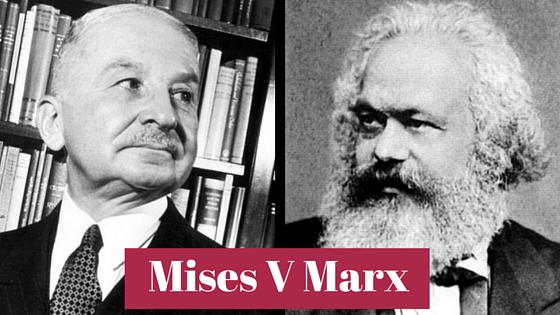
Mises V Marx

In this episode, Professor Peter Boettke, Professor of Economics and Philosophy at George Mason University, discusses the thinking of Ludwig von Mises and Karl Marx. Peter highlights the underlying theses behind both economists arguments – liberalism and socialism.

Read the first chapter to Living Economics by Peter Boettke here.

Economics:

In this episode, Peter mentions: Austrian economics, Marxism, liberalism, socialism, the Diamond-Water Paradox, instability of capitalism, private ownership, communal ownership, monopoly, financial crisis, leverage, 

Economists:

In this episode, Peter mentions: Ludwig von Mises, Karl Marx, Milton Friedman, Joan Robinson, Rosa Luxemburg, Elinor Ostrom, Adam Smith, F. A. Hayek, Milton Friedman, Paul Samuelson, John Cochrane, Paul Krugman, Joseph Stiglitz and J. K. Galbraith.

Books:

  • Living Economics: Yesterday, Today, and Tomorrow by Peter J. Boettke
  • The Communist Manifesto by Karl Marx
  • Karl Marx and the Close of His System  by Eugen von Böhm-Bawerk
  • Mises: The Last Knight of Liberalism Jörg Guido Hülsmann
  • Phishing for Phools: The Economics of Manipulation and Deception by George A. Akerlof and Robert Schiller
  • After War: The Political Economy of Exporting Democracy by Christopher J. Coyne
  • Doing Bad by Doing Good: Why Humanitarian Action Fails by Christopher J. Coyne
  • The Road to Serfdom: Text and Documents–The Definitive Edition by F. A. Hayek
  • How the Dismal Science Got Its Name: Classical Economics and the Ur-Text of Racial Politics by David M. Levy
  • The Soul of Man Under Socialism by Oscar Wilde
  • The Grapes of Wrath by John Steinbeck
http://traffic.libsyn.com/economicrockstar/084_Peter_Boettke_2_Final.mp3

Podcast: Play in new window | Download

083: Stephen Kinsella on Stock Flow Models, Rent Controls and Being the Green Lantern of Economics

April 28, 2016 by Frank

http://traffic.libsyn.com/economicrockstar/083_Stephen_Kinsella.mp3
Play in New WindowDownload

083: Stephen Kinsella on Stock Flow Models, Rent Controls and Being the Green Lantern of Economics

Stephen Kinsella is a Senior Lecturer in Economics at the Kemmy Business School, the University of Stephen KinsellaLimerick in Ireland and a Research Fellow at the Geary Institute at University College Dublin. He is currently visiting Professor of Economics at Université Paris.

Stephen has two PhD’s, is well published in many Economics Journals and has won several grants worth around 1.5 million Euro.

Stephen’s area of expertise is in the study of the Irish and European economies.

He has written 4 books:

  • Ireland in 2050: How we will be Living
  • Understanding Ireland’s Economic Crisis: Prospects for Recovery
  • QuickWin Economics and
  • Computable Economics.

Stephen is a weekly columnist for the Sunday Business Post newspaper and he also has his own website stephenkinsella.net which is amazingly rich in content, covering issues on the Irish and European economy as well as material he covers in his lectures.

Economics:

In this episode, Stephen mentions: stock flow consistent models, rent controls, GDP, wealth, consumption, government expenditure, investment, net exports, debt-to-GDP, stock of unemployed-to-flow of the labor force, taxes, austerity, QE, pro-cyclical policy, unemployment, automatic stabilizers, Brexit, foreign direct investment, hyperinflation, purchasing power of money, housing, pricing mechanism and money supply.

Economists:

In this episode, Stephen mentions: Wynne Godley, Lance Taylor, Marc Lavoie, Kevin O’Rourke, Philip Lane, Dermot McAleese, Edward Nell, Carmen M. Reinhart, Kenneth S. Rogoff and Joseph Stiglitz.

In this episode you will learn:

  • how and why Stephen completed two PhD’s and how he completed his first within 12 months.
  • about stock flow consistent models.
  • about the features of a stock flow model.
  • why the Irish government bailed out the banks.
  • how Ireland received ‘help’ from international economies, particularly the US and the UK, to quickly move out of a recession since the Great Financial Crisis.
  • whether Ireland will suffer if the UK left the EU in the so-called Brexit.
  • how rent controls lead to an inefficient market outcome.

Links:

  • Institute of New Economic Thinking

Papers:

  • Stephen Kinsella (2001). Hedgehog Logic – the Problems of Econometrics Today. Student Economic Review.
  • Stephen Kinsella (2007). Logarithms: A Tutorial.

Books: 

  • QuickWin Economics-Answers to Your Top 100 Economics Questions by Stephen Kinsella
  • Ireland in 2050: How we will be Living by Stephen Kinsella
  • Understanding Ireland’s Economic Crisis: Prospects for Recovery by Stephen Kinsella
  • Monetary Economics An Integrated Approach to Credit, Money, Income, Production and Wealth by Wynne Godley and Marc Lavoie
  • Swimming with Sharks: My Journey into the World of the Bankers by Joris Luyendijk
  • This Time Is Different: Eight Centuries of Financial Folly by Carmen M. Reinhart and Kenneth S. Rogoff
  • Seeing Like a State: How Certain Schemes to Improve the Human Condition Have Failed by James Scott
http://traffic.libsyn.com/economicrockstar/083_Stephen_Kinsella.mp3

Podcast: Play in new window | Download
082: Peter Boettke on Smith and Keynes and Why We Should Be ‘Living Economics’

April 21, 2016 by Frank

http://traffic.libsyn.com/economicrockstar/082_Peter_Boettke.mp3
Play in New WindowDownload

082: Peter Boettke on Smith and Keynes and Why We Should Be ‘Living Economics’

Peter Boettke is Professor of Economics and Philosophy at George Mason University, the BB&TPeter Boettke Economic Rockstar Professor for the Study of Capitalism, and the Director of the F.A. Hayek Program for Advanced Study in Philosophy, Politics, and Economics at the Mercatus Center at George Mason University.

Peter is now the co-author, along with David Prychitko, of the classic principles of economics texts of Paul Heyne’s The Economic Way of Thinking.

Professor Boettke’s most recent book, Living Economics, provides a resource for how teachers and students can engage in many fascinating questions in economics and illuminates the core principles that should guide our thinking.

Peter’s efforts in the classroom have earned him a number of distinctions including the Golden Dozen Award for Excellence in Teaching from the College of Arts and Sciences at New York University and the George Mason University Alumni Association’s 2009 Faculty Member of the Year award.

Peter’s research has primarily been in the area of comparative political and economic systems and the consequences with regard to material progress and political freedom.

Economics:

In this episode, Peter mentions: Classical economics, Austrian economics, Keynesian economics, credit transmission, institutions, the invisible hand, mainline economics, mainstream economics, private property, public choice, rent-seeking, opportunity cost, scarcity, exchange, markets, negative externalities, laissez-faire, Coase theorem, Pigouvian tax, reciprocity, inflation, stagflation and Malthus’ theory of The General Glut.

Economists:

In this episode, Peter mentions: Adam Smith, F. A. Hayek, Ludwig von Mises, Milton Friedman, Paul Samuelson, John Maynard Keynes,Frédéric Bastiat, David Hume, Vernon Smith, Thomas Robert Malthus, J. K. Galbraith, Paul Heyne, Hyman Minsky, Thorstein Veblen, Steve Keen, Ben Bernanke, Arthur Pigou, Gordon Tullock, James Buchanan, Robert Coase, Elinor Ostrom, Vincent Ostrom and Major Douglas.

Papers:

  • Teaching Austrian Economics to Graduate Students
  • Beyond Equilibrium Economics: Reflections on the Uniqueness of the Austrian Tradition

Books:

  • Living Economics: Yesterday, Today, and Tomorrow by Peter J. Boettke
  • The Economic Consequences of Peace by J. M. Keynes
  • The End of Laissez-Faire by J. M. Keynes
  • The Rogue Gallery of Economic Thinkers by J. M. Keynes
  • The Road to Serfdom by F. A. Hayek
  • Challenging Institutional Analysis and Development: The Bloomington School by Paul Dragos Aligica and Peter Boettke
http://traffic.libsyn.com/economicrockstar/082_Peter_Boettke.mp3

Podcast: Play in new window | Download

081: Julie Nelson on the Importance of Ecology in Economics and the Misconception of Gender Roles in the Economy

April 14, 2016 by Frank

http://traffic.libsyn.com/economicrockstar/081_Julie_Nelson.mp3
Play in New WindowDownload

081: Julie Nelson on the Importance of Ecology in Economics and the Misconception of Gender Roles in the Economy

Julie Nelson is Professor of Economics at University of Massachusetts Boston and Senior Research Fellow at Global Development and Environment Institute, Tufts University, also in the USA.Julie Nelson Economic Rockstar

Julie’s research areas include feminist economics, ecological economics, the philosophy and methodology of economics, ethics and economics, the teaching of economics, and the empirical study of individual and household behavior.

Professor Nelson has also served as a Research Economist at the U.S. Bureau of Labor Statistics and a Visiting Associate Professor at Harvard University amongst others.

Julie is the author of Economics for Humans and author, co-author, or co-editor of several other books including Beyond Economic Man: Feminist Theory and Economics.

She has also authored numerous articles in journals ranging from Econometrica, the American Economic Review, and the Journal of Political Economy, to Signs: Journal of Women in Culture and Society, Feminist Economics, and Ecological Economics.

Professor Nelson earned a B.A. degree in Economics from St. Olaf College and an M.A. and Ph.D. in Economics from the University of Wisconsin, Madison, USA.

Julie, along with Mark Maier, runs the website introducingeconomics.org

Economics:

In this episode, Julie mentions: statistical inference, bias, production function, land, labor, capital, resource maintenance, feminist economics, care, GDP, Pigouvian tax, carbon, welfare gains, negative externality and Kyoto Agreement.

Economists:

In this episode, Julie mentions: John Stuart Mill, Gary Becker and Amartya Sen.

Quotes by Julie in Episode 81:

“Math gives you internal consistency. It does not give you objectivity and reliability.” – Julie Nelson

Click To Tweet

“Most economic textbooks tell you there are three basic economic activities… production, distribution and consumption. We added one at the beginning and what we called ‘resource maintenance’. That is, how are you ever going to produce anything if you don’t have the resources and if you haven’t taken care of them and sustained them in a way that they’ll be productive in the future” – Julie Nelson

“No one would be so silly to try to address an economic problem without looking at its social, ethical, physical and political dimensions. But later economists didn’t remember those cautions of Mills and just ran with the math aspect of it.” – Julie Nelson

“There’s still a long way to go to think of gender in an intelligent and equitable way.” – Julie Nelson

Click To Tweet

Takeaway:

“Be careful about what you believe that economists are telling you.” – Julie Nelson

“Wherever we are in our life whether we’re at work in a business or at home or bringing our whole selves with us. We don’t just bring parts of ourselves. So if you want to be an ethical person anywhere, we need to do that when we’re at work.” – Julie Nelson

Books:

  • Men are from Mars. Women are from Venus by John Gray
  • ECONned: How Unenlightened Self Interest Undermined Democracy and Corrupted Capitalism by Yves Smith
  • The Shareholder Value Myth by Lynn Stout

Links:

  • www.julieanelson.com
http://traffic.libsyn.com/economicrockstar/081_Julie_Nelson.mp3

Podcast: Play in new window | Download

080: Will Australia’s Property Market and Economy Go Down Under? An Episode Featuring Steve Keen

April 10, 2016 by Frank

http://traffic.libsyn.com/economicrockstar/080_Australia_and_Steve_Keen.mp3
Play in New WindowDownload

080:  Will Australia’s Property Market and Economy Go Down Under? An Episode Featuring Steve Keen

1

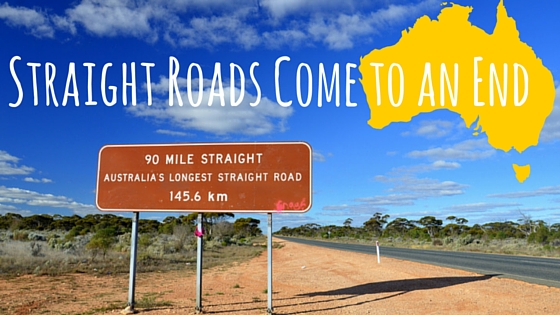
This weeks episode of the Economic Rockstar podcast features the Australian economy. There is talk amongst economists, analysts and commentators, be it speculative or not, that the Australian economy or it’s housing market will implode within the next 12 to 18 months. I am joined with Professor Steve Keen who explains why the property market in Australia will crash, taking its economy down with it.

Given the nature of this podcast, I cannot ignore the discussion that is taking place on what’s going on with the  Australian economy. To be honest, a listener to this podcast who is living in Australia contacted me on what’s going on there, and he and his friends are taking precautions in the event of a collapse in house prices. I also have Irish friends who emigrated to Australia once the financial crisis hit. These young men travelled from Ireland to Australia and know, with first-hand experience, how an economy and housing market performs prior to a crash. They, like others, are tuned into events that lead to a bursting of a bubble. Doubters and cynics may claim that this is an unscientific approach to analysing the market, but shouldn’t we also consider non-numeric data in the form of intuition and gut-instinct?

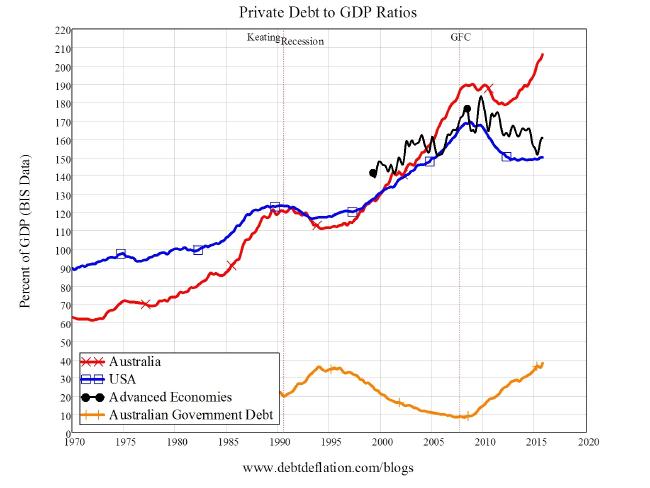
Economic data is also available today that supports the claim that the Australian housing market is on the brink of collapse. Australia’s private debt to GDP is currently at 210%, the highest in its history. Such high ratios were experienced by other developed economies prior to the Great Financial Crisis which pushed them into recession following a property market crash. Is Australia different? Australia is most definitely not immune to such crashes.

Did you know that house prices plunged 30 percent or more in NSW and Victoria in the 1890s and 1930s — the biggest such reversals in Australia’s history — the result was bank collapses and mass unemployment. Could this be repeated?

So a question I’d like to pose would be ‘What’s worse? Carrying out a pre-mortem or a post-mortem. Both can have very damaging repercussions for an individual if decision-making was wrong. A pre-mortem forces someone to take a contrarian view of the economy. They can then write up a checklist of possible events that could materialize and the actions that need to be taken today to assure a minimum negative impact.

Can a person’s pre-mortem be evidence of over-confidence or can it be a deep-rooted intuitive reading of all the vital signs that are indicating something sinister that had once played out before? After-all, many economies have experienced busts and housing market crashes. No country is immune to these events. What precipitates a housing crisis has been explained on numerous occasions in the economic literature, albeit for different time periods, economic cycles and, dare I say, personal viewpoints and data collection methods.

So, should we ignore the intuition and gut instinct of those in tune with the development of an economy and its actors? Is Australia different to other economies? After all, Australia hasn’t experienced a recession since 1991 – 25 years ago!

Should we ignore or heed the warnings of the naysayers? Can intuition be considered a valid barometer to understanding how events are likely to unfold in an economy?

Nobel laureate Danial Kahneman who, in an interview with McKinsey and Company, considered the intuition of professionals in the decision-making process. Kahneman stated that:

There are some conditions where you have to trust your intuition. When you are under time pressure for a decision, you need to follow intuition. My general view, though, would be that you should not take your intuitions at face value. Overconfidence is a powerful source of illusions, primarily determined by the quality and coherence of the story that you can construct, not by its validity. If people can construct a simple and coherent story, they will feel confident regardless of how well grounded it is in reality.

Despite this statement being considered under a different context, it could easily be applied to the economy since professionals are a subset of the population and their decisions can impact the local and wider economy.

Let’s break this statement down.

Kahneman states that “When you are under time pressure for a decision, you need to follow intuition.” In an economy or a housing market that is performing so well like Australia today, time doesn’t play a central role for the majority of those involved in the decision-making process. Of course, well-timed investments can be the difference between a gain and a loss.

Typically, in good times, people can become blind-sided and focus on the positive news. The economy will continue on as it has always done. The housing market will continue performing strongly and it will always be a good time to buy property. When you’re in the thick of it, the good times keep rolling. You want to participate in any market whose assets are experiencing capital appreciation. The majority of people make decisions based on past performance. The housing market in Australia has grown to unprecedented yet worrying levels.

Any negative news or commentary is largely dismissed and the bearers of the bad news are typically criticised and vilified. Humans have the ability to forget their past failings and fallibilities and repeatedly make the same mistakes over and over again. Economic history shows us the misconceptions and judgemental errors made by humans from Tulip Mania to the South Sea Bubble and the dot-com crash. If the housing market was to implode in Australia, time would become the main focus as people will rush to the exits. Housing is not as liquid as stocks or cash and a housing crash will be the result.

Participants in the Australian housing market are accumulating dangerous levels of private debt, never seen before in its history. Private household debt now stands at 210% of GDP. This is an unhealthy level for any economy to be in and one that was highlighted by Professor Steve Keen in his blog debtdeflation.com and his book Debunking Economics. Professor Keen warned of the risks to many economies and their housing market prior to the Great Financial Crisis.

Private Debt to GDP Steve Keen Economic Rockstar

Australia’s Private Debt to GDP Ratio as Calculated by Professor Steve Keen

He also warned about Australia’s economy at the time but Australia avoided a recession. Policy initiatives at the time, as well as the availability of credit, rising commodity prices (of which Australia benefits from), a demand for housing stock from mainland China and an appetite for risk to avail of the speculative gains being made in an accelerating property market has resulted in Australia being different to other economies.

Australia is the darling economy and a perceived role model on how to maintain economic growth. These positives led to immigration rising as a demand for employment increased. And as we know, when jobs are created, income levels rise feeding the demand for goods and services. Eventually, confidence rises and speculative purchases are made. When the desired expectations to these speculative purchases come to fruition, then people become overconfident.

As Kahneman stated earlier, “Overconfidence is a powerful source of illusions, primarily determined by the quality and coherence of the story that you can construct, not by its validity. If people can construct a simple and coherent story, they will feel confident regardless of how well grounded it is in reality.”

RBA economist Peter Tulip last year suggested Australian housing could be as much as 30 percent undervalued. This type of commentary is not helpful in a market that is overheating and when participants or would-be buyers are excited about capital appreciation despite being negatively geared. This is definitely a new take on Tulip Mania!

The same economist, Peter Tulip, in a 2007 working paper for the OECD, wrote about how safe Iceland’s economy was and that it’s banking system was secure and stable, and that it’s housing market should be liberalised and opened up to competition.

Today, there are reports of being able to borrow 10 times your pre-tax income to purchase a property. This is not a healthy situation for anyone to be in, including banks.

What could be the catalyst to a housing market crash in Australia?

Australia has an active sub-prime mortgage market. Interest rates are low at 2% (yet they could go lower as we have seen elsewhere). Perhaps the Royal Bank of Australia isa keeping a 2% cushion in the event of implementing a loose monetary policy in the event of a crash. Unfortunately, this type of stimulus will not work as households will be required to pay down its debt and the economy could enter into a Japanese-style era of stagflation.

Australia is dependent heavily on its commodities, hence the dollar being know as a commodity currency.  There is a continuing drop in resource prices and commodity-dependent companies such as Rio and BHP are in trouble.

Banking shares have dropped and could be seen as ominous of what’s to come. Are there people in the know? Are they liquidating their holdings? Check out what happened to many of the leading US and European banking shares prior to October 2008 – the official start of the Great Financial Crisis. They were already on a downward trajectory.

Is China slowing down? The Chinese have also accumulated high levels of private debt and their private debt to GDP ratio is similarly high to Australia’s. If Chinese investment in the Australian property market stops, then the market could implode.

There is an overwhelming supply of apartments in Brisbane, Melbourne and Sydney. Many of these apartments lie vacant and buyers are expecting their negatively geared position to be offset by further capital appreciation. Also, immigrants have proven to be very mobile. When signs of a weakening economy materialise, they will emigrate leaving a slump in housing or rental demand. Owners will fail to meet repayments as the main source of their rental income will disappear.

Put simply, in the words of Professor Steve Keen, Australia’s housing market is a Ponzi scheme and those that got in first will be the winners while all of those who got in over the last few years will suffer.

Links:

  • www.debtdeflation.com/blog by Steve Keen
  • Get Ready for an Australian Recession by 2017 – Steve Keen
  • Strategic decisions: When can you trust your gut? McKinsey and Company interview with Daniel Kahneman and Gary Klein.
  • Tulip, P. (2007). Financial Markets in Iceland. OECD. Working Paper No. 549.
  • Fox, R. and Tulip, P. (2014). Is Housing Overvalued? Reserve Bank of Australia.

Books:

  • Debunking Economics by Steve Keen

http://traffic.libsyn.com/economicrockstar/080_Australia_and_Steve_Keen.mp3

Podcast: Play in new window | Download

The Maths Factor: Give the Gift of Math

April 4, 2016 by Frank

The Maths Factor:

Give the Gift of Math to Your Child or Grandchild!

Here’s a little something that you or someone you know may be interested in.

I have my 8 year-old son signed up on this for just over a year now. His level of math is beyond his class year. He’s almost done with multiplication when he normally would be on addition and subtraction. There’s no pressure with performing.

The Maths Factor is easy to use and makes math learning fun. He literally spends less than 5 minutes a day doing it and the pay-off is amazing.

There’s no pressure with performing. The Maths Factor is easy to use and makes math learning fun. He literally spends less than 5 minutes a day doing it and the pay-off is amazing.

You can get started for just £1 for your first month. No commitments required. If it’s not for you, then you can cancel at any time.

Click on the image below and you’ll be redirected to a sign-up page to avail of this offer.

Honestly, the learning is fun.

You can choose the level that is suitable to your child’s requirements (Explorer, Adventurer or Pioneer) and the modules are geared toward getting the best out of your child’s learning ability.

Each module has up to 24 math questions. Prior to doing the 24 questions, Carol (pictured below) gives a video tutorial on the calculations (addition to division and, for the advanced, working with fractions and long division).

There’s also a Games Centre that matches up with the level so that your child can learn math without realising it. Clever!

What’s more, The Maths Factor has the 30 Day Challenge which encourages your child to complete 30 consecutive days of math. And the best thing is that once completed, your child is rewarded with a medal – a real medal. How’s that for a reward and an incentive (or a nudge to those Behavioral Economists).

For full disclosure, I’ll receive a small commission if you decide to sign up to The Maths Factor by clicking on the image below or by using the code FC-27287-FR. In return, you’ll get your first month for just £1.

If I didn’t believe in this, I wouldn’t share it so publicly. If you have any questions about it, please email me and I’ll get back to you.

TheMathsFactor Voucher


079: Bryan Caplan on Parenting, the Case Against Education and the Rational Voter

March 31, 2016 by Frank

http://traffic.libsyn.com/economicrockstar/079_Bryan_Caplan.mp3
Play in New WindowDownload

079: Bryan Caplan on Parenting, the Case Against Education and the Rational Voter

Bryan Caplan is Professor of Economics at George Mason University and Senior Scholar at the Mercatus Center.Bryan Caplan Economic Rockstar

Bryan is the author of The Myth of the Rational Voter: Why Democracies Choose Bad Policies, named “the best political book of the year” by the New York Times, and Selfish Reasons to Have More Kids: Why Being a Great Parent Is Less Work and More Fun Than You Think. He also blogs at EconLog.

Bryan has published in the New York Times, the Washington Post, the Wall Street Journal, the American Economic Review, the Economic Journal, the Journal of Law and Economics, and Intelligence, and has appeared on 20/20, FoxNews, and C-SPAN. He is now working on a new book, The Case Against Education.

His webpage, bcaplan.com, features both his academic research and his numerous other interests, including the online Museum of Communism.

Bryan has a B.A. in Economics from University of California, Berkeley and a Ph.D. in Economics from Princeton University.

Economists and Influencers:

In this episode, Bryan mentions: Milton Friedman, Gary Becker, Daniel Kahneman and Tyler Cowen.

Economics:

In this episode, Bryan mentions: the signaling effect, behavioral genetics, fertility rates, immigration, open borders, productivity and democracy.

Where to Find Bryan Caplan:

  • www.bryancaplan.com
  • EconLog

Books:

  • The Myth of the Rational Voter: Why Democracies Choose Bad Policies by Bryan Caplan
  • Selfish Reasons to Have More Kids: Why Being a Great Parent Is Less Work and More Fun Than You Think by Bryan Caplan
  • Understanding Comics: The Invisible Art by Scott McCloud
http://traffic.libsyn.com/economicrockstar/079_Bryan_Caplan.mp3

Podcast: Play in new window | Download

078: Arnold Kling on the Hidden Story of How Markets Work, the Mortgage Crisis and How We Pay for Health Care

March 24, 2016 by Frank

http://traffic.libsyn.com/economicrockstar/078_Arnold_Kling_.mp3
Play in New WindowDownload

078: Arnold Kling on the Hidden Story of How Markets Work, the Mortgage Crisis and How We Pay for Health Care

Arnold Kling is a Mercatus Center–affiliated senior scholar at George Mason University and a member of the arnold kling economic rockstarFinancial Markets Working Group.

Arnold specializes in housing-finance policy, financial institutions, macroeconomics, and the inside workings of America’s federal financial institutions. He also is an adjunct scholar at the Cato Institute in Washington, DC.

Arnold has testified before Congress on the collapse of Fannie Mae and Freddie Mac

He has authored five books, including Crisis of Abundance: Rethinking How We Pay for Health Care and Invisible Wealth: The Hidden Story of How Markets Work.

Arnold has published articles in the Economist, the Wall Street Journal, the New York Times, the Atlantic, and Forbes, among others, and he blogs at arnoldkling.com/blog/.

Previously, Arnold served as a senior economist at Freddie Mac and a staff economist on the Board of Governors of the Federal Reserve System.

He started Homefair, one of the first commercial websites on the Internet.

Arnold Kling received his PhD in economics from Massachusetts Institute of Technology.

“If you want to live a good lifestyle, you can find hobbies and interests that don’t cost very much. So it’s not hard to enjoy life. But if you want to make yourself miserable, watch politics.” – Arnold Kling

Economics:

In this episode, Arnold mentions and discusses: information rules, economic information, marginal cost of information, advertising, versioning, bundling, Austrian economics, risk measurement, capital, tax, mortgage-backed securities, loans, bubbles, crashes, excess leverage, marked-to-market, economics of health care, labor, capital, land, institutions.

Economists:

In this episode, Arnold mentions and discusses: Hal Varian, Carl Shapiro, Brad deLong, Tyler Cowen, Paul Krugman, Paul Volker, Douglass North, Robin Hanson, Bryan Caplan, James Buchanan, Adam Smith, F. A. Hayek and Robert Solow.

In this episode you will learn:

  • about Moore’s Law and what it means for the economy.
  • why economists are being lured into the world of start-ups and tech companies.
  • about the power of freemium and why companies need to build up trust to create a loyal customer base.
  • the difference between versioning and bundling.
  • what the future holds for the accessing information online.
  • about Arnold’s company online Homefair and how it was one of the first internet companies.
  • what really went on behind closed doors at Fannie Mae and Freddie Mac that resulted in their demise.
  • why Fannie Mae and Freddie Mac were bailed out.
  • how changing the culture at Freddie Mac caused its collapse.
  • about the state of health care in America today.
  • how Americans are to pay for the higher costs of health care.
  • about the fibre-bubble in the 1990s.
  • why we are richer today than a couple of hundred years ago.
  • why ideas are the foundation to economic growth and prosperity.
  • why nations like Cuba and North Korea are poor (bad institutions).
  • about the work being done at George Mason University.

Where to Find Arnold Kling:

  • www.arnoldkling.com/blog/

Books:

  • Crisis of Abundance: Rethinking How We Pay for Health Care by Arnold Kling
  • Invisible Wealth: The Hidden Story of How Markets Work by Arnold Kling
  • Information Rules: A Strategic Guide to the Network Economy by Carl Shapiro and Hal Varian
  • The Revolt of the Public and the Crisis of Authority in the New Millennium by Martin Gurri

Links: 

  • 23andMe: www.23andme.com
    • View reports on over 100 health conditions and traits
    • Find out about your inherited risk factors and how you might respond to certain medications
    • Discover your lineage and find DNA relatives
http://traffic.libsyn.com/economicrockstar/078_Arnold_Kling_.mp3

Podcast: Play in new window | Download

077: The Irish Economy 100 years on from the 1916 Easter Rising

March 17, 2016 by Frank

http://traffic.libsyn.com/economicrockstar/077_Ireland.mp3
Play in New WindowDownload

077: The Irish Economy 100 years on from the 1916 Easter Rising

This is a commemorative episode celebrating the 100 year anniversary of Ireland’s 1916 Easter Rising in which the Proclamation of the Republic was read by Padraig Pearse at four minutes past noon on Easter Monday, April 24th, from the steps of the General Post Office on Sackville Street (now known as O’Connell Street). The document proclaimed Ireland’s independence from Great Britain.

How was Ireland’s economy performing in 1916 and how far have we come 100 years on?

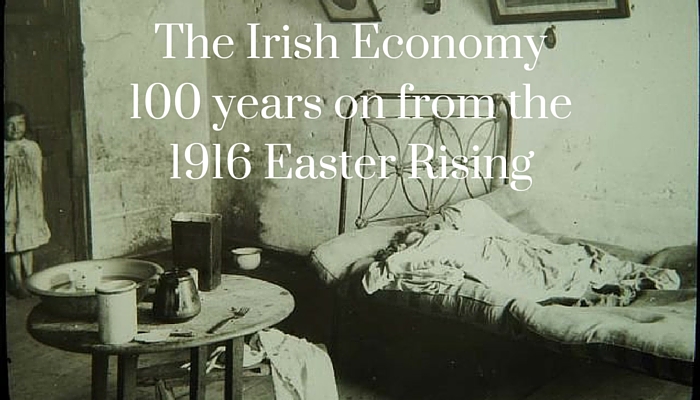
The Irish Economy 100 years on from the 1916 Easter Rising

Background:

Ireland in 1916, consisting of 32 counties, was ruled by Great Britain. The 32 county economy experienced a period of unprecedented prosperity mainly due to the positive economic effects of the First World War.

However, since the Great Irish Famine of 1846, Ireland experienced mass emigration and large numbers of deaths. The laissez-faire economic ideology was a failure. From the period 1851 to 1916, over 5 million Irish citizens emigrated reducing the population from a peak of approximately 8 million to 3 million.

The Irish economy was ruled by Great Britain and its economy became increasingly tied to trends in global markets. The cost of living increased and there were some rises in living standards. These were subject to sharp declines due to the recessions of 1859 to 1863 and 1877 to 1880. Poverty was widespread and tensions between landlords and tenant farmers escalated. Despite this poverty, Irish living standards were above most of Eastern and Central Europe but income levels remained below the UK and the US.

Ireland’s economy became increasingly reliant on four main industries: Agriculture, Linen production, Shipbuilding (where the Titanic was built) and Brewing and Distilling. However, agricultural exports were heavily dependent on Great Britain and Shipbuilding was dependent on an outdated industry. For example, it wasn’t long after the First World War that the Irish Shipbuilding industry collapsed.

The First World War of 1914 brought about a period of prosperity for Ireland, due to the increased demand for food, linen and ships that were directly linked to the war effort. However, this prosperity was not shared by all.

So what did the Irish economy of 1916 look like compared to its economy today 100 years on?

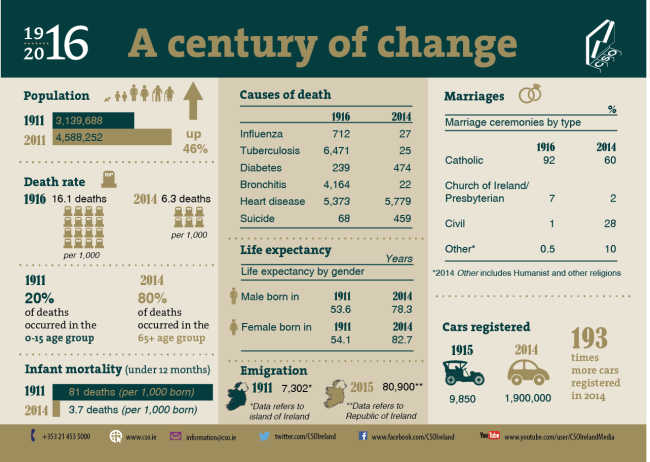
CSO 1916 - 2016 infographic

Source: Central Statistics Office

Population:

The population of Ireland in 1916 was one of the lowest recorded in its history. According to the population census of 1911, the population stood at just 3.14 million. It represented a country devastated by death caused by the famine over a half century previous and the subsequent mass emigration that ensued.

A 9-year-old Irish immigrant laborer shucks oysters in front of his foreman in the U.S. in 1911. pic.twitter.com/cOKICWk8Ta

— HISTORY (@HISTORY) April 12, 2016

Today, Ireland’s population has recovered to 4.59 million, an increase of 46%. However, many have emigrated due to the financial crisis of 2007, most notably Ireland’s youth. We have reverted to being a net emigration population after a period of becoming a net immigration population, attracting workers from overseas as well as bringing Irish people home.

Emigration for the whole island of Ireland in 1916 was 7,366 or 17 per 10,000 of the population. This had fallen from a substantial level before the outbreak of the Great War. The latest data for 2015 shows emigration for the Republic of Ireland at 80,900 representing 175 per 10,000 of the population.

Emigration in 1916 consisted of 5,580 females and only 1,786 males. This I found surprising.

The four main destinations for Irish emigrants in 1916 were the US, the UK, Canada and then Australia.

In 2015, the UK was the main destination for Irish emigrants. Only 7% of emigrants went to the US in 2015 compared to 58% emigrating in 1916.

The Irish diaspora abroad is quite large. Despite being a small island off Western Europe, Irish smiles have been welcomed all over the world. Ancestry can be traced back to Ireland particularly for those living in the United States, the UK, Argentina, Australia and Canada.

Today, it is estimated that there are 80 million people of Irish descent living around the world today. Other that the Republic of Ireland and Northern Ireland, Montserrat in the Caribbean is the only other country where St. Patrick’s Day is a public holiday.

Montserrat is known as the Emerald Isle of the Caribbean and it’s Irish heritage dates back to the 17th century when the island became a safe haven for the Irish who were originally sent to the Caribbean as slaves by Great Britain’s leader Oliver Cromwell. A census in 1678 showed that more than half of the population on the island were Irish.

Life Expectancy:

According to records for 1911, the life expectancy for a male born in Ireland was 53.6 years and for a female 54.1 years. Today, a male born in Ireland has a life expectancy of 78.3 years and a female 82.7 years.

Despite the period of prosperity, Ireland remained divided in terms of the gap between wealth and poor. Much of rural Ireland in the west of the country lived as an agrarian society, dependent on agriculture for a living. Living standards were much lower relative to other parts of the country.

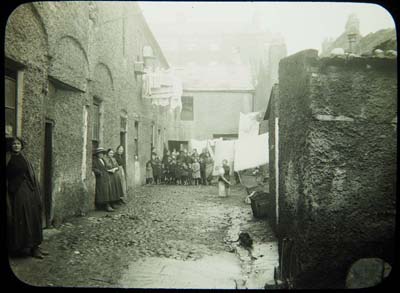
Urban areas did not escape the ravishes of poverty. Inequality was more prevalent in urban towns, particularly in Dublin city. Despite a boom in food and linen exports in 1916, the Irish poor remained hungry.

Henrietta Place, Dublin 1913. The flight of wealth to the suburbs often meant an escape from inner city squalor.

Henrietta Place, Dublin 1913. The flight of wealth to the suburbs often meant an escape from inner city squalor.

Poverty levels in Ireland today are at 8% with households consisting of one adult and one or more dependent children considered most at risk. Rural Ireland, including the West of Ireland, has a higher incidence of poverty than the rest of the country. As the saying goes, things change but always stay the same!

Many adults and children perished due to influenza, bronchitis and tuberculosis. These were the leading causes of death in Ireland along with heart disease. Today, heart disease is the leading cause of death in Ireland with few incidences of death from the other forms. The number of deaths by suicide that was officially recorded in 1916 were 68 compared to 459 for 2014, This represented 10 per 100,000 of the population compared to approximately 2 per 100,000 of the population.

Housing:

Ireland’s macro economy of 2016 is showing remarkable progress since it’s recession, bailout and financial crisis. The Irish have a love affair with housing. Perhaps it has its roots in history where many people were evicted from their homes during the Great Irish Famine.

During the boom from 1998 to 2007, Irish house prices soared only to come crashing down once the crisis hit. At its peak, over 90,000 houses were built but today only 11,000 houses were completed. The Irish housing market is under immense stress with demand outstripping supply. This shortage is resulting in much higher rents than what was recorded during the boom period. House prices are recovering but recent government legislation is making it difficult for landlords who are selling their property or evicting their tenants in order to capture the higher rental yields. Ireland is undergoing a housing crisis in today.

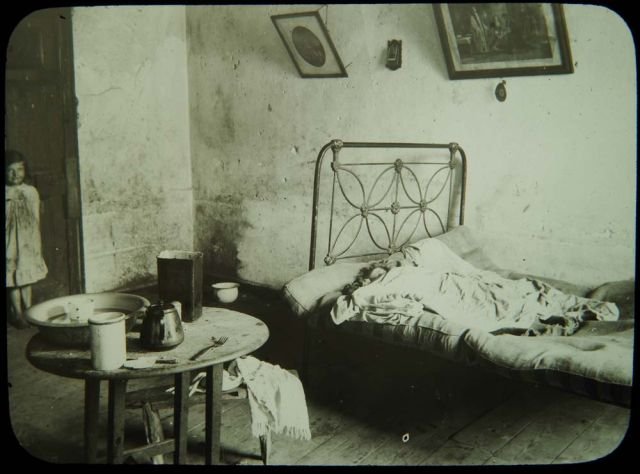
In 1916, Ireland experienced a severe housing crisis. Dublin and other cities became infamous for the living conditions of its citizens. The tenements, where many impoverished families lived, marked a bleak period in recent Irish history.

Multiple families shared large terraced houses with extremely poor sanitary and hygiene conditions. It was estimated at the time that 20,000 families in Dublin occupied single rooms and in some cases with other families. Family sizes of 8 or 10 children were not unusual. There were cases of 104 people occupying a single house built to accommodate one family.

A Tenement Room on Francis Street, Dublin in 1913

A Tenement Room on Francis Street, Dublin in 1913

Many evictions took place as families fell behind in rent. Facing starvation, children queued for bread which was handed out by religious orders. Many people in the West of Ireland emigrated due to food shortages and abandoned their homes. Despite many empty homes in the rural parts of Ireland, many families suffered homelessness, extremely poor living conditions and starvation.

Due to the housing crisis that Ireland is experiencing today in 2016, there are some echoes of the past. Homelessness has jumped 100% since January 2015. Over 700 families are living in emergency accommodation in hotels and guest houses. Evictions are up significantly and there are currently 17,000 people in the courts who are at risk of losing their homes. Food parcels are being handed out each week and the number queuing is rising.

Employment:

The Irish economy in 1916 was transitioning toward becoming an industrial nation. It was by no means considered backward and was in fact placed in the group of middle-ranking industrialised countries along with the Netherlands, the Scandinavian countries, Italy and Portugal.  26.8% of workers in 1911 worked in manufacturing jobs compared to 8.6% in 2011.

An estimated 150,000 men had joined the British army and many men and women went to the UK to find employment in munition factories and hospitals. Wages had increased during this time.

Almost 50% of the working population were employed in the Agriculture sector in 1911. This compares to just 4.9% in 2011.

In 1911, 8.8% of the labour force in Ireland worked in the professional group of occupations. By 2011, these workers now account for over 40% of the Irish workforce.

Ireland’s unemployment rate today is 8.8% coming from a recent high of 14.4%. It is unsure what the level was in 1916.

Exports:

Ireland in 1916 mostly consisted of indigenous industries. 85,000 workers were employed in linen production with over 18 million pounds (weight) of linen yarn and 112 million pounds (weight) of finished linen goods exported. Prior to the outbreak of World War I in 1914, about 70% of these exports were to the United States of America. However between 1914 and 1918, linen was in great demand for military purposes by the British Army for items such as tents, haversacks, hospital equipment and aeroplane fabric.

Today much of its traditional industry gone today. Very few linen manufacturers and weavers exist today. To bring my own personal family history into this story, my family remains one of a few linen weavers in Ireland today, producing the best Irish linen in the market with exports to countries that include Japan, the US and Italy. I’m personally proud of my father for what he has achieved and for extending the Irish tradition of producing the finest linen in the world.

Ireland is considered a small open economy and the UK still remains one of our largest trading partners. The Irish economy attracts many multinationals companies to locate here. In 2016, Ireland ranks among the top countries regarding industrial competitiveness and ease of doing business.

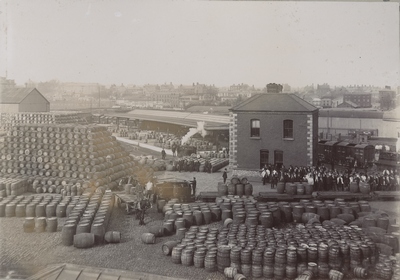
The Guinness brewery was the main brewery in Ireland and in 1916 it had the largest output of any brewery in the world, brewing more than two-thirds of all beer brewed in Ireland.

Cask Yard St. James' Gate Brewery 1906 - 1913

Cask Yard St. James’ Gate Brewery 1906 – 1913

The largest exporting sectors in Ireland during 1916 were woollens, brewing, butter, bacon, poultry, cattle, cotton goods and linen. The sectors that were in decline included horses, whiskey, pigs and sheep.

Ireland had a trade surplus of 1.5 million pounds (and a balance surplus of 11.1 million pounds) in 1916. For the latest data today, which is January 2016, Ireland is operating a trade surplus of 4.99 billion euro. Ireland’s largest exporting sectors are Medical and pharmaceutical products (representing 27% of total exports), Office machines and automatic data processing machines, and Food and live animals (representing 7.8% of our total exports).

The EU accounts for 56% of the total value of Irish goods exported. Belgium is Irelands largest export trading partner accounting for 15% of the total value of goods exported.

Great Britain remains Ireland’s single largest source of imports with 25% of the total value of goods imported to Ireland.

The USA remains Irelands largest non-EU destination for exports and imports.

GDP:

According to research by Kevin O’Rourke of the Department of Economics at University College Dublin a proxy measure for GDP per capita in Ireland was estimated to be 32.50 in 1913. This was based on a GDP estimate of 150 million. To put this into some context, the estimated GDP per capita in 1864 was 12.50 with GDP estimated at 60 million – over a 160% increase in nominal terms between the Famine and the Great War. Irish GDP per capita converged on the UK average during this time.

According to the International Geary-Khamis dollars, Ireland’s GDP per capita in 1913 was $2,736 whereas the US GDP per capita was $5,301 and the UK’s at $4,921, almost twice that of Ireland’s. This seems to suggest that incomes had yet to converge with those in Great Britain.

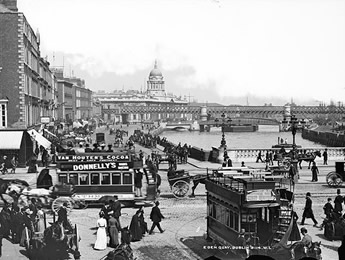
Eden Quay displays the bustle of turn of the century Dublin city life

Eden Quay displays the bustle of turn of the century Dublin city life

Ireland would have been considered one of the poorest Western European countries along with Greece, Italy, Portugal and Spain – yes there’s that familiar acronym of the financial crisis.

Today, Ireland is considered one of the richest countries in the world with GDP per capita of just under $49,000, placing the country in 10th position, with the US in 9th and the UK in 19th according to the World Bank.

GDP for Ireland was $11.9 million but this collapsed to $7.8 million by 1921 perhaps due to the Irish civil war. It was only in 1960 that Ireland recovered to pre-1916 levels.

There were 9,850 cars registered in Ireland in 1915 with now over 2 million registered today.

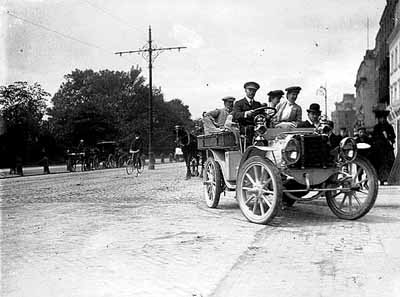
F_Horse, bicycle, Car_Stephen'sGreen_clar21t

Inflation:

Due to the outbreak of the First World War in 1914 and the resulting scarcity of goods, inflation in Ireland increased considerably by 200% over the wartime period as measured by the wholesale price index.

Unless wage inflation was outpacing price inflation in 1916, which is very unlikely, families must have experienced a real reduction in the purchasing power of their £.

These increases in prices were also due to Government policy which increased taxes and duties on various products.

The retail price of butter, tea and eggs were expensive in 1916. For example, the price of a pound of butter then would have cost 7 euro 35 cent updated to today’s consumer price index compared to today’s price of 2 euro 79 cent.

Links:

  • Data: Central Statistics Office
  • Data: International Geary-Khamis dollars by Professor Angus Maddison
  • Paper: Monetary Data and Proxy GDP Estimates: Ireland 1840 – 1921 by Kevin O’Rourke, UCD.
  • Read Ireland’s Proclamation of the Republic where equal rights for all men, women and children was declared along with the creation of a sovereign country.

Family History Research:

  • Ireland’s Census: Search for your Irish Heritage for the following Census years: 1911, 1901, 1851, 1841, 1831 and 1821.
  • National Library of Ireland: www.nli.ie

Images:

  • All images courtesy of the National Library of Ireland
  • Infographic courtesy of the Central Statistics Office
http://traffic.libsyn.com/economicrockstar/077_Ireland.mp3

Podcast: Play in new window | Download

076: Greg Ip on Foolproofing the Economy and Why Stability is Destabilizing

March 10, 2016 by Frank

http://traffic.libsyn.com/economicrockstar/076_Greg_Ip.mp3
Play in New WindowDownload

076: Greg Ip on Foolproofing the Economy and Why Stability is Destabilizing

Greg Ip is one of the best-known economics journalists in the US.Greg Ip Economic Rockstar

He is currently chief economics commentator of The Wall Street Journal and writes about U.S. and global economic developments and policy each week in the Capital Account column and on Real Time Economics, the Wall Street Journal’s economics blog.

From 2008 to January 2015, he was U.S. Economics Editor of The Economist magazine. Greg is the author of Foolproof: Why Safety Can Be Dangerous and How Danger Makes Us Safe as well as author of The Little Book of Economics: How the Economy Works in the Real World.

“Stability is Destabilising”- Hyman Minsky

Economics:

In this episode, Greg mentions and discusses: junk bonds, capitalism, investment, growth, financial crisis, bank deposits, loans, currency, gold, exchange rates, money market funds, bank run, exchange traded funds, recessions, unintended consequences and the Paradox of Thrift.

Economists:

In this episode, Greg mentions and discusses: Paul Volcker, Hyman Minsky, Gary Gorton, Joseph Schumpeter and John Maynard Keynes.


In this episode you will learn:

  • about the theme behind Greg Ip’s latest book Foolproof.

  • when the pursuit of safety lead us into danger?

  • what forest fires have to do with Wall Street.

  • about the relationship between the financial market (and its potential for a crisis) and ecological systems.
  • the way we publicly and privately try to cope with risk and danger and how those choices can create unintended consequences.

  • about the Fallacy of Composition: Things you do that are safe actually end up making other people less safe.
  • what American Football can teach us about the Fallacy of Composition.
  • how making American Football safe with the introduction of helmets has created increased risk taking and more injuries.
  • what past economic and financial crises have in common.
  • how the financial system succeeded too well in making people feel their money was safe.
  • how banking regulations and capital controls introduced after the financial crisis will create risks in other parts of the economy and financial markets.
  • if savings is actually bad for the economy.

  • about Keynes’ Paradox of Thrift and how savings forces others to borrow.

  • whether exchange traded funds (ETFs) will be the next financial catastrophe.
  • about the Peltzman Effect on anti-lock brakes.
  • how Paul Volcker‘s regulation of capital flows caused the growth of shadow banking.

  • how The Great Moderation changed attitudes about debt and how relaxed laws allowed high-risk households to borrow for mortgages.

  • about Gary Gorton of Yale and his explanation for a financial crisis.
  • how being present in danger can remind ourselves of the things that aren’t always safe.
  • whether the finance industry could take the lessons learned about safety and regulation in the airline industry.
  • why the Lehman Brothers collapse surprised many due to the US government indicating to the market that banks and mortgage companies would be bailed out.
  • how German savers were much to blame for the euro crisis than their European counterparts that borrowed.
  • why we continue to build cities near water which can cause devastation in the form of floods and tidal waves.
  • why The Netherlands, with their ‘Room For The River’ programme, is destroying dykes and allowing their lands to flood.
  • why Greg Ip is worried about the situation in China and how the stability that the government is trying to maintain will eventually lead to instability.

“If banks are limited from lending then lending activity will migrate elsewhere. We see this happening at exchange traded funds and other shadowy parts of the financial system. And you worry that risks are starting to grow there.” – Greg IP

“One way to protect ourselves against disaster is to make use of the presence of danger to remind ourselves that things aren’t always safe and to take steps that keep us safe”.  – Greg IP

“What I worry about more is that the pendulum has swung too far against risk taking. And the risks that are been taken are being channeled too far in the direction of financial risk and not real economy risk – people starting new businesses or buying new homes.” – Greg Ip

“What I worry about China is that they have leadership that is worried about political and economic stability.”

Where to Find Greg Ip:

  • The Wall Street Journal 
  • www.gregip.com

Books:

  • Foolproof: Why Safety Can Be Dangerous and How Danger Makes Us Safe by Greg Ip
  • The Little Book of Economics: How the Economy Works in the Real World by Greg Ip

Other Interesting Links:

  • Deregulation: The Expected and The Unexpected by Sam Peltzman
  • Do we really need more regulation of financial derivatives? by Merton H. Miller
  • Financial Innovation: The Last Twenty Years and the Next by Merton H. Miller
  • Peltzman, S. (1975). The Effects of Automobile Safety Regulation, Journal of Political Economy: 677 – 726.
  • National Center for Catastrophic Sport Injury Research 
  • Probability of a Hazardous Material Truck Accident in New Jersey by Damodaran, M., Daniel, J. and Luke, A. C. (2002)
http://traffic.libsyn.com/economicrockstar/076_Greg_Ip.mp3

Podcast: Play in new window | Download

  • Prev Page...
  • 1
  • …
  • 8
  • 9
  • 10
  • 11
  • 12
  • …
  • 19
  • ...Next Page

Frank Conway

Frank Conway is founder of Economic Rockstar and lecturer of economics, finance and statistics. Read More…

View My Blog Posts

Youtube Sub

Become a Patron of the Economic Rockstar Podcast

patreon

Ireland’s Economy by the Numbers

Leaving Cert Economics: Ireland’s Economy  Click here to download a workbook on Ireland’s Economy so that you can add your own notes. [Original size] Ireland’s Economy by fconway

Categories

Subscribe and Never Miss An Episode

itunes-logo

Recent Posts

  • Ireland’s Economy by the Numbers April 8, 2019
  • 174: Wendy Carlin on The Core Project, Capitalism, Democracy and Normative Statements February 13, 2019
  • 173: Stephen Wright on Core Econ as a Learning Resource for Mainstream Economics January 28, 2019
  • 172: Best of 2018 Part 2: From the Great Depression to Futurism; Institutions, Individualism, Cooperation and Reciprocity January 22, 2019
  • 171: Best of 2018 Part 1 January 3, 2019

Copyright © 2026 · Podcast Pro Theme on Genesis Framework · WordPress · Log in

This website uses cookies to improve your experience. We'll assume you're ok with this, but you can opt-out if you wish. Accept Reject Read More
Privacy Policy

Privacy Overview

This website uses cookies to improve your experience while you navigate through the website. Out of these, the cookies that are categorized as necessary are stored on your browser as they are essential for the working of basic functionalities of the website. We also use third-party cookies that help us analyze and understand how you use this website. These cookies will be stored in your browser only with your consent. You also have the option to opt-out of these cookies. But opting out of some of these cookies may affect your browsing experience.

Necessary
Always Enabled
Necessary cookies are absolutely essential for the website to function properly. This category only includes cookies that ensures basic functionalities and security features of the website. These cookies do not store any personal information.
Non-necessary
Any cookies that may not be particularly necessary for the website to function and is used specifically to collect user personal data via analytics, ads, other embedded contents are termed as non-necessary cookies. It is mandatory to procure user consent prior to running these cookies on your website.
SAVE & ACCEPT