• ABOUT
  • RESOURCES
  • PODCAST
  • BOOKS
  • BLOG
  • SUPPORTERS
  • QFA Financial Advice
  • CONTACT

Economic Rockstar

Connecting Brilliant Minds in Economics and Finance

056: Campbell Harvey on Improving Significance Tests, the Importance of Positive Skew and the Future of Blockchain

October 28, 2015 by Frank

http://traffic.libsyn.com/economicrockstar/056_Harvey_Campbell_Final.mp3
Play in New WindowDownload

056: Campbell Harvey on Improving Significance Tests, the Importance of Positive Skew and the Future of Blockchain

Campbell R. Harvey is Professor of Finance at the Fuqua School of Business at Duke University and a Research Campbell HarveyAssociate of the National Bureau of Economic Research in Cambridge, Massachusetts. He served as Editor of The Journal of Finance from 2006-2012 and is President-elect of the American Finance Association.
Professor Harvey obtained his doctorate at the University of Chicago in business finance. He has served on the faculties of the Stockholm School of Economics, the Helsinki School of Economics, and the Booth School of Business at the University of Chicago. He has also been a visiting scholar at the Board of Governors of the Federal Reserve System.

Campbell received the 2014 Reader’s Choice Award for the best paper published in the Financial Analysts Journal and the 2015 prize for the best paper published in the Journal of Portfolio Management. His recent work on evaluating trading strategies has won best paper awards.

Campbell’s research interests include statistical methods, risk management, asset allocation, real assets and cryptocurrencies. He is the Investment Strategy Advisor to the Man Group plc, the world’s largest, publicly listed, global hedge fund.

Economics:

In this interview, Campbell mentions: t-statistics, significance tests, trading strategies, investment premium, beta, correlation, standard deviation, confidence interval, P-value, Bonferroni multiple testing method, Type I error, Type II error, probability, normal distribution, optimal portfolio, volatility, expected returns, portfolio, pay-off, skew, over-fitting, regularisation, Efficient Market Hypothesis, Fractal Markets, stock market anomalies, Straw Man Model, momentum effect, mis-pricing and outliers.

Economists:

In this interview, Campbell mentions: Nassim Taleb, Benoit Mandlebrot, Peter Edgar, Yan Liu and Eugene Fama.

In this episode you will learn:

  • why it’s important to use t-statistics and significance tests and how it can be improved.
  • about the very simple idea Professor Campbell Harvey applies to his statistical modelling to improve the robustness of his tests.
  • why it’s wrong to use 2 standard deviations to have 95% confidence when running many tests.
  • about ‘Significant’, the XKCD cartoon that illustrates the vulnerability of statistical significance testing.
  • do green jelly beans really cause acne? How significance tests can mislead with a fluke.
  • how a trading strategy based upon picking a portfolio of shares based upon the first letter of a ticker symbol showed that those tickers that began with the letter A outperformed other stocks.
  • how testing multiple times is effectively data mining and what should be done about it.
  • about the meaning of 95% confidence and 5% level of significance.
  • what a p-value is and why we ant it to be as small as possible.
  • if it’s important for the finance and economics profession to look at how other sciences are applying testing methods?
  • whether we need a tougher standard to lower the possibility of false discoveries?
  • if there is a chance of a fluke finding and why we should apply the Bonferroni multiple testing method solve this?
  • about the decay signature of the Higgs Boson and whether it is just background noise.
  • whether the findings of many published academic peer-reviewed papers are wrong.
  • about Type I and Type II errors and their trade-off.
  • about All Trials’ mission to make all randomised control trials made public.
  • the problems when measuring and using volatility in asset returns.
  • why the level of skew in a distribution must play more of an important role in risk management and portfolio selection.
  • why Taleb’s Black Swan only looks at one side of the distribution – the negative side, and why we must also look at the positive side.
  • how applying ‘regularization’ to portfolio selection avoids ‘over-fitting’ the data so that unexpected future outcomes can be considered.
  • about the efficient market hypothesis and the 316 anomalies that have been published to refute this hypothesis.
  • why the best traders are in Asia and how insider activity makes them so.
  • about the rise of crypto currencies and Bitcoin and why schools across US universities are introducing modules on it.
  • what is blockchain and why its is safe.
  • about the bank’s idea of creating a permission blockchain.

The Problem with Significance Testing and How to Solve It

If you’re trying to see if a variable Y is associated with a variable in a significant way, we usually think of looking at that correlation and determining whether you’re 95% confident that you’ve got it right. Usually what that means is that you’re 2 standard deviations away from zero. So, zero would be there’s no relation.

It turns out that that is perfectly acceptable if we’re looking at one correlation between Y and X. However, if it’s not X, it’s X1 you try. You try X2. You try X3, you try … X100. You try 100 different things. Then the criteria of using 2 standard deviations to have 95% confidence is just plain wrong.

The reason why this is wrong, is that when you’re running 100 tests, there is going to be a high probability that something will turn up that’s 2 standard deviations from zero just by chance.

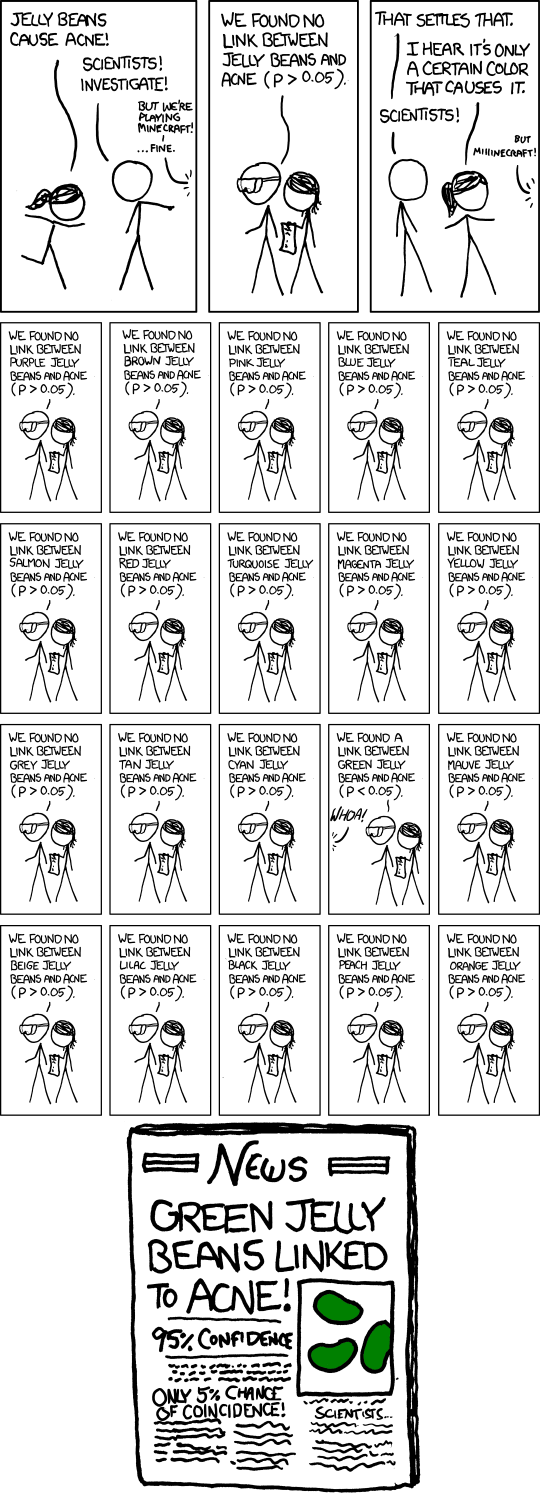
The ‘Jelly Bean’ cartoon by XKCD called ‘Significant’ illustrates how testing a hypothesis can become misleading when conducting a significance test. The hypothesis being tested here is whether jelly beans causes acne.

A randomised control trial is ‘conducted’ by scientists. This is done where, say we have 50 people with jelly beans and 50 people with no jelly beans and we count the acne. And what basically happens is that there is no significance. So the scientists don’t achieve the 95% and conclude that there is no relation between jelly beans and acne.

However, the cartoon further illustrates what happens when the color of each jelly bean is tested to see if a particular color causes acne. 20 additional randomised control trials are conducted. The cartoon shows that the link between the Red Jelly Bean and acne is insignificant. Blue Jelly Bean – insignificant. Until you get to the last jelly bean, the 20th, which is the Green Jelly Bean. They find that there is a significant relation between Green Jelly Beans and acne. The final frame in the cartoon is a headline saying ‘Green Jelly Beans Linked to Acne’.

So, if you do 20 trials, one of those is likely to show up as significant using the standard criteria and it’s a fluke.

“The idea of my research is that we need to raise the bar that 2 standard deviations is no longer – that 2 sigma is no longer – something that should be considered. We need to go much higher.” – Professor Campbell Harvey

http://imgs.xkcd.com/comics/significant.png

The Bonferroni Multiple Testing Method

When we say that there is 95% confidence, we are saying that there is a 5% chance that the finding is a fluke. The 5% is called the p-value. What you would like is for that p-value to be as small as possible. You want as small as possible probability that the finding is a fluke. So the usual p-value for a single test with just X and Y for 5%, would imply 2 standard deviations. When you do multiple tests, you need more than 2 standard deviations from zero. If there is a chance of a fluke finding, then we should apply the Bonferroni multiple testing method solve this.

What the Bonferroni does is a simple correction. What it says is ‘you discover a p-value which is, say, 0.004 and you multiply by the number of things or X’s you’ve tried, which is, say, X1 to X100. All of a sudden, your p-value transforms to 0.4 or 40%. That means there is a 40% chance that in repeated trials that this thing you’ve identified, say X57, is a fluke. So when you use this adjustment, you discard that variable.

Quotes by Professor Campbell Harvey in Episode 56 of the Economic Rockstar Podcast:

In the practice of finance, some investment manager goes to a client and shows a great strategy and looks amazing. But they don’t tell the client or potential client that they tried 499 other possibilities and this is the only one out of 500 that worked – Professor Campbell Harvey. 

“Over half of what’s published in empirical asset pricing is probably incorrect” – Professor Campbell Harvey

Click To Tweet

“The problem with volatility is that it is a symmetric measure, that if you’re way above the average that contributes to the same volatility as if you’re way below the average” – Professor Campbell Harvey

“I’ve being pushing for the last 15 years to reform the way that we do our portfolio analysis, our standard models, to have the skew play a role.” – Professor Campbell Harvey

“It’s also a fact that it’s really hard to find any asset return that adheres to a normal distribution. If it does, it is very unusual.” – Professor Campbell Harvey

“What we want in economics and finance is repeatability.” – Professor Campbell Harvey

Click To Tweet

“I believe, just as Gene Fama believes, that markets are inefficient.” – Professor Campbell Harvey

Click To Tweet

“Blockchain provides a way to give unprecedented security. You’re immune effectively from this hacking.”

Click To Tweet

Books:

  • The New York Times Dictionary of Money and Investing: The Essential A-to-Z Guide to the Language of the New Market by Campbell Harvey and Gretchen Morgenson
  • The Black Swan by Nassim Taleb
  • The Ascent of Money by Neil Ferguson

Papers:

  • Evaluating Trading Strategies. by Campbell Harvey and Yan Lui
  • Where are the World’s Best Analysts? Campbell Harvey, Sam Radnor, Khalil Mohammed and William Ferreira
  • Conditional Skewness in Asset Pricing Tests. Campbell Harvey and Akhtar Siddique, Journal of Finance 55, (2000): 1263-1295. (P56)

Other Resources:

  • Garden of Econ podcast
  • Hypertextual Finance Glossary – Over 8,000 Entries and 18,000 Hyperlinks: The largest financial glossary on the Internet
  • The New York Times Dictionary of Money and Investing: The Essential A-to-Z Guide to the Language of the New Market by Campbell Harvey and Gretchen Morgenson

Websites:

  • www.alltrials.net

Where to Find Campbell: 

Website: Duke University

http://traffic.libsyn.com/economicrockstar/056_Harvey_Campbell_Final.mp3

Podcast: Play in new window | Download

055: David Skarbek on the Economics of Prison Gangs and The Social Order of the Underworld

October 22, 2015 by Frank

http://traffic.libsyn.com/economicrockstar/055_David_Skarbek_Final.mp3
Play in New WindowDownload

055: David Skarbek on the Economics of Prison Gangs and The Social Order of the Underworld

Dr David Skarbek is a Senior Lecturer in Political Economy and Undergraduate Exam Board Chair in the Department of Political Economy at Kings College, London.

David’s research interest is to understand how people define and enforce property rights in the absence of strong, effective governments. His work has examined incarceration, gangs, and crime in the United States.

David received a BS in Economics from San Jose State University and a MA and PhD in Economics from George Mason University. He previously taught in the political science department at Duke University.

David’s teaching include ‘Research Methods for Politics’, ‘Economics of Crime’ and ‘Political Economy of Organized Crime’

David’s new book is The Social Order of the Underworld: How Prison Gangs Govern the American Penal System (Oxford University Press). It examines how inmates create self-governance institutions to promote economic and social interactions behind bars.

Economists:

In this interview, David mentions: Alex Tabarrok, Peter Leeson and Peter Boettke.

Economics:

In this interview, David mentions: Scarcity, rationality, irrationality, incentives, governance, social economics, black market economy, gang taxes, drug taxes, marginal cost, correlation, constitutional economics, the collective action problem, free-rider problem, monopoly, trade and protection.

Economics explains everything when properly applied and that discovering how it does so is the most delightful intellectual project that one can imagine – David Skarbek

“Gangs formed because the prison population became very large” – David Skarbek

Click To Tweet

Prison is a very strategic environment. In some ways prison is somewhat an excellent context to apply the rational choice approach – David Skarbek

In this episode you will learn:

  • what makes states stable.
  • how prisoners trade in a black market economy.
  • why gang-based governance in prisons looks very different today than 100 years ago.
  • why big prison systems have serious prison gang problems compared to small prison systems.
  • how women prisons are better controlled as they are governed in a decentralised way.
  • about the control that prisoners in adult correctional facilities have control over minors in juvenile correctional facilities.
  • whether private prisons result in a larger prison population.
  • diminishing returns to prison years.
  • how do prison guards feel about prison gangs.
  • how the costs of having prison gangs is externalised to the taxpayer.
  • how the availability of resources that are provided by prisons could determine the level of prison gang culture.
  • why didn’t slaves revolt when being shipped to other countries.
  • how the free-rider problem was the main reason why slaves did not revolt on ships.
  • whether having weapons is necessary in reducing crime.

Books:

  • The Social Order of the Underworld: How Prison Gangs Govern the American Penal System by David Skerbek
  • The Invisible Hook: The Hidden Economics of Pirates by Peter Leeson
  • Enforcing the Convict Code: Violence and Prison Culture by Rebecca Trammell
  • The Better Angels of Our Nature: Why Violence Has Declined by Steven Pinker

Papers:

  • Why Didn’t Slaves Revolt More Often During the Middle Passage? (D. Skarbek and A. Marcum) Rationality & Society 26(2) 2014: 232-262.

Movies:

  • The Godfather
  • The Godfather II

Where to Find David:

  • Website: www.davidskarbek.com
  • Twitter: @DavidSkarbek
http://traffic.libsyn.com/economicrockstar/055_David_Skarbek_Final.mp3

Podcast: Play in new window | Download
054: Christine Exley on the Economics of Volunteering, Market Failure in the Homeless Dog Market and Wagaroo

October 15, 2015 by Frank

http://traffic.libsyn.com/economicrockstar/054_Christine_Exley_Final.mp3
Play in New WindowDownload

054: Christine Exley on the Economics of Volunteering, Market Failure in the Homeless Dog Market and Wagaroo

Christine Exley is Professor of Business Administration at Harvard Business School. Christine is also Co-founder and Christine ExleyChief of Research at Wagaroo – an organisation dedicated to re-house homeless dogs to responsible and loving families.

Wagaroo was founded to bring a simple principle to life: When it comes to getting a pet, it’s time to make it easier for people to do the right thing! No puppy mills. No backyard breeders. Just owners, rescues, responsible breeders, and shelters working together to find great homes for dogs who need them. Find out more at wagaroo.com.

This episode is dedicated to Pepper, Christine’s family pet dog who recently passed away. Pepper is the Pit Bull that Christine mentions in this episode whom she rescued from a dog shelter.

Economics:

In this interview, Christine mentions: gender differences, labor markets, incentives, market failure, search costs, information asymmetry, supply, demand, thick and thin markets, labor markets and wage elasticities.

Economists:

In this interview, Christine mentions: Al Roth, Dan Ariely, Shawn Humphrey, Doug Bernstein, Charlie Springer and Stephen Terry.

In this episode you will learn:

  • the use of assumptions in economic models for testing.
  • how to encourage volunteering and whether monetary incentives work.
  • how a trip to Honduras changed Christine’s academic path from mathematics to economics.
  • how a story about an individuals’ plight can be a powerful message to have people react in a charitable manner, while the plight of millions with no media coverage of a personal story of suffering could become less powerful.
  • about Wagaroo and why Christine set it up to help save dogs from puppy mills.
  • what are thick and thin markets.
  • how to spot an irresponsible dog breeder.
  • about the family2family programme run by Wagaroo.
  • how localised knowledge is key to separate the responsible dog breeder from the irresponsible breeder.
  • why more must be done to regulate and protect animals.
  • how Christine saved a pups life from a dog shelter when she was 17 and became her family pet.
  • why people put in less effort once they hit a target.
  • about the motivating benefits of rewarding volunteers with gift cards rather than a cash equivalent.
  • how virtual rewards, like stickers and badges, can incentivise people to rmeet targets.
  • how people’s perceptions of Pit Bull are an Econ 101 thing!

Quotes by Christine in Episode 54 of the Economic Rockstar Podcast:

“Your population of volunteers really matters” – Christine Exley

Click To Tweet

On Al Roth – “He’s someone who always encourages you to dream bigger” – Christine Exley

Click To Tweet

On the successful family2family programme run by Wagaroo: “As an economist I’m very pleased with how clean and, in a sense, compatible that is” – Christine Exley

Market Failure in the Market for Homeless Pets

“I think there’s every market failure in the book in the market for homeless pets” – Christine Exley

Click To Tweet

Two of the biggest ones arise from search costs. It’s really hard to find the dog you’re looking for. There are thousands of organisations globally that have dogs. There are thousands, if not millions, of families each year that need to re-home dogs.

The heterogeneity in types of dogs – different sizes, ages, breeds and personalities. The inventory is not always up-to-date. It’s hard to coordinate among multiple actors. It’s a disaster. Trying to find out all of that information is challenging.

Information asymmetry is another market failure. Often people on the other side have more information about the dog than you do. Sometimes no one has information on the dog. Maybe the dog was found on the street and we have no idea what’s this dogs history is or how this dog would interact in different environments.

There are many fundamental challenges that really make it a tricky market.

There’s actually about 2 million dogs and cats every year that are killed because they don’t find homes. So there’s certainly a surplus so to speak of dogs and cats.

Up to 23 million people are interested in acquiring a pet for their family in any given year. The vast majority are open to multiple sources – adoption, buying from a breeder.

It’s very easy for bad actors to imitate good actors – Christine Exley

Personal Habits:

  • Getting up at 5:45 am and Running

Takeaway:

  • Get a dog. Particularly get a Pit Bull – Christine Exley

    Click To Tweet

Internet Resource:

  • Wagaroo
  • Al Roth’s blog: marketdesigner
  • LaTex

Contact: spot@wagaroo.com

Where to Find Christine:

  • wagaroo.com
  • wagaroo.com/app
http://traffic.libsyn.com/economicrockstar/054_Christine_Exley_Final.mp3

Podcast: Play in new window | Download

053: Helena Norberg-Hodge on Localisation, Trade Treaties and the Economics of Happiness

October 8, 2015 by Frank

http://traffic.libsyn.com/economicrockstar/Helena_Norberg_Hodge_Final.mp3
Play in New WindowDownload

053: Helena Norberg-Hodge on Localisation, Trade Treaties and the Economics of Happiness

Helena Norberg-Hodge is the founder and director of Local Futures. A pioneer of the ‘new economy’ movement, she has been promoting an economics of personal, social and ecological well-being for more than 30 years.Helena Norberg Hodge

Helena is the producer and co-director of the award-winning documentary The Economics of Happiness, and is the author of Ancient Futures: Learning from Ladakh, described as “an inspirational classic”.

Helena has given public lectures in seven languages, and has appeared in broadcast, print, and online media worldwide.

She was honored with the Right Livelihood Award (or ‘Alternative Nobel Prize’) for her groundbreaking work in Ladakh, and received the 2012 Goi Peace Prize for contributing to “the revitalization of cultural and biological diversity, and the strengthening of local communities and economies worldwide”.

Economics:

In this interview, Helena mentions: localisation, globalisation, deregulation, finance, banking, money, real economy, price, demand, subsidies, tax, business alliances, lobbying, competition, trade treaties, unemployment, poverty, natural environment, growth, climate, energy consumption, comparative advantage and GDP.

Economists:

In this interview, Helena mentions: Alex Tabarrok, Adam Smith, David Riccardo,

In this episode you will learn:

  • how and why Helena decided to advocate for and promote localisation.
  • about Ladakh and how it was removed from the rest of the world.
  • how the global market was very destructive to the local market in Ladakh.
  • how globalisation destroyed the livelihood of farms and local businesses and created unemployment.
  • how the happiness and high self-esteem among the people of Ladakh was destroyed after a decade of economic development.
  • why extreme tensions between buddhists and muslims erupted after living in peace for over 500 years in Ladakh.
  • about Ladakh, where the Dalai Lama is the spiritual head.
  • how Ladakh has become a case study on how a local economy has been quickly affected by globalisation.
  • about the phenomenal work Helena is doing to highlight the changing lives and economy of Ladakh and other regions.
  • about the true meaning of the real economy and how cheap money and speculation is destroying it.
  • why the earth is so precious and must be protected before we see irreversible and horrific damage.
  • about the terrific work being undertaken by Local Futures to highlight the need for economic change to protect our earth.
  • why we need to make the local food market a global initiative.
  • how small towns and villages are taking initiatives to feed their community with fresh, organic foods.
  • how schools are integrating nature into their infrastructure to increase the well-being of staff and pupils.
  • how nature provides profound and important psychological healing benefits.
  • how diversifying and staying local can provide more diversified foods per unit of land and water than the large monocultures.
  • why farmers prefer to work closely with the customer than with large-scale supermarkets.
  • whether small farmers and businesses should create a group to represent the their interests and to lobby governments in much the same way as large companies like Volkswagen and Monsanto.
  • how to make small and local businesses more visible.
  • about Helena’s mantra for resistance and renewal – resisting trade treaties and renewing localisation.
  • about the law that was passed in Sweden to have trade treaties to be discussed in secret.
  • how, under the new trade agreements, multinational corporations can sue governments if they inhibit their profit-making ability of that governments country.
  • whether GDP is a good measure of progress and how Helena interprets its true meaning.

Quotes by Helena on the Economic Rockstar Podcast:

“The EU is essentially an economic union and it’s bringing with it a centralised bureaucracy” – Helena Norberg-Hodge

About Earth Being Our Only Economy:

“The earth is our only economy. There’s nothing we use that doesn’t come from the earth. Nothing, nothing. Every iPad, every shoe, every television. And that economy, the real economy, is diversity. It requires and can only continue to live by respecting the uniqueness of every leaf, of every human being. Everything that lives is unique and is changing from moment to moment.” – Helena Norberg-Hodge

“I describe Nature as the economy, but it’s also our Mother. It’s our spiritual home” – Helena Norberg-Hodge

Click To Tweet

“Usually when people talk about the economy, they’re just thinking about paper money. They don’t think about culture and farming as having anything to do with the economy.” – Helena Norberg-Hodge

“The global food economy, from beginning to end, is the biggest contributor to CO2 emissions, and it’s not just because of the factory farming with animals. It’s across the board.” – Helena Norberg-Hodge

About the Stock Market and Cheap Money:

“The market is really young lads sitting in front of computers speculating with huge amounts of money. And they inevitably have to and do favour the giant. They’re betting on the giants ‘horses’ like Monsanto, McDonalds and Walmart. And so this connection between that flood of cheap money created out of thin air, now has become a sort of a ‘blind machinery’ that is eating up the real economy, the earth, extremely rapidly and we’re going to see more horrific examples.” – Helena Norberg-Hodge

Other Quotes:

There is a growing local food market that is going global – Helena Norberg-Hodge

Click To Tweet

GDP is an outrageous measure of progress. It is simply a measure of commercialisation – Helena Norberg-Hodge

With Riccardo and the notion of comparative advantage, it sounds good on the surface. But let’s remember it was brought in in a time of slavery – Helena Norberg-Hodge

Where to Find Helena:

  • Local Futures: www.localfutures.org
  • Economics of Happiness
http://traffic.libsyn.com/economicrockstar/Helena_Norberg_Hodge_Final.mp3

Podcast: Play in new window | Download
052: Alex Tabarrok on Globalisation, Bounty Hunters and Leveraging Online Education

October 1, 2015 by Frank

http://traffic.libsyn.com/economicrockstar/Alex_Tabbarrok__Final.mp3
Play in New WindowDownload

052: Alex Tabarrok on Globalisation, Bounty Hunters and Leveraging Online Education

Alex Tabarrok is Associate Professor of Economics at George Mason University and co-founder (with Tyler Cowen) of Marginal Revolution University, an online platform for learning economics.Alex Tabarrok

Alex is Senior Fellow and former Research Director for The Independent Institute, Assistant Editor of The Independent Review, Bartley J. Madden Chair in Economics at the Mercatus Center and Director of the Center for Study of Public Choice.

Alex is the author or editor of a number of books including the introductory economics textbooks, Modern Principles, The Voluntary City and Changing the Guard: Private Prisons and the Control of Crime.

Alex is a TED speaker with over 640,000 views of his TED talk, How Ideas Trump Crises.

Alex received his Ph.D. in economics from George Mason University, and he has taught at the University of Virginia and Ball State University.

“I hope to be teaching long after I’m dead” – Alex Tabarrok

Click To Tweet

In this episode, you will learn:

  • how to ensure that criminals turn up of trial and to reduce the possibility of them becoming a fugitive.
  • how bounty hunters are more successful than the police in catching criminals.
  • why bounty hunters and bail bondsmen are the most best for the taxpayer.
  • why bounty hunters invited Alex Tabarrok to join them in a bounty hunting.
  • why a mother’s signature on a bail bond is the most effective way of making sure a criminal repays its  due.
  • how effective are the police in deterring crime.
  • how a police strike in Montreal in 1967 resulted in an spike in crime.
  • how the terror alert level results in an increase in police presence and results in a decrease in local crime.
  • whether we should reward the police for reducing crime and the problems that could arise from this reward system.
  • about the use of value-added tests for identifying teacher quality.
  • whether the best teachers have a positive impact on the future earnings of their students.
  • if a country can have a welfare state and open borders.
  • how the next generation of immigrants revert to the average of their adopted country including crime.
  • why immigrants to the United States are the most entrepreneurial.
  • why Alex co-founded Marginal Revolution University.
  • what Marginal Revolution University is about and who it’s for.
  • how to leverage the best teachers and leverage their experience.
  • how teaching will evolve into a format that’s similar to how plays evolved into movies with leading actors being paid millions of dollars and the production being created just once.
  • how artificial intelligence and computer adaptive learning programmes will be the next wave of teaching and learning.
  • what is the ideal length for a recorded educational video.
  • why universities will have to adapt to online technologies.
  • why parents and politicians want colleges to use online technologies.

Immigrants have lower crime rates, but the children of immigrants have about average crime rates. It’s unfortunate that the immigrants adopt our ways. They assimilate to American crime rates – Alex Tabarrok

Personal Habits:

I love doing what I do and that removes a lot of barriers. It gets you up in the mornings – Alex Tabarrok

Takeaway:

“Economics is fun. Economics brings in these world histories, things about climate, geography and history” – Alex Tabarrok

Economics:

In this interview, Alex mentions: crime, incentives, causality, elasticity, Baumol’s Cost Disease, rewards, redistribution, welfare, taxes, entrepreneurship, human capital, globalisation, public goods, free trade, structural unemployment and trade.

Economists:

In this interview, Alex mentions: Tyler Cowen, Greg Mankiw, Paul Krugman, Eric Callan, John Click, Milton Freidamn, John Nash, Bryan Caplan, Robin Hanson, Joseph Schumpeter, Adam Smith, David Hume and Richard Cantillon.

“This is a cliche, but Adam Smith really is great” – Alex Tabarrok

Click To Tweet

Ted:

  • How Ideas Trump Crises by Alex Tabarrok
  • Comment: Solving Crises Through Innovation and Ideas or Creating Problems Through Marginalisation and Displacement by Frank Conway

My TED talk is 75% of my entire teaching. So that 15 minute talk has been seen by so many people that that’s the majority – the big majority of all my teaching in my life. – Alex Tabarrok

Podcasts:

  • EconPop

Books:

  • Economics in One Lesson by Henry Hazlitt
  • The Armchair Economist by Stephen Lansberg
  • Freakonomics by Steven  D. Levitt and Stephen J. Dubnar
  • An Economist Gets Lunch: New Rules for Everyday Foodies by Tyler Cowen
  • The Undercover Economist by Tim Hartford
  • The Undercover Economist Strikes Back by Tim Hartford
  • The Case Against Education by Bryan Caplan (coming soon)
  • The Age of Em by Robin Hanson 
  • Trekonomics by Manu Saadia

    http://traffic.libsyn.com/economicrockstar/Alex_Tabbarrok__Final.mp3

    Podcast: Play in new window | Download

    051: Eyal Winter on How Excessive Giving Ensures the Survival of the Human Race and on the Beautiful Mind of John Nash

    September 23, 2015 by Frank

    http://traffic.libsyn.com/economicrockstar/Eyal_Winter_Final.mp3
    Play in New WindowDownload

    051: Eyal Winter on How Excessive Giving Ensures the Survival of the Human Race and on the Beautiful Mind of John Nash

    eyal winter

    Eyal Winter is the Silverzweig Professor of Economics at the Hebrew University and Economics Professor at Leicester University.

    He is a member and a former director of the Center for the Study of Rationality, an elected council member of the International Game Theory Society and an elected fellow of the Economic Theory Society.

    Eyal was awarded the Humboldt Prize for excellence in research by the German government in 2010. He has presented his work in more than 120 research institutes in 26 countries around the world including Harvard, Stanford, Princeton, Berkeley, Cambridge, and Oxford.

    Eyal’s book Feeling Smart: Why our Emotions are More Rational Than We Think was published in January 2015.

    Eyal graduated from the Hebrew University of Jerusalem in Mathematics, Statistics and Economics before going on to study his doctorate in Game Theory.

    In this episode you will learn:

    • if there is a link between game theory and behavioral economics.
    • how the perceptions of human behaviour vary greatly across all disciplines.
    • if there is a need to have divisions in universities regarding the disciplines being taught.
    • how we can use emotion in a strategic way to make us better off.
    • why human evolution has not removed emotion if it’s considered a hindrance in economics.
    • the importance of training your rationality and emotions to work together.
    • why you should look at something from an outsiders perspective when dealing with an emotional situation.
    • how anger can be an emotion that can make you financially better off.
    • why love, empathy and sympathy can make you better-off in the way how other people treat us.
    • what Eyal Winter means when he says that there is logic in emotion and emotion in logic.
    • how subjective information is more powerful than evidence-based information.
    • why intuition should be taken into consideration in the decision-making process rather than using evidence alone.
    • why you should invoke your rationality into the decision-making process rather than rely on your gut instinct.
    • how game theory is not always about choosing the most optimal outcome for an individual.
    • how we can learn why humans give excessively by observing the behavior of ants and bees.
    • about the incentives of suicide bombers and why their behavior is not irrational if you think about their community.
    • why we treat each other much better than we treat animals.
    • about the incentive to donate and how mixed ethnic communities donate less than more homogenous communities.
    • why the Scandinavian countries are willing to pay the highest taxes and yet have the lowest tax evasion in the world.
    • why it was fascinating yet frustrating for Eyal Winter when he met John Nash.
    • why John Nash developed the Nash Equilibrium to reflect his own way of dealing with people and situations.
    • if we can change people’s behaviour with incentives or social pressure.
    • whether children have a higher emotional intelligence than adults.
    • if seeing a comedian live would be better than seeing your doctor if you feel sad.
    • whether employees should be subjected to ‘Emotional Labor’ by their employers.

    Influencers:

    Nobel Laureate Bob Aumann

    Economics:

    In this interview, Eyal mentions: game theory, rationality, irrationality, human behavior, donations, incentives,

    Economists:

    In this interview, Eyal mentions: Herbert Gintis, Bob Aumann and John Nash.

    Personal Habits:

    Play Guitar – Traditional Israeli songs and rock, listens to classical music and travel.

    “The human race has only one effective weapon, and that is laughter.” -Mark Twain

    Click To Tweet

    Books:

    • Feeling Smart: Why our Emotions are More Rational Than We Think by Eyal Winter
    • Mapping Human History: Genes, Race and Our Common Origins by Stephen Olson

    Resources:

    • Psychology Today 
    • Haaretz Newspaper 

    Song:

    • The Famous Blue Raincoat by Leonard Cohen sung by Professor Eyal Winter
    http://traffic.libsyn.com/economicrockstar/Eyal_Winter_Final.mp3

    Podcast: Play in new window | Download
    050: Dan Ariely on Irrational Behavior and the Importance of Our Environment When Making Decisions

    September 16, 2015 by Frank

    http://traffic.libsyn.com/economicrockstar/050_Dan_Ariely_Final.mp3
    Play in New WindowDownload

    050: Dan Ariely on Irrational Behavior and the Importance of Our Environment When Making Decisions

    Dan Ariely is Professor of Psychology & Behavioral Economics at Duke University in North Carolina. Dan’s interests spanDan Ariely a wide range of behaviors, and his sometimes unusual experiments are consistently interesting, amusing and informative, demonstrating profound ideas that fly in the face of common wisdom.

    In addition to appointments at the Fuqua School of Business, the Center for Cognitive Neuroscience, the Department of Economics, and the School of Medicine at Duke University, Dan is also a founding member of the Center for Advanced Hindsight.

    Dan is the author of the New York Times bestsellers Predictably Irrational, The Upside of Irrationality, and The Honest Truth About Dishonesty and his latest book Irrationally Yours is now available.

    Dan has received numerous honors and awards in medicine, psychology and economics.

    Dan received a B.A in Psychology from Tel Aviv University, an M.A and PhD in Cognitive Psychology from University of North Carolina and another PhD in Business Administration from Duke University.

    Influencer:

    Professor Hanan Frenk, Tel Aviv University

    Economists:

    In this interview, Dan mentions: Brian Wansink. 

    Psychologists:

    In this interview, Dan mentions: Mike Norton and Elizabeth Dunn.

    Economics:

    In this interview, Dan mentions and discusses: Tragedy of the Commons, behavioral economics, public goods, pricing, decision-making, choice architecture, Ulysses Contract, happiness, asymmetric dominance effect and choice.

    Takeaway:

    “Think about your environment and always experiment” – Dan Ariely

    Click To Tweet

    In this episode, you will learn:

    • about Dan Ariely’s traumatic experience resulting in severe burns.
    • how Dan Ariely found his love for psychology and behavioral economics.
    • why Dan will not be teaching his Irrational Behavior course on Coursera.
    • the problems with MOOCs like Coursera and why it is making the wrong choice regarding its open platform system.
    • why Dan was turned down for his first book – a cookbook and what advice he was given by a publisher.
    • why we as humans make very costly mistakes and what we can do about it.
    • how people eat more than they realise and how experiments in economics have shown this.
    • why we are bad at doing things that makes us happy.
    • the most common mistake companies make when making decisions or processing information.
    • how companies can avoid making mistakes.
    • if anger is a good or bad emotion.
    • the most surprising finding from Dan Ariely’s research.
    • the most surprising question put to Ask Ariely.
    • how to get poor people in Kenya to save.
    • how your environment matters when making decisions.

    Quotes by Dan Ariely in Episode 50 of the Economic Rockstar Podcast:

    “Choice architecture is this idea that our environment influences how we make decisions” – Dan Ariely

    Click To Tweet

    “In the process of trying to not make any mistakes, companies create environments that punish risk and therefore punish ingenuity and growth” – Dan Ariely

    “Tim is a very interesting character and he is experimenting on himself. We have to realize that his experiments have the validity that they work very well for him” – Dan Ariely

    On Coursera:

    “I think we do need rules for trolls. I think that pricing is a very good mechanism for some things and I’m not sure it’s a mechanism for all for all things like this. The reality is that Coursera probably over samples from the people on the tail of the distribution in terms of mental stability.” – Dan Ariely

    Books:

    • Predictably Irrational by Dan Ariely
    • The Upside of Irrationality by Dan Ariely
    • The Honest Truth About Dishonesty by Dan Ariely
    • Irrationally Yours by Dan Ariely
    • The 4 Hour Chef by Tim Ferriss
    • Happy Money: The Science of Smarter Spending by Elizabeth Dunn and Michael Norton

    Resources Mentioned by Dan Ariely:

    • Kitchen Safe: www.thekitchensafe.com
    • Coursera: www.coursera.org

    Where to Find Dan Ariely:

    • Website: www.danariely.com
    • Twitter: @danariely
    • LinkedIn: Dan Ariely
    • Ted: www.ted.com

    Transcript:

    The full transcript of this episode with Dan Ariely will be available shortly.

    Thanks for Listening!

    Thanks so much for joining me again this week. Have some feedback you’d like to share? Leave a note in the comment section below!

    If you enjoyed this episode, please share it using the social media buttons you see at the bottom of the post.

    Also, please leave an honest review for the Economic Rockstar Podcast on iTunes! Ratings and reviews are extremely helpful and greatly appreciated! They do matter in the rankings of the show, and I read each and every one of them.

    http://traffic.libsyn.com/economicrockstar/050_Dan_Ariely_Final.mp3

    Podcast: Play in new window | Download

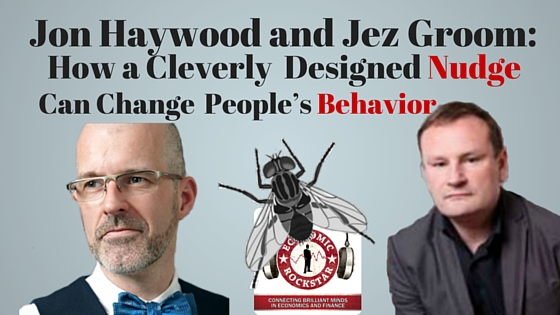
    049: Jez Groom and Jon Haywood on How a Cleverly Designed Nudge Can Change People’s Behavior – Including How We Pee

    September 10, 2015 by Frank

    http://traffic.libsyn.com/economicrockstar/Jez_Groom_Final.mp3
    Play in New WindowDownload

    049: Jez Groom and Jon Haywood on How a Cleverly Designed Nudge Can Change People’s Behavior – Including How We Pee

    Jez Groom is a behavioral economist and co-founder of the behavioral practice #ogilvychange in the United Kingdom.

    Alongside Rory Sutherland, Jez has created the Nudge Awards and Nudgestock, bringing the best in behavioral economics to the mainstream.

    Jon Haywood is the founder of Ambassadogs and has been working in the Advertising industry for almost 20 years.

    Jon has specialised in taking a more consumer (human) perspective of the marketing challenge, working with the likes of Rory Sutherland of #ogilvychange on understanding how behavioural economics can add a significant competitive advantage to the creative ideation process.

    Jez Groom and Jon Haywood

    Economists:

    Rory Sutherland, Paul Dolan, Richard Thaler, Cass Sunstein, Daniel Kahneman, Dan Ariely and Malcolm Gladwell.

    Economics:

    Behavioural economics, choice architecture, nudge, framing, heuristic, ’Fly in the Urinal’, ‘Piano Stairs’, ‘Stickman’, ‘The Religious Norming and The Begger’ and the ‘Facial Feedback Hypothesis’,

    In this episode, you will learn:

    • how #ogilvychange is bringing Behavioural Economics into the mainstream.
    • about Nudgestock which brings academics and practitioners together to discuss the theoretical and practical intersection of behavioural economics.
    • how a ‘Fat Stickman’ pointing to an escalator and a ‘Thin Stickman’ pointing to the stairs can nudge a person to take the stairs.
    • about the bathroom tip-jar trick that could net you more tips than ever!
    • how re-arranging the choice architecture of a sales product can boost sales.
    • how #ogilvychange gave The Times newspaper a ROI of 250 in incremental sales on a 1 investment.
    • that offering customers too many choices can affect your bottom-line.
    • how changing the environment of sales agents can increase average sales by 185% simply by changing the colours of the walls.
    • how we can nudge people to take the stairs rather than the elevator by creating ‘The Piano Stairs’.
    • how we can encourage people to bin their litter by simply creating ‘The World’s Deepest Bin’.
    • how we can reduce the amount of urine that ends up on the floor by putting a sticker in the urinal.
    • why businesses and governments are now embracing behavioral economics.
    • and much more!

    How a Clever Nudge Can Change People’s Behavior:

    The Fun Theory, an initiative by Volkswagen, aims to create ways to encourage people to make a small change in their lives for the better. A nudge is a strategic approach by firms, governments and individuals to encourage people to behave in a way you would like them to behave. Nudging has become quite synonymous with behavioral economics lately, particularly since the release of Thaler’s book ‘Nudge’.

    The Piano Stairs:

    There is a general consensus that taking the stairs rather than the elevator or escalator can, overtime, make people lead a healthier and happier life. Perhaps that outcome is somewhat extreme, but people may ‘feel better’ if they take the stairs every time. However, how can we encourage people to take the stairs rather than the elevator?

    Should we stop the escalator from moving or have an ‘Out of Order’ sign on an elevator? Not a good idea as this would possibly have an undesired outcome as people would end up infuriated. Although they are forced to the take the stairs, the path taken to get from A to B is not desirable. Problems would also arise for those unable to physically take the stairs. We should allow an option but encourage people, if they can, to take the stairs.

    Should we send out messages outlining the health and well-being benefits of taking the stairs? Perhaps this could be effective but taking the stairs today will not make someone any fitter or healthier. People will more than likely delay or feel it is pointless.

    https://www.youtube.com/watch?v=0Yu62StlsMY

    Do you remember or have you seen the 1988 movie Big featuring Tom Hanks? Tom’s character had made a wish, the day before when he was a young boy, to be older. His wish comes true but his mind and behavior is that of his younger self. Tom’s character immortalizes the famous New York toy store, FAO Schwarz, by playing ‘Chopsticks’ on a large piano on the floor. This captured the imagination of many people who wathced his movie and I’m sure the behavioral scientists at The Fun Theory knew exactly how they could now encourage people to take the stairs rather than the escalator.

    Enter The Piano Stairs, a fun and interactive experiment to nudge people to take the stairs and to, perhaps, feel better. Check out their video here and the interesting results achieved with this ‘nudge’ from The Fun Theory.

    The Urinal Fly:

    In this episode of the Economic Rockstar podcast, Jez Groom mentioned how placing a sticker of a fly in a urinal reduced the incidence of mis-direction of toileting by men. Subsequently, I reached out to Jon Haywood from ambassadogs.nl who explained the concept of the Urinal Fly and how a sticker or print of a fly within a urinal is a nudge that changed the behavior of those men in question.

    Jon is from Amsterdam and this particular nudge is credited to Amsterdam’s Schiphol Airport. The manager of the cleaning department at Schiphol Airport, Jos van Bedaf, is credited to introducing the urinal fly in order to reduce the amount of spillage. According to Jon Haywood, this had the effect of reducing spillage, resulting in lower clean-up costs and improved toilet conditions. The fly was chosen as it appears insanitary and men can aim at the image. A butterfly couldn’t be chosen as men may aim around this image as it could conjure up an image of beauty that you wouldn’t like to harm.

    The World’s Deepest Bin:

    Another nudge was developed by The Fun Theory to encourage people to bin their litter and have a litter-free environment. Again, Jon Haywood talks to us about this particular nudge and how a piece of deposited litter passed an internal sensor which activated a sound giving the perception that the litter was falling for 10 seconds.

    Recommended Books:

    • Thinking, Fast and Slow by Daniel Kahneman
    • Nudge by Richard H. Thaler
    • Blink by Malcolm Gladwell
    • Outliers by Malcom Gladwell
    • Freakonomics by Steven D. Levitt and Stephen Dubnar
    • SuperFreakonomics by Steven D. Levitt and Stephen J. Dubnar

    Resources:

    • #nudgesinthewild
    • O Behave!
    • www.thenudgeawards.com

    Where to Find Jez Groom:

    www.ogilvychange.com

    Where to Find Jon Haywood:

    www.ambassadogs.nl

    http://traffic.libsyn.com/economicrockstar/Jez_Groom_Final.mp3

    Podcast: Play in new window | Download
    048: Steve Hanke on Currency Boards, Moral Hazard and the Benefits of Privatization

    September 3, 2015 by Frank

    http://traffic.libsyn.com/economicrockstar/048_Steve_Hanke_Final.mp3
    Play in New WindowDownload

    048: Steve Hanke on Currency Boards, Moral Hazard and the Benefits of Privatization

    Steve Hanke is a Professor of Applied Economics, specializing in currency boards. He is Co-Director of the Institutesteve hanke for Applied Economics, Global Health, and the Study of Business Enterprise at The Johns Hopkins University in Baltimore.

    Steve is a Senior Fellow and Director of the Troubled Currencies Project at the Cato Institute in Washington, D.C. and a member of the Charter Council of the Society of Economic Measurement and the Financial Advisory Council of the United Arab Emirates.

    Previously, Professor Hanke was a Senior Economist on President Reagan’s Council of Economic Advisers and was also an Advisor to the Presidents of Bulgaria, Venezuela, and Indonesia.

    He played an important role in establishing new currency regimes in Argentina, Estonia, Bulgaria, Bosnia-Herzegovina, Ecuador, Lithuania, and Montenegro. Professor Hanke has also advised the governments of many other countries, including Albania, Kazakhstan and Yugoslavia.

    In 1998, Steve was named one of the twenty-five most influential people in the world by World Trade Magazine.

    Professor Hanke is a well-known currency and commodity trader and serves as Chairman of Hanke-Guttridge Capital Management, LLC.

    Steve Hanke’s most recent books are Zimbabwe: Hyperinflation to Growth (2008) and A Blueprint for a Safe, Sound Georgian Lari (2010).

    Influencers:

    Friedrich Hayek, Kenneth Boulding of the University of Colorado  and Bob Mundell

    Economics:

    In this interview, Steve mentions and discusses: currency boards, monetary policy, inflation, hyper-inflation, interest rates, currency reserves, optimum currency area, common currency, fiscal policy, moral hazard, eurozone, ECB, the World Bank, property rights, investment, central bank, dollarisation, interventionist policy, privatisation, hedging, Chicago Mercantile Exchange, futures contract and bitcoin.

    Economists:

    In this interview, Steve mentions and discusses: Kirk Schuller, Milton Friedman, Friedrich Hayek, Adam Smith, Robert Mundell and Kenneth Boulding.

    There have only been 56 hyper-inflations in world history and I think I’ve stopped more of them than any living economist – Professor Steve Hanke

    In this episode, you will learn:

    • what is a currency board and the reason why a country should resort to one.
    • about Bulgaria’s currency crisis in 1997, how hyper-inflation hit 142 percent per month and what Steve Hanke did to solve the problem.
    • the successful use of currency boards in Bulgaria in 1997 to significantly reduce inflation and interest rates.
    • why Bulgaria has one of the lowest fiscal deficits of any country.
    • about Yugoslavia’s hyper-inflation of 313 million percent in 1994.
    • why Montenegro dumped the Yugolsav Dinar for the Deutschmark during Slobodan Milosevic’s presidency of Yugoslavia.
    • how Montenegro will join the euro currency without having to do a currency changeover.
    • if it makes sense to leave a currency board to join a monetary union and giving up fiscal autonomy.
    • why it’s best for Bulgaria to stay outside the eurozone due to the issue of moral hazard.
    • why Greece ran up a fiscal deficit of 12.7% of GDP when the Maastricht Treaty stated a strict adherence to a maximum level of 3%.
    • about the Greek bailout of $472 billion and how it amounts to almost $43,000 for every man, woman and child in Greece.
    • how a currency board removes the moral hazard of a unified currency area by financing spending with current taxes or the private bond market.
    • if Greece should abandon the euro and set up a currency board and pegging their currency with the euro.
    • how a Greek currency board would operate if Greece left the eurozone.
    • about the success of the Hong Kong currency board and how it operates without a central bank.
    • if we are heading toward a one world currency.
    • why most small countries should abandon their currency and anchor it to the euro, dollar, yen or yuan.
    • whether Greece should sell off its ports, lands and other property to private investors just as Hayek proposed and Ronald Reagan did in the US in the 1980s.
    • about Ronald Reagan’s privatisation programme in the US in the early 1980s.
    • about the Bureaucratic Rule of Two and why privatisation is an optimal outcome for government, enterprise and society.
    • what Hayek was like as a person and what he thought of Ronald Reagan, The Intellectual.
    • about candling in the old days when grading eggs for futures contracts.

    On Currency Boards:

    A currency board system is a system in which you issue a domestic currency, which is anchored to a sound currency at a fixed exchange rate that’s fully convertible. The local currency is backed up with a 100% anchor currency’s reserves. So the local currency really becomes a clone of whatever the anchor currency happens to be.

    The currency board is not allowed to emit credit to the government. If the government needs money for fiscal expansion, the only way to get this finance (in the form of your local currency) is to take hard currency in (like the euro) and exchange it for the local currency. Bulgaria has been doing this since 1997. The government cannot sell bonds to raise finance. They convert the euro (previously the Deutschmark) into their local currency, the lev, and can then carry out fiscal stimulus. Consequently, Bulgaria has one of the lowest fiscal deficits in Europe.

    On Bulgaria and Why It Should Not Join the Eurozone:

    “With the currency board, they (Bulgaria) ‘clone’ the euro, so they’re in a unified currency area with the eurozone but they’re not formally part of the eurozone itself. I’ve counselled the Bulgarians, and the best thing to do is to stay with that arrangement. And the reason why is that the eurozone, the common currency area, has a huge moral hazard associated with it. That is, something that creates bad behaviour encourages bad behaviour and Greece is a perfect example.” – Professor Steve Hanke

    On the Greek Deceit and Its Fiscal Deficit:

    “Greece entered the eurozone in 2001 on false pretences. They cooked the books and got in. They were allowed in the club even though the club knew the Greeks were lying in terms of their economics statistics.”

    “The Greeks calculated that they could spend like drunken sailors, which they did and ran a completely irresponsible fiscal operation.”

    “The moral hazard is you join a club and if you think the club won’t enforce its rules and won’t force you to tow the line, you will just go on your merry way spending and deficit spending and knowing, or at least thinking that, in this case the eurozone, would bail you out.”

    Greece ranks 151 out of 189 countries for the ability of doing business. If you make a contract in Greece, the probability of having that contract enforced is very low by international standards. It’s like being in Zimbabwe. Greece is supposed to be part of the European Union and a modern country but it isn’t.

    Greece should leave the eurozone, set up a currency board and re-introduce the Drachma. This would create fiscal discipline just like the situation in Bulgaria.

    Quotes by Steve Hanke in Episode 048 of the Economic Rockstar Podcast:

    I was hedging and trading when I was 14 years of age. I was trading with my grandfather – @steve_hanke

    Click To Tweet

    Hong Kong was aways a unilateralist free trader. That encourages competition, entrepreneurship and productivity. The countries with open trade tend to be more free market in general and they grow more rapidly. – Steve Hanke

    “About 90 Central Banks should just be done away with completely and either a currency board be put in or a stronger foreign currency like the dollar, the euro or the yen.” – Steve Hanke

    “If you want lower fiscal deficits, lower inflation and higher rates of growth you adopt with a currency board system or dollarize” – Steve Hanke

    If you want to reduce corruption you privatise. But the potential gains in terms of economic prosperity are enormous – @steve_hanke

    Click To Tweet

    Europe’s lands are “a mere waste and loss of country in respect both of produce and population.” – Adam Smith

    Click To Tweet

    Bitcoin has a unit of account problem – @steve_hanke

    Click To Tweet

    On Hayek:

    “He was delightful and charming and very interesting, particularly for Mrs Hanke and myself. One of Mrs Hanke’s Great Aunts was one of Hayek’s earlier loves of his life.”

    Recommended Books:

    • Zimbabwe: Hyperinflation to Growth by Steve Hanke (Free download)
    • The Wealth of Nations by Adam Smith
    • Reagan, In His Own Hand by Ronald Reagan, edited by Marty Andersson et al.
    • The Advanced Introduction To The Austrian School of Economics by Randall Holcombe
    • The Essential Hayek by Donald Boudreaux (Free Kindle download)

    Resources:

    • Case Studies written by Steve Hanke
    • Troubled Currencies Project
    • The Hanke-Krus Hyperinflation Index
    • http://econographic.com/hyperinflation
    • On the Measurement of Zimbabwe’s Hyperinflation by S. Hanke and A. Kwok
    • Friedman: Float or Fix? by Steve H. Hanke
    • Reflections on Currency Reform and the Euro by Steve H. Hanke
    • The Privatization Debate: An Insider’s View by Steve H. Hanke
    • Could Greece Adopt the Dollar? by Steve H. Hanke
    • Reflections on Reagan the Intellectual by Steve H. Hanke
    • On the Fall of the Rupiah and Suharto by Steve H. Hanke
    • Doing Business 2015 Report by The World Bank

    Where to Find Steve Hanke:

    • Cato Institute: http://www.cato.org/people/steve-hanke
    • Johns Hopkins Institute: http://krieger.jhu.edu/iae/co-directors
    • Twitter: @steve_hanke
    http://traffic.libsyn.com/economicrockstar/048_Steve_Hanke_Final.mp3

    Podcast: Play in new window | Download

    047: Victor Ricciardi on The Psychology of Financial Planning and Investing

    August 27, 2015 by Frank

    http://traffic.libsyn.com/economicrockstar/047_Victor_Ricciardi_Final.mp3
    Play in New WindowDownload

    047: Victor Ricciardi on The Psychology of Financial Planning and Investing

    Victor Ricciardi is Finance Professor at Goucher College, Baltimore, Maryland where he teaches courses in Victor Ricciardipersonal financial planning, corporate finance, investments, behavioral finance, and the psychology of money.

    Victor is the Coordinator of Behavioral & Experimental Research for the Social Science Research Network also known as SSRN.

    Victor is the current Editor for seven SSRN eJournals including Behavioral & Experimental Finance, History of Finance, and Behavioral & Experimental Economics.

    He received his PhD from Golden Gate University and his MBA from St. John’s University.

    Victor’s current book Investor Behavior: The Psychology of Financial Planning and Investing with co-editor Kent Baker is now available and has 30 chapters on emerging research in behavioral finance.

    In this episode, you will learn:

    • the difference between Behavioral Economics and Behavioral Finance.
    • the rational approach to investing and whether it exists.
    • what bounded rationality really means.
    • if companies help you make decisions for their own personal benefit.
    • how framing can be a powerful tool to help customers make decisions.
    • the importance of financial literacy at different stages of your life.
    • the similarities between behavioral economics and marketing.
    • the future of Behavioral Economics and Behavioral Finance.
    • how your mood, good or bad, can influence your buying behaviour and increase risk-taking.
    • about the importance of studying the subconscious mind in finance or neurofinance.
    • why people generally do not take losses, known as loss aversion.
    • why Victor disagreed with the traditional views of economics and decided to study behavioral finance.
    • how and why some governments are using behavioural finance and economics techniques to nudge us to make better financial decisions in our lives.
    • how status quo bias makes it harder for employees to opt out of an automatically enrolled savings retirement plan.
    • how mounting student debt and high youth unemployment in the US could make it difficult to service pensions leading to a pension ‘ponzi’ scheme or a crisis.
    • why Victor Ricciardi believes that there should have been a law designed to make retirement planning easier for the employee.
    • what you should do when investing so as to manage bull and bear market cycles.

    Economics:

    In this interview, Victor mentions and discusses: behavioral Economics, Behavioral Finance, rational, bounded rationality, heuristics, framing, annuity puzzle, investment, consumption, self-control bias, nudging, consumer behavior, mutual returns, savings, investments, neurofinance, risk tolerance, over-confidence, loss aversion, nudging, status quo bias, retirement planning and wage inflation.

    Economists:

    In this interview, Victor mentions and discusses: Richard Peterson, Douglas Rice, Daniel Kahnemann, Amos Tversky, Robert Olson, Richard Thaler and Hersh Shefrin.

    Influencers:

    William Sharpe, Harry Markovicz, Terence Odean, Robert Olsen, Dan Ariely, Mair Stockman, Hersch Shefrin and John Nofsinger.

    Quotes by Victor Ricciardi in Episode 047 of the Economic Rockstar Podcast:

    Behavioural Finance is the notion of integrating psychology with finance. So you’re looking at some major themes where people are not only rational but they make decisions based on emotions. – Victor Ricciardi

    Risk tolerance is the maximum amount of risk a person is willing to take in their overall portfolio or risky asset. Typically, people are either very conservative risk-takers, they’re average or they’re very aggressive. The component of risk tolerance that’s related to it is known as ‘Risk Perception’, in which our feelings and emotions will increase or have an impact on our overall risk tolerance. – Victor Ricciardi

    Takeaway:

    Meet with a financial planner and get a financial plan done. In terms of investing, try to understand what type of investor you are and come with an asset allocation that you are comfortable with. Rebalance your portfolio on a year basis which allows you to stay within your risk tolerance. – Victor Ricciardi

    Recommend Resources:

    • Twitter

    Recommend Books:

    • Investor Behavior: The Psychology of Financial Planning and Investing by Victor Ricciardi and Kent Baker
    • The Psychology of Investing by Jon Nofsinger
    • Irrationally Yours by Dan Ariely
    • Predictably Irrational by Dan Ariely
    • Misbehaving by Richard Thaler

    Where to Find Victor Ricciardi:

    • Twitter
    • Goucher College
    http://traffic.libsyn.com/economicrockstar/047_Victor_Ricciardi_Final.mp3

    Podcast: Play in new window | Download

    • Prev Page...
    • 1
    • …
    • 11
    • 12
    • 13
    • 14
    • 15
    • …
    • 19
    • ...Next Page

    Frank Conway

    Frank Conway is founder of Economic Rockstar and lecturer of economics, finance and statistics. Read More…

    View My Blog Posts

    Youtube Sub

    Become a Patron of the Economic Rockstar Podcast

    patreon

    Ireland’s Economy by the Numbers

    Leaving Cert Economics: Ireland’s Economy  Click here to download a workbook on Ireland’s Economy so that you can add your own notes. [Original size] Ireland’s Economy by fconway

    Categories

    Subscribe and Never Miss An Episode

    itunes-logo

    Recent Posts

    • Ireland’s Economy by the Numbers April 8, 2019
    • 174: Wendy Carlin on The Core Project, Capitalism, Democracy and Normative Statements February 13, 2019
    • 173: Stephen Wright on Core Econ as a Learning Resource for Mainstream Economics January 28, 2019
    • 172: Best of 2018 Part 2: From the Great Depression to Futurism; Institutions, Individualism, Cooperation and Reciprocity January 22, 2019
    • 171: Best of 2018 Part 1 January 3, 2019

    Copyright © 2026 · Podcast Pro Theme on Genesis Framework · WordPress · Log in

    This website uses cookies to improve your experience. We'll assume you're ok with this, but you can opt-out if you wish. Accept Reject Read More
    Privacy Policy

    Privacy Overview

    This website uses cookies to improve your experience while you navigate through the website. Out of these, the cookies that are categorized as necessary are stored on your browser as they are essential for the working of basic functionalities of the website. We also use third-party cookies that help us analyze and understand how you use this website. These cookies will be stored in your browser only with your consent. You also have the option to opt-out of these cookies. But opting out of some of these cookies may affect your browsing experience.
    Necessary
    Always Enabled
    Necessary cookies are absolutely essential for the website to function properly. This category only includes cookies that ensures basic functionalities and security features of the website. These cookies do not store any personal information.
    Non-necessary
    Any cookies that may not be particularly necessary for the website to function and is used specifically to collect user personal data via analytics, ads, other embedded contents are termed as non-necessary cookies. It is mandatory to procure user consent prior to running these cookies on your website.
    SAVE & ACCEPT