• ABOUT
  • RESOURCES
  • PODCAST
  • BOOKS
  • BLOG
  • SUPPORTERS
  • QFA Financial Advice
  • CONTACT

Economic Rockstar

Connecting Brilliant Minds in Economics and Finance

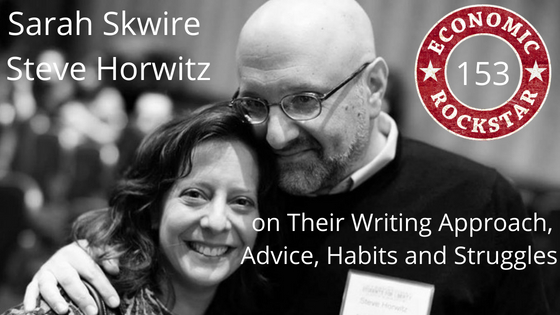
153: Sarah Skwire and Steve Horwitz on Their Writing Approach, Advice, Habits and Struggles
August 12, 2018 by Frank

http://traffic.libsyn.com/economicrockstar/153_Sarah_and_Steve_Final.mp3
Play in New WindowDownload

153: Sarah Skwire and Steve Horwitz on Their Writing Approach, Advice, Habits and Struggles


I catch up once again with Sarah Skwire and Steve Horwitz but this episode is a little different and was inspired by my previous conversation with Sarah back in episode 129.

Sarah Skwire is the Literary Editor of FEE.org and a senior fellow at Liberty Fund, Inc. She is a poet and author of the writing textbook Writing with a Thesis. She is a member of the FEE Faculty Network. 

Steve Horwitz is the Charles A. Dana Professor of Economics at St. Lawrence University and the author of Hayek’s Modern Family: Classical Liberalism and the Evolution of Social Institutions. He spent the 2016-17 academic year as a Visiting Scholar at the John H. Schnatter Institute for Entrepreneurship and Free Enterprise at Ball State University.

Other Episodes:

  • 129: Sarah Skwire on the Sensibility of Literature for Economic Thinking
  • 108: Steve Horwitz on Spontaneous Order, the Microfoundations of Macroeconomics and Three Economic Myths

Books:

  • Writing with a Thesis by Sarah Skwire and David Skwire
  • Hayek’s Modern Family: Classical Liberalism and the Evolution of Social Institutions by Steve Horwitz

Patreon

If you’re a fan of the podcast and would like to show your support in anyway, please check out my Patreon page at www.patreon.com/economicrockstar where you can sign up for any of the awards for as little as $1 a month or you can simply follow me on the Economic Rockstar Facebook page or on Twitter or simply recommend the show to a friend, especially if they have never had the opportunity to study economics.

http://traffic.libsyn.com/economicrockstar/153_Sarah_and_Steve_Final.mp3

Podcast: Play in new window | Download
  • facebook
  • linkedin
  • twitter
  • google+
  • pinterest

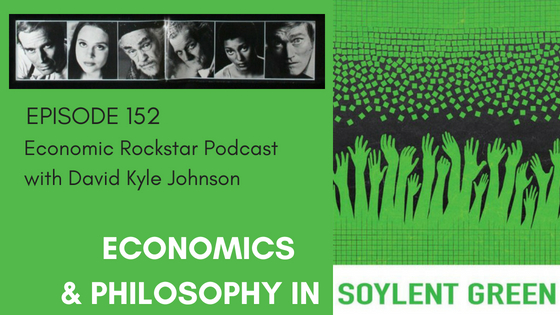
152: David Kyle Johnson on Economics and Philosophy in Soylent Green

August 10, 2018 by Frank

http://traffic.libsyn.com/economicrockstar/152_Kyle_Soylent_Green_Final.mp3
Play in New WindowDownload

152: David Kyle Johnson on Economics and Philosophy in Soylent Green

This is a 3rd instalment of my interviews with Professor David Kyle Johnson, an  Associate Professor of Philosophy at King’s College in Wilkes-Barre, Pennsylvania.

We catch up again after watching the 1973 dystopian movie ‘Soylent Green‘ and discuss some economics and philosophical themes that run through the movie.

In this Episode, we cover:

  • Scarcity
  • Choice
  • Over-population
  • Consumption
  • Inflation
  • Production
  • Automation
  • Altruism
  • Theft
  • Black market economy
  • Pricing
  • Equilibrium
  • The Invisible Hand

Social Issues Discussed Include:

  • Social class/status,
  • Feminism
  • Poverty

Philosophical Questions Addressed Include:

  • Should we resort to cannibalism to save the human race?
  • Should we have the right to die with dignity in the face of a terminal illness, the loss of hope or over our moral principles?
  • Is there a god?
  • And more.

Movies:

  • Soylent Green (1973) Directed by Richard Fleischer

Other Episodes to Check Out:

146: David Kyle Johnson on Science Fiction as Philosophy and Finding Nietzsche’s Übermensch in Economics

151: Unreleased Bonus Episode with David Kyle Johnson

Books:

  • Make Room, Make Room: The Classic Novel of an Overpopulated Future by Harry Harrison
  • The Population Bomb by Paul Erlich

Patreon

If you’re a fan of the podcast and would like to show your support in anyway, please check out my Patreon page at www.patreon.com/economicrockstar where you can sign up for any of the awards for as little as $1 a month or you can simply follow me on the Economic Rockstar Facebook page or on Twitter or simply recommend the show to a friend, especially if they have never had the opportunity to study economics.

http://traffic.libsyn.com/economicrockstar/152_Kyle_Soylent_Green_Final.mp3

Podcast: Play in new window | Download
  • facebook
  • linkedin
  • twitter
  • google+
  • pinterest

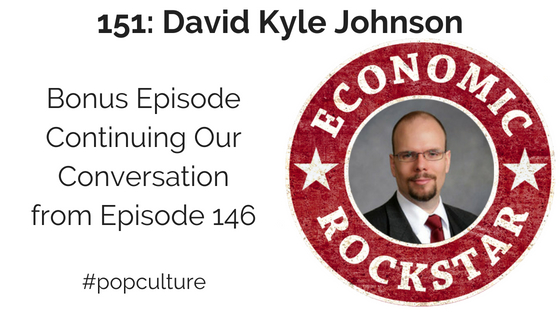
151: Unreleased Bonus Episode with David Kyle Johnson

August 8, 2018 by Frank

http://traffic.libsyn.com/economicrockstar/151_Bonus_David_Kyle_Johnson_Final.mp3
Play in New WindowDownload

151: Unreleased Bonus Episode with David Kyle Johnson

This is a continuation of my conversation with Professor David Kyle Johnson from Episode 146.

Checkout Episode 146 if you want to catch up with our conversation prior to this Bonus Episode.

We agreed to meet up a third time to talk about economics and philosophy in Soylent Green since I hadn’t watched the movie. So we did just that in Episode 152. Check it out here: www.economicrockstar.com/soylentgreen


In this episode we touch on the following themes:

  • Overpopulation
  • Food scarcity
  • Inefficient agricultural and meat production methods
  • Euthanasia

Books:

  • Make Room, Make Room: The Classic Novel of an Overpopulated Future by Harry Harrison
  • The Population Bomb by Paul Erlich
  • Mein Kamf by Adolf Hitler
  • The Handmaid’s Tale by Margaret Atwood
  • How to Think About Weird Things: Critical Thinking for a New Age by Theodore Schick and Lewis Vaughn

Movies:

  • Soylent Green

TV Series:

  • Black Mirror
  • The Orville
  • M.A.S.H.
  • The Handmaid’s Tale

People:

  • Socrates
  • Plato

Patreon

If you’re a fan of the podcast and would like to show your support in anyway, please check out my Patreon page at www.patreon.com/economicrockstar where you can sign up for any of the awards for as little as $1 a month or you can simply follow me on the Economic Rockstar Facebook page or on Twitter or simply recommend the show to a friend, especially if they have never had the opportunity to study economics.

http://traffic.libsyn.com/economicrockstar/151_Bonus_David_Kyle_Johnson_Final.mp3

Podcast: Play in new window | Download

  • facebook
  • linkedin
  • twitter
  • google+
  • pinterest

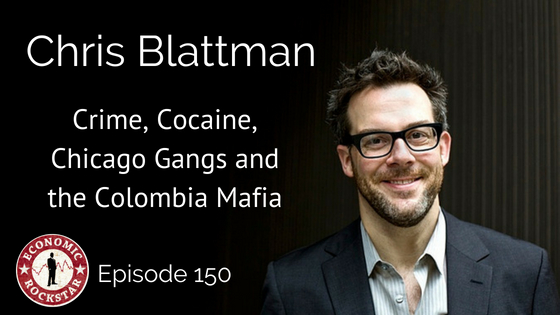
150: Chris Blattman on Crime, Cocaine, Chicago Gangs and the Colombia Mafia

July 29, 2018 by Frank

http://traffic.libsyn.com/economicrockstar/150_Chris_Blattman_Final.mp3
Play in New WindowDownload

150: Chris Blattman on Crime, Cocaine, Chicago Gangs and the Colombia Mafia

Chris Blattman is the Ramalee E. Pearson Professor of Global Conflict Studies at The University of Chicago’s Pearson Institute and Harris Public Policy.

He is an economist and political scientist who studies poverty, violence and crime in developing countries.

Chris has designed and evaluated strategies for tackling poverty, including cash transfers to the poorest.

Much of his work is with the victims and perpetrators of crime and violence, testing the link between poverty and violence.

His recent work looks at other sources of and solutions to violence.

These solutions range from behavioral therapy to social norm change and local-level state building.

He has worked mainly in Colombia, Liberia, Uganda, Ethiopia, and Chicago’s South Side. Dr. Blattman was previously a faculty member at Columbia and Yale Universities, and holds a PhD in Economics from UC Berkeley and a Master’s in Public Administration and International Development from the Harvard Kennedy School. He chairs the Peace & Recovery sector at Innovations for Poverty Action and the Crime, Violence and Conflict initiative at MIT’s Poverty Action Lab.

In this episode you will learn:

  • The real reason why Chris decided to study conflict and the conflict zone.
  • How he met his wife, a humanitarian worker and Phd student, met in an internet cafe in Nairobi.
  • If crime rates are lower in special economic zones than in other areas outside these zones?
  • Whether Chris encounters any psychological difficulties when conducting field study research.
  • Why Chris researches cocaine gangland warfare in Colombia and Chicago?
  • About the hierarchy that exist in the Colombian mafia.
  • Why Colombia’s coca trade is woven deep within the fabric of Colombian society.
  • About Colombian gangs and how the mafia operate.
  • How Chris is working with authorities to develop policy interventions and initiatives  to reduce the influence of mafia.
  • and much more.

“One fairly common thing, counter intuitive so much surprising but really widely documented now is that exposure to traumatic experiences often lead people to become more socially oriented, more cooperative, more engaged in their communities. So there is a silver lining to this dark cloud.” Professor Chris Blattman

People:

  • Walter O’Brien Scorpion Computer Services
  • Kate Cronin-Furman Wronging Rights Blog

Links:

  • Chris Blattman: www.chrisblattman.com
  • Kate Cronin-Furman: www.wrongingrights.com
  • University of Waterloo

Books:

  • My Struggle: Book 2 A Man in Love
  • The Illiad by Homer
  • The Odyssey by Homer
  • The Anti-Politics Machine: Development, Depoliticization, and Bureaucratic Power in Lesotho by James Fergusan
  • Seeing Like a State: How Certain Schemes to Improve the Human Condition Have Failed
    by James C. Scott
  • The Art of Not Being Governed: An Anarchist History of Upland Southeast Asia by James C. Scott


Recommended Episodes to Listen After This One:

  • 101: Chris Coyne on the Opportunity Cost of War, Exporting Democracy and the Nirvana Fallacy
  • 055: David Skarbek on the Economics of Prison Gangs and The Social Order of the Underworld

Patreon

If you’re a fan of the podcast and would like to show your support in anyway, please check out my Patreon page at www.patreon.com/economicrockstar where you can sign up for any of the awards for as little as $1 a month or you can simply follow me on the Economic Rockstar Facebook page or on Twitter or simply recommend the show to a friend, especially if they have never had the opportunity to study economics.

http://traffic.libsyn.com/economicrockstar/150_Chris_Blattman_Final.mp3

Podcast: Play in new window | Download

  • facebook
  • linkedin
  • twitter
  • google+
  • pinterest

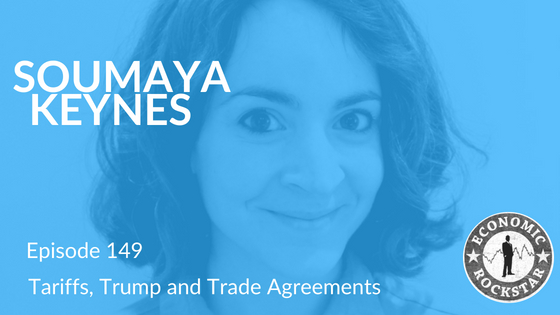
149: Soumaya Keynes on Tariffs, Trump and Trade Agreements

July 22, 2018 by Frank

http://traffic.libsyn.com/economicrockstar/149_Soumaya_Keynes_Final.mp3
Play in New WindowDownload

149: Soumaya Keynes on Tariffs, Trump and Trade Agreements


Soumaya Keynes is the economics and trade correspondent at The Economist. She writes for the print edition and the Free Exchange blog.

Before joining The Economist Soumaya did research on the public finances and pensions at the Institute for Fiscal Studies, an economic research institute.

Before that Soumaya worked in the Banking and Credit team at Her Majesty’s Treasury in London. Soumaya has an M.Phil. and B.A. in Economics from Trinity College, Cambridge.

She is co-host of a weekly podcast on trade economics called Trade Talks.

In this episode, Soumaya mentions and discusses:

  • Tariffs and Trade.
  • On the WTO: when they established and for what reason.
  • The General Agreement on Tariffs and Trade (GATT).
  • Trans-Pacific Partnership (TPP).
  • NATO.
  • EU blockage of US beef imports due to hormone induction but lacks scientific evidence.
  • Brexit: can Ireland and the UK create their own trade agreement as made permissible within the WTO which was also similar to those countries who created the TPP.
  • About NAFTA.
  • Why did Trump go after reforming or disrupting NAFTA?

Books:

Evicted: Poverty and Profit in the American City by Mathew Desmond.

Janesville: An American Story by Amy Goldstein

On Writing Well by William Zinsser


Writing Tips:

Excerpt from this episode with Soumaya Keynes

“Clear writing has value anywhere would be my first point. As someone who reads a lot of academic articles for my job, I think it has an impression that academic writing has to be wordier or more complicated essentially to demonstrate how clever you are. And as a reader of that I would argue that good writing is good wherever it is and there is huge value to being clear and having short sentences and being understandable. You know, jargon is often something that people hide behind. Do you really need to use the ten-letter version of the word where a five-letter version is available?

One thing that came to me relatively late is that essentially there are two kind of writers. There are the kind who other people think of as natural writers who can write out a first draft and it’s perfect. And for disclosure I am not one of those kind of writers. And then the other kind is the kind that basically needs three drafts to get what they are happy with. And I think before I came to The Economist that I would have thought that maybe because I need three drafts as I wasn’t as good a writer as the person who could do it first time. But that I think is really not the case. Just because it feels like it’s taken a lot of effort that you need to do a lot of re-writing to get it in the shape that you want that doesn’t say anything about the quality of the final product or just how good a writer you are.

The risk is that if you know that you need a few rounds of editing to get something in to the shape that you wanted that you label yourself a bad writer and that makes you worried or anxious about writing anything new.

And so, my words of wisdom would be ‘You’re still a great writer even if it takes you a few tries’, or at least that what I tell myself.”

Other Episodes that May Interest You:

  • 144: Donald Boudreaux on International Trade, Tariffs and Protectionism
  • 040: Rebecca Harding on Trade Finance and How Delta Economics Can Help Identify Growth Opportunities World-Wide

Links:

  • Soumaya Keynes personal website
  • The Economist
  • Trade Talks podcast
  • Peterson Institute for International Economics

Patreon

If you’re a fan of the podcast and would like to show your support in anyway, please check out my Patreon page at www.patreon.com/economicrockstar where you can sign up for any of the awards for as little as $1 a month or you can simply follow me on the Economic Rockstar Facebook page or on Twitter or simply recommend the show to a friend, especially if they have never had the opportunity to study economics.

http://traffic.libsyn.com/economicrockstar/149_Soumaya_Keynes_Final.mp3

Podcast: Play in new window | Download

  • facebook
  • linkedin
  • twitter
  • google+
  • pinterest

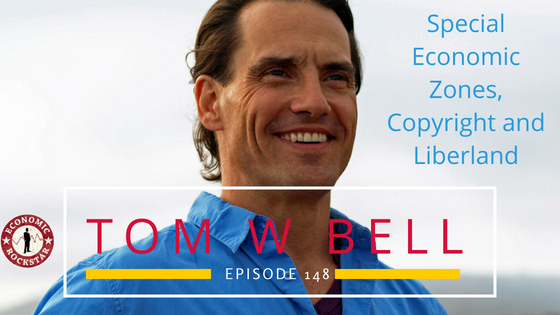
148: Tom W. Bell on Special Economic Zones, Copyright and Liberland

July 15, 2018 by Frank

http://traffic.libsyn.com/economicrockstar/148_Tom_W_Bell_Final.mp3
Play in New WindowDownload

148: Tom W. Bell on Special Economic Zones, Copyright and Liberland

Tom W. Bell earned his Juris Doctor degree from the University of Chicago in 1993, then practiced law in Silicon Valley and Washington, D.C. before serving as a policy director at the Cato Institute. In 1998, he joined the faculty of Chapman University, Fowler School of Law, where he teaches all of the first-year common law courses and electives in high-tech and intellectual property law.

Professor Bell has published papers on copyright, Internet law, polycentric law, prediction markets, and the Third Amendment (the one about quartering troops). His books include “Intellectual Privilege: Copyright, Common Law, and the Common Good” (Mercatus 2014) and “Your Next Government? From the Nation State to Stateless Associations” (Cambridge University Press 2017, forthcoming). Through Archimediate LLC, Tom designs, installs, and supports legal systems for special jurisdictions. Most recently, that work has taken him to French Polynesia, where he helped forge a memorandum of understanding to allow seasteading in that island paradise.

In this Episode, Tom talks about:

  • Copyright.
  • Start-Up Cities.
  • Private cities/communities.
  • Co-op and private cities: how they work and whether crime rates are different there than in any other city.
  • What are Special Economic Zones and what do they do for the country?
  • Why SEZs are making a comeback.
  • How the United States boosted SEZs again in 1948, when Operation Bootstrap made Puerto Rico a free trade zone for U.S. companies engaged not just in trade but also in production.
  • Zones for Employment and Economic Development (ZEDE).
  • Honduras, US, Hong Kong, China and Saudi Arabia (KAEC 2006 and Neom 2017).
  • Seasteading.
  • Liberland: who owns it?
  • Elon Musk, Space X, Tesla and the HyperLoop.
  • Georgia’s Anaklia Port project.

Links:

  • www.tomwbell.com

Books:

  • Your Next Government? From the Nation State to Stateless Associations by Tom W. Bell
  • Intellectual Privilege: Copyright, Common Law, and the Common Good by Tom W. Bell
  • Intellectual Privilege: Copyright, Common Law, and the Common Good (FREE PDF DOWNLOAD) by Tom W. Bell

Patreon

If you’re a fan of the podcast and would like to show your support in anyway, please check out my Patreon page at www.patreon.com/economicrockstar where you can sign up for any of the awards for as little as $1 a month or you can simply follow me on the Economic Rockstar Facebook page or on Twitter or simply recommend the show to a friend, especially if they have never had the opportunity to study economics.

http://traffic.libsyn.com/economicrockstar/148_Tom_W_Bell_Final.mp3

Podcast: Play in new window | Download

  • facebook
  • linkedin
  • twitter
  • google+
  • pinterest

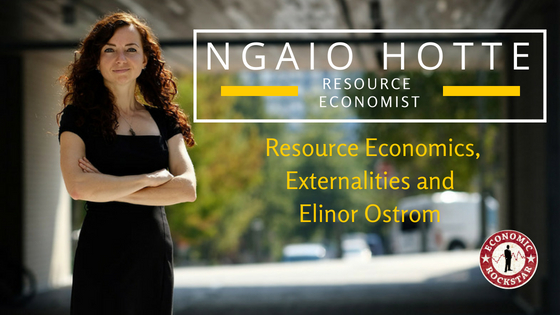
147: Ngaio Hotte on Resource Economics, Externalities and Elinor Ostrom

July 8, 2018 by Frank

http://traffic.libsyn.com/economicrockstar/147_Ngaio_Hotte_Final.mp3
Play in New WindowDownload

147: Ngaio Hotte on Resource Economics, Externalities and Elinor Ostrom


Ngaio Hotte is co-founder of the consultancy firm Resource Economics Group, which is based in British Columbia in Canada. Resource Economics Group specializes in natural resources policy, planning and management. They do research and support decision-making related to the many values of natural resources and trade-offs associated with managing these values for the benefit of people and the planet.

Ngaio is a Ph.D candidate at the University of British Columbia. Her research title is ‘How can trust be built among parties engaged in collaborative natural resource governance?’ and she draws influence from the work of the only female Nobel laureate in economics, Elinor Ostrom.

Ngaio’s Research Interests include trust, government-to-government relations, Indigenous communities, collaboration and natural resources and we touch on some of these topics in out conversation in this episode.

You can find out more about Ngaio’s work at www.resource-economics.ca.

Economics:

In this episode, Ngaio mentions and/or discusses: Elasticity of demand, externalities, substitutes, meat tax, carbon tax, resource extraction, resource management, tanker spills, New Institutional Economics, game theory, private ownership, the Tragedy of the Commons, the Broken Window Fallacy, reciprocity, trust and self-interest. 

Economists:

This episode mentions and/or discusses: Elinor Ostrom, Garrett Harden (Tragedy of the Commons), Donald J. Boudreaux, Cameron Murray, Jason Shogren and Herbert Gintis.

  • What is an externality and examples of negative and positive externalities.
  • The market value for the pollination that is created by the honey bees – people will pay bee keepers to bring their hives to certain areas so that they can pollinate the plants.
  • Addressing the negative externality of oil spillages using a carbon tax.
  • The Broken Window Fallacy.
  • Is it better for the environment and for the minimisation of pollution to have the private ownership rather than the public ownership of lands and waters?
  • Collective action by Elinor Ostrom.
  • Crack Gardens in Tokyo and Guerrilla Gardening in parkways between sidewalks and parking spots.
  • Ron Finley: Gangsta Gardener for the Urban Community– all in search for organic apples nearby and failed.
  • How tax breaks in Vancouver can beautify the landscape and generate positive externalities.
  • Writing advice.

Papers:

  • Hotte, N. and U. Rashid Sumaila, (2014). How much could a tanker spill cost British Columbians? Environment, Development and Sustainability, February 2014, Volume 16, Issue 1, pp 159–180.
  • Garrett Harden (1968). The Tragedy of the Commons. Science, New Series, Vol. 162, No. 3859 (Dec. 13, 1968), pp. 1243-1248 

Organisations:

  • Resource Economics Group: Check out the list of projects, op-eds and articles written by Ngaio Hotte here.
  • Shifting Growth

Other Links:

  • Hotte, N. (November 2, 2015). Urban forestry and the greening of Canadian cities. Spacing.

  • Nobel Speech by Elinor Ostrom: Beyond Markets and States: Polycentric Governance of Complex Economic Systems

  • Ostrom’s the Movie: Elinor Ostrom’s Governing the Commons and the Cooperative Enterprise Movement by Barbara Allen

  • Ron Finley: Gangsta Gardener for the Urban Community: www.ronfinley.com
  • TED: Ron Finley A guerilla gardener in South Central LA

Books:

  • Governing the Commons: The Evolution of Institutions for Collective Action by Elinor Ostrom

Patreon:

If you’re a fan of the podcast and would like to show your support in anyway, please check out my Patreon page at www.patreon.com/economicrockstar where you can sign up for any of the awards for as little as $1 a month or you can simply follow me on the Economic Rockstar Facebook page or on Twitter or simply recommend the show to a friend, especially if they have never had the opportunity to study economics.

http://traffic.libsyn.com/economicrockstar/147_Ngaio_Hotte_Final.mp3

Podcast: Play in new window | Download

  • facebook
  • linkedin
  • twitter
  • google+
  • pinterest

146: David Kyle Johnson on Science Fiction as Philosophy and Finding Nietzsche’s Übermensch in Economics

June 30, 2018 by Frank

http://traffic.libsyn.com/economicrockstar/146_David_Kyle_Johnson_Final.mp3
Play in New WindowDownload

146: David Kyle Johnson on Science Fiction as Philosophy and Finding Nietzsche’s Übermensch in Economics

David Kyle Johnson is Associate Professor of Philosophy at King’s College in Wilkes-Barre, Pennsylvania. He earned a master’s degree and doctorate in philosophy from the University of Oklahoma.

At Oklahoma, he won the coveted Kenneth Merrill Graduate Teaching Award. In 2011, the American Philosophical Association’s committee on public philosophy gave him an award for his ability to make philosophy accessible to the general public.

Professor Johnson regularly teaches classes on metaphysics, philosophy of religion, philosophy of mind, and logic, as well as courses on critical thinking and scientific reasoning. He has published papers on human freedom, the problem of natural evil, the multiverse, the existence of souls, and many related topics in such journals as Religious Studies, Sophia, Philo, Philosophy and Literature, and Think. He also maintains two blogs for Psychology Today.

Professor Johnson also publishes on the intersection of pop culture and philosophy. One of his books, Inception and Philosophy: Because It’s Never Just a Dream, inspired an authors@Google talk with more than half-a-million YouTube views. He also has written numerous articles that explore the relationship between philosophical questions and such pop cultural phenomena as The Hobbit, Doctor Who, Batman, South Park, Johnny Cash, Quentin Tarantino, and Christmas.

Economics:

In this episode Kyle discusses/mentions: Mercantilism, Capitalism, Socialism, Marxism, free trade and poverty.

Economists mentioned in this Episode:

  • Adam Smith, Karl Marx and John Maynard Keynes.

Philosophers mentioned in this Episode:

  • John Locke, Nietzsche and John Rawls.

People mentioned in this Episode:

  • Bill Gates, Elon Musk, The Emperor, David X. Cohen and Christopher Nolan.

Shows/Movies mentioned in this Episode:

  • Black Mirror
  • Twilight Zone
  • Star Trek
  • Star Wars
  • Doctor Who
  • 2001: A Space Odyssey
  • Lord of the Rings
  • The Simpsons
  • Futurama

Books:

  • Inception and Philosophy by David Kyle Johnson
  • Introducing Philosophy Through Pop Culture: From Socrates to South Park, Hume to House by David Kyle Johnson
  • Heroes and Philosophy: Buy the Book, Save the World by David Kyle Johnson
  • The Wealth of Nations by Adam Smith
  • Lord of the Rings

Courses:

  • Sci-Phi: Science Fiction as Philosophy with David Kyle Johnson
  • The Big Questions of Philosophy
  • Exploring Metaphysics with David Kyle Johnson

http://traffic.libsyn.com/economicrockstar/146_David_Kyle_Johnson_Final.mp3

Podcast: Play in new window | Download

  • facebook
  • linkedin
  • twitter
  • google+
  • pinterest

145: Marie Mora on Puerto Rican Socioeconomic Outcomes in the US and the AEA Mentoring Program

June 24, 2018 by Frank

http://traffic.libsyn.com/economicrockstar/145_Marie_Mora_Final.mp3
Play in New WindowDownload

145: Marie Mora on Puerto Rican Socioeconomic Outcomes in the US and the AEA Mentoring Program


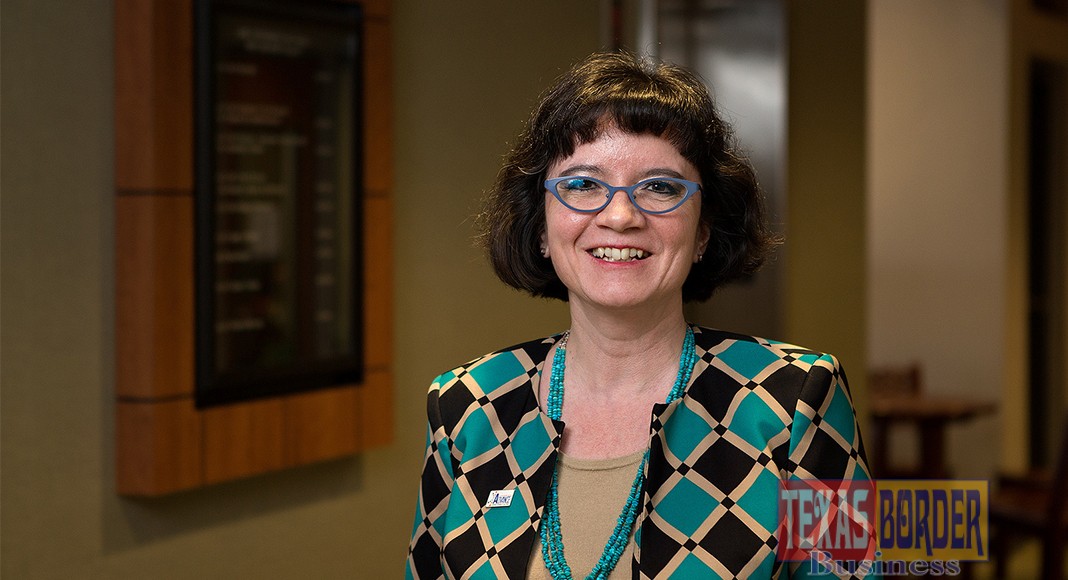
Marie Mora is professor of economics at the University of Texas Rio Grande Valley. Previously, she served as professor of economics at the University of Texas–Pan American and associate professor of economics at New Mexico State University.

Professor Mora serves as director of the National Science Foundation-funded American Economic Association Mentoring Program and has served on the board of the American Economic Association’s Committee on the Status of Minority Groups in the Economics Profession.

She also served two terms as a member of the U.S. Bureau of Labor Statistics Data Users Advisory Committee, two terms as president of the American Society of Hispanic Economists and was a member of the Dallas Fed’s Texas Border Colonias Study Steering Committee and the Early Education Subcommittee of the San Antonio Hispanic Chamber of Commerce Economic Development Committee.

Her recognitions include the Outstanding Support of Hispanic Issues in Higher Education Award from the American Association of Hispanics in Higher Education and the Cesar Estrada Chavez Award from the American Association for Access, Equity and Diversity.

Marie Mora was appointed to the Board of Directors of the Federal Reserve Bank of Dallas’ San Antonio Branch in 2018.

She has co-authored a number of books Population, Migration, and Socioeconomic Outcomes of Island and Mainland Puerto Ricans and Hispanic Entrepreneurs in the 2000s.

Economists:

In this episode, Marie mentions: Jeremy Bentham, Paul Douglas, Joan Robinson, Alberto Dávila and Darrick Hamilton.

Links:

  1. American Society of Hispanic Economists
  2. AEA Mentoring Program supported by the National Science Foundation.

Papers

Check out selected papers by Professor Mora at her faculty profile page.

Books

  • Population, Migration, and Socioeconomic Outcomes of Island and Mainland Puerto Ricans: La Crisis Boricua by Marie Mora, Alberto Dávila and Havidán Rodríguez.
  • Hispanic Entrepreneurs in the 2000s by Marie Mora and Alberto Dávila.
  • The Economic Status of the Hispanic Population co-edited/co-authored by Marie Mora and Alberto Dávila.
  • Labor Market Issues along the U.S.-Mexico Border co-edited/co-authored by Marie Mora and Alberto Dávila.
  • The Politics of Hispanic Education by Kenneth J. Meier and Joseph Stewart, Jr.
  • Latinos/as in the United States: Changing the Face of América Editors: Rodriguez, Havidan, Saenz, Rogelio, Menjivar, Cecilia (Eds.)


Patreon

If you’re a fan of the podcast and would like to show your support in anyway, please check out my Patreon page at www.patreon.com/economicrockstar where you can sign up for any of the awards for as little as $1 a month or you can simply follow me on the Economic Rockstar Facebook page or on Twitter or simply recommend the show to a friend, especially if they have never had the opportunity to study economics.

http://traffic.libsyn.com/economicrockstar/145_Marie_Mora_Final.mp3

Podcast: Play in new window | Download

  • facebook
  • linkedin
  • twitter
  • google+
  • pinterest

144: Donald Boudreaux on International Trade, Tariffs and Protectionism

June 15, 2018 by Frank

http://traffic.libsyn.com/economicrockstar/144_Donald_Boudreaux_Final.mp3
Play in New WindowDownload

144: Donald Boudreaux on International Trade, Tariffs and Protectionism

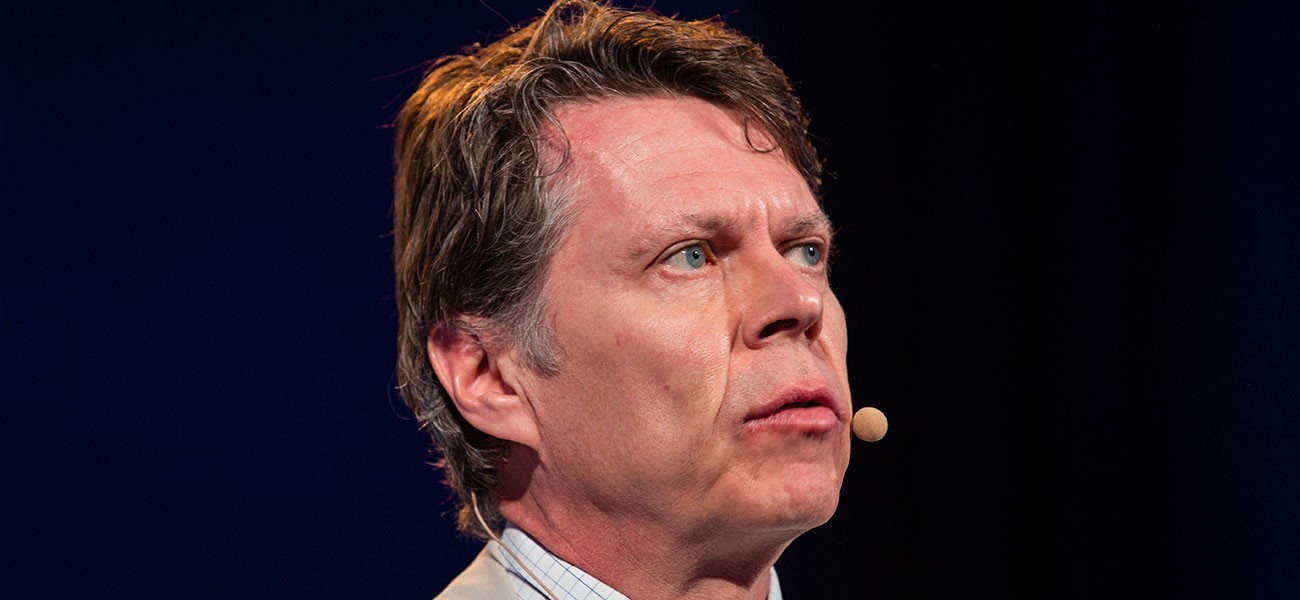
Donald Boudreaux is an American economist, author, professor, and co-director of the Program on the American Economy and Globalization at the Mercatus Center at George Mason University in Fairfax, Virginia.

He is the author of the 2007 and 2012 books Globalization and Hypocrites and Half-Wits, respectively.

He contributes a column twice a month to the Pittsburgh Tribune-Review and contributes to the Cafe Hayek blog.

Economists mentioned in the Episode:

David Ricardo, Adam Smith, John Maynard Keynes, James Buchanan, Russ Roberts, Hecksher-Ohlin, Daniel Ikenson.

In this Episode, you will learn:

  • Why we should look at Ricardo’s model of comparative advantage at an individual level rather than at a country level.
  • Why Krispy Kreme had to close some of its stores.
  • Is French Bourdeaux wine really all French or does the global supply chain have some hidden origins to this grape?
  • Does globalisation facilitate material prosperity?
  • Is there a race to the bottom?
  • Is globalisation facilitating our human needs for increased leisure time?
  • Is globalisation good for us?
  • Protectionism and what it means for US jobs.
  • Will car manufacturing jobs come back to Detroit?
  • Are restrictions to trade a contributor to poor economic growth?
  • Does trade promote diplomacy and reduce military intervention?
  • Did the 1930 Smoot-Hawley tariff on US imports worsen the Great Depression?
  • and much more.

People mentioned in this Episode:

  • Katharine Graham CEO of The Washington Post in the 1970s.
  • Warren Buffett
  • H. L. Mencken (journalist 19 – 20th century)

Where to find Donald J. Boudreaux:

  • Cafe Hayek
  • www.donaldjboudreaux.com

Readings:

  • Economic Possibilities for our Grandchildren by John Maynard Keynes (1930)   

Books:

  • Hypocrites and Half-Wits: A Daily Dose of Sanity from Cafe Hayek by Donald Boudreaux
  • Globalization by Donald Boudreaux
  • An Enquiry into the Nature and Causes of the Wealth of Nations by Adam Smith
  • Perennial Seller by Ryan Holiday

Patreon

If you’re a fan of the podcast and would like to show your support in anyway, please check out my Patreon page at www.patreon.com/economicrockstar where you can sign up for any of the awards for as little as $1 a month or you can simply follow me on the Economic Rockstar Facebook page or on Twitter or simply recommend the show to a friend, especially if they have never had the opportunity to study economics.

http://traffic.libsyn.com/economicrockstar/144_Donald_Boudreaux_Final.mp3

Podcast: Play in new window | Download
  • facebook
  • linkedin
  • twitter
  • google+
  • pinterest
  • Prev Page...
  • 1
  • 2
  • 3
  • 4
  • 5
  • …
  • 18
  • ...Next Page

Frank Conway

Frank Conway is founder of Economic Rockstar and lecturer of economics, finance and statistics. Read More…

View My Blog Posts

Youtube Sub

Become a Patron of the Economic Rockstar Podcast

patreon

Ireland’s Economy by the Numbers

Leaving Cert Economics: Ireland’s Economy  Click here to download a workbook on Ireland’s Economy so that you can add your own notes. [Original size] Ireland’s Economy by fconway

Categories

Subscribe and Never Miss An Episode

itunes-logo

Recent Posts

  • Ireland’s Economy by the Numbers April 8, 2019
  • 174: Wendy Carlin on The Core Project, Capitalism, Democracy and Normative Statements February 13, 2019
  • 173: Stephen Wright on Core Econ as a Learning Resource for Mainstream Economics January 28, 2019
  • 172: Best of 2018 Part 2: From the Great Depression to Futurism; Institutions, Individualism, Cooperation and Reciprocity January 22, 2019
  • 171: Best of 2018 Part 1 January 3, 2019

Copyright © 2026 · Podcast Pro Theme on Genesis Framework · WordPress · Log in

This website uses cookies to improve your experience. We'll assume you're ok with this, but you can opt-out if you wish. Accept Reject Read More
Privacy Policy

Privacy Overview

This website uses cookies to improve your experience while you navigate through the website. Out of these, the cookies that are categorized as necessary are stored on your browser as they are essential for the working of basic functionalities of the website. We also use third-party cookies that help us analyze and understand how you use this website. These cookies will be stored in your browser only with your consent. You also have the option to opt-out of these cookies. But opting out of some of these cookies may affect your browsing experience.
Necessary
Always Enabled
Necessary cookies are absolutely essential for the website to function properly. This category only includes cookies that ensures basic functionalities and security features of the website. These cookies do not store any personal information.
Non-necessary
Any cookies that may not be particularly necessary for the website to function and is used specifically to collect user personal data via analytics, ads, other embedded contents are termed as non-necessary cookies. It is mandatory to procure user consent prior to running these cookies on your website.
SAVE & ACCEPT