• ABOUT
  • RESOURCES
  • PODCAST
  • BOOKS
  • BLOG
  • SUPPORTERS
  • QFA Financial Advice
  • CONTACT

Economic Rockstar

Connecting Brilliant Minds in Economics and Finance

022: Josh Angrist on Taking the Con Out of Econometrics – Kung Fu Style

March 5, 2015 by Frank

http://traffic.libsyn.com/economicrockstar/022_Josh_Angrist.mp3
Play in New WindowDownload

022: Josh Angrist on Taking the Con Out of Econometrics – Kung Fu Style

Master Joshway, better known as Josh Angrist, is the Ford Professor of Economics at MIT and a ResearchAssociate in the NBER’s programs on Children, Education, and Labor Studies. Josh received his B.A. from Oberlin College, spent time as an undergraduate studying at the London School of Economics and as a Masters student at Hebrew University. He completed his Ph.D. in Economics at Princeton.

Angrist’s research interests include the effects of school inputs and school organization on student achievement; the impact of education and social programs on the labor market; the effects of immigration, labor market regulation and institutions; and econometric methods for program and policy evaluation.

Josh is a Fellow of the American Academy of Arts and Sciences, The Econometric Society, and has served on many editorial boards and as a Co-editor of the Journal of Labor Economics.

Josh is the author (with Steve Pischke) of Mostly Harmless Econometrics as well as Mastering ‘Metrics.

Find out in this episode how Josh went from High School drop-out to Professor of Economics at MIT.

Never forget that, at the most, the teacher can give you fifteen percent of the art. The rest you have to get for yourself through practice and hard work. I can show you the path but I can not walk it for you – Kung Fu Master Tan Soh Tin

Economic Themes:

In this interview, Josh mentions and discusses: econometrics, clinical trials, randomized trials, instrumental variables, regression, health insurance, longitudinal studies, selection bias, fairness, human capital, the quantity-quality trade-off, specification testing, robustness, time series, BLUE, Gauss-Markov, labor economics, regression, reverse causality, spurious correlation and data mining.

Economists:

In this interview, Josh mentions: Gary Becker, Shoshana Grossbard, Marina Adshade, Steve Pischke, Chris Blattman, Matt Holian, Christopher Sims, Russell Roberts, Greg Mankiw, Amy Finkelstein, Nancy Qian, Erlich, Ed Leamer, Steven D. Levitt, Stephen J. Dubner, Phil Oriopolis, Alan Kreuger, Orley Ashenfelter, David Card, Whitney Newey, Guido Imbens, Gary Chamberlain, Allan Meltzer, Scott Richard and Daniel Hamermesh.

On Mastering ‘Metrics: The intersection of the highway is a metaphor for causality. This is the theme of the book – ‘you’re facing a choice you’ll never know what the counterfactual was. You can imagine it’. The goal of econometrics is to reveal that in some way through statistical methods or experimentation. – Josh Angrist.

Josh and Steve’s book, Mastering ‘Metrics, is Kung Fu themed and they use that as a vehicle for humour.

MasterJoshwayMasterStevefu

Find out:

  • about Master Joshway and Master Steveway – the Kung Fu Economists.
  • how Josh went from working in a mental hospital to working in MIT.
  • why and how the Kung Fu theme was adopted by Josh and Steve.
  • where the names Master Joshway and Master SteveFu came from.
  • why Josh is a critic of macroeconomics.
  • the difference between traditional applied micro and applied micro today.
  • Josh’s views on using assumptions in microeconomics.
  • how to design an microeconomics experiment using randomized trials.
  • about health insurance in the US.
  • about Obama Care or the Affordable Care Act.
  • the Oregon Health Experiment where health insurance was offered as a lottery.
  • about Ireland’s upcoming health insurance policy change.
  • about the ‘Furious Five’ – not Kung Fu Panda – but the core research methods.
  • what’s a good economics experiment for family size.
  • where babies come from – Storks?
  • what are the chances of US married couples having a 3rd child if the first two are the same gender.
  • if people who come from large family sizes have worse outcomes?
  • about Gary Becker’s quantity-quality trade-off and how it relates to family size in China.
  • if capital punishment deters homicide.
  • why and how econometrics and specification tests are better today than they were in the past.
  • why Freakonomics is a must read for students or potential students of economics.
  • why being born later in the year is good for your educational attainment.
  • about Josh’s lucky breaks in life.
  • why Josh dropped out of school at 16 and about his army sergeant stripes.
  • about Josh’s hyper Jim Kramer-like teaching style.
  • about an amazing list of economists that have personally influenced Josh.
  • what helps Josh clear his head and keep in shape.

Macro v Micro

“Macro is a very theory-driven, model-driven field. They don’t run enough regressions or collect enough data and look for good experiments” – Josh Angrist.

“There’s nothing wrong with assumptions. That’s a misguided criticism. We have to simplify the world to learn anything about it. Otherwise you’re lost in the details.” – Josh Angrist.

“Every research project begins with the question. I have to convince my students of this and sometimes my colleagues – it isn’t let data come first, even though we’re very data-driven people. The first step is the question where it’s likely to lead me to a good research design.”

“In US census data, if you take married two-parent families who’d have at least two children, , the probability of having a 3rd child when they have a mixed sex is 0.37, and that goes to 0.43 or 0.44 when they either have two boys or two girls.”

“Ed Leamer in his paper, Let’s Take the Con Out of Econometrics, stated that nobody takes anybody else’s data analysis seriously. Nobody believes anything anybody else does.” Steve Pischke and Josh Angrist, in their paper, argue that that’s no longer true.

“The purpose of our book is to try to bring the way econometrics is taught in line with the way applied micro, at least, is done.” – Josh Angrist.

The traditional econometrics canon is built around a heavy mathematical framework that focuses on technical concerns, assumptions and many issues that are second-order statistics concerns, like heteroskedasticity or whether the model is really linear, that makes little sense and has nothing to do with modern empirical practice.

Recommended Books:

  • Mastering ‘Metrics: The Path from Cause to Effect by Josh Angrist and Steve Pishcke
  • Mostly Harmless Econometrics by Josh Angrist and Steve Pishcke
  • The Hitch-Hiker’s Guide to the Galaxy by Douglas Adams
  • Freakonomics:  A Rogue Economist Explores the Hidden Side of Everything by Steven D. Levitt and Stephen J. Dubner

Josh Angrist on Freakonomics: “ It’s so engaging and well written and covers such interesting questions that I think it wins us a lot of converts to studying economics. My daughter got interested in economics by reading Freakonomics and she majored in economics.”

Papers:

  • The Credibility Revolution in Empirical Economics: How Better Research Design is Taking the Con out of Econometrics by Josh Angrist and Steve Pischke.
  • Let’s Take the Con out of Econometrics (1983) by Ed Leamer 
  • Does Compulsory School Attendance Affect Schooling and Earnings? (1991) by Josh Angrist and Alan Kreuger. 

Datasets:

  • RAND Health Insurance Experiment
  • The Oregon Health Insurance Experiment

Blog Posts:

  • Kung Fu ‘Metrics by Chris Blattman
  • Econometrics and Kung Fu by Matt Holian

Podcast Episodes:

  • 093: Arthur Charpentier on Freakonometrics, Machine Learning and Big Data

Where To Find Josh Angrist:

  • Website: www.masteringmetrics.com
  • Facebook: Mastering ‘Metrics

Resources Used in the Episode:

www.incompetech.com Cartoon Battle Kevin McLeod Far East

http://traffic.libsyn.com/economicrockstar/022_Josh_Angrist.mp3

Podcast: Play in new window | Download

  • facebook
  • linkedin
  • twitter
  • google+
  • pinterest

021: Paul Dolan on the Economics of Happiness

February 26, 2015 by Frank

http://traffic.libsyn.com/economicrockstar/021_Paul_Dolan.mp3
Play in New WindowDownload

021: Paul Dolan on the Economics of Happiness

Paul Dolan is an internationally renowned expert on happiness, behaviour and public policy. He is currently a Professor of Behavioural Science in the Department of Social Policy at the London School of Economics and Political Science.

Paul has previously held academic posts at York, Newcastle, Sheffield and Imperial and he has been a visiting scholar at Princeton University, working with Daniel Kahneman.

Professor Dolan has over 100 peer-reviewed publications which cover many topics including behavioural science, subjective wellbeing, equity in health and health valuation.

Paul is currently a Member of the World Economic Forum Panel on Behavioural Science, the Chief Academic Advisor on Economic Appraisal for the UK Government’s Economic Service. He is also a member of National Academy of Sciences Panel on Wellbeing and of the Measuring National Wellbeing Advisory Forum for the Office for National Statistics in the UK.

Paul is the author of ‘Happiness by Design’.

Economic Themes:

In this interview, Paul mentions and discusses:  behavioral economics, happiness, nudging, trade-off, pleasure-purpose principle, production function, utility models, causal relationships, priming effects, System 1, System 2

Economists:

In this interview, Paul mentions: Daniel Kahneman, Amos Tversky, Irving Fischer and Gregory Mankiw.

“2,500 years of ethical discourse hasn’t resolved the question what is the source of happiness” – Paul Dolan

Find Out:

  • how Paul evolved from a health economist to a behavioral economist.
  • how many years of your life would you be willing to give up to avoid being anxious or being down.
  • if Aristotle and other philosophers are right in saying that happiness can only be defined on a death-bed when reflecting upon your life.
  • how to create a pleasure-purpose balance that’s right for you.
  • how you can use the production function process to produce happiness.
  • what is this production process that makes us happy.
  • if money makes you happier.
  • how happiness studies influence policy decision-making.
  • about the limitations to happiness research and what can be done to make better research.
  • what nudging is.
  • how nudging by policy-makers can make you happier.
  • about the morality of nudging.
  • how supermarkets can nudge you into buying their breads and cakes.
  • why self-help books are a waste of money as they try to change your mindset.
  • why Paul’s book, ‘Happiness By Design’ will help you to change what you do.
  • about Paul’s ‘3 Pillars of Happiness’ – Deciding, Designing and Doing.
  • how designing your life to make things simple and easy can help you achieve your goals.
  • about the essence of mindfulness.
  • why people who are easily distracted are more likely to be less happy.
  • if your phone can make you unhappy and what you should do about it.
  • why Paul is a ‘Happy Hammer’ (West Ham fan) despite never winning the league.
  • how the power of ‘hope’ can make you happy by allowing your imagination run freely.

Pleasure-Purpose Principle

Alongside pleasure sits purpose. Happy lives are ones that have a good balance between experiences that are pleasurable on the one hand and purposeful on the other. You need to find out the right balance between pleasure and purpose that is right for you.

The creation of happiness is like a product function of a firm. A firm uses inputs, puts them through a production process to create outputs.  A person can equally use inputs like money, marriage, sex, jobs and watching television that are stimuli and we can convert them into happiness by a production process.

What is that production process? According to Paul this production process is called ‘Attention’. Attention is the ‘glue’ that keeps our lives together in terms of behaviour and happiness. The answer to the question ‘Does money make you happier?’ depends on how much attention you pay it.

“Most of economic modelling is based on looking at what people do, not what people say”

Challenges with Happiness Economics: “A lot of what we think we know comes from making inferences from associations. We need to to do more research and field experiments where we look at the causal impact of interventions on people’s happiness.”

You can beg, borrow and steal money, but you’re never going to get time that’s lost – Paul Dolan

Click To Tweet

Lost happiness is lost forever – Prof Paul Dolan

Click To Tweet

Nudging

Nudging can sometimes be overt and sometimes covert. It can take the form of financial incentives or below-conscious stimuli such as sounds, tastes and smells. The latter is known as priming effects.

According to Paul Dolan, the definition of a successful nudge is one where people, who are being nudged toward a particular direction with the expectation that they would be better-off, become happier as a result of being nudged.

Policy-makers assume after a nudge that people are better off, but research hasn’t captured the after-effects of these nudges to find out if they are indeed better off. Paul is all for designing nudges that make people happier, not by how he judges how they should be happier but according to what large datasets tell him what affects people’s happiness.

Listen to Paul’s 3 Pillars of Happiness: Deciding, Designing and Doing 

The Essence of Mindfulness: “We’re generally happier when we’re paying attention to what we’re doing and who we’re doing it with – living in the moment” – Paul Dolan.

“When you’re switching activities, your brain is using energy and it makes you more tired and less happy” – Paul Dolan.

“Being a football fan is a bit like faith. You can’t really change it once you’ve got it” – Paul Dolan.

Recommended Book:

  • Happiness By Design by Professor Paul Dolan

Where To Find Paul Dolan:

  • Twitter: @profpauldolan
  • Website: www.pauldolan.co.uk
  • Website: London School of Economics
http://traffic.libsyn.com/economicrockstar/021_Paul_Dolan.mp3

Podcast: Play in new window | Download

  • facebook
  • linkedin
  • twitter
  • google+
  • pinterest

020: George Magnus on The Age of Ageing, China and the EU

February 19, 2015 by Frank

http://traffic.libsyn.com/economicrockstar/020_George_Magnus.mp3
Play in New WindowDownload

020: George Magnus on The Age of Ageing, China and the EU

George Magnus is an independent economist, consultant and commentator. He has a distinguished career that started with some teaching assignments but was spent mostly in the financial services industry.UBS INVESTMENT GROWTH

Before going solo in 2012, George was the Senior Economic Adviser at UBS Investment Bank having previously been the Chief Economist for 10 years. In almost 30 years of working experience in the City, he has held senior positions at SG Warburg, Chase Manhattan Bank and Bank of America. He is a well-known and highly regarded economist in the financial community and has won many accolades in professional surveys as one of the top global economists.

George is well known for his commentaries and interviews in newspapers, journals, TV and radio, most notably for the Financial Times, CNBC and Bloomberg.

George, gained widespread acclaim for declaring in early 2007 that we would face a Minsky Moment – or systemic banking crisis – and a decade of slow growth, has extensive experience of writing on, explaining and speaking about the global economy.

His first book, The Age of Ageing: How Demographics Are Changing The Global Economy And Our World was published in 2008. His latest book, Uprising: Will Emerging Markets Shape or Shake the Global Economy was published at the end of 2010, and assesses, in particular, whether China is set to dominate the world system.

Economic Themes:

In this interview, George mentions and discusses: bubbles, crashes, business cycles, demography, pensions, labor, emerging markets, life expectancy, debt-to-GDP, monetary union and fiscal union.

Economists:

In this interview, George mentions: Hyman Minsky, Thomas Malthus, J.K. Galbraith, James Galbraith (son), Thomas Picketty and Michael Pettis.

Influencer:

J.K. Galbraith

In this episode, you will learn: 

  • about bubbles and why we never learn from them.
  • how demographics are changing the world economy through declining fertility and rising life expectancy.
  • about the need for a policy agenda to cope with an ageing society.
  • why age-related commitments and promises such as pensions and health care schemes are unaffordable.
  • why there is a pension crisis to come and how it mimics a Ponzi-scheme.
  • about the fastest ageing country – China – and what problems will exist in the future.
  • if economies can experience positive growth rates if population declines by relying on robotics.
  • how the second machine age may bring problems to those whose jobs have been automated.
  • if there will be a strong Luddite presence in the future given the pace of technological change.
  • about the failure of the BRIC emerging countries to live up to their expectations.
  • if China is all hype.
  • what the real problem is in Europe in terms of its monetary union.
  • why the EU should have started with a fiscal and political union first and then build a monetary union on top.
  • about George Magnus’ band ‘Prisom’ and his love of Led Zeppelin and Pink Floyd.
On China: We have to decide whether reform is hope or hype. In many cases it’s hype. – George Magnus

Click To Tweet

Favorite Internet Resource:

  • Michael Pettis: China Financial Markets 
  • Margaret McMillan (Historian): Margaret McMillan 

Favorite Books:

  • The Second Machine Age by Erik Brynjolfsson and Andrew McAfee
  • A Short History of Financial Euphoria by J.K. Galbraith
  • The Culture of Contentment by J.K. Galbraith
  • The Age of Aging: How Demographics are Changing the Global Economy and Our World by George Magnus
  • Uprising: Will Emerging Markets Shape or Shake the World Economy by George Magnus
  • The Deluge: The Great War, America and the Remaking of the Global Order, 1916-1931 by Adam Tooz

Where To Find George Magnus:

  • Website: www.georgemagnus.com
  • Twitter: @georgemagnus1
http://traffic.libsyn.com/economicrockstar/020_George_Magnus.mp3

Podcast: Play in new window | Download

  • facebook
  • linkedin
  • twitter
  • google+
  • pinterest

019: Mark Thornton on the Decriminalization of Marijuana and the Skyscraper Curse

February 12, 2015 by Frank

http://traffic.libsyn.com/economicrockstar/019_Mark_Thorton_Pt_2.mp3
Play in New WindowDownload

019: Mark Thornton on the Decriminalization of Marijuana and the Skyscraper Curse

This is the part 2 of an interview with Mark. Part 1 can be found as episode 18 on iTunes, Stitcher Radio or at www.economicrockstar.com/markthornton

Mark has withdrawn himself from politics and concentrates now on education, primarily of the general public because the Austrian perspective says:

the world works according to the ideology of the masses so we have to change that mindset of the masses before we’re ever going to get political reform of the type Austrians would like to see – Dr. Mark Thornton

Mark Thornton

In this episode, you will learn:

  • a little about Dr. Mark Thornton’s ancestral history.
  • Mark’s views on why Ron Paul should be the next US President or even the Speaker of the House of Representatives.
  • the Skyscraper Index and how a correlation exists between a record-setting height and a global economic crisis.
  • how Mark predicted the economic crises from 2007/08.
  • how the ending of the alcohol prohibition in 1933 cut homicides by 50% and how the countries can learn from this with the drugs industry.
  • the social-economic benefits of the decriminalization of drugs in Portugal.
  • the benefits of marijuana and why it should be legalized.

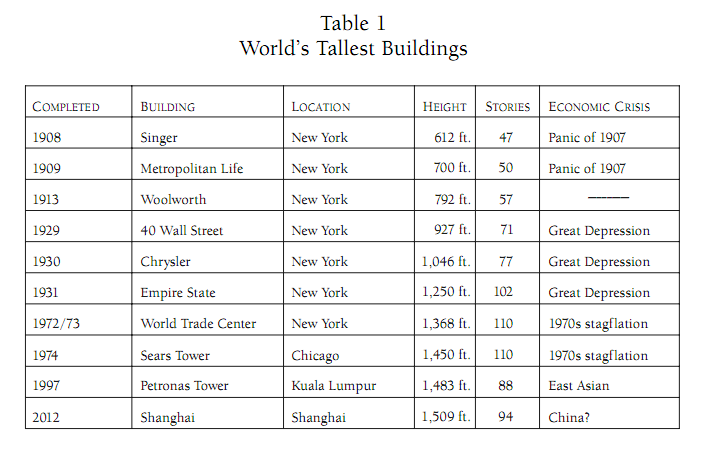
The Skyscraper Curse: How a Record-Breaking Skyscraper is Ominous for an Economic Crisis

There appears to be a correlation between record-setting skyscrapers and world economic crises (Table 1 below). There may not be any rational reasoning as to why this correlation may exist but it has implications of the Austrian Theory of the Business Cycle.

Source: Thornton, M. (2005). Skyscrapers and Business Cycles. The Quarterly Journal of Austrian Economics, 8 (1): 51-74

Source: Thornton, M. (2005). Skyscrapers and Business Cycles. The Quarterly Journal of Austrian Economics, 8 (1): 51-74

Mark, in his writings, outlines the theoretical reasons and history of why the Skyscraper Index and crises are related. He also explains why it takes artificially low interest rates by the central banks to cause prosperity, speculation and exuberance which leads to record-setting skyscrapers.

In 2006, the Burj Dubai Tower in the Middle East set the record for the highest building in the world. This skyscraper wasn’t open to the public until 2010, but the record was set in 2006.

The Skyscraper Curse is great tool to see what’s going on in the most significant bubbles and busts over the last 100 years. The diagram below shows the tallest buildings at Mark’s time of writing in 2004/05. He has highlighted the correlations between the record-setting heights and the economic crises that followed. In Table 1 above, Mark questioned whether the next tallest building was to occur in China. In hindsight, the Burj Dubai Tower set the record in 2006 signalling the Great Recession. China is currently building 40% of the world’s skyscrapers. It had planned to build the tallest building in the world, reaching 838 metres, 10 metres higher than the Burj Dubai Tower. This was planned to be completed in 90 days. However, building has been postponed until safety examinations have been passed and building permits gained. Is China postponing its inevitable economic crisis?

Source: Thornton, M. (2005). Skyscrapers and Business Cycles. The Quarterly Journal of Austrian Economics, 8 (1): 51-74

Source: Thornton, M. (2005). Skyscrapers and Business Cycles. The Quarterly Journal of Austrian Economics, 8 (1): 51-74

The Economics of Prohibition and The Case for Legalizing Drugs

In the 1920s, the US government introduced The Prohibition on the manufacture, trade and consumption of alcohol. Consequently, there was an upsurge in the illegal manufacture and distribution of alcohol, creating a black market economy and the formation of mafia gangs. Crime and homicide rates increased.

In his book, The Economics of Prohibition, Dr. Mark Thornton takes a look at the consequences of todays prohibition – that of drugs – and how this has impacted on the economy, the counterfeiting of money and the lives of people.

By 1933, murder rates in the United States doubled to 10 in 100,000 of the population. When Prohibition did come to an end then, the murder rate fell back to normal levels of 5 in 100,000. There were virtually no organised crime outside New Orleans and New York City prior to The Alcohol Prohibition but it was everywhere after prohibition was put in place. By repealing prohibition, organised crime was reduced. Crime, corruption and bribery was and still is greatly enhanced by prohibition.

Today we see the same thing in the United States, most prominently in Centra America and South America where the drugs are grown, manufactured and transported to the US and Europe. Drug traffickers use Mexico, the land bridge of South America, to bring drugs into California and Texas and the murder rate in these states have increased substantially.

Civil societies in countries such as Nicaragua, Guatemala and Honduras have broken down completely. The drug gangs and drug cartels dominate those areas and they either bride the politicians, police and military or they threaten them. It has come to the point that young children are emigrating from Central America to the United States through Mexico given how bad the situation is for them and their families.

Mark is in favor of decriminalising and legalizing drugs which would have the effect of reducing organised crime, corruption and bribery. Portugal, for example, have decriminalised all drugs and have experienced improvements in all social indicators. There is less drug abuse, less needle-bourn diseases, less addiction, less drug consumption and less crime.

American’s are waking up to the fact that it is insane to make marijuana illegal: Dr Thornton

Click To Tweet

Marijuana is now legalized for recreational use in four states in the US, including the District of Columbia where Washington is. It can be used for medicinal purposes, in industry and in textiles and has many commercial uses. People’s ideology about marijuana, the prohibition and the war on drugs has changed.

Close to 80% of Americans support legal medical marijuana in the US.

Books and Papers by Mark Thornton:

  • Housing: Too Good to be True (2004) by Dr. Mark Thornton [FREE Download]
  • Skyscrapers and Business Cycles (2005) by Dr. Mark Thornton [FREE Download]
  • The Economics of Prohibition by Dr. Mark Thornton

Where To Find Mark Thornton:

  • Website: Mises.org
  • Twitter: @DrMarkThornton
  • Facebook: Mises Institute
  • LinkenIn: Friends of Austrian Economics and Mises Institute
http://traffic.libsyn.com/economicrockstar/019_Mark_Thorton_Pt_2.mp3

Podcast: Play in new window | Download

  • facebook
  • linkedin
  • twitter
  • google+
  • pinterest

018: Mark Thornton on Austrian Economics and Why the Nazi’s and the KGB Wanted Mises Papers

February 5, 2015 by Frank

http://traffic.libsyn.com/economicrockstar/018_Mark_Thornton_Pt_1.mp3
Play in New WindowDownload

018: Mark Thornton on Austrian Economics and Why the Nazi’s and the KGB Wanted Mises Papers

Mark ThorntonDr. Mark Thornton is an economist who lives in Auburn, Alabama. Mark is Senior Fellow at the Ludwig von Mises Institute and serves as the Book Review Editor of the Quarterly Journal of Austrian Economics.

Mark’s publications include The Economics of Prohibition; Tariffs, Blockades, and  Inflation: The Economics of the Civil War (2004), The Quotable Mises (2005),The Bastiat Collection (2007), An Essay on Economic Theory (2010), and The Bastiat Reader (2014).

Dr. Thornton served as the editor of the Austrian Economics Newsletter and as a member of the Editorial Board of the Journal of Libertarian Studies. He has served as a member of the graduate faculties of Auburn University and Columbus State University. He has also taught economics at Auburn University at Montgomery and Trinity University in Texas.

Mark served as Assistant Superintendent of Banking and economic adviser to Governor Fob James of Alabama (1997-1999), and he was awarded the University Research Award at Columbus State University in 2002. Mark is a graduate of St. Bonaventure University and received his PhD in economics from Auburn University.

Economics Themes:

In this interview, Mark mentions and discusses: Competition, Entrepreneurship, comparative economic systems, economic history, business cycles, value theory, population policy, purchasing power, deflation, monetary policy and bitcoins.

Economists and Economic Schools:

In this interview, Mark mentions: Ludwig von Miss, Friedrich Hayek, David Hume, Israel Kirzner, Carl Menger, Richard Cantillon, Friedrich von Wieser, Eugen von Böhm-Bawerk, Joseph Schumpeter, Fritz Machlup, Adam Smith, Anne-Robert-Jacques Turgot, Irving Fischer, Milton Friedman, Ben Bernanke, Scott Sumner, George Soros, Nassim Nicholas Taleb, Jim Rogers, Paul Krugman, Austrian Economics, Merchantilists, Physiocrats, French Liberals and Classical Economists.

Influencers and Favorite Economists:

Scott Sumner, Richard Cantillon, Ludwig von Mises and Murray Rothbard.

Why Mark Read Economics:

As a teenager I could clearly see in the 1970s, the government was the problem and in college I discovered libertarianism. I was an economics major and I also discovered Austrian economics. I come from a family of entrepreneurs and there my perspective was developed. The small business person and the day-to-day interferences and interventions government introduced in the form of regulations, subsidies and taxes.

I came across economics outside of the classroom and outside of college – Dr. Mark Thornton

Mark’s Affirmation and Motto:

‘Do not give in to evil but proceed ever more boldly against it’ – Virgil

Click To Tweet

By going by this motto, it frees you up to take a stand you actually believe in rather than watering it down or covering it up – Dr. Mark Thornton.

In this episode, you will learn:

  • about the Greek and Roman philosophical roots of Austrian Economics.
  • about the importance of deduction and logic in Austrian thinking.
  • the limitations to Austrian Economic thinking.
  • about Irish economist Richard Cantillon, who remains quite elusive in economics.
  • who Richard Cantillon influenced through his writings.
  • why the Austrian School of Economics is given its name.
  • how von Mises’ papers got in the hands of Nazi Germany and then the Soviets.
  • whether von Mises or Irving Fischer was right about the 1929 Stock Market Crash and the subsequent Great Depression.
  • who would support Bitcoins – von Mises or Fischer?
  • why bitcoins were created.
  • how similar bitcoins are with gold and the Gold Standard.

Austrian Economic Perspectives and Its Limitations

The Austrian Theory is based on logic and deduction and it tries to remain realistic. In other words, you don’t make false assumptions about humanity or the economy or the world we live in. You try to stick with realistic aspects of human behavior and you theorize, by deducing logically, what economic theory should be in order to help explain things in the real world.

The limitation for Austrian Economics is that it will never be able to have a complete theoretical understanding of the economy and it will never be able to make predictions about the future especially with respect to the magnitude of changes and the timing of actual real-world results. The Austrian School has limited predictive power about certain economic policies, regulation, subsidies, price controls, etc.

You can find Austrian insights going back to the Greeks and the Romans. It’s not until you get to the Scholastics where you see thinkers that have the same basis, realism, logic and deduction. The world works because of the ideology of the masses.

Richard Cantillon

Irish economist Richard Cantillon (1680s – 1734) is the precursor to Austrian Economics and he is the first person to put together a comprehensive treatise on economics along the lines of the Austrian School which would come after him. Cantillon was an influencer on people like Hayek, Karl Menger, the French Liberals and many of the Classical Economists and Physiocrats.

The Austrian School really starts with the publication of Cantillon’s essay ‘Essai sur la Nature du Commerce in Général’ (Essay on the Nature of Trade in General). Unfortunately, Cantillon fell out of favour with many investors that were caught up in the ‘Mississippi Bubble’ of which played a part and was subsequently ‘murdered’ when his house burnt down (there is speculation that he staged his own death to avoid the wrath of his debtors. His work was not published until 25 years after his murder. It influenced Adam Smith and Anne-Robert-Jacques Turgot. However, Cantillon’s work fell into obscurity at the time of the neo-classical school from the second half of the 19th Century to 1930 and has since been on a path of re-discovering and re-interpreting Cantillon – what he wrote, what it meant.

The Birth of Austrian Economics

Carl Menger wrote his book ‘Principles of Economics’ explaining his theoretical understanding of economics. His students von Wieser and von Böhm-Bawerk eventually became mentors to von Mises, Schumpeter and Hayek. They were known as Austrian economists simply because of their country of origin as they did not fit into any particular school of economics at that time. Hayek worked for von Mises at the Institute of Business Cycle Research. Hayek went on to work in the London School where he influenced many British economists to adopt the Austrian methods and theories.

Mises, the Nazi’s and the KGB

During World War II, Mises left Vienna due to the Nazi threat as he was both the arch-nemisis of all Socialists as well as being Jewish. On invading Vienna, the Nazi’s took von Mises works and were studied by the Nazi Intelligence Service. And when the Soviets invaded Germany, both Communists and National Socialists saw that von Mises was the main opponent of Socialism and saw that it was unviable. It was only because of the downfall of the Soviet Union was Mises’ papers rediscovered in Moscow in a KGB warehouse.

von Mises published a paper in 1920 and showed that  Socialism in its pure form was impossible and in any form was irrational. Socialism would not be efficient or productive when you have one person or one group of people making economic decisions on labor, resources and production. This would be an impossibility as they would have to come up with decisions as to what to produce, how to produce it, who to produce it for and how much to produce. They would then have to make those decisions on every good in the economy. It just can’t be done at this level, and the Soviet Union eventually realised this and they had to introduce money , wage rates and interest rates. They had to break up production by industry and introduce prices based on the West, and undergo the allocation of resources. In the end, no matter how many modifications they made, they still couldn’t produce enough food, clothing and shelter to keep their population growing.

Mises, Irving Fischer and the Fed

I ask Mark about Mises views of the economy in 1928 compared to that of Fischer’s. Fischer had been writing extensively in the public domain up to that point in time and Mises worried about the economy and the economic approach taken by government, which was largely influenced by Fischer. Fischer wrote that the US economy and investment in the stock market was safe. The 1929 Stock Market Crash and the subsequent Great Depression proved Mises correct and resulted in Fischer losing his wealth but not the use of his monetary economic perspective.

Irving Fischer was trained in Germany in modern economics with the use of statistics. The system he devised was based on a stable dollar, where the purchasing power of the dollar would remain the same. He developed price indexes to measure the purchasing power of the dollar and then suggested that monetary policy be implemented to maintain a stable dollar value. This type of mechanical economics and government bureaucracy to achieve this mechanistic view of the macro-economy resulted in Fischer being very influential in the US. He had a great influence on people like Milton Friedman and Ben Bernanke, and the modern economic policies of the US today are guided by his approach to a stable dollar and to the manipulation of monetary policy to keep a stable dollar. When the purchasing power of the dollar starts to increase the dollar – or deflation – then the monetary authorities have to throw in more dollars or credit in the system to try and dilute the value of that dollar.

Mises’ perspective and approach was different to Fischer’s and in 1928 he wrote a book outlining why Fischer’s approach was wrong and that it would cause considerable problems of size and magnitude. Mises approach was a more natural approach of the market economy that money was a weight of gold, silver or copper and the coins would remain the same weight, i.e. a silver dollar would be 25 grams of pure silver and these coins would be allowed to fluctuate in both the short-run and the long-run. This provides a shock absorber for the entire economy because the value of money is fluctuating, the value of domestic and foreign goods are fluctuating (in terms of domestic goods) and the system is not fragile. Everything can move in the economy.

However, Fischer’s approach, by guaranteeing a stable dollar and not allowing it to adjust vis-a-vis everything else in the economy creates ultimately a fragile system. Mises’ view was that you hold the metal content of the dollar constant and you allow them to fluctuate in market value, whereas Fischer believed you would essentially change the weight of the coins. He actually advocated this system but realised it to be unworkable and so retreated to making monetary policy maintain the market value of the US dollar or any currency.

Under Fischer’s approach, a bureaucracy has been created to be in charge of maintaining money and credit in the economy and giving the government the ability to increase the money supply to reduce interest rates. This has created a panacea for politicians to get out the ‘magic check book’ and make the economy ‘feel better’ in the short term.

The Central Bank is essentially a ‘legal’ counterfeiter, which is very valuable for both the political class as well as the big banks that it benefits – Dr. Mark Thornton

Bitcoins

The creator(s) of bitcoins did so in response to the financial crisis of 2008 – 2009 and they saw that central banks were responsible for that, as well as the banks who got a bailout. The average ordinary citizen ended up absorbing most of the losses.

Bitcoin is not controlled by politicians or anyone else. It’s part of an electronic marketplace and it mimics the Gold Standard in several ways:

Miners, or people who want to produce Bitcoins, have to expend real resources – their time, their money, their computing power, the purchase of special devices and a tremendous amount of electricity – just like the way gold miners expend resources on mining for gold.

The mining process becomes progressively more difficult overtime and there will be an end with production for bitcoin per se, whereas with gold, the process will go on indefinitely.

The way Bitcoin tries to alleviate the eventual deflationary pressure on bitcoins is that one Bitcoin can be broken up into a million different pieces in the same way a US dollar can be broken up into 100 pieces or cents.

Eventually people will stop allocating resources to the production of new Bitcoin. This can be a good thing because, at some point, resources will be wasted on producing valueless bitcoins from the social perspective.

Whoever invented Bitcoin did so on the Austrian perspective of the economy and on the perspective that the Gold Standard is a much better system and is decentralized in the market economy.

“Fischer was a ‘control-freak’ in many ways. He wanted to control everything, even the genetics of the American population. He would strongly disapprove of Bitcoin” – Dr. Mark Thornton

Recommended Books:

  • The Theory of Money and Credit by Ludwig von Mises
  • Principles of Economics by Carl Menger
http://traffic.libsyn.com/economicrockstar/018_Mark_Thornton_Pt_1.mp3

Podcast: Play in new window | Download
  • facebook
  • linkedin
  • twitter
  • google+
  • pinterest

017: Marina Adshade on Understanding Economics the Sexy and ‘Hard’ Way

January 29, 2015 by Frank

http://traffic.libsyn.com/economicrockstar/017_Marina_Adshade_Final.mp3
Play in New WindowDownload

017: Marina Adshade on Understanding Economics the Sexy and ‘Hard’ Way

Marina AdshadeDr. Marina Adshade, author of Dollars and Sex, engages in original economic research in the area of women in the economy. She has a Ph.D. from Queen’s University in Ontario Canada and currently teaches economics at the Vancouver School of Economics at the University of British Columbia.

In 2008, Marina developed a unique specialization in the economics of sex and love  and launched an undergraduate course titled ‘Economics of Sex and Love’, which invited her students to approach questions of sex and love through an economist’s lens. The class was an immediate hit with students and, by the time the first term started, had generated international media attention.

This culminated in the publication of her first book in 2013, ‘Dollars and Sex: How Economics Influences Sex and Love’. Marina converts economic theory into a sexy science by applying the principles of supply and demand and other market forces to matters of love, courtship, sex, intimacy, and marriage. 

Marina is a regular contributor to Canada’s national newspaper The Globe and Mail and the Canadian Business Magazine. She has written for several other publications including The Wall Street Journal, the Sunday Times and the Daily Mail in the UK, and Psychology Today. She is a sought after public speaker as well as a radio and television commentator on issues relevant to all women.

Economics Themes:

In this interview, Marina mentions and discusses: The New Household Economics, supply and demand, GDP, standard of living, bargaining power, the uncanny valley, unemployment, game theory, barter and the Big Mac Index.

Economists and Economic Schools:

In this interview, Marina mentions: Gary Becker, Shoshana Grossbard, Betsey Stevenson, Justin Wolfers, Thomas Malthus, Nathan Nunn and Jeremy Greenwood.

Influencers:

Jeremy Greenwood – Engines of Liberation, Gary Becker, Betsey Stevenson and all economists who have been brave enough to take on these topics.

When Gary Becker started on the New Household economics, he was criticised.

It takes a lot of courage to talk about new ideas and to bring new ideas into the economics fold – Marina Adshade.

One has to work very hard to maintain your creativity, to work hard to maintain a willingness to assume risks in the work that you do -Marina Adshade

Advice:

Make sure you know your value on the market – Marina Adshade

Click To Tweet

Mantra:

The idea that you can take a risk and be successful and the willingness to think creatively. Apply creative thought to the work that you do can be incredibly valuable – Marina Adshade

Personal Habits:

I spend as little time as possible within my office sitting behind my desk. I like to be out in the world. If I have something that I have to write or a talk that I have to give, a lot of the thoughts that inspire that I get from being outside walking around.

In this episode, you will learn:

  • why we should use sex and love in economics.
  • why Dr. Adshade decided to use the topic of sex in teaching economics.
  • why international media attention from Korea and Russia brought a spotlight to Marina’s Module.
  • why Malthus called economics a dismal science.
  • how sci-fi novels are better at predicting new technologies more so than social change.
  • about the future of sex with androids.
  • how the male contraceptive can increase the bargaining of power of men over women.
  • how economic growth results in liberal attitudes.
  • if there is a causal relationship between economic growth and gay marriage.
  • who makes a better saver: men or women?
  • how Orgasms can be used to explain Game Theory.

  • how the market for sex and love is like a barter economy.

  • the similarities between Economics and Biology.

  • if you met somebody that had a variety of qualities that you valued but didn’t love, would you still marry that person?

  • about the Big Mac Index and the Blow Job Index.

Dollars and Sex ‘A collection of theories and evidence that would give anyone, frankly, a hard-on for economics.’

Click To Tweet

Why Using Sex to Teach Economics Improves Student Engagement and Understanding

So much of what we do is about the fundamental unit of the household and so much of that comes form decisions that we make about sex and relationships. The reason why Marina decided on this approach to teaching economics was to simply engage with students. The material could be delivered in such a way that students could apply it to their own lives and internalise the theories that educators want them to understand.

How Sex Can Impact Our Social and Economic Environment and Vice Versa

Thomas Malthus called economics the ‘Dismal Science’ because he felt that economic theory predicts that whenever you have increases in technology, people would just increase the number of children they have in such a way that there would never be any gains in the standard of living. So, we were destined to be over-populated, over-crowded and poor.

The story of Malthus is based on our sexuality. Women couldn’t keep their knickers on as soon as national GDP went up a little bit.

I’m an Economic Historian. I spend most of my mornings thinking about the plough, the hoe and female sexual desire. We have 200 years of fertility changes. We have a hundred years of changes in sexual values. I think so much of this is rooted in our economics system. – Dr. Marina Adshade.

A small technological advance like contraceptives can have big social changes and can lead to the situation where we (US and Canada) are now. In Canada 35% of wives out-earn their husbands and that’s a remarkable change from where we were 30 or 40 years ago.

New technologies (on-line dating is now celebrating its 20-year anniversary) are arriving all the time and they are changing the way that we structure our relationships, the way that we bargain with our spouses and the way that we negotiate our lives within our relationships.

The future of sex with robots could be a reality by 2020. This will most definitely present some genuine challenges for us as a society when that becomes possible. The hypothesis of the ‘Uncanny Valley’ could present some problems for human-robot interaction, due to the possible revulsion or level of discomfort that a human has toward a robot. This problem could only be resolved if the robot improves its natural likeness and appearance as a human. Sex with robots has the potential to structure our relationships. It will have serious implications with our ethical challenges.

There are more imminent changes to our social economy. The introduction of male contraceptives into the market are only a matter of years away now, with human clinical trials taking place. This could potentially reduce the bargaining power of women regarding fertility to increasing the bargaining power of men. Handing the control of fertility to men has the potential to shift those dynamics.

Prostitution and other explicit markets have been transformed by technologies, where sex workers can advertise their services online. This movement expanded beyond the original market and has almost become normalised to the extent that other services are being provided online such as the Sugar Daddy – Sugar Baby concept.

The website SeekingArrangement.com reports year-on-year increases of female university student sign-ups to the site seeking a sugar daddy. Such increases are possibly the result of the mounting student debt faced by graduates and an arrangement with a sugar daddy could be a way of reducing this debt burden. Low wages and unemployment are also other factors that increases the willingness of students to enter such an arrangement. However, supply alone does not create a market, and the demand-side may not be as high. Therefore, the claim that the average amount in cash and gifts that a female sugar baby receives from her sugar daddy may not be as high as the $6,200 level.

The market for sex and love is like a barter economy. There is no currency that prices the supply or demand for sex. Perhaps there is an intangible currency in terms of the millions of stimuli that each person emits. The qualities that are revealed in this economy get picked on by other people.

Economic Growth Can Cause Social Attitudes Toward Sex to Change

Economic growth can change peoples attitudes, transitioning a country’s social norms from a conservative to a more liberal and open outlook. Many developed countries are debating about the right to gay marriage. Currently, Ireland will hold a referendum in May 2015 about right to gay marriage.

Marriage is an economic institution and we’d like to think that they create incentives for behaviour and they structure the way that our markets operate. But the institutions themselves is endogenous. Society chooses institutions that is optimal for them at any point in time.

The traditional marriage between a man and woman has historically been the optimal way of structuring a marriage, especially since men had the comparative advantage in work outside of the home. Men have the comparative advantage in wage labor and women has the comparative advantage in household production, particularly since the Industrial Revolution which caused a strict division between working and home. So, it made sense to structure marriage that way because of the gains from trade – men and women were so different.

This is no longer the case as the change in the nature of the market has eroded the man’s comparative advantage, particularly since it has become more skill-based and less physical. When men and women become similar with each other, then the nature of marriage changes. We no longer experience the gains from trade with marriage.

If marriage is no longer based on the gains from trade, then why limit marriage to men and women. Why not women with women and men with men. Marriage is more so based on love and companionship today and does not have the elements of the need for productivity.

Justin Wolfers and Bestey Stevenson talked about consumption compatibilities was the driving force of marriage in the modern period. It no longer makes sense to talk about the structure of marriage around the idea of production.

Economics and Biology: The Link

When we think of love as a biological response it is much easier to think of it in economic terms – the idea that we choose who we love. The heightened excitement that you get when you meet somebody that you’re attracted to is so similar to reactions to other experiences that people sometimes confuse them.

The height and adrenaline experienced by a person on a roller-coaster, can be the same heightened excitement that a person feels when attracted to someone. Perhaps the best first date could be the amusement park.

Blow Job Index

Instead of the Big Mac Index, The Economist could look at the Blow Job Index. They could look at variations in the prices of blow jobs around the world. There is an enormous amount of variation in the price of this service, which is largely a uniform service.

It is tied to opportunities for women and also for development. A blow job in Vancouver is possibly more expensive than a blow job in Bangkok. The problem is that it is incredibly difficult to get this data. There are web services that post prices but we’re not there yet.

A Big Mac is a standard product, irrespective of the country in which you buy it. In other words, a Big Mac in Canada is the same as a Big Mac in Ireland and beyond. However, prices will differ. A blow job, however, may not be the same in different countries due to the length of a penis. Should a blow job be more expensive in a country where the penis size is larger? If a Big Mac was twice as big in one country compared to another, then should you be expected to pay more?

Should the price of a blow job be correlated with the price of a penis? The Penis Size Worldwide Map, available on TargetMap.com

Recommended Books:

  • Dollars and Sex by Marina Adshade
  • Dear Committee Members by Julie Schumacher

Favourite Internet Resource:

PEW Research Centre: Pew Research Center is a nonpartisan fact tank that informs the public about the issues, attitudes and trends shaping America and the world. It conducts public opinion polling, demographic research, media content analysis and other empirical social science research.

Where To Find Marina Adshade:

  • Twitter: @dollarsandsex
  • Website: marinaadshade.com
http://traffic.libsyn.com/economicrockstar/017_Marina_Adshade_Final.mp3

Podcast: Play in new window | Download

  • facebook
  • linkedin
  • twitter
  • google+
  • pinterest

016: Jack Schwager on How You Can Become a Market Wizard with Fundseeder.com

January 22, 2015 by Frank

http://traffic.libsyn.com/economicrockstar/016_Jack_Schwager.mp3
Play in New WindowDownload

016: Jack Schwager on How You Can Become a Market Wizard with Fundseeder.com

Untitled design (10)

Jack Schwager is a recognized industry expert in futures and hedge funds and the author of a number of widely acclaimed financial books. Mr. Schwager is one of the founders of Fund Seeder (FundSeeder.com), a platform designed to find undiscovered trading talent worldwide and connect unknown successful traders with sources of investment capital.

Previously, Mr. Schwager was a partner in the Fortune Group (2001-2010), a London-based hedge fund advisory firm. His prior experience also includes 22 years as Director of Futures research for some of Wall Street’s leading firms, most recently Prudential Securities.

Mr. Schwager has written extensively on the futures industry and great traders in all financial markets. He is perhaps best known for his best-selling series of interviews with the greatest hedge fund managers of the last three decades: Market Wizards (1989), The New Market Wizards (1992), Stock Market Wizards (2001), Hedge Fund Market Wizards (2012), and The Little Book of Market Wizards (2014).

His other books include Market Sense and Nonsense (2012), a compendium of investment misconceptions, and the three-volume series, Schwager on Futures, consisting of Fundamental Analysis (1995), Technical Analysis (1996), and Managed Trading (1996). He is also the author of Getting Started in Technical Analysis (1999), part of John Wiley’s popular Getting Started series.

Mr. Schwager is a frequent seminar speaker and has lectured on a range of analytical topics including the characteristics of great traders, investment fallacies, hedge fund portfolios, managed accounts, technical analysis, and trading system evaluation. He holds a BA in Economics from Brooklyn College (1970) and an MA in Economics from Brown University (1971).

Economic and Finance Themes:

In this interview, Jack mentions and discusses: chartists, technical analysis, fundamentals, futures, normal distribution curve, options, Black-Scholes Options Pricing Model, option warrant trading, efficient market hypothesis, probability, negative externalities, fiscal responsibility, Keynesianism, deficits and demand.

I chose economics because I wasn’t any good to major in physics or math. I just felt I would be mediocre if I went into those fields. On the positive side, I had a super professor for Econ1. He was just so clear and logical – Jack Schwager.

Economists and Traders:

In this interview, Jack mentions: David Shaw, Ed Thorp, John Bender, Michael Marcus, Fischer Black, Robert Merton, Myron Scholes, John Maynard Keynes, Michael Lewis, Nassim Nicholas Taleb, and Yoram Bauman.

In this episode, you will learn:

  • why Jack chose economics at University.
  • about the similarities between Physics and Economics and why they are so different as a science.
  • if there is a certain personality that is required in trading financial markets.
  • if there is a holy grail to trading the markets.
  • about the importance of discipline.
  • how an $18 ‘Job Wanted’ ad in the New York Times landed Jack a position as a key analyst.
  • the one trader that particularly impressed Jack.
  • about the different strategies of some of Jack’s Market Wizards.
  • why normal distribution tail events can have a higher probability of occurrence than is lead to believe.
  • about the tragic ending of Market Wizard John Bender and the current case against his wife by the Costa Rican authorities for his ‘murder’.
  • about Fund Seeder – the world’s first search engine for undiscovered trading talent.
  • about Jack’s forthcoming book with the working title ‘Undiscovered Market Wizards’ and how you could possibly feature it.
  • about the Market Wizards Roadshow coming soon in 2015.
  • why Jack wrote his book ‘Market Sense and Nonsense’.
  • about the debunking of the efficient market hypothesis.
  • what a negative externality is in the context of economic theory.

Physics, Economics and the Stock Market: A Connection

Economics is more complex from a quantitative standpoint because in physics at least the rules are well-defined and don’t change and in economics they’re not stable.

Many schools in economics get it wrong because they fail to appreciate the influence of human behavior which is not stable.

Because of the human element it becomes much more difficult to forecast in economics than it is using physical laws.

A lot of traders interviewed for the Market Wizards book come from the higher level mathematics and physics spectrum. That’s one type of person who is attracted to the markets. It’s solving analytical problems that intrigues them.

Other traders are very intuitive and have a completely different approach to trading markets.

Trading with  Discipline in the Markets

There are no secrets to trading the markets. There are an untold number of ways in which the markets can be successfully approached.

They are all very difficult and most people will fail. There is no common approach and it’s more of a matter of finding an approach that works for you.

On Trading: Regardless of how you do it, you better have discipline – Jack Schwager

Click To Tweet

It doesn’t matter if you’re quant or not quant, chart or fundamental,  long-term or short-term. Whatever approach you do use, you better be disciplined or it’s not going to work.

Once I got involved in futures, I quickly discovered that at that time, at least on the analytical side, there wasn’t much talent out there. I think I succeeded because competition was very easy at that time – Jack Schwager.

Life for almost all of us is tremendously influenced by chance more so than people would admit or realise – Jack Schwager.

Probability and Options

On Ed Thorp: He is the walking refutation of the Efficient Market Hypothesis – Jack Schwager

Click To Tweet

The options markets are pricing for the assumption of equal probabilities at all times on both sides.

Options are priced for neutrality all of the time and that’s not reality. There are certain circumstances in the markets where something happening is much more likely to occur on one side of the distribution curve than the other.

The markets may assume a log normal distribution. But when there is a critical stop level at some price then, when the market goes to that price, the probability that the market will go below that price, what is considered within the tail events, will be much greater. Just getting to that critical price can trigger an avalanche of orders.

Fundseeder: The World’s First Search Engine for Undiscovered Trading Talent

The concept of Fund Seeder is to create a central place on the web where all traders, particularly undiscovered traders can establish their track records, have them verified and then have investors who are looking to allocate new trading talent find them.

The trader links their brokerage accounts with their own account on Fund Seeder so the numbers come directly from the traders’ brokerage account. That critical verification step occurs on this central platform allowing the traders and potential investors to verify the numbers.

There are traders from over 60 countries on Fundseeder who now have the opportunity to get in front of potential investors and establish a track record.

There is also the ‘seeding’ side where investor groups will participate to find traders and offer seed funding. It acts like venture capital where traders will receive seed funding to allow them trade larger accounts, which otherwise would not have been available to them outside Fund Seeder.

Many brokerage firms can be connected to Fund Seeder, including Interactive Brokers, and many more will connect in the near future.

Fund Seeder is a place where traders go to be discovered and where investors go to look for traders. You trade, we connect, they invest – Jack Schwager

Problems Jack Sees with Economics and Finance

  • The Efficient Market Hypothesis.
  • The Sharpe Ratio.
  • Looking at past returns to pick investments.
  • Volatility as a satisfactory and complete measure of risk.
  • Risk management.
On writing Market Sense and Nonsense: ‘I really wanted to throw stones’ – Jack Schwager

Click To Tweet

Jack Schwager on Economists, Externalities and Fiscal Responsibility

I believe that 90% of economists will agree 90% of the time. Economists do agree on a lot of things. You can go from a liberal to a conservative spectrum in economics and still have wide agreement on a lot of things Jack Schwager.

The solution to global warming is a revenue-neutral carbon tax. You have a cost attached to the polluter side and you have a benefit attached to growth and expansion.

Keynes would never have argued for deficit spending in an expanding economy

Recommended Books:

  • Beat the Dealer by Ed Thorp
  • Market Wizards by Jack Schwager
  • Market Sense and Nonsense: How the Markets Really Work (and How They Don’t) by Jack Schwager
  • The Big Short by Michael Lewis
  • Liars Poker by Michael Lewis
  • Reminiscences if a Stock Operator by Edwin Lefèvre
  • Fooled by Randomness by Nassim Nicholas Taleb
  • The Black Swan by Nassim Nicholas Taleb
  • When Genius Failed: The Rise and Fall of Long Term Capital Management by Roger Lowenstein
  • Fortune’s Formula: The Untold Story of the Scientific Betting System that Beat the Casinos and Wall Street by William Poundstone
  • More Money Than God: Hedge Funds and the Making of a New Elite by Sebastian Mallaby
  • Endurance: Shackleton’s Incredible Voyage by Alfred Lansing

Where To Find Jack Schwager:

  • Fundseeder.com
  • Website: www.jackschwager.com
  • Twitter: @jackschwager
  • facebook
  • linkedin
  • twitter
  • google+
  • pinterest

015: Niels Kaastrup-Larsen on Trend Following Strategies and Stock Market Turmoil Ahead

January 14, 2015 by Frank

http://traffic.libsyn.com/economicrockstar/015_Niels_Kaastrup-Larsson_.mp3
Play in New WindowDownload

015: Niels Kaastrup-Larsen on Trend Following Strategies and Stock Market Turmoil Ahead

TopTraderPodcast NielsNiels Kaastrup-Larsen is Managing Director of Dunn Capital (Europe). Niels is a trend follower with more than 20 years experience in the hedge fund industry, working for some of the largest CTAs or Commodity Trading Advisors in the world, including Chesapeake Capital. Niels co-founded, built and managed three businesses within the alternative investment space, including Rho Asset Management.

Niels trades futures markets in a systematic and highly-automated way. He is the founder and host of the popular podcast ‘Top Traders Unplugged’, where he uses his experience and contacts in the industry to deliver insightful, engaging and passionate interviews with the most successful hedge fund managers and traders.

Economic and Finance Themes:

In this interview, Niels mentions and discusses: Trend following, futures markets, gold, anomalies, confirmation bias, efficient market hypothesis, fixed-income securities, treasuries, bonds, the Great Depression, stock market portfolio, diversification, equities, systematic trading, stop-losses, technical analysis.

Niels’ Influencers:

Jerry Parker of Chesapeake Capital, Michael Lewis and Jack Schwager

‘There’s no doubt that Jack Schwager’s book ‘Market Wizards’ was an inspiration’ – Niels Kaastrup-Larsson

Click To Tweet

Niels’ Affirmations:

  • ‘The trend is your friend’.
  • ‘KISS – Keep it Simple’.
  • ‘Cut your losses, let your profits run’.
  • ‘Diversification is so important because markets are very different animals and you’re going to have periods of time where types of markets are trending and easy to trade.’
  • Strict Risk Control.
  • Discipline: 
    ‘Without discipline you’re not going to get very far’ Niels Kaastrup-Larsson

    Click To Tweet

Niels’ Personal Habits:

Niels loves playing football on a Friday evening with a group of friends who all come from diverse backgrounds. It allows him to clear his mind and to think about things other than trading.

In todays world we really need to focus on WHY we do what we do and not just what we do and how we do it – Niels citing Simon Sinek (see recommended books below).

Find out:

  • about trend following and how to spot a trend.
  • what is a trend following strategy.
  • two ways in which we can take on market risk – one good and the other not so good.
  • how emotions can lead to losses.
  • why trend followers use computers with built-in trend following rules to make trades.
  • why we are more likely to buy a bar of soap that is reduced by 50% in a retail store than buy a stock that has fallen 50%.
  • how you should diversify a portfolio.
  • how global markets are beginning to diverge which is key for a trend following strategy.
  • why Niels believes that global markets will be in turmoil within the next 5 years.
  • why Niels believes the economic cycle will turn by October 2015.
  • why events will unfold just like 1929.
  • if the Swiss and Germans should take back their gold reserves from the United States.
  • about whether there are job opportunities in the trading industry today.

  • why the industry has become more scientific.

  • how to navigate through the noise when markets undergo a process of price discovery.

  • why Niels created the Top Traders Unplugged podcast rather than write a book.
  • Niels recommendation for a great market data resource.

Niels didn’t know what he wanted to do after High-School, but one thing he did know was that he didn’t want to go to university and try to learn from books. He was much more interested in doing things and being practical is his approach to learning.

A job in a bank seemed a good compromise – Niels would learn by doing and get paid for it!

Niels’ Defining Moment:

Niels took a job in a large bank in Denmark straight out of High-School and, during his induction week, he passed by a room full of young people waving their arms and shouting. He found out that they were trading currencies, stocks and bonds. Immediately, Niels knew that after his 2 years of training, that’s what he was going to do. At the age of 19 or 20, Niels began trading Danish government bonds.

Niels began reading international magazines about traders and came across tables of rankings based upon trader performance. These traders were systematic trend followers or Commodity Trading Advisors.

Trend-Following:

It was intriguing to me to see that these people [trend-followers] could continue to produce extraordinary returns.

Niels searched for and read books on interviews with traders in general and some were rule-based or systematic traders.

Niels got a chance to work with Jerry Parker of Chesapeake Capital who was once part of the well-publicized Turtle Trader experiment, which was run by Richard Dennis and Bill Eckhardt.

“It is the most consistent way of investing your money when you look at it in the very long-run”  – Niels Kaastrop-Larsen.

I see people like Jerry Parker and Bill Dunn with thirty or forty years track record still making all-time highs and they’re still going strong, There are not that many discretionary traders doing that. I think that there is something to this methodology.

Trend following comes down to the way we as human beings take on risk. There are two ways that we can do that:

1) a convergent risk-taking style.

2) a divergent risk-taking style.

A convergent risk-taking world is one where you believe that you know where all the risks are and you see the environment as being stable. Therefore, you are willing to bet a large proportion of your assets on a single or few investment themes because you really fell sure that you have it right. When assets go up based on on your expectations, you take your profits quickly as the movement confirms your theory.

On the other hand, when equities fall you still believe that you will be right at the end of the day. So what happens is that you are going to increase your risk and double-up – ‘you double in trouble’. Unfortunately, many investors make their decisions when prices are going against them.

In a convergent world, the profile of a trader is one who makes very small gains because you take your profit quickly. But once in a while you have a devastating loss with huge amounts because you won’t accept you’re wrong.

The equity curve or the returns profile for this trader is quite flat and then spikes downwards where you will lose most, if not all, of your money.

In a divergent risk-taking world, people confess that they don’t know what is going to happen tomorrow. So, the way they play these situations is that they are always unsure what they are going to do and, therefore, their risk-taking is generally small. But since their risks are small, it allows them to take risks in many different opportunities at the same time.

If people here are wrong and, because they feel unsure about their investment from the beginning, they cut there losses quickly just to get out. They didn’t feel good from the beginning and if they continue to lose money then it will feel worse.

When these people are right and their trades are working out for them, then they believe that something is right and they take on a little bit more risk because the movement is going in their favor. They increase their position size.

The equity curve of this trader can be flat or slightly down for some time but then spikes upward where they get a good run and increase their risk at the right time. They make a lot of money with these few investment opportunities.

‘The universe that I came from, the trend-followers or rule-based strategies, use a divergent strategy. We’re not trying to forecast what is going to happen tomorrow, we let the financial media try to that. Instead, we analyse historic price data and when data goes in a certain direction, then we essentially react to that price action’ – Niels Kaastrop-Larsen.

Trend Following Strategies:

Trend following is about ‘buying highs and selling lows’, which is the opposite to what most people would think. They buy the lows because they think it’s cheap and sell the highs as it’s more expensive.

Trend followers think completely opposite to the traditional investor.

Trend following strategies are also known as using price breakout methodologies.

If a stock, like Microsoft, was reaching a high, a trend-follower would buy or go long this stock with the belief that it could go higher. If the stock was at the lower end of a price range or band, then you would want to go short the stock.

Moving averages could also be used with the same effect, but their are small differences.

Once you’ve got your entry signal, then you need an exit because if you are wrong, you need to cut your losses. You want to have small losses and big winners.

Many traders lose money because they don’t know when to get out and even if they do, they usually don’t have the discipline to get out. This is why trend followers use computers to do it for them because, emotionally, it is not very easy to take a loss. It’s not very easy to take a profit either, so using rules and putting them into a computer.

‘The rules do not have to be complicated. But it’s the discipline of doing this day-in-day-out, even with 10 losing days in a row, you still keep doing it as you believe in the rules you created’ – Niels Kaastrop-Larsen.

Based on cognitive reasoning, our brains actually work quite opposite to our day-to-day decisions that we make.

A lot of people don’t make money in the stock market despite all the news and advice that they get.

Trading a Diversified Portfolio:

If you want others to trade for you then you need:

1) Different managers: Each manager trades different markets,

2) Speed: both short-term, medium-term and long-term periods.

3) Strategies: Then you can go into detail about the strategies.

‘You should certainly allocate to smaller managers who are more nimble, who maybe more innovative because they have more flexibility in their strategy, which the bigger firms don’t have. They can trade markets that the bigger firms can’t do.‘

If you want to trade for yourself you need to:

1) Consider whether you want to trade all markets – commodities and financials or just a few.

2) Know how you’re going to make your investments, not when.

‘You must have a prudent approach to risk and that really boils down to diversification.’

Click To Tweet

Market Turmoil Expected Soon:

‘The problem is going to start in the fixed-income market. It’s the bond market that I worry the most. The whole system has been pumped with liquidity and a lot of bad debt is sitting in places in the system that we probably don’t know about’ –Niels Kaastrop-Larsen.

‘The whole idea of creating a strong and more stable financial structure has back-fired because the banks have not become smaller, they’ve become bigger. So the systemic risk that the authorities wanted to combat back in 2009 has in fact increased’ – Niels Kaastrop-Larsen.

The economic cycle will turn by October 2015 and once they turn, that will have a major effect on the financial markets. Once this happens, the fixed-income markets around the world will burst, so the bubble in sovereign debt will burst.

This means the whole financial sector will get into much more serious problems than before because there is not any central bank in the world that can take interest rates from 5% to zero. The weapons in their armoury is much less. This will spill over to the equity markets, but you could see a steep increase in equity markets before this happens. This is what happened in 1929 before the Great Depression.

We could be in the first depressionary environment since 1929 when we get into 2016, 2017 and 2018. That’s a scary thought but it can create opportunity.

The losers in this will be retail investors who, by their bank and financial advisor, will be advised to buy more bonds or more stocks because that’s where we’ve seen the gains in the last 5 years.

If you don’t understand history, you’re likely to repeat your errors.

Click To Tweet

Gold Reserves and The Swiss Referendum:

The people of Switzerland made the wrong choice by not demanding that the Swiss National Bank should hold at least 20% of their reserves in gold and by not demanding that gold be returned to Switzerland.

Gold will get its shine back. It will fall a little before going back up.

There are a number of theories about the amount of gold in Fort Knox, with one of them being that there is no longer the amount of gold in the vaults there that we may once believed.

‘Many believe that gold is a hedge against inflation. To me gold is a hedge against government’ – Niels Kaastrup-Larsen

Click To Tweet

If you had an asset at a time of crisis, wouldn’t you want it at home? Countries should have their gold at home. The Americans told the Germans it would take them 8 years to deliver the gold. So maybe there is some truth about whether the gold is still there or not.

Are There Job Opportunities in Trading Today?

The approach to trading is more scientific now more than ever. Trading firms look for scientists who can work with large volumes of data in order to identify patterns.

‘There are less need for traders because machines have taken over’ – Niels Kaastrup-Larsen

Click To Tweet

You are more likely to get a job in the trading industry if you come from a more academic or scientific approach.

If you trade your own account and have found a system, then it could be a good idea to approach a large firm and tell them of your system and trading history. You should be honest that you do not know of all the answers. That way you could get a position with a firm.

‘90% of assets are managed by 10% of managers, and 10% of assets have to be divided by 90% of managers’

How to Navigate Through the Noise When Markets Undergo a Process of Price Discovery:

If you are using moving averages, you have the element of time involved meaning that the moving averages have to turn and cross before you get a signal to either enter or exit a trade.

When it comes to exiting a trade, using moving averages can be dangerous in some ways because if you have a very steep and fast change in trend you could give back a lot of your profit.

A price breakout strategy would allow you to use stop-loss rules that can allow you to move up underneath the trend.

The only thing you should look at is the price. Price is objective. It is probably the only thing we can rely on that in this very second the price of a financial futures market is what it is. Anything you start doing after price is a derivative of price whether it is volatility or something else. I would caution against using too many fancy indicators – KISS – Keep It Simple’

Favorite Books:

  • Liars Poker by Michael Lewis
  • Market Wizards by Jack Schwager
  • It Starts With Why by Simon Sinek

Favorite Internet Resource:

  • Commodity Systems Inc. – Market Data and Trading Software “Provides great data in a timely manners and it’s quite inexpensive compared to other providers

Where To Find Niels Kaastrup-Larsson:

  • Niels Website: TopTradersUnplugged.com
  • On Twitter: @TopTradersLive
  • Niels’ Podcast: Top Traders Unplugged
  • Dunn Capital: https://dunncapital.com/about/
http://traffic.libsyn.com/economicrockstar/015_Niels_Kaastrup-Larsson_.mp3

Podcast: Play in new window | Download
  • facebook
  • linkedin
  • twitter
  • google+
  • pinterest

014: Shoshana Grossbard on Why Dry Cleaners Charge Women More, on the Economics of Love & Marriage and on Polygamy

January 8, 2015 by Frank

http://traffic.libsyn.com/economicrockstar/014_Shoshana_Grossbard.mp3
Play in New WindowDownload

014: Shoshana Grossbard on Why Dry Cleaners Charge Women More, on the Economics of Love & Marriage and on Polygamy

Shoshana GrossbardShoshana Grossbard is Professor of Economics at San Diego State University and founding editor of the Review of Economics of the Household.  Shoshana has been a fellow and visiting lecturer  at numerous universities including Stanford, Columbia University, the University of Zaragoza, Spain, Tel Aviv and Bar Ilan University, as well as in Munich and Bonn, Germany.

Shoshana obtained her Phd from the University of Chicago where she developed an interest in the New Home Economics from its founders, the late Nobel Laureate Gary Becker and the late Jacob Mincer. The main focus of Shoshana’s research is household economics, family economics and the economics of marriage and, as a student, developed her first non-unitary model of household decision-making. Shoshana is actively promoting the establishment of household economics as a separate specialty in economics. She is one of the first social scientists to have analyzed consequences of gender imbalance in the sex ratio for intra-household distribution, labor supply, fertility and cohabitation. The economics and social impact of polygamy is also a research interest.

Shoshana has published 5 books and more than 50 articles on the determinants of marriage, consumption and labor supply and on the law and economics of household decisions. She is fluent in English, French, Hebrew, Spanish, and Dutch and has presented her work at many universities in more than 13 countries.

Economic Themes:

In this interview, Shoshana mentions and discusses: household economics, family economics, economics of the household, household decision-making, sex-ratios, the economic and social impact of polygamy, determinants of marriage, opportunity cost, consumption and labor supply, immigration, population, marriage, price discrimination, government intervention and elasticity.

Economists and Economic Schools:

In this interview, Shoshana mentions: New Home Economics, Gary Becker, Jacob Mincer, Adam Smith, Arleen Leibowitz, Linda Edwards, Andrea Beller, Elizabeth Landes, Catalina Amuedo-Dorantes and Sankar Mukhopadhyay.

Shoshana’s Defining Moment/Affirmations/Mantra:

Shoshana is defined by the feminist movement of the 1960s/1970s in her early student days and her mother’s dislike of being a housewife.

I’ve remained a feminist for the rest of my life. It was always very clear to me that I was going to have a career in addition to having a family.

Personal Habits:

Hard work. I work very long hours, I work very hard and I’m very motivated to be successful. There’s no other way.

If you don’t work hard, things don’t just fall on your lap – Shoshana Grossbard

Click To Tweet

Advice:

It’s very important to have a critical eye. Whatever you read you have to realise that most research, including research by economists is biased by the point of view of the writer and they have an axe to grind typically. You have to try to figure out what’s the axe they’re grinding before you read it.

In this episode, you will learn:

  • about Shoshana being a 1970s hippie and her demonstrations against King Constantine of Greece.
  • about the differences in female educational participation between the 1960s and present day.
  • about the sexist advertisements that existed which placed the wife in the household.
  • about the origins of the New Home Economics.
  • about what the theory of household means.
  • how Shoshana transitioned herself from an interest in the economics of education to the economics of polygamy while a student of Gary Becker.
  • how Shoshana’s approach to the study of polygamy differed with Gary Becker’s.
  • what quasi-wages are for the stay-at-home mum or dad.
  • if there is an opportunity cost to marriage.
  • the implication on labor force participation as a result of marriage.
  • about WiHo or Work-in-Household.
  • about the importance of the sex-ratio in determining labor force participation.
  • how Shoshana calculates the sex-ratio.
  • how women’s participation in the labor force can be a direct result of fluctuations in the sex-ratio.
  • how a high sex-ratio (more men than women) can increase the bargaining power of men.
  • how a low sex-ratio (more women than men) can increase the bargaining power of women.
  • if Hilary Clinton‘s year of birth allowed her to be the successful and educated person she is today due to the low sex ratio in the US between 1946 and 1950.
  • about the marriage-squeeze hypothesis (in which there is a shortage of men or women for marriage).
  • about the detail of Ireland’s population pyramid, which indicates a male marriage squeeze for those aged 4 to 10 (more males due to births) and a female marriage squeeze for those aged 20 to 29 (more females due to male emigration).
  • about the relevance of the sex-ratio of immigrants and how the freedom of labor can solve the problem of a  marriage squeeze.
  • if the availability of polygamy translates into a higher bargaining power for women.
  • if polygamy solves a marriage market disequilibrium.
  • about the polygamy ruling in Canada.
  • how polygamy can be harmful for young men and why they are known as the lost boys.
  • about the Fundamentalist Latter Day Saints in British Columbia.
  • if the government should intervene in markets where gender price discrimination occurs.
  • who pays more for dry-cleaning services – males or females – based on their elasticity of demand.
  • if we should trust our spouse given the ideology behind economics that all market participants are self-interested and seek to gain wealth without any consideration of others.
  • if spousal love diminishes once you have children and that the love you have toward your child compensates for the lack of love from your spouse.

Origins of New Household Economics:

When Gary Becker and Jacob Mincer started New Home Economics, it was mostly their initiative but it was the students at the University of Columbia at that time who participated in the labor workshops that were very instrumental in promoting and developing it.

There were a high proportion of women who attended the workshop including Arleen Leibowitz and Linda Edwards and, later on, Andrea Beller and Elizabeth Landes.

It is wrong to view New Home Economics as ideologically motivated to maintain old-fashioned gender roles.

One of the major ideas of the New Home Economics is to consider households like firms where there is household production and to analyse them with the same tools economists analyse business firms.

So basically, households are non-profit firms but there are many small non-profit firms in the economy that are considered part of the economy that are counted in GNP. But the most prevalent non-profit firm, the household, is not counted in the GNP.

Jacob Mincer and Gary Becker were not concerned about what was counted in GNP but they were more micro-economists. So they wanted to use all the tool available from price theory and apply them to the analysis of what households do:

  • How do they divide the housework?
  • Do women participate in the labor force?
  • The trade-off between household production and participation in the labor force.

The Origins of Shoshana’s Work:

Shoshana‘s approach to the study of polygamy took account of the point of view of women whereas Gary Becker considered variables such as how men’s incomes determined the number of wives he would have.

Shoshana challenged Gary stating that it’s not just about men’s income but it’s also a matter of women’s education, the age of the women, the fertility of the women and the resources that they have because they can bargain with the men about what they’re willing to do.

Shoshana continued to work on economic development issues because polygamy is practiced mostly in less-developed countries where she examined data in Nigeria and then the study of consensual marriages in Guatemala.

Jacob Mincer advised Shoshana, when she was seeking a job, to do more mainstream economics rather than the exotic research mentioned above which may not be of interest to economists in general. That is when she switched to the study of labor force participation and developed a theory of allocation of time in markets for labor and marriage.

There is a major difference between the model developed by Grossbard and that developed by Becker and Mincer. When Becker and Mincer talk of household production, they refer to households as a unit or as an entity making decisions. However, in Grossbard’s model it is the individuals making decisions.

Household Decision-Making and Quasi-Wages

The fundamental question of New Household Economics: Is there an opportunity cost to marriage and what is the implication on labor force participation as a result of marriage?

Individuals, from an early age, have a concept and vision of how they want to live their lives.

Work in Household (WiHo) represents the willingness to work in a household to, say, raise children.

On Gender Price Discrimination:

“We should all be conscious that sometimes there is exploitation of the consumer and if you don’t like the subliminal advertising that companies use to make you buy perfume or aftershave well then just don’t buy it.”

I’m not a fan of regulation – Shoshana Grossbard

Click To Tweet

Dry cleaners charge more for women’s blouses than for men’s shirts, despite them being the same product, with perhaps the main difference being that the buttons on a blouse are typically located on one side of a blouse to that of a man’s shirt.

Dry cleaners are aware that the price elasticity of demand for a woman needing dry cleaning is less than that of a man, meaning that there is more of a need for women to use the dry cleaning services and would, hence pay more as no-one else would do it for them.

On the other hand, the elasticity of demand is more for men, meaning that dry cleaners may charge less for the same service so as to encourage men to dry clean.

Shoshana states that the reason for this gender price differential by dry cleaners is that the majority of men would not go to a dry cleaners as they have a wife, girlfriend or mother who would take on the task of cleaning their clothes. The WiHo or Work in Household is higher for these women as they have, in the majority of cases, taken on the responsibility of running the household chores.

The women who arrive at a dry cleaners are those who have a low WiHo perhaps due to a working career or an unwillingness to take on the responsibility of such chores or even due to the lack of people willing to do the work, such as a spouse.

How the Activities of a Home Differs to the Activities of a Market

Adam Smith stated: “It is not from the benevolence of the butcher, the brewer or the baker that we expect our dinner but from the regard of their own interest”.

If we view all participants in a household as economic agents who have a certain degree of self-interest, should we trust our spouse?

The statement by Adam Smith is about the functioning of the market and how the competition among the bakers and the other professionals brings down the prices and eventually the consumer benefits.

The problem with household production, which is a non-profit firm, is that most of what is produced at home is not going to be sold in the market, principally the children, the beauty of the  home, the harmony in the home. These are products that are being consumed by the producers themselves or by the people who pay for the WiHo. In this case, the market system doesn’t work.

The benevolence of the spouse is a very important element. Adam Smith also had a Theory of Moral Sentiments and in the framework of the household, altruism matters. So, benevolence and altruism matters.

Favorite Books:

  • Dollars and Sex by Marina Adshade
  • The Marriage Motive: The Price Theory of Marriage by Shoshana Grossbard
  • Publications of Shoshana Grossbard

Favorite Internet Resource:

  • marinaadshade.com  and on Twitter: @dollarsandsex
  • omgchronicles.vickilarson.com and on Twitter: @OMGchronicles
  • Gretchen Livingston on Twitter: @DrGMLivingston

Where To Find Shoshana Grossbard:

  • Facebook: Economics of Love
  • Twitter: @econoflove
http://traffic.libsyn.com/economicrockstar/014_Shoshana_Grossbard.mp3

Podcast: Play in new window | Download
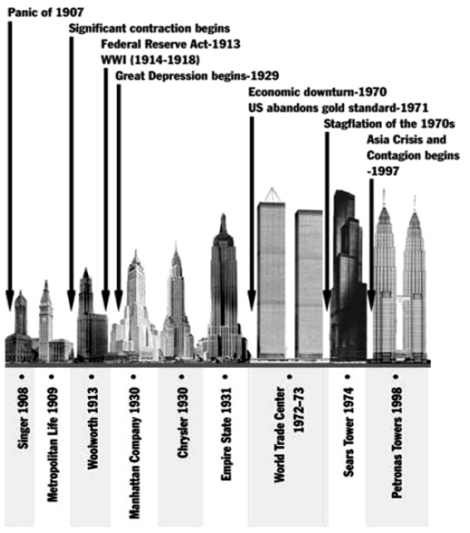
  • facebook
  • linkedin
  • twitter
  • google+
  • pinterest

013: Frank Conway Reviews the Personal Habits and Advice of Our Guests of 2014

January 1, 2015 by Frank

http://traffic.libsyn.com/economicrockstar/013_Personal_Habits_and_Advice_.mp3
Play in New WindowDownload

013: Frank Conway Reviews the Personal Habits and Advice of Our Guests of 2014

This episode reviews the personal habits and advice of the Economic Rockstar guests of 2014. I explore each episode and find, what I believe, are invaluable nuggets of information. These may not necessarily be related to economics and finance, but given that it’s a New Year, I’d like to share with you their habits and advice. I’ll be personally adopting most of these for 2015. I hope that at least one will resonate with you.

Thanks for listening and enjoy.

The Personal Habits and Advice of the Economic Rockstar Guests of 2014

1) The Importance of Being Mentored

2) Help Others

3) Talk to People

4) Network and Build Your Community

5) Create a Vision and Take Risks

6) Take Responsibilty For Your Actions

7) Give Yourself Permission to Fail and Challenge Yourself

8) Work Hard and Be Disciplined

9) Don’t Settle, Choose Adventure and Fulfill Your Potential

10) Be Careful Who You Listen To

11) Read – Education Is Important

12) Laughter Can Help You Learn

13) Pay Yourself First and Clear Your Debts

Episodes 001 and 002: Jason Stapleton on Technical Trading Systems and Trader Psychology.

Personal Habits: Discipline and the Willingness to Work

A background in the Marine Corp instilled a discipline that Jason could use to his advantage in trading financial markets.  Jason admits that he was average among his group at the Marine Corp but he was willing to work longer, harder and faster than anybody else to be successful. Jason carried this attitude with him to learn how to trade the markets, experiencing losses and gains along the way and eventually building his multi-million dollar business, Trade Empowered, from a $900 initial investment.Know (1)

Advice: ‘Don’t Settle. Be Exceptional’

  • Jason advises that the key to successful trading is to develop a trading strategy and emphasises the benefits of backtesting – “the real benefit of backtesting is the psychological aspect.”  Find out more on the benefits of backtesting in this interview.
  • On stop-losses: “Know where you’re getting out before you get in.”

‘Shut off the noise, avoid financial news TV and stay out of trading forums.’ – Jason Stapleton

Click To Tweet

  • “Most people in life settle for some level of mediocrity between total failure and their true potential. They just settle in life. I would just simply say don’t settle. I don’t care what it is you do, don’t settle. Be exceptional at what you do.”

Don’t settle for mediocrity. People will drag you down. Be exceptional at what you do.

Click To Tweet

Episode 003: Erin Lowry on Millennials, College Debt and Asking for the Order

Personal Habits: ‘A Respect for Money’

A respect for money was instilled in Erin at a young age by her father, which she carried right through into her adult life. As a head-strong decision-maker, Erin was faced with an ‘economic’ choice in adolescence which resulted in her finishing college debt-free! These traits, coupled with her mother’s mantra ‘Ask for the Order’ has given Erin enough social and financial clout too pursue her love of personal finance and helping fellow millennials to straighten out their finances.

Advice: ‘Pay Yourself First’

‘As soon as you get your paycheck, the first thing you do is pay yourself’ – Erin Lowry

Click To Tweet

Good (3)

  • If you felt an outcome was unfair, ‘Ask for the Order’.  If you don’t tell people what you want, they can’t read your mind and the worse someone can tell you is ‘No’.
  • I find that list writing helps me organize my thoughts and then when I cross something off, it’s just such a satisfying feeling.
  • If you are having debt problems, talk about it to your loved ones, to your closest friends, to a credible financial planner or to a priest.
  • ‘Put yourself out there, develop contacts and network with others. You can be successful this way.’
  • ‘Never just make the minimum payment on your credit card. Pay it off in full. Banks will earn high interest on outstanding credit card debt.’

Episode 004: Jadrian Wooten on Using Sports to Carve Out a Career in Economics – Sports Economics

Personal Habits:

  • “My goal is try to get people reading about economics or thinking about economics.”– Jadrian Wooten.
  • Jadrian has a unique style of teaching that comes from the influences of his past teachers.  
  • “I am a word minimizer when it comes to slides. I love talking. I have no problem chatting with students and being in front of the classroom.”
  • “I am a big believer in showing them data, showing them graphs, showing them stuff that’s actually going on – actual application.”
  • “I am a big believer in the ‘Zero Inbox’. I don’t keep e-mails in my inbox. If something comes into my e-mail, I’ll respond to it immediately if I can.”

Advice:

  • If you think you have the ability when you start and if you put your mind to it, you can achieve the things that you want to do and if you don’t think that you can do it, then you know that’s also true, you are going to end up failing because of self-defeat.

‘You’ll be successful in this class, as an adult and in life, if you just read’ – Jadrian Wooten

Click To Tweet

  • The more you read, even books that are non-academic, you can see economic applications.

‘Dedicate time in your day to reading… it can be just books in general’ – Jadrian Wooten

Click To Tweet

Episode 005: Hector Avellaneda on Buying Gold to Protect Your Wealth from a Dollar Crisis

Personal Habits:

  • A hard worker, head-strong, determined, passionate and a desire to find out the truth through research, self-education, reading and learning.
  • Hector had a desire to find out what went wrong in his life as he was mis-sold the American idea of taking on college debt . With a limited exposure to finance and economics in college, $50,000 of college debt and unemployed due to the Great Recession of 2008, Hector read widely to learn and understand about the truth behind the US economy, the trillions of dollars of debt and the risks of a mass student loan default and a dollar crisis. 

Advice:

  • Before making a college decision, do a course that will allow you to earn an income to pay off your debt, otherwise do not take on college debt.
  • To have financial and economic freedom, become an entrepreneur.
  • Increase your understanding of financial literacy. Read books on money.

  • Schools and Universities need to teach more economics, finance and financial literacy subjects to all students.

  • Self-education is very important – read books and get access to the necessary information online.

Episode 006: Andrew Heaton on Using Comedy to Explain Economic Concepts

Personal Habits:

  • Andrew works extremely hard to get things done. He has blended comedy with economics to allow this dismal science to become enjoyable or entertaining.
  • Andrew believes that having the right mentor is hugely beneficial and such a relationship allows him to learn and focus on reaching small milestones. This has worked out favorably well for Andrew in the field of economics where he developed a strong set of opinions on some theoretical aspects of economics. By expanding his knowledge-base through economics books and the many discussions with his mentor, Gene Epstein, Andrew has opened new doors and created new opportunities that otherwise may not have been attainable. His love of economics, particularly the Austrian and Chicago Schools and libertarianism, has given Andrew a lot of material to work on for his comedic performances onstage, online and in books.
  • Andrew writes quite frequently and believes that constant writing will have a payoff in terms of the publication of a book.
  • Andrew writes ‘common sense economics for people who need to learn about common sense economics’
  • ‘When you start arguing with somebody your adrenaline level shoots up.  Just on a biochemical level, you become much less able to hear what they are saying because you are taking a defensive posture. Conversely, when you’re laughing, you produce endorphins.  And, if I can make you laugh, for a moment you are willing to listen to me – just for a moment.’

Advice:

  • ‘If you’re gonna have a lot of activities that you are doing, you need to be mentally organised and very good at prioritising.’
  • ‘To supercharge your day, when you are getting to your tasks, do the one you hate most first… the rest of your day is a cinch.’
  • ‘With books, the trick is you just write a thousand words a night… your subconscious mind works on it and when you sit down the following night it’s a little bit easier.  You have a full novel in two and half months.’

Episode 007: Ryan Blair – Gangster turned Millionaire on Decision-Making, Game Theory and Incentives

Personal Habits:

  • I'm anRyan’s Philosophy: “Success is about your beliefs, values, actions and skills. So if you work on all of these things you will be successful.”
  • Ryan’s life purpose goal: “I will measure my influence by the network of the people I can draw upon for inspiration and economic creation.
  • On Failing: “I fail forward and try to draw from certain things or from my gang past or maybe perhaps an investment that I made that didn’t work out so well.”
  • ‘I’m an idealist. I like to make things as good as I possibly can’ – Ryan Blair

    Click To Tweet

  • Asking questions: “I ask a lot of questions of myself. Am I doing the right things? Am I making the right adjustments necessary for me to achieve the result that I want? I ask myself the question ‘Why not?”.
  • Decision-making: “If bad decisions are made, you’ve just got to assess it, understand it and make better decisions, and eventually you accumulate enough right decisions to where you’ve got success”.
  • “The Path is all Math” – “you’re reverse engineering or you’re finding the mathematical equation to get the result you’re looking for and that could be a result of fixing any deficiency in your life or to improve something. There’s generally a mathematical path to it and that could simply be the number of steps in the formula or the amount of time it takes for you to get the result that you’re looking for.”
  • Attributes required to make multi-generational wealth: creativity and strong work ethic.

Advice:

  • On Vision: “I use that method in my life and my conscious and subconscious has no choice but to pursue them because I really fall in love with the vision.”
  • On Recruitment: “Recruitment is one of the most important things on building a culture in business.
  • Be careful in deals that you do as an entrepreneur with venture capitalists or sophisticated investors.
  • On Getting the Best Deal: “If you’re not prepared to walk away [from the deal] and the other party knows that, then you’re gonna be out-negotiated in many cases or you simply won’t get the best result possible for you, your family and your shareholders, which is what’s most important in a business negotiation”.
  • On Learning: Because Ryan knew that he wanted to be an entrepreneur, it was easy for him to associate learning with growth as an entrepreneur.
  • On Opportunities: “Opportunity exists all around you. If you’re looking for it and if you train yourself in how to see it – start there. If I sat in my garden, I could possibly find an opportunity to become an entrepreneur and be successful”.
  • On Nutrition and Learning: “Have a breakfast in the morning before school so as to have a proper education. Nutrition is so important to learning and to growth in an individual.”

Episode 008: Robbie Butler on Using Sports to Teach Entry-Level Economics

Personal Habits:We use

  • Robbie, like all great educators, is always learning about the most optimal ways to teaching economics.
  • Constantly updating the teaching material.
  • On the Value of Informal Meet-ups: “Some of our coffee meetings can be quite vicious, but it’s a good sounding board for ideas.”
  • On Ways of Learning: “Because we all learn in very different ways, we need to teach in such a way that tries to capture as many forms of multiple intelligence theory as we can. We use sports as a lens to the economic world”.

Advice:

On Learning and Teaching Economics: “We all have to develop ourselves and our understanding”.

If you work hard, you get the returns – there are no shortcuts @RobbieButlerUCC

Click To Tweet

On Research: “Try and keep the material as current as you possibly can”.

On Hard Work: “Hard work is everything. Nobody is born with an innate ability to do something. The harder you work, the easier things become. Thant applies to college, studying, sports and life in general” – Robbie Butler, UCC.

Episode 009: Naomi Brockwell (Bitcoin Girl) on Bitcoins, Liberty, Government and Fiat Currency

Personal Habits:The fact that

  • “I like people who are inspiring and I like reading their biographies” – Naomi Brockwell
  • Naomi subscribes to Louise Hay’s Daily Affirmation
  • Naomi and Gene Epstein run an Austrian economics reading group together.

I like to surround myself with such amazing and inspiring people – Naomi Brockwell

Click To Tweet

  • Economics is just an incredible way of helping the less fortunate areas of society, of helping people out of poverty, of helping the unrepresented, people being persecuted by government. Economics, if you really understand it, provides all of these answers. With economics, you could do a lot more to help people.

Advice:

Find people who you find really inspirational and learn as much as you can – Naomi Brockwell

Click To Tweet

  • “We really underestimate what we can achieve and if we remember that so much more is possible than we may think, then that’s a good way to live. It encourages you to press your boundaries and explore new horizons. Seek what your potential is, really try to fulfil your potential.” – Naomi Brockwell

Episode 010: Douglas Goldstein on How Chess Can Teach Us Lessons on Strategic Financial Planning

For thosePersonal Habits:

  • ‘I tend to be more conservative. I look for ways of trying to protect my business and my savings. I’mconstantly looking for problems, coming up with solutions before the problems arise so that they don’t arise.’
  • Goal-setting. Check out Doug’s and Susan’s goal-setting paradigm STRATegic in Rich As A King.
  • Doug is an anti-debt person and is a philanthropist.
  • Doug organizes everything first thing in the morning – calender, email and builds a list of what needs to be done. He does the unpleasant but most important things first. Everything that’s crossed out are his accomplishments for the day.

Takeaway:

  • ‘Get yourself a teacher – a real mentor’ – Doug Goldstein

    Click To Tweet

  • Don’t be afraid to pick up the phone and calling someone if you have a question about your business.
  • Having a pretty good strategy today is much better than having no strategy until maybe one day you’ll develop one.
  • It’s okay to develop as a strategist. It’s what all investors do and it’s what all chess players do.
  • The news you’re getting from most sources is probably useless.
  • ‘Give me a stock clerk with a goal and I’ll give you a man who will make history. Give me a man with no goals and I’ll give you  a stock clerk.’ J.C. Penney
  • Doug uses this quote from Alice in Wonderland to explain the concept of having a specific budgeting roadmap or goal set within a certain time frame.
  • When Planning for a year, plant corn. When planning for a decade, plant trees. When planning for a life, train and educate people’ – Chinese proverb.
  • For those who want long-term success, start with education – Doug Goldstein

    Click To Tweet

Advice:

  • There’s nothing that you’re actually going to know about what’s going to happen tomorrow in the markets. But what you do know is to educate your clients about how to responsibly take care of their own money.
  • Every move must have a purpose – Susan Polgar Chess Grandmaster

    Click To Tweet


  • Amateur investors  and amateur chess players move around because they can’t figure out their strategy. They make a move that doesn’t really have a purpose and that’s a huge mistake.
  • Go into meetings and discussions with people as a friend. Assume that they’re there to work with you and not against you. You’ll be much happier.
  • Plan ahead. ‘It wasn’t raining when Noah built the Ark’ – Howard Ruff

    Click To Tweet


  • Focus on developing a strategy.
  • Build your community – that’s how you will ultimately succeed. Build a group of people that you can constantly be in touch.
  • ‘Spend a lot more time focusing on what you can give to people, than what you can get from them. I believe that’s the path to success.’ Doug Goldstein
  • ‘Liquidity, having access to your money, is really really important’ – Doug Goldstein

    Click To Tweet

Career Advice

‘We are not the same as our parents and grandparents. You’re not going to work for some company for your whole life and then retire with a great pension at 60. it’s up to you to take care of yourself. The governments going broke, your parents are probably going broke, you’re going broke and you’re in debt. You’ve got to get your own act together. As soon as you understand how business works, you should try and set your own sails and find something that you really enjoy doing, that can add value and work really hard to do it.’

‘There’s nothing wrong with a little bit of hard work in order to succeed. Don’t assume someones going give it to you’

Episode 011: Steve Keen on Debunking Economics and the Misinterpretation of Keynes

L I G H T H O U S E (1)


012: Yoram Bauman on Cartoons, Being a Stand-Up Economist & His Passion to Save the Environment 

The


.


http://traffic.libsyn.com/economicrockstar/013_Personal_Habits_and_Advice_.mp3

Podcast: Play in new window | Download
  • facebook
  • linkedin
  • twitter
  • google+
  • pinterest
  • Prev Page...
  • 1
  • …
  • 14
  • 15
  • 16
  • 17
  • 18
  • ...Next Page

Frank Conway

Frank Conway is founder of Economic Rockstar and lecturer of economics, finance and statistics. Read More…

View My Blog Posts

Youtube Sub

Become a Patron of the Economic Rockstar Podcast

patreon

Ireland’s Economy by the Numbers

Leaving Cert Economics: Ireland’s Economy  Click here to download a workbook on Ireland’s Economy so that you can add your own notes. [Original size] Ireland’s Economy by fconway

Categories

Subscribe and Never Miss An Episode

itunes-logo

Recent Posts

  • Ireland’s Economy by the Numbers April 8, 2019
  • 174: Wendy Carlin on The Core Project, Capitalism, Democracy and Normative Statements February 13, 2019
  • 173: Stephen Wright on Core Econ as a Learning Resource for Mainstream Economics January 28, 2019
  • 172: Best of 2018 Part 2: From the Great Depression to Futurism; Institutions, Individualism, Cooperation and Reciprocity January 22, 2019
  • 171: Best of 2018 Part 1 January 3, 2019

Copyright © 2026 · Podcast Pro Theme on Genesis Framework · WordPress · Log in

This website uses cookies to improve your experience. We'll assume you're ok with this, but you can opt-out if you wish. Accept Reject Read More
Privacy Policy

Privacy Overview

This website uses cookies to improve your experience while you navigate through the website. Out of these, the cookies that are categorized as necessary are stored on your browser as they are essential for the working of basic functionalities of the website. We also use third-party cookies that help us analyze and understand how you use this website. These cookies will be stored in your browser only with your consent. You also have the option to opt-out of these cookies. But opting out of some of these cookies may affect your browsing experience.
Necessary
Always Enabled
Necessary cookies are absolutely essential for the website to function properly. This category only includes cookies that ensures basic functionalities and security features of the website. These cookies do not store any personal information.
Non-necessary
Any cookies that may not be particularly necessary for the website to function and is used specifically to collect user personal data via analytics, ads, other embedded contents are termed as non-necessary cookies. It is mandatory to procure user consent prior to running these cookies on your website.
SAVE & ACCEPT